Close Modal

What Was the Trail of Tears?

Part of What Was?

Illustrated by Dede Putra
Paperback
$7.99 US
5-5/16"W x 7-5/8"H (13.5 x 19.4 cm) | 5 oz (155 g) | 60 per carton
On sale Sep 01, 2026 | 112 Pages | 9780593751862
Age 8-12 years | Grades 3-7
Sales rights: World

Learn about one of the worst tragedies in American history: the Indian Removal Act of 1830.

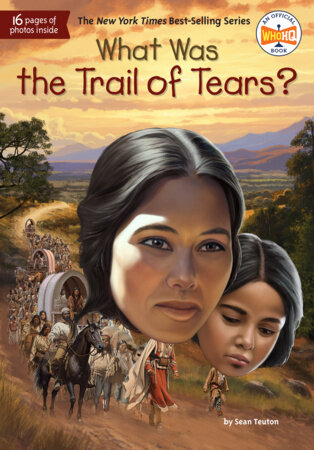
From 1838 to 1839, thousands of people from the Cherokee Nation and other Indigenous tribes were forced off their homelands because the white settlers believed this land belonged to them. The journey, which became known as the Trail of Tears, took up to six months and saw the Cherokee traveling across rivers, valleys, and mountains for over eight hundred miles in bitter cold and blazing heat. They had little food or water, and many of them died along the way. By the time they made it to their destination in present-day Oklahoma, the Cherokee Nation had suffered huge losses, including cultural disruptions that led them to refer to this long and brutal march as "The Trail Where They Cried."

Author Sean Teuton masterfully explains why this community was forced to relocate and recounts stories from travelers whose lives and cultures were forever changed.
What Was the Trail of Tears?

March 1839
Fort Gibson, Indian Territory,
Present-Day Oklahoma


Eight-year-old Sasa, whose name means “goose” in the Cherokee language, reached for her mother’s hand. Although Sasa once loved sewing, and running with her cousins through her family’s fields, today she felt so hungry she could barely stand. Cuts on her bare feet bled into the dirt, and her clothes hung in shreds. Sasa felt afraid. She moved closer to her mother. “What will happen to us now that our trip is over?” she asked.

Her mother raised her chin and replied, “We don’t know, Sasa, but we’re still together. And we will remain strong.”

Sasa and her mother were standing in line under the hot sun with hundreds of other Cherokees who hoped to get food after their long and frightening journey. Back when they were forced to leave their land, her mother had told Sasa they were going to a new home in the West. Now they were here, but this place didn’t feel like a home. Soldiers pointed guns at the lines of people waiting for food. Nearby, a group of sick people huddled under a tree. When they’d left three months ago, there were around one thousand people in her group. Of that number, nearly one hundred had died. The dead were mostly children and grandparents. Sasa began to cry as soldiers loaded dead bodies into a wagon.

All she wanted to do was go home, but she knew the soldiers would make her stay.

As Sasa stood in line, she remembered the life she had lived not so long ago in the old place, where she never felt afraid. Her people, Native Americans of the Cherokee Nation, had lived there since long before the United States was a country.

Cherokee families lived together in towns covering a vast territory in America’s Southeast. There, the men in Sasa’s family hunted to provide meat, and defended the land. The women in her family farmed the land to provide vegetables, and made their clothes from deerskins, which they decorated with beads. The girls helped weave baskets and belts. Sasa and her cousins often played together. In the evenings, everyone ate, told stories, and climbed into their bunk beds in the same big house. Through song and dance, they worshipped a creator who made the earth.

After Europeans arrived in the 1500s, some Cherokees visited them and got ideas about how to build their nation. In 1821, a Cherokee artist invented a written language. And in 1827, Cherokee leaders wrote a constitution—the rules by which they would govern. They established that they had their own country, laws, and lands. They were Indians, but many lived just like other Americans.

Sasa felt both happy and sad when she remembered her life in her homeland. But she told herself, as her mother often did, that she was actually one of the lucky ones, because she survived what happened next.

In 1828, Americans found out the Cherokees’ beautiful farmland also had gold. In that same year, Andrew Jackson was elected president of the United States.

Jackson refused to say the Cherokees had a written language and a constitution.

Jackson said Cherokees weren’t fully human, like white people. He lied and said they were savages—which meant they were more primitive and wilder than white people. And he said savages couldn’t live near white or civilized people.

In May 1838, the United States ordered the US Army to drive the Cherokees from their homes, just as President Jackson had promised during his campaign. In fact, he vowed to remove not only the Cherokee but also the Chickasaw, Choctaw, Creek, and Seminole from the South. The United States forced the Cherokees into fenced camps. Trapped inside, they couldn’t find enough food, clean water, shelter to sleep in, or places to use the bathroom. Soon, men, women, and children began to get sick. Hundreds died.

After months of living in the camps, the United States government moved the Cherokees farther west, beyond the Mississippi River, to a place they called Indian Territory. They forced some into wagons where there was room only for the elders, the children, and the sick. Everyone else had to walk. Without enough blankets and food, thousands became sick, froze, or starved to death.

Sasa and her mother were only two of around sixteen thousand Cherokees, as well as tens of thousands of other Indian tribal members, who were forced to leave their homes forever. They traveled around one thousand miles under unbearable conditions. This period of cruelty—a march that took between three and six months—became known as the Trail of Tears. It is one of the most shameful events in American history.
Who HQ is your headquarters for history. The Who HQ team is always working to provide simple and clear answers to some of our biggest questions. From Who Was George Washington? to Who Is Michelle Obama?, and What Was the Battle of Gettysburg? to Where Is the Great Barrier Reef?, we strive to give you all the facts. Visit us at WhoHQ.com View titles by Who HQ
Available for sale exclusive:
•     Afghanistan
•     Aland Islands
•     Albania
•     Algeria
•     Andorra
•     Angola
•     Anguilla
•     Antarctica
•     Antigua/Barbuda
•     Argentina
•     Armenia
•     Aruba
•     Australia
•     Austria
•     Azerbaijan
•     Bahamas
•     Bahrain
•     Bangladesh
•     Barbados
•     Belarus
•     Belgium
•     Belize
•     Benin
•     Bermuda
•     Bhutan
•     Bolivia
•     Bonaire, Saba
•     Bosnia Herzeg.
•     Botswana
•     Bouvet Island
•     Brazil
•     Brit.Ind.Oc.Ter
•     Brit.Virgin Is.
•     Brunei
•     Bulgaria
•     Burkina Faso
•     Burundi
•     Cambodia
•     Cameroon
•     Canada
•     Cape Verde
•     Cayman Islands
•     Centr.Afr.Rep.
•     Chad
•     Chile
•     China
•     Christmas Islnd
•     Cocos Islands
•     Colombia
•     Comoro Is.
•     Congo
•     Cook Islands
•     Costa Rica
•     Croatia
•     Cuba
•     Curacao
•     Cyprus
•     Czech Republic
•     Dem. Rep. Congo
•     Denmark
•     Djibouti
•     Dominica
•     Dominican Rep.
•     Ecuador
•     Egypt
•     El Salvador
•     Equatorial Gui.
•     Eritrea
•     Estonia
•     Ethiopia
•     Falkland Islnds
•     Faroe Islands
•     Fiji
•     Finland
•     France
•     Fren.Polynesia
•     French Guinea
•     Gabon
•     Gambia
•     Georgia
•     Germany
•     Ghana
•     Gibraltar
•     Greece
•     Greenland
•     Grenada
•     Guadeloupe
•     Guam
•     Guatemala
•     Guernsey
•     Guinea Republic
•     Guinea-Bissau
•     Guyana
•     Haiti
•     Heard/McDon.Isl
•     Honduras
•     Hong Kong
•     Hungary
•     Iceland
•     India
•     Indonesia
•     Iran
•     Iraq
•     Ireland
•     Isle of Man
•     Israel
•     Italy
•     Ivory Coast
•     Jamaica
•     Japan
•     Jersey
•     Jordan
•     Kazakhstan
•     Kenya
•     Kiribati
•     Kuwait
•     Kyrgyzstan
•     Laos
•     Latvia
•     Lebanon
•     Lesotho
•     Liberia
•     Libya
•     Liechtenstein
•     Lithuania
•     Luxembourg
•     Macau
•     Macedonia
•     Madagascar
•     Malawi
•     Malaysia
•     Maldives
•     Mali
•     Malta
•     Marshall island
•     Martinique
•     Mauritania
•     Mauritius
•     Mayotte
•     Mexico
•     Micronesia
•     Minor Outl.Ins.
•     Moldavia
•     Monaco
•     Mongolia
•     Montenegro
•     Montserrat
•     Morocco
•     Mozambique
•     Myanmar
•     Namibia
•     Nauru
•     Nepal
•     Netherlands
•     New Caledonia
•     New Zealand
•     Nicaragua
•     Niger
•     Nigeria
•     Niue
•     Norfolk Island
•     North Korea
•     North Mariana
•     Norway
•     Oman
•     Pakistan
•     Palau
•     Palestinian Ter
•     Panama
•     PapuaNewGuinea
•     Paraguay
•     Peru
•     Philippines
•     Pitcairn Islnds
•     Poland
•     Portugal
•     Puerto Rico
•     Qatar
•     Reunion Island
•     Romania
•     Russian Fed.
•     Rwanda
•     S. Sandwich Ins
•     Saint Martin
•     Samoa,American
•     San Marino
•     SaoTome Princip
•     Saudi Arabia
•     Senegal
•     Serbia
•     Seychelles
•     Sierra Leone
•     Singapore
•     Sint Maarten
•     Slovakia
•     Slovenia
•     Solomon Islands
•     Somalia
•     South Africa
•     South Korea
•     South Sudan
•     Spain
•     Sri Lanka
•     St Barthelemy
•     St. Helena
•     St. Lucia
•     St. Vincent
•     St.Chr.,Nevis
•     St.Pier,Miquel.
•     Sth Terr. Franc
•     Sudan
•     Suriname
•     Svalbard
•     Swaziland
•     Sweden
•     Switzerland
•     Syria
•     Tadschikistan
•     Taiwan
•     Tanzania
•     Thailand
•     Timor-Leste
•     Togo
•     Tokelau Islands
•     Tonga
•     Trinidad,Tobago
•     Tunisia
•     Turkey
•     Turkmenistan
•     Turks&Caicos Is
•     Tuvalu
•     US Virgin Is.
•     USA
•     Uganda
•     Ukraine
•     Unit.Arab Emir.
•     United Kingdom
•     Uruguay
•     Uzbekistan
•     Vanuatu
•     Vatican City
•     Venezuela
•     Vietnam
•     Wallis,Futuna
•     West Saharan
•     Western Samoa
•     Yemen
•     Zambia
•     Zimbabwe

About

Learn about one of the worst tragedies in American history: the Indian Removal Act of 1830.

From 1838 to 1839, thousands of people from the Cherokee Nation and other Indigenous tribes were forced off their homelands because the white settlers believed this land belonged to them. The journey, which became known as the Trail of Tears, took up to six months and saw the Cherokee traveling across rivers, valleys, and mountains for over eight hundred miles in bitter cold and blazing heat. They had little food or water, and many of them died along the way. By the time they made it to their destination in present-day Oklahoma, the Cherokee Nation had suffered huge losses, including cultural disruptions that led them to refer to this long and brutal march as "The Trail Where They Cried."

Author Sean Teuton masterfully explains why this community was forced to relocate and recounts stories from travelers whose lives and cultures were forever changed.

Excerpt

What Was the Trail of Tears?

March 1839
Fort Gibson, Indian Territory,
Present-Day Oklahoma


Eight-year-old Sasa, whose name means “goose” in the Cherokee language, reached for her mother’s hand. Although Sasa once loved sewing, and running with her cousins through her family’s fields, today she felt so hungry she could barely stand. Cuts on her bare feet bled into the dirt, and her clothes hung in shreds. Sasa felt afraid. She moved closer to her mother. “What will happen to us now that our trip is over?” she asked.

Her mother raised her chin and replied, “We don’t know, Sasa, but we’re still together. And we will remain strong.”
Sasa and her mother were standing in line under the hot sun with hundreds of other Cherokees who hoped to get food after their long and frightening journey. Back when they were forced to leave their land, her mother had told Sasa they were going to a new home in the West. Now they were here, but this place didn’t feel like a home. Soldiers pointed guns at the lines of people waiting for food. Nearby, a group of sick people huddled under a tree. When they’d left three months ago, there were around one thousand people in her group. Of that number, nearly one hundred had died. The dead were mostly children and grandparents. Sasa began to cry as soldiers loaded dead bodies into a wagon.

All she wanted to do was go home, but she knew the soldiers would make her stay.

As Sasa stood in line, she remembered the life she had lived not so long ago in the old place, where she never felt afraid. Her people, Native Americans of the Cherokee Nation, had lived there since long before the United States was a country.

Cherokee families lived together in towns covering a vast territory in America’s Southeast. There, the men in Sasa’s family hunted to provide meat, and defended the land. The women in her family farmed the land to provide vegetables, and made their clothes from deerskins, which they decorated with beads. The girls helped weave baskets and belts. Sasa and her cousins often played together. In the evenings, everyone ate, told stories, and climbed into their bunk beds in the same big house. Through song and dance, they worshipped a creator who made the earth.


After Europeans arrived in the 1500s, some Cherokees visited them and got ideas about how to build their nation. In 1821, a Cherokee artist invented a written language. And in 1827, Cherokee leaders wrote a constitution—the rules by which they would govern. They established that they had their own country, laws, and lands. They were Indians, but many lived just like other Americans.

Sasa felt both happy and sad when she remembered her life in her homeland. But she told herself, as her mother often did, that she was actually one of the lucky ones, because she survived what happened next.

In 1828, Americans found out the Cherokees’ beautiful farmland also had gold. In that same year, Andrew Jackson was elected president of the United States.

Jackson refused to say the Cherokees had a written language and a constitution.

Jackson said Cherokees weren’t fully human, like white people. He lied and said they were savages—which meant they were more primitive and wilder than white people. And he said savages couldn’t live near white or civilized people.

In May 1838, the United States ordered the US Army to drive the Cherokees from their homes, just as President Jackson had promised during his campaign. In fact, he vowed to remove not only the Cherokee but also the Chickasaw, Choctaw, Creek, and Seminole from the South. The United States forced the Cherokees into fenced camps. Trapped inside, they couldn’t find enough food, clean water, shelter to sleep in, or places to use the bathroom. Soon, men, women, and children began to get sick. Hundreds died.

After months of living in the camps, the United States government moved the Cherokees farther west, beyond the Mississippi River, to a place they called Indian Territory. They forced some into wagons where there was room only for the elders, the children, and the sick. Everyone else had to walk. Without enough blankets and food, thousands became sick, froze, or starved to death.

Sasa and her mother were only two of around sixteen thousand Cherokees, as well as tens of thousands of other Indian tribal members, who were forced to leave their homes forever. They traveled around one thousand miles under unbearable conditions. This period of cruelty—a march that took between three and six months—became known as the Trail of Tears. It is one of the most shameful events in American history.

Author

Who HQ is your headquarters for history. The Who HQ team is always working to provide simple and clear answers to some of our biggest questions. From Who Was George Washington? to Who Is Michelle Obama?, and What Was the Battle of Gettysburg? to Where Is the Great Barrier Reef?, we strive to give you all the facts. Visit us at WhoHQ.com View titles by Who HQ

Rights

Available for sale exclusive:
•     Afghanistan
•     Aland Islands
•     Albania
•     Algeria
•     Andorra
•     Angola
•     Anguilla
•     Antarctica
•     Antigua/Barbuda
•     Argentina
•     Armenia
•     Aruba
•     Australia
•     Austria
•     Azerbaijan
•     Bahamas
•     Bahrain
•     Bangladesh
•     Barbados
•     Belarus
•     Belgium
•     Belize
•     Benin
•     Bermuda
•     Bhutan
•     Bolivia
•     Bonaire, Saba
•     Bosnia Herzeg.
•     Botswana
•     Bouvet Island
•     Brazil
•     Brit.Ind.Oc.Ter
•     Brit.Virgin Is.
•     Brunei
•     Bulgaria
•     Burkina Faso
•     Burundi
•     Cambodia
•     Cameroon
•     Canada
•     Cape Verde
•     Cayman Islands
•     Centr.Afr.Rep.
•     Chad
•     Chile
•     China
•     Christmas Islnd
•     Cocos Islands
•     Colombia
•     Comoro Is.
•     Congo
•     Cook Islands
•     Costa Rica
•     Croatia
•     Cuba
•     Curacao
•     Cyprus
•     Czech Republic
•     Dem. Rep. Congo
•     Denmark
•     Djibouti
•     Dominica
•     Dominican Rep.
•     Ecuador
•     Egypt
•     El Salvador
•     Equatorial Gui.
•     Eritrea
•     Estonia
•     Ethiopia
•     Falkland Islnds
•     Faroe Islands
•     Fiji
•     Finland
•     France
•     Fren.Polynesia
•     French Guinea
•     Gabon
•     Gambia
•     Georgia
•     Germany
•     Ghana
•     Gibraltar
•     Greece
•     Greenland
•     Grenada
•     Guadeloupe
•     Guam
•     Guatemala
•     Guernsey
•     Guinea Republic
•     Guinea-Bissau
•     Guyana
•     Haiti
•     Heard/McDon.Isl
•     Honduras
•     Hong Kong
•     Hungary
•     Iceland
•     India
•     Indonesia
•     Iran
•     Iraq
•     Ireland
•     Isle of Man
•     Israel
•     Italy
•     Ivory Coast
•     Jamaica
•     Japan
•     Jersey
•     Jordan
•     Kazakhstan
•     Kenya
•     Kiribati
•     Kuwait
•     Kyrgyzstan
•     Laos
•     Latvia
•     Lebanon
•     Lesotho
•     Liberia
•     Libya
•     Liechtenstein
•     Lithuania
•     Luxembourg
•     Macau
•     Macedonia
•     Madagascar
•     Malawi
•     Malaysia
•     Maldives
•     Mali
•     Malta
•     Marshall island
•     Martinique
•     Mauritania
•     Mauritius
•     Mayotte
•     Mexico
•     Micronesia
•     Minor Outl.Ins.
•     Moldavia
•     Monaco
•     Mongolia
•     Montenegro
•     Montserrat
•     Morocco
•     Mozambique
•     Myanmar
•     Namibia
•     Nauru
•     Nepal
•     Netherlands
•     New Caledonia
•     New Zealand
•     Nicaragua
•     Niger
•     Nigeria
•     Niue
•     Norfolk Island
•     North Korea
•     North Mariana
•     Norway
•     Oman
•     Pakistan
•     Palau
•     Palestinian Ter
•     Panama
•     PapuaNewGuinea
•     Paraguay
•     Peru
•     Philippines
•     Pitcairn Islnds
•     Poland
•     Portugal
•     Puerto Rico
•     Qatar
•     Reunion Island
•     Romania
•     Russian Fed.
•     Rwanda
•     S. Sandwich Ins
•     Saint Martin
•     Samoa,American
•     San Marino
•     SaoTome Princip
•     Saudi Arabia
•     Senegal
•     Serbia
•     Seychelles
•     Sierra Leone
•     Singapore
•     Sint Maarten
•     Slovakia
•     Slovenia
•     Solomon Islands
•     Somalia
•     South Africa
•     South Korea
•     South Sudan
•     Spain
•     Sri Lanka
•     St Barthelemy
•     St. Helena
•     St. Lucia
•     St. Vincent
•     St.Chr.,Nevis
•     St.Pier,Miquel.
•     Sth Terr. Franc
•     Sudan
•     Suriname
•     Svalbard
•     Swaziland
•     Sweden
•     Switzerland
•     Syria
•     Tadschikistan
•     Taiwan
•     Tanzania
•     Thailand
•     Timor-Leste
•     Togo
•     Tokelau Islands
•     Tonga
•     Trinidad,Tobago
•     Tunisia
•     Turkey
•     Turkmenistan
•     Turks&Caicos Is
•     Tuvalu
•     US Virgin Is.
•     USA
•     Uganda
•     Ukraine
•     Unit.Arab Emir.
•     United Kingdom
•     Uruguay
•     Uzbekistan
•     Vanuatu
•     Vatican City
•     Venezuela
•     Vietnam
•     Wallis,Futuna
•     West Saharan
•     Western Samoa
•     Yemen
•     Zambia
•     Zimbabwe