An argument that production tools shape the aesthetics and political economy of games as an expressive medium.
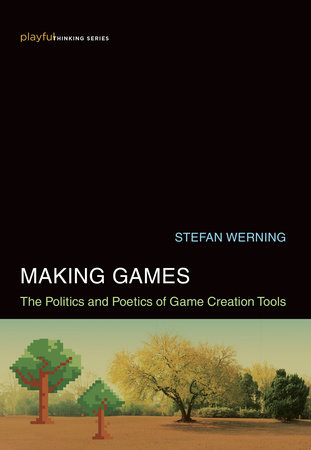
In Making Games, Stefan Werning considers the role of tools (primarily but not exclusively software), their design affordances, and the role they play as sociotechnical actors. Drawing on a wide variety of case studies, Werning argues that production tools shape the aesthetics and political economy of games as an expressive medium. He frames game-making as a (meta)game in itself and shows that tools, like games, have their own "procedural rhetoric" and should not always be conceived simply in terms of optimization and best practices.
Stefan Werning is Associate Professor for Digital Media and Game Studies at Utrecht University. He has worked in the digital games industry, most notably at Codemasters and Nintendo of Europe.
On Thinking Playfully Introduction Chapter I: Making Sense of Tools Chapter II: Tool Essays: From Tool Fandom and Aesthetic Ecosystems to the Evolution of Tool Affordances Chapter III: A Call for Evocative Tool Design: Game Creation as... Acknowledgements Notes References Index
An argument that production tools shape the aesthetics and political economy of games as an expressive medium.
In Making Games, Stefan Werning considers the role of tools (primarily but not exclusively software), their design affordances, and the role they play as sociotechnical actors. Drawing on a wide variety of case studies, Werning argues that production tools shape the aesthetics and political economy of games as an expressive medium. He frames game-making as a (meta)game in itself and shows that tools, like games, have their own "procedural rhetoric" and should not always be conceived simply in terms of optimization and best practices.
Author
Stefan Werning is Associate Professor for Digital Media and Game Studies at Utrecht University. He has worked in the digital games industry, most notably at Codemasters and Nintendo of Europe.
On Thinking Playfully Introduction Chapter I: Making Sense of Tools Chapter II: Tool Essays: From Tool Fandom and Aesthetic Ecosystems to the Evolution of Tool Affordances Chapter III: A Call for Evocative Tool Design: Game Creation as... Acknowledgements Notes References Index