Close Modal

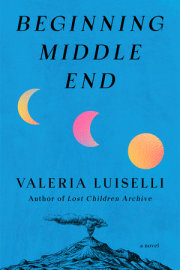
Beginning Middle End

A Novel

Author Valeria Luiselli On Tour
Look inside
Large Print (Large Print - Tradepaper)
$37.00 US
6.08"W x 9.19"H x 0.98"D   (15.4 x 23.3 x 2.5 cm) | 16 oz (454 g) | 12 per carton
On sale Jul 28, 2026 | 464 Pages | 9798217347001
Sales rights: US, Canada, Open Mkt

See Additional Formats
From the beloved, award-winning author of the modern classics Lost Children Archive and Tell Me How It Ends comes her most powerful and page-turning novel yet: the tale of a mother and a daughter starting over, searching for a new story.

"A beautiful, maybe perfect, novel.” —Tommy Orange, author of Wandering Stars


This story begins when a mother and her daughter take off on a trip. It is a summer of rapidly changing winds, volcanic rumbles, and sudden tempests. They’ve landed in Sicily, near the ancient ruins where the mother’s grandmother worked long ago on an archaeological dig. The narrator’s marriage has collapsed, her mother is losing her memory, and her daughter is on the threshold of adolescence, starting to ask difficult questions and form complex memories. How do you begin again? the narrator wonders, pondering her family line. How do you begin again if you got the beginning wrong?

While the mother tries to figure out how to reconstruct their lives as a duo—cooking meals side by side, reading out loud to each other, playing chess, bickering and making up—her daughter takes the reins of the story, and their journey soon becomes a quest for origins, not just to the familial past across continents, languages, and generations, but also farther back, to a mythical and even geological past.

Beginning Middle End evolves into a road novel of exquisite tenderness, spanning four generations of women. In their travels through Sicily, mother and daughter cross paths with the island’s migrants, storekeepers, and elders, and also its volcanoes, its winds, and its waters. Weaving myths, ancient philosophy, and natural history with fleeting moments of contemporary life, the unforgettable characters in this novel take us on a journey across time, and confront some of life’s primary questions: How do stories shape our children’s memories and imagination? How do we situate ourselves deeply in the world while accepting our transience in it? How are a family’s memories made and what happens when they disappear?

Warm, funny, and poetic, this novel is an ode to imagination and possibility in dark times.

MOTHER

What are you most afraid of in old age, Ma?

GRANDMOTHER

Perder la mente.

DAUGHTER

Is this for a novel, Mama?

MOTHER

I’m not sure.

DAUGHTER

Will you finally write a novel with a beginning, a middle, and an end?

GRANDMOTHER

Perder claridad.


I

CONTENTS
In the beginning was a mother and a daughter. Later, somewhere closer to the middle, there were other mothers and daughters, there were men, there were other people in general. But for now, it is only she and I, and a ray of sunlight enters the bedroom through a sliver between the curtains, and the ray crosses the thick smoky air and touches the bed, staggers a line across the wrinkles of the sheet from her toes, up her legs, stomach, chest, and neck, then disperses into her face, and she is sleeping, and I put my hand on her forehead and gently wake her up.

THE WORLD
I had been looking for something like a beginning. A strange thing, perhaps, to expect from time or from life: the chance to begin, or to begin again. All I had to do, or so I thought, was to answer a simple question: How do I reinvent it, the story, our lives? It was going to be only she and I for now.

FINITUDE
I was eager to be elsewhere, far from my old spaces, far from my present moment. I had finished writing a difficult book, finished a project recording soundscapes and oral histories in the U.S.-Mexico borderlands, and had then passed through a slow, entangled divorce. The constellation—finishing, finishing, finishing—had left me feeling like an astronaut: in circumflotation, enclosed but never quite anywhere.

The weeks and months had passed, the unceasing rotation of the calendar, but I found myself as if always in the same spot. For some time after those endings, I had been stumbling from one false beginning to the next. I hadn’t been able to start writing anything other than scattered notes, I hadn’t been able to start anything that felt like a real relationship, I hadn’t been able to find that feeling—which many reported—of life starting anew after a big ending.

UNITY
Now, almost a year later, the book was about to come out in translation in several languages in Europe, and I had accepted all the invitations sent to my agency. I had, in fact, earnestly asked my agent to look for more, for anything: readings, conferences, workshops, book clubs. A friend of mine had noted:

You’re like those people who will eat everything on an airplane just because it’s free.

I took my daughter out of school a little before the end of the year, and registered her for homeschooling for the rest of the seventh-grade cycle. I had found perfect tenants from April to September: a couple of Canadian medievalists. They’d take care of our plants, they would pay on time, they wouldn’t steal my books.

I didn’t reply anything to that friend, but for days in my head I kept telling him:

Nothing is free on airplanes anymore.

SHAPE
Two suitcases: one gray, one green. We left the city at the beginning of spring. The original plan was: we would move and move again, light suitcases, loose schedules, until things fell back into place. April and May, we moved every two or three days, hotels mostly, small and large towns and cities, book readings and lectures and symposiums. In Switzerland and Austria, all the readers that came to my events were either septuagenarians or octogenarians, which was both very moving and somewhat concerning. There were brief stays in Lyon, Warsaw, Istanbul, Athens, Berlin. I had an IUD extraction in Munich. She lost a molar inside a bowl of soup in a café in Prague.

MOTION
I observed her closely, perhaps too closely now that it was only she and I, her behavior a strange mirror of my capacity or incapacity to raise her well on my own. Everywhere we went, she obsessively bought old postcards, scribbled things on them, but then refused to send them to anyone. Everywhere we went, all she wanted to do was read on her own or play chess with me.

In Berlin, I tried to teach her how to ride a bicycle: impossible, she pedaled always backward. I tried not to think about it metaphorically. In a small coastal town near Amsterdam, we stood a long time on the gray shore of a long beach and watched schoolchildren swim with their shoes on. As the swell approached the shoreline, the children would swim against the current, their sneakers visible above the surface, moving in short, quick, shallow kicks. It was a strange, disquieting sight, after which my daughter refused to get into the water.

A few days later, in Barcelona, she cried inconsolably after we saw a woman—maybe young, maybe old, possibly homeless—mumbling at a city wall. We had walked past her, and the woman had opened her rucksack and poured its contents onto the sidewalk: a spill of old books. She held one of them up, read some words we didn’t understand, then looked at us, pointed a finger, smiled a wide smile, and announced:

Omnes fines mundi!

REASONS FOR ITS NAME
What is it—to start again? Where is it—the beginning? Perhaps things never fall into place entirely, but when June came and I had finished my last work commitments and cashed the checks I was able to cash, and we took a plane that landed one evening in Catania Airport, I had a feeling for the first time in months that we had finally arrived somewhere. We would finally have a chance to settle down in one place for some time.

My maternal grandmother was originally from a small town near Catania. And though she died when I was still young, and I had never come to the island until now, as soon as we stepped off the airplane I felt a distinct sense of home—past or future, I’m not sure. We climbed down the metal stairs onto the tarmac, looked up at the star-clustered sky, and she said:

Look, Ma, a sky-yawning.

A what?

A sky-yawning.

What do you mean?

Nothing, Ma, never mind.

Perhaps it wasn’t a sense of home, but something like an echo of someone else’s belonging: borrowed memories, rumors passed down. I read somewhere that the word “echo” comes from the Greek “oikos,” which means “house”—and if that is true, maybe “echo” and “belonging” are more closely related than one might think.

THE ELEMENTS
It was, of course, an impossible plan—moving until something finally fell into place—because usually nothing just falls into place. A liberating idea, an impossible plan. Eventually, I thought, I’d have a clearer plan. Eventually, though, we would have to move for very different reasons than the ones which initially sprung us outward, but that came later, and we didn’t know anything about that then.


II

GOD
In the taxi from the airport to the apartment, the man on the radio says Etna spewed a plume of ash and gas earlier today, but no damages are reported. He also says there will be a lunar eclipse before dawn, and that the Levante will soon be entering from the east. My daughter asks me:

What is Etna, Ma?

A volcano.

Is it dangerous?

Not at all, darling.

And what’s the Levante?

That I don’t know.

But the taxi driver says he does know. There are two lineages of taxi drivers, the ones who say they don’t know anything, and the ones who know all the things. He tells us the Levante is a good wind, one of the many winds that sweep over this island. So many winds populate the skies here with their furious blasts and roaring gales, he says, that the Greeks thought that it was in one of the caves off this coast that the god Aeolus housed all the winds: the cold and dry Mistral, as well as the Greco and Tramontana from the north; the warm Libeccio and Mezzogiorno from the south and the southwest, thick with tempests and shoreward billows; the western Ponente, which sailors await eagerly because it brings clear skies, still waters, and swift leave-takings; the brutal, scorching Scirocco from the southeast, which carries sands from the Sahara, turns the sky red or orange, and makes people angry, anxious, or insane. And, finally, this soft, humming, damp Levante coming in from the east, which turns the sea a much deeper, darker blue, brings respite from the dry heat, and sometimes brings rain. Sailors prefer it to any other wind, he finishes off with almost lyrical enthusiasm, because it carries them forward with swift, smooth gusts from the stern.

It feels like a good omen, I think, to arrive with the Levante. Or am I confused, and is a gust from the stern a good wind for leaving instead of arriving? In any case, maybe on this island, this summer, she and I will finally have a real beginning. We just have to find a routine, a sustained everydayness: I have to find a way into a new form of motherhood, and maybe even a way back into writing, turn all my notes into something and finish a book.

THE PLANETS
My daughter asks, so during the rest of the drive toward the apartment I tell her things I remember about my grandmother, her great-grandmother: we called her Nanna, and she smoked a pack and a half of Camel cigarettes every day since she was twelve. She had a quick temper but also an expansive warmth and a sharp sense of humor. She was born in a place called Philosophiana, was a farmer, and collected old objects she found buried in the fields. When she was twenty-one she had dressed as a man in order to be hired as a day laborer in archaeological digs near her house, took part in important findings there, but then was caught cross-dressing, got fired, and decided to emigrate. She learned how to read and write while aboard the ship, read a lot of books after that, survived a shipwreck, played a lot of chess, was a terrible cook, believed in luck, and was extremely superstitious. She was inconveniently good looking—dark olive skin, wild curls, disastrous teeth—and liked to brag that she had moonyellow Boticellian eyes. She threw insults at ungentlemanly men (cretino deficiente), aggressive drivers (cretino demente deficiente), and politicians on the television (cretino deficiente del cazzo). She lost her memory in her seventies. She died alone in an asylum for the insane in Mexico City in 1989.

NATURE OF THE PLANETS
My daughter and I share several things in common with her: the bad teeth, a love for chess and books, the superstitions—never pass salt directly from hand to hand without first setting it down on a surface, avoid eye contact with your own reflection in a window if it’s raining outside, make a wish at 11:11 a.m. and 11:11 p.m. I inherited the nicotine passion and the soccer passion. My daughter has her beauty, her enviable mane, all untamable curls, and her Botticellian eyes, a little darker than my grandmother’s, the color of maple syrup. Perhaps all those little things can be called echoes of a person, in the sense of repetition and reverberation, but also in the sense that our bodies and minds are physical spaces where traces of those who came before us still live and bounce around.

SOLAR ECLIPSES
Plan, premise, plot: Why is the language of fiction writing so full of real estate? Piazza Manganelli 16, a Baroque arched entrance framed by pilasters with concrete cherubs and ornaments, a heavy wooden door, an internal courtyard, one flight of marble stairs up, keys under the doormat, apartment number 2.

The apartment belongs to a man I know, a friend—a man I know. He is a pianist and would be on tour for the rest of the month, said he’d leave the keys under the rug and we should please make ourselves at home. He’d be back at the start of July, and we would be welcome to stay with him as long as we wanted.

He and I had met almost a year ago, when he was giving concerts in New York. We’d had a brief and feverish encounter sometime after the divorce, and we’d kept in touch almost daily all these past months, writing to each other, sometimes talking on the phone at absurd hours of the day or the night, talking mostly about divorce (he had two behind him, so he had advice), talking about children (he had none, so on his side that conversation was mostly speculative), talking about his concerts, and my projects, talking about our plans, his plans and my plans, separately, but also possible plans to meet again one day, one day sometime later.

LUNAR ECLIPSES
In the foyer, we leave our shoes, our two suitcases, my backpack, and her briefcase portfolio. We make our way straight to the kitchen and sit at a big wooden table, waiting for water to boil in a tiny pot, the only one I found, for a quick pasta with butter and some sage we plucked from a pot on the kitchen balcony. My mother writes to ask if we arrived safely. When my mother sends a message, she always sounds like she’s delivering both a horoscope and a weather report, and she sometimes signs it at the end with her name and relationship to me, as if I did not have her saved in my contacts, as if she were sending a fax from a public fax machine. In this message, she confirms and doubles down on what the radio said, except that in her words the predictions sound ominous:

Eclipse penumbral. ¡Vienen tormentas! Tiempos de cambio. Besos, Mamá, Manuela.

No longer so sure that a penumbral eclipse followed by storms is a good omen, we follow my mother’s instructions, just in case, and take three garlic cloves from a garlic hive hanging next to the stove, then plant them with our left thumbs under the moonlight in a pot of rosemary out on the kitchen balcony.

THE NIGHT
Two bedrooms, one large and one smaller, on opposite ends of the living room, each with an en suite bathroom. My daughter drags her green suitcase into the smaller bedroom, and I roll the gray suitcase into the bigger one.

My suitcase on the bed, and the slow choreography of unpacking. Here, in his room, I unpack not the way I usually do: all clothes dumped from suitcase to bed, then slowly sorted. Here, in his room, I try to unpack as if I were him, the pianist, unpacking after a trip: a man of systems and routines. I take out one item at a time, from suitcase to closet, suitcase to closet.

There is a story by Antonio di Benedetto called “Abandonment and Passivity,” about a woman who abandons a man. But we never see the woman and we never see the man, only a suitcase leaving a room and a glass of water on the bedside table, and a note pressed under the glass of water that we never come to read. All there is in the story is this bedroom that has been left behind, never a single living thing. Except somewhere in the middle of the story, when a fly suddenly appears and the narrator says: “Sanctioned by inertia, a fly goes from sun to sun, from sun to sun, but only twice.” I have never understood this line. A fly that lives twenty-four hours? Or forty-eight? Or something else entirely in the flying pattern of a fly?

The quiet objects in his closet seem selected and punctuated by the tempered hand of method: shoes, trousers, belts, shirts, ties, jackets, a few T-shirts. I hang and fold my shirts and pants and long dresses next to his things. His: all black or marine blue. Mine: a disarray of colors. One of my dresses hangs next to one of his jackets. Suspended, they hover together in a strange, ghostly kind of dance: a meeting in absentia.
“A moving ode to our short time in the world and the connections that make our lives worth living. Luiselli is truly a bard for our modern times.”
Chicago Review of Books

“Luiselli pushes the formal envelope in her most audacious work yet.”
The Boston Globe

“Luiselli’s prose is elegant as ever—she handles difficult themes with grace, and the two main characters prove to be unforgettable. It’s quickly becoming apparent that Luiselli is one of the country’s most gifted novelists.”
Los Angeles Times

“A mother and daughter rework their lives against a volcanic backdrop, amid the Sicilians and their ancient history. After the last page, you sit there a while.”
Chicago Tribune

“The road novel weaves together four generations of women through archaeology, mythology, and the natural world, using Luiselli’s characteristic ‘documentary fiction’ style of storytelling—for which she was awarded the MacArthur Fellowship in 2019.”
W Magazine

Beginning Middle End is a radical release from prescribed chronology and an emotional look into intergenerational remembrance. It’s a novel that, with a tender hand, leads the reader through a journey’s frustrations and joys before finally arriving at a renewed sense of an ending.”
BOMB Magazine, “Editor’s Choice”

“What sets Valeria Luiselli’s new novel apart is its clarity, its immediacy, its vividness. Not just the characters, but the very rooms, the views from windows and the streets, are created with precision and lucidity. And then there are the feelings and the memories, the desires and the fears—these are etched with an astonishing sense of accuracy.”
—Colm Tóibín, author of The News from Dublin

“This book is a profound meditation on parenthood and the nature of change, the essence of story, of accounts and why we account, of what should be accounted for. And at its core is the impossible attempt to return something lost and unknowable—something from the past that sees into the future. I loved it, beginning, middle, and end. It’s a beautiful, maybe perfect, novel.”
—Tommy Orange, author of Wandering Stars

“Inventive, brilliant, playful, and transporting, Beginning Middle End dazzles on every page. It is a novel about love, self-invention, and lore, both historical and familial. Valeria Luiselli is extravagantly gifted—a writer possessed of both wisdom and an inquisitive, powerful heart.”
—Katie Kitamura, author of Audition

“This book is an animal from the future, with five hearts beating at once—daughter, mother, grandmother, great-grandmother, and reader. Each time one of the hearts beats faster, it touches all the others. An instant classic; Valeria Luiselli at her bravest and most sincere.”
—Samanta Schweblin, author of Good and Evil and Other Stories
© Clayton Cubitt
Valeria Luiselli is an acclaimed writer of both fiction and nonfiction. She is the author of the essay collection Sidewalks; the novels Faces in the Crowd and The Story of My Teeth; and, most recently, Tell Me How It Ends: An Essay in Forty Questions and the international bestseller Lost Children Archive. She is the recipient of a MacArthur “Genius Grant,” and the winner of two Los Angeles Times Book Prizes, an American Book Award, the Folio Prize, and the 2021 International Dublin Literary Award. Her work has been translated into more than thirty languages. She lives in New York City. View titles by Valeria Luiselli
Available for sale exclusive:
•     Canada
•     Guam
•     Minor Outl.Ins.
•     North Mariana
•     Philippines
•     Puerto Rico
•     Samoa,American
•     US Virgin Is.
•     USA

Available for sale non-exclusive:
•     Afghanistan
•     Aland Islands
•     Albania
•     Algeria
•     Andorra
•     Angola
•     Anguilla
•     Antarctica
•     Argentina
•     Armenia
•     Aruba
•     Austria
•     Azerbaijan
•     Bahrain
•     Belarus
•     Belgium
•     Benin
•     Bhutan
•     Bolivia
•     Bonaire, Saba
•     Bosnia Herzeg.
•     Bouvet Island
•     Brazil
•     Bulgaria
•     Burkina Faso
•     Burundi
•     Cambodia
•     Cape Verde
•     Centr.Afr.Rep.
•     Chad
•     Chile
•     China
•     Colombia
•     Comoro Is.
•     Congo
•     Cook Islands
•     Costa Rica
•     Croatia
•     Cuba
•     Curacao
•     Czech Republic
•     Dem. Rep. Congo
•     Denmark
•     Djibouti
•     Dominican Rep.
•     Ecuador
•     Egypt
•     El Salvador
•     Equatorial Gui.
•     Eritrea
•     Estonia
•     Ethiopia
•     Faroe Islands
•     Finland
•     France
•     Fren.Polynesia
•     French Guinea
•     Gabon
•     Georgia
•     Germany
•     Greece
•     Greenland
•     Guadeloupe
•     Guatemala
•     Guinea Republic
•     Guinea-Bissau
•     Haiti
•     Heard/McDon.Isl
•     Honduras
•     Hong Kong
•     Hungary
•     Iceland
•     Indonesia
•     Iran
•     Israel
•     Italy
•     Ivory Coast
•     Japan
•     Kazakhstan
•     Kyrgyzstan
•     Laos
•     Latvia
•     Lebanon
•     Liberia
•     Libya
•     Liechtenstein
•     Lithuania
•     Luxembourg
•     Macau
•     Macedonia
•     Madagascar
•     Maldives
•     Mali
•     Marshall island
•     Martinique
•     Mauritania
•     Mayotte
•     Mexico
•     Micronesia
•     Moldavia
•     Monaco
•     Mongolia
•     Montenegro
•     Morocco
•     Netherlands
•     New Caledonia
•     Nicaragua
•     Niger
•     Niue
•     Norfolk Island
•     North Korea
•     Norway
•     Oman
•     Palau
•     Palestinian Ter
•     Panama
•     Paraguay
•     Peru
•     Poland
•     Portugal
•     Qatar
•     Reunion Island
•     Romania
•     Russian Fed.
•     Rwanda
•     Saint Martin
•     San Marino
•     SaoTome Princip
•     Saudi Arabia
•     Senegal
•     Serbia
•     Sint Maarten
•     Slovakia
•     Slovenia
•     South Korea
•     South Sudan
•     Spain
•     St Barthelemy
•     St.Pier,Miquel.
•     Sth Terr. Franc
•     Suriname
•     Svalbard
•     Sweden
•     Switzerland
•     Syria
•     Tadschikistan
•     Taiwan
•     Thailand
•     Timor-Leste
•     Togo
•     Tokelau Islands
•     Tunisia
•     Turkey
•     Turkmenistan
•     Ukraine
•     Unit.Arab Emir.
•     Uruguay
•     Uzbekistan
•     Vatican City
•     Venezuela
•     Vietnam
•     Wallis,Futuna
•     West Saharan

Not available for sale:
•     Antigua/Barbuda
•     Australia
•     Bahamas
•     Bangladesh
•     Barbados
•     Belize
•     Bermuda
•     Botswana
•     Brit.Ind.Oc.Ter
•     Brit.Virgin Is.
•     Brunei
•     Cameroon
•     Cayman Islands
•     Christmas Islnd
•     Cocos Islands
•     Cyprus
•     Dominica
•     Falkland Islnds
•     Fiji
•     Gambia
•     Ghana
•     Gibraltar
•     Grenada
•     Guernsey
•     Guyana
•     India
•     Iraq
•     Ireland
•     Isle of Man
•     Jamaica
•     Jersey
•     Jordan
•     Kenya
•     Kiribati
•     Kuwait
•     Lesotho
•     Malawi
•     Malaysia
•     Malta
•     Mauritius
•     Montserrat
•     Mozambique
•     Myanmar
•     Namibia
•     Nauru
•     Nepal
•     New Zealand
•     Nigeria
•     Pakistan
•     PapuaNewGuinea
•     Pitcairn Islnds
•     S. Sandwich Ins
•     Seychelles
•     Sierra Leone
•     Singapore
•     Solomon Islands
•     Somalia
•     South Africa
•     Sri Lanka
•     St. Helena
•     St. Lucia
•     St. Vincent
•     St.Chr.,Nevis
•     Sudan
•     Swaziland
•     Tanzania
•     Tonga
•     Trinidad,Tobago
•     Turks&Caicos Is
•     Tuvalu
•     Uganda
•     United Kingdom
•     Vanuatu
•     Western Samoa
•     Yemen
•     Zambia
•     Zimbabwe

About

From the beloved, award-winning author of the modern classics Lost Children Archive and Tell Me How It Ends comes her most powerful and page-turning novel yet: the tale of a mother and a daughter starting over, searching for a new story.

"A beautiful, maybe perfect, novel.” —Tommy Orange, author of Wandering Stars


This story begins when a mother and her daughter take off on a trip. It is a summer of rapidly changing winds, volcanic rumbles, and sudden tempests. They’ve landed in Sicily, near the ancient ruins where the mother’s grandmother worked long ago on an archaeological dig. The narrator’s marriage has collapsed, her mother is losing her memory, and her daughter is on the threshold of adolescence, starting to ask difficult questions and form complex memories. How do you begin again? the narrator wonders, pondering her family line. How do you begin again if you got the beginning wrong?

While the mother tries to figure out how to reconstruct their lives as a duo—cooking meals side by side, reading out loud to each other, playing chess, bickering and making up—her daughter takes the reins of the story, and their journey soon becomes a quest for origins, not just to the familial past across continents, languages, and generations, but also farther back, to a mythical and even geological past.

Beginning Middle End evolves into a road novel of exquisite tenderness, spanning four generations of women. In their travels through Sicily, mother and daughter cross paths with the island’s migrants, storekeepers, and elders, and also its volcanoes, its winds, and its waters. Weaving myths, ancient philosophy, and natural history with fleeting moments of contemporary life, the unforgettable characters in this novel take us on a journey across time, and confront some of life’s primary questions: How do stories shape our children’s memories and imagination? How do we situate ourselves deeply in the world while accepting our transience in it? How are a family’s memories made and what happens when they disappear?

Warm, funny, and poetic, this novel is an ode to imagination and possibility in dark times.

Excerpt

MOTHER

What are you most afraid of in old age, Ma?

GRANDMOTHER

Perder la mente.

DAUGHTER

Is this for a novel, Mama?

MOTHER

I’m not sure.

DAUGHTER

Will you finally write a novel with a beginning, a middle, and an end?

GRANDMOTHER

Perder claridad.


I

CONTENTS
In the beginning was a mother and a daughter. Later, somewhere closer to the middle, there were other mothers and daughters, there were men, there were other people in general. But for now, it is only she and I, and a ray of sunlight enters the bedroom through a sliver between the curtains, and the ray crosses the thick smoky air and touches the bed, staggers a line across the wrinkles of the sheet from her toes, up her legs, stomach, chest, and neck, then disperses into her face, and she is sleeping, and I put my hand on her forehead and gently wake her up.

THE WORLD
I had been looking for something like a beginning. A strange thing, perhaps, to expect from time or from life: the chance to begin, or to begin again. All I had to do, or so I thought, was to answer a simple question: How do I reinvent it, the story, our lives? It was going to be only she and I for now.

FINITUDE
I was eager to be elsewhere, far from my old spaces, far from my present moment. I had finished writing a difficult book, finished a project recording soundscapes and oral histories in the U.S.-Mexico borderlands, and had then passed through a slow, entangled divorce. The constellation—finishing, finishing, finishing—had left me feeling like an astronaut: in circumflotation, enclosed but never quite anywhere.

The weeks and months had passed, the unceasing rotation of the calendar, but I found myself as if always in the same spot. For some time after those endings, I had been stumbling from one false beginning to the next. I hadn’t been able to start writing anything other than scattered notes, I hadn’t been able to start anything that felt like a real relationship, I hadn’t been able to find that feeling—which many reported—of life starting anew after a big ending.

UNITY
Now, almost a year later, the book was about to come out in translation in several languages in Europe, and I had accepted all the invitations sent to my agency. I had, in fact, earnestly asked my agent to look for more, for anything: readings, conferences, workshops, book clubs. A friend of mine had noted:

You’re like those people who will eat everything on an airplane just because it’s free.

I took my daughter out of school a little before the end of the year, and registered her for homeschooling for the rest of the seventh-grade cycle. I had found perfect tenants from April to September: a couple of Canadian medievalists. They’d take care of our plants, they would pay on time, they wouldn’t steal my books.

I didn’t reply anything to that friend, but for days in my head I kept telling him:

Nothing is free on airplanes anymore.

SHAPE
Two suitcases: one gray, one green. We left the city at the beginning of spring. The original plan was: we would move and move again, light suitcases, loose schedules, until things fell back into place. April and May, we moved every two or three days, hotels mostly, small and large towns and cities, book readings and lectures and symposiums. In Switzerland and Austria, all the readers that came to my events were either septuagenarians or octogenarians, which was both very moving and somewhat concerning. There were brief stays in Lyon, Warsaw, Istanbul, Athens, Berlin. I had an IUD extraction in Munich. She lost a molar inside a bowl of soup in a café in Prague.

MOTION
I observed her closely, perhaps too closely now that it was only she and I, her behavior a strange mirror of my capacity or incapacity to raise her well on my own. Everywhere we went, she obsessively bought old postcards, scribbled things on them, but then refused to send them to anyone. Everywhere we went, all she wanted to do was read on her own or play chess with me.

In Berlin, I tried to teach her how to ride a bicycle: impossible, she pedaled always backward. I tried not to think about it metaphorically. In a small coastal town near Amsterdam, we stood a long time on the gray shore of a long beach and watched schoolchildren swim with their shoes on. As the swell approached the shoreline, the children would swim against the current, their sneakers visible above the surface, moving in short, quick, shallow kicks. It was a strange, disquieting sight, after which my daughter refused to get into the water.

A few days later, in Barcelona, she cried inconsolably after we saw a woman—maybe young, maybe old, possibly homeless—mumbling at a city wall. We had walked past her, and the woman had opened her rucksack and poured its contents onto the sidewalk: a spill of old books. She held one of them up, read some words we didn’t understand, then looked at us, pointed a finger, smiled a wide smile, and announced:

Omnes fines mundi!

REASONS FOR ITS NAME
What is it—to start again? Where is it—the beginning? Perhaps things never fall into place entirely, but when June came and I had finished my last work commitments and cashed the checks I was able to cash, and we took a plane that landed one evening in Catania Airport, I had a feeling for the first time in months that we had finally arrived somewhere. We would finally have a chance to settle down in one place for some time.

My maternal grandmother was originally from a small town near Catania. And though she died when I was still young, and I had never come to the island until now, as soon as we stepped off the airplane I felt a distinct sense of home—past or future, I’m not sure. We climbed down the metal stairs onto the tarmac, looked up at the star-clustered sky, and she said:

Look, Ma, a sky-yawning.

A what?

A sky-yawning.

What do you mean?

Nothing, Ma, never mind.

Perhaps it wasn’t a sense of home, but something like an echo of someone else’s belonging: borrowed memories, rumors passed down. I read somewhere that the word “echo” comes from the Greek “oikos,” which means “house”—and if that is true, maybe “echo” and “belonging” are more closely related than one might think.

THE ELEMENTS
It was, of course, an impossible plan—moving until something finally fell into place—because usually nothing just falls into place. A liberating idea, an impossible plan. Eventually, I thought, I’d have a clearer plan. Eventually, though, we would have to move for very different reasons than the ones which initially sprung us outward, but that came later, and we didn’t know anything about that then.


II

GOD
In the taxi from the airport to the apartment, the man on the radio says Etna spewed a plume of ash and gas earlier today, but no damages are reported. He also says there will be a lunar eclipse before dawn, and that the Levante will soon be entering from the east. My daughter asks me:

What is Etna, Ma?

A volcano.

Is it dangerous?

Not at all, darling.

And what’s the Levante?

That I don’t know.

But the taxi driver says he does know. There are two lineages of taxi drivers, the ones who say they don’t know anything, and the ones who know all the things. He tells us the Levante is a good wind, one of the many winds that sweep over this island. So many winds populate the skies here with their furious blasts and roaring gales, he says, that the Greeks thought that it was in one of the caves off this coast that the god Aeolus housed all the winds: the cold and dry Mistral, as well as the Greco and Tramontana from the north; the warm Libeccio and Mezzogiorno from the south and the southwest, thick with tempests and shoreward billows; the western Ponente, which sailors await eagerly because it brings clear skies, still waters, and swift leave-takings; the brutal, scorching Scirocco from the southeast, which carries sands from the Sahara, turns the sky red or orange, and makes people angry, anxious, or insane. And, finally, this soft, humming, damp Levante coming in from the east, which turns the sea a much deeper, darker blue, brings respite from the dry heat, and sometimes brings rain. Sailors prefer it to any other wind, he finishes off with almost lyrical enthusiasm, because it carries them forward with swift, smooth gusts from the stern.

It feels like a good omen, I think, to arrive with the Levante. Or am I confused, and is a gust from the stern a good wind for leaving instead of arriving? In any case, maybe on this island, this summer, she and I will finally have a real beginning. We just have to find a routine, a sustained everydayness: I have to find a way into a new form of motherhood, and maybe even a way back into writing, turn all my notes into something and finish a book.

THE PLANETS
My daughter asks, so during the rest of the drive toward the apartment I tell her things I remember about my grandmother, her great-grandmother: we called her Nanna, and she smoked a pack and a half of Camel cigarettes every day since she was twelve. She had a quick temper but also an expansive warmth and a sharp sense of humor. She was born in a place called Philosophiana, was a farmer, and collected old objects she found buried in the fields. When she was twenty-one she had dressed as a man in order to be hired as a day laborer in archaeological digs near her house, took part in important findings there, but then was caught cross-dressing, got fired, and decided to emigrate. She learned how to read and write while aboard the ship, read a lot of books after that, survived a shipwreck, played a lot of chess, was a terrible cook, believed in luck, and was extremely superstitious. She was inconveniently good looking—dark olive skin, wild curls, disastrous teeth—and liked to brag that she had moonyellow Boticellian eyes. She threw insults at ungentlemanly men (cretino deficiente), aggressive drivers (cretino demente deficiente), and politicians on the television (cretino deficiente del cazzo). She lost her memory in her seventies. She died alone in an asylum for the insane in Mexico City in 1989.

NATURE OF THE PLANETS
My daughter and I share several things in common with her: the bad teeth, a love for chess and books, the superstitions—never pass salt directly from hand to hand without first setting it down on a surface, avoid eye contact with your own reflection in a window if it’s raining outside, make a wish at 11:11 a.m. and 11:11 p.m. I inherited the nicotine passion and the soccer passion. My daughter has her beauty, her enviable mane, all untamable curls, and her Botticellian eyes, a little darker than my grandmother’s, the color of maple syrup. Perhaps all those little things can be called echoes of a person, in the sense of repetition and reverberation, but also in the sense that our bodies and minds are physical spaces where traces of those who came before us still live and bounce around.

SOLAR ECLIPSES
Plan, premise, plot: Why is the language of fiction writing so full of real estate? Piazza Manganelli 16, a Baroque arched entrance framed by pilasters with concrete cherubs and ornaments, a heavy wooden door, an internal courtyard, one flight of marble stairs up, keys under the doormat, apartment number 2.

The apartment belongs to a man I know, a friend—a man I know. He is a pianist and would be on tour for the rest of the month, said he’d leave the keys under the rug and we should please make ourselves at home. He’d be back at the start of July, and we would be welcome to stay with him as long as we wanted.

He and I had met almost a year ago, when he was giving concerts in New York. We’d had a brief and feverish encounter sometime after the divorce, and we’d kept in touch almost daily all these past months, writing to each other, sometimes talking on the phone at absurd hours of the day or the night, talking mostly about divorce (he had two behind him, so he had advice), talking about children (he had none, so on his side that conversation was mostly speculative), talking about his concerts, and my projects, talking about our plans, his plans and my plans, separately, but also possible plans to meet again one day, one day sometime later.

LUNAR ECLIPSES
In the foyer, we leave our shoes, our two suitcases, my backpack, and her briefcase portfolio. We make our way straight to the kitchen and sit at a big wooden table, waiting for water to boil in a tiny pot, the only one I found, for a quick pasta with butter and some sage we plucked from a pot on the kitchen balcony. My mother writes to ask if we arrived safely. When my mother sends a message, she always sounds like she’s delivering both a horoscope and a weather report, and she sometimes signs it at the end with her name and relationship to me, as if I did not have her saved in my contacts, as if she were sending a fax from a public fax machine. In this message, she confirms and doubles down on what the radio said, except that in her words the predictions sound ominous:

Eclipse penumbral. ¡Vienen tormentas! Tiempos de cambio. Besos, Mamá, Manuela.

No longer so sure that a penumbral eclipse followed by storms is a good omen, we follow my mother’s instructions, just in case, and take three garlic cloves from a garlic hive hanging next to the stove, then plant them with our left thumbs under the moonlight in a pot of rosemary out on the kitchen balcony.

THE NIGHT
Two bedrooms, one large and one smaller, on opposite ends of the living room, each with an en suite bathroom. My daughter drags her green suitcase into the smaller bedroom, and I roll the gray suitcase into the bigger one.

My suitcase on the bed, and the slow choreography of unpacking. Here, in his room, I unpack not the way I usually do: all clothes dumped from suitcase to bed, then slowly sorted. Here, in his room, I try to unpack as if I were him, the pianist, unpacking after a trip: a man of systems and routines. I take out one item at a time, from suitcase to closet, suitcase to closet.

There is a story by Antonio di Benedetto called “Abandonment and Passivity,” about a woman who abandons a man. But we never see the woman and we never see the man, only a suitcase leaving a room and a glass of water on the bedside table, and a note pressed under the glass of water that we never come to read. All there is in the story is this bedroom that has been left behind, never a single living thing. Except somewhere in the middle of the story, when a fly suddenly appears and the narrator says: “Sanctioned by inertia, a fly goes from sun to sun, from sun to sun, but only twice.” I have never understood this line. A fly that lives twenty-four hours? Or forty-eight? Or something else entirely in the flying pattern of a fly?

The quiet objects in his closet seem selected and punctuated by the tempered hand of method: shoes, trousers, belts, shirts, ties, jackets, a few T-shirts. I hang and fold my shirts and pants and long dresses next to his things. His: all black or marine blue. Mine: a disarray of colors. One of my dresses hangs next to one of his jackets. Suspended, they hover together in a strange, ghostly kind of dance: a meeting in absentia.

Praise

“A moving ode to our short time in the world and the connections that make our lives worth living. Luiselli is truly a bard for our modern times.”
Chicago Review of Books

“Luiselli pushes the formal envelope in her most audacious work yet.”
The Boston Globe

“Luiselli’s prose is elegant as ever—she handles difficult themes with grace, and the two main characters prove to be unforgettable. It’s quickly becoming apparent that Luiselli is one of the country’s most gifted novelists.”
Los Angeles Times

“A mother and daughter rework their lives against a volcanic backdrop, amid the Sicilians and their ancient history. After the last page, you sit there a while.”
Chicago Tribune

“The road novel weaves together four generations of women through archaeology, mythology, and the natural world, using Luiselli’s characteristic ‘documentary fiction’ style of storytelling—for which she was awarded the MacArthur Fellowship in 2019.”
W Magazine

Beginning Middle End is a radical release from prescribed chronology and an emotional look into intergenerational remembrance. It’s a novel that, with a tender hand, leads the reader through a journey’s frustrations and joys before finally arriving at a renewed sense of an ending.”
BOMB Magazine, “Editor’s Choice”

“What sets Valeria Luiselli’s new novel apart is its clarity, its immediacy, its vividness. Not just the characters, but the very rooms, the views from windows and the streets, are created with precision and lucidity. And then there are the feelings and the memories, the desires and the fears—these are etched with an astonishing sense of accuracy.”
—Colm Tóibín, author of The News from Dublin

“This book is a profound meditation on parenthood and the nature of change, the essence of story, of accounts and why we account, of what should be accounted for. And at its core is the impossible attempt to return something lost and unknowable—something from the past that sees into the future. I loved it, beginning, middle, and end. It’s a beautiful, maybe perfect, novel.”
—Tommy Orange, author of Wandering Stars

“Inventive, brilliant, playful, and transporting, Beginning Middle End dazzles on every page. It is a novel about love, self-invention, and lore, both historical and familial. Valeria Luiselli is extravagantly gifted—a writer possessed of both wisdom and an inquisitive, powerful heart.”
—Katie Kitamura, author of Audition

“This book is an animal from the future, with five hearts beating at once—daughter, mother, grandmother, great-grandmother, and reader. Each time one of the hearts beats faster, it touches all the others. An instant classic; Valeria Luiselli at her bravest and most sincere.”
—Samanta Schweblin, author of Good and Evil and Other Stories

Author

© Clayton Cubitt
Valeria Luiselli is an acclaimed writer of both fiction and nonfiction. She is the author of the essay collection Sidewalks; the novels Faces in the Crowd and The Story of My Teeth; and, most recently, Tell Me How It Ends: An Essay in Forty Questions and the international bestseller Lost Children Archive. She is the recipient of a MacArthur “Genius Grant,” and the winner of two Los Angeles Times Book Prizes, an American Book Award, the Folio Prize, and the 2021 International Dublin Literary Award. Her work has been translated into more than thirty languages. She lives in New York City. View titles by Valeria Luiselli

Rights

Available for sale exclusive:
•     Canada
•     Guam
•     Minor Outl.Ins.
•     North Mariana
•     Philippines
•     Puerto Rico
•     Samoa,American
•     US Virgin Is.
•     USA

Available for sale non-exclusive:
•     Afghanistan
•     Aland Islands
•     Albania
•     Algeria
•     Andorra
•     Angola
•     Anguilla
•     Antarctica
•     Argentina
•     Armenia
•     Aruba
•     Austria
•     Azerbaijan
•     Bahrain
•     Belarus
•     Belgium
•     Benin
•     Bhutan
•     Bolivia
•     Bonaire, Saba
•     Bosnia Herzeg.
•     Bouvet Island
•     Brazil
•     Bulgaria
•     Burkina Faso
•     Burundi
•     Cambodia
•     Cape Verde
•     Centr.Afr.Rep.
•     Chad
•     Chile
•     China
•     Colombia
•     Comoro Is.
•     Congo
•     Cook Islands
•     Costa Rica
•     Croatia
•     Cuba
•     Curacao
•     Czech Republic
•     Dem. Rep. Congo
•     Denmark
•     Djibouti
•     Dominican Rep.
•     Ecuador
•     Egypt
•     El Salvador
•     Equatorial Gui.
•     Eritrea
•     Estonia
•     Ethiopia
•     Faroe Islands
•     Finland
•     France
•     Fren.Polynesia
•     French Guinea
•     Gabon
•     Georgia
•     Germany
•     Greece
•     Greenland
•     Guadeloupe
•     Guatemala
•     Guinea Republic
•     Guinea-Bissau
•     Haiti
•     Heard/McDon.Isl
•     Honduras
•     Hong Kong
•     Hungary
•     Iceland
•     Indonesia
•     Iran
•     Israel
•     Italy
•     Ivory Coast
•     Japan
•     Kazakhstan
•     Kyrgyzstan
•     Laos
•     Latvia
•     Lebanon
•     Liberia
•     Libya
•     Liechtenstein
•     Lithuania
•     Luxembourg
•     Macau
•     Macedonia
•     Madagascar
•     Maldives
•     Mali
•     Marshall island
•     Martinique
•     Mauritania
•     Mayotte
•     Mexico
•     Micronesia
•     Moldavia
•     Monaco
•     Mongolia
•     Montenegro
•     Morocco
•     Netherlands
•     New Caledonia
•     Nicaragua
•     Niger
•     Niue
•     Norfolk Island
•     North Korea
•     Norway
•     Oman
•     Palau
•     Palestinian Ter
•     Panama
•     Paraguay
•     Peru
•     Poland
•     Portugal
•     Qatar
•     Reunion Island
•     Romania
•     Russian Fed.
•     Rwanda
•     Saint Martin
•     San Marino
•     SaoTome Princip
•     Saudi Arabia
•     Senegal
•     Serbia
•     Sint Maarten
•     Slovakia
•     Slovenia
•     South Korea
•     South Sudan
•     Spain
•     St Barthelemy
•     St.Pier,Miquel.
•     Sth Terr. Franc
•     Suriname
•     Svalbard
•     Sweden
•     Switzerland
•     Syria
•     Tadschikistan
•     Taiwan
•     Thailand
•     Timor-Leste
•     Togo
•     Tokelau Islands
•     Tunisia
•     Turkey
•     Turkmenistan
•     Ukraine
•     Unit.Arab Emir.
•     Uruguay
•     Uzbekistan
•     Vatican City
•     Venezuela
•     Vietnam
•     Wallis,Futuna
•     West Saharan

Not available for sale:
•     Antigua/Barbuda
•     Australia
•     Bahamas
•     Bangladesh
•     Barbados
•     Belize
•     Bermuda
•     Botswana
•     Brit.Ind.Oc.Ter
•     Brit.Virgin Is.
•     Brunei
•     Cameroon
•     Cayman Islands
•     Christmas Islnd
•     Cocos Islands
•     Cyprus
•     Dominica
•     Falkland Islnds
•     Fiji
•     Gambia
•     Ghana
•     Gibraltar
•     Grenada
•     Guernsey
•     Guyana
•     India
•     Iraq
•     Ireland
•     Isle of Man
•     Jamaica
•     Jersey
•     Jordan
•     Kenya
•     Kiribati
•     Kuwait
•     Lesotho
•     Malawi
•     Malaysia
•     Malta
•     Mauritius
•     Montserrat
•     Mozambique
•     Myanmar
•     Namibia
•     Nauru
•     Nepal
•     New Zealand
•     Nigeria
•     Pakistan
•     PapuaNewGuinea
•     Pitcairn Islnds
•     S. Sandwich Ins
•     Seychelles
•     Sierra Leone
•     Singapore
•     Solomon Islands
•     Somalia
•     South Africa
•     Sri Lanka
•     St. Helena
•     St. Lucia
•     St. Vincent
•     St.Chr.,Nevis
•     Sudan
•     Swaziland
•     Tanzania
•     Tonga
•     Trinidad,Tobago
•     Turks&Caicos Is
•     Tuvalu
•     Uganda
•     United Kingdom
•     Vanuatu
•     Western Samoa
•     Yemen
•     Zambia
•     Zimbabwe