Close Modal

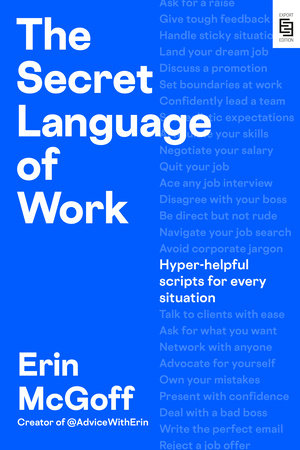
The Secret Language of Work

Hyper-Helpful Scripts for Every Situation

Paperback
$22.00 US
5.51"W x 8.25"H x 0.65"D   (14.0 x 21.0 x 1.7 cm) | 8 oz (227 g) | 24 per carton
On sale Mar 10, 2026 | 288 Pages | 9798217183562
Sales rights: US, Canada, Open Mkt
Export Edition

See Additional Formats
From the creator of AdviceWithErin, the definitive book on how to use the right words at work—so you can build the career you deserve

We’ve all been there: you’re sweating, sitting in front of your laptop, and the interviewer on the screen says, “Tell me about yourself.” You freeze. Is that even a question? What are they expecting from you? What do you say?

If that paragraph made your heart beat a little faster, TikTok star, career educator, and “the internet’s big sister” Erin McGoff is here to help. In The Secret Language of Work, McGoff shares her best, customizable scripts for how to communicate in the professional world—word-for-word, exactly what to say during interviews, while negotiating salaries, when you need to set boundaries with co-workers, as you advocate for yourself, and in any sticky situation at the office. With McGoff’s advice, you will master the unwritten rules of work speak that are key to career advancement.

Learning how to say the right words, in the right order, in the right way, at the right time, is an art that too few people are taught. Stellar communication is probably the most valuable skill you can possess—and once you know the secret language of work, you will be able to confidently tackle anything your sure-to-be outstanding career presents to you.
Chapter 1

Change Your Words, Change Your Life

Clear is kind. Unclear is unkind.
-Brené Brown

When I was a freshman in college, I landed an internship at a small commercial film production company. In my interview, I was eager to please. I said I could do anything! I'd stay late, work hard, and do whatever needed to be done-even "sweep the floors" if I had to. (Yes, I actually said that.) I pictured myself drafting call sheets, organizing the gear room, shaking hands with celebrities on set, reviewing scripts, and learning from directors. I was so excited!

But the truth is, I had no idea what I was doing. I was merely a guppy out in the big blue sea, faking it until I made it. This was my first time working in a corporate environment, and I didn't know what to expect or what would be expected of me. What should I wear? Should I get to work early? How could I impress everyone around me?

To my dismay, I showed up on my first day (overdressed and too early) and was introduced to my first task by an unenthusiastic post-production manager. "You need to organize these files. It's pretty self-explanatory," he said and left me alone in a dark, windowless room. It was just me, Excel, a hard drive, and a broken dream.

I looked at the screen and saw files-lots and lots of files. I had to cross-reference them with a spreadsheet. It was menial, tedious, boring, and unglamorous. (I mean, there were no celebrities!)

I quickly grew bitter. This was an unpaid internship. I was giving up three half days a week-days I could have spent working at a paid job-to do some random tasks alone in a room while learning nothing about filmmaking. I wondered if this was even legal.

But . . . I had told them I'd do anything, right? I couldn't blame them . . . right? In my interview, I had basically promised to do just this. I decided that as a rookie intern, I just had to bite my tongue.

Another producer who worked at the production company checked in on me every now and then (probably for proof of life). She was so nice, and I was hoping that one day she'd come to my rescue. But when she asked me how everything was going, I responded, "Great!" I didn't know how to say in a professional way, "I'm so bored I want to rip out my hair. Is there literally anything else I could do?"

Meanwhile, the aforementioned unenthusiastic post-production manager was often nowhere to be found. (I guess he was my boss? It was never clear.) When he did show his face, I'd remind him of my existence and ask him to check my work. I waited eagerly, daydreaming of him snapping out of it and saying, "You're still doing this? I have a commercial that needs editing. How about you take over as our lead editor?" But alas, he never did.

It continued on like this for an entire semester. I eventually realized that I could get my work done pretty efficiently and spend the rest of the time watching Vimeo Staff Picks, eating Chinese takeout, and doing homework. But overall, the internship was a bust. I learned very little and met almost no one.

It took me years to realize that to a great extent this was my fault. See, I never vocalized . . . well . . . anything. I wanted to be happy-go-lucky and help out wherever I could. I didn't want to offend anyone by complaining about the work I was being assigned. And I assumed that if I did a good job at my tasks, the people around me would notice and eventually give me more interesting things to work on. That, my friends, was my first crucial mistake: assuming anything about anyone, anytime, anywhere.

As my career progressed, I was able to observe and absorb the secret language of work-the language that highly successful people know how to speak to get what they want. I witnessed businesswomen smiling and even laughing as they negotiated deals. I saw colleagues smartly challenge each other on ideas and give blunt feedback that somehow wasn't offensive. I saw folks articulate their thoughts, share opinions, lead conversations, and make tough decisions, all without any emotional baggage attached.

These people knew how to communicate professionally and perfectly curate their words to communicate what they meant. They would never sit in a windowless room eating Chinese food for an entire semester. They would have looked at that room on day one and said, "Yeah, this isn't going to work for me." But, you know, in a professional way.

In fact, these folks probably wouldn't have been in that room in the first place because they would have asserted themselves in the interview. Maybe they would even have managed to negotiate for a stipend so that the internship wasn't completely unpaid. They knew how to professionally, effortlessly, and joyfully advocate for themselves. I had so much to learn.

After that internship, I became obsessed with mastering the art of professional communication. How could I take my honest thoughts and turn them into effective, strategic communication? How could I be direct without being rude, confident without being cocky, assertive without being arrogant, and successful while still being liked? How could I learn this secret language that magically made everyone listen to and like me, all while still getting my way?

It took me awhile, but through a lot of trial and error, I learned all this, and I went on to craft my dream career by using the secret language of work. After a few years of studying this hidden curriculum, I no longer had to blindly send résumés to apply for jobs or vent to my friends about annoying coworkers. I networked effectively and communicated proactively with decision-makers, and people were saying my name in rooms full of possibilities. As a result, the types of opportunities I dreamed of started finding me.

Maybe you're thinking, "Good for you, Erin, but I'm an introvert and shy and just not outgoing and confident like you!" Well, I've got some news for you: I'm an introverted recovering people pleaser whose ideal Friday night is sitting on the couch under a heavy throw blanket watching a movie with my dog and husband.

In fact, many (dare I assume most?) successful people I know are actually quite introverted. Being an introvert, quiet, or shy doesn't automatically mean you can't also be a powerful leader and have a wildly successful career. That's a narrative you have concocted for yourself, and I hate to say it, but it's not doing you any favors. Don't tell yourself a story that takes away your power. The only thing standing between you and what you want is you-no one else can give you what you want. It's up to you, my introverted little superstar. (Also, if you're an extrovert reading this, you're a superstar too.)

The Desired Outcome

Take a moment to picture yourself in the future, living your dream life. Not your parents', siblings', or friends' dream lives. Not my dream life. (I live on a ranch with a few dozen rescue dogs and own a bookshop café . . . okay, snapping out of it.) Your dream life, whatever that looks like. I encourage you to dream, and to keep that dream close to your heart.

Remembering what you want is half the recipe for good communication. In Stephen Covey's book The 7 Habits of Highly Effective People, the second habit is: "Start with the end in mind." To plan the route to where you're going, you have to first know where you are going. What do you really want at the end of the day?

Moving forward, I will refer to this end result as your "desired outcome," which is essential to keep in mind. Your desired outcome can be macro, like landing your dream job, or micro, like getting your boss to approve your PTO. The important thing to know, though, is that once you are clear on your desired outcome, strategic communication is the key to getting it.

Most people treat talking as a means to an end-I need to use mouth sounds to get what I want. But words are incredibly powerful. Learning how to say the right words, in the right order, in the right way, at the right time is a rare skill that too few people invest in mastering. But those who do master it find that they quickly land on the fast track to achieving what they want. In fact, stellar communication is probably the most valuable career (and life) skill you can possess. Once you get the hang of it, you'll be shocked at how quickly and effortlessly amazing things start falling into your lap.

Remember the first line of this book? Most play checkers, few play chess. Checkers is a simple game that you play one move at a time. In the world of communication, this means that if someone makes you mad, you tell them they made you mad. Simple as that! But chess is about strategy, thinking several steps ahead, and remembering that every move you make needs to contribute to your desired outcome: winning the game. Good professional communication is chess. The obvious move isn't always the most advantageous for winning the overall game. You have to know how to play and think several steps ahead.

Workplace communication is about so much more than just making chitchat in the break room or figuring out what to say during those awkward "We're just waiting on one more person to join . . ." first minutes of a Zoom call. No matter what kind of job you have or desire, communication is at the heart of every single aspect of your career. It is the key to getting a great job, a raise, a promotion, a mentor-the list goes on and on forever.

Sure, there are some other things you need to know in order to succeed at work. You need to be technically skilled for the job, dress appropriately, be on time, and have a good work ethic. But in general, the difference between a competent worker with a very okay career and a competent worker with an incredible career is their ability to communicate effectively.

Every day I receive hundreds of messages, emails, and comments from my community asking for my advice on particular work challenges they're facing. And while at first glance these problems all seem completely different from one another other, nearly every single one of them boils down to the same issue: interpersonal communication. In fact, these people are all basically asking the same question: "How do I tell [blank] [blank]?" For example:

"How do I tell my boss that I need a raise or I'm quitting?"

"How can I ask for an extra week of PTO for my wedding?"

"How do I negotiate my salary when I have no experience?"

"How can I tell my coworker to stop using my mug?"

Here's something I need you to understand: Until AI takes over completely and robots eradicate the human race, your boss will be a person, your company will be run by people, and your colleagues and clients will also be people. Professional communication is about dealing with other people. It's about relationships. And the only way to work well with people and get them to listen to and be open to your ideas and requests is to learn how to professionally communicate as a human to other humans. (Again, until AI takes over, and robots enter the chat.)

The Case for Professional Communication

If you can feel yourself bristling at the idea of professional communication in general and thinking, "Ugh, I don't want to speak like those aforementioned robots," I get it. A lot of people have a problem with the whole idea of trying to sound professional. They feel that professional communication signals and perpetuates classism and elitism. And just as I shared via Jessie and Samantha's story, there is absolutely some truth to that.

Yes, professional communication can feel unnecessary and time-consuming, I mean, just say what you mean, right? I used to think that way too, until I learned about the secret language of work and how powerful it can be. Imagine this: You're six months into dating someone you're really into, and they invite you to come meet their parents. You show up to their front door in your sweats with empty hands. You waltz inside, plop down on the couch, and say, "So, Barb, what's for dinner?" You wouldn't do that, would you? (Please say no.) Even though that may be perfectly acceptable behavior when rolling up to your best friend's house, it's not so appropriate in this scenario.

My point is that we all take on different personas in different environments. When meeting your new boyfriend or girlfriend's parents for the first time, you're going to put on your "meeting the parents for the first time" persona. You're going to be on your best behavior, show up with a gift, compliment the food, help clean up, and try to impress them. Why? Because that's what's in your best interest: having a good relationship with your potential future in-laws! Remember, it's all about the desired result-it's chess, not checkers.

The same logic applies at work. It's important to have a work persona. It's not like you're being fake or pretending to be someone you're not. You're simply adjusting your behavior to be your best self for the environment you're in. That way, you can more easily separate your professional life from your personal life. Don't try to bring your "full self" to work, unless you want work to start expecting your "full self."

It took me a long time-years!-to learn these skills, partially because a lot of the existing advice on the subject didn't really speak to me. (Get it? Speak? I'll be here all week!) While I've read many excellent books and studies on professional communication, some of which I'll be referencing later on, I found that most advice encourages over-the-top professional speech, which can feel super phony and exclusionary. So, if all you've learned and been taught about professional communication before is to entirely change how you speak, dress, act, and present yourself-I hear you.

We're all unique, and my problem with a lot of existing professional communication advice is that it made me feel like I had to put myself in a box and pretend to be someone I'm not. I had to turn off my sense of humor, tiptoe around what I mean, stop being too friendly, but also smile more? On one side of the spectrum, there are communication experts encouraging us to "lead with your authentic self," or "walk in your truth," but . . . what does that even mean? It's so squishy. Do I have to wear certain shoes to walk in my truth? How does this translate to telling my boss I'm burned out-I need the words!
The Secret Language of Work teaches the hidden dynamics that earn respect, calm conflict, and open doors at every stage of your professional life. If you work—and you talk—you need this book.”
— Jefferson Fisher, bestselling author of The Next Conversation

“In The Secret Language of Work, Erin McGoff offers practical wisdom to guide young professionals to speak with confidence and land their dream job. Read this book today to demystify what works in the workplace.”
— Arthur C. Brooks, Harvard professor and #1 New York Times bestselling author

“There is a secret language of work, and Erin knows the code. Grab this book, devour it, and watch everything get easier at your job.”
— Vanessa Van Edwards, bestselling author and founder of Science of People

“Readers will wish they could take Erin to every interview and meeting they have—and with the practical wisdom they'll gain from this book, they can. A must read for every young adult trying to demystify the brand new world of work.”
— Meg Jay, PhD, author of The Defining Decade and The Twentysomething Treatment

“Knowing the hidden rules and expectations behind interviewing, negotiating, and presenting yourself well can catapult you into new opportunities and adventures. But you need to hone and develop these skills; Erin McGoff details specific, actionable advice we all can benefit from.”
— Matt Abrahams, author of Think Faster, Talk Smarter and host of the podcast Think Fast, Talk Smart
Erin McGoff is an award-winning filmmaker and content creator—known as the “internet’s big sister" through her AdviceWithErin branding. McGoff has built a significant online presence with millions of followers, delivering candid career and life advice for Gen Z and Millennials. She received a Pulitzer Fellowship in 2017 and was named a Forbes 30 Under 30 recipient in 2025. Her impact has been recognized by publications like the New York Times, Washington Post, Wall Street Journal, Business Insider, and others, and she is currently a contributor to CNBC. McGoff lives in Washington, D.C., with an occasional trip up to her cabin in the Catskills she custom-built, with her husband, Michael, and dog, Olive. View titles by Erin McGoff
Available for sale exclusive:
•     Guam
•     Minor Outl.Ins.
•     North Mariana
•     Philippines
•     Puerto Rico
•     Samoa,American
•     US Virgin Is.

Available for sale non-exclusive:
•     Afghanistan
•     Aland Islands
•     Albania
•     Algeria
•     Andorra
•     Angola
•     Anguilla
•     Antarctica
•     Argentina
•     Armenia
•     Aruba
•     Austria
•     Azerbaijan
•     Bahrain
•     Belarus
•     Belgium
•     Benin
•     Bhutan
•     Bolivia
•     Bonaire, Saba
•     Bosnia Herzeg.
•     Bouvet Island
•     Brazil
•     Bulgaria
•     Burkina Faso
•     Burundi
•     Cambodia
•     Cameroon
•     Cape Verde
•     Centr.Afr.Rep.
•     Chad
•     Chile
•     China
•     Colombia
•     Comoro Is.
•     Congo
•     Cook Islands
•     Costa Rica
•     Croatia
•     Cuba
•     Curacao
•     Czech Republic
•     Dem. Rep. Congo
•     Denmark
•     Djibouti
•     Dominican Rep.
•     Ecuador
•     Egypt
•     El Salvador
•     Equatorial Gui.
•     Eritrea
•     Estonia
•     Ethiopia
•     Faroe Islands
•     Finland
•     France
•     Fren.Polynesia
•     French Guinea
•     Gabon
•     Georgia
•     Germany
•     Greece
•     Greenland
•     Guadeloupe
•     Guatemala
•     Guinea Republic
•     Guinea-Bissau
•     Haiti
•     Heard/McDon.Isl
•     Honduras
•     Hong Kong
•     Hungary
•     Iceland
•     Indonesia
•     Iran
•     Iraq
•     Israel
•     Italy
•     Ivory Coast
•     Japan
•     Jordan
•     Kazakhstan
•     Kuwait
•     Kyrgyzstan
•     Laos
•     Latvia
•     Lebanon
•     Liberia
•     Libya
•     Liechtenstein
•     Lithuania
•     Luxembourg
•     Macau
•     Macedonia
•     Madagascar
•     Maldives
•     Mali
•     Marshall island
•     Martinique
•     Mauritania
•     Mayotte
•     Mexico
•     Micronesia
•     Moldavia
•     Monaco
•     Mongolia
•     Montenegro
•     Morocco
•     Myanmar
•     Nepal
•     Netherlands
•     New Caledonia
•     Nicaragua
•     Niger
•     Niue
•     Norfolk Island
•     North Korea
•     Norway
•     Oman
•     Palau
•     Palestinian Ter
•     Panama
•     Paraguay
•     Peru
•     Poland
•     Portugal
•     Qatar
•     Reunion Island
•     Romania
•     Russian Fed.
•     Rwanda
•     Saint Martin
•     San Marino
•     SaoTome Princip
•     Saudi Arabia
•     Senegal
•     Serbia
•     Singapore
•     Sint Maarten
•     Slovakia
•     Slovenia
•     South Korea
•     South Sudan
•     Spain
•     St Barthelemy
•     St.Pier,Miquel.
•     Sth Terr. Franc
•     Sudan
•     Suriname
•     Svalbard
•     Sweden
•     Switzerland
•     Syria
•     Tadschikistan
•     Taiwan
•     Thailand
•     Timor-Leste
•     Togo
•     Tokelau Islands
•     Tunisia
•     Turkey
•     Turkmenistan
•     Ukraine
•     Unit.Arab Emir.
•     Uruguay
•     Uzbekistan
•     Vatican City
•     Venezuela
•     Vietnam
•     Wallis,Futuna
•     West Saharan
•     Western Samoa
•     Yemen

Not available for sale:
•     Antigua/Barbuda
•     Australia
•     Bahamas
•     Bangladesh
•     Barbados
•     Belize
•     Bermuda
•     Botswana
•     Brit.Ind.Oc.Ter
•     Brit.Virgin Is.
•     Brunei
•     Canada
•     Cayman Islands
•     Christmas Islnd
•     Cocos Islands
•     Cyprus
•     Dominica
•     Falkland Islnds
•     Fiji
•     Gambia
•     Ghana
•     Gibraltar
•     Grenada
•     Guernsey
•     Guyana
•     India
•     Ireland
•     Isle of Man
•     Jamaica
•     Jersey
•     Kenya
•     Kiribati
•     Lesotho
•     Malawi
•     Malaysia
•     Malta
•     Mauritius
•     Montserrat
•     Mozambique
•     Namibia
•     Nauru
•     New Zealand
•     Nigeria
•     Pakistan
•     PapuaNewGuinea
•     Pitcairn Islnds
•     S. Sandwich Ins
•     Seychelles
•     Sierra Leone
•     Solomon Islands
•     Somalia
•     South Africa
•     Sri Lanka
•     St. Helena
•     St. Lucia
•     St. Vincent
•     St.Chr.,Nevis
•     Swaziland
•     Tanzania
•     Tonga
•     Trinidad,Tobago
•     Turks&Caicos Is
•     Tuvalu
•     USA
•     Uganda
•     United Kingdom
•     Vanuatu
•     Zambia
•     Zimbabwe

About

From the creator of AdviceWithErin, the definitive book on how to use the right words at work—so you can build the career you deserve

We’ve all been there: you’re sweating, sitting in front of your laptop, and the interviewer on the screen says, “Tell me about yourself.” You freeze. Is that even a question? What are they expecting from you? What do you say?

If that paragraph made your heart beat a little faster, TikTok star, career educator, and “the internet’s big sister” Erin McGoff is here to help. In The Secret Language of Work, McGoff shares her best, customizable scripts for how to communicate in the professional world—word-for-word, exactly what to say during interviews, while negotiating salaries, when you need to set boundaries with co-workers, as you advocate for yourself, and in any sticky situation at the office. With McGoff’s advice, you will master the unwritten rules of work speak that are key to career advancement.

Learning how to say the right words, in the right order, in the right way, at the right time, is an art that too few people are taught. Stellar communication is probably the most valuable skill you can possess—and once you know the secret language of work, you will be able to confidently tackle anything your sure-to-be outstanding career presents to you.

Excerpt

Chapter 1

Change Your Words, Change Your Life

Clear is kind. Unclear is unkind.
-Brené Brown

When I was a freshman in college, I landed an internship at a small commercial film production company. In my interview, I was eager to please. I said I could do anything! I'd stay late, work hard, and do whatever needed to be done-even "sweep the floors" if I had to. (Yes, I actually said that.) I pictured myself drafting call sheets, organizing the gear room, shaking hands with celebrities on set, reviewing scripts, and learning from directors. I was so excited!

But the truth is, I had no idea what I was doing. I was merely a guppy out in the big blue sea, faking it until I made it. This was my first time working in a corporate environment, and I didn't know what to expect or what would be expected of me. What should I wear? Should I get to work early? How could I impress everyone around me?

To my dismay, I showed up on my first day (overdressed and too early) and was introduced to my first task by an unenthusiastic post-production manager. "You need to organize these files. It's pretty self-explanatory," he said and left me alone in a dark, windowless room. It was just me, Excel, a hard drive, and a broken dream.

I looked at the screen and saw files-lots and lots of files. I had to cross-reference them with a spreadsheet. It was menial, tedious, boring, and unglamorous. (I mean, there were no celebrities!)

I quickly grew bitter. This was an unpaid internship. I was giving up three half days a week-days I could have spent working at a paid job-to do some random tasks alone in a room while learning nothing about filmmaking. I wondered if this was even legal.

But . . . I had told them I'd do anything, right? I couldn't blame them . . . right? In my interview, I had basically promised to do just this. I decided that as a rookie intern, I just had to bite my tongue.

Another producer who worked at the production company checked in on me every now and then (probably for proof of life). She was so nice, and I was hoping that one day she'd come to my rescue. But when she asked me how everything was going, I responded, "Great!" I didn't know how to say in a professional way, "I'm so bored I want to rip out my hair. Is there literally anything else I could do?"

Meanwhile, the aforementioned unenthusiastic post-production manager was often nowhere to be found. (I guess he was my boss? It was never clear.) When he did show his face, I'd remind him of my existence and ask him to check my work. I waited eagerly, daydreaming of him snapping out of it and saying, "You're still doing this? I have a commercial that needs editing. How about you take over as our lead editor?" But alas, he never did.

It continued on like this for an entire semester. I eventually realized that I could get my work done pretty efficiently and spend the rest of the time watching Vimeo Staff Picks, eating Chinese takeout, and doing homework. But overall, the internship was a bust. I learned very little and met almost no one.

It took me years to realize that to a great extent this was my fault. See, I never vocalized . . . well . . . anything. I wanted to be happy-go-lucky and help out wherever I could. I didn't want to offend anyone by complaining about the work I was being assigned. And I assumed that if I did a good job at my tasks, the people around me would notice and eventually give me more interesting things to work on. That, my friends, was my first crucial mistake: assuming anything about anyone, anytime, anywhere.

As my career progressed, I was able to observe and absorb the secret language of work-the language that highly successful people know how to speak to get what they want. I witnessed businesswomen smiling and even laughing as they negotiated deals. I saw colleagues smartly challenge each other on ideas and give blunt feedback that somehow wasn't offensive. I saw folks articulate their thoughts, share opinions, lead conversations, and make tough decisions, all without any emotional baggage attached.

These people knew how to communicate professionally and perfectly curate their words to communicate what they meant. They would never sit in a windowless room eating Chinese food for an entire semester. They would have looked at that room on day one and said, "Yeah, this isn't going to work for me." But, you know, in a professional way.

In fact, these folks probably wouldn't have been in that room in the first place because they would have asserted themselves in the interview. Maybe they would even have managed to negotiate for a stipend so that the internship wasn't completely unpaid. They knew how to professionally, effortlessly, and joyfully advocate for themselves. I had so much to learn.

After that internship, I became obsessed with mastering the art of professional communication. How could I take my honest thoughts and turn them into effective, strategic communication? How could I be direct without being rude, confident without being cocky, assertive without being arrogant, and successful while still being liked? How could I learn this secret language that magically made everyone listen to and like me, all while still getting my way?

It took me awhile, but through a lot of trial and error, I learned all this, and I went on to craft my dream career by using the secret language of work. After a few years of studying this hidden curriculum, I no longer had to blindly send résumés to apply for jobs or vent to my friends about annoying coworkers. I networked effectively and communicated proactively with decision-makers, and people were saying my name in rooms full of possibilities. As a result, the types of opportunities I dreamed of started finding me.

Maybe you're thinking, "Good for you, Erin, but I'm an introvert and shy and just not outgoing and confident like you!" Well, I've got some news for you: I'm an introverted recovering people pleaser whose ideal Friday night is sitting on the couch under a heavy throw blanket watching a movie with my dog and husband.

In fact, many (dare I assume most?) successful people I know are actually quite introverted. Being an introvert, quiet, or shy doesn't automatically mean you can't also be a powerful leader and have a wildly successful career. That's a narrative you have concocted for yourself, and I hate to say it, but it's not doing you any favors. Don't tell yourself a story that takes away your power. The only thing standing between you and what you want is you-no one else can give you what you want. It's up to you, my introverted little superstar. (Also, if you're an extrovert reading this, you're a superstar too.)

The Desired Outcome

Take a moment to picture yourself in the future, living your dream life. Not your parents', siblings', or friends' dream lives. Not my dream life. (I live on a ranch with a few dozen rescue dogs and own a bookshop café . . . okay, snapping out of it.) Your dream life, whatever that looks like. I encourage you to dream, and to keep that dream close to your heart.

Remembering what you want is half the recipe for good communication. In Stephen Covey's book The 7 Habits of Highly Effective People, the second habit is: "Start with the end in mind." To plan the route to where you're going, you have to first know where you are going. What do you really want at the end of the day?

Moving forward, I will refer to this end result as your "desired outcome," which is essential to keep in mind. Your desired outcome can be macro, like landing your dream job, or micro, like getting your boss to approve your PTO. The important thing to know, though, is that once you are clear on your desired outcome, strategic communication is the key to getting it.

Most people treat talking as a means to an end-I need to use mouth sounds to get what I want. But words are incredibly powerful. Learning how to say the right words, in the right order, in the right way, at the right time is a rare skill that too few people invest in mastering. But those who do master it find that they quickly land on the fast track to achieving what they want. In fact, stellar communication is probably the most valuable career (and life) skill you can possess. Once you get the hang of it, you'll be shocked at how quickly and effortlessly amazing things start falling into your lap.

Remember the first line of this book? Most play checkers, few play chess. Checkers is a simple game that you play one move at a time. In the world of communication, this means that if someone makes you mad, you tell them they made you mad. Simple as that! But chess is about strategy, thinking several steps ahead, and remembering that every move you make needs to contribute to your desired outcome: winning the game. Good professional communication is chess. The obvious move isn't always the most advantageous for winning the overall game. You have to know how to play and think several steps ahead.

Workplace communication is about so much more than just making chitchat in the break room or figuring out what to say during those awkward "We're just waiting on one more person to join . . ." first minutes of a Zoom call. No matter what kind of job you have or desire, communication is at the heart of every single aspect of your career. It is the key to getting a great job, a raise, a promotion, a mentor-the list goes on and on forever.

Sure, there are some other things you need to know in order to succeed at work. You need to be technically skilled for the job, dress appropriately, be on time, and have a good work ethic. But in general, the difference between a competent worker with a very okay career and a competent worker with an incredible career is their ability to communicate effectively.

Every day I receive hundreds of messages, emails, and comments from my community asking for my advice on particular work challenges they're facing. And while at first glance these problems all seem completely different from one another other, nearly every single one of them boils down to the same issue: interpersonal communication. In fact, these people are all basically asking the same question: "How do I tell [blank] [blank]?" For example:

"How do I tell my boss that I need a raise or I'm quitting?"

"How can I ask for an extra week of PTO for my wedding?"

"How do I negotiate my salary when I have no experience?"

"How can I tell my coworker to stop using my mug?"

Here's something I need you to understand: Until AI takes over completely and robots eradicate the human race, your boss will be a person, your company will be run by people, and your colleagues and clients will also be people. Professional communication is about dealing with other people. It's about relationships. And the only way to work well with people and get them to listen to and be open to your ideas and requests is to learn how to professionally communicate as a human to other humans. (Again, until AI takes over, and robots enter the chat.)

The Case for Professional Communication

If you can feel yourself bristling at the idea of professional communication in general and thinking, "Ugh, I don't want to speak like those aforementioned robots," I get it. A lot of people have a problem with the whole idea of trying to sound professional. They feel that professional communication signals and perpetuates classism and elitism. And just as I shared via Jessie and Samantha's story, there is absolutely some truth to that.

Yes, professional communication can feel unnecessary and time-consuming, I mean, just say what you mean, right? I used to think that way too, until I learned about the secret language of work and how powerful it can be. Imagine this: You're six months into dating someone you're really into, and they invite you to come meet their parents. You show up to their front door in your sweats with empty hands. You waltz inside, plop down on the couch, and say, "So, Barb, what's for dinner?" You wouldn't do that, would you? (Please say no.) Even though that may be perfectly acceptable behavior when rolling up to your best friend's house, it's not so appropriate in this scenario.

My point is that we all take on different personas in different environments. When meeting your new boyfriend or girlfriend's parents for the first time, you're going to put on your "meeting the parents for the first time" persona. You're going to be on your best behavior, show up with a gift, compliment the food, help clean up, and try to impress them. Why? Because that's what's in your best interest: having a good relationship with your potential future in-laws! Remember, it's all about the desired result-it's chess, not checkers.

The same logic applies at work. It's important to have a work persona. It's not like you're being fake or pretending to be someone you're not. You're simply adjusting your behavior to be your best self for the environment you're in. That way, you can more easily separate your professional life from your personal life. Don't try to bring your "full self" to work, unless you want work to start expecting your "full self."

It took me a long time-years!-to learn these skills, partially because a lot of the existing advice on the subject didn't really speak to me. (Get it? Speak? I'll be here all week!) While I've read many excellent books and studies on professional communication, some of which I'll be referencing later on, I found that most advice encourages over-the-top professional speech, which can feel super phony and exclusionary. So, if all you've learned and been taught about professional communication before is to entirely change how you speak, dress, act, and present yourself-I hear you.

We're all unique, and my problem with a lot of existing professional communication advice is that it made me feel like I had to put myself in a box and pretend to be someone I'm not. I had to turn off my sense of humor, tiptoe around what I mean, stop being too friendly, but also smile more? On one side of the spectrum, there are communication experts encouraging us to "lead with your authentic self," or "walk in your truth," but . . . what does that even mean? It's so squishy. Do I have to wear certain shoes to walk in my truth? How does this translate to telling my boss I'm burned out-I need the words!

Praise

The Secret Language of Work teaches the hidden dynamics that earn respect, calm conflict, and open doors at every stage of your professional life. If you work—and you talk—you need this book.”
— Jefferson Fisher, bestselling author of The Next Conversation

“In The Secret Language of Work, Erin McGoff offers practical wisdom to guide young professionals to speak with confidence and land their dream job. Read this book today to demystify what works in the workplace.”
— Arthur C. Brooks, Harvard professor and #1 New York Times bestselling author

“There is a secret language of work, and Erin knows the code. Grab this book, devour it, and watch everything get easier at your job.”
— Vanessa Van Edwards, bestselling author and founder of Science of People

“Readers will wish they could take Erin to every interview and meeting they have—and with the practical wisdom they'll gain from this book, they can. A must read for every young adult trying to demystify the brand new world of work.”
— Meg Jay, PhD, author of The Defining Decade and The Twentysomething Treatment

“Knowing the hidden rules and expectations behind interviewing, negotiating, and presenting yourself well can catapult you into new opportunities and adventures. But you need to hone and develop these skills; Erin McGoff details specific, actionable advice we all can benefit from.”
— Matt Abrahams, author of Think Faster, Talk Smarter and host of the podcast Think Fast, Talk Smart

Author

Erin McGoff is an award-winning filmmaker and content creator—known as the “internet’s big sister" through her AdviceWithErin branding. McGoff has built a significant online presence with millions of followers, delivering candid career and life advice for Gen Z and Millennials. She received a Pulitzer Fellowship in 2017 and was named a Forbes 30 Under 30 recipient in 2025. Her impact has been recognized by publications like the New York Times, Washington Post, Wall Street Journal, Business Insider, and others, and she is currently a contributor to CNBC. McGoff lives in Washington, D.C., with an occasional trip up to her cabin in the Catskills she custom-built, with her husband, Michael, and dog, Olive. View titles by Erin McGoff

Rights

Available for sale exclusive:
•     Guam
•     Minor Outl.Ins.
•     North Mariana
•     Philippines
•     Puerto Rico
•     Samoa,American
•     US Virgin Is.

Available for sale non-exclusive:
•     Afghanistan
•     Aland Islands
•     Albania
•     Algeria
•     Andorra
•     Angola
•     Anguilla
•     Antarctica
•     Argentina
•     Armenia
•     Aruba
•     Austria
•     Azerbaijan
•     Bahrain
•     Belarus
•     Belgium
•     Benin
•     Bhutan
•     Bolivia
•     Bonaire, Saba
•     Bosnia Herzeg.
•     Bouvet Island
•     Brazil
•     Bulgaria
•     Burkina Faso
•     Burundi
•     Cambodia
•     Cameroon
•     Cape Verde
•     Centr.Afr.Rep.
•     Chad
•     Chile
•     China
•     Colombia
•     Comoro Is.
•     Congo
•     Cook Islands
•     Costa Rica
•     Croatia
•     Cuba
•     Curacao
•     Czech Republic
•     Dem. Rep. Congo
•     Denmark
•     Djibouti
•     Dominican Rep.
•     Ecuador
•     Egypt
•     El Salvador
•     Equatorial Gui.
•     Eritrea
•     Estonia
•     Ethiopia
•     Faroe Islands
•     Finland
•     France
•     Fren.Polynesia
•     French Guinea
•     Gabon
•     Georgia
•     Germany
•     Greece
•     Greenland
•     Guadeloupe
•     Guatemala
•     Guinea Republic
•     Guinea-Bissau
•     Haiti
•     Heard/McDon.Isl
•     Honduras
•     Hong Kong
•     Hungary
•     Iceland
•     Indonesia
•     Iran
•     Iraq
•     Israel
•     Italy
•     Ivory Coast
•     Japan
•     Jordan
•     Kazakhstan
•     Kuwait
•     Kyrgyzstan
•     Laos
•     Latvia
•     Lebanon
•     Liberia
•     Libya
•     Liechtenstein
•     Lithuania
•     Luxembourg
•     Macau
•     Macedonia
•     Madagascar
•     Maldives
•     Mali
•     Marshall island
•     Martinique
•     Mauritania
•     Mayotte
•     Mexico
•     Micronesia
•     Moldavia
•     Monaco
•     Mongolia
•     Montenegro
•     Morocco
•     Myanmar
•     Nepal
•     Netherlands
•     New Caledonia
•     Nicaragua
•     Niger
•     Niue
•     Norfolk Island
•     North Korea
•     Norway
•     Oman
•     Palau
•     Palestinian Ter
•     Panama
•     Paraguay
•     Peru
•     Poland
•     Portugal
•     Qatar
•     Reunion Island
•     Romania
•     Russian Fed.
•     Rwanda
•     Saint Martin
•     San Marino
•     SaoTome Princip
•     Saudi Arabia
•     Senegal
•     Serbia
•     Singapore
•     Sint Maarten
•     Slovakia
•     Slovenia
•     South Korea
•     South Sudan
•     Spain
•     St Barthelemy
•     St.Pier,Miquel.
•     Sth Terr. Franc
•     Sudan
•     Suriname
•     Svalbard
•     Sweden
•     Switzerland
•     Syria
•     Tadschikistan
•     Taiwan
•     Thailand
•     Timor-Leste
•     Togo
•     Tokelau Islands
•     Tunisia
•     Turkey
•     Turkmenistan
•     Ukraine
•     Unit.Arab Emir.
•     Uruguay
•     Uzbekistan
•     Vatican City
•     Venezuela
•     Vietnam
•     Wallis,Futuna
•     West Saharan
•     Western Samoa
•     Yemen

Not available for sale:
•     Antigua/Barbuda
•     Australia
•     Bahamas
•     Bangladesh
•     Barbados
•     Belize
•     Bermuda
•     Botswana
•     Brit.Ind.Oc.Ter
•     Brit.Virgin Is.
•     Brunei
•     Canada
•     Cayman Islands
•     Christmas Islnd
•     Cocos Islands
•     Cyprus
•     Dominica
•     Falkland Islnds
•     Fiji
•     Gambia
•     Ghana
•     Gibraltar
•     Grenada
•     Guernsey
•     Guyana
•     India
•     Ireland
•     Isle of Man
•     Jamaica
•     Jersey
•     Kenya
•     Kiribati
•     Lesotho
•     Malawi
•     Malaysia
•     Malta
•     Mauritius
•     Montserrat
•     Mozambique
•     Namibia
•     Nauru
•     New Zealand
•     Nigeria
•     Pakistan
•     PapuaNewGuinea
•     Pitcairn Islnds
•     S. Sandwich Ins
•     Seychelles
•     Sierra Leone
•     Solomon Islands
•     Somalia
•     South Africa
•     Sri Lanka
•     St. Helena
•     St. Lucia
•     St. Vincent
•     St.Chr.,Nevis
•     Swaziland
•     Tanzania
•     Tonga
•     Trinidad,Tobago
•     Turks&Caicos Is
•     Tuvalu
•     USA
•     Uganda
•     United Kingdom
•     Vanuatu
•     Zambia
•     Zimbabwe