Close Modal

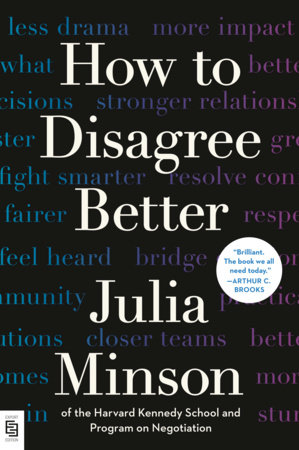
How to Disagree Better

Paperback
$22.00 US
5.96"W x 8.95"H x 0.8"D   (15.1 x 22.7 x 2.0 cm) | 11 oz (306 g) | 24 per carton
On sale Mar 24, 2026 | 304 Pages | 9798217183081
Sales rights: US, Canada, Open Mkt
Export Edition

See Additional Formats
Celebrated Harvard Kennedy School Professor and behavioral scientist Julia Minson has devoted her career to understanding the psychology of disagreement and its relevance to negotiations, conflict-resolution, and decision-making. In this revolutionary book, Minson reveals the counterintuitive secret to living a life of less drama and more impact

How many times have you tried to resolve a dispute by overwhelming someone with a flood of facts, appealing to your counterpart’s emotions, or pointing out the hypocrisy of their arguments only to end up in an even deeper disagreement than when you started? Julia Minson’s two decades of research into the science of disagreement uncovers two insights that can change every disagreement: persuasion doesn’t work nearly as well as we think it does, and displaying receptiveness to opposing views is the key to not only preventing conflict, but also to forging stronger relationships and making better decisions.

The science shows that receptive individuals don’t just fight less, they also get more done—they are better negotiators, better peacemakers, and yes, better influencers than the rest of us. Through original research and case studies, How to Disagree Better will show you:

  • Why persuasion doesn’t work as well as you think it does
  • How you can reach better conflict outcomes simply by signaling receptiveness
  • That disagreeing well is a skill all of us can learn
  • How to apply these ideas at home with your partner and kids, as well as at work in your negotiations and decision-making

By practicing receptiveness, you’ll see your conflicts soften, your conversations deepen, and your relationships grow stronger. You will create a richer, wiser, kinder life for yourself and for those around you—and you will find them agreeing with you a little more often, too.
CAUTION: This email originated from outside of Penguin Random House. Please be extra cautious when opening file attachments or clicking on links.

1
Disagreement, Conflict, and What's Wrong with Everyone Around You

Here is a poorly kept and perpetually embarrassing secret about my academic career-my passion for the science of disagreement did not come from observing the harm that violent conflict sows in the world or studying the academic literature and identifying theoretical gaps that needed filling. My passion for disagreement was primarily fueled by my years as a competitive ballroom dancer, training with, competing with, and regularly fighting with my partner and later husband, Ryan.

I began ballroom dancing as a little girl in Russia. This might seem strange to many American readers, but in Eastern Europe in the eighties, taking ballroom dancing lessons was as common as taking ballet or tap lessons is in the United States. All the little girls wanted to do it, and all the little boys were forced into dancing with their sisters. By the time I had met my husband, I had thousands of hours of training and years of competitive experience under my belt. Ryan, who had never danced a step in his life, wanted to learn to dance because he had grand plans to flirt with a woman he expected to see again at a friend's wedding. I was his teacher.

My husband has an infuriating quality. He is just good at things-not necessarily amazing, but notably above average at almost everything, especially things that require physical coordination and musicality. When it came to dancing, he improved quickly because of his talent and interest-and also because his teacher (soon his girlfriend) had endless time and energy for teaching him. We practiced during every available hour and on every patch of hardwood we could find. I quickly came to realize that I had more fun dancing with this complete beginner than with my competition partner. As weeks turned into months, I decided that I would rather break up the competitive partnership I was involved in and dance with Ryan, even if that meant going back to the basics.

There are several unique aspects to ballroom dancing that make it the perfect microcosm for the study of conflict. First of all, the two partners are in perpetual intimate physical contact. The front of your body is literally plastered to your partner's, meaning that you can feel their most minute movements, down to their breath and their heart rate. Good physical contact improves your ability to lead and follow-to coordinate your movements wordlessly and instantaneously. Indeed, after dancing together for years, I could move my body in response to Ryan's much more quickly than it took my conscious brain to understand what was happening. And when everything worked, when we moved in complete harmony, when we felt in sync with the music and with each other-it was like telepathy. To this day, few experiences I have had compare to this feeling of "oneness."

But of course, it didn't always work. One of us would lose our balance, move too slowly, stretch too far or not far enough, and the other person would get annoyed. And the finely honed sense that allowed us to feel each other's every movement also allowed us to feel each other's every mood. I'd get upset with his tightened grip on my back, he'd get upset that I was upset, and the magic would dissolve in an instant. Left in its place was another couple glaring at each other across several feet of empty dance floor.

Like every dance partnership, when things went badly, we tried to diagnose the cause. Predictably, the cause was the other person. His claim that I had moved too slowly was met with my claim that he had not provided enough momentum. When I said he miscounted the rhythm, he said I was the one who started counting from the wrong measure. When he said I was leaning too far back, I said that he was not counterbalancing enough with his own weight. In fact, every practice, two hours a day, seven days a week, featured a dozen instances where we were both absolutely sure that the other person caused the problem and was simply failing to acknowledge it.

This state of nearly perpetual conflict on the dance floor was especially baffling since we knew each other and the choreography as well as any two people possibly could. We were in love and rarely fought about anything outside of dancing. We had world-class coaches to help us solve our problems, and we were both highly intelligent and analytical people. So how could he be so sure I was to blame and I be so sure that he was? And why did our different perspectives have to lead to so many ugly spats?

My only consolation was that just about everyone around us had the same problem. Observing other dancing couples, ranging from relative beginners to nationally ranked professionals, I saw the same strange phenomenon: Highly trained people who deeply cared about improving their performance were similarly unable to agree on the basic physical facts of which one of them missed the beat or rotated too far.

In my early twenties, I decided to get a PhD in social psychology, not because I had ambitions to bring peace to the Middle East or to restore democracy but because I wanted to figure out how to stop fighting with my dance partner.

Psychological Causes of Conflict

I applied to graduate school and was fortunate enough to be admitted to Stanford. There, I studied under the legendary psychologist Lee Ross, who at that time was scientifically proving a truth that, while seeming obvious, has profound implications: Most conflict stems from the simple fact that everyone thinks they are right. In his work, Lee argued that most people go around the world believing that their perceptions, experiences, and interpretations of events reflect an objective, knowable external reality. Lee called this phenomenon "naïve realism"-a term borrowed from philosophy and intended to highlight that people "naïvely" believe that their perceptions and judgments are "realistic" in some deep, fundamental sense.

Through many clever experiments, Lee and his students demonstrated how this stance then led to conflict across a broad variety of contexts and topics. Because of naïve realism, any time a person had an opinion (which is basically always) and encountered another person (often), they both entered the conversation with a firm conviction that they "got it." Because both people believed themselves to be fundamentally reasonable and objective, to the extent that their opinions diverged, the seeds of conflict had been sown. As soon as I encountered Lee's work, I realized that I had found my intellectual home. From that time forward, naïve realism and its logical extensions formed the basis of my research program.

In retrospect, it is likely that Lee, who had spent decades working on the conflicts in Northern Ireland and the Middle East, found my desire to apply his theories to squabbles between ballroom dance partners silly. But as an immensely curious person, who found almost all human behavior fascinating, he also recognized what was unique about this particular context: If people who were as close and aligned as Ryan and I were couldn't get past the differences in our perceptions, what hope was there for the rest of the world? Was there some fundamental psychological commonality in conflicts between lovers, colleagues, and nation-states? Indeed, over the years it turned out that competitive ballroom dancing was an excellent laboratory in which to study conflict-a context wherein two parties often saw things fundamentally differently but deeply cared about the outcome and had to reach consensus in order to move forward (or backward, or sideways). I quickly realized that naïve realism was exactly what was causing the issues between Ryan and me.

A unique feature of ballroom dancing is that the partners spend the vast majority of the time facing each other. This means that when Ryan and I passed by a mirror on the wall of the dance studio, I would see my front and his back, but he wouldn't see us at all, because at that moment he would be facing in the opposite direction. As we would move and rotate, our perspectives would shift, but there would literally never be a time when we would both be seeing the world (and ourselves) from the same vantage point. In other words, we would see the same performance, but never at the same time or from the same angle. It turns out that this curious physical arrangement was the perfect metaphor for naïve realism-both partners could grow increasingly certain in their convictions about the quality of their dancing or the source of their mistakes without considering the fact that those convictions might be entirely different if they only saw the world from their partner's point of view.

An important thing to keep in mind is that naïve realism actually serves people quite well, especially in navigating their physical world-a world that even under the simplest circumstances requires humans to make hundreds of tiny judgments every hour. Thanks to this mindset, we quickly assume that when our feet encounter resistance, they must be on solid ground; when a predator seems very small, it must be very far away; and when green strawberries turn red, they're ready to eat. We thus form the habit of treating our perceptions as accurate reflections of the physical world around us, completely ignoring all the distortion and processing that happens in the split second between sensory contact and the interpretation that our conscious mind imposes on the incoming signal. We do not stop to consider that in a different light, in a different gravity, or with a different set of sensory organs, we would have a completely different experience. Who's got that kind of time? Assuming your views to be basically correct is a pretty effective approach to life-right up until two naïve realists learn that they see the world differently.

Like other cognitive shortcuts-which psychologists often call "cognitive biases"-naïve realism likely persists because it is efficient. Trusting our judgment allows us to make decisions quickly, and the mistakes we make are outweighed by the benefits of this efficiency. The problem is that naïve realism operates largely outside of our awareness and thus shapes our beliefs even in those cases where it might be wise to stop and reconsider. Importantly, just as we don't question our conclusions when it comes to basic sensory experiences, we similarly don't question our conclusions concerning complex and highly disputed social phenomena. In the same way that we mostly forget about the way our sensory organs shape our physical perceptions, we similarly forget about the ways in which our upbringing, our cultural background, our self-interest, our shortsightedness, or our bad mood shape our social judgments. We walk around the world convinced that we are reasonable, objective, sensible people who basically see the world as it is, largely oblivious to the fact that others might see it differently because their views are also being shaped by their backgrounds, personalities, incentives, or moods.

One might argue that all in all, this is not particularly problematic. Everyone has a unique perspective on the world, and we should all live and let live. "You do you"-as my teenage daughters might say. But one other important feature of human psychology gets in the way of us being able to peacefully coexist. Namely, when encountering disagreements, people quickly and automatically make a set of judgments about the reason for the divergence in their views. Psychologists call this process "making an attribution"-we are attributing the behavior to some cause or set of causes that gave rise to it. And like most human judgments, the attribution process is far from perfect.

People make attributions for all sorts of social phenomena, not just disagreement. A fundamental task of living in a highly complex society is understanding why other members of the species do whatever they do so that each person can predict the others' behavior with some accuracy. Most of the time, these attributional judgments too are fast and automatic, occurring in the backs of our minds without ever being questioned.

For example, when I see a person waving at another as they walk toward each other, I might attribute that behavior to the fact that they probably know each other and have a friendly relationship. This inference allows me to predict that when they meet, they will probably stop and chat and are unlikely to get into a fistfight. When I see a person hand a cashier money, I attribute the behavior to the fact that the person has taken a product from the store shelf. I can then predict that the cashier is likely to give the customer a receipt and unlikely to break into song. The stories we effortlessly generate about why a particular behavior is taking place allow us to make sense of the world and predict the next act in the play that is unfolding all around us.

However, most attributions we make are extrapolations based on prior patterns we have observed, not deductions based on our observation of the situation at hand. In the end, attributing somebody's behavior to a particular cause is an educated guess that is influenced by the contents of our life experience, our processing capacity, and a variety of cognitive biases. For example, if I see a person angrily kicking their car, I might attribute that behavior to the person's bad temper. What I might not know is that this person is having a very bad day because their dog just died, their partner broke up with them, and they are about to miss a job interview thanks to the broken-down car. In this case (as in many others), I am making a guess based on my previous experience with car-kickers, without knowing all the facts related to this particular instance.

When we encounter disagreement, we follow a similar process. We draw on what we know from our life experience and make an educated guess about why we might be disagreeing. And this is where naïve realism comes into play. If what I have learned from my life experience is that I am a reasonable person who basically "gets it," the most obvious explanation for why we disagree is that something is wrong with them.

As it happens, we rarely struggle to generate hypotheses about the shortcomings that lead other people to disagree with us. An obvious possibility that often springs to mind first is that they are simply not aware of all the relevant information. For example, if your colleague is complaining about unusually high expenses, you might say: "No, the expenses for July are not higher than usual. The conference costs are just making them look higher than they really are." In fact, many disagreements start with the assumption that the other person simply made a mistake and once you correct them, they will not only get back to being on the right track but will probably thank you for the valuable information you provided.
"This book will change your conversations, your negotiations, your relationships, and your life. Compelling, urgent, and deeply practical, this is the book we need in this moment."
—Katy Milkman, author of How to Change and host of the podcast Choiceology

"This brilliant book provides a roadmap for disagreeing without bitterness, leading to more happiness and less conflict. This is the book we all need today."
—Arthur C. Brooks, author of From Strength to Strength

"To reach the right decision, disagreement is often necessary—but it has its risks. In this wonderful book, Julia Minson shows us how to disagree in the best possible way."
—Carol Dweck, author of Mindset

“We don’t need to disagree less—we need to argue more respectfully, and this book reveals how. Drawing on her extensive knowledge of the science and practice of constructive disagreement, Julia Minson offers lessons for fighting well that are both timely and timeless.”
—Adam Grant, author of Think Again and host of the podcast Re:Thinking

"Julia Minson wants you to know that disagreement, done better, really does lead to better decisions. Weaving rigorous research and vivid storytelling, How to Disagree Better is a must read for anyone seeking to foster mutual understanding, constructive dialogue, and more effective outcomes at work and at home."
—Amy C. Edmondson, author of The Fearless Organization

"Finally! A book about how to disagree better, based on actual science! A must read for anyone who is avoiding a hard conversation in their life (which is to say, everyone)."
—Amanda Ripley, author of High Conflict

"Julia Minson delivers a research-backed guide for turning polarization into productive dialogue—timely insight for a country searching for common ground."
—Spencer Cox, governor of Utah


Julia Minson is a professor at the Harvard Kennedy School. She is a behavioral scientist with extensive research experience in conflict, communication, negotiations, and decision-making. Her primary line of research addresses the “psychology of disagreement”—how people engage with opinions, judgments, and decisions that differ from their own. Her work has been published in top academic outlets and covered by CNN, TIMEThe AtlanticThe Washington Post, and The New York Times. View titles by Julia Minson
Available for sale exclusive:
•     Guam
•     Minor Outl.Ins.
•     North Mariana
•     Philippines
•     Puerto Rico
•     Samoa,American
•     US Virgin Is.

Available for sale non-exclusive:
•     Afghanistan
•     Aland Islands
•     Albania
•     Algeria
•     Andorra
•     Angola
•     Anguilla
•     Antarctica
•     Argentina
•     Armenia
•     Aruba
•     Austria
•     Azerbaijan
•     Bahrain
•     Belarus
•     Belgium
•     Benin
•     Bolivia
•     Bonaire, Saba
•     Bosnia Herzeg.
•     Bouvet Island
•     Brazil
•     Bulgaria
•     Burkina Faso
•     Burundi
•     Cambodia
•     Cape Verde
•     Centr.Afr.Rep.
•     Chad
•     Chile
•     China
•     Colombia
•     Comoro Is.
•     Congo
•     Cook Islands
•     Costa Rica
•     Croatia
•     Cuba
•     Curacao
•     Czech Republic
•     Dem. Rep. Congo
•     Denmark
•     Djibouti
•     Dominican Rep.
•     Ecuador
•     Egypt
•     El Salvador
•     Equatorial Gui.
•     Eritrea
•     Estonia
•     Ethiopia
•     Faroe Islands
•     Finland
•     France
•     Fren.Polynesia
•     French Guinea
•     Gabon
•     Georgia
•     Germany
•     Greece
•     Greenland
•     Guadeloupe
•     Guatemala
•     Guinea Republic
•     Guinea-Bissau
•     Haiti
•     Heard/McDon.Isl
•     Honduras
•     Hong Kong
•     Hungary
•     Iceland
•     Indonesia
•     Iran
•     Israel
•     Italy
•     Ivory Coast
•     Japan
•     Kazakhstan
•     Kyrgyzstan
•     Laos
•     Latvia
•     Lebanon
•     Liberia
•     Libya
•     Liechtenstein
•     Lithuania
•     Luxembourg
•     Macau
•     Macedonia
•     Madagascar
•     Maldives
•     Mali
•     Marshall island
•     Martinique
•     Mauritania
•     Mayotte
•     Mexico
•     Micronesia
•     Moldavia
•     Monaco
•     Mongolia
•     Montenegro
•     Morocco
•     Myanmar
•     Nepal
•     Netherlands
•     New Caledonia
•     Nicaragua
•     Niger
•     Niue
•     Norfolk Island
•     North Korea
•     Norway
•     Oman
•     Palau
•     Palestinian Ter
•     Panama
•     Paraguay
•     Peru
•     Poland
•     Portugal
•     Qatar
•     Reunion Island
•     Romania
•     Russian Fed.
•     Saint Martin
•     San Marino
•     SaoTome Princip
•     Saudi Arabia
•     Senegal
•     Serbia
•     Singapore
•     Sint Maarten
•     Slovakia
•     Slovenia
•     South Korea
•     South Sudan
•     Spain
•     St Barthelemy
•     St.Pier,Miquel.
•     Sth Terr. Franc
•     Suriname
•     Svalbard
•     Sweden
•     Switzerland
•     Syria
•     Tadschikistan
•     Taiwan
•     Thailand
•     Timor-Leste
•     Togo
•     Tokelau Islands
•     Tunisia
•     Turkey
•     Turkmenistan
•     Ukraine
•     Unit.Arab Emir.
•     Uruguay
•     Uzbekistan
•     Vatican City
•     Venezuela
•     Vietnam
•     Wallis,Futuna
•     West Saharan
•     Western Samoa
•     Yemen

Not available for sale:
•     Antigua/Barbuda
•     Australia
•     Bahamas
•     Bangladesh
•     Barbados
•     Belize
•     Bermuda
•     Bhutan
•     Botswana
•     Brit.Ind.Oc.Ter
•     Brit.Virgin Is.
•     Brunei
•     Cameroon
•     Canada
•     Cayman Islands
•     Christmas Islnd
•     Cocos Islands
•     Cyprus
•     Dominica
•     Falkland Islnds
•     Fiji
•     Gambia
•     Ghana
•     Gibraltar
•     Grenada
•     Guernsey
•     Guyana
•     India
•     Iraq
•     Ireland
•     Isle of Man
•     Jamaica
•     Jersey
•     Jordan
•     Kenya
•     Kiribati
•     Kuwait
•     Lesotho
•     Malawi
•     Malaysia
•     Malta
•     Mauritius
•     Montserrat
•     Mozambique
•     Namibia
•     Nauru
•     New Zealand
•     Nigeria
•     Pakistan
•     PapuaNewGuinea
•     Pitcairn Islnds
•     Rwanda
•     S. Sandwich Ins
•     Seychelles
•     Sierra Leone
•     Solomon Islands
•     Somalia
•     South Africa
•     Sri Lanka
•     St. Helena
•     St. Lucia
•     St. Vincent
•     St.Chr.,Nevis
•     Sudan
•     Swaziland
•     Tanzania
•     Tonga
•     Trinidad,Tobago
•     Turks&Caicos Is
•     Tuvalu
•     USA
•     Uganda
•     United Kingdom
•     Vanuatu
•     Zambia
•     Zimbabwe

Introduction: Why Do We Need a Book About Disagreement?
1: Disagreement, Conflict, and What’s Wrong with Everyone Around You
2: Discovering the Receptive Mindset
3: It’s Not the Thought That Counts
4: The Awesome Power of Signaling Learning Goals
5: Asking the Right Questions
6: Listening with Your Words
7: The H.E.A.R. Framework—Showing Receptiveness While Making Your Point
8: What’s Your Story?
9: The Courage to Speak with Receptiveness
10: Building Your Receptiveness Muscle
11: Building Receptive Relationships, Teams, and Communities
Conclusion
Acknowledgements
Notes
Index

About

Celebrated Harvard Kennedy School Professor and behavioral scientist Julia Minson has devoted her career to understanding the psychology of disagreement and its relevance to negotiations, conflict-resolution, and decision-making. In this revolutionary book, Minson reveals the counterintuitive secret to living a life of less drama and more impact

How many times have you tried to resolve a dispute by overwhelming someone with a flood of facts, appealing to your counterpart’s emotions, or pointing out the hypocrisy of their arguments only to end up in an even deeper disagreement than when you started? Julia Minson’s two decades of research into the science of disagreement uncovers two insights that can change every disagreement: persuasion doesn’t work nearly as well as we think it does, and displaying receptiveness to opposing views is the key to not only preventing conflict, but also to forging stronger relationships and making better decisions.

The science shows that receptive individuals don’t just fight less, they also get more done—they are better negotiators, better peacemakers, and yes, better influencers than the rest of us. Through original research and case studies, How to Disagree Better will show you:

  • Why persuasion doesn’t work as well as you think it does
  • How you can reach better conflict outcomes simply by signaling receptiveness
  • That disagreeing well is a skill all of us can learn
  • How to apply these ideas at home with your partner and kids, as well as at work in your negotiations and decision-making

By practicing receptiveness, you’ll see your conflicts soften, your conversations deepen, and your relationships grow stronger. You will create a richer, wiser, kinder life for yourself and for those around you—and you will find them agreeing with you a little more often, too.

Excerpt

CAUTION: This email originated from outside of Penguin Random House. Please be extra cautious when opening file attachments or clicking on links.

1
Disagreement, Conflict, and What's Wrong with Everyone Around You

Here is a poorly kept and perpetually embarrassing secret about my academic career-my passion for the science of disagreement did not come from observing the harm that violent conflict sows in the world or studying the academic literature and identifying theoretical gaps that needed filling. My passion for disagreement was primarily fueled by my years as a competitive ballroom dancer, training with, competing with, and regularly fighting with my partner and later husband, Ryan.

I began ballroom dancing as a little girl in Russia. This might seem strange to many American readers, but in Eastern Europe in the eighties, taking ballroom dancing lessons was as common as taking ballet or tap lessons is in the United States. All the little girls wanted to do it, and all the little boys were forced into dancing with their sisters. By the time I had met my husband, I had thousands of hours of training and years of competitive experience under my belt. Ryan, who had never danced a step in his life, wanted to learn to dance because he had grand plans to flirt with a woman he expected to see again at a friend's wedding. I was his teacher.

My husband has an infuriating quality. He is just good at things-not necessarily amazing, but notably above average at almost everything, especially things that require physical coordination and musicality. When it came to dancing, he improved quickly because of his talent and interest-and also because his teacher (soon his girlfriend) had endless time and energy for teaching him. We practiced during every available hour and on every patch of hardwood we could find. I quickly came to realize that I had more fun dancing with this complete beginner than with my competition partner. As weeks turned into months, I decided that I would rather break up the competitive partnership I was involved in and dance with Ryan, even if that meant going back to the basics.

There are several unique aspects to ballroom dancing that make it the perfect microcosm for the study of conflict. First of all, the two partners are in perpetual intimate physical contact. The front of your body is literally plastered to your partner's, meaning that you can feel their most minute movements, down to their breath and their heart rate. Good physical contact improves your ability to lead and follow-to coordinate your movements wordlessly and instantaneously. Indeed, after dancing together for years, I could move my body in response to Ryan's much more quickly than it took my conscious brain to understand what was happening. And when everything worked, when we moved in complete harmony, when we felt in sync with the music and with each other-it was like telepathy. To this day, few experiences I have had compare to this feeling of "oneness."

But of course, it didn't always work. One of us would lose our balance, move too slowly, stretch too far or not far enough, and the other person would get annoyed. And the finely honed sense that allowed us to feel each other's every movement also allowed us to feel each other's every mood. I'd get upset with his tightened grip on my back, he'd get upset that I was upset, and the magic would dissolve in an instant. Left in its place was another couple glaring at each other across several feet of empty dance floor.

Like every dance partnership, when things went badly, we tried to diagnose the cause. Predictably, the cause was the other person. His claim that I had moved too slowly was met with my claim that he had not provided enough momentum. When I said he miscounted the rhythm, he said I was the one who started counting from the wrong measure. When he said I was leaning too far back, I said that he was not counterbalancing enough with his own weight. In fact, every practice, two hours a day, seven days a week, featured a dozen instances where we were both absolutely sure that the other person caused the problem and was simply failing to acknowledge it.

This state of nearly perpetual conflict on the dance floor was especially baffling since we knew each other and the choreography as well as any two people possibly could. We were in love and rarely fought about anything outside of dancing. We had world-class coaches to help us solve our problems, and we were both highly intelligent and analytical people. So how could he be so sure I was to blame and I be so sure that he was? And why did our different perspectives have to lead to so many ugly spats?

My only consolation was that just about everyone around us had the same problem. Observing other dancing couples, ranging from relative beginners to nationally ranked professionals, I saw the same strange phenomenon: Highly trained people who deeply cared about improving their performance were similarly unable to agree on the basic physical facts of which one of them missed the beat or rotated too far.

In my early twenties, I decided to get a PhD in social psychology, not because I had ambitions to bring peace to the Middle East or to restore democracy but because I wanted to figure out how to stop fighting with my dance partner.

Psychological Causes of Conflict

I applied to graduate school and was fortunate enough to be admitted to Stanford. There, I studied under the legendary psychologist Lee Ross, who at that time was scientifically proving a truth that, while seeming obvious, has profound implications: Most conflict stems from the simple fact that everyone thinks they are right. In his work, Lee argued that most people go around the world believing that their perceptions, experiences, and interpretations of events reflect an objective, knowable external reality. Lee called this phenomenon "naïve realism"-a term borrowed from philosophy and intended to highlight that people "naïvely" believe that their perceptions and judgments are "realistic" in some deep, fundamental sense.

Through many clever experiments, Lee and his students demonstrated how this stance then led to conflict across a broad variety of contexts and topics. Because of naïve realism, any time a person had an opinion (which is basically always) and encountered another person (often), they both entered the conversation with a firm conviction that they "got it." Because both people believed themselves to be fundamentally reasonable and objective, to the extent that their opinions diverged, the seeds of conflict had been sown. As soon as I encountered Lee's work, I realized that I had found my intellectual home. From that time forward, naïve realism and its logical extensions formed the basis of my research program.

In retrospect, it is likely that Lee, who had spent decades working on the conflicts in Northern Ireland and the Middle East, found my desire to apply his theories to squabbles between ballroom dance partners silly. But as an immensely curious person, who found almost all human behavior fascinating, he also recognized what was unique about this particular context: If people who were as close and aligned as Ryan and I were couldn't get past the differences in our perceptions, what hope was there for the rest of the world? Was there some fundamental psychological commonality in conflicts between lovers, colleagues, and nation-states? Indeed, over the years it turned out that competitive ballroom dancing was an excellent laboratory in which to study conflict-a context wherein two parties often saw things fundamentally differently but deeply cared about the outcome and had to reach consensus in order to move forward (or backward, or sideways). I quickly realized that naïve realism was exactly what was causing the issues between Ryan and me.

A unique feature of ballroom dancing is that the partners spend the vast majority of the time facing each other. This means that when Ryan and I passed by a mirror on the wall of the dance studio, I would see my front and his back, but he wouldn't see us at all, because at that moment he would be facing in the opposite direction. As we would move and rotate, our perspectives would shift, but there would literally never be a time when we would both be seeing the world (and ourselves) from the same vantage point. In other words, we would see the same performance, but never at the same time or from the same angle. It turns out that this curious physical arrangement was the perfect metaphor for naïve realism-both partners could grow increasingly certain in their convictions about the quality of their dancing or the source of their mistakes without considering the fact that those convictions might be entirely different if they only saw the world from their partner's point of view.

An important thing to keep in mind is that naïve realism actually serves people quite well, especially in navigating their physical world-a world that even under the simplest circumstances requires humans to make hundreds of tiny judgments every hour. Thanks to this mindset, we quickly assume that when our feet encounter resistance, they must be on solid ground; when a predator seems very small, it must be very far away; and when green strawberries turn red, they're ready to eat. We thus form the habit of treating our perceptions as accurate reflections of the physical world around us, completely ignoring all the distortion and processing that happens in the split second between sensory contact and the interpretation that our conscious mind imposes on the incoming signal. We do not stop to consider that in a different light, in a different gravity, or with a different set of sensory organs, we would have a completely different experience. Who's got that kind of time? Assuming your views to be basically correct is a pretty effective approach to life-right up until two naïve realists learn that they see the world differently.

Like other cognitive shortcuts-which psychologists often call "cognitive biases"-naïve realism likely persists because it is efficient. Trusting our judgment allows us to make decisions quickly, and the mistakes we make are outweighed by the benefits of this efficiency. The problem is that naïve realism operates largely outside of our awareness and thus shapes our beliefs even in those cases where it might be wise to stop and reconsider. Importantly, just as we don't question our conclusions when it comes to basic sensory experiences, we similarly don't question our conclusions concerning complex and highly disputed social phenomena. In the same way that we mostly forget about the way our sensory organs shape our physical perceptions, we similarly forget about the ways in which our upbringing, our cultural background, our self-interest, our shortsightedness, or our bad mood shape our social judgments. We walk around the world convinced that we are reasonable, objective, sensible people who basically see the world as it is, largely oblivious to the fact that others might see it differently because their views are also being shaped by their backgrounds, personalities, incentives, or moods.

One might argue that all in all, this is not particularly problematic. Everyone has a unique perspective on the world, and we should all live and let live. "You do you"-as my teenage daughters might say. But one other important feature of human psychology gets in the way of us being able to peacefully coexist. Namely, when encountering disagreements, people quickly and automatically make a set of judgments about the reason for the divergence in their views. Psychologists call this process "making an attribution"-we are attributing the behavior to some cause or set of causes that gave rise to it. And like most human judgments, the attribution process is far from perfect.

People make attributions for all sorts of social phenomena, not just disagreement. A fundamental task of living in a highly complex society is understanding why other members of the species do whatever they do so that each person can predict the others' behavior with some accuracy. Most of the time, these attributional judgments too are fast and automatic, occurring in the backs of our minds without ever being questioned.

For example, when I see a person waving at another as they walk toward each other, I might attribute that behavior to the fact that they probably know each other and have a friendly relationship. This inference allows me to predict that when they meet, they will probably stop and chat and are unlikely to get into a fistfight. When I see a person hand a cashier money, I attribute the behavior to the fact that the person has taken a product from the store shelf. I can then predict that the cashier is likely to give the customer a receipt and unlikely to break into song. The stories we effortlessly generate about why a particular behavior is taking place allow us to make sense of the world and predict the next act in the play that is unfolding all around us.

However, most attributions we make are extrapolations based on prior patterns we have observed, not deductions based on our observation of the situation at hand. In the end, attributing somebody's behavior to a particular cause is an educated guess that is influenced by the contents of our life experience, our processing capacity, and a variety of cognitive biases. For example, if I see a person angrily kicking their car, I might attribute that behavior to the person's bad temper. What I might not know is that this person is having a very bad day because their dog just died, their partner broke up with them, and they are about to miss a job interview thanks to the broken-down car. In this case (as in many others), I am making a guess based on my previous experience with car-kickers, without knowing all the facts related to this particular instance.

When we encounter disagreement, we follow a similar process. We draw on what we know from our life experience and make an educated guess about why we might be disagreeing. And this is where naïve realism comes into play. If what I have learned from my life experience is that I am a reasonable person who basically "gets it," the most obvious explanation for why we disagree is that something is wrong with them.

As it happens, we rarely struggle to generate hypotheses about the shortcomings that lead other people to disagree with us. An obvious possibility that often springs to mind first is that they are simply not aware of all the relevant information. For example, if your colleague is complaining about unusually high expenses, you might say: "No, the expenses for July are not higher than usual. The conference costs are just making them look higher than they really are." In fact, many disagreements start with the assumption that the other person simply made a mistake and once you correct them, they will not only get back to being on the right track but will probably thank you for the valuable information you provided.

Praise

"This book will change your conversations, your negotiations, your relationships, and your life. Compelling, urgent, and deeply practical, this is the book we need in this moment."
—Katy Milkman, author of How to Change and host of the podcast Choiceology

"This brilliant book provides a roadmap for disagreeing without bitterness, leading to more happiness and less conflict. This is the book we all need today."
—Arthur C. Brooks, author of From Strength to Strength

"To reach the right decision, disagreement is often necessary—but it has its risks. In this wonderful book, Julia Minson shows us how to disagree in the best possible way."
—Carol Dweck, author of Mindset

“We don’t need to disagree less—we need to argue more respectfully, and this book reveals how. Drawing on her extensive knowledge of the science and practice of constructive disagreement, Julia Minson offers lessons for fighting well that are both timely and timeless.”
—Adam Grant, author of Think Again and host of the podcast Re:Thinking

"Julia Minson wants you to know that disagreement, done better, really does lead to better decisions. Weaving rigorous research and vivid storytelling, How to Disagree Better is a must read for anyone seeking to foster mutual understanding, constructive dialogue, and more effective outcomes at work and at home."
—Amy C. Edmondson, author of The Fearless Organization

"Finally! A book about how to disagree better, based on actual science! A must read for anyone who is avoiding a hard conversation in their life (which is to say, everyone)."
—Amanda Ripley, author of High Conflict

"Julia Minson delivers a research-backed guide for turning polarization into productive dialogue—timely insight for a country searching for common ground."
—Spencer Cox, governor of Utah


Author

Julia Minson is a professor at the Harvard Kennedy School. She is a behavioral scientist with extensive research experience in conflict, communication, negotiations, and decision-making. Her primary line of research addresses the “psychology of disagreement”—how people engage with opinions, judgments, and decisions that differ from their own. Her work has been published in top academic outlets and covered by CNN, TIMEThe AtlanticThe Washington Post, and The New York Times. View titles by Julia Minson

Rights

Available for sale exclusive:
•     Guam
•     Minor Outl.Ins.
•     North Mariana
•     Philippines
•     Puerto Rico
•     Samoa,American
•     US Virgin Is.

Available for sale non-exclusive:
•     Afghanistan
•     Aland Islands
•     Albania
•     Algeria
•     Andorra
•     Angola
•     Anguilla
•     Antarctica
•     Argentina
•     Armenia
•     Aruba
•     Austria
•     Azerbaijan
•     Bahrain
•     Belarus
•     Belgium
•     Benin
•     Bolivia
•     Bonaire, Saba
•     Bosnia Herzeg.
•     Bouvet Island
•     Brazil
•     Bulgaria
•     Burkina Faso
•     Burundi
•     Cambodia
•     Cape Verde
•     Centr.Afr.Rep.
•     Chad
•     Chile
•     China
•     Colombia
•     Comoro Is.
•     Congo
•     Cook Islands
•     Costa Rica
•     Croatia
•     Cuba
•     Curacao
•     Czech Republic
•     Dem. Rep. Congo
•     Denmark
•     Djibouti
•     Dominican Rep.
•     Ecuador
•     Egypt
•     El Salvador
•     Equatorial Gui.
•     Eritrea
•     Estonia
•     Ethiopia
•     Faroe Islands
•     Finland
•     France
•     Fren.Polynesia
•     French Guinea
•     Gabon
•     Georgia
•     Germany
•     Greece
•     Greenland
•     Guadeloupe
•     Guatemala
•     Guinea Republic
•     Guinea-Bissau
•     Haiti
•     Heard/McDon.Isl
•     Honduras
•     Hong Kong
•     Hungary
•     Iceland
•     Indonesia
•     Iran
•     Israel
•     Italy
•     Ivory Coast
•     Japan
•     Kazakhstan
•     Kyrgyzstan
•     Laos
•     Latvia
•     Lebanon
•     Liberia
•     Libya
•     Liechtenstein
•     Lithuania
•     Luxembourg
•     Macau
•     Macedonia
•     Madagascar
•     Maldives
•     Mali
•     Marshall island
•     Martinique
•     Mauritania
•     Mayotte
•     Mexico
•     Micronesia
•     Moldavia
•     Monaco
•     Mongolia
•     Montenegro
•     Morocco
•     Myanmar
•     Nepal
•     Netherlands
•     New Caledonia
•     Nicaragua
•     Niger
•     Niue
•     Norfolk Island
•     North Korea
•     Norway
•     Oman
•     Palau
•     Palestinian Ter
•     Panama
•     Paraguay
•     Peru
•     Poland
•     Portugal
•     Qatar
•     Reunion Island
•     Romania
•     Russian Fed.
•     Saint Martin
•     San Marino
•     SaoTome Princip
•     Saudi Arabia
•     Senegal
•     Serbia
•     Singapore
•     Sint Maarten
•     Slovakia
•     Slovenia
•     South Korea
•     South Sudan
•     Spain
•     St Barthelemy
•     St.Pier,Miquel.
•     Sth Terr. Franc
•     Suriname
•     Svalbard
•     Sweden
•     Switzerland
•     Syria
•     Tadschikistan
•     Taiwan
•     Thailand
•     Timor-Leste
•     Togo
•     Tokelau Islands
•     Tunisia
•     Turkey
•     Turkmenistan
•     Ukraine
•     Unit.Arab Emir.
•     Uruguay
•     Uzbekistan
•     Vatican City
•     Venezuela
•     Vietnam
•     Wallis,Futuna
•     West Saharan
•     Western Samoa
•     Yemen

Not available for sale:
•     Antigua/Barbuda
•     Australia
•     Bahamas
•     Bangladesh
•     Barbados
•     Belize
•     Bermuda
•     Bhutan
•     Botswana
•     Brit.Ind.Oc.Ter
•     Brit.Virgin Is.
•     Brunei
•     Cameroon
•     Canada
•     Cayman Islands
•     Christmas Islnd
•     Cocos Islands
•     Cyprus
•     Dominica
•     Falkland Islnds
•     Fiji
•     Gambia
•     Ghana
•     Gibraltar
•     Grenada
•     Guernsey
•     Guyana
•     India
•     Iraq
•     Ireland
•     Isle of Man
•     Jamaica
•     Jersey
•     Jordan
•     Kenya
•     Kiribati
•     Kuwait
•     Lesotho
•     Malawi
•     Malaysia
•     Malta
•     Mauritius
•     Montserrat
•     Mozambique
•     Namibia
•     Nauru
•     New Zealand
•     Nigeria
•     Pakistan
•     PapuaNewGuinea
•     Pitcairn Islnds
•     Rwanda
•     S. Sandwich Ins
•     Seychelles
•     Sierra Leone
•     Solomon Islands
•     Somalia
•     South Africa
•     Sri Lanka
•     St. Helena
•     St. Lucia
•     St. Vincent
•     St.Chr.,Nevis
•     Sudan
•     Swaziland
•     Tanzania
•     Tonga
•     Trinidad,Tobago
•     Turks&Caicos Is
•     Tuvalu
•     USA
•     Uganda
•     United Kingdom
•     Vanuatu
•     Zambia
•     Zimbabwe

Table of Contents

Introduction: Why Do We Need a Book About Disagreement?
1: Disagreement, Conflict, and What’s Wrong with Everyone Around You
2: Discovering the Receptive Mindset
3: It’s Not the Thought That Counts
4: The Awesome Power of Signaling Learning Goals
5: Asking the Right Questions
6: Listening with Your Words
7: The H.E.A.R. Framework—Showing Receptiveness While Making Your Point
8: What’s Your Story?
9: The Courage to Speak with Receptiveness
10: Building Your Receptiveness Muscle
11: Building Receptive Relationships, Teams, and Communities
Conclusion
Acknowledgements
Notes
Index

New & Upcoming Psychology Titles for Higher Education

Keep your psychology curriculum current with these new and upcoming books. They bring today’s topics on mental health, identity, cognition, and connection into focus. Aligned with course objectives, these titles enhance core learning while blending current research with engaging narratives. For more books on psychology see here.

Read more