Close Modal

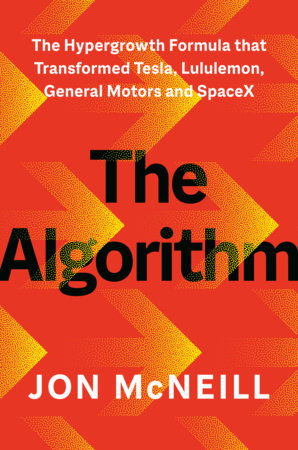
The Algorithm

The Hypergrowth Formula That Transformed Tesla, Lululemon, General Motors, and SpaceX

Look inside
Hardcover
$30.00 US
5.71"W x 8.55"H x 0.91"D   (14.5 x 21.7 x 2.3 cm) | 11 oz (312 g) | 12 per carton
On sale Mar 24, 2026 | 224 Pages | 9798217177530
Sales rights: US, Canada, Open Mkt

See Additional Formats
A USA Today Bestseller

From a former President of Tesla comes The Algorithm—the first book written by any of Elon Musk’s direct reports—a transformative guide for leaders, entrepreneurs, and innovators who want to emulate the paradigm-shattering approach Musk used to launch Tesla and SpaceX to meteoric success.


Jon McNeill had already founded and sold six startups when Sheryl Sandberg introduced him to Elon Musk, who was looking for help at Tesla. McNeill was steeped in the lean principles that had made Toyota a global powerhouse—principles focused on achieving efficiency and optimization by incrementally improving existing systems and processes. What he learned from Elon at Tesla was its antithesis, an approach that required radical rethinking to explode the status quo, attack complexity, and set seemingly unrealistic goals. Elon called this five-step framework “The Algorithm.” 
  1.  
    • Question every requirement.
    • Delete every possible step in the process. 
    • Simplify and optimize. 
    • Accelerate cycle time. 
    • Automate. 
In this book, McNeill details this tremendously powerful set of tools, which brought Tesla from a production crisis that threatened to derail it to a period of hypergrowth. During his tenure, revenue boomed from $2B to $20B in just 30 months. Since his departure from Tesla, McNeill has used The Algorithm in every enterprise he has worked with to supercharge speed, efficiency, innovation, and growth. Featuring case studies from Tesla and SpaceX, as well as from Lululemon, GM, and companies of various sizes across industries, he reveals how any business can do the same and achieve the unimaginable.
Chapter One

Step 1

Question Every Requirement

To be the world's leading automaker, Tesla needed China, both to make cars and to sell them. This was no mystery. China was already the biggest auto market in the world. And with its powerful supply chains and skilled workers, we had no doubt that a Tesla factory in China would quickly become our most efficient auto plant. Strategically, a Chinese factory was essential.

But there was one problem. The Chinese demanded equity participation in foreign-owned plants. Global manufacturers were eager enough for a foothold in the Chinese market that they readily accepted the condition. General Motors, Microsoft, Airbus, and Volkswagen, among many others, had joint ventures in China. If Tesla built a plant, it seemed that Elon would have to make room for a government-sanctioned partner.

Elon didn't want any part of it. He sent me to Beijing in 2015 with instructions to negotiate a 100 percent Tesla-owned manufacturing plant in China.

He was following the first step of the Algorithm, which is to question every requirement. Rules and regulations can be changed or, in some cases, defied. Each rule, as Elon saw it, limits possibilities, hobbling innovation and boxing in growth. Although in some cases, Elon's zeal in this area can blind him to the value of certain regulations, it never hurts to question them.

When you have a large organization, things that started out as good ideas can become rules, and then those rules can become requirements. So when constrained by rules, we investigate. With a bit of digging, we'd find that what appeared at first to be requirements often turned out to be recommendations, customs, or conventions. Laws had to be obeyed (especially the laws of physics), but not all requirements were laws, and not all of them came from governments. Some of them came from suppliers, telling us what we could and couldn't do with a piece of equipment. But when we drilled down, those instructions were often just what an engineer at that company simply viewed as reasonable, or a best practice. It was not a hard-and-fast rule.

Sometimes, one of our engineers would insist that a new approach was dangerous. Of course we took this seriously-but questioned it at the same time. Were the engineers right? Did they have data to back up their claim?

A corporate culture expands its possibilities if it looks at every "no" as a potential "yes." This can lead to all kinds of breakthroughs, both big and small.

Elon trusted that we'd find a way around the Chinese edict concerning foreign ownership. It was a rule that gave the Chinese government more control. Importantly, it also gave the government rights to the revenue derived from its ownership. But Tesla needed all the cash flow from that market to survive against much larger and better-funded competitors.

From Elon's point of view, there was no reason that Chinese officials couldn't make an exception. My assignment was to find a way for them to make a big one.

Upon landing in Beijing, I met with my colleagues there. Robin Ren, a Shanghai native who went to the University of Pennsylvania with Elon, headed Tesla's operations in China. Tom Zhu, an engineer, ran Tesla's retail business in the country. And Grace Tao, formerly a news anchor in the country, ran government relations. This was an incredible team. They knew the language and the culture, they had critical relationships, and they laid out for me the Chinese government's priorities. The government wanted job growth above all. We could promise lots of jobs. We also had to know what the Chinese were hungry for. The government's recently unveiled five-year plan seemed custom-made for Tesla. It called for development in our core specialties: electric vehicles, batteries, and clean energy. We headed into negotiations with a powerful hand.

I flew over for about a week every month. There were many negotiations in offices, as well as over meals and copious drinks into the night. The process took fourteen months, but we finally won the go-ahead for the first 100 percent foreign-owned auto plant in China. (We retained all of the financial ownership, although the Chinese people, as stipulated by the 1949 Communist Revolution, retained formal ownership of the land the plant would be built on.)

We achieved what no other Western company was able to do-not Apple, not GM, not Ford, not Procter and Gamble. The Tesla China entity would be able to control its own cash flow, without profit sharing, and help to fund the electric vehicle revolution globally.

Zhu oversaw the building of our mammoth plant, Gigafactory Shanghai. The first Model 3s started rolling off its lines in late 2019 (just after I had left the company).

The success in China seemed to prove Elon's point that even with the most firmly established norms, there can be exceptions.

The laws of physics, he'll admit, are a lot less flexible. Yet at the same time, even seemingly physical constraints can be challenged. The semiconductor industry has been nudging against atomic limitations for more than half a century. At the same time, it's all too easy to use physics as an excuse. Think of unsuccessful aviators in the nineteenth century. After failing to hoist their contraptions into the air, they could shrug their shoulders and say, "Well, you can't fight gravity."

But the right machines could fight gravity. Many of the biggest breakthroughs come from questioning and probing rules that appear ironclad, and quite a few of them are disguised as physical or chemical limitations.

This was on my mind one summer afternoon in California. I was with Doug Field, our head of engineering. We were on the walkway, looking down on our immense Fremont assembly plant, with its more than 5 million square feet. The daunting mandate we faced was to cut half of our manufacturing costs. This was urgent, Elon said, for Tesla to win in world markets-especially in China, the biggest and most competitive of them all.

Half of the giant space Doug and I were looking at was occupied by the body shop. This is where legions of robots weld some three hundred parts into the main supporting structure of the car, the chassis. The robots alone represented more than half of our capital costs. And even in a factory dominated by robots, labor costs remained stubbornly high. In the struggle to keep all the machines in sync, our team of robotics engineers was putting in lots of overtime.

The challenge was to keep scores of robots working in concert. That created immense complexity, which led to problems. Tiny delays or a simple communication gaffe between two machines could throw off the entire process. This created chronic quality issues, like gaps between doors and frames.

The body shop was a drain on productivity further down the assembly line. This was an area I'd focused on decades before meeting Elon and learning about the Algorithm. Back when Dave Goldberg and I were consulting in the Iowa meatpacking business, we worked with a plant manager whose mentor at MIT-an Israeli professor named Eli Goldratt-was writing a book on precisely the production issues we were struggling with. Goldratt was sending the chapters as he wrote them to the plant manager in Storm Lake, Iowa. The plant manager gave them to Goldie and me.

Goldratt's book was called The Goal, and it was transformative. It helped us simplify complex problems by zeroing in on constraints. The key, Goldratt wrote, was to hunt for bottlenecks in the industrial process. Why? Because a process cannot go faster than its slowest step. That is the constraint. And it has to be eliminated for the process to speed up.

The telltale sign of a constraint is a pileup of inventory at one stage or another. Each bottleneck requires a fix. Some are simple, others anything but. The very process of focusing on what isn't working well, and fixing it, leads to dramatic gains in performance. It trains your attention on what matters while also eliminating complexity. The continuous-improvement process known as Kaizen, developed in the last century by Toyota, works on similar principles.

One thing about simplicity is that it travels well. Simple, compelling concepts, such as "Hunt down constraints and fix them," work in practically any human endeavor.

After adopting Goldratt's methodology, the Storm Lake plant quickly became the most productive and profitable in the company. By applying its lessons to other plants, Goldie and I became known as the manufacturing guys at Bain.

Goldratt's philosophy fit neatly into Elon's Algorithm, especially the focus on simplicity and bottlenecks. But what to do when half of the entire manufacturing process, the body shop, is one enormous bottleneck?

I asked Doug if there would be any way to eliminate that entire side of production, and all the costs and quality issues associated with it.

He gazed at the operations in the body shop for a while. Then he said, "Let me go home and think about this."

The next day he came in and rolled a Matchbox car across the table. He turned the tiny model over and showed us the bottom. Unlike our cars, its body featured a single part. It was cast, with liquid metal injected into a mold. The Matchbox car was made from just two casts, top and bottom. That's how Mattel could manufacture the toys for a couple of bucks.

Everyone knew, of course, that toy cars could be cast. It was just a few drops of molten metal. But full-size cars were a different story altogether. From the earliest days of manufacturing, automakers had always insisted on welding the big and heavy components. Welds, they believed, were stronger and could absorb more energy in a crash.

Casting was used only for small components. To attempt casting larger parts seemed foolhardy-and dangerous. Even a splatter of liquid metal can kill or severely injure a worker. The tremendous heat generated by large casts of molten metal could conceivably crack or even explode the molds. It was this very real fear that kept automakers from experimenting with large casts. Anyone who dared to challenge the common wisdom ran the risk of a deadly inferno.

Yet a lot had changed since Henry Ford's day. The sciences had advanced tremendously, from metallurgy to robotics. So maybe things that used to be impossible, even unthinkable-like casting a chassis-weren't so far-fetched.

Doug was aware of developments in casting in the steel industry. For a full century, the industry had poured tons of molten steel into ingots or, later, thick slabs. That metal then was flattened into sheets. It was an expensive and time-consuming process.

In the late 1980s, executives at the fast-growing steel company Nucor, of Charlotte, North Carolina, moved to eliminate a big step in the process. Their idea was to pour the molten steel into a new type of caster, one that would process it directly into sheet steel. This seemed counterintuitive. At nearly 3,000 degrees Fahrenheit, molten steel is unruly. It laps and bubbles. But the Nucor team, working with a German machine maker, the SMS Group, succeeded. Their flat-casting approach gave them a jump on the industry. The technology is now standard at companies around the world.

It was clear to Doug, as he rolled the Matchbox car on the table and made his case, that big pieces could be cast. It was really just a matter of figuring out how to do it.

So we experimented. In the back of the factory was a pile of aluminum wheel rims that had been rejected for scratches. We asked a couple of engineers to melt them in a small smelter. Right away, Doug and his team were able to cast pieces that were a lot bigger than the toy car. Our experiments continued, producing larger and larger pieces until, finally, we cast our first chassis parts.

The process worked better than we could have dreamed. We began to build plants in Shanghai and in Austin with big casters in place of the body shop. Our chassis required only three parts, down from three hundred. This greatly simplified everything from the supply chain to quality control. Not only was it cheaper, but production volume also increased, and quality became more consistent.

As I write this, there's a global shortage of this casting machinery. Whereas Tesla has equipped its factories with new casters, its competitors are still waiting to get their hands on one as they scramble to catch up.

This single innovation gave our team a five- to seven-year jump on the rest of the industry. It brought an end to the chronic delays and quality issues. We accomplished this by getting rid of the body shop and its robots altogether.

This casting example powerfully illustrates the first step of the Algorithm: Question every requirement. Doug questioned the century-old norms of requiring a body shop in a car factory. But like so many of the case studies in this book, this one demonstrates other steps of the Algorithm-such as eliminating steps and simplifying processes-that work together. They not only create efficiencies and breakthroughs but also build a culture of questioning and experimentation.

When Doug came up with his radical and potentially dangerous idea, he understood that he would not be laughed at or belittled for it-and that if he made a good case, he'd have the freedom to develop it. That is essential to the culture at Tesla.

This freedom is also essential for innovation and hypergrowth. It's understood and accepted that a certain percentage of these efforts will come up short. After all, only by failing can we be sure that we're pushing far enough into the realm of the possible.

Sometimes, "Impossible" Means "Unsolved"

Two years before joining Tesla, I was having trouble sleeping. Like many parents, I was worried about my teenager, who was about to get his driver's license. I pictured my sixteen-year-old son behind the wheel, hearing a buzz and reaching for his phone. This scenario led to visions, all of them horrifying. Distracted driving accounted for more highway deaths than alcohol. I was anxious to protect my son, along with everyone in his orbit, from friends in the car to children chasing a ball into the street.

There had to be an app, I figured, to disable a driver's phone. It was something millions of parents wanted, so it seemed to be a no-brainer. But when I looked into it, I found that no such app existed. When the Apple iPhone was new, I learned, there had been discussions of the very technology I wanted.

Steve Jobs foresaw how much the passengers in a car would be relying on their phones for navigation, messaging, and entertainment. He asked if there was a way to disable the driver's messaging without interfering with the passengers' phones. He was told that GPS was accurate to only ten meters (thirty feet). That meant it wasn't possible to pinpoint which phone in a car belonged to the driver, so Apple couldn't solve the problem. Passengers were free to enjoy their phones, and it would be up to the drivers to exercise healthy restraint. That had parents like me tossing and turning at night.
© John F. Martin
Jon McNeill is the cofounder and CEO of venture capital firm DVx Ventures. A serial entrepreneur and business leader with a proven track record of boosting revenue and scaling companies, he served as the president of Tesla, Inc., and the COO of Lyft. McNeill currently holds positions on the board of directors of General Motors, CrossFit, and Lululemon, among others. A sought-after speaker, he is a frequent contributor to CNBC and is regularly quoted in business publications such as Fortune, Semafor, and TechCrunch. View titles by Jon McNeill
Available for sale exclusive:
•     Canada
•     Guam
•     Minor Outl.Ins.
•     North Mariana
•     Philippines
•     Puerto Rico
•     Samoa,American
•     US Virgin Is.
•     USA

Available for sale non-exclusive:
•     Afghanistan
•     Aland Islands
•     Albania
•     Algeria
•     Andorra
•     Angola
•     Anguilla
•     Antarctica
•     Argentina
•     Armenia
•     Aruba
•     Austria
•     Azerbaijan
•     Bahrain
•     Belarus
•     Belgium
•     Benin
•     Bhutan
•     Bolivia
•     Bonaire, Saba
•     Bosnia Herzeg.
•     Bouvet Island
•     Brazil
•     Bulgaria
•     Burkina Faso
•     Burundi
•     Cambodia
•     Cameroon
•     Cape Verde
•     Centr.Afr.Rep.
•     Chad
•     Chile
•     China
•     Colombia
•     Comoro Is.
•     Congo
•     Cook Islands
•     Costa Rica
•     Croatia
•     Cuba
•     Curacao
•     Czech Republic
•     Dem. Rep. Congo
•     Denmark
•     Djibouti
•     Dominican Rep.
•     Ecuador
•     Egypt
•     El Salvador
•     Equatorial Gui.
•     Eritrea
•     Estonia
•     Ethiopia
•     Faroe Islands
•     Finland
•     France
•     Fren.Polynesia
•     French Guinea
•     Gabon
•     Georgia
•     Germany
•     Greece
•     Greenland
•     Guadeloupe
•     Guatemala
•     Guinea Republic
•     Guinea-Bissau
•     Haiti
•     Heard/McDon.Isl
•     Honduras
•     Hong Kong
•     Hungary
•     Iceland
•     Indonesia
•     Iran
•     Iraq
•     Israel
•     Italy
•     Ivory Coast
•     Japan
•     Jordan
•     Kazakhstan
•     Kuwait
•     Kyrgyzstan
•     Laos
•     Latvia
•     Lebanon
•     Liberia
•     Libya
•     Liechtenstein
•     Lithuania
•     Luxembourg
•     Macau
•     Macedonia
•     Madagascar
•     Maldives
•     Mali
•     Marshall island
•     Martinique
•     Mauritania
•     Mayotte
•     Mexico
•     Micronesia
•     Moldavia
•     Monaco
•     Mongolia
•     Montenegro
•     Morocco
•     Myanmar
•     Nepal
•     Netherlands
•     New Caledonia
•     Nicaragua
•     Niger
•     Niue
•     Norfolk Island
•     North Korea
•     Norway
•     Oman
•     Palau
•     Palestinian Ter
•     Panama
•     Paraguay
•     Peru
•     Poland
•     Portugal
•     Qatar
•     Reunion Island
•     Romania
•     Russian Fed.
•     Rwanda
•     Saint Martin
•     San Marino
•     SaoTome Princip
•     Saudi Arabia
•     Senegal
•     Serbia
•     Singapore
•     Sint Maarten
•     Slovakia
•     Slovenia
•     South Korea
•     South Sudan
•     Spain
•     St Barthelemy
•     St.Pier,Miquel.
•     Sth Terr. Franc
•     Sudan
•     Suriname
•     Svalbard
•     Sweden
•     Switzerland
•     Syria
•     Tadschikistan
•     Taiwan
•     Thailand
•     Timor-Leste
•     Togo
•     Tokelau Islands
•     Tunisia
•     Turkey
•     Turkmenistan
•     Ukraine
•     Unit.Arab Emir.
•     Uruguay
•     Uzbekistan
•     Vatican City
•     Venezuela
•     Vietnam
•     Wallis,Futuna
•     West Saharan
•     Western Samoa
•     Yemen

Not available for sale:
•     Antigua/Barbuda
•     Australia
•     Bahamas
•     Bangladesh
•     Barbados
•     Belize
•     Bermuda
•     Botswana
•     Brit.Ind.Oc.Ter
•     Brit.Virgin Is.
•     Brunei
•     Cayman Islands
•     Christmas Islnd
•     Cocos Islands
•     Cyprus
•     Dominica
•     Falkland Islnds
•     Fiji
•     Gambia
•     Ghana
•     Gibraltar
•     Grenada
•     Guernsey
•     Guyana
•     India
•     Ireland
•     Isle of Man
•     Jamaica
•     Jersey
•     Kenya
•     Kiribati
•     Lesotho
•     Malawi
•     Malaysia
•     Malta
•     Mauritius
•     Montserrat
•     Mozambique
•     Namibia
•     Nauru
•     New Zealand
•     Nigeria
•     Pakistan
•     PapuaNewGuinea
•     Pitcairn Islnds
•     S. Sandwich Ins
•     Seychelles
•     Sierra Leone
•     Solomon Islands
•     Somalia
•     South Africa
•     Sri Lanka
•     St. Helena
•     St. Lucia
•     St. Vincent
•     St.Chr.,Nevis
•     Swaziland
•     Tanzania
•     Tonga
•     Trinidad,Tobago
•     Turks&Caicos Is
•     Tuvalu
•     Uganda
•     United Kingdom
•     Vanuatu
•     Zambia
•     Zimbabwe

About

A USA Today Bestseller

From a former President of Tesla comes The Algorithm—the first book written by any of Elon Musk’s direct reports—a transformative guide for leaders, entrepreneurs, and innovators who want to emulate the paradigm-shattering approach Musk used to launch Tesla and SpaceX to meteoric success.


Jon McNeill had already founded and sold six startups when Sheryl Sandberg introduced him to Elon Musk, who was looking for help at Tesla. McNeill was steeped in the lean principles that had made Toyota a global powerhouse—principles focused on achieving efficiency and optimization by incrementally improving existing systems and processes. What he learned from Elon at Tesla was its antithesis, an approach that required radical rethinking to explode the status quo, attack complexity, and set seemingly unrealistic goals. Elon called this five-step framework “The Algorithm.” 
  1.  
    • Question every requirement.
    • Delete every possible step in the process. 
    • Simplify and optimize. 
    • Accelerate cycle time. 
    • Automate. 
In this book, McNeill details this tremendously powerful set of tools, which brought Tesla from a production crisis that threatened to derail it to a period of hypergrowth. During his tenure, revenue boomed from $2B to $20B in just 30 months. Since his departure from Tesla, McNeill has used The Algorithm in every enterprise he has worked with to supercharge speed, efficiency, innovation, and growth. Featuring case studies from Tesla and SpaceX, as well as from Lululemon, GM, and companies of various sizes across industries, he reveals how any business can do the same and achieve the unimaginable.

Excerpt

Chapter One

Step 1

Question Every Requirement

To be the world's leading automaker, Tesla needed China, both to make cars and to sell them. This was no mystery. China was already the biggest auto market in the world. And with its powerful supply chains and skilled workers, we had no doubt that a Tesla factory in China would quickly become our most efficient auto plant. Strategically, a Chinese factory was essential.

But there was one problem. The Chinese demanded equity participation in foreign-owned plants. Global manufacturers were eager enough for a foothold in the Chinese market that they readily accepted the condition. General Motors, Microsoft, Airbus, and Volkswagen, among many others, had joint ventures in China. If Tesla built a plant, it seemed that Elon would have to make room for a government-sanctioned partner.

Elon didn't want any part of it. He sent me to Beijing in 2015 with instructions to negotiate a 100 percent Tesla-owned manufacturing plant in China.

He was following the first step of the Algorithm, which is to question every requirement. Rules and regulations can be changed or, in some cases, defied. Each rule, as Elon saw it, limits possibilities, hobbling innovation and boxing in growth. Although in some cases, Elon's zeal in this area can blind him to the value of certain regulations, it never hurts to question them.

When you have a large organization, things that started out as good ideas can become rules, and then those rules can become requirements. So when constrained by rules, we investigate. With a bit of digging, we'd find that what appeared at first to be requirements often turned out to be recommendations, customs, or conventions. Laws had to be obeyed (especially the laws of physics), but not all requirements were laws, and not all of them came from governments. Some of them came from suppliers, telling us what we could and couldn't do with a piece of equipment. But when we drilled down, those instructions were often just what an engineer at that company simply viewed as reasonable, or a best practice. It was not a hard-and-fast rule.

Sometimes, one of our engineers would insist that a new approach was dangerous. Of course we took this seriously-but questioned it at the same time. Were the engineers right? Did they have data to back up their claim?

A corporate culture expands its possibilities if it looks at every "no" as a potential "yes." This can lead to all kinds of breakthroughs, both big and small.

Elon trusted that we'd find a way around the Chinese edict concerning foreign ownership. It was a rule that gave the Chinese government more control. Importantly, it also gave the government rights to the revenue derived from its ownership. But Tesla needed all the cash flow from that market to survive against much larger and better-funded competitors.

From Elon's point of view, there was no reason that Chinese officials couldn't make an exception. My assignment was to find a way for them to make a big one.

Upon landing in Beijing, I met with my colleagues there. Robin Ren, a Shanghai native who went to the University of Pennsylvania with Elon, headed Tesla's operations in China. Tom Zhu, an engineer, ran Tesla's retail business in the country. And Grace Tao, formerly a news anchor in the country, ran government relations. This was an incredible team. They knew the language and the culture, they had critical relationships, and they laid out for me the Chinese government's priorities. The government wanted job growth above all. We could promise lots of jobs. We also had to know what the Chinese were hungry for. The government's recently unveiled five-year plan seemed custom-made for Tesla. It called for development in our core specialties: electric vehicles, batteries, and clean energy. We headed into negotiations with a powerful hand.

I flew over for about a week every month. There were many negotiations in offices, as well as over meals and copious drinks into the night. The process took fourteen months, but we finally won the go-ahead for the first 100 percent foreign-owned auto plant in China. (We retained all of the financial ownership, although the Chinese people, as stipulated by the 1949 Communist Revolution, retained formal ownership of the land the plant would be built on.)

We achieved what no other Western company was able to do-not Apple, not GM, not Ford, not Procter and Gamble. The Tesla China entity would be able to control its own cash flow, without profit sharing, and help to fund the electric vehicle revolution globally.

Zhu oversaw the building of our mammoth plant, Gigafactory Shanghai. The first Model 3s started rolling off its lines in late 2019 (just after I had left the company).

The success in China seemed to prove Elon's point that even with the most firmly established norms, there can be exceptions.

The laws of physics, he'll admit, are a lot less flexible. Yet at the same time, even seemingly physical constraints can be challenged. The semiconductor industry has been nudging against atomic limitations for more than half a century. At the same time, it's all too easy to use physics as an excuse. Think of unsuccessful aviators in the nineteenth century. After failing to hoist their contraptions into the air, they could shrug their shoulders and say, "Well, you can't fight gravity."

But the right machines could fight gravity. Many of the biggest breakthroughs come from questioning and probing rules that appear ironclad, and quite a few of them are disguised as physical or chemical limitations.

This was on my mind one summer afternoon in California. I was with Doug Field, our head of engineering. We were on the walkway, looking down on our immense Fremont assembly plant, with its more than 5 million square feet. The daunting mandate we faced was to cut half of our manufacturing costs. This was urgent, Elon said, for Tesla to win in world markets-especially in China, the biggest and most competitive of them all.

Half of the giant space Doug and I were looking at was occupied by the body shop. This is where legions of robots weld some three hundred parts into the main supporting structure of the car, the chassis. The robots alone represented more than half of our capital costs. And even in a factory dominated by robots, labor costs remained stubbornly high. In the struggle to keep all the machines in sync, our team of robotics engineers was putting in lots of overtime.

The challenge was to keep scores of robots working in concert. That created immense complexity, which led to problems. Tiny delays or a simple communication gaffe between two machines could throw off the entire process. This created chronic quality issues, like gaps between doors and frames.

The body shop was a drain on productivity further down the assembly line. This was an area I'd focused on decades before meeting Elon and learning about the Algorithm. Back when Dave Goldberg and I were consulting in the Iowa meatpacking business, we worked with a plant manager whose mentor at MIT-an Israeli professor named Eli Goldratt-was writing a book on precisely the production issues we were struggling with. Goldratt was sending the chapters as he wrote them to the plant manager in Storm Lake, Iowa. The plant manager gave them to Goldie and me.

Goldratt's book was called The Goal, and it was transformative. It helped us simplify complex problems by zeroing in on constraints. The key, Goldratt wrote, was to hunt for bottlenecks in the industrial process. Why? Because a process cannot go faster than its slowest step. That is the constraint. And it has to be eliminated for the process to speed up.

The telltale sign of a constraint is a pileup of inventory at one stage or another. Each bottleneck requires a fix. Some are simple, others anything but. The very process of focusing on what isn't working well, and fixing it, leads to dramatic gains in performance. It trains your attention on what matters while also eliminating complexity. The continuous-improvement process known as Kaizen, developed in the last century by Toyota, works on similar principles.

One thing about simplicity is that it travels well. Simple, compelling concepts, such as "Hunt down constraints and fix them," work in practically any human endeavor.

After adopting Goldratt's methodology, the Storm Lake plant quickly became the most productive and profitable in the company. By applying its lessons to other plants, Goldie and I became known as the manufacturing guys at Bain.

Goldratt's philosophy fit neatly into Elon's Algorithm, especially the focus on simplicity and bottlenecks. But what to do when half of the entire manufacturing process, the body shop, is one enormous bottleneck?

I asked Doug if there would be any way to eliminate that entire side of production, and all the costs and quality issues associated with it.

He gazed at the operations in the body shop for a while. Then he said, "Let me go home and think about this."

The next day he came in and rolled a Matchbox car across the table. He turned the tiny model over and showed us the bottom. Unlike our cars, its body featured a single part. It was cast, with liquid metal injected into a mold. The Matchbox car was made from just two casts, top and bottom. That's how Mattel could manufacture the toys for a couple of bucks.

Everyone knew, of course, that toy cars could be cast. It was just a few drops of molten metal. But full-size cars were a different story altogether. From the earliest days of manufacturing, automakers had always insisted on welding the big and heavy components. Welds, they believed, were stronger and could absorb more energy in a crash.

Casting was used only for small components. To attempt casting larger parts seemed foolhardy-and dangerous. Even a splatter of liquid metal can kill or severely injure a worker. The tremendous heat generated by large casts of molten metal could conceivably crack or even explode the molds. It was this very real fear that kept automakers from experimenting with large casts. Anyone who dared to challenge the common wisdom ran the risk of a deadly inferno.

Yet a lot had changed since Henry Ford's day. The sciences had advanced tremendously, from metallurgy to robotics. So maybe things that used to be impossible, even unthinkable-like casting a chassis-weren't so far-fetched.

Doug was aware of developments in casting in the steel industry. For a full century, the industry had poured tons of molten steel into ingots or, later, thick slabs. That metal then was flattened into sheets. It was an expensive and time-consuming process.

In the late 1980s, executives at the fast-growing steel company Nucor, of Charlotte, North Carolina, moved to eliminate a big step in the process. Their idea was to pour the molten steel into a new type of caster, one that would process it directly into sheet steel. This seemed counterintuitive. At nearly 3,000 degrees Fahrenheit, molten steel is unruly. It laps and bubbles. But the Nucor team, working with a German machine maker, the SMS Group, succeeded. Their flat-casting approach gave them a jump on the industry. The technology is now standard at companies around the world.

It was clear to Doug, as he rolled the Matchbox car on the table and made his case, that big pieces could be cast. It was really just a matter of figuring out how to do it.

So we experimented. In the back of the factory was a pile of aluminum wheel rims that had been rejected for scratches. We asked a couple of engineers to melt them in a small smelter. Right away, Doug and his team were able to cast pieces that were a lot bigger than the toy car. Our experiments continued, producing larger and larger pieces until, finally, we cast our first chassis parts.

The process worked better than we could have dreamed. We began to build plants in Shanghai and in Austin with big casters in place of the body shop. Our chassis required only three parts, down from three hundred. This greatly simplified everything from the supply chain to quality control. Not only was it cheaper, but production volume also increased, and quality became more consistent.

As I write this, there's a global shortage of this casting machinery. Whereas Tesla has equipped its factories with new casters, its competitors are still waiting to get their hands on one as they scramble to catch up.

This single innovation gave our team a five- to seven-year jump on the rest of the industry. It brought an end to the chronic delays and quality issues. We accomplished this by getting rid of the body shop and its robots altogether.

This casting example powerfully illustrates the first step of the Algorithm: Question every requirement. Doug questioned the century-old norms of requiring a body shop in a car factory. But like so many of the case studies in this book, this one demonstrates other steps of the Algorithm-such as eliminating steps and simplifying processes-that work together. They not only create efficiencies and breakthroughs but also build a culture of questioning and experimentation.

When Doug came up with his radical and potentially dangerous idea, he understood that he would not be laughed at or belittled for it-and that if he made a good case, he'd have the freedom to develop it. That is essential to the culture at Tesla.

This freedom is also essential for innovation and hypergrowth. It's understood and accepted that a certain percentage of these efforts will come up short. After all, only by failing can we be sure that we're pushing far enough into the realm of the possible.

Sometimes, "Impossible" Means "Unsolved"

Two years before joining Tesla, I was having trouble sleeping. Like many parents, I was worried about my teenager, who was about to get his driver's license. I pictured my sixteen-year-old son behind the wheel, hearing a buzz and reaching for his phone. This scenario led to visions, all of them horrifying. Distracted driving accounted for more highway deaths than alcohol. I was anxious to protect my son, along with everyone in his orbit, from friends in the car to children chasing a ball into the street.

There had to be an app, I figured, to disable a driver's phone. It was something millions of parents wanted, so it seemed to be a no-brainer. But when I looked into it, I found that no such app existed. When the Apple iPhone was new, I learned, there had been discussions of the very technology I wanted.

Steve Jobs foresaw how much the passengers in a car would be relying on their phones for navigation, messaging, and entertainment. He asked if there was a way to disable the driver's messaging without interfering with the passengers' phones. He was told that GPS was accurate to only ten meters (thirty feet). That meant it wasn't possible to pinpoint which phone in a car belonged to the driver, so Apple couldn't solve the problem. Passengers were free to enjoy their phones, and it would be up to the drivers to exercise healthy restraint. That had parents like me tossing and turning at night.

Author

© John F. Martin
Jon McNeill is the cofounder and CEO of venture capital firm DVx Ventures. A serial entrepreneur and business leader with a proven track record of boosting revenue and scaling companies, he served as the president of Tesla, Inc., and the COO of Lyft. McNeill currently holds positions on the board of directors of General Motors, CrossFit, and Lululemon, among others. A sought-after speaker, he is a frequent contributor to CNBC and is regularly quoted in business publications such as Fortune, Semafor, and TechCrunch. View titles by Jon McNeill

Rights

Available for sale exclusive:
•     Canada
•     Guam
•     Minor Outl.Ins.
•     North Mariana
•     Philippines
•     Puerto Rico
•     Samoa,American
•     US Virgin Is.
•     USA

Available for sale non-exclusive:
•     Afghanistan
•     Aland Islands
•     Albania
•     Algeria
•     Andorra
•     Angola
•     Anguilla
•     Antarctica
•     Argentina
•     Armenia
•     Aruba
•     Austria
•     Azerbaijan
•     Bahrain
•     Belarus
•     Belgium
•     Benin
•     Bhutan
•     Bolivia
•     Bonaire, Saba
•     Bosnia Herzeg.
•     Bouvet Island
•     Brazil
•     Bulgaria
•     Burkina Faso
•     Burundi
•     Cambodia
•     Cameroon
•     Cape Verde
•     Centr.Afr.Rep.
•     Chad
•     Chile
•     China
•     Colombia
•     Comoro Is.
•     Congo
•     Cook Islands
•     Costa Rica
•     Croatia
•     Cuba
•     Curacao
•     Czech Republic
•     Dem. Rep. Congo
•     Denmark
•     Djibouti
•     Dominican Rep.
•     Ecuador
•     Egypt
•     El Salvador
•     Equatorial Gui.
•     Eritrea
•     Estonia
•     Ethiopia
•     Faroe Islands
•     Finland
•     France
•     Fren.Polynesia
•     French Guinea
•     Gabon
•     Georgia
•     Germany
•     Greece
•     Greenland
•     Guadeloupe
•     Guatemala
•     Guinea Republic
•     Guinea-Bissau
•     Haiti
•     Heard/McDon.Isl
•     Honduras
•     Hong Kong
•     Hungary
•     Iceland
•     Indonesia
•     Iran
•     Iraq
•     Israel
•     Italy
•     Ivory Coast
•     Japan
•     Jordan
•     Kazakhstan
•     Kuwait
•     Kyrgyzstan
•     Laos
•     Latvia
•     Lebanon
•     Liberia
•     Libya
•     Liechtenstein
•     Lithuania
•     Luxembourg
•     Macau
•     Macedonia
•     Madagascar
•     Maldives
•     Mali
•     Marshall island
•     Martinique
•     Mauritania
•     Mayotte
•     Mexico
•     Micronesia
•     Moldavia
•     Monaco
•     Mongolia
•     Montenegro
•     Morocco
•     Myanmar
•     Nepal
•     Netherlands
•     New Caledonia
•     Nicaragua
•     Niger
•     Niue
•     Norfolk Island
•     North Korea
•     Norway
•     Oman
•     Palau
•     Palestinian Ter
•     Panama
•     Paraguay
•     Peru
•     Poland
•     Portugal
•     Qatar
•     Reunion Island
•     Romania
•     Russian Fed.
•     Rwanda
•     Saint Martin
•     San Marino
•     SaoTome Princip
•     Saudi Arabia
•     Senegal
•     Serbia
•     Singapore
•     Sint Maarten
•     Slovakia
•     Slovenia
•     South Korea
•     South Sudan
•     Spain
•     St Barthelemy
•     St.Pier,Miquel.
•     Sth Terr. Franc
•     Sudan
•     Suriname
•     Svalbard
•     Sweden
•     Switzerland
•     Syria
•     Tadschikistan
•     Taiwan
•     Thailand
•     Timor-Leste
•     Togo
•     Tokelau Islands
•     Tunisia
•     Turkey
•     Turkmenistan
•     Ukraine
•     Unit.Arab Emir.
•     Uruguay
•     Uzbekistan
•     Vatican City
•     Venezuela
•     Vietnam
•     Wallis,Futuna
•     West Saharan
•     Western Samoa
•     Yemen

Not available for sale:
•     Antigua/Barbuda
•     Australia
•     Bahamas
•     Bangladesh
•     Barbados
•     Belize
•     Bermuda
•     Botswana
•     Brit.Ind.Oc.Ter
•     Brit.Virgin Is.
•     Brunei
•     Cayman Islands
•     Christmas Islnd
•     Cocos Islands
•     Cyprus
•     Dominica
•     Falkland Islnds
•     Fiji
•     Gambia
•     Ghana
•     Gibraltar
•     Grenada
•     Guernsey
•     Guyana
•     India
•     Ireland
•     Isle of Man
•     Jamaica
•     Jersey
•     Kenya
•     Kiribati
•     Lesotho
•     Malawi
•     Malaysia
•     Malta
•     Mauritius
•     Montserrat
•     Mozambique
•     Namibia
•     Nauru
•     New Zealand
•     Nigeria
•     Pakistan
•     PapuaNewGuinea
•     Pitcairn Islnds
•     S. Sandwich Ins
•     Seychelles
•     Sierra Leone
•     Solomon Islands
•     Somalia
•     South Africa
•     Sri Lanka
•     St. Helena
•     St. Lucia
•     St. Vincent
•     St.Chr.,Nevis
•     Swaziland
•     Tanzania
•     Tonga
•     Trinidad,Tobago
•     Turks&Caicos Is
•     Tuvalu
•     Uganda
•     United Kingdom
•     Vanuatu
•     Zambia
•     Zimbabwe

March Picks For Higher Education

Our March Picks for Higher Education feature a range of fiction and nonfiction curated to resonate with college students, professors, and lifelong learners. These selections are ideal for seminar discussions and independent exploration. For the complete list of March Picks for Higher Education, click here. Check out all our February collections using these links below.

Read more