Last January, while sorting through my storeroom ahead of an imminent move, I came across an old shoe box. I opened the box to find several diaries dating back to my childhood. Among the stack of journals, there was a pamphlet, the words “A Book of Poems” written in pencil across its front. The booklet was thin: five sheets of rough A5 paper folded in half and bound with staples. I had added two zigzagging lines under the title, one line progressing up in six steps from the left, the other inclining down in seven steps to the right. Was it a kind of cover illustration? Or simply a doodle? The year—1979—and my name were written on the back of the chapbook, with a total of eight poems inscribed on the inner leaves by the same neat, penciled hand as on the front and back covers. Eight different dates marked the bottom of each page in chronological order. The lines penned by my eight-year-old self were suitably innocent and unpolished, but one poem from April caught my eyes. It opened with the following stanzas:
Where is love? It is inside my thump-thumping beating chest. What is love? It is the gold thread connecting between our hearts. In a flash I was transported back forty years, as memories of that afternoon spent putting the pamphlet together came back to me. My short, stubby pencil with its biro-cap extender, the eraser dust, the big metal stapler I had sneaked out from my father’s room. I remembered how after learning that our family would be moving to Seoul, I had an impulse to gather the poems I had scribbled on slips of paper, or in the margins of notebooks and workbooks, or between journal entries, and collect them into a single volume. I recalled, too, the inexplicable feeling of not wanting to show my “Book of Poems” to anyone once it was completed.
Before placing the diaries and the booklet back as I had found them and closing the lid over them, I took a photo of that poem with my phone. I did this out of a sense that there was a continuity between some of the words I had written then and who I now was. Inside my chest, in my beating heart. Between our hearts. The golden thread that joins—a thread that emanates light.
•
Fourteen years later, with the publication of my first poem and then my first short story in the following year, I became a Writer. In another five years, I would publish my first long work of fiction, which I had written over the course of about three years. I was, and remain, intrigued by the process of writing poetry and short stories, but writing novels has a special pull on me. My books have taken me anywhere from a year to seven years to complete, for which I have exchanged considerable portions of my personal life. This is what draws me to the work. The way I can delve into, and dwell in, the questions I feel are imperative and urgent, so much so that I decide to accept the tradeoff.
Each time I work on a novel, I endure the questions, I live inside them. When I reach the end of these questions—which is not the same as when I find answers to them—is when I reach the end of the writing process. By then, I am no longer as I was when I began, and from that changed state, I start again. The next questions follow, like links in a chain, or like dominoes, overlapping and joining and continuing, and I am moved to write something new.
While writing my third novel,
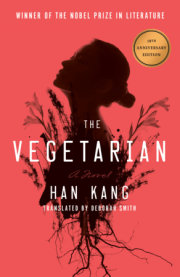
The Vegetarian, from 2003 to 2005, I was staying with some painful questions: Can a person ever be completely innocent? To what depths can we reject violence? What happens to one who refuses to belong to the species called human?
Electing not to eat meat in a refusal of violence, and in the end declining all food and drink except water in the belief that she has transformed into a plant, Yeong-hye, the protagonist of
The Vegetarian, finds herself in the ironic situation of quickening towards death in her bid to save herself. Yeong-hye and her sister In-hye, who are in fact co-protagonists, scream soundlessly through devastating nightmares and ruptures, but are together in the end. I set the final scene in an ambulance, as I hoped Yeong-hye would remain alive in the world of this story. The car rushes down the mountain road beneath blazing green leaves while the alert older sister gazes intensely out the window. Perhaps awaiting a response, or perhaps in protest. The entire novel resides in a state of questioning. Staring and defying. Waiting for a response.
Ink and Blood, the novel that followed
The Vegetarian, continues these questions. To refuse life and the world in order to refuse violence is an impossibility. We cannot, after all, turn into plants. Then how do we continue on? In this mystery novel, sentences in roman and italic type jostle and clash, as the main character, who has long wrestled with death’s shadow, risks her life to prove that her friend’s sudden death cannot have been by suicide. As I wrote the closing scene, as I described her dragging herself across the floor to crawl her way out of death and destruction, I was asking myself these questions: Must we not survive in the end? Should our lives not bear witness to what is true?
With my fifth novel,
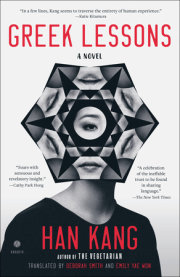
Greek Lessons, I pushed even further. If we must live on in this world, which moments make that possible? A woman who has lost her speech and a man who is losing his sight are walking through stillness and darkness when their solitary paths cross. I wanted to attend to the tactile moments in this story. The novel progresses at it own slow pace through stillness and darkness to when the woman’s hand reaches out and writes a few words in the man’s palm. In that luminous instant that expands to an eternity, these two characters reveal the softer parts of themselves. The question I wanted to ask here was this: Could it be that by regarding the softest aspects of humanity, by caressing the irrefutable warmth that resides there, we can go on living after all in this brief, violent world?
Having reached the end of this question, I began thinking about my next book. This was in the spring of 2012, not long after
Greek Lessons was published. I told myself I would write a novel that takes another step towards light and warmth. I would suffuse this life- and world-embracing work with bright, transparent sensations. I soon found a title and was twenty pages into the first draft, when I was forced to stop.
I realized that something within was preventing me from writing this novel.
•
Until then, I hadn’t considered writing about Gwangju.
I was nine years old when my family left Gwangju in January 1980, roughly four months before the mass killings began. When I happened across the upside-down spine of
Gwangju Photo Book on a bookshelf a few years later and looked through it when there were no adults around, I was twelve. This book contained photographs of Gwangju residents and students killed with clubs, bayonets, and guns while resisting the new military powers that had orchestrated the coup. Published and distributed in secret by the survivors and the families of the dead, the book bore witness to the truth at a time when the truth was being distorted by strict media suppression. As a child, I hadn’t grasped the political significance of those images, and the ravaged faces became fixed in my mind as a fundamental question about humans: Is this the act of one human towards another? And then, seeing a photo of an endless queue of people waiting to donate blood outside a university hospital: Is this the act of one human towards another? These two questions clashed and seemed irreconcilable, their incompatibility a knot I couldn’t undo.
So that one spring day in 2012, as I tried my hand at writing a radiant, life-affirming novel, I was once again confronted by this unresolved problem. I had long lost a sense of deep-rooted trust in humans. How, then, could I embrace the world? I had to face this impossible conundrum if I meant to move forwards, I realized. I understood that writing was my only means of getting through and past it.
I spent the better part of that year sketching out my novel, imagining that May 1980 in Gwangju would form one layer of the book. In December, I visited the cemetery in Mangwol-dong. It was well past noon and a heavy snow had fallen just the day before. Later, as the light darkened, I walked out of the freezing cemetery with my hand over my chest, close to my heart. I told myself this next novel would look squarely at Gwangju, rather than consigning it to a single layer. I obtained a book containing more than 900 testimonials, and every day for nine hours over the course of a month, I read each account collected there. Then I read up on not just Gwangju but other cases of state violence. Then, looking even further afield and back in time, I read about mass killings that humans have repeatedly perpetrated throughout the world and throughout history.
During this period of researching my novel, two questions were often foremost in my mind. Back in my mid-twenties, I had written these lines on the first page of every new diary:
Can the present help the past?Can the living save the dead?
Copyright © 2026 by Han Kang. All rights reserved. No part of this excerpt may be reproduced or reprinted without permission in writing from the publisher.