Close Modal

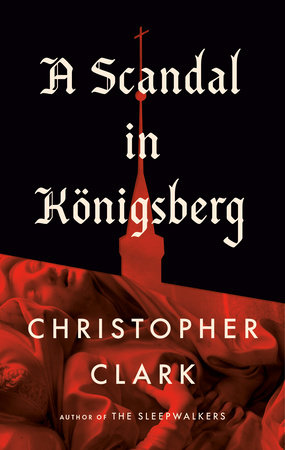
A Scandal in Königsberg

Look inside
Hardcover
$27.00 US
5.69"W x 8.57"H x 0.79"D   (14.5 x 21.8 x 2.0 cm) | 10 oz (283 g) | 12 per carton
On sale Mar 10, 2026 | 192 Pages | 9798217060948
Sales rights: US,CAN,OpnMkt(no EU)

Named a Best Book of the Year by The Times (London)

As told by one of our greatest historians, the story of the scandal that took down two Lutheran preachers in the heart of nineteenth-century Prussia—a chamber piece of cultish esotericism, pseudoscience, and political resistance that conjures up Europe at the end of the age of reason and presages our current age of misinformation


In 1835, Johannes Ebel and Georg Heinrich Diestel were tried for having started a cult. Worse: It was a cult that encouraged scandalous sexual behavior in women, including the daughters of prestigious Prussian families—causing the deaths of two young women from sexual exhaustion. The trial would absorb and polarize the city of Königsberg for half a decade and ruin the lives and careers of its defendants, despite their eventual legal exoneration. The historical moment it encapsulates—a Europe reeling from the triumph and horror of a new industrial, imperial era, struggling to decide which principles will reign in the aftermath of Enlightenment reason—is a fable for our present time of political, social, and existential disquiet.

The great Cambridge historian Christopher Clark—known for The Sleepwalkers, his monumental, defining study of the causes of the First World War—came across the files containing this story three decades ago; it has been swirling in his mind ever since. In gripping, narrative prose, Clark immerses us in a Königsberg scarred by the horrors of the Napoleonic Wars, where Immanuel Kant had recently inaugurated the theory of consciousness that completely reshaped humanity’s understanding of itself—but where the distinction between reason and fanaticism was now up for grabs. A Scandal in Königsberg is a European history in exquisite miniature—and a peerless lesson in the theological and philosophical debates that animated the Western world at one of its great moments of transformation.

Rich and provocative, A Scandal in Königsberg articulates an unsettling antecedent for our most fiercely litigated contemporary questions of sexual identity, freedom of thought, and who gets to decide what constitutes the truth.
1.
The City of Almost

In the 1830s, the city of Königsberg still bathed in the amber glow of the late Enlightenment, at least in the minds of educated people who had never been there. Immanuel Kant (1724-1804) had lived, studied, written and taught here for most of his life, the clocklike regularity of his daily routines attracting small crowds of gawpers. His remains lay in the professors' crypt of the city's cathedral and a monument consisting of a bust by Johann Gottfried Schadow on a plinth of grey Silesian marble stood in the main lecture theatre of the university. The former house and garden of the great man had been taken over by a bathing facility, but the new owner of the house had fixed a marble tablet above the door with the inscription: 'Immanuel Kant lived and taught here from 1783 until 12 February 1804'. All three sites counted among the city's principal tourist destinations.

The intricate geography of the city was etched into the memory of at least some by the 'Königsberg Bridge Problem', one of the world's most famous mathematical puzzles. Seven bridges crossed the three arms of the River Pregel. Was it possible, the Swiss mathematician Leonhard Euler asked in 1735, to walk a route through the town by crossing each bridge once and only once? And if it was not, could this impossibility be mathematically proven? The 'geometry of position' Euler devised to prove that it was not possible laid the foundations of modern combinatorial topology.

Königsberg was the capital city of East Prussia, the easternmost province of the Prussian kingdom. This was the provincial descendant of the Duchy of Prussia, a Baltic principality that had been controlled by the Teutonic Order until
its secularization in 1525. By means of complex marital manoeuvring, the Hohenzollern Electors of Brandenburg in Berlin secured the right of succession to this far-flung territory. Seventeenth-century Ducal Prussia, which was roughly as large as Brandenburg itself, lay outside the Holy Roman Empire on the Baltic coast, surrounded by the lands of the Polish-Lithuanian Commonwealth and subject to the sovereignty of the Kings of Poland. It was a place of windswept beaches and inlets, cereal-bearing plains, wide lakes, marshes and sombre forests. Over seven hundred kilometres of roads and tracks, virtually impassable in wet weather, lay between Berlin and Königsberg.

Only in 1657 did King John Casimir of Poland cede full sovereignty over Ducal Prussia to the Hohenzollerns of Brandenburg, an event of enormous importance for the dynasty's future. In 1701, during the reign of Elector Frederick III of Brandenburg, the Ducal Prussian sovereignty would be used to acquire the title of king for the House of Hohenzollern. In due course, even the ancient and venerable name of Brandenburg would be overshadowed by 'Kingdom of Prussia', the name increasingly used in the eighteenth century for the totality of the lands ruled by the dynasty. The peripheral location of East Prussia thus belied its centrality to the history of the kingdom. No wonder East Prussians thought of themselves as the inhabitants of a 'country' (Land), rather than of a province.

In the mid-nineteenth century, Prussians from across the Hohenzollern lands also remembered Königsberg as a theatre of the struggle against Napoleon and the rebirth of the Kingdom of Prussia. After the destruction of the Prussian armed forces at the hands of Napoleon in 1806-7, the court had fled to Memel on the border of the Russian Empire. Königsberg was occupied by the French army and subjected to exorbitant requisitioning and contributions. The resulting war debts would not be paid off until 1900. From the autumn of 1807, the city became the headquarters of a remarkable cohort of statesmen and officials - Stein, Hardenberg, Scharnhorst, Clausewitz, Gneisenau, Wilhelm von Humboldt and Boyen, not to mention Theodor von Schön and Carl von Altenstein. These men formed the embryo of a new kind of administration, tightly organized around thematic administrative and decision-making centres, and focused on seizing the opportunities offered by the Prussian defeat in order to rationalize decision-making structures and channel the dormant energies of state and society.

It was also from here that Napoleon launched his doomed campaign against the Russian Empire. By June 1812, some 300,000 men - French, Germans, Italians, Dutch, Walloons and others - were gathered in east Prussia. It soon became clear that the provincial administration was in no position to coordinate the provisioning of this vast mass of troops. The previous year's harvest had been poor and grain supplies were quickly depleted. Hans Jakob von Auerswald, Provincial President of West and East Prussia, reported in April that the farm animals in both provinces were dying of hunger, the roads were strewn with dead horses, and there was no seed corn left. The provincial government's provisioning apparatus soon broke down under the pressure, and individual commanders simply ordered their troops to carry out independent requisitioning. It was said that those who still owned draught animals ploughed and sowed at night, so as not to see their last horse or ox carted off. Others hid their horses in the forest, though the French soon got wise to this practice and began combing the woods for concealed animals. There were numerous reports of excesses by the French troops, especially extortion, plundering and beatings. One report from a senior official spoke of devastation 'even worse than in the Thirty Years War'.

Throughout the province, the mood gradually shifted from resentment to a simmering hatred of the Napoleonic forces. Vague early rumours of French setbacks in Russia were greeted with excitement and heartfelt schadenfreude. The first sketchy reports of the burning of Moscow (razed by the Russians to deny Napoleon winter quarters) arrived in Königsberg at the beginning of October. There was particular interest in reports of the appalling destruction inflicted on the Grande Armée by irregular forces of Cossacks and armed peasant partisans. On 14 December, the 29th bulletin of the Grande Armée put an end to any further doubts about the outcome of the Russian campaign. Issued in the Emperor's name, the bulletin blamed the catastrophe on bad weather and the incompetence and treachery of others, announced that Napoleon had left his men in Russia and was hastening westwards towards Paris, and closed with a remarkably brutal expression of imperial self-centredness: 'The Emperor's health has never been better.'

As the last stragglers of the French Grande Armée entered Königsberg on 20 December 1812, the city became the backdrop for a world-historical moment. The once-invincible army of Napoleon was a ravaged remnant of its former self. Johann Theodor Schmidt, the President of Police in Königsberg, recalled the sight of the French limping westwards out of Russia:

The noblest figures had been bent and shrunken by frost and hunger, they were covered with blue bruises and white frost-sores. Whole limbs were frozen off and rotting [. . .] they gave off a pestilential stench [. . .]. Their clothing consisted of rags, straw mats, old women's clothing, sheepskins, or whatever else they could lay hands on. None had proper headgear; instead they bound their heads with old cloth or pieces of shirt; instead of shoes and leggings, their feet were wrapped with straw, fur or rags.

The slow-burning anger of the peasantry now ignited into acts of revenge as the rural population took matters into their own hands. 'The lowest classes of the people,' District President Theodor von Schön reported from Gumbinnen, 'and especially the peasants, permit themselves in their fanaticism the most horrific mistreatment of these unhappy wretches [. . .] in the villages and on the country roads, they vent all their rage against them [. . .]. All obedience to the officials has ceased.'

For several weeks it seemed that the French might be intending to defend the walled city of Königsberg against the pursuing Russians, a decision that would have exposed the city to bombardment and devastation - this was an era in which the populations of besieged cities often paid a terrible price for their refusal to submit. But at ten o'clock in the evening of 4 January 1813, as the skies over Königsberg glowed red with the reflected light of the Russian campfires, the chief of police and his staff discovered that the French had simply disappeared from the city and stolen off westwards. By midnight, the first Cossack scouts could be seen riding quietly on unshod horses to confirm that the French had gone. Königsberg now became the place where Prussia changed from being a reluctant ally of the French to a member of the coalition that would drive Napoleon and his armies out of Germany and restore the integrity and independence of Prussia. It was here on 5 February 1813 that the East Prussian Estates, widely known at the time as 'representatives of the nation', convened under a Russian interim occupation to take control of the new situation. Contemporaries experienced and remembered these events as a new point of departure in the history of the kingdom.


Yet for first-time visitors in the 1830s, the experience of arriving in Königsberg was usually a disappointment. Since 1828, ‘Reichsstraße Nr. 1’ had connected Berlin with Königsberg via 565 kilometres of government-built all-weather roads. The ‘Express Mail Coach’, introduced on this route in 1821, could cover this distance in only five or six days.(Not until 1857, when the railway link was completed, did it become possible to make the journey in one day.) The sight that greeted weary travellers as they descended from their coaches was not especially inspiring. There were seven gates in the city walls. These were not objects of great beauty and most of them, a contemporary noted, were ‘of mediocre construction’. There had been plans afoot since 1834 to demolish and rebuild the Sackheim Gate through which Prussian troops had passed in 1813 to join the struggle against France; this would have supplied the city with at least one presentable entrance, but as late as 1840 work on the proposed improvements had not yet begun. Even friends of the city conceded that it lacked distinguished public and private buildings. There were no splendid residences in the style of Potsdam and Berlin. And the houses of Königsberg were narrow. ‘Most of them,’ wrote one son of the city, ‘are only three windows wide; indeed I know of a few which are only one window in breadth’ - in such houses, he added, ‘there is never enough light’.

The finest houses could be found along the Langgasse, but their colours and design were too varied to compose an attractive streetscape. The thoroughfares of the East Prussian capital had once been quite broad, but thanks to lax building regulations almost every property owner in the central districts had filled the space in front of his house with a staircase, an outbuilding, or some other structure, so that by the beginning of the nineteenth century, only the middle part of the street, which was just wide enough for two carriages, was still free. The first purpose-built paved footpath was laid in 1816 on the Fließstraße, but it was a long time before other streets received the same treatment. Pedestrians were forced to walk in the deep muck and dung stirred up by so many vehicles and often found themselves in mortal danger, because there was nowhere to take shelter when two carriages happened to pass each other. The various sheds and porticos gave such a messy and chaotic general impression, one citizen reported, that he could scarcely believe he was walking on the main streets of a major European city.

The most disappointing feature of all was the riverfront. Everyone agreed that the city was well situated on a fine, broad river that almost never flooded. The River Pregel approached the city in two parallel arms that in joining formed an island, known as the Kneiphof, which was an almost perfect extended rectangle. The river's right bank rose gently and from several pretty ponds there flowed streams whose strong current drove many mills. The quay along the Pregel could have been one of the finest in Germany if the houses along it had not been built with their rear ends, 'which are even uglier than the fronts', facing towards the water. To make matters worse, the banks of the watercourse were not lined with stone quays or tiled embankments but secured with wooden stakes. The rotten, wet wooden palisades along the Pregel struck an unhappy contrast with the stately quays of the Spree in Berlin or the Seine in Paris. The suburbs of Königsberg were better laid out, because there were fewer outhouses and obstructions, but they were also scrappy and chaotic, with streets running between the picket fences of gardens and many individual patches of unbuilt space, even on the main thoroughfares. 'One could find awful hovels between some of the finest buildings'.

None of this meant that the city lacked charm. It just meant that the best views of Königsberg were not of the city itself but from its houses and bridges onto the river or into the surrounding countryside. The Pregel was the true commercial heart of Königsberg. The waters around the islanded Kneiphof were filled in spring and summer with numerous ships. Natives and visitors alike took pleasure in picking out the Baltic trade vessels of the Swedes, the English and the Dutch. Then there were the Polish wicine, flat-bottomed mastless river barges up to 170 feet in length that worked the northern rivers. Many of these craft were seasonal visitors, but a portion of them remained over winter, resting along the banks of the Pregel.

In summer, the streets were full of people boarding or alighting from the ships: Polish noblemen, commoners and Jews; Russians and Swedes in national dress. One could hear Latvian in the Rossgarten, Lithuanian in the Sackheim district, Polish on the Ox Market, Russian in the Vorstadt district, and Dutch, English, Swedish and Danish at the Licent on the northern bank of the Pregel just east of the Kneiphof. (The Licent was the Licence Packing House where people arriving by ship deposited their suitcases and packages.) From the Green Bridge on the southwestern corner of the Kneiphof there was a magnificent view downriver towards the Dutch Barrier through a forest of masts - in winter one could observe countless walkers and sledges out on the ice. From the Dutch Barrier westward towards the Baltic, there were marvellous views at sunset, when the waters of the Pregel became a carpet of rippling gold. From the upper storeys of the houses of the Sackheim district one could see the ships arriving from Lithuania and the flatlands behind them. From parts of the Rossgarten one could see westward down the curves of the river all the way to the coast at Pillau.

The presence of Immanuel Kant at the city's university, known as the Albertina, had once attracted to the city many talented young people who wanted to acquire an understanding of the latest philosophical trends. But after his death in 1804 at the age of seventy-nine, the university lapsed into the status of a sleepy provincial college. In the years 1802-5 the average number of enrolled students was only 132. Even after extensive reforms to the curriculum and the establishment of new clinics and research facilities, the number of students never exceeded 452. The political tone of student life was muted by the standards of the German cities of this era. The professoriate included some moderately distinguished figures, such as the lively Hegelian philosopher Karl Rosenkranz, and these individuals were well known in the city, but before 1848 there were no living figures of global renown. In a sketch of his adoptive city published in 1842, Rosenkranz, who had lived there for nine years, captured Königsberg's status as one of the lesser lights of the German-speaking world:
“Clark is an elegant and evocative writer, and A Scandal in Königsberg offers a brisk account of a 19th-century sex panic that captivated the public and ruined lives . . . Clark tells his story with verve.” —Jennifer Szalai, The New York Times Book Review

“Brilliant.” Harper's

“A moral panic over a lurid sex scandal becomes culture war fodder for a polarized nation in this nuanced unearthing of a little-remembered episode in 1830s Prussia. . . . Clark astutely notes that, much like with today’s moral panics, concern about gender conformity seemed to be the panic’s prime motivator. . . . This meticulously researched history astonishes in its timeliness.” Publishers Weekly (starred review)

“Clark provides a detailed and immersive view of these events . . . that feel more modern than their chronology would suggest. . . . [A Scandal in Königsberg] maintains a well-paced narrative that makes it accessible to a broader audience. Ebel and other historical figures in the book are intriguing and multifaceted, enlivening an obscure story long overlooked by historians.” Library Journal

“[Clark’s] studied focus on the specificity of the scandal in Königsberg allows each reader to consider how cults of personality, sensational accusations, performative outrage, and unyielding beliefs might undermine or endanger not only individual livelihoods, but also the deeply human pursuits of spiritual fulfillment, community, and power. An unexpectedly prescient cautionary tale.” Kirkus

“At first glance the story of an obscure sex scandal among an evangelical sect in 19th-century Prussia might seem a bit slight. But Christopher Clark, one of our greatest historians, uses it as the hook for a haunting reflection on the power of gossip, fake news and social conformity. Sketching the world of Königsberg with tremendous empathy, he gives us an unforgettable range of characters, from the androgynous preacher Johann Ebel to the splendidly named Count Finck von Finckenstein.” —Dominic Sandbrook, The Times (London), Best Books of 2025

“A lucky archival find led Christopher Clark to a bizarre tale of nineteenth-century religious zeal and sexual paranoia in a German city now long vanished from the map. His elegant and perceptive reconstruction of provincial turmoil opens up fascinating wider perspectives on German society and religion as it moved toward unification in the Second Reich.” —Diarmaid MacCulloch, Emeritus Professor of the History of the Church, University of Oxford

“In this lively and deeply researched book, the eminent historian Christopher Clark uncovers a scandal charged with illicit sex, sensational trials, and fervent religious zeal. More than the tale of a wayward cult, A Scandal in Königsberg offers a brilliant miniature history of nineteenth-century Prussia—its politics, class tensions, and cultural life brought vividly to the page.” —David S. Reynolds, author of Abe: Abraham Lincoln in His Times and Walt Whitman's America

“Clark writes with his characteristic clarity and wit. This carefully researched microhistory clearly echoes our own time.” —Anna von der Goltz, Financial Times

A splendid exercise in historical recuperation. [A Scandal in Königsberg] illustrates the confusions, uncertainties, and prejudices of a period when the horrors of revolution and warfare were still vivid in the European memory, and men and women were desperately searching for ordinary, lowercase enlightenment and spiritual guidance.John Banville, Literary Review (London)

“Fans of tales of clerical skulduggery, of German history in general, and culture wars. . . plus anyone interested in how intolerance ruins lives, will enjoy Clark’s latest, not least because it is ‘short and lively.’” —Jonathan Boff, The Spectator

“This small book is many things, but for me what shines brightest is a tale of two renegade preachers who understood women and love.” —Gerard de Groot, The Times

“The rise of ‘fake news’ and ‘alternative facts’ in our own time. . . lend the story revealed by the files in the Geheimes Staatsarchiv an unexpected contemporary relevance. . . . Clark tells this engrossing story with all his usual narrative verve and stylistic brilliance.” —Richard J. Evans, The Times Literary Supplement
© Alexander Hein
Christopher Clark is a professor of modern European history and a fellow of St. Catharine's College at the University of Cambridge, UK. He is the author of Revolutionary Spring, The Sleepwalkers, Time and Power, Iron Kingdom, and other books. View titles by Christopher Clark
Available for sale exclusive:
•     Canada
•     Guam
•     Minor Outl.Ins.
•     North Mariana
•     Philippines
•     Puerto Rico
•     Samoa,American
•     US Virgin Is.
•     USA

Available for sale non-exclusive:
•     Afghanistan
•     Aland Islands
•     Albania
•     Algeria
•     Andorra
•     Angola
•     Anguilla
•     Antarctica
•     Argentina
•     Armenia
•     Aruba
•     Azerbaijan
•     Bahrain
•     Belarus
•     Benin
•     Bhutan
•     Bolivia
•     Bonaire, Saba
•     Bosnia Herzeg.
•     Bouvet Island
•     Brazil
•     Burkina Faso
•     Burundi
•     Cambodia
•     Cape Verde
•     Centr.Afr.Rep.
•     Chad
•     Chile
•     China
•     Colombia
•     Comoro Is.
•     Congo
•     Cook Islands
•     Costa Rica
•     Cuba
•     Curacao
•     Dem. Rep. Congo
•     Djibouti
•     Dominican Rep.
•     Ecuador
•     Egypt
•     El Salvador
•     Equatorial Gui.
•     Eritrea
•     Ethiopia
•     Faroe Islands
•     Fren.Polynesia
•     French Guinea
•     Gabon
•     Georgia
•     Greenland
•     Guadeloupe
•     Guatemala
•     Guinea Republic
•     Guinea-Bissau
•     Haiti
•     Heard/McDon.Isl
•     Honduras
•     Hong Kong
•     Iceland
•     Indonesia
•     Israel
•     Ivory Coast
•     Japan
•     Kazakhstan
•     Kyrgyzstan
•     Laos
•     Lebanon
•     Liberia
•     Libya
•     Liechtenstein
•     Macau
•     Macedonia
•     Madagascar
•     Maldives
•     Mali
•     Marshall island
•     Martinique
•     Mauritania
•     Mayotte
•     Mexico
•     Micronesia
•     Moldavia
•     Monaco
•     Mongolia
•     Montenegro
•     Morocco
•     Myanmar
•     Nepal
•     New Caledonia
•     Nicaragua
•     Niger
•     Niue
•     Norfolk Island
•     North Korea
•     Norway
•     Oman
•     Palau
•     Palestinian Ter
•     Panama
•     Paraguay
•     Peru
•     Qatar
•     Reunion Island
•     Russian Fed.
•     Rwanda
•     Saint Martin
•     San Marino
•     SaoTome Princip
•     Saudi Arabia
•     Senegal
•     Serbia
•     Sint Maarten
•     South Korea
•     South Sudan
•     St Barthelemy
•     St.Pier,Miquel.
•     Sth Terr. Franc
•     Suriname
•     Svalbard
•     Switzerland
•     Syria
•     Tadschikistan
•     Taiwan
•     Thailand
•     Timor-Leste
•     Togo
•     Tokelau Islands
•     Tunisia
•     Turkey
•     Turkmenistan
•     Ukraine
•     Unit.Arab Emir.
•     Uruguay
•     Uzbekistan
•     Vatican City
•     Venezuela
•     Vietnam
•     Wallis,Futuna
•     West Saharan
•     Yemen

Not available for sale:
•     Antigua/Barbuda
•     Australia
•     Austria
•     Bahamas
•     Bangladesh
•     Barbados
•     Belgium
•     Belize
•     Bermuda
•     Botswana
•     Brit.Ind.Oc.Ter
•     Brit.Virgin Is.
•     Brunei
•     Bulgaria
•     Cameroon
•     Cayman Islands
•     Christmas Islnd
•     Cocos Islands
•     Croatia
•     Cyprus
•     Czech Republic
•     Denmark
•     Dominica
•     Estonia
•     Falkland Islnds
•     Fiji
•     Finland
•     France
•     Gambia
•     Germany
•     Ghana
•     Gibraltar
•     Greece
•     Grenada
•     Guernsey
•     Guyana
•     Hungary
•     India
•     Iran
•     Iraq
•     Ireland
•     Isle of Man
•     Italy
•     Jamaica
•     Jersey
•     Jordan
•     Kenya
•     Kiribati
•     Kuwait
•     Latvia
•     Lesotho
•     Lithuania
•     Luxembourg
•     Malawi
•     Malaysia
•     Malta
•     Mauritius
•     Montserrat
•     Mozambique
•     Namibia
•     Nauru
•     Netherlands
•     New Zealand
•     Nigeria
•     Pakistan
•     PapuaNewGuinea
•     Pitcairn Islnds
•     Poland
•     Portugal
•     Romania
•     S. Sandwich Ins
•     Seychelles
•     Sierra Leone
•     Singapore
•     Slovakia
•     Slovenia
•     Solomon Islands
•     Somalia
•     South Africa
•     Spain
•     Sri Lanka
•     St. Helena
•     St. Lucia
•     St. Vincent
•     St.Chr.,Nevis
•     Sudan
•     Swaziland
•     Sweden
•     Tanzania
•     Tonga
•     Trinidad,Tobago
•     Turks&Caicos Is
•     Tuvalu
•     Uganda
•     United Kingdom
•     Vanuatu
•     Western Samoa
•     Zambia
•     Zimbabwe

About

Named a Best Book of the Year by The Times (London)

As told by one of our greatest historians, the story of the scandal that took down two Lutheran preachers in the heart of nineteenth-century Prussia—a chamber piece of cultish esotericism, pseudoscience, and political resistance that conjures up Europe at the end of the age of reason and presages our current age of misinformation


In 1835, Johannes Ebel and Georg Heinrich Diestel were tried for having started a cult. Worse: It was a cult that encouraged scandalous sexual behavior in women, including the daughters of prestigious Prussian families—causing the deaths of two young women from sexual exhaustion. The trial would absorb and polarize the city of Königsberg for half a decade and ruin the lives and careers of its defendants, despite their eventual legal exoneration. The historical moment it encapsulates—a Europe reeling from the triumph and horror of a new industrial, imperial era, struggling to decide which principles will reign in the aftermath of Enlightenment reason—is a fable for our present time of political, social, and existential disquiet.

The great Cambridge historian Christopher Clark—known for The Sleepwalkers, his monumental, defining study of the causes of the First World War—came across the files containing this story three decades ago; it has been swirling in his mind ever since. In gripping, narrative prose, Clark immerses us in a Königsberg scarred by the horrors of the Napoleonic Wars, where Immanuel Kant had recently inaugurated the theory of consciousness that completely reshaped humanity’s understanding of itself—but where the distinction between reason and fanaticism was now up for grabs. A Scandal in Königsberg is a European history in exquisite miniature—and a peerless lesson in the theological and philosophical debates that animated the Western world at one of its great moments of transformation.

Rich and provocative, A Scandal in Königsberg articulates an unsettling antecedent for our most fiercely litigated contemporary questions of sexual identity, freedom of thought, and who gets to decide what constitutes the truth.

Excerpt

1.
The City of Almost

In the 1830s, the city of Königsberg still bathed in the amber glow of the late Enlightenment, at least in the minds of educated people who had never been there. Immanuel Kant (1724-1804) had lived, studied, written and taught here for most of his life, the clocklike regularity of his daily routines attracting small crowds of gawpers. His remains lay in the professors' crypt of the city's cathedral and a monument consisting of a bust by Johann Gottfried Schadow on a plinth of grey Silesian marble stood in the main lecture theatre of the university. The former house and garden of the great man had been taken over by a bathing facility, but the new owner of the house had fixed a marble tablet above the door with the inscription: 'Immanuel Kant lived and taught here from 1783 until 12 February 1804'. All three sites counted among the city's principal tourist destinations.

The intricate geography of the city was etched into the memory of at least some by the 'Königsberg Bridge Problem', one of the world's most famous mathematical puzzles. Seven bridges crossed the three arms of the River Pregel. Was it possible, the Swiss mathematician Leonhard Euler asked in 1735, to walk a route through the town by crossing each bridge once and only once? And if it was not, could this impossibility be mathematically proven? The 'geometry of position' Euler devised to prove that it was not possible laid the foundations of modern combinatorial topology.

Königsberg was the capital city of East Prussia, the easternmost province of the Prussian kingdom. This was the provincial descendant of the Duchy of Prussia, a Baltic principality that had been controlled by the Teutonic Order until
its secularization in 1525. By means of complex marital manoeuvring, the Hohenzollern Electors of Brandenburg in Berlin secured the right of succession to this far-flung territory. Seventeenth-century Ducal Prussia, which was roughly as large as Brandenburg itself, lay outside the Holy Roman Empire on the Baltic coast, surrounded by the lands of the Polish-Lithuanian Commonwealth and subject to the sovereignty of the Kings of Poland. It was a place of windswept beaches and inlets, cereal-bearing plains, wide lakes, marshes and sombre forests. Over seven hundred kilometres of roads and tracks, virtually impassable in wet weather, lay between Berlin and Königsberg.

Only in 1657 did King John Casimir of Poland cede full sovereignty over Ducal Prussia to the Hohenzollerns of Brandenburg, an event of enormous importance for the dynasty's future. In 1701, during the reign of Elector Frederick III of Brandenburg, the Ducal Prussian sovereignty would be used to acquire the title of king for the House of Hohenzollern. In due course, even the ancient and venerable name of Brandenburg would be overshadowed by 'Kingdom of Prussia', the name increasingly used in the eighteenth century for the totality of the lands ruled by the dynasty. The peripheral location of East Prussia thus belied its centrality to the history of the kingdom. No wonder East Prussians thought of themselves as the inhabitants of a 'country' (Land), rather than of a province.

In the mid-nineteenth century, Prussians from across the Hohenzollern lands also remembered Königsberg as a theatre of the struggle against Napoleon and the rebirth of the Kingdom of Prussia. After the destruction of the Prussian armed forces at the hands of Napoleon in 1806-7, the court had fled to Memel on the border of the Russian Empire. Königsberg was occupied by the French army and subjected to exorbitant requisitioning and contributions. The resulting war debts would not be paid off until 1900. From the autumn of 1807, the city became the headquarters of a remarkable cohort of statesmen and officials - Stein, Hardenberg, Scharnhorst, Clausewitz, Gneisenau, Wilhelm von Humboldt and Boyen, not to mention Theodor von Schön and Carl von Altenstein. These men formed the embryo of a new kind of administration, tightly organized around thematic administrative and decision-making centres, and focused on seizing the opportunities offered by the Prussian defeat in order to rationalize decision-making structures and channel the dormant energies of state and society.

It was also from here that Napoleon launched his doomed campaign against the Russian Empire. By June 1812, some 300,000 men - French, Germans, Italians, Dutch, Walloons and others - were gathered in east Prussia. It soon became clear that the provincial administration was in no position to coordinate the provisioning of this vast mass of troops. The previous year's harvest had been poor and grain supplies were quickly depleted. Hans Jakob von Auerswald, Provincial President of West and East Prussia, reported in April that the farm animals in both provinces were dying of hunger, the roads were strewn with dead horses, and there was no seed corn left. The provincial government's provisioning apparatus soon broke down under the pressure, and individual commanders simply ordered their troops to carry out independent requisitioning. It was said that those who still owned draught animals ploughed and sowed at night, so as not to see their last horse or ox carted off. Others hid their horses in the forest, though the French soon got wise to this practice and began combing the woods for concealed animals. There were numerous reports of excesses by the French troops, especially extortion, plundering and beatings. One report from a senior official spoke of devastation 'even worse than in the Thirty Years War'.

Throughout the province, the mood gradually shifted from resentment to a simmering hatred of the Napoleonic forces. Vague early rumours of French setbacks in Russia were greeted with excitement and heartfelt schadenfreude. The first sketchy reports of the burning of Moscow (razed by the Russians to deny Napoleon winter quarters) arrived in Königsberg at the beginning of October. There was particular interest in reports of the appalling destruction inflicted on the Grande Armée by irregular forces of Cossacks and armed peasant partisans. On 14 December, the 29th bulletin of the Grande Armée put an end to any further doubts about the outcome of the Russian campaign. Issued in the Emperor's name, the bulletin blamed the catastrophe on bad weather and the incompetence and treachery of others, announced that Napoleon had left his men in Russia and was hastening westwards towards Paris, and closed with a remarkably brutal expression of imperial self-centredness: 'The Emperor's health has never been better.'

As the last stragglers of the French Grande Armée entered Königsberg on 20 December 1812, the city became the backdrop for a world-historical moment. The once-invincible army of Napoleon was a ravaged remnant of its former self. Johann Theodor Schmidt, the President of Police in Königsberg, recalled the sight of the French limping westwards out of Russia:

The noblest figures had been bent and shrunken by frost and hunger, they were covered with blue bruises and white frost-sores. Whole limbs were frozen off and rotting [. . .] they gave off a pestilential stench [. . .]. Their clothing consisted of rags, straw mats, old women's clothing, sheepskins, or whatever else they could lay hands on. None had proper headgear; instead they bound their heads with old cloth or pieces of shirt; instead of shoes and leggings, their feet were wrapped with straw, fur or rags.

The slow-burning anger of the peasantry now ignited into acts of revenge as the rural population took matters into their own hands. 'The lowest classes of the people,' District President Theodor von Schön reported from Gumbinnen, 'and especially the peasants, permit themselves in their fanaticism the most horrific mistreatment of these unhappy wretches [. . .] in the villages and on the country roads, they vent all their rage against them [. . .]. All obedience to the officials has ceased.'

For several weeks it seemed that the French might be intending to defend the walled city of Königsberg against the pursuing Russians, a decision that would have exposed the city to bombardment and devastation - this was an era in which the populations of besieged cities often paid a terrible price for their refusal to submit. But at ten o'clock in the evening of 4 January 1813, as the skies over Königsberg glowed red with the reflected light of the Russian campfires, the chief of police and his staff discovered that the French had simply disappeared from the city and stolen off westwards. By midnight, the first Cossack scouts could be seen riding quietly on unshod horses to confirm that the French had gone. Königsberg now became the place where Prussia changed from being a reluctant ally of the French to a member of the coalition that would drive Napoleon and his armies out of Germany and restore the integrity and independence of Prussia. It was here on 5 February 1813 that the East Prussian Estates, widely known at the time as 'representatives of the nation', convened under a Russian interim occupation to take control of the new situation. Contemporaries experienced and remembered these events as a new point of departure in the history of the kingdom.


Yet for first-time visitors in the 1830s, the experience of arriving in Königsberg was usually a disappointment. Since 1828, ‘Reichsstraße Nr. 1’ had connected Berlin with Königsberg via 565 kilometres of government-built all-weather roads. The ‘Express Mail Coach’, introduced on this route in 1821, could cover this distance in only five or six days.(Not until 1857, when the railway link was completed, did it become possible to make the journey in one day.) The sight that greeted weary travellers as they descended from their coaches was not especially inspiring. There were seven gates in the city walls. These were not objects of great beauty and most of them, a contemporary noted, were ‘of mediocre construction’. There had been plans afoot since 1834 to demolish and rebuild the Sackheim Gate through which Prussian troops had passed in 1813 to join the struggle against France; this would have supplied the city with at least one presentable entrance, but as late as 1840 work on the proposed improvements had not yet begun. Even friends of the city conceded that it lacked distinguished public and private buildings. There were no splendid residences in the style of Potsdam and Berlin. And the houses of Königsberg were narrow. ‘Most of them,’ wrote one son of the city, ‘are only three windows wide; indeed I know of a few which are only one window in breadth’ - in such houses, he added, ‘there is never enough light’.

The finest houses could be found along the Langgasse, but their colours and design were too varied to compose an attractive streetscape. The thoroughfares of the East Prussian capital had once been quite broad, but thanks to lax building regulations almost every property owner in the central districts had filled the space in front of his house with a staircase, an outbuilding, or some other structure, so that by the beginning of the nineteenth century, only the middle part of the street, which was just wide enough for two carriages, was still free. The first purpose-built paved footpath was laid in 1816 on the Fließstraße, but it was a long time before other streets received the same treatment. Pedestrians were forced to walk in the deep muck and dung stirred up by so many vehicles and often found themselves in mortal danger, because there was nowhere to take shelter when two carriages happened to pass each other. The various sheds and porticos gave such a messy and chaotic general impression, one citizen reported, that he could scarcely believe he was walking on the main streets of a major European city.

The most disappointing feature of all was the riverfront. Everyone agreed that the city was well situated on a fine, broad river that almost never flooded. The River Pregel approached the city in two parallel arms that in joining formed an island, known as the Kneiphof, which was an almost perfect extended rectangle. The river's right bank rose gently and from several pretty ponds there flowed streams whose strong current drove many mills. The quay along the Pregel could have been one of the finest in Germany if the houses along it had not been built with their rear ends, 'which are even uglier than the fronts', facing towards the water. To make matters worse, the banks of the watercourse were not lined with stone quays or tiled embankments but secured with wooden stakes. The rotten, wet wooden palisades along the Pregel struck an unhappy contrast with the stately quays of the Spree in Berlin or the Seine in Paris. The suburbs of Königsberg were better laid out, because there were fewer outhouses and obstructions, but they were also scrappy and chaotic, with streets running between the picket fences of gardens and many individual patches of unbuilt space, even on the main thoroughfares. 'One could find awful hovels between some of the finest buildings'.

None of this meant that the city lacked charm. It just meant that the best views of Königsberg were not of the city itself but from its houses and bridges onto the river or into the surrounding countryside. The Pregel was the true commercial heart of Königsberg. The waters around the islanded Kneiphof were filled in spring and summer with numerous ships. Natives and visitors alike took pleasure in picking out the Baltic trade vessels of the Swedes, the English and the Dutch. Then there were the Polish wicine, flat-bottomed mastless river barges up to 170 feet in length that worked the northern rivers. Many of these craft were seasonal visitors, but a portion of them remained over winter, resting along the banks of the Pregel.

In summer, the streets were full of people boarding or alighting from the ships: Polish noblemen, commoners and Jews; Russians and Swedes in national dress. One could hear Latvian in the Rossgarten, Lithuanian in the Sackheim district, Polish on the Ox Market, Russian in the Vorstadt district, and Dutch, English, Swedish and Danish at the Licent on the northern bank of the Pregel just east of the Kneiphof. (The Licent was the Licence Packing House where people arriving by ship deposited their suitcases and packages.) From the Green Bridge on the southwestern corner of the Kneiphof there was a magnificent view downriver towards the Dutch Barrier through a forest of masts - in winter one could observe countless walkers and sledges out on the ice. From the Dutch Barrier westward towards the Baltic, there were marvellous views at sunset, when the waters of the Pregel became a carpet of rippling gold. From the upper storeys of the houses of the Sackheim district one could see the ships arriving from Lithuania and the flatlands behind them. From parts of the Rossgarten one could see westward down the curves of the river all the way to the coast at Pillau.

The presence of Immanuel Kant at the city's university, known as the Albertina, had once attracted to the city many talented young people who wanted to acquire an understanding of the latest philosophical trends. But after his death in 1804 at the age of seventy-nine, the university lapsed into the status of a sleepy provincial college. In the years 1802-5 the average number of enrolled students was only 132. Even after extensive reforms to the curriculum and the establishment of new clinics and research facilities, the number of students never exceeded 452. The political tone of student life was muted by the standards of the German cities of this era. The professoriate included some moderately distinguished figures, such as the lively Hegelian philosopher Karl Rosenkranz, and these individuals were well known in the city, but before 1848 there were no living figures of global renown. In a sketch of his adoptive city published in 1842, Rosenkranz, who had lived there for nine years, captured Königsberg's status as one of the lesser lights of the German-speaking world:

Praise

“Clark is an elegant and evocative writer, and A Scandal in Königsberg offers a brisk account of a 19th-century sex panic that captivated the public and ruined lives . . . Clark tells his story with verve.” —Jennifer Szalai, The New York Times Book Review

“Brilliant.” Harper's

“A moral panic over a lurid sex scandal becomes culture war fodder for a polarized nation in this nuanced unearthing of a little-remembered episode in 1830s Prussia. . . . Clark astutely notes that, much like with today’s moral panics, concern about gender conformity seemed to be the panic’s prime motivator. . . . This meticulously researched history astonishes in its timeliness.” Publishers Weekly (starred review)

“Clark provides a detailed and immersive view of these events . . . that feel more modern than their chronology would suggest. . . . [A Scandal in Königsberg] maintains a well-paced narrative that makes it accessible to a broader audience. Ebel and other historical figures in the book are intriguing and multifaceted, enlivening an obscure story long overlooked by historians.” Library Journal

“[Clark’s] studied focus on the specificity of the scandal in Königsberg allows each reader to consider how cults of personality, sensational accusations, performative outrage, and unyielding beliefs might undermine or endanger not only individual livelihoods, but also the deeply human pursuits of spiritual fulfillment, community, and power. An unexpectedly prescient cautionary tale.” Kirkus

“At first glance the story of an obscure sex scandal among an evangelical sect in 19th-century Prussia might seem a bit slight. But Christopher Clark, one of our greatest historians, uses it as the hook for a haunting reflection on the power of gossip, fake news and social conformity. Sketching the world of Königsberg with tremendous empathy, he gives us an unforgettable range of characters, from the androgynous preacher Johann Ebel to the splendidly named Count Finck von Finckenstein.” —Dominic Sandbrook, The Times (London), Best Books of 2025

“A lucky archival find led Christopher Clark to a bizarre tale of nineteenth-century religious zeal and sexual paranoia in a German city now long vanished from the map. His elegant and perceptive reconstruction of provincial turmoil opens up fascinating wider perspectives on German society and religion as it moved toward unification in the Second Reich.” —Diarmaid MacCulloch, Emeritus Professor of the History of the Church, University of Oxford

“In this lively and deeply researched book, the eminent historian Christopher Clark uncovers a scandal charged with illicit sex, sensational trials, and fervent religious zeal. More than the tale of a wayward cult, A Scandal in Königsberg offers a brilliant miniature history of nineteenth-century Prussia—its politics, class tensions, and cultural life brought vividly to the page.” —David S. Reynolds, author of Abe: Abraham Lincoln in His Times and Walt Whitman's America

“Clark writes with his characteristic clarity and wit. This carefully researched microhistory clearly echoes our own time.” —Anna von der Goltz, Financial Times

A splendid exercise in historical recuperation. [A Scandal in Königsberg] illustrates the confusions, uncertainties, and prejudices of a period when the horrors of revolution and warfare were still vivid in the European memory, and men and women were desperately searching for ordinary, lowercase enlightenment and spiritual guidance.John Banville, Literary Review (London)

“Fans of tales of clerical skulduggery, of German history in general, and culture wars. . . plus anyone interested in how intolerance ruins lives, will enjoy Clark’s latest, not least because it is ‘short and lively.’” —Jonathan Boff, The Spectator

“This small book is many things, but for me what shines brightest is a tale of two renegade preachers who understood women and love.” —Gerard de Groot, The Times

“The rise of ‘fake news’ and ‘alternative facts’ in our own time. . . lend the story revealed by the files in the Geheimes Staatsarchiv an unexpected contemporary relevance. . . . Clark tells this engrossing story with all his usual narrative verve and stylistic brilliance.” —Richard J. Evans, The Times Literary Supplement

Author

© Alexander Hein
Christopher Clark is a professor of modern European history and a fellow of St. Catharine's College at the University of Cambridge, UK. He is the author of Revolutionary Spring, The Sleepwalkers, Time and Power, Iron Kingdom, and other books. View titles by Christopher Clark

Rights

Available for sale exclusive:
•     Canada
•     Guam
•     Minor Outl.Ins.
•     North Mariana
•     Philippines
•     Puerto Rico
•     Samoa,American
•     US Virgin Is.
•     USA

Available for sale non-exclusive:
•     Afghanistan
•     Aland Islands
•     Albania
•     Algeria
•     Andorra
•     Angola
•     Anguilla
•     Antarctica
•     Argentina
•     Armenia
•     Aruba
•     Azerbaijan
•     Bahrain
•     Belarus
•     Benin
•     Bhutan
•     Bolivia
•     Bonaire, Saba
•     Bosnia Herzeg.
•     Bouvet Island
•     Brazil
•     Burkina Faso
•     Burundi
•     Cambodia
•     Cape Verde
•     Centr.Afr.Rep.
•     Chad
•     Chile
•     China
•     Colombia
•     Comoro Is.
•     Congo
•     Cook Islands
•     Costa Rica
•     Cuba
•     Curacao
•     Dem. Rep. Congo
•     Djibouti
•     Dominican Rep.
•     Ecuador
•     Egypt
•     El Salvador
•     Equatorial Gui.
•     Eritrea
•     Ethiopia
•     Faroe Islands
•     Fren.Polynesia
•     French Guinea
•     Gabon
•     Georgia
•     Greenland
•     Guadeloupe
•     Guatemala
•     Guinea Republic
•     Guinea-Bissau
•     Haiti
•     Heard/McDon.Isl
•     Honduras
•     Hong Kong
•     Iceland
•     Indonesia
•     Israel
•     Ivory Coast
•     Japan
•     Kazakhstan
•     Kyrgyzstan
•     Laos
•     Lebanon
•     Liberia
•     Libya
•     Liechtenstein
•     Macau
•     Macedonia
•     Madagascar
•     Maldives
•     Mali
•     Marshall island
•     Martinique
•     Mauritania
•     Mayotte
•     Mexico
•     Micronesia
•     Moldavia
•     Monaco
•     Mongolia
•     Montenegro
•     Morocco
•     Myanmar
•     Nepal
•     New Caledonia
•     Nicaragua
•     Niger
•     Niue
•     Norfolk Island
•     North Korea
•     Norway
•     Oman
•     Palau
•     Palestinian Ter
•     Panama
•     Paraguay
•     Peru
•     Qatar
•     Reunion Island
•     Russian Fed.
•     Rwanda
•     Saint Martin
•     San Marino
•     SaoTome Princip
•     Saudi Arabia
•     Senegal
•     Serbia
•     Sint Maarten
•     South Korea
•     South Sudan
•     St Barthelemy
•     St.Pier,Miquel.
•     Sth Terr. Franc
•     Suriname
•     Svalbard
•     Switzerland
•     Syria
•     Tadschikistan
•     Taiwan
•     Thailand
•     Timor-Leste
•     Togo
•     Tokelau Islands
•     Tunisia
•     Turkey
•     Turkmenistan
•     Ukraine
•     Unit.Arab Emir.
•     Uruguay
•     Uzbekistan
•     Vatican City
•     Venezuela
•     Vietnam
•     Wallis,Futuna
•     West Saharan
•     Yemen

Not available for sale:
•     Antigua/Barbuda
•     Australia
•     Austria
•     Bahamas
•     Bangladesh
•     Barbados
•     Belgium
•     Belize
•     Bermuda
•     Botswana
•     Brit.Ind.Oc.Ter
•     Brit.Virgin Is.
•     Brunei
•     Bulgaria
•     Cameroon
•     Cayman Islands
•     Christmas Islnd
•     Cocos Islands
•     Croatia
•     Cyprus
•     Czech Republic
•     Denmark
•     Dominica
•     Estonia
•     Falkland Islnds
•     Fiji
•     Finland
•     France
•     Gambia
•     Germany
•     Ghana
•     Gibraltar
•     Greece
•     Grenada
•     Guernsey
•     Guyana
•     Hungary
•     India
•     Iran
•     Iraq
•     Ireland
•     Isle of Man
•     Italy
•     Jamaica
•     Jersey
•     Jordan
•     Kenya
•     Kiribati
•     Kuwait
•     Latvia
•     Lesotho
•     Lithuania
•     Luxembourg
•     Malawi
•     Malaysia
•     Malta
•     Mauritius
•     Montserrat
•     Mozambique
•     Namibia
•     Nauru
•     Netherlands
•     New Zealand
•     Nigeria
•     Pakistan
•     PapuaNewGuinea
•     Pitcairn Islnds
•     Poland
•     Portugal
•     Romania
•     S. Sandwich Ins
•     Seychelles
•     Sierra Leone
•     Singapore
•     Slovakia
•     Slovenia
•     Solomon Islands
•     Somalia
•     South Africa
•     Spain
•     Sri Lanka
•     St. Helena
•     St. Lucia
•     St. Vincent
•     St.Chr.,Nevis
•     Sudan
•     Swaziland
•     Sweden
•     Tanzania
•     Tonga
•     Trinidad,Tobago
•     Turks&Caicos Is
•     Tuvalu
•     Uganda
•     United Kingdom
•     Vanuatu
•     Western Samoa
•     Zambia
•     Zimbabwe