Close Modal

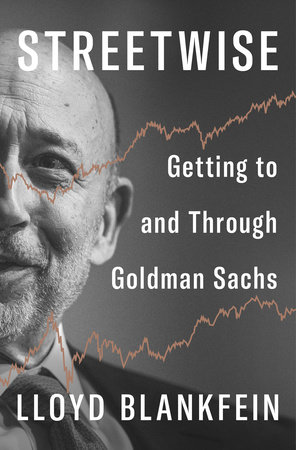
Streetwise

Getting to and Through Goldman Sachs

Look inside
Hardcover
$35.00 US
6.55"W x 9.55"H x 1.29"D   (16.6 x 24.3 x 3.3 cm) | 22 oz (618 g) | 12 per carton
On sale Mar 03, 2026 | 400 Pages | 9798217058921
Sales rights: US, Canada, Open Mkt

See Additional Formats
additional book photo
The New York Times bestseller

From the long-tenured head of Goldman Sachs, an institution legendary for its culture of success, comes a candid memoir of global leadership in an age of extreme turbulence.

"Funny, mainly blunt, unexpectedly vulnerable and rarely apologetic.” —Bloomberg

“No one has gotten inside the secret walls of Goldman Sachs and told the story of everything about it, warts and all. Now the man who ran it tells all—and it’s incredible.” —Jim Cramer

"Lively and insightful." —The Wall Street Journal


When Lloyd Blankfein was attacked as a Wall Street fat cat, he had to smile, thinking of his precarious childhood in the notorious public housing projects of East New York, Brooklyn, and attending a high school so chaotic he didn’t feel safe leaving class to go to the bathroom in his time there. Harvard University was a total moonshot, and his outsider status never wore off, there or at Harvard Law. When he struck people as street-y, it wasn’t Wall Street they were thinking of. But if the chip never quite left Blankfein's shoulder, neither did a wry, resilient spirit and a lucid, democratic intelligence that saw through airs and found talent and ideas in unlikely places.

Streetwise is a delightfully honest, sharp and often very funny reckoning with the author’s education—in finance, human nature, and the workings of the world. It abounds with lessons about leading teams of brilliant, aggressive, competitive people and harmonizing them around shared goals; changing when times are hard and when they’re good; managing risk; and knowing a crisis is at hand before it swamps you so you can guide your team to the further shore. Blankfein is famed for his calm hand on Goldman Sachs’s tiller during the global financial crisis, and that story is told in full here, among many other decisive episodes.

Suffusing Streetwise is the author’s deep and abiding respect for the partnership culture of Goldman Sachs. We follow the never-ending work to protect and preserve that culture through all sorts of tumult—the challenge behind every other challenge. He is open about when he and the firm got it wrong, which was often enough, but the creative, risk-taking spirit was never snuffed—even as the fail-safes put in place to protect the firm and its clients held when they were needed the most. A powerful blueprint for the wise stewardship of a cause that is larger than yourself, Streetwise will inspire and inform readers throughout the global business community and beyond.
Chapter 1
Advantages

When I go into a room full of people, I have to decide whether I'm going to be the member of the establishment or the kid from Brooklyn.

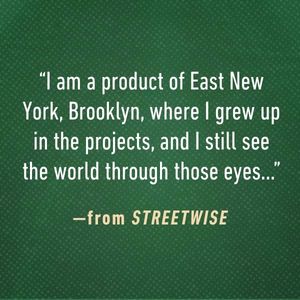
I am a product of East New York, Brooklyn, where I grew up in the projects, and I still see the world through those eyes. To this day, I have to concentrate to say rather and not rath-uh. I can't compare myself with people I've worked with who overcame really severe disadvantage, like broken homes, civil wars, extreme poverty, or forced emigration. But growing up in public housing, in a family that was just getting by, and attending public schools that were failing, left its mark on me. I struggle with ambivalence. I spend half my time wanting to give stuff to my kids, the other half tormenting them for having stuff I gave them that I didn't have.

My earliest memories are from the South Bronx, where my family lived in a tenement building on Leggett Avenue. I used to love watching the coal that heated the building get delivered. It made a roar as it poured from the truck down a chute into the cellar. Another memory: the organ-grinder who sometimes played on the sidewalk outside our apartment. My mother wrapped a coin in paper and threw it out the window for his monkey to pick up.

When I was three, we moved from the Bronx to East New York, in search of a better life-which, for a time, we found. The year was 1957 and the city hadn't yet finished paving the streets of the new public housing development we were moving into, the Linden Houses, run by the New York City Housing Authority. This was subsidized housing for the working class, with buildings arrayed in an irregular pattern bordered by bits of landscaped greenery. They were not yet "the projects." At the time, it must have seemed like Shangri-la to my parents. Everything was clean and new. Children had an actual playground, with swings and monkey bars to climb. The neighborhood was reasonably safe. Those nineteen largely identical redbrick high-rises were not yet blighted in the ways they would be by the time I was in high school.

My mother, my father, my sister, my grandmother, and I occupied a small apartment with two bedrooms and a bathroom, maybe eight hundred square feet, on the fourth floor of a fourteen-story tower at 243 Wortman Avenue. My sister, Jacky, and I shared a bedroom, while my grandmother, Lilly, slept on a foldout couch in the living room. It was tight but neat. You weren't allowed to sit on a bed-beds were for sleeping, not sitting, according to my mom. There were plastic slipcovers on every piece of furniture that anyone could sit on or lean against. When we got our first TV, a big console set that I watched every afternoon and evening while lying on the living room floor, my mom made me rotate to different places on the floor so I wouldn't wear out the rug unevenly. When my parents retired to Florida decades later, the furniture they left behind was in pristine condition.

My Blankfein ancestors were Yiddish-speaking Jews who emigrated in the 1880s from a shtetl that was then in Russia and is now part of Poland. Isaac Blankfein, my paternal great-grandfather, worked as a tailor on Delancey Street, on the Lower East Side. He started a wholesale garment business that moved around Lower Manhattan, first to Greene Street-long before that neighborhood was called SoHo-then to Bleecker Street in Greenwich Village, then to East 14th Street. My grandfather Saul, who died when I was six, was the youngest of Isaac's five sons, and the only one who stayed involved in the family business. When that business went bad during the Depression, our branch of the family became the poor relations. Over the years, as I became more famous (or notorious), I've heard from various Blankfeins descended from the other four brothers. They ended up as professionals-teachers, doctors, and lawyers. Not our side of the family. My dad worked as a clerk in the post office, while his younger brother, my uncle Sheldon, worked as a cutter in the Garment District.

After my grandfather Saul died, my grandmother Hannah Blankfein stayed in their apartment in a brownstone in the South Bronx, which I remember surrounded by rubble-strewn vacant lots as the neighborhood declined. On the long drive from Brooklyn to visit her, I would sleep, or pretend to sleep, stretched out in the back seat of our car. Because Hannah's mother was from Austria and spoke German rather than Yiddish, I understood that she was from a slightly higher social class among descendants of Jewish immigrants. A voluble, outgoing woman, my grandmother was uneducated but might have been the most accomplished person in our family. She was active in Bronx politics, served as a district leader, and even attended the 1964 Democratic Convention in Atlantic City as an alternate delegate.

My mother Blanche's family, the Krellmans, came to the United States a little later, around the turn of the twentieth century. They were also from the Pale of Settlement at the western edge of the Tsarist Empire. My mother's parents had a bitter divorce when she was young, and she broke off relations with her father, who subsequently remarried and had another family. My mom stuck with her mother, my grandmother Lilly, so I never knew my grandfather on my mother's side. When I shared a room with her as a kid, Grandma Lilly never talked about him. She worked at S. Klein, a department store on Union Square in Manhattan, which was a long ride on the 2 train from New Lots Avenue. Her job at Klein's was "floorwalker," which meant helping lady customers find the right size dresses and assisting the regular salespeople.

My mother was an extrovert and a schmoozer, always engaging strangers in conversation-an instinct she passed along to her children. But while she projected a lot of warmth to the outside world, she was all business at home, where she was the principal decision-maker about everything in our crowded household. During the day, she worked as a receptionist at a burglar alarm company-one of the few growth industries in the neighborhood. Other than watching TV in the evening, her main form of recreation was playing mah-jongg with women friends. She was only nineteen in 1940 when she married my father, Seymour, who was five years older. They met while working in the same dry-goods store in the Bronx. When he was drafted into the army in 1942, he was sent to Omaha, Nebraska, to work as a mechanic at the Army Air Corps base there. My mom moved there to be with him. My older sister was conceived there and was born on V-J Day, September 2, 1945.

My father was a big man-223 pounds at the time of his enlistment, according to his army records-but quieter than my mother and somewhat overshadowed by her. My dad liked to point to new car ads and say, "I can't wait to buy that car in six years." I inherited both his sense of humor and his anxiety. He was a constant worrier who never let the gas gauge on our secondhand Pontiac fall below three quarters full. I remember him taking that car, with its old-style divided windshield, to be checked out at a garage before the longest drive we'd take every summer, to Weiner's Hotel, a Jewish-owned resort in Moodus, Connecticut. Part of the "Connecticut Catskills," the hotel had cabins and a kind of musty main building. As I write this, I can still smell the mildew. You didn't really want to unpack. There was a shared bathroom on every floor.

My dad worked nights as a mail sorter at the post office because it meant a 10 percent pay boost above the day shift. We all had to be quiet during the day while he slept. In our world, nobody's father, if he had a job, went to work in a suit. No one I knew had a parent who had gone to college. My friends' fathers worked for the government, drove taxis, or were store clerks. I knew kids whose parents were Holocaust survivors, or "refugees" as they were called back then. My father was content with his job at the post office, or at least glad he had a secure job. Earlier, when I was very young, he was laid off from his job as a delivery driver for a dry-goods company. He was unemployed for a while, and the atmosphere at home was miserable and anxious. He never wanted that to happen again, hence his attachment to the civil service.

I had never been to the place where my father worked. He retired while I was in law school, and his coworkers threw a small party for him on his last day, at their station at the General Post Office in Brooklyn. Our family was invited. I remember going in, seeing the cramped space where letters moved by on a conveyor belt and the guys sorted them into slots. I remember thinking, How soul-destroying. But it got worse. Behind my dad and his colleagues was a large piece of equipment, literally in a plastic wrapper. I asked what it was. It was a machine that could sort mail at hyperspeed via an "electronic reader." It was meant to perform the same job held by my dad and his coworkers, only a lot faster, more cheaply, and better. But the government wouldn't deploy the machine and displace the workers until they retired. Imagine performing that mindless job when you knew it didn't even need to be performed. I still feel so sad when I think about the waste of my dad's brains and effort.

There was always tension and fighting at home about the lack of money, the lack of privacy, the need to be quiet, and miscellaneous stresses, like whose turn it was to use the bathroom and how long someone was taking. Cutting "cents off" coupons from newspapers for grocery items was the arts-and-crafts project I remember. A searing memory for me as an eight- or nine-year-old kid was breaking my glasses while roughhousing with friends. I didn't get yelled at, but I was made to feel that new glasses were budget breaking. My folks did the best they could, and I loved them, but we didn't always get along.

Even more than my mother, my sister, Jacky, was a people person-we used to say she could talk to a lamppost. Nine years older than me, she was in some ways more of a parent than a sibling. She was my coconspirator, the person with whom I could always laugh about our lives. Jacky was the one who took me to the World's Fair in Flushing in 1964. We rode Walt Disney's "It's a Small World" ride and watched a life-size animatronic Abraham Lincoln deliver excerpts from the Gettysburg Address. My strongest memory is of a futuristic technology you could try inside a bubble-shaped "Family Phone Booth": the speakerphone. To ten-year-old me, it seemed like a contraption from Dick Tracy.

Jacky, cut from the same cloth as me, was a victim of the attitudes of the 1950s and early 1960s. At school, she was channeled into a "commercial" diploma, which meant studying stenography and typing instead of history and English. She married at twenty, mostly, I think, to get out of our house. That turned out to be a costly mistake. She had a baby within a year, right after her husband, a bookkeeper, was discovered to have stolen from his employer. She moved back into our apartment with her baby, which meant that I had to share a room with my grandmother in the slightly larger apartment we were assigned in one of the other towers. My sister's divorce was ugly, and the police were often called to mediate disputes over child custody.

Because my father worked nights, we seldom had family dinners together. My mom put everything in the toaster oven, even hamburgers, and we ate a lot of Birds Eye frozen dinners. Corn and spinach, as far as I knew, came from cans, not the ground. Sometimes my grandmother would cook something slightly more effortful. Our kitchen table wasn't exactly a lively intellectual environment. I don't remember my parents having any political conversations, unless you count the constant cursing of Mayor Lindsay because of the deterioration of the neighborhood. But like everyone else in our world, my parents voted Democratic. We got the Daily Mirror, a Hearst tabloid that folded in 1963, and later the New York Daily News. I would play the Jumble word puzzle, perhaps a precursor to the New York Times Spelling Bee, which I'm addicted to these days, but a great deal easier. The Times never made an appearance in our household, and I doubt that anyone in my immediate family had even heard of The Wall Street Journal.

For kids in the projects, there were no organized sports or teams-no Little League or junior football. There were cement playgrounds, where children could play street games like skelly, where you flick bottle caps into squares outlined with chalk, or stickball, which you played with a rubber Spaldeen or a handball. Ring-a-levio was a game of team tag. I was the best at Chinese handball, which we played against the side of P.S. 190 on Sheffield Avenue. In the fall, we played touch football in a mostly deserted parking lot, using the parallel lines as yard markers. If the Battle of Waterloo was won on the playing fields of Eton, as Wellington is supposed to have said, a lot of personalities and characters were shaped playing those street games in Brooklyn.

We kids sorted ourselves out-there were no adults supervising. I was slightly chubby in those days, not a great athlete, not great eyesight, and I tended to get picked nearly last. Joining the local Y swim team and later the swim team in high school got me in better shape. But I was funny, and I made friends like Felice Yurkiewicz and Richard Kalb, whom I've been close to my whole life. When I'm with them, my Brooklyn accent comes back in full force. At school, my report cards usually identified me as the class clown.

Felice, who lived on the second floor of our building, was a friend throughout our childhoods. We both taught ourselves to read from DC and Action Comics. We used to quiz each other: Where does Superman keep the Bottle City of Kandor? In his Fortress of Solitude. At seven or eight, I'm not sure we understood the concept of solitude, but we knew the answer. As my tastes matured, I came to like Batman better. Superman didn't earn his superpowers. He got them by virtue of being born on the planet Krypton-a nepo baby if there ever was one. Batman, on the other hand, was a regular guy, albeit from a wealthy family, who through smarts and hard work became the peer of other superheroes with supernatural advantages.
"Lively and insightful." Wall Street Journal

“Funny, mainly blunt, unexpectedly vulnerable and rarely apologetic . . . Streetwise brings alive the culture clashes of trading desks of the 1980s, the milieu of Liar’s Poker . . . A tough, insecure outsider finally found something that fit in a firm that demands consensus-building . . . [Goldman] is a unique, persistently original, paradoxical creation in modern finance. Streetwise is a son’s loving letter in thanks.” Bloomberg

“Highly readable. Blankfein recounts his upbringing and career with amusing anecdotes ​as well as honest and at times brutal assessments of his fellow executives." —Reuters

“Lloyd Blankfein is scary smart about people, markets, and life generally. His 10,000 Small Businesses idea proved to be a huge winner, and I personally witnessed the time and effort he devoted to its success. During the 2008–2009 financial crisis, Lloyd acted decisively, and he tells the story of what happened with unique insights.” —Warren Buffett

“Lloyd Blankfein has always been a straight shooter, but his journey from public housing to the heights of Wall Street wasn’t a straight line. Streetwise is packed with important lessons about leadership, risk-taking, decision-making, and giving back.” —Michael Bloomberg, founder of Bloomberg and Bloomberg Philanthropies and 108th mayor of New York

“Lloyd Blankfein rose through the ranks to the top of Goldman Sachs during Wall Street’s most turbulent decades. Streetwise is a disarmingly honest account of his ascent over those years, full of insights about the changes in the business of finance, as down-to-earth and sharp-witted as the man himself, a must read for anyone who wishes to understand the power dynamics within a giant investment bank.” —Liaquat Ahamed, Pulitzer Prize-winning author of Lords of Finance

“No one has gotten inside the secret walls of Goldman Sachs and told the story of everything about it, warts and all. Now the man who ran it tells all—and it’s incredible. Hate him, like him, you must read him. I worked at Goldman and I knew none of this, because no one did. He’s brilliant, he’s comical, he’s smarter than us all—arrogant and humble at the same time, an up-from-nowhere kid who is the great American story. He should know better than to reveal the secrets: maybe he couldn’t help himself, maybe he couldn’t live with himself. I loved the guy before and now call me in awe of him. You will be too.” —Jim Cramer

“The best tool kit I’ve read about how to navigate going up the ladder in corporate life and how to lead and manage big business. And you also get the human story of a very warm and witty human.” —Barry Diller

“Having survived every financial crisis from 1987 to 2008, Lloyd Blankfein has written an autobiography that answers the question: How did Goldman Sachs do it? Under his leadership, Goldman did more than survive Wall Street’s biggest storms—it thrived despite them. Yet Streetwise is also a very personal story of American social mobility, describing with dry humor the challenges the author faced as he ascended from the housing projects of Brooklyn via Harvard to the heights of Wall Street. Every serious student of financial history will have to read Streetwise. Those who appreciate the gritty realities of the American dream will enjoy it, too.” —Niall Ferguson, Milbank Family Senior Fellow, the Hoover Institution, and author of The Ascent of Money

“Entertaining.” Bloomberg

“Few leaders have demonstrated greater steadiness and clarity in moments of turbulence than Lloyd Blankfein. In Streetwise, he brings readers inside the defining moments of modern finance—from the volatility of emerging markets in the 1990s to the crucible of the 2008 financial crisis. What emerges is both a personal story of resilience and a leadership blueprint grounded in realism, humility, and conviction. Lloyd’s reflections on culture, risk, and responsibility resonate far beyond Wall Street. Streetwise is essential reading for those who seek to lead with purpose and intent.” —Ken Griffin, founder and CEO, Citadel

“Truly frank books by Wall Street giants are rare. But Lloyd Blankfein has written one. I highly recommend this for anyone interested in high finance at one of its most perilous times.” —David M. Rubenstein, cofounder and cochairman, the Carlyle Group
© Goldman Sachs. All rights reserved
Lloyd Blankfein was chairman and CEO of Goldman Sachs from 2006 to 2018. View titles by Lloyd Blankfein
Available for sale exclusive:
•     Canada
•     Guam
•     Minor Outl.Ins.
•     North Mariana
•     Philippines
•     Puerto Rico
•     Samoa,American
•     US Virgin Is.
•     USA

Available for sale non-exclusive:
•     Afghanistan
•     Aland Islands
•     Albania
•     Algeria
•     Andorra
•     Angola
•     Anguilla
•     Antarctica
•     Argentina
•     Armenia
•     Aruba
•     Austria
•     Azerbaijan
•     Bahrain
•     Belarus
•     Belgium
•     Benin
•     Bhutan
•     Bolivia
•     Bonaire, Saba
•     Bosnia Herzeg.
•     Bouvet Island
•     Brazil
•     Bulgaria
•     Burkina Faso
•     Burundi
•     Cambodia
•     Cameroon
•     Cape Verde
•     Centr.Afr.Rep.
•     Chad
•     Chile
•     China
•     Colombia
•     Comoro Is.
•     Congo
•     Cook Islands
•     Costa Rica
•     Croatia
•     Cuba
•     Curacao
•     Czech Republic
•     Dem. Rep. Congo
•     Denmark
•     Djibouti
•     Dominican Rep.
•     Ecuador
•     Egypt
•     El Salvador
•     Equatorial Gui.
•     Eritrea
•     Estonia
•     Ethiopia
•     Faroe Islands
•     Finland
•     France
•     Fren.Polynesia
•     French Guinea
•     Gabon
•     Georgia
•     Germany
•     Greece
•     Greenland
•     Guadeloupe
•     Guatemala
•     Guinea Republic
•     Guinea-Bissau
•     Haiti
•     Heard/McDon.Isl
•     Honduras
•     Hong Kong
•     Hungary
•     Iceland
•     Indonesia
•     Iran
•     Iraq
•     Israel
•     Italy
•     Ivory Coast
•     Japan
•     Jordan
•     Kazakhstan
•     Kuwait
•     Kyrgyzstan
•     Laos
•     Latvia
•     Lebanon
•     Liberia
•     Libya
•     Liechtenstein
•     Lithuania
•     Luxembourg
•     Macau
•     Macedonia
•     Madagascar
•     Maldives
•     Mali
•     Marshall island
•     Martinique
•     Mauritania
•     Mayotte
•     Mexico
•     Micronesia
•     Moldavia
•     Monaco
•     Mongolia
•     Montenegro
•     Morocco
•     Myanmar
•     Nepal
•     Netherlands
•     New Caledonia
•     Nicaragua
•     Niger
•     Niue
•     Norfolk Island
•     North Korea
•     Norway
•     Oman
•     Palau
•     Palestinian Ter
•     Panama
•     Paraguay
•     Peru
•     Poland
•     Portugal
•     Qatar
•     Reunion Island
•     Romania
•     Russian Fed.
•     Rwanda
•     Saint Martin
•     San Marino
•     SaoTome Princip
•     Saudi Arabia
•     Senegal
•     Serbia
•     Singapore
•     Sint Maarten
•     Slovakia
•     Slovenia
•     South Korea
•     South Sudan
•     Spain
•     St Barthelemy
•     St.Pier,Miquel.
•     Sth Terr. Franc
•     Sudan
•     Suriname
•     Svalbard
•     Sweden
•     Switzerland
•     Syria
•     Tadschikistan
•     Taiwan
•     Thailand
•     Timor-Leste
•     Togo
•     Tokelau Islands
•     Tunisia
•     Turkey
•     Turkmenistan
•     Ukraine
•     Unit.Arab Emir.
•     Uruguay
•     Uzbekistan
•     Vatican City
•     Venezuela
•     Vietnam
•     Wallis,Futuna
•     West Saharan
•     Western Samoa
•     Yemen

Not available for sale:
•     Antigua/Barbuda
•     Australia
•     Bahamas
•     Bangladesh
•     Barbados
•     Belize
•     Bermuda
•     Botswana
•     Brit.Ind.Oc.Ter
•     Brit.Virgin Is.
•     Brunei
•     Cayman Islands
•     Christmas Islnd
•     Cocos Islands
•     Cyprus
•     Dominica
•     Falkland Islnds
•     Fiji
•     Gambia
•     Ghana
•     Gibraltar
•     Grenada
•     Guernsey
•     Guyana
•     India
•     Ireland
•     Isle of Man
•     Jamaica
•     Jersey
•     Kenya
•     Kiribati
•     Lesotho
•     Malawi
•     Malaysia
•     Malta
•     Mauritius
•     Montserrat
•     Mozambique
•     Namibia
•     Nauru
•     New Zealand
•     Nigeria
•     Pakistan
•     PapuaNewGuinea
•     Pitcairn Islnds
•     S. Sandwich Ins
•     Seychelles
•     Sierra Leone
•     Solomon Islands
•     Somalia
•     South Africa
•     Sri Lanka
•     St. Helena
•     St. Lucia
•     St. Vincent
•     St.Chr.,Nevis
•     Swaziland
•     Tanzania
•     Tonga
•     Trinidad,Tobago
•     Turks&Caicos Is
•     Tuvalu
•     Uganda
•     United Kingdom
•     Vanuatu
•     Zambia
•     Zimbabwe

Preface ix

1. Advantages 1

2. Getting Out 16

3. Glimpses Beyond 32

4. Lawyer, Briefly 40

5. Gold Mettle 49

6. From Gold Man to Goldman 64

7. Breaking Through 74

8. De-Vals and Re-Vals 83

9. Innovation 92

10. Howdy, Partner! 106

11. Paranoia Is a Job Requirement 114

12. My First “Crisis of the Century” 124

13. How I Earned My Reputation for Being Difficult 133

14. Lloyd of London 141

15. To IPO or Not to IPO 149

16. The Unforeseen 173

17. Succession 187

18. Is He Completely Housebroken? 198

19. A Modern Merchant Bank 211

20. The Partnership Culture 223

21. The Storm Before the Storm 240

22. Don’t Get Dead 260

23. How to Survive a Crisis 279

24. How Did You Do It? 291

25. Just a Few More Calamities 315

26. Notes on an Illness 327

27. Goodbye to All That 337

28. Risk Is Risky 344

Epilogue: Life After Goldman 359

Acknowledgments 365

Image Credits 369

Index 371

Photos

additional book photo

About

The New York Times bestseller

From the long-tenured head of Goldman Sachs, an institution legendary for its culture of success, comes a candid memoir of global leadership in an age of extreme turbulence.

"Funny, mainly blunt, unexpectedly vulnerable and rarely apologetic.” —Bloomberg

“No one has gotten inside the secret walls of Goldman Sachs and told the story of everything about it, warts and all. Now the man who ran it tells all—and it’s incredible.” —Jim Cramer

"Lively and insightful." —The Wall Street Journal


When Lloyd Blankfein was attacked as a Wall Street fat cat, he had to smile, thinking of his precarious childhood in the notorious public housing projects of East New York, Brooklyn, and attending a high school so chaotic he didn’t feel safe leaving class to go to the bathroom in his time there. Harvard University was a total moonshot, and his outsider status never wore off, there or at Harvard Law. When he struck people as street-y, it wasn’t Wall Street they were thinking of. But if the chip never quite left Blankfein's shoulder, neither did a wry, resilient spirit and a lucid, democratic intelligence that saw through airs and found talent and ideas in unlikely places.

Streetwise is a delightfully honest, sharp and often very funny reckoning with the author’s education—in finance, human nature, and the workings of the world. It abounds with lessons about leading teams of brilliant, aggressive, competitive people and harmonizing them around shared goals; changing when times are hard and when they’re good; managing risk; and knowing a crisis is at hand before it swamps you so you can guide your team to the further shore. Blankfein is famed for his calm hand on Goldman Sachs’s tiller during the global financial crisis, and that story is told in full here, among many other decisive episodes.

Suffusing Streetwise is the author’s deep and abiding respect for the partnership culture of Goldman Sachs. We follow the never-ending work to protect and preserve that culture through all sorts of tumult—the challenge behind every other challenge. He is open about when he and the firm got it wrong, which was often enough, but the creative, risk-taking spirit was never snuffed—even as the fail-safes put in place to protect the firm and its clients held when they were needed the most. A powerful blueprint for the wise stewardship of a cause that is larger than yourself, Streetwise will inspire and inform readers throughout the global business community and beyond.

Excerpt

Chapter 1
Advantages

When I go into a room full of people, I have to decide whether I'm going to be the member of the establishment or the kid from Brooklyn.

I am a product of East New York, Brooklyn, where I grew up in the projects, and I still see the world through those eyes. To this day, I have to concentrate to say rather and not rath-uh. I can't compare myself with people I've worked with who overcame really severe disadvantage, like broken homes, civil wars, extreme poverty, or forced emigration. But growing up in public housing, in a family that was just getting by, and attending public schools that were failing, left its mark on me. I struggle with ambivalence. I spend half my time wanting to give stuff to my kids, the other half tormenting them for having stuff I gave them that I didn't have.

My earliest memories are from the South Bronx, where my family lived in a tenement building on Leggett Avenue. I used to love watching the coal that heated the building get delivered. It made a roar as it poured from the truck down a chute into the cellar. Another memory: the organ-grinder who sometimes played on the sidewalk outside our apartment. My mother wrapped a coin in paper and threw it out the window for his monkey to pick up.

When I was three, we moved from the Bronx to East New York, in search of a better life-which, for a time, we found. The year was 1957 and the city hadn't yet finished paving the streets of the new public housing development we were moving into, the Linden Houses, run by the New York City Housing Authority. This was subsidized housing for the working class, with buildings arrayed in an irregular pattern bordered by bits of landscaped greenery. They were not yet "the projects." At the time, it must have seemed like Shangri-la to my parents. Everything was clean and new. Children had an actual playground, with swings and monkey bars to climb. The neighborhood was reasonably safe. Those nineteen largely identical redbrick high-rises were not yet blighted in the ways they would be by the time I was in high school.

My mother, my father, my sister, my grandmother, and I occupied a small apartment with two bedrooms and a bathroom, maybe eight hundred square feet, on the fourth floor of a fourteen-story tower at 243 Wortman Avenue. My sister, Jacky, and I shared a bedroom, while my grandmother, Lilly, slept on a foldout couch in the living room. It was tight but neat. You weren't allowed to sit on a bed-beds were for sleeping, not sitting, according to my mom. There were plastic slipcovers on every piece of furniture that anyone could sit on or lean against. When we got our first TV, a big console set that I watched every afternoon and evening while lying on the living room floor, my mom made me rotate to different places on the floor so I wouldn't wear out the rug unevenly. When my parents retired to Florida decades later, the furniture they left behind was in pristine condition.

My Blankfein ancestors were Yiddish-speaking Jews who emigrated in the 1880s from a shtetl that was then in Russia and is now part of Poland. Isaac Blankfein, my paternal great-grandfather, worked as a tailor on Delancey Street, on the Lower East Side. He started a wholesale garment business that moved around Lower Manhattan, first to Greene Street-long before that neighborhood was called SoHo-then to Bleecker Street in Greenwich Village, then to East 14th Street. My grandfather Saul, who died when I was six, was the youngest of Isaac's five sons, and the only one who stayed involved in the family business. When that business went bad during the Depression, our branch of the family became the poor relations. Over the years, as I became more famous (or notorious), I've heard from various Blankfeins descended from the other four brothers. They ended up as professionals-teachers, doctors, and lawyers. Not our side of the family. My dad worked as a clerk in the post office, while his younger brother, my uncle Sheldon, worked as a cutter in the Garment District.

After my grandfather Saul died, my grandmother Hannah Blankfein stayed in their apartment in a brownstone in the South Bronx, which I remember surrounded by rubble-strewn vacant lots as the neighborhood declined. On the long drive from Brooklyn to visit her, I would sleep, or pretend to sleep, stretched out in the back seat of our car. Because Hannah's mother was from Austria and spoke German rather than Yiddish, I understood that she was from a slightly higher social class among descendants of Jewish immigrants. A voluble, outgoing woman, my grandmother was uneducated but might have been the most accomplished person in our family. She was active in Bronx politics, served as a district leader, and even attended the 1964 Democratic Convention in Atlantic City as an alternate delegate.

My mother Blanche's family, the Krellmans, came to the United States a little later, around the turn of the twentieth century. They were also from the Pale of Settlement at the western edge of the Tsarist Empire. My mother's parents had a bitter divorce when she was young, and she broke off relations with her father, who subsequently remarried and had another family. My mom stuck with her mother, my grandmother Lilly, so I never knew my grandfather on my mother's side. When I shared a room with her as a kid, Grandma Lilly never talked about him. She worked at S. Klein, a department store on Union Square in Manhattan, which was a long ride on the 2 train from New Lots Avenue. Her job at Klein's was "floorwalker," which meant helping lady customers find the right size dresses and assisting the regular salespeople.

My mother was an extrovert and a schmoozer, always engaging strangers in conversation-an instinct she passed along to her children. But while she projected a lot of warmth to the outside world, she was all business at home, where she was the principal decision-maker about everything in our crowded household. During the day, she worked as a receptionist at a burglar alarm company-one of the few growth industries in the neighborhood. Other than watching TV in the evening, her main form of recreation was playing mah-jongg with women friends. She was only nineteen in 1940 when she married my father, Seymour, who was five years older. They met while working in the same dry-goods store in the Bronx. When he was drafted into the army in 1942, he was sent to Omaha, Nebraska, to work as a mechanic at the Army Air Corps base there. My mom moved there to be with him. My older sister was conceived there and was born on V-J Day, September 2, 1945.

My father was a big man-223 pounds at the time of his enlistment, according to his army records-but quieter than my mother and somewhat overshadowed by her. My dad liked to point to new car ads and say, "I can't wait to buy that car in six years." I inherited both his sense of humor and his anxiety. He was a constant worrier who never let the gas gauge on our secondhand Pontiac fall below three quarters full. I remember him taking that car, with its old-style divided windshield, to be checked out at a garage before the longest drive we'd take every summer, to Weiner's Hotel, a Jewish-owned resort in Moodus, Connecticut. Part of the "Connecticut Catskills," the hotel had cabins and a kind of musty main building. As I write this, I can still smell the mildew. You didn't really want to unpack. There was a shared bathroom on every floor.

My dad worked nights as a mail sorter at the post office because it meant a 10 percent pay boost above the day shift. We all had to be quiet during the day while he slept. In our world, nobody's father, if he had a job, went to work in a suit. No one I knew had a parent who had gone to college. My friends' fathers worked for the government, drove taxis, or were store clerks. I knew kids whose parents were Holocaust survivors, or "refugees" as they were called back then. My father was content with his job at the post office, or at least glad he had a secure job. Earlier, when I was very young, he was laid off from his job as a delivery driver for a dry-goods company. He was unemployed for a while, and the atmosphere at home was miserable and anxious. He never wanted that to happen again, hence his attachment to the civil service.

I had never been to the place where my father worked. He retired while I was in law school, and his coworkers threw a small party for him on his last day, at their station at the General Post Office in Brooklyn. Our family was invited. I remember going in, seeing the cramped space where letters moved by on a conveyor belt and the guys sorted them into slots. I remember thinking, How soul-destroying. But it got worse. Behind my dad and his colleagues was a large piece of equipment, literally in a plastic wrapper. I asked what it was. It was a machine that could sort mail at hyperspeed via an "electronic reader." It was meant to perform the same job held by my dad and his coworkers, only a lot faster, more cheaply, and better. But the government wouldn't deploy the machine and displace the workers until they retired. Imagine performing that mindless job when you knew it didn't even need to be performed. I still feel so sad when I think about the waste of my dad's brains and effort.

There was always tension and fighting at home about the lack of money, the lack of privacy, the need to be quiet, and miscellaneous stresses, like whose turn it was to use the bathroom and how long someone was taking. Cutting "cents off" coupons from newspapers for grocery items was the arts-and-crafts project I remember. A searing memory for me as an eight- or nine-year-old kid was breaking my glasses while roughhousing with friends. I didn't get yelled at, but I was made to feel that new glasses were budget breaking. My folks did the best they could, and I loved them, but we didn't always get along.

Even more than my mother, my sister, Jacky, was a people person-we used to say she could talk to a lamppost. Nine years older than me, she was in some ways more of a parent than a sibling. She was my coconspirator, the person with whom I could always laugh about our lives. Jacky was the one who took me to the World's Fair in Flushing in 1964. We rode Walt Disney's "It's a Small World" ride and watched a life-size animatronic Abraham Lincoln deliver excerpts from the Gettysburg Address. My strongest memory is of a futuristic technology you could try inside a bubble-shaped "Family Phone Booth": the speakerphone. To ten-year-old me, it seemed like a contraption from Dick Tracy.

Jacky, cut from the same cloth as me, was a victim of the attitudes of the 1950s and early 1960s. At school, she was channeled into a "commercial" diploma, which meant studying stenography and typing instead of history and English. She married at twenty, mostly, I think, to get out of our house. That turned out to be a costly mistake. She had a baby within a year, right after her husband, a bookkeeper, was discovered to have stolen from his employer. She moved back into our apartment with her baby, which meant that I had to share a room with my grandmother in the slightly larger apartment we were assigned in one of the other towers. My sister's divorce was ugly, and the police were often called to mediate disputes over child custody.

Because my father worked nights, we seldom had family dinners together. My mom put everything in the toaster oven, even hamburgers, and we ate a lot of Birds Eye frozen dinners. Corn and spinach, as far as I knew, came from cans, not the ground. Sometimes my grandmother would cook something slightly more effortful. Our kitchen table wasn't exactly a lively intellectual environment. I don't remember my parents having any political conversations, unless you count the constant cursing of Mayor Lindsay because of the deterioration of the neighborhood. But like everyone else in our world, my parents voted Democratic. We got the Daily Mirror, a Hearst tabloid that folded in 1963, and later the New York Daily News. I would play the Jumble word puzzle, perhaps a precursor to the New York Times Spelling Bee, which I'm addicted to these days, but a great deal easier. The Times never made an appearance in our household, and I doubt that anyone in my immediate family had even heard of The Wall Street Journal.

For kids in the projects, there were no organized sports or teams-no Little League or junior football. There were cement playgrounds, where children could play street games like skelly, where you flick bottle caps into squares outlined with chalk, or stickball, which you played with a rubber Spaldeen or a handball. Ring-a-levio was a game of team tag. I was the best at Chinese handball, which we played against the side of P.S. 190 on Sheffield Avenue. In the fall, we played touch football in a mostly deserted parking lot, using the parallel lines as yard markers. If the Battle of Waterloo was won on the playing fields of Eton, as Wellington is supposed to have said, a lot of personalities and characters were shaped playing those street games in Brooklyn.

We kids sorted ourselves out-there were no adults supervising. I was slightly chubby in those days, not a great athlete, not great eyesight, and I tended to get picked nearly last. Joining the local Y swim team and later the swim team in high school got me in better shape. But I was funny, and I made friends like Felice Yurkiewicz and Richard Kalb, whom I've been close to my whole life. When I'm with them, my Brooklyn accent comes back in full force. At school, my report cards usually identified me as the class clown.

Felice, who lived on the second floor of our building, was a friend throughout our childhoods. We both taught ourselves to read from DC and Action Comics. We used to quiz each other: Where does Superman keep the Bottle City of Kandor? In his Fortress of Solitude. At seven or eight, I'm not sure we understood the concept of solitude, but we knew the answer. As my tastes matured, I came to like Batman better. Superman didn't earn his superpowers. He got them by virtue of being born on the planet Krypton-a nepo baby if there ever was one. Batman, on the other hand, was a regular guy, albeit from a wealthy family, who through smarts and hard work became the peer of other superheroes with supernatural advantages.

Praise

"Lively and insightful." Wall Street Journal

“Funny, mainly blunt, unexpectedly vulnerable and rarely apologetic . . . Streetwise brings alive the culture clashes of trading desks of the 1980s, the milieu of Liar’s Poker . . . A tough, insecure outsider finally found something that fit in a firm that demands consensus-building . . . [Goldman] is a unique, persistently original, paradoxical creation in modern finance. Streetwise is a son’s loving letter in thanks.” Bloomberg

“Highly readable. Blankfein recounts his upbringing and career with amusing anecdotes ​as well as honest and at times brutal assessments of his fellow executives." —Reuters

“Lloyd Blankfein is scary smart about people, markets, and life generally. His 10,000 Small Businesses idea proved to be a huge winner, and I personally witnessed the time and effort he devoted to its success. During the 2008–2009 financial crisis, Lloyd acted decisively, and he tells the story of what happened with unique insights.” —Warren Buffett

“Lloyd Blankfein has always been a straight shooter, but his journey from public housing to the heights of Wall Street wasn’t a straight line. Streetwise is packed with important lessons about leadership, risk-taking, decision-making, and giving back.” —Michael Bloomberg, founder of Bloomberg and Bloomberg Philanthropies and 108th mayor of New York

“Lloyd Blankfein rose through the ranks to the top of Goldman Sachs during Wall Street’s most turbulent decades. Streetwise is a disarmingly honest account of his ascent over those years, full of insights about the changes in the business of finance, as down-to-earth and sharp-witted as the man himself, a must read for anyone who wishes to understand the power dynamics within a giant investment bank.” —Liaquat Ahamed, Pulitzer Prize-winning author of Lords of Finance

“No one has gotten inside the secret walls of Goldman Sachs and told the story of everything about it, warts and all. Now the man who ran it tells all—and it’s incredible. Hate him, like him, you must read him. I worked at Goldman and I knew none of this, because no one did. He’s brilliant, he’s comical, he’s smarter than us all—arrogant and humble at the same time, an up-from-nowhere kid who is the great American story. He should know better than to reveal the secrets: maybe he couldn’t help himself, maybe he couldn’t live with himself. I loved the guy before and now call me in awe of him. You will be too.” —Jim Cramer

“The best tool kit I’ve read about how to navigate going up the ladder in corporate life and how to lead and manage big business. And you also get the human story of a very warm and witty human.” —Barry Diller

“Having survived every financial crisis from 1987 to 2008, Lloyd Blankfein has written an autobiography that answers the question: How did Goldman Sachs do it? Under his leadership, Goldman did more than survive Wall Street’s biggest storms—it thrived despite them. Yet Streetwise is also a very personal story of American social mobility, describing with dry humor the challenges the author faced as he ascended from the housing projects of Brooklyn via Harvard to the heights of Wall Street. Every serious student of financial history will have to read Streetwise. Those who appreciate the gritty realities of the American dream will enjoy it, too.” —Niall Ferguson, Milbank Family Senior Fellow, the Hoover Institution, and author of The Ascent of Money

“Entertaining.” Bloomberg

“Few leaders have demonstrated greater steadiness and clarity in moments of turbulence than Lloyd Blankfein. In Streetwise, he brings readers inside the defining moments of modern finance—from the volatility of emerging markets in the 1990s to the crucible of the 2008 financial crisis. What emerges is both a personal story of resilience and a leadership blueprint grounded in realism, humility, and conviction. Lloyd’s reflections on culture, risk, and responsibility resonate far beyond Wall Street. Streetwise is essential reading for those who seek to lead with purpose and intent.” —Ken Griffin, founder and CEO, Citadel

“Truly frank books by Wall Street giants are rare. But Lloyd Blankfein has written one. I highly recommend this for anyone interested in high finance at one of its most perilous times.” —David M. Rubenstein, cofounder and cochairman, the Carlyle Group

Author

© Goldman Sachs. All rights reserved
Lloyd Blankfein was chairman and CEO of Goldman Sachs from 2006 to 2018. View titles by Lloyd Blankfein

Rights

Available for sale exclusive:
•     Canada
•     Guam
•     Minor Outl.Ins.
•     North Mariana
•     Philippines
•     Puerto Rico
•     Samoa,American
•     US Virgin Is.
•     USA

Available for sale non-exclusive:
•     Afghanistan
•     Aland Islands
•     Albania
•     Algeria
•     Andorra
•     Angola
•     Anguilla
•     Antarctica
•     Argentina
•     Armenia
•     Aruba
•     Austria
•     Azerbaijan
•     Bahrain
•     Belarus
•     Belgium
•     Benin
•     Bhutan
•     Bolivia
•     Bonaire, Saba
•     Bosnia Herzeg.
•     Bouvet Island
•     Brazil
•     Bulgaria
•     Burkina Faso
•     Burundi
•     Cambodia
•     Cameroon
•     Cape Verde
•     Centr.Afr.Rep.
•     Chad
•     Chile
•     China
•     Colombia
•     Comoro Is.
•     Congo
•     Cook Islands
•     Costa Rica
•     Croatia
•     Cuba
•     Curacao
•     Czech Republic
•     Dem. Rep. Congo
•     Denmark
•     Djibouti
•     Dominican Rep.
•     Ecuador
•     Egypt
•     El Salvador
•     Equatorial Gui.
•     Eritrea
•     Estonia
•     Ethiopia
•     Faroe Islands
•     Finland
•     France
•     Fren.Polynesia
•     French Guinea
•     Gabon
•     Georgia
•     Germany
•     Greece
•     Greenland
•     Guadeloupe
•     Guatemala
•     Guinea Republic
•     Guinea-Bissau
•     Haiti
•     Heard/McDon.Isl
•     Honduras
•     Hong Kong
•     Hungary
•     Iceland
•     Indonesia
•     Iran
•     Iraq
•     Israel
•     Italy
•     Ivory Coast
•     Japan
•     Jordan
•     Kazakhstan
•     Kuwait
•     Kyrgyzstan
•     Laos
•     Latvia
•     Lebanon
•     Liberia
•     Libya
•     Liechtenstein
•     Lithuania
•     Luxembourg
•     Macau
•     Macedonia
•     Madagascar
•     Maldives
•     Mali
•     Marshall island
•     Martinique
•     Mauritania
•     Mayotte
•     Mexico
•     Micronesia
•     Moldavia
•     Monaco
•     Mongolia
•     Montenegro
•     Morocco
•     Myanmar
•     Nepal
•     Netherlands
•     New Caledonia
•     Nicaragua
•     Niger
•     Niue
•     Norfolk Island
•     North Korea
•     Norway
•     Oman
•     Palau
•     Palestinian Ter
•     Panama
•     Paraguay
•     Peru
•     Poland
•     Portugal
•     Qatar
•     Reunion Island
•     Romania
•     Russian Fed.
•     Rwanda
•     Saint Martin
•     San Marino
•     SaoTome Princip
•     Saudi Arabia
•     Senegal
•     Serbia
•     Singapore
•     Sint Maarten
•     Slovakia
•     Slovenia
•     South Korea
•     South Sudan
•     Spain
•     St Barthelemy
•     St.Pier,Miquel.
•     Sth Terr. Franc
•     Sudan
•     Suriname
•     Svalbard
•     Sweden
•     Switzerland
•     Syria
•     Tadschikistan
•     Taiwan
•     Thailand
•     Timor-Leste
•     Togo
•     Tokelau Islands
•     Tunisia
•     Turkey
•     Turkmenistan
•     Ukraine
•     Unit.Arab Emir.
•     Uruguay
•     Uzbekistan
•     Vatican City
•     Venezuela
•     Vietnam
•     Wallis,Futuna
•     West Saharan
•     Western Samoa
•     Yemen

Not available for sale:
•     Antigua/Barbuda
•     Australia
•     Bahamas
•     Bangladesh
•     Barbados
•     Belize
•     Bermuda
•     Botswana
•     Brit.Ind.Oc.Ter
•     Brit.Virgin Is.
•     Brunei
•     Cayman Islands
•     Christmas Islnd
•     Cocos Islands
•     Cyprus
•     Dominica
•     Falkland Islnds
•     Fiji
•     Gambia
•     Ghana
•     Gibraltar
•     Grenada
•     Guernsey
•     Guyana
•     India
•     Ireland
•     Isle of Man
•     Jamaica
•     Jersey
•     Kenya
•     Kiribati
•     Lesotho
•     Malawi
•     Malaysia
•     Malta
•     Mauritius
•     Montserrat
•     Mozambique
•     Namibia
•     Nauru
•     New Zealand
•     Nigeria
•     Pakistan
•     PapuaNewGuinea
•     Pitcairn Islnds
•     S. Sandwich Ins
•     Seychelles
•     Sierra Leone
•     Solomon Islands
•     Somalia
•     South Africa
•     Sri Lanka
•     St. Helena
•     St. Lucia
•     St. Vincent
•     St.Chr.,Nevis
•     Swaziland
•     Tanzania
•     Tonga
•     Trinidad,Tobago
•     Turks&Caicos Is
•     Tuvalu
•     Uganda
•     United Kingdom
•     Vanuatu
•     Zambia
•     Zimbabwe

Table of Contents

Preface ix

1. Advantages 1

2. Getting Out 16

3. Glimpses Beyond 32

4. Lawyer, Briefly 40

5. Gold Mettle 49

6. From Gold Man to Goldman 64

7. Breaking Through 74

8. De-Vals and Re-Vals 83

9. Innovation 92

10. Howdy, Partner! 106

11. Paranoia Is a Job Requirement 114

12. My First “Crisis of the Century” 124

13. How I Earned My Reputation for Being Difficult 133

14. Lloyd of London 141

15. To IPO or Not to IPO 149

16. The Unforeseen 173

17. Succession 187

18. Is He Completely Housebroken? 198

19. A Modern Merchant Bank 211

20. The Partnership Culture 223

21. The Storm Before the Storm 240

22. Don’t Get Dead 260

23. How to Survive a Crisis 279

24. How Did You Do It? 291

25. Just a Few More Calamities 315

26. Notes on an Illness 327

27. Goodbye to All That 337

28. Risk Is Risky 344

Epilogue: Life After Goldman 359

Acknowledgments 365

Image Credits 369

Index 371