Introduction: Play More, Stress Less
Parenting is overwhelming. Let’s just admit that. No matter what you might see online or read in books, most parents are running around like crazy, feeling like they never get it all done or do any of it exactly right. Is your home in a constant state of chaos and clutter? Are you burned out? Are you ever able to concentrate on just one thing? Do you feel like your only job is to feed, clean, and entertain your child? Does a nap sound like an impossible dream? Whether you have an infant or a pre-teen, one child or six children, chances are you sometimes secretly feel like you’re barely getting by.
Parents are expected to do it all—work full time while also parenting perfectly, or if they stay at home with their kids, control every aspect of their child’s development to make sure they turn into baby geniuses. There’s a lot of noise in the parenting space today. Just look at Instagram. It’s filled with influencers suggesting that if you don’t parent this way or that way, or if you fail to maintain a certain high level of engagement with your kids, or stimulate them with enough learning, you’re doing it wrong. The implication is that you might be a bad parent and your child will suffer because of it.
Kids feel overwhelmed, too. They don’t always know what they’re supposed to be doing, and that can make them feel unsteady. Unsteady feelings can lead to unwanted behaviors. They can’t always articulate their likes and dislikes, or fully display their natural talents. They don’t always know how to ask for help when they don’t understand something. Depending on their developmental stage, they may have trouble expressing their emotions, following rules, or connecting with you in the way you wish they could. That can cause anxiety and undermine self-confidence in them and you. At home, children crave connection, and they want to show you what they can do, but they don’t always know how to get your attention, especially if you are too stressed or overwhelmed to offer it. At the same time, they long for more independence and some control over their own lives. What’s a conflicted, confused, stressed-out parent to do?
You’ll begin to find the answers with independent play.
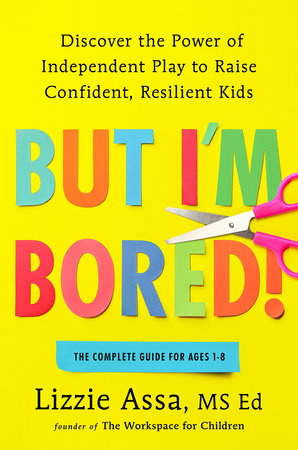
As the founder of The Workspace for Children, I have real, practical, simple, low-effort, high-impact answers to that question. Teaching parents and children how to institute independent play successfully in their homes is my mission. I have an MsED from the Bank Street College of Education in New York City and have taught at the Downtown Little School and the City and Country School in Manhattan, where child-led play principles are prized and practiced. And in all the press I have done over the years, no matter who is interviewing me, I get the same question again and again, which is some form of: “How do I get my children to play independently?”
Independent play has multiple benefits, including giving parents some time to themselves and building confidence and creativity in their children. This book will help you to create a home environment conducive to independent play. My goal is to help you personalize independent play for your unique family and child. The strategies I teach work, and I know that because I’ve used them with the many families I’ve coached, as well as with my own children.
When I decided to write this book, I did not want to add to all the noise. I wanted to help turn down the noise. You don’t have to do everything perfectly. It’s possible to get clear on what your family values are and create a life that reflects them. You can help your child to feel safe, connected, comfortable, and confident at home, even if the outside world doesn’t always feel that way. In the process, you’ll free your child to be a child, and also create more time for yourself. You’ll be better able to meet your own needs and parent in a way that feels more authentic to who you are.
When children play independently, they get to explore their lives and inner world on their own, instead of following someone else’s direction. They learn to come up with their own ideas, instead of relying on
your ideas. They learn to make plans, create what they imagine, figure out who they are and what they really love to do. Independent play time will give your children the opportunity to explore their own thoughts and interests.
Even boredom is a good thing in this context—kids are rarely bored anymore, when they are given access to so much digital stimulation, but boredom is what leads to creativity. You may be in the habit of preventing your child from becoming bored, but boredom is exactly what opens the door for children to begin dreaming, creating, and gaining confidence in their own ability to entertain themselves.
Even if, for you, your child playing independently just means you finally get a chance to clean up the kitchen without anybody pulling on your clothing or whining “Mooommmm” or “Daaaddd,” wouldn’t that be worth the time it takes to read this book? You can have this. Your family can have this. This book was designed for you.
The goal of my work, my business, my courses, and now this book, is to build play confidence in ways that contribute to the culture of your family. In this book, you’ll learn more about how to discover who your child really is, what’s developmentally appropriate, how to think differently about what play is, and how your child could best be playing independently, in a way tailored to their unique personality.
You’ll learn how to create play pockets throughout your home, how to choose open-ended toys that spark imagination rather than controlling it, how to set play boundaries and stick to them, the wonders of quiet time, and how to close the loop afterwards with connection time that strengthens your relationship with your child, helps them to feel seen and loved, and doesn’t take up your entire day.
I’m also going to talk frankly about parental guilt, because not spending time with your children can feel like you aren’t doing your job. In reality, it’s exactly the opposite. I know what parental burnout feels like. I’ve been there myself. Burnout helps no one. We all need help, but the last thing a busy parent needs is more things to do.
If somebody told me to read a book about a parenting system that was going to take a lot of time and be a lot of work, I wouldn’t be interested. That’s not the book I’m writing. These strategies aren’t about giving you more to do. They are about giving you less to do, with high-impact, low-effort strategies that will give you the space and time you need to replenish and get things done that aren’t about direct interaction with your children. Then, when you are with your child, you will be a more connected, more alert, more focused, better-listening parent than you were before.
That’s what every child really needs.
In a world we can’t always control, independent play gives children the chance to create a world they
can control. As you watch your child become more independent, more confident at expressing their natural talents, as you see their interests sprouting and spreading from the seeds you have planted at home, your entire family will benefit. You will all feel calmer, more connected, and your child won’t depend on you—or on screens—for their constant entertainment.
This book will help you to create an oasis of calm in your home where your family can be together and—in ways
everybody loves and needs—also be apart. From there, you can watch your child grow into an independent, self-directed young adult.
Copyright © 2026 by Lizzie Assa, MSEd. All rights reserved. No part of this excerpt may be reproduced or reprinted without permission in writing from the publisher.