Chapter 1
Before
Elwood Scudder rose from his cot like a broken marionette. His limbs refused to cooperate, his head heavy as an anchor.
Something was scratching and scuffling outside his cabin. Surely, he’d shut the storage bins last night so the raccoons wouldn’t ransack his food again. But from the pain thrumming behind his eyes and the bottles littering the floor, it was more likely he had not.
Elwood pinched the bridge of his nose and blinked a slow, rolling blink as the scuffling from outside stirred again.
“I hate raccoons,” he muttered.
Scanning the cabin for his boots, he found them still on his feet. He tiptoed over the empty bottles so as not to alert the thieving varmints outside. Each step required herculean focus just to reach the door.
So far, hunting season had been little more than baiting traps and waiting in deer blinds. Elwood had yet to catch any prey.
Until now, he thought.
He seized his rifle, then fumbled through his pockets for his phone, the one his wife made him carry when he was alone in the woods.
Take it, she had insisted.
I trust you, but not your bad heart. So far, he’d found the thing utterly worthless, save for its flashlight. He switched it on and stepped out into the frost-caked dawn of September. The ground crackled underfoot, so Elwood sat to remove his boots, choosing wet socks and frozen feet over losing the element of surprise. It was far more difficult than expected.
Struggling to his feet, he gripped the stock of the rifle and leveled it to his eye. The barrel bounced unsteadily, so Elwood squeezed his eyes shut and shook his head to clear the cobwebs. That only made him feel like he was at sea.
“Focus, Scudder,” he grumbled.
After a few settling breaths, he peered around the cabin’s corner.
The lid of the first bin showed no sign of intruders, nor did the second, both latched and locked as they should be. But the third was not. There, a dark shape rummaged under its open cover. Softly, or as softly as his fumbling fingers would allow, Elwood released the rifle’s safety lock.
Far too loudly.
The shadow shot up from inside the bin and locked its pale green eyes on Elwood. However, the creature staring back at Elwood wasn’t a raccoon, or any animal for that matter, but an older girl dressed in what looked like a hospital gown. It was a strange sight, for sure, but not nearly as strange as what protruded from the girl’s head. They looked like rounded horns—no, branches covered in thorns.
Elwood, while not a particularly religious man, certainly not a good one, still thought only one thing.
“Devil!” he hollered.
At the word, the girl sprang from the bin, her green eyes widening even further.
Then, with surprising speed, she turned for the woods and fled.
Elwood rushed to stop her, gun still raised, and stumbled over his feet. He crashed hard to the ground, his rifle discharging a single report into the air, sending nesting birds scattering like musket fire.
Clawing onto all fours, his weak heart pounding, Elwood grimaced at his phone’s flashlight shining up at him. He snatched it with one hand, rubbing away rings of blindness with the other, and turned its beam back toward the bin.
A figure flashed across the phone’s screen, its camera accidentally activated after his fall. The girl was charging deeper into the forest toward the high briar.
“Stop!” he cried, knowing there was no passage through the razor-like thicket.
But when the girl reached the hedge, it simply parted like a theater curtain ushering her through. She turned back as the woody tangle knitted closed once more, her eyes as wild as a wolf’s and her head cloaked in the same thorns that surrounded her. And then she, and everything around her, bloomed in an explosion of white flowers.
Elwood, whose simple mind had little room for things that weren’t obvious, did the only thing he could think of: He snapped a picture as the girl disappeared.
Chapter 2
Far from Ordinary
“Brides,” growls Mom, hanging up the phone. “Weddings would be so much better if there weren’t brides. Somehow, because it’s their happiest day, they insist on making it everybody else’s worst! Promise me now, Sprout, you won’t be like that when you get married.”
I don’t answer, nor do I look up from my book. I merely give a thumbs-up. The first reason is because Mom says this every week about her wedding clients. The second is that, given my unusual condition, the idea of marrying anyone seems unlikely. Not that it bothers me much. It just means I’ll probably become one of those old ladies with lots of cats, which is unfortunate because I’m a dog person. Although currently the dog next to me, a three-legged pound pooch named Speedwell, is doing little to ingratiate himself after stealing my bean burrito when I wasn’t looking.
“You’re revolting,” I say to him. “I can’t believe you snarfed that whole thing.”
Speedwell, belly up, only thumps his tail in response.
“So, what does this one want?” I ask, returning to Mom’s bride dilemma du jour.
“She’s decided she wants bluebird-blue lavender flowers to match her bridesmaid gowns. And only a day before the wedding.”
“Is there even such a thing as bluebird-blue lavender?”
“Of course there isn’t. But apparently, the internet says otherwise.”
“You know, the internet also says Abraham Lincoln was a vampire slayer.”
“Precisely.”
“Well, there’s gotta be something else.”
Mom shrugs. “I’d trudge out to the Delacroix estate if I had time. There’s a field of wild delphinium next to the greenhouse. Though, things were so overgrown last time I was there, I doubt I could even reach it now.”
“Oh, I know,” I say with a snap of my fingers. “What about buttercups? Those come in blue.”
Mom shakes her head. “I suggested that, but the bride said her sister had buttercups for her wedding.”
“And?”
“And apparently, she hates her sister.”
This is another comment made weekly and one more reminder of why I’m glad to be an only child. Sibling drama seems like a waste of energy, and I prefer to reserve my snark for higher callings, like rebelling against the worthless mindfulness exercises Mom makes me do to calm my emotions.
“I’ll come up with something,” says Mom. “Unless you know somewhere else I could get a few blue blossoms in a pinch?”
Her eyes drift suggestively to the top of my head.
“You’re funny,” I say, not meaning it.
“Fine. If you want to help, you can go to the barn and grab me six of those oval baskets with the tall handles.”
“That’s odd. I don’t remember saying I wanted to help,” I reply with a scrutinizing eyebrow.
“That’s odd. I don’t remember you not remembering,” says Mom with her own look, which means
Now.
“On my way,” I huff, giving my best side-eye and throwing in an extra helping of victimization.
“Ahem,” hints Mom, stopping me before I reach the door. “Forgetting something?”
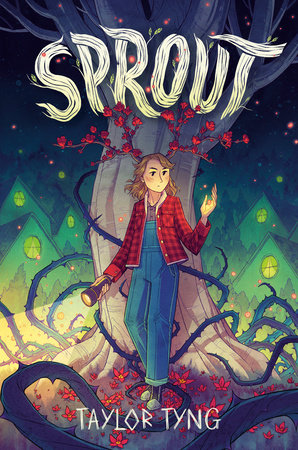
“Sorry,” I grumble, grabbing the faded green corduroy hat from the coatrack.
Honestly, she shouldn’t need to remind me. After all, my pageboy cap is as much a part of me as anything else is. Furthermore, Mom’s insistence that I wear it isn’t because it’s cold outside. It’s because of who I am.
To say I’m different from other thirteen-year-old girls—or from anyone—is like calling a boiling pot warm. It’s like saying wasps prick, or sharks nibble, or that oxygen is merely helpful. My kind of different goes beyond category, light-years past unexplainable, into a world of human unknown. And though it’s reasonable to think you would’ve heard my story before, I doubt you’d know anything about me, let alone ever see me, even if you happened to visit the old mill town of Tolsbury, Massachusetts, where I live.
Copyright © 2026 by Taylor Tyng. All rights reserved. No part of this excerpt may be reproduced or reprinted without permission in writing from the publisher.