Close Modal

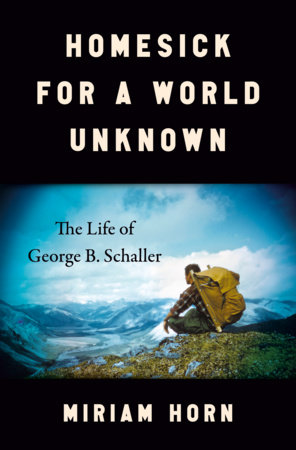
Homesick for a World Unknown

The Life of George B. Schaller

Look inside
Hardcover
$40.00 US
6.38"W x 9.56"H x 1.66"D   (16.2 x 24.3 x 4.2 cm) | 30 oz (850 g) | 12 per carton
On sale Apr 21, 2026 | 640 Pages | 9781984881342
Sales rights: World

In this riveting portrait of George B. Schaller, the world’s leading field biologist, Miriam Horn captures the seventy years he spent living among wild animals in the world’s remotest regions, forever altering how we see—and save—the natural world

In 1959, though just twenty-six years old and a graduate student, George B. Schaller shrugged off warnings of mortal danger and set off for the Belgian Congo to do what no other scientist had dared: study mountain gorillas, the real King Kong, by living alongside them. Boldly refusing arms and retinue, Schaller and his wife, Kay, established a home in the jungle and came to share the apes’ rhythms and rules. After more than two years of immersive research—a groundbreaking methodology he would spend his life honing—Schaller transformed how the world viewed gorillas; they were not murderous brutes but tender creatures, and more like humans than any twentieth-century scientist had recognized. His mission to revolutionize our perceptions of wild animals would propel him across four continents and inspire generations of scientists.

In Homesick for a World Unknown, Miriam Horn draws on thousands of pages from Schaller’s journals and letters, globe-spanning interviews, and two journeys into the field with the legendary scientist himself to trace his emergence as the founding father of modern wildlife conservation. She probes what drives him to know Earth’s wildest places and most fearsome creatures, beginning with a childhood upended by displacement and atrocity. Born in Berlin in 1933 to an American socialite married to a German diplomat during the Nazi era, the young Schaller was moved from one occupied country to another before finally arriving with his mother in the U.S. in 1947, as an enemy alien. It was in the Missouri woods that teenage George found a place of respite and at the University of Alaska that he found both his calling and a lifelong partner in Kay.

In the decades following his work in the Congo, Schaller went on to conduct the earliest studies of Indian tigers, Serengeti lions, Brazilian jaguars, Chinese pandas, and Tibetan brown bears, meticulously cataloging their private lives. He navigated acute danger, violent conflict, and treacherous politics in pursuit of empathy for and preservation of creatures big and small. It was Schaller who first guided Jane Goodall on her chimp study in Tanzania and led Peter Matthiessen into Nepal in search of the snow leopard. And while remaking wildlife science, his impact went further still: he spurred the creation of vast national parks and partnered with local communities to protect the homes they share with these animals. A vivid and captivating account of the adventurous life of George B. Schaller, here is the definitive portrait of the man who dared to challenge us to rethink our place in the natural world.
P R O L O G U E


He would be torn limb from limb.


All the Great Men of Science said so, if this rash young man went to live with the real King Kong, Africa’s monstrous mountain gorilla. Known the world over for its crazed chest‑beating and hooting, slavering scream, this ape was savagery incarnate, or worse: a creature—as the first Westerner to ever see one had warned—of that “hideous order, half man, half beast.” Fearing that not even bullets would stop the demon, Paul du Chaillu had ordered his men to load their flintlocks with ragged hunks of cast iron. None ever forgot the goliath’s dying groans, “full of brutishness” yet “terribly human.”


George Beals Schaller had read Du Chaillu’s account when he set off for the Belgian Congo in 1959. He knew that Carl Akeley, who had killed five gorillas to stuff for the American Museum of Natural History—pausing along the way to strangle an attacking leopard with his bare hands—had called any white man who got close to one without shooting “a plain darn fool.” He had listened to famed paleoanthropologist Louis Leakey argue with other “old Africa hands” over whether Schaller should wear armor or a disguise, what weapons he should carry, whether he would survive at all.

And then, without retinue or pith helmet, George went to the gorillas. Alone. When charged by a roaring silverback, he stood his ground. He couldn’t have shot the brute if he’d wanted to. Certain that it would change his bearing in ways the apes would sense, he had refused—then and forever after—to carry a gun.


What emboldened a twenty‑six‑year‑old graduate student to defy the scientific magi, in these jungles and for the rest of his life? How did he step free of the fear that has driven so much of human history, and into relationships no scientist had yet ventured, including with Earth’s most reviled creatures?


History offered scant precedent for approaching wild animals in Schaller’s utterly unguarded way. Most zoologists had until then studied only specimens on cold tables, or broken creatures in shackles or cages. C. R. Carpenter had observed free‑living howler monkeys in Panama and gibbons in Thailand, but even he soon retreated to the controlled environment of his rhesus macaque compound in Puerto Rico. Konrad Lorenz’s studies of animal behavior would win him the Nobel Prize, but he had met his feather-weight geese and jackdaws as near pets within the menagerie he made of his own home.


The animals Schaller would spend his life with were far bigger than any of those, and sometimes truly dangerous. But they could be known, he believed, only by entering their world. So he transformed scientific practice: committing months or years to winning the trust and acceptance of lions and tigers and bears, assimilating to their rhythms and rules, endeavoring to see the universe through their eyes.


Though risky for a young scientist, that meant breaking all prevailing norms. For much of the twentieth century, the natural sciences, extending a lineage that ran from Descartes to B. F. Skinner, had insisted on a “disinterested” stance toward creatures seen to be of a distinctly lower order: insensate automatons, animated only by reflex. For the serious scientist, they were data; by “twisting the lion’s tail” (in Bacon’s apocryphal phrase) the “objective” investigator could answer a question, test a hypothesis, advance his own grand theories.

Schaller stood nearly alone in claiming a radically different conception of nature and science, this one descended from the nineteenth‑century Romantic understanding that the “expression of the emotions in man and animals,” as Darwin titled his final book, were variations on an evolutionary theme. If animals’ interior lives were closely akin to our own, empathy and intuition became critical instruments for understanding them, and lyricism for expressing their complexity. Nature held out a path not to cold mastery but to communion, a stepping free of the self into something far larger and more powerful.


Schaller’s quest to know these others would take him into six continents and a life of high drama and romance. Unmoored from his earliest days, he never quit moving, crashing into all the darkness and light the century had to offer, piling up enough brushes with death, transcendent encounters, and grand adventures to fill a dozen lives. Born in Berlin in 1933 to an ambitious young American socialite and a pliant diplomat working for Hitler, he survived aerial bombings, American soldiers’ rough searches, and a narrow escape from the Russian zone—fending for himself much of the time, evacuated again and again as the front closed in. Completing high school in Missouri as an enemy alien, then college in the territory of Alaska, he joined the expedition that gave birth to the Arctic National Wildlife Refuge, writing the trip report that ultimately helped sway Eisenhower. He stayed through the violence that erupted when Belgium abruptly left Congo, witnessing the tragedy that unfolds when desperate animals and desperate people collide, and taking mad risks to protect the gorillas. Again and again, for the sake of the giant panda or Marco Polo sheep, he navigated historic upheavals—from the aftermath of China’s Cultural Revolution to the flood of Kalashnikovs, Apache helicopters, and opium dealers unleashed in Afghanistan by its series of imperial wars.


Despite all the wrecked countries and tense borders, the informants, corrupt officials, and opportunistic expats, Schaller completed an astonishing run of first‑ever studies—of Indian tigers, Serengeti lions, Himalayan snow leopards, Brazilian jaguars, Chinese pandas, Gobi Desert wild camels, and the grand mountain goats, sheep, antelope, cats, and bears of the Tibetan Plateau, to which over forty years he was granted a near‑unfettered access no other Westerner has ever had. As David Attenborough, one of his myriad acolytes, once said, “I thought he must sit back and think: What other impossible creature can I imagine that nobody else could get near?”


Coming of age just as air travel became commonplace, Schaller reached far more of the planet than Alexander von Humboldt, Charles Darwin, or any of the earlier generations of adventurer‑naturalists. And, in this age of specialization, likely more than any since. Focused by his thirties on the unprotected and unstudied expanses where most life on Earth remained, he walked thousands of miles alone or with local companions, often traversing landscapes outsiders had never seen.


In many of those places—Pakistan’s scorched deserts, Sichuan’s iced bamboo forests, Brazil’s sultry wetlands—he stayed, sometimes for years. Settling into leopard or panda time, he endured alongside them the shrapnel of sandstorms, freezing blizzards and blistering heat, hunger, thirst, leeches, and larvae that burrow under the skin—and also their wild freedom, griefs, and loves. On occasion, he traveled even across time. Driven to know what life was like when we ourselves were still wildlife, he once spent a week living as a hominid near the site of our African origins, reliant on tools of his own making and scavenging what he couldn’t kill.
Like devotees across centuries, Schaller embraced the mortifications of the flesh and extreme tests inflicted by these pilgrimages—from abandonment in a whiteout at seventeen thousand feet to venomous snakes in malarial jungles. He came to know many kinds of emptiness and aloneness.


All was made bearable by his love, from age nineteen to the end of his life, for the slight, acerbic, ever‑undaunted Kay Morgan. It was she who kept their sons from toddling into the tiger ravine, she who ran after the pet baby warthog and bottle‑fed their rescued lion cub, searched out vegetables to stave off the boys’ rickets, shepherded them through middle school in Lahore while their father vanished for months into Asia’s highest mountains. Though she loved wildness as much as he, she paid her own high price for his commitment, superseding all others, to the largest idea of family.


Like the Horatii swearing their oath to Rome as wives and children wept, Schaller’s code of honor seemed of another age. Those asked to describe him often reached for archaic phrases. He was a “pillar” in the world, a man of “sterling character” and deep humility, a companion one would entrust with one’s life. He was not without powerful internal drives—the explorer’s to be first, the scientist’s to know and name, the artist’s to faithfully convey, the missionary’s to save. But his own psychology never much interested him, far less, certainly, than the mystery of these other beings. Much of his power lay in all he didn’t need: not wealth, nor fame, nor even adulation—at least from humans. Lacking (as his younger son put it) the “selfie emotions,” he steadfastly refused whatever might steal his time or dispirit him, including solipsism.


Instead, it was to the world that he brought his attention, as intense and devout as prayer. His patience and openness were the very opposite of the shallow, inflamed voyeurism we call our attention economy, so bent on searching out all the ways we are not “them.” What kept Schaller going through decades of acute danger and misery, political chaos and heartbreak, was an urge few beyond children or poets remember: to climb inside the other’s skin, to live unalienated in the manner of a bird or caribou. To be recognized as someone others needn’t fear.


If ultimately on a spiritual quest, Schaller had an immeasurable impact on the world. It’s hard to find a wildlife biologist on any continent untouched by “the most important animal researcher in the twentieth century,” as admirers from Attenborough to Michael Crichton have called him. It was Schaller who guided Jane Goodall in the first months of her chimp study. It was his work that Dian Fossey took up a decade later: She learned from him how to use noseprints to identify individuals and even worked with his tracker Sanwekwe, though she never forgot Mary Leakey’s withering dismissal: “‘So you’re the girl who’s going to out‑Schaller Schaller.’ It was an intimidating thought to carry with me.” The first chapter of her memoir, Gorillas in the Mist, is titled “In the Mountain Meadow of Carl Akeley and George Schaller”; in the film version, after Fossey (Sigourney Weaver) has fled headlong down the mountain pursued by a roaring male, the character based on Sanwekwe (John Omirah Miluwi) asks her, “What does Schaller’s book say when a gorilla charges?” It says, she answers, “Never run.”


Schaller’s nearly two dozen books, the finest of which zoologist Desmond Morris, author of The Naked Ape, ranked with the works of Darwin, Lorenz, and W. H. Auden, inspired many: Robert Sapolsky became a primatologist after reading The Year of the Gorilla; E. O. Wilson drew heavily on Schaller’s gorilla and lion studies in Sociobiology. His exacting methods—which included a “micro‑documentation [of the] frequency, weight, section count and position excreted of the creature’s faeces” that one admirer called “astonishing”—set the standard for all who followed, and cemented the enduring value of his studies. Half a century later, his monographs on gorillas, tigers, and lions are still relied upon by scientists and conservationists as their bible.


Most fundamental was his remaking, or recovery, of our understanding of animal consciousness. In the way that tunnels now give wild animals safe passage under highways, Schaller carried older, even ancient, values safely through the arid wastelands of modern science. His vivid rendering of these creatures—their singular personalities, memories, aspirations, friendships, and rivalries—laid the ground for generations of scientists who followed. Emulating his methods, they have reached across to elephants, octopuses, owls, hawks, crows, wolves, and myriad others, taking as given his insights on those beings’ complex societies, communication, and minds.


His influence reverberated far beyond science, marking some of the most important cultural artifacts of the past half century. Schaller is the “GS” who led Peter Matthiessen in search of the snow leopard. Director Stanley Kubrick based the Dawn of Man sequence that opens 2001: A Space Odyssey on his gorilla work, and Crichton wrote him into the sequel to Jurassic Park, offered to a diffident young scientist as an exemplar, a renegade who proved expert after expert to be “wrong . . . just wrong.”


His impact on the global political landscape was just as profound. From his walks across continents, he grasped before others, and more comprehensively, the radical changes unfolding in even the remotest places. Over seven decades he saw the before and after, crossing terrain largely unaltered since the Pleistocene, but also lands once vibrating with millions of animals now emptied of life. Witnessing firsthand our modern Great Dying, he led his peers in turning from pure science to learning what animals need to survive, setting in motion what in the 1970s would become the new field of conservation biology. And despite a reserve that borders on the hermetic, he proved masterful at diplomacy—persuading governments to protect parks in China, Afghanistan, and a half dozen other countries that together span more than two hundred thousand square miles, an area bigger than France. Were it not for Schaller, we would likely have no mountain gorillas, no wild pandas. As Mannahatta author Eric W. Sanderson put it: “George saved more nature than anyone, ever.”


That accomplishment depended on yet another, if far slower, transformation. When Schaller began his work in the Belgian Congo, conservation was still infected with ideas of the white man’s burden. The men in London and Brussels who ruled the fate of most of the world’s wild animals asserted the same authority over the people who lived alongside those animals. They were “Naturvölker” to be managed, or intrusions on Eden to be cleared away.


Perhaps opened up by his rebellion against the scientific establishment to other kinds of knowledge, Schaller was able, stepwise, to see more. From the Gwich’in in Alaska and Batwa in Congo he learned how deeply people with millennia of tenure know the animals and land. In India he saw that tigers would be safe only if their human neighbors were too; in Nepal, that villagers and wild sheep depended on the same forests and grasslands, and were equally doomed if the trees and grasses were stripped by loggers or overgrazing. Though it would take decades, he would come to see in China and Afghanistan that it had to be the local communities who shaped and enforced protections, because it was right, and because it was the only way they’d endure.


As George grew into these insights, he helped pull the world along with him, leading a process still underway of decolonizing conservation. As head for many decades of global field science at the Wildlife Conservation Society (WCS), the nation’s longest‑running wildlife conservation organization and the first to hire field scientists, he advanced community‑led conservation and nourished what he counts as his most important legacy: three generations of Indian, Chinese, Brazilian, Rwandan, and Afghani scientists, many of them women, creating new possibilities in their home countries for animals and humans together.


Though he is a magnificent writer, winning many honors including a National Book Award, Schaller always counted himself a “biographer of animals.” Far from the “awful lot of ‘I’” that characterizes much nature writing, he offered only sparing glimpses of himself. Subsumed in these other beings’ lives, the existential crises he wrestled with were theirs. He had practical reasons, too, for his self‑effacement: In places like China, he was often most effective when least visible.


Having turned down many biographers, he submitted to my scrutiny only late in life, hoping (it seems) to leave one more useful bit of himself behind. Because I had spent half my life working in conservation, for the US Forest Service and Environmental Defense Fund, and written in previous books about the challenges and synergies in reconciling human and nonhuman lives, he thought I could be trusted, he later told me, to be true to the complexities.


Over the course of nearly six years, George and Kay allowed me to spend many days in their New Hampshire home, interviewing them individually and together and wading through family albums, letters, diaries, and crates of slides, fossils, horns, and other treasures. George often loomed about as I worked, answering any scientific questions precisely, even ones he’d not considered for half a century. Twice, we traveled together. In early 2020 we went to India where, more than fifty years after his landmark study of tigers, acolytes traveled many days and nights to meet him, and locals still sought his guidance on how to resolve life‑or‑death conflicts between humans and wildlife—pressed into closer proximity there than anywhere else on Earth. Though I saw how ill at ease he was in the throngs jamming India’s streets and airports, he clearly loved animal teemings, content to watch for hours as sambar, wild pigs, chital, and finally a tiger wandered through the maidan. A second trip to the US–Mexico borderlands in summer 2024 found him still intent at ninety‑one to understand how the border wall had doomed Arizona’s historic population of jaguars, and how Mexican and American scientists were working together to recover them.


Like all who spend time with him, I crashed into his world‑class taciturnity. Most people, when invited to talk about themselves, go on and on. George answered as tersely as possible, then stopped; there was no warming to the attention nor pleasure at the sound of his own voice. “Not easy to know,” Peter Matthiessen once said of him.


Silence is an obligatory habit for those who watch animals. But Schaller’s went further. Dropping again and again into new countries—thirty‑two in all—each infinitely complex in its history, social structures, and politics, he learned to listen, speaking on what he knew (ecology), quiet on all he recognized that even years in a country would not suffice to understand. Running deeper still was an awkwardness born of his perennially exiled and perilous childhood. Cat biologist Alan Rabinowitz, who overcame the isolation imposed by a childhood stutter by visiting the jaguars in the Bronx Zoo, saw in his mentor a familiar hesitancy. George himself saw that “animals tend to be shy because people have made them afraid” with our noise and menace, because he had been made shy that way too.

My task, in short, often mimicked Schaller’s: to peer into an opaque creature.


I stumbled into a second, stranger parallel when George and his siblings put seventy‑year‑old Bundesarchiv documents into my hands. Like my father, who had escaped from Germany in 1939 but returned in 1941 as an American spy, Schaller’s father spent the last years of the war in Bavaria, interrogating high‑ranking prisoners of war. Our fathers had the same job, that is, on opposite sides.


It was the Schallers’ openness, matched by their gift across generations for preserving artifacts, that ultimately made this biography possible. I was permitted to read a century of letters saved through war, exile, and many transcontinental moves; journals kept by Kay and the boys; “lost” materials including Schaller’s proposal to Pakistan’s Zulfikar Ali Bhutto for a national park; talismans saved by others, like his 1973 packing list for Peter Matthiessen. Colleagues and friends across sixteen countries were just as generous with their vivid memories, dating as far back as the early 1960s.


Richest of all were the two daily field journals Schaller kept for seventy years—one for data, one narrative—recording in real time everything seen, heard, smelled, tasted, and felt by one of history’s most acute sensoria. It was through this writing, said colleague David Western (called Jonah, as he will be here), that “George thinks and reveals himself.” As the first to read the more than twenty thousand pages, now archived at the Yale Peabody Museum, I found “that real poetry,” as Nabokov called it, “with which the live experience of these receptive, knowledgeable and chaste naturalists endowed their research.”

Yet even in these stunningly precise accounts, the intensity cannot be felt vicariously. It is only through presence, our own animal body, that one can know the peace of being allowed near a wild creature or of having it meet your gaze; the primal anxiety of standing alone in a boundless landscape, ill‑equipped with a human’s weak senses to know who else is alive nearby. That I share with Schaller a call to these other beings posed a paradoxical obstacle. It is hard to explain a love one can’t imagine being without, to describe this deepest antidote to loneliness offered by the more-than‑human world.
"Engaging, often lyrical . . . Horn, a writer on environmental themes who previously worked for conservation groups, has obvious affection and admiration for her subject and his late wife, Kay, who often shared the dangers and deprivations of his long career. Both cooperated with the project, giving the author access to intimate family correspondence. But as Horn makes clear, despite her subject’s voluminous bibliography and more than 20,000 pages of accumulated field notes, the awkward, taciturn Schaller remains for her something of an 'opaque creature,' not unlike those whose lives he devoted himself to understanding . . . Schaller found his deepest satisfactions by disappearing into the last wildernesses, his eyes wide open. We could all stand to learn from his humility." —Gary Rosen, The New York Times Book Review

“Meticulously researched, gripping… Horn’s biography is a magnificent tribute not only to a giant of a scientist but also to a nearly vanished way of doing fieldwork: A science-trained person yearns to connect with other animals, observes them at length with binoculars and notebook in hand, and fires up to protect them from forces such as poaching and livestock overgrazing, government corruption, and climate change. Horn accurately sums up Schaller’s legacy: His work reminds us that ‘every being has an equal claim on life and freedom.’” —Science

"Homesick for a World Unknown is an extraordinarily engaging biography of an extraordinarily effective conservation biologist. Whether you’ve been following George Schaller’s pioneering studies and reading his books for half a century or you have just learned of him, you will devour this book and admire its subject." —Rewilding Magazine

"In Homesick for a World Unknown: The Life of George B. Schaller, Miriam Horn attempts something both straightforward and unusually difficult: to write a full biography of a man who spent most of his life turning his attention away from himself . . . The result is a book that is expansive without being intrusive, admiring without being reverential, and alert to ambiguity even when recounting an extraordinary career . . . The book is particularly strong when describing the practical consequences of Schaller’s work. His studies were not only descriptive; they became foundational . . . Jane Goodall, Dian Fossey, Peter Matthiessen, Robert Sapolsky, and many others were shaped by his work, sometimes directly . . . Schaller did not seek to dominate nature or withdraw from it. He tried, persistently, to understand it on its own terms. That ambition, modest and radical at once, gives Homesick for a World Unknown its lasting weight." —Mongabay

“[A] comprehensive biography of the renowned scientist and adventurer . . . A fine account of a life well lived, to the benefit of all who love animals.” —Kirkus (starred review)

“An invaluable portrait . . . As lavishly specific as its subject’s lifework . . . Horn is a spirited, virtuoso biographer and this tour de force is electric with Schaller’s dramatic and audacious pursuits, epic fortitude and determination, intrepidness and diplomacy, camouflaged pain and sheer ecstasy over the marvels of Earth, all charged by his resounding belief that ‘every being has an equal claim on life and freedom.’”—Booklist (starred review)

“A must-read for anyone interested in the history of conservation, as well as readers looking for solutions to current-day conservation crises.”Laura Nan Hargrove, Library Journal (starred review)

“George Schaller seems to have met, and understood, every animal on earth, from Serengeti lions to South American jaguars to Tibetan brown bears. As notable for his foundational texts as for his unorthodox methods, Schaller could lasso an anaconda and mesmerize a panda. (Then there were the unusual pets, the lion cub, warthog, sand boa, and mongoose among them). First in the field, Schaller was the last of his kind; Miriam Horn makes us homesick for his brand of immersive adventure in this splendid, gracefully written biography.” —Stacy Schiff, Pulitzer Prize-winning author of The Revolutionary

"A magnificent and inspiring book on a magnificent and inspiring life. George Schaller’s work has forever changed our understanding of animals and the science of conservation and field biology, and this book explores the deep—and at times dark—well from which he draws his extraordinary courage, compassion, and insight. I was riveted from page one, and you will be, too." —Sy Montgomery, National Book Award Finalist and New York Times bestselling author of The Soul of an Octopus

"Before there was Goodall or Fossey, before there were National Geographic wildlife films, school conservation clubs, Earth Day, there was George Schaller, our greatest naturalist. For 70 years, he has gone to Earth's last wild places to understand their animals, to translate and advocate for them, all while seemingly never leaving a soiling footprint in his wake. This is the beautiful biography that those of us in awe of Schaller have waited for." —Robert Sapolsky, New York Times bestselling author of Determined and Behave

“An enthralling, engaging masterwork, Homesick for a World Unknown follows almost day by day the life of the pioneering field biologist George Schaller. As he did, we live among Congo gorillas, Indian tigers, Serengeti lions, Tibetan bears. He taught Jane Goodall how to study chimps. He set an example for whole generations of scientists. What a story!” —Richard Rhodes, Pulitzer Prize-winning author of The Making of the Atomic Bomb and Scientist

"A brilliant, beautifully crafted biography of the world’s most intrepid explorer and naturalist. Miriam Horn captures George Schaller’s relentless, patient encounters with Africa’s mountain gorillas, Nepal’s snow leopards and dozens of other fast-disappearing wildlife throughout the globe. Schaller’s life is a heart-rending story of physical courage, stamina and human empathy for the private lives of these remarkable creatures. Horn’s Schaller is at once an adventure story, a love story and an inspiring celebration of scientific inquiry. A formidable achievement." —Kai Bird, Pulitzer Prize-winning historian and director of the Leon Levy Center for Biography
© Ahna Tessler
Miriam Horn is a bestselling author, environmental advocate, journalist, and filmmaker. Her previous books include Rebels in White Gloves, Earth: The Sequel (coauthor), and Rancher, Farmer, Fisherman. She produced two as documentary films, with one premiering at Sundance. Before turning to books, Horn worked at the Environmental Defense Fund and the US Forest Service, and wrote for magazines and newspapers, including The New York Times. She lives in Colorado, in the South San Juan Mountains. View titles by Miriam Horn
Available for sale exclusive:
•     Afghanistan
•     Aland Islands
•     Albania
•     Algeria
•     Andorra
•     Angola
•     Anguilla
•     Antarctica
•     Antigua/Barbuda
•     Argentina
•     Armenia
•     Aruba
•     Australia
•     Austria
•     Azerbaijan
•     Bahamas
•     Bahrain
•     Bangladesh
•     Barbados
•     Belarus
•     Belgium
•     Belize
•     Benin
•     Bermuda
•     Bhutan
•     Bolivia
•     Bonaire, Saba
•     Bosnia Herzeg.
•     Botswana
•     Bouvet Island
•     Brazil
•     Brit.Ind.Oc.Ter
•     Brit.Virgin Is.
•     Brunei
•     Bulgaria
•     Burkina Faso
•     Burundi
•     Cambodia
•     Cameroon
•     Canada
•     Cape Verde
•     Cayman Islands
•     Centr.Afr.Rep.
•     Chad
•     Chile
•     China
•     Christmas Islnd
•     Cocos Islands
•     Colombia
•     Comoro Is.
•     Congo
•     Cook Islands
•     Costa Rica
•     Croatia
•     Cuba
•     Curacao
•     Cyprus
•     Czech Republic
•     Dem. Rep. Congo
•     Denmark
•     Djibouti
•     Dominica
•     Dominican Rep.
•     Ecuador
•     Egypt
•     El Salvador
•     Equatorial Gui.
•     Eritrea
•     Estonia
•     Ethiopia
•     Falkland Islnds
•     Faroe Islands
•     Fiji
•     Finland
•     France
•     Fren.Polynesia
•     French Guinea
•     Gabon
•     Gambia
•     Georgia
•     Germany
•     Ghana
•     Gibraltar
•     Greece
•     Greenland
•     Grenada
•     Guadeloupe
•     Guam
•     Guatemala
•     Guernsey
•     Guinea Republic
•     Guinea-Bissau
•     Guyana
•     Haiti
•     Heard/McDon.Isl
•     Honduras
•     Hong Kong
•     Hungary
•     Iceland
•     India
•     Indonesia
•     Iran
•     Iraq
•     Ireland
•     Isle of Man
•     Israel
•     Italy
•     Ivory Coast
•     Jamaica
•     Japan
•     Jersey
•     Jordan
•     Kazakhstan
•     Kenya
•     Kiribati
•     Kuwait
•     Kyrgyzstan
•     Laos
•     Latvia
•     Lebanon
•     Lesotho
•     Liberia
•     Libya
•     Liechtenstein
•     Lithuania
•     Luxembourg
•     Macau
•     Macedonia
•     Madagascar
•     Malawi
•     Malaysia
•     Maldives
•     Mali
•     Malta
•     Marshall island
•     Martinique
•     Mauritania
•     Mauritius
•     Mayotte
•     Mexico
•     Micronesia
•     Minor Outl.Ins.
•     Moldavia
•     Monaco
•     Mongolia
•     Montenegro
•     Montserrat
•     Morocco
•     Mozambique
•     Myanmar
•     Namibia
•     Nauru
•     Nepal
•     Netherlands
•     New Caledonia
•     New Zealand
•     Nicaragua
•     Niger
•     Nigeria
•     Niue
•     Norfolk Island
•     North Korea
•     North Mariana
•     Norway
•     Oman
•     Pakistan
•     Palau
•     Palestinian Ter
•     Panama
•     PapuaNewGuinea
•     Paraguay
•     Peru
•     Philippines
•     Pitcairn Islnds
•     Poland
•     Portugal
•     Puerto Rico
•     Qatar
•     Reunion Island
•     Romania
•     Russian Fed.
•     Rwanda
•     S. Sandwich Ins
•     Saint Martin
•     Samoa,American
•     San Marino
•     SaoTome Princip
•     Saudi Arabia
•     Senegal
•     Serbia
•     Seychelles
•     Sierra Leone
•     Singapore
•     Sint Maarten
•     Slovakia
•     Slovenia
•     Solomon Islands
•     Somalia
•     South Africa
•     South Korea
•     South Sudan
•     Spain
•     Sri Lanka
•     St Barthelemy
•     St. Helena
•     St. Lucia
•     St. Vincent
•     St.Chr.,Nevis
•     St.Pier,Miquel.
•     Sth Terr. Franc
•     Sudan
•     Suriname
•     Svalbard
•     Swaziland
•     Sweden
•     Switzerland
•     Syria
•     Tadschikistan
•     Taiwan
•     Tanzania
•     Thailand
•     Timor-Leste
•     Togo
•     Tokelau Islands
•     Tonga
•     Trinidad,Tobago
•     Tunisia
•     Turkey
•     Turkmenistan
•     Turks&Caicos Is
•     Tuvalu
•     US Virgin Is.
•     USA
•     Uganda
•     Ukraine
•     Unit.Arab Emir.
•     United Kingdom
•     Uruguay
•     Uzbekistan
•     Vanuatu
•     Vatican City
•     Venezuela
•     Vietnam
•     Wallis,Futuna
•     West Saharan
•     Western Samoa
•     Yemen
•     Zambia
•     Zimbabwe

Contents

Prologue 1

1. A Box of Eggs
Europe, 1933–47

2. Coming Into the Country
US, 1947–59, Raptors, Ravens, Grizzly Bears, Caribou

3. Gorilla Honeymoon
Congo, 1959–60, Mountain Gorillas

4. Burning Bright
India, 1963–65, Tigers and Their Prey

5. A Peaceable Kingdom
Serengeti, 1966–69, Lions, Wild Dogs, Cheetah

6. Into the High and Magical Realms Pakistan and Nepal, 1970–75, Snow Leopard, Punjab Urial, Blue and Marco Polo Sheep, Markhor and Wild Sindh Goats
7. New‑World Jungles
Brazil, 1975–79, Jaguars, Caiman, Capybara

8. Rescued to Death
Sichuan Province, China, 1980–85, Giant Pandas

9. Forty Years in Tibet
Tibetan Plateau, 1980–2020, Tibetan Antelope, Tibetan Brown Bear, Snow Leopard

Epilogue
North, South, and West of China, 1989–2020, Gobi Bears, Mongolian Gazelle, Wild Bactrian Camels, Indochinese Warty Pig, Saola, Asiatic Cheetah

About

In this riveting portrait of George B. Schaller, the world’s leading field biologist, Miriam Horn captures the seventy years he spent living among wild animals in the world’s remotest regions, forever altering how we see—and save—the natural world

In 1959, though just twenty-six years old and a graduate student, George B. Schaller shrugged off warnings of mortal danger and set off for the Belgian Congo to do what no other scientist had dared: study mountain gorillas, the real King Kong, by living alongside them. Boldly refusing arms and retinue, Schaller and his wife, Kay, established a home in the jungle and came to share the apes’ rhythms and rules. After more than two years of immersive research—a groundbreaking methodology he would spend his life honing—Schaller transformed how the world viewed gorillas; they were not murderous brutes but tender creatures, and more like humans than any twentieth-century scientist had recognized. His mission to revolutionize our perceptions of wild animals would propel him across four continents and inspire generations of scientists.

In Homesick for a World Unknown, Miriam Horn draws on thousands of pages from Schaller’s journals and letters, globe-spanning interviews, and two journeys into the field with the legendary scientist himself to trace his emergence as the founding father of modern wildlife conservation. She probes what drives him to know Earth’s wildest places and most fearsome creatures, beginning with a childhood upended by displacement and atrocity. Born in Berlin in 1933 to an American socialite married to a German diplomat during the Nazi era, the young Schaller was moved from one occupied country to another before finally arriving with his mother in the U.S. in 1947, as an enemy alien. It was in the Missouri woods that teenage George found a place of respite and at the University of Alaska that he found both his calling and a lifelong partner in Kay.

In the decades following his work in the Congo, Schaller went on to conduct the earliest studies of Indian tigers, Serengeti lions, Brazilian jaguars, Chinese pandas, and Tibetan brown bears, meticulously cataloging their private lives. He navigated acute danger, violent conflict, and treacherous politics in pursuit of empathy for and preservation of creatures big and small. It was Schaller who first guided Jane Goodall on her chimp study in Tanzania and led Peter Matthiessen into Nepal in search of the snow leopard. And while remaking wildlife science, his impact went further still: he spurred the creation of vast national parks and partnered with local communities to protect the homes they share with these animals. A vivid and captivating account of the adventurous life of George B. Schaller, here is the definitive portrait of the man who dared to challenge us to rethink our place in the natural world.

Excerpt

P R O L O G U E


He would be torn limb from limb.


All the Great Men of Science said so, if this rash young man went to live with the real King Kong, Africa’s monstrous mountain gorilla. Known the world over for its crazed chest‑beating and hooting, slavering scream, this ape was savagery incarnate, or worse: a creature—as the first Westerner to ever see one had warned—of that “hideous order, half man, half beast.” Fearing that not even bullets would stop the demon, Paul du Chaillu had ordered his men to load their flintlocks with ragged hunks of cast iron. None ever forgot the goliath’s dying groans, “full of brutishness” yet “terribly human.”


George Beals Schaller had read Du Chaillu’s account when he set off for the Belgian Congo in 1959. He knew that Carl Akeley, who had killed five gorillas to stuff for the American Museum of Natural History—pausing along the way to strangle an attacking leopard with his bare hands—had called any white man who got close to one without shooting “a plain darn fool.” He had listened to famed paleoanthropologist Louis Leakey argue with other “old Africa hands” over whether Schaller should wear armor or a disguise, what weapons he should carry, whether he would survive at all.

And then, without retinue or pith helmet, George went to the gorillas. Alone. When charged by a roaring silverback, he stood his ground. He couldn’t have shot the brute if he’d wanted to. Certain that it would change his bearing in ways the apes would sense, he had refused—then and forever after—to carry a gun.


What emboldened a twenty‑six‑year‑old graduate student to defy the scientific magi, in these jungles and for the rest of his life? How did he step free of the fear that has driven so much of human history, and into relationships no scientist had yet ventured, including with Earth’s most reviled creatures?


History offered scant precedent for approaching wild animals in Schaller’s utterly unguarded way. Most zoologists had until then studied only specimens on cold tables, or broken creatures in shackles or cages. C. R. Carpenter had observed free‑living howler monkeys in Panama and gibbons in Thailand, but even he soon retreated to the controlled environment of his rhesus macaque compound in Puerto Rico. Konrad Lorenz’s studies of animal behavior would win him the Nobel Prize, but he had met his feather-weight geese and jackdaws as near pets within the menagerie he made of his own home.


The animals Schaller would spend his life with were far bigger than any of those, and sometimes truly dangerous. But they could be known, he believed, only by entering their world. So he transformed scientific practice: committing months or years to winning the trust and acceptance of lions and tigers and bears, assimilating to their rhythms and rules, endeavoring to see the universe through their eyes.


Though risky for a young scientist, that meant breaking all prevailing norms. For much of the twentieth century, the natural sciences, extending a lineage that ran from Descartes to B. F. Skinner, had insisted on a “disinterested” stance toward creatures seen to be of a distinctly lower order: insensate automatons, animated only by reflex. For the serious scientist, they were data; by “twisting the lion’s tail” (in Bacon’s apocryphal phrase) the “objective” investigator could answer a question, test a hypothesis, advance his own grand theories.

Schaller stood nearly alone in claiming a radically different conception of nature and science, this one descended from the nineteenth‑century Romantic understanding that the “expression of the emotions in man and animals,” as Darwin titled his final book, were variations on an evolutionary theme. If animals’ interior lives were closely akin to our own, empathy and intuition became critical instruments for understanding them, and lyricism for expressing their complexity. Nature held out a path not to cold mastery but to communion, a stepping free of the self into something far larger and more powerful.


Schaller’s quest to know these others would take him into six continents and a life of high drama and romance. Unmoored from his earliest days, he never quit moving, crashing into all the darkness and light the century had to offer, piling up enough brushes with death, transcendent encounters, and grand adventures to fill a dozen lives. Born in Berlin in 1933 to an ambitious young American socialite and a pliant diplomat working for Hitler, he survived aerial bombings, American soldiers’ rough searches, and a narrow escape from the Russian zone—fending for himself much of the time, evacuated again and again as the front closed in. Completing high school in Missouri as an enemy alien, then college in the territory of Alaska, he joined the expedition that gave birth to the Arctic National Wildlife Refuge, writing the trip report that ultimately helped sway Eisenhower. He stayed through the violence that erupted when Belgium abruptly left Congo, witnessing the tragedy that unfolds when desperate animals and desperate people collide, and taking mad risks to protect the gorillas. Again and again, for the sake of the giant panda or Marco Polo sheep, he navigated historic upheavals—from the aftermath of China’s Cultural Revolution to the flood of Kalashnikovs, Apache helicopters, and opium dealers unleashed in Afghanistan by its series of imperial wars.


Despite all the wrecked countries and tense borders, the informants, corrupt officials, and opportunistic expats, Schaller completed an astonishing run of first‑ever studies—of Indian tigers, Serengeti lions, Himalayan snow leopards, Brazilian jaguars, Chinese pandas, Gobi Desert wild camels, and the grand mountain goats, sheep, antelope, cats, and bears of the Tibetan Plateau, to which over forty years he was granted a near‑unfettered access no other Westerner has ever had. As David Attenborough, one of his myriad acolytes, once said, “I thought he must sit back and think: What other impossible creature can I imagine that nobody else could get near?”


Coming of age just as air travel became commonplace, Schaller reached far more of the planet than Alexander von Humboldt, Charles Darwin, or any of the earlier generations of adventurer‑naturalists. And, in this age of specialization, likely more than any since. Focused by his thirties on the unprotected and unstudied expanses where most life on Earth remained, he walked thousands of miles alone or with local companions, often traversing landscapes outsiders had never seen.


In many of those places—Pakistan’s scorched deserts, Sichuan’s iced bamboo forests, Brazil’s sultry wetlands—he stayed, sometimes for years. Settling into leopard or panda time, he endured alongside them the shrapnel of sandstorms, freezing blizzards and blistering heat, hunger, thirst, leeches, and larvae that burrow under the skin—and also their wild freedom, griefs, and loves. On occasion, he traveled even across time. Driven to know what life was like when we ourselves were still wildlife, he once spent a week living as a hominid near the site of our African origins, reliant on tools of his own making and scavenging what he couldn’t kill.
Like devotees across centuries, Schaller embraced the mortifications of the flesh and extreme tests inflicted by these pilgrimages—from abandonment in a whiteout at seventeen thousand feet to venomous snakes in malarial jungles. He came to know many kinds of emptiness and aloneness.


All was made bearable by his love, from age nineteen to the end of his life, for the slight, acerbic, ever‑undaunted Kay Morgan. It was she who kept their sons from toddling into the tiger ravine, she who ran after the pet baby warthog and bottle‑fed their rescued lion cub, searched out vegetables to stave off the boys’ rickets, shepherded them through middle school in Lahore while their father vanished for months into Asia’s highest mountains. Though she loved wildness as much as he, she paid her own high price for his commitment, superseding all others, to the largest idea of family.


Like the Horatii swearing their oath to Rome as wives and children wept, Schaller’s code of honor seemed of another age. Those asked to describe him often reached for archaic phrases. He was a “pillar” in the world, a man of “sterling character” and deep humility, a companion one would entrust with one’s life. He was not without powerful internal drives—the explorer’s to be first, the scientist’s to know and name, the artist’s to faithfully convey, the missionary’s to save. But his own psychology never much interested him, far less, certainly, than the mystery of these other beings. Much of his power lay in all he didn’t need: not wealth, nor fame, nor even adulation—at least from humans. Lacking (as his younger son put it) the “selfie emotions,” he steadfastly refused whatever might steal his time or dispirit him, including solipsism.


Instead, it was to the world that he brought his attention, as intense and devout as prayer. His patience and openness were the very opposite of the shallow, inflamed voyeurism we call our attention economy, so bent on searching out all the ways we are not “them.” What kept Schaller going through decades of acute danger and misery, political chaos and heartbreak, was an urge few beyond children or poets remember: to climb inside the other’s skin, to live unalienated in the manner of a bird or caribou. To be recognized as someone others needn’t fear.


If ultimately on a spiritual quest, Schaller had an immeasurable impact on the world. It’s hard to find a wildlife biologist on any continent untouched by “the most important animal researcher in the twentieth century,” as admirers from Attenborough to Michael Crichton have called him. It was Schaller who guided Jane Goodall in the first months of her chimp study. It was his work that Dian Fossey took up a decade later: She learned from him how to use noseprints to identify individuals and even worked with his tracker Sanwekwe, though she never forgot Mary Leakey’s withering dismissal: “‘So you’re the girl who’s going to out‑Schaller Schaller.’ It was an intimidating thought to carry with me.” The first chapter of her memoir, Gorillas in the Mist, is titled “In the Mountain Meadow of Carl Akeley and George Schaller”; in the film version, after Fossey (Sigourney Weaver) has fled headlong down the mountain pursued by a roaring male, the character based on Sanwekwe (John Omirah Miluwi) asks her, “What does Schaller’s book say when a gorilla charges?” It says, she answers, “Never run.”


Schaller’s nearly two dozen books, the finest of which zoologist Desmond Morris, author of The Naked Ape, ranked with the works of Darwin, Lorenz, and W. H. Auden, inspired many: Robert Sapolsky became a primatologist after reading The Year of the Gorilla; E. O. Wilson drew heavily on Schaller’s gorilla and lion studies in Sociobiology. His exacting methods—which included a “micro‑documentation [of the] frequency, weight, section count and position excreted of the creature’s faeces” that one admirer called “astonishing”—set the standard for all who followed, and cemented the enduring value of his studies. Half a century later, his monographs on gorillas, tigers, and lions are still relied upon by scientists and conservationists as their bible.


Most fundamental was his remaking, or recovery, of our understanding of animal consciousness. In the way that tunnels now give wild animals safe passage under highways, Schaller carried older, even ancient, values safely through the arid wastelands of modern science. His vivid rendering of these creatures—their singular personalities, memories, aspirations, friendships, and rivalries—laid the ground for generations of scientists who followed. Emulating his methods, they have reached across to elephants, octopuses, owls, hawks, crows, wolves, and myriad others, taking as given his insights on those beings’ complex societies, communication, and minds.


His influence reverberated far beyond science, marking some of the most important cultural artifacts of the past half century. Schaller is the “GS” who led Peter Matthiessen in search of the snow leopard. Director Stanley Kubrick based the Dawn of Man sequence that opens 2001: A Space Odyssey on his gorilla work, and Crichton wrote him into the sequel to Jurassic Park, offered to a diffident young scientist as an exemplar, a renegade who proved expert after expert to be “wrong . . . just wrong.”


His impact on the global political landscape was just as profound. From his walks across continents, he grasped before others, and more comprehensively, the radical changes unfolding in even the remotest places. Over seven decades he saw the before and after, crossing terrain largely unaltered since the Pleistocene, but also lands once vibrating with millions of animals now emptied of life. Witnessing firsthand our modern Great Dying, he led his peers in turning from pure science to learning what animals need to survive, setting in motion what in the 1970s would become the new field of conservation biology. And despite a reserve that borders on the hermetic, he proved masterful at diplomacy—persuading governments to protect parks in China, Afghanistan, and a half dozen other countries that together span more than two hundred thousand square miles, an area bigger than France. Were it not for Schaller, we would likely have no mountain gorillas, no wild pandas. As Mannahatta author Eric W. Sanderson put it: “George saved more nature than anyone, ever.”


That accomplishment depended on yet another, if far slower, transformation. When Schaller began his work in the Belgian Congo, conservation was still infected with ideas of the white man’s burden. The men in London and Brussels who ruled the fate of most of the world’s wild animals asserted the same authority over the people who lived alongside those animals. They were “Naturvölker” to be managed, or intrusions on Eden to be cleared away.


Perhaps opened up by his rebellion against the scientific establishment to other kinds of knowledge, Schaller was able, stepwise, to see more. From the Gwich’in in Alaska and Batwa in Congo he learned how deeply people with millennia of tenure know the animals and land. In India he saw that tigers would be safe only if their human neighbors were too; in Nepal, that villagers and wild sheep depended on the same forests and grasslands, and were equally doomed if the trees and grasses were stripped by loggers or overgrazing. Though it would take decades, he would come to see in China and Afghanistan that it had to be the local communities who shaped and enforced protections, because it was right, and because it was the only way they’d endure.


As George grew into these insights, he helped pull the world along with him, leading a process still underway of decolonizing conservation. As head for many decades of global field science at the Wildlife Conservation Society (WCS), the nation’s longest‑running wildlife conservation organization and the first to hire field scientists, he advanced community‑led conservation and nourished what he counts as his most important legacy: three generations of Indian, Chinese, Brazilian, Rwandan, and Afghani scientists, many of them women, creating new possibilities in their home countries for animals and humans together.


Though he is a magnificent writer, winning many honors including a National Book Award, Schaller always counted himself a “biographer of animals.” Far from the “awful lot of ‘I’” that characterizes much nature writing, he offered only sparing glimpses of himself. Subsumed in these other beings’ lives, the existential crises he wrestled with were theirs. He had practical reasons, too, for his self‑effacement: In places like China, he was often most effective when least visible.


Having turned down many biographers, he submitted to my scrutiny only late in life, hoping (it seems) to leave one more useful bit of himself behind. Because I had spent half my life working in conservation, for the US Forest Service and Environmental Defense Fund, and written in previous books about the challenges and synergies in reconciling human and nonhuman lives, he thought I could be trusted, he later told me, to be true to the complexities.


Over the course of nearly six years, George and Kay allowed me to spend many days in their New Hampshire home, interviewing them individually and together and wading through family albums, letters, diaries, and crates of slides, fossils, horns, and other treasures. George often loomed about as I worked, answering any scientific questions precisely, even ones he’d not considered for half a century. Twice, we traveled together. In early 2020 we went to India where, more than fifty years after his landmark study of tigers, acolytes traveled many days and nights to meet him, and locals still sought his guidance on how to resolve life‑or‑death conflicts between humans and wildlife—pressed into closer proximity there than anywhere else on Earth. Though I saw how ill at ease he was in the throngs jamming India’s streets and airports, he clearly loved animal teemings, content to watch for hours as sambar, wild pigs, chital, and finally a tiger wandered through the maidan. A second trip to the US–Mexico borderlands in summer 2024 found him still intent at ninety‑one to understand how the border wall had doomed Arizona’s historic population of jaguars, and how Mexican and American scientists were working together to recover them.


Like all who spend time with him, I crashed into his world‑class taciturnity. Most people, when invited to talk about themselves, go on and on. George answered as tersely as possible, then stopped; there was no warming to the attention nor pleasure at the sound of his own voice. “Not easy to know,” Peter Matthiessen once said of him.


Silence is an obligatory habit for those who watch animals. But Schaller’s went further. Dropping again and again into new countries—thirty‑two in all—each infinitely complex in its history, social structures, and politics, he learned to listen, speaking on what he knew (ecology), quiet on all he recognized that even years in a country would not suffice to understand. Running deeper still was an awkwardness born of his perennially exiled and perilous childhood. Cat biologist Alan Rabinowitz, who overcame the isolation imposed by a childhood stutter by visiting the jaguars in the Bronx Zoo, saw in his mentor a familiar hesitancy. George himself saw that “animals tend to be shy because people have made them afraid” with our noise and menace, because he had been made shy that way too.

My task, in short, often mimicked Schaller’s: to peer into an opaque creature.


I stumbled into a second, stranger parallel when George and his siblings put seventy‑year‑old Bundesarchiv documents into my hands. Like my father, who had escaped from Germany in 1939 but returned in 1941 as an American spy, Schaller’s father spent the last years of the war in Bavaria, interrogating high‑ranking prisoners of war. Our fathers had the same job, that is, on opposite sides.


It was the Schallers’ openness, matched by their gift across generations for preserving artifacts, that ultimately made this biography possible. I was permitted to read a century of letters saved through war, exile, and many transcontinental moves; journals kept by Kay and the boys; “lost” materials including Schaller’s proposal to Pakistan’s Zulfikar Ali Bhutto for a national park; talismans saved by others, like his 1973 packing list for Peter Matthiessen. Colleagues and friends across sixteen countries were just as generous with their vivid memories, dating as far back as the early 1960s.


Richest of all were the two daily field journals Schaller kept for seventy years—one for data, one narrative—recording in real time everything seen, heard, smelled, tasted, and felt by one of history’s most acute sensoria. It was through this writing, said colleague David Western (called Jonah, as he will be here), that “George thinks and reveals himself.” As the first to read the more than twenty thousand pages, now archived at the Yale Peabody Museum, I found “that real poetry,” as Nabokov called it, “with which the live experience of these receptive, knowledgeable and chaste naturalists endowed their research.”

Yet even in these stunningly precise accounts, the intensity cannot be felt vicariously. It is only through presence, our own animal body, that one can know the peace of being allowed near a wild creature or of having it meet your gaze; the primal anxiety of standing alone in a boundless landscape, ill‑equipped with a human’s weak senses to know who else is alive nearby. That I share with Schaller a call to these other beings posed a paradoxical obstacle. It is hard to explain a love one can’t imagine being without, to describe this deepest antidote to loneliness offered by the more-than‑human world.

Praise

"Engaging, often lyrical . . . Horn, a writer on environmental themes who previously worked for conservation groups, has obvious affection and admiration for her subject and his late wife, Kay, who often shared the dangers and deprivations of his long career. Both cooperated with the project, giving the author access to intimate family correspondence. But as Horn makes clear, despite her subject’s voluminous bibliography and more than 20,000 pages of accumulated field notes, the awkward, taciturn Schaller remains for her something of an 'opaque creature,' not unlike those whose lives he devoted himself to understanding . . . Schaller found his deepest satisfactions by disappearing into the last wildernesses, his eyes wide open. We could all stand to learn from his humility." —Gary Rosen, The New York Times Book Review

“Meticulously researched, gripping… Horn’s biography is a magnificent tribute not only to a giant of a scientist but also to a nearly vanished way of doing fieldwork: A science-trained person yearns to connect with other animals, observes them at length with binoculars and notebook in hand, and fires up to protect them from forces such as poaching and livestock overgrazing, government corruption, and climate change. Horn accurately sums up Schaller’s legacy: His work reminds us that ‘every being has an equal claim on life and freedom.’” —Science

"Homesick for a World Unknown is an extraordinarily engaging biography of an extraordinarily effective conservation biologist. Whether you’ve been following George Schaller’s pioneering studies and reading his books for half a century or you have just learned of him, you will devour this book and admire its subject." —Rewilding Magazine

"In Homesick for a World Unknown: The Life of George B. Schaller, Miriam Horn attempts something both straightforward and unusually difficult: to write a full biography of a man who spent most of his life turning his attention away from himself . . . The result is a book that is expansive without being intrusive, admiring without being reverential, and alert to ambiguity even when recounting an extraordinary career . . . The book is particularly strong when describing the practical consequences of Schaller’s work. His studies were not only descriptive; they became foundational . . . Jane Goodall, Dian Fossey, Peter Matthiessen, Robert Sapolsky, and many others were shaped by his work, sometimes directly . . . Schaller did not seek to dominate nature or withdraw from it. He tried, persistently, to understand it on its own terms. That ambition, modest and radical at once, gives Homesick for a World Unknown its lasting weight." —Mongabay

“[A] comprehensive biography of the renowned scientist and adventurer . . . A fine account of a life well lived, to the benefit of all who love animals.” —Kirkus (starred review)

“An invaluable portrait . . . As lavishly specific as its subject’s lifework . . . Horn is a spirited, virtuoso biographer and this tour de force is electric with Schaller’s dramatic and audacious pursuits, epic fortitude and determination, intrepidness and diplomacy, camouflaged pain and sheer ecstasy over the marvels of Earth, all charged by his resounding belief that ‘every being has an equal claim on life and freedom.’”—Booklist (starred review)

“A must-read for anyone interested in the history of conservation, as well as readers looking for solutions to current-day conservation crises.”Laura Nan Hargrove, Library Journal (starred review)

“George Schaller seems to have met, and understood, every animal on earth, from Serengeti lions to South American jaguars to Tibetan brown bears. As notable for his foundational texts as for his unorthodox methods, Schaller could lasso an anaconda and mesmerize a panda. (Then there were the unusual pets, the lion cub, warthog, sand boa, and mongoose among them). First in the field, Schaller was the last of his kind; Miriam Horn makes us homesick for his brand of immersive adventure in this splendid, gracefully written biography.” —Stacy Schiff, Pulitzer Prize-winning author of The Revolutionary

"A magnificent and inspiring book on a magnificent and inspiring life. George Schaller’s work has forever changed our understanding of animals and the science of conservation and field biology, and this book explores the deep—and at times dark—well from which he draws his extraordinary courage, compassion, and insight. I was riveted from page one, and you will be, too." —Sy Montgomery, National Book Award Finalist and New York Times bestselling author of The Soul of an Octopus

"Before there was Goodall or Fossey, before there were National Geographic wildlife films, school conservation clubs, Earth Day, there was George Schaller, our greatest naturalist. For 70 years, he has gone to Earth's last wild places to understand their animals, to translate and advocate for them, all while seemingly never leaving a soiling footprint in his wake. This is the beautiful biography that those of us in awe of Schaller have waited for." —Robert Sapolsky, New York Times bestselling author of Determined and Behave

“An enthralling, engaging masterwork, Homesick for a World Unknown follows almost day by day the life of the pioneering field biologist George Schaller. As he did, we live among Congo gorillas, Indian tigers, Serengeti lions, Tibetan bears. He taught Jane Goodall how to study chimps. He set an example for whole generations of scientists. What a story!” —Richard Rhodes, Pulitzer Prize-winning author of The Making of the Atomic Bomb and Scientist

"A brilliant, beautifully crafted biography of the world’s most intrepid explorer and naturalist. Miriam Horn captures George Schaller’s relentless, patient encounters with Africa’s mountain gorillas, Nepal’s snow leopards and dozens of other fast-disappearing wildlife throughout the globe. Schaller’s life is a heart-rending story of physical courage, stamina and human empathy for the private lives of these remarkable creatures. Horn’s Schaller is at once an adventure story, a love story and an inspiring celebration of scientific inquiry. A formidable achievement." —Kai Bird, Pulitzer Prize-winning historian and director of the Leon Levy Center for Biography

Author

© Ahna Tessler
Miriam Horn is a bestselling author, environmental advocate, journalist, and filmmaker. Her previous books include Rebels in White Gloves, Earth: The Sequel (coauthor), and Rancher, Farmer, Fisherman. She produced two as documentary films, with one premiering at Sundance. Before turning to books, Horn worked at the Environmental Defense Fund and the US Forest Service, and wrote for magazines and newspapers, including The New York Times. She lives in Colorado, in the South San Juan Mountains. View titles by Miriam Horn

Rights

Available for sale exclusive:
•     Afghanistan
•     Aland Islands
•     Albania
•     Algeria
•     Andorra
•     Angola
•     Anguilla
•     Antarctica
•     Antigua/Barbuda
•     Argentina
•     Armenia
•     Aruba
•     Australia
•     Austria
•     Azerbaijan
•     Bahamas
•     Bahrain
•     Bangladesh
•     Barbados
•     Belarus
•     Belgium
•     Belize
•     Benin
•     Bermuda
•     Bhutan
•     Bolivia
•     Bonaire, Saba
•     Bosnia Herzeg.
•     Botswana
•     Bouvet Island
•     Brazil
•     Brit.Ind.Oc.Ter
•     Brit.Virgin Is.
•     Brunei
•     Bulgaria
•     Burkina Faso
•     Burundi
•     Cambodia
•     Cameroon
•     Canada
•     Cape Verde
•     Cayman Islands
•     Centr.Afr.Rep.
•     Chad
•     Chile
•     China
•     Christmas Islnd
•     Cocos Islands
•     Colombia
•     Comoro Is.
•     Congo
•     Cook Islands
•     Costa Rica
•     Croatia
•     Cuba
•     Curacao
•     Cyprus
•     Czech Republic
•     Dem. Rep. Congo
•     Denmark
•     Djibouti
•     Dominica
•     Dominican Rep.
•     Ecuador
•     Egypt
•     El Salvador
•     Equatorial Gui.
•     Eritrea
•     Estonia
•     Ethiopia
•     Falkland Islnds
•     Faroe Islands
•     Fiji
•     Finland
•     France
•     Fren.Polynesia
•     French Guinea
•     Gabon
•     Gambia
•     Georgia
•     Germany
•     Ghana
•     Gibraltar
•     Greece
•     Greenland
•     Grenada
•     Guadeloupe
•     Guam
•     Guatemala
•     Guernsey
•     Guinea Republic
•     Guinea-Bissau
•     Guyana
•     Haiti
•     Heard/McDon.Isl
•     Honduras
•     Hong Kong
•     Hungary
•     Iceland
•     India
•     Indonesia
•     Iran
•     Iraq
•     Ireland
•     Isle of Man
•     Israel
•     Italy
•     Ivory Coast
•     Jamaica
•     Japan
•     Jersey
•     Jordan
•     Kazakhstan
•     Kenya
•     Kiribati
•     Kuwait
•     Kyrgyzstan
•     Laos
•     Latvia
•     Lebanon
•     Lesotho
•     Liberia
•     Libya
•     Liechtenstein
•     Lithuania
•     Luxembourg
•     Macau
•     Macedonia
•     Madagascar
•     Malawi
•     Malaysia
•     Maldives
•     Mali
•     Malta
•     Marshall island
•     Martinique
•     Mauritania
•     Mauritius
•     Mayotte
•     Mexico
•     Micronesia
•     Minor Outl.Ins.
•     Moldavia
•     Monaco
•     Mongolia
•     Montenegro
•     Montserrat
•     Morocco
•     Mozambique
•     Myanmar
•     Namibia
•     Nauru
•     Nepal
•     Netherlands
•     New Caledonia
•     New Zealand
•     Nicaragua
•     Niger
•     Nigeria
•     Niue
•     Norfolk Island
•     North Korea
•     North Mariana
•     Norway
•     Oman
•     Pakistan
•     Palau
•     Palestinian Ter
•     Panama
•     PapuaNewGuinea
•     Paraguay
•     Peru
•     Philippines
•     Pitcairn Islnds
•     Poland
•     Portugal
•     Puerto Rico
•     Qatar
•     Reunion Island
•     Romania
•     Russian Fed.
•     Rwanda
•     S. Sandwich Ins
•     Saint Martin
•     Samoa,American
•     San Marino
•     SaoTome Princip
•     Saudi Arabia
•     Senegal
•     Serbia
•     Seychelles
•     Sierra Leone
•     Singapore
•     Sint Maarten
•     Slovakia
•     Slovenia
•     Solomon Islands
•     Somalia
•     South Africa
•     South Korea
•     South Sudan
•     Spain
•     Sri Lanka
•     St Barthelemy
•     St. Helena
•     St. Lucia
•     St. Vincent
•     St.Chr.,Nevis
•     St.Pier,Miquel.
•     Sth Terr. Franc
•     Sudan
•     Suriname
•     Svalbard
•     Swaziland
•     Sweden
•     Switzerland
•     Syria
•     Tadschikistan
•     Taiwan
•     Tanzania
•     Thailand
•     Timor-Leste
•     Togo
•     Tokelau Islands
•     Tonga
•     Trinidad,Tobago
•     Tunisia
•     Turkey
•     Turkmenistan
•     Turks&Caicos Is
•     Tuvalu
•     US Virgin Is.
•     USA
•     Uganda
•     Ukraine
•     Unit.Arab Emir.
•     United Kingdom
•     Uruguay
•     Uzbekistan
•     Vanuatu
•     Vatican City
•     Venezuela
•     Vietnam
•     Wallis,Futuna
•     West Saharan
•     Western Samoa
•     Yemen
•     Zambia
•     Zimbabwe

Table of Contents

Contents

Prologue 1

1. A Box of Eggs
Europe, 1933–47

2. Coming Into the Country
US, 1947–59, Raptors, Ravens, Grizzly Bears, Caribou

3. Gorilla Honeymoon
Congo, 1959–60, Mountain Gorillas

4. Burning Bright
India, 1963–65, Tigers and Their Prey

5. A Peaceable Kingdom
Serengeti, 1966–69, Lions, Wild Dogs, Cheetah

6. Into the High and Magical Realms Pakistan and Nepal, 1970–75, Snow Leopard, Punjab Urial, Blue and Marco Polo Sheep, Markhor and Wild Sindh Goats
7. New‑World Jungles
Brazil, 1975–79, Jaguars, Caiman, Capybara

8. Rescued to Death
Sichuan Province, China, 1980–85, Giant Pandas

9. Forty Years in Tibet
Tibetan Plateau, 1980–2020, Tibetan Antelope, Tibetan Brown Bear, Snow Leopard

Epilogue
North, South, and West of China, 1989–2020, Gobi Bears, Mongolian Gazelle, Wild Bactrian Camels, Indochinese Warty Pig, Saola, Asiatic Cheetah