Close Modal

Honor

Hardcover
$19.99 US
6"W x 9"H (15.2 x 22.9 cm) | 20 oz (567 g) | 12 per carton
On sale Jun 09, 2026 | 240 Pages | 9781662621086
Age 12 and up | Grade 7 & Up
Sales rights: World

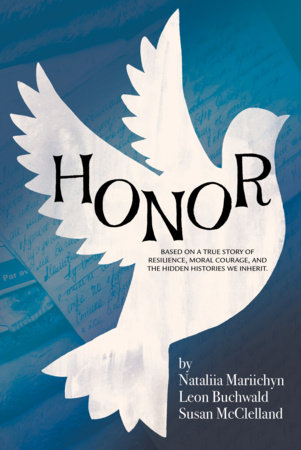
Told from dual perspectives, this remarkable true story for YA readers recounts the tale of two individuals—a Ukrainian teen in the early 2010s and a Jewish boy in hiding during WWII—whose lives are entwined through a box of letters.

Nataliia, a teenager in Ukraine, is at home when she makes a puzzling discovery: a box of letters written from a Jewish boy, Eliezer, about his experience during the Holocaust. At first, Nataliia doesn't understand why her family possesses Eliezer's letters. But as she reads through them, she is able to piece together a fascinating connection—her ancestors were the ones who sheltered Eliezer during the war. Decades later, Nataliia and Eliezer’s family find each other in the same orbit again—as the world faces conflicts anew.

This is the incredible true story of two families brought together through war and a girl’s discovery of her family’s past—and what it means for the future.
Leizer, February 1943

It was early evening, late February, that time of year when the forests stretching out from the Carpathian Mountains fought hard to hold back the heavy winds. The clouds hung low, the days short; the chill having been slow to come, would now not leave.

On this night, the sky to the west held crimson hues, foreshadowing the longer days soon to come. To the east, though, was a winter blue-black, which made the farmer’s wife feel uneasy. She often talked about how, as children, she and her brother played a game in the grottos, pretending to be ghosts, including Shubin, a spirit from the east who had become trapped on this earth plane. In the summer, the farmer’s wife thought these stories were make-believe. But in the winter, when it was night more often than day, the farmer’s wife went to bed early to shut off a nagging suspicion that these ghosts might be real. It was believed that actually seeing Shubin’s ghost or any other spirit brought misfortune.

The farmer liked these long winter nights, for it was then he had time away from his fields. Before the Nazis, he liked to light the fire in the common room and read. For the past two years, since the Nazis and their allies—the Axis powers—walked his dusty roads, he’d just sit, stare at the fire, and pray.

On this night, the farmer, like his wife, felt something steal over him like a fog. But unlike fog, this felt dark, as if it had emerged from somewhere evil. He stood up from the rocking chair he had brought from his childhood home. He moved to the window, chipping away at the coating of ice that had formed on the inside of the glass pane. He looked out, peering as best he could past the shadows of his house, straining to see his frozen wheat field.

Once, he told me that if I stood still and was quiet, the wind would talk to me. And on this night, the wind, with its low whistle through the gaps in the window frames, confirmed his unease. Something wasn’t right.

He had done well as a farmer. He had enough land for his crops, which included wheat and maize; an apple orchard; and an array of animals—goats, pigs, sheep, and a horse. His farmhouse, a series of small interconnected buildings, was made of brick, stone, and wood, with a tin roof. One of the buildings held the kitchen and hearth, one held a sitting space, another held bedrooms for his son and two daughters and a fourth was a barn for his chickens and sheep in the winter. He’d built the well himself, and a cellar, too. He shivered thinking about the cool, dry space where his wife stored root vegetables. His eyes moved toward it. I was there now, hiding, peering at him through a tiny sliver in the flooring.

His first wife had died in the 1920s from tuberculosis. He loved her, he told me, but he was also grateful that their only child, a son, survived the illness. After a year as a widower, he married his second wife, and had two daughters, the younger of whom, on this night, was three. The older girl, thirteen, was my friend.

The smaller child cooed in the corner. The farmer’s eyes moved from the cellar to her. While he had wanted more sons to help him with the farm and eventually take it over, he found himself in awe of his daughters’ freedom. He thought of their high-pitched laughter and squeals as they worked in the fields, and their warmth as they nestled close to him in that rocking chair, where he told them stories of his own childhood exploring the grottos. The girls filled up his heart, he told me, bringing him, home to himself, so he felt less lonely. His son made him think of possibilities outside in the world. “Girls may be harder to raise,” his wife once explained to me, “but they never leave you.”
The farmer soon discovered the source of his unease when the two Nazis arrived at his home. The wind seemed to kick up, and its whistling became a howl. One of the farmer’s dogs barked, which made the Alsatian, the Germans had brought with them, snarl.

The Germans who invaded in the spring of 1941 were proud, fierce fighters, many young, in their early twenties. But over the course of their battle against the Soviet Union, the armies from the West faced an enemy they couldn’t defeat—the hills, forests and weather.

The two German officers who came that night were older. They stood very straight and seemed confident and secure. They didn’t look hungry or weakened. I was sure they were part of the Schutzstaffel, the SS—the Nazi murder unit. David, my friend with the Jewish partisans, told me that the SS soldiers were given alcohol and drugs to dull any morals they had as they executed tens of thousands of Jews.

These two men that appeared at the farmer’s house wore tailored, pressed uniforms in lead-pipe blue, with stripes and medals on the lapels. The men asked no questions as they kicked open the wooden door, leaving it ajar, so the fire danced in the breeze. Their boots pounded on the floor as they moved from the back rooms to the front, shooting their guns into the ceilings.

The farmer’s younger daughter screamed from the noise, rocking and covering her ears.

Then the shooting stopped. The younger child stared with her mouth agape. The farmer’s oldest daughter moved in close to him, one of her hands gripping his so tightly that he felt his fingers go numb. In the other hand, she held the sewing she had been working on: an embroidered handkerchief.

The SS men stood still, looking at the ceiling and listening for the sound of a thud or a movement, anything that would indicate their bullets had hit flesh.

“Where are the Jews?” one of them shouted, rounding on the farmer. The younger child jumped and cried again.

The farmer knew some German, but pretended not to. He twitched.

The SS men called out the names of the Jews they were looking for, “Berta Leiblich-Buchwald! Shloma Buchwald! Leizer Buchwald!”

The farmer shrugged, pretending that he didn’t understand.

His older daughter knew German. She had to—her school was now run by Nazis. She translated for her father.

The farmer swallowed hard. He said in Ukrainian that he did not know where the Jews were. “There are no Jews in this place.” His daughter translated his words back to the Germans.

After she spoke, the farmer curled up his face and spat, hoping the action would convey to the Germans that he hated Jews.

I noticed that my friend’s stockings were wet where she had urinated on herself.
One of the German men stepped toward the farmer’s oldest daughter and ran a gloved finger along her jawbone.

The farmer fell to his knees, pulling his daughter down with him, and held his hands up as if in prayer or surrender. Again in Ukrainian, he begged for the Germans to trust him.

He spoke quickly, and his daughter struggled to keep up as she translated.

He told the Germans that he supported the Nazis; that the entire family did. He told them he looked forward to being part of Germany’s expansion so that he and his people didn’t have to bow to the Soviets anymore. He spat again and said that Jews were responsible for Soviet communism, which was godless and an instrument of evil, and he welcomed the Nazi army and the Christian soldiers to rid the world of the Russians and the Jewish socialist threat. “I believe in what you are doing,” the farmer said. His daughter, he said, pointing to the girl beside him, loved the Nazi school she attended. Especially race studies, he added. She liked learning how superior the Germans were to others. She was even planning to attend Nazi youth meetings.

“I’m a good Christian,” the farmer said. He leaned toward his daughter and pulled out the pendant she wore from under her sweater, revealing a small cross.
“Lord Jesus Christ, Son of God,

have mercy on me, a sinner.” Amen.
When the farmer was finished, the other German officer, older, with a scar that ran down his left cheek, aimed his pistol at the younger of the girls. “Swear on her life, you are not hiding Jews,” he said.

“I swear,” The farmer said, swallowing hard, fighting back his terror.

Tears dripped down his cheeks and his body shook. His older daughter, still beside him, breathed heavily. The farmer, in a choked voice, repeated. “I swear on my daughter’s life.”

When the German would not put down the weapon, the farmer said again, “I swear on the life of my children, of both my daughters.” He raised his eyes this time and looked the Nazi in the eyes. “Even if you kill her, my answer will not change. I have nothing to hide.”

The German cocked the trigger.

Before the Nazis came, the farmer’s younger daughter had been playing with her doll, which was made from corn husks. The Nazi soldier stepped on the doll, tearing it in two.

The child continued to stare, her eyes glassy. I could see the blood draining from her cheeks. She became still, so still, I wondered if she was dead. I wondered if I was, too. I’d heard that spirits don’t know they’re dead.

Suddenly, the soldier uncocked his pistol and stepped back from the small girl, putting the weapon out of sight, somewhere beneath his long leather overcoat.

After they left, the farmer’s wife ran into the room. The farmer shut the door and pulled his entire family into a huddle.

They sat on the floor, propped against each other, shaking and sobbing.

They were still clutching each other, alive and breathing, asleep lying entwined under a blanket on the floor, when dawn broke. The farmer and his younger daughter were awakened by the creaking sound of the hinges of my door opening. I knew I was never supposed to come out during the day, but I had to know if Mameh and Shloma were alive.

“It’s just one of the chickens,” the farmer whispered to his daughter, pushing her head back down to go back to sleep. “It’s just a chicken. Go back to sleep now.”

The farmer and I locked eyes. He motioned to the attic and mouthed, “Quietly, go check.”
Susan McClelland is a journalist and the author of over ten books, including Boy from Buchenwald and The Bite of the Mango. View titles by Susan McClelland
Nataliia Mariichyn is the great-granddaughter of Grigory and Mariya Palidova, a couple in Ukraine who sheltered the Buchwald family in their home in Ukraine during WWII. Raised in Ukraine, Nataliia is currently a war refugee in Montreal, Canada, where descendants of the Buchwald family helped her relocate. View titles by Nataliia Mariichyn
Available for sale exclusive:
•     Afghanistan
•     Aland Islands
•     Albania
•     Algeria
•     Andorra
•     Angola
•     Anguilla
•     Antarctica
•     Antigua/Barbuda
•     Argentina
•     Armenia
•     Aruba
•     Australia
•     Austria
•     Azerbaijan
•     Bahamas
•     Bahrain
•     Bangladesh
•     Barbados
•     Belarus
•     Belgium
•     Belize
•     Benin
•     Bermuda
•     Bhutan
•     Bolivia
•     Bonaire, Saba
•     Bosnia Herzeg.
•     Botswana
•     Bouvet Island
•     Brazil
•     Brit.Ind.Oc.Ter
•     Brit.Virgin Is.
•     Brunei
•     Bulgaria
•     Burkina Faso
•     Burundi
•     Cambodia
•     Cameroon
•     Canada
•     Cape Verde
•     Cayman Islands
•     Centr.Afr.Rep.
•     Chad
•     Chile
•     China
•     Christmas Islnd
•     Cocos Islands
•     Colombia
•     Comoro Is.
•     Congo
•     Cook Islands
•     Costa Rica
•     Croatia
•     Cuba
•     Curacao
•     Cyprus
•     Czech Republic
•     Dem. Rep. Congo
•     Denmark
•     Djibouti
•     Dominica
•     Dominican Rep.
•     Ecuador
•     Egypt
•     El Salvador
•     Equatorial Gui.
•     Eritrea
•     Estonia
•     Ethiopia
•     Falkland Islnds
•     Faroe Islands
•     Fiji
•     Finland
•     France
•     Fren.Polynesia
•     French Guinea
•     Gabon
•     Gambia
•     Georgia
•     Germany
•     Ghana
•     Gibraltar
•     Greece
•     Greenland
•     Grenada
•     Guadeloupe
•     Guam
•     Guatemala
•     Guernsey
•     Guinea Republic
•     Guinea-Bissau
•     Guyana
•     Haiti
•     Heard/McDon.Isl
•     Honduras
•     Hong Kong
•     Hungary
•     Iceland
•     India
•     Indonesia
•     Iran
•     Iraq
•     Ireland
•     Isle of Man
•     Israel
•     Italy
•     Ivory Coast
•     Jamaica
•     Japan
•     Jersey
•     Jordan
•     Kazakhstan
•     Kenya
•     Kiribati
•     Kuwait
•     Kyrgyzstan
•     Laos
•     Latvia
•     Lebanon
•     Lesotho
•     Liberia
•     Libya
•     Liechtenstein
•     Lithuania
•     Luxembourg
•     Macau
•     Macedonia
•     Madagascar
•     Malawi
•     Malaysia
•     Maldives
•     Mali
•     Malta
•     Marshall island
•     Martinique
•     Mauritania
•     Mauritius
•     Mayotte
•     Mexico
•     Micronesia
•     Minor Outl.Ins.
•     Moldavia
•     Monaco
•     Mongolia
•     Montenegro
•     Montserrat
•     Morocco
•     Mozambique
•     Myanmar
•     Namibia
•     Nauru
•     Nepal
•     Netherlands
•     New Caledonia
•     New Zealand
•     Nicaragua
•     Niger
•     Nigeria
•     Niue
•     Norfolk Island
•     North Korea
•     North Mariana
•     Norway
•     Oman
•     Pakistan
•     Palau
•     Palestinian Ter
•     Panama
•     PapuaNewGuinea
•     Paraguay
•     Peru
•     Philippines
•     Pitcairn Islnds
•     Poland
•     Portugal
•     Puerto Rico
•     Qatar
•     Reunion Island
•     Romania
•     Russian Fed.
•     Rwanda
•     S. Sandwich Ins
•     Saint Martin
•     Samoa,American
•     San Marino
•     SaoTome Princip
•     Saudi Arabia
•     Senegal
•     Serbia
•     Seychelles
•     Sierra Leone
•     Singapore
•     Sint Maarten
•     Slovakia
•     Slovenia
•     Solomon Islands
•     Somalia
•     South Africa
•     South Korea
•     South Sudan
•     Spain
•     Sri Lanka
•     St Barthelemy
•     St. Helena
•     St. Lucia
•     St. Vincent
•     St.Chr.,Nevis
•     St.Pier,Miquel.
•     Sth Terr. Franc
•     Sudan
•     Suriname
•     Svalbard
•     Swaziland
•     Sweden
•     Switzerland
•     Syria
•     Tadschikistan
•     Taiwan
•     Tanzania
•     Thailand
•     Timor-Leste
•     Togo
•     Tokelau Islands
•     Tonga
•     Trinidad,Tobago
•     Tunisia
•     Turkey
•     Turkmenistan
•     Turks&Caicos Is
•     Tuvalu
•     US Virgin Is.
•     USA
•     Uganda
•     Ukraine
•     Unit.Arab Emir.
•     United Kingdom
•     Uruguay
•     Uzbekistan
•     Vanuatu
•     Vatican City
•     Venezuela
•     Vietnam
•     Wallis,Futuna
•     West Saharan
•     Western Samoa
•     Yemen
•     Zambia
•     Zimbabwe

About

Told from dual perspectives, this remarkable true story for YA readers recounts the tale of two individuals—a Ukrainian teen in the early 2010s and a Jewish boy in hiding during WWII—whose lives are entwined through a box of letters.

Nataliia, a teenager in Ukraine, is at home when she makes a puzzling discovery: a box of letters written from a Jewish boy, Eliezer, about his experience during the Holocaust. At first, Nataliia doesn't understand why her family possesses Eliezer's letters. But as she reads through them, she is able to piece together a fascinating connection—her ancestors were the ones who sheltered Eliezer during the war. Decades later, Nataliia and Eliezer’s family find each other in the same orbit again—as the world faces conflicts anew.

This is the incredible true story of two families brought together through war and a girl’s discovery of her family’s past—and what it means for the future.

Excerpt

Leizer, February 1943

It was early evening, late February, that time of year when the forests stretching out from the Carpathian Mountains fought hard to hold back the heavy winds. The clouds hung low, the days short; the chill having been slow to come, would now not leave.

On this night, the sky to the west held crimson hues, foreshadowing the longer days soon to come. To the east, though, was a winter blue-black, which made the farmer’s wife feel uneasy. She often talked about how, as children, she and her brother played a game in the grottos, pretending to be ghosts, including Shubin, a spirit from the east who had become trapped on this earth plane. In the summer, the farmer’s wife thought these stories were make-believe. But in the winter, when it was night more often than day, the farmer’s wife went to bed early to shut off a nagging suspicion that these ghosts might be real. It was believed that actually seeing Shubin’s ghost or any other spirit brought misfortune.

The farmer liked these long winter nights, for it was then he had time away from his fields. Before the Nazis, he liked to light the fire in the common room and read. For the past two years, since the Nazis and their allies—the Axis powers—walked his dusty roads, he’d just sit, stare at the fire, and pray.

On this night, the farmer, like his wife, felt something steal over him like a fog. But unlike fog, this felt dark, as if it had emerged from somewhere evil. He stood up from the rocking chair he had brought from his childhood home. He moved to the window, chipping away at the coating of ice that had formed on the inside of the glass pane. He looked out, peering as best he could past the shadows of his house, straining to see his frozen wheat field.

Once, he told me that if I stood still and was quiet, the wind would talk to me. And on this night, the wind, with its low whistle through the gaps in the window frames, confirmed his unease. Something wasn’t right.

He had done well as a farmer. He had enough land for his crops, which included wheat and maize; an apple orchard; and an array of animals—goats, pigs, sheep, and a horse. His farmhouse, a series of small interconnected buildings, was made of brick, stone, and wood, with a tin roof. One of the buildings held the kitchen and hearth, one held a sitting space, another held bedrooms for his son and two daughters and a fourth was a barn for his chickens and sheep in the winter. He’d built the well himself, and a cellar, too. He shivered thinking about the cool, dry space where his wife stored root vegetables. His eyes moved toward it. I was there now, hiding, peering at him through a tiny sliver in the flooring.

His first wife had died in the 1920s from tuberculosis. He loved her, he told me, but he was also grateful that their only child, a son, survived the illness. After a year as a widower, he married his second wife, and had two daughters, the younger of whom, on this night, was three. The older girl, thirteen, was my friend.

The smaller child cooed in the corner. The farmer’s eyes moved from the cellar to her. While he had wanted more sons to help him with the farm and eventually take it over, he found himself in awe of his daughters’ freedom. He thought of their high-pitched laughter and squeals as they worked in the fields, and their warmth as they nestled close to him in that rocking chair, where he told them stories of his own childhood exploring the grottos. The girls filled up his heart, he told me, bringing him, home to himself, so he felt less lonely. His son made him think of possibilities outside in the world. “Girls may be harder to raise,” his wife once explained to me, “but they never leave you.”
The farmer soon discovered the source of his unease when the two Nazis arrived at his home. The wind seemed to kick up, and its whistling became a howl. One of the farmer’s dogs barked, which made the Alsatian, the Germans had brought with them, snarl.

The Germans who invaded in the spring of 1941 were proud, fierce fighters, many young, in their early twenties. But over the course of their battle against the Soviet Union, the armies from the West faced an enemy they couldn’t defeat—the hills, forests and weather.

The two German officers who came that night were older. They stood very straight and seemed confident and secure. They didn’t look hungry or weakened. I was sure they were part of the Schutzstaffel, the SS—the Nazi murder unit. David, my friend with the Jewish partisans, told me that the SS soldiers were given alcohol and drugs to dull any morals they had as they executed tens of thousands of Jews.

These two men that appeared at the farmer’s house wore tailored, pressed uniforms in lead-pipe blue, with stripes and medals on the lapels. The men asked no questions as they kicked open the wooden door, leaving it ajar, so the fire danced in the breeze. Their boots pounded on the floor as they moved from the back rooms to the front, shooting their guns into the ceilings.

The farmer’s younger daughter screamed from the noise, rocking and covering her ears.

Then the shooting stopped. The younger child stared with her mouth agape. The farmer’s oldest daughter moved in close to him, one of her hands gripping his so tightly that he felt his fingers go numb. In the other hand, she held the sewing she had been working on: an embroidered handkerchief.

The SS men stood still, looking at the ceiling and listening for the sound of a thud or a movement, anything that would indicate their bullets had hit flesh.

“Where are the Jews?” one of them shouted, rounding on the farmer. The younger child jumped and cried again.

The farmer knew some German, but pretended not to. He twitched.

The SS men called out the names of the Jews they were looking for, “Berta Leiblich-Buchwald! Shloma Buchwald! Leizer Buchwald!”

The farmer shrugged, pretending that he didn’t understand.

His older daughter knew German. She had to—her school was now run by Nazis. She translated for her father.

The farmer swallowed hard. He said in Ukrainian that he did not know where the Jews were. “There are no Jews in this place.” His daughter translated his words back to the Germans.

After she spoke, the farmer curled up his face and spat, hoping the action would convey to the Germans that he hated Jews.

I noticed that my friend’s stockings were wet where she had urinated on herself.
One of the German men stepped toward the farmer’s oldest daughter and ran a gloved finger along her jawbone.

The farmer fell to his knees, pulling his daughter down with him, and held his hands up as if in prayer or surrender. Again in Ukrainian, he begged for the Germans to trust him.

He spoke quickly, and his daughter struggled to keep up as she translated.

He told the Germans that he supported the Nazis; that the entire family did. He told them he looked forward to being part of Germany’s expansion so that he and his people didn’t have to bow to the Soviets anymore. He spat again and said that Jews were responsible for Soviet communism, which was godless and an instrument of evil, and he welcomed the Nazi army and the Christian soldiers to rid the world of the Russians and the Jewish socialist threat. “I believe in what you are doing,” the farmer said. His daughter, he said, pointing to the girl beside him, loved the Nazi school she attended. Especially race studies, he added. She liked learning how superior the Germans were to others. She was even planning to attend Nazi youth meetings.

“I’m a good Christian,” the farmer said. He leaned toward his daughter and pulled out the pendant she wore from under her sweater, revealing a small cross.
“Lord Jesus Christ, Son of God,

have mercy on me, a sinner.” Amen.
When the farmer was finished, the other German officer, older, with a scar that ran down his left cheek, aimed his pistol at the younger of the girls. “Swear on her life, you are not hiding Jews,” he said.

“I swear,” The farmer said, swallowing hard, fighting back his terror.

Tears dripped down his cheeks and his body shook. His older daughter, still beside him, breathed heavily. The farmer, in a choked voice, repeated. “I swear on my daughter’s life.”

When the German would not put down the weapon, the farmer said again, “I swear on the life of my children, of both my daughters.” He raised his eyes this time and looked the Nazi in the eyes. “Even if you kill her, my answer will not change. I have nothing to hide.”

The German cocked the trigger.

Before the Nazis came, the farmer’s younger daughter had been playing with her doll, which was made from corn husks. The Nazi soldier stepped on the doll, tearing it in two.

The child continued to stare, her eyes glassy. I could see the blood draining from her cheeks. She became still, so still, I wondered if she was dead. I wondered if I was, too. I’d heard that spirits don’t know they’re dead.

Suddenly, the soldier uncocked his pistol and stepped back from the small girl, putting the weapon out of sight, somewhere beneath his long leather overcoat.

After they left, the farmer’s wife ran into the room. The farmer shut the door and pulled his entire family into a huddle.

They sat on the floor, propped against each other, shaking and sobbing.

They were still clutching each other, alive and breathing, asleep lying entwined under a blanket on the floor, when dawn broke. The farmer and his younger daughter were awakened by the creaking sound of the hinges of my door opening. I knew I was never supposed to come out during the day, but I had to know if Mameh and Shloma were alive.

“It’s just one of the chickens,” the farmer whispered to his daughter, pushing her head back down to go back to sleep. “It’s just a chicken. Go back to sleep now.”

The farmer and I locked eyes. He motioned to the attic and mouthed, “Quietly, go check.”

Author

Susan McClelland is a journalist and the author of over ten books, including Boy from Buchenwald and The Bite of the Mango. View titles by Susan McClelland
Nataliia Mariichyn is the great-granddaughter of Grigory and Mariya Palidova, a couple in Ukraine who sheltered the Buchwald family in their home in Ukraine during WWII. Raised in Ukraine, Nataliia is currently a war refugee in Montreal, Canada, where descendants of the Buchwald family helped her relocate. View titles by Nataliia Mariichyn

Rights

Available for sale exclusive:
•     Afghanistan
•     Aland Islands
•     Albania
•     Algeria
•     Andorra
•     Angola
•     Anguilla
•     Antarctica
•     Antigua/Barbuda
•     Argentina
•     Armenia
•     Aruba
•     Australia
•     Austria
•     Azerbaijan
•     Bahamas
•     Bahrain
•     Bangladesh
•     Barbados
•     Belarus
•     Belgium
•     Belize
•     Benin
•     Bermuda
•     Bhutan
•     Bolivia
•     Bonaire, Saba
•     Bosnia Herzeg.
•     Botswana
•     Bouvet Island
•     Brazil
•     Brit.Ind.Oc.Ter
•     Brit.Virgin Is.
•     Brunei
•     Bulgaria
•     Burkina Faso
•     Burundi
•     Cambodia
•     Cameroon
•     Canada
•     Cape Verde
•     Cayman Islands
•     Centr.Afr.Rep.
•     Chad
•     Chile
•     China
•     Christmas Islnd
•     Cocos Islands
•     Colombia
•     Comoro Is.
•     Congo
•     Cook Islands
•     Costa Rica
•     Croatia
•     Cuba
•     Curacao
•     Cyprus
•     Czech Republic
•     Dem. Rep. Congo
•     Denmark
•     Djibouti
•     Dominica
•     Dominican Rep.
•     Ecuador
•     Egypt
•     El Salvador
•     Equatorial Gui.
•     Eritrea
•     Estonia
•     Ethiopia
•     Falkland Islnds
•     Faroe Islands
•     Fiji
•     Finland
•     France
•     Fren.Polynesia
•     French Guinea
•     Gabon
•     Gambia
•     Georgia
•     Germany
•     Ghana
•     Gibraltar
•     Greece
•     Greenland
•     Grenada
•     Guadeloupe
•     Guam
•     Guatemala
•     Guernsey
•     Guinea Republic
•     Guinea-Bissau
•     Guyana
•     Haiti
•     Heard/McDon.Isl
•     Honduras
•     Hong Kong
•     Hungary
•     Iceland
•     India
•     Indonesia
•     Iran
•     Iraq
•     Ireland
•     Isle of Man
•     Israel
•     Italy
•     Ivory Coast
•     Jamaica
•     Japan
•     Jersey
•     Jordan
•     Kazakhstan
•     Kenya
•     Kiribati
•     Kuwait
•     Kyrgyzstan
•     Laos
•     Latvia
•     Lebanon
•     Lesotho
•     Liberia
•     Libya
•     Liechtenstein
•     Lithuania
•     Luxembourg
•     Macau
•     Macedonia
•     Madagascar
•     Malawi
•     Malaysia
•     Maldives
•     Mali
•     Malta
•     Marshall island
•     Martinique
•     Mauritania
•     Mauritius
•     Mayotte
•     Mexico
•     Micronesia
•     Minor Outl.Ins.
•     Moldavia
•     Monaco
•     Mongolia
•     Montenegro
•     Montserrat
•     Morocco
•     Mozambique
•     Myanmar
•     Namibia
•     Nauru
•     Nepal
•     Netherlands
•     New Caledonia
•     New Zealand
•     Nicaragua
•     Niger
•     Nigeria
•     Niue
•     Norfolk Island
•     North Korea
•     North Mariana
•     Norway
•     Oman
•     Pakistan
•     Palau
•     Palestinian Ter
•     Panama
•     PapuaNewGuinea
•     Paraguay
•     Peru
•     Philippines
•     Pitcairn Islnds
•     Poland
•     Portugal
•     Puerto Rico
•     Qatar
•     Reunion Island
•     Romania
•     Russian Fed.
•     Rwanda
•     S. Sandwich Ins
•     Saint Martin
•     Samoa,American
•     San Marino
•     SaoTome Princip
•     Saudi Arabia
•     Senegal
•     Serbia
•     Seychelles
•     Sierra Leone
•     Singapore
•     Sint Maarten
•     Slovakia
•     Slovenia
•     Solomon Islands
•     Somalia
•     South Africa
•     South Korea
•     South Sudan
•     Spain
•     Sri Lanka
•     St Barthelemy
•     St. Helena
•     St. Lucia
•     St. Vincent
•     St.Chr.,Nevis
•     St.Pier,Miquel.
•     Sth Terr. Franc
•     Sudan
•     Suriname
•     Svalbard
•     Swaziland
•     Sweden
•     Switzerland
•     Syria
•     Tadschikistan
•     Taiwan
•     Tanzania
•     Thailand
•     Timor-Leste
•     Togo
•     Tokelau Islands
•     Tonga
•     Trinidad,Tobago
•     Tunisia
•     Turkey
•     Turkmenistan
•     Turks&Caicos Is
•     Tuvalu
•     US Virgin Is.
•     USA
•     Uganda
•     Ukraine
•     Unit.Arab Emir.
•     United Kingdom
•     Uruguay
•     Uzbekistan
•     Vanuatu
•     Vatican City
•     Venezuela
•     Vietnam
•     Wallis,Futuna
•     West Saharan
•     Western Samoa
•     Yemen
•     Zambia
•     Zimbabwe