Close Modal

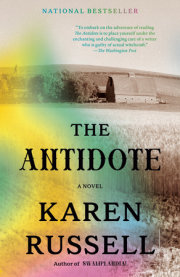
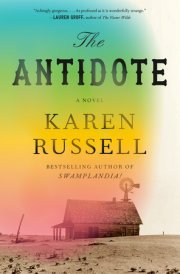
The Antidote

A Novel

Author Karen Russell On Tour
Paperback
$19.00 US
6.11"W x 9.23"H x 1.09"D   (15.5 x 23.4 x 2.8 cm) | 16 oz (448 g) | 30 per carton
On sale Mar 11, 2025 | 432 Pages | 9781524712822
Sales rights: US, Canada, Open Mkt
Export Edition

See Additional Formats
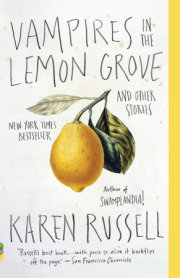
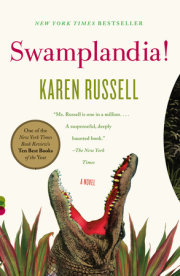
NATIONAL BESTSELLER • FINALIST FOR THE NATIONAL BOOK AWARD • From Pulitzer finalist, MacArthur Fellowship recipient, and bestselling author of Swamplandia! and Vampires in the Lemon Grove Karen Russell: a gripping dust bowl epic about five characters whose fates become entangled after a storm ravages their small Nebraskan town

FINALIST FOR THE NATIONAL BOOK CRITICS CIRCLE AWARD FOR FICTION • LONGLISTED FOR THE PEN/JEAN STEIN BOOK AWARD • WINNER OF THE PACIFIC NORTHWEST BOOK AWARD • THE NEW YORK TIMES BOOK REVIEW EDITORS' CHOICE


The Antidote opens on Black Sunday, as a historic dust storm ravages the fictional town of Uz, Nebraska. But Uz is already collapsing—not just under the weight of the Great Depression and the dust bowl drought but beneath its own violent histories. The Antidote follows a "Prairie Witch,” whose body serves as a bank vault for peoples’ memories and secrets; a Polish wheat farmer who learns how quickly a hoarded blessing can become a curse; his orphan niece, a basketball star and witch’s apprentice in furious flight from her grief; a voluble scarecrow; and a New Deal photographer whose time-traveling camera threatens to reveal both the town’s secrets and its fate.

Russell's novel is above all a reckoning with a nation’s forgetting—enacting the settler amnesia and willful omissions passed down from generation to generation, and unearthing not only horrors but shimmering possibilities. The Antidote echoes with urgent warnings for our own climate emergency, challenging readers with a vision of what might have been—and what still could be.
The Prairie Witch

A person can lose everything in an instant. A fortune, a family, the sun. I’ve had to learn this lesson twice in my life. The first time it happened, I was a fifteen-year-old fugitive from the Home for Unwed Mothers. The second time, I was a prairie witch chained to my cot in a cinder-block jailhouse. “Your second home,” the Sheriff liked to say. Officially, I do not exist in his West; nevertheless, it is a crime to pay me a visit.

On Black Sunday, before anybody knew to call it Black Sunday, I woke up in the jailhouse to a sound like a freight train tunneling through me. An earsplitting howl that seemed to shake the stone walls. My body trembled like a husk on the cot. My fingers clawed into the mattress. For those early moments in the dark I was nothing but the fear of floating off. What had happened to me while I slept? It felt as if a knife had scraped the marrow from my bones. Some­thing vital inside me had liquefied and drained away, and in its place was this new weightlessness. Lightness and wrongness, a blanketing whiteness that ran up my spine and seeped out of my mouth. Bank­rupt was the word that rose in my mind. At first, I did not recognize the voice crying out for help as my own. I clamped down on the sound, panicked—I could not afford to lose any more ballast. My numb limbs began to prickle with feeling, pins and needles stitching them back to my brain. It was not a happy reunion. Ten white toes sprouted like mushrooms on the edge of a filthy green blanket, wav­ing to me from the outermost limit of what I could make out. A kero­sene lantern in the hallway gave off a feeble emerald glow, beyond which the cell plunged into shadow. Not even the pain was mine. It came and went like the wind. Then it drilled through my skin and swallowed the world.

Or perhaps the black blizzard was already well under way when I woke up. Choking heat filled the jailhouse, along with lashing tails of dust. It occurred to me that I might be buried here before I could recollect who I was. Minutes and hours lost all meaning for me; I balled up on the cot and prepared to be pulled apart by a cyclone. Eventually the winds began to weaken. Light cut a pathway across the turbulent sky—I watched a pale line brightening and widening through the small cell window. A greenish disc hung above the cloud wall, and it took me ages to recognize the sun. It was not midnight after all, but well past noon.

I began to remember more about the land beyond this cell, the edgeless prairie. The name of the town where I worked returned to me: Uz, Nebraska, southeast of the Sandhills and west of the Platte River. We were four years into the worst drought that any newcomer to the Great Plains had ever experienced. Other beings kept older diaries. Cored cottonwood trees told a millennial story written in wavy circles that no politician had cared to read. Congressmen train themselves to think in election cycles, not planetary ones. They see spiking market highs and lows, and forget how to read in circles. Uz had been having brownouts for months. Plagues of jaws and man­dibles. Grasshoppers rattled down on the tractor cabs from hissing clouds. Thousands of jackrabbits fanned over the Plains, chewing through anything green. Winged indigo beetles blew in from God alone knew where, husks shaped like hourglasses that nobody on the High Plains had ever seen before 1931. Red sand from Oklahoma and black dirt from Kansas and dove gray earth from the eastern plains of Colorado formed a rolling ceiling of dust above Uz that flashed with heat lightning.

The Sheriff and his family lived in a two-story brick frame house facing the jail, parts and blueprint purchased from the Sears, Roe­buck catalog. It sat on the free side of the property, five hundred yards beyond the bars of my two-foot-by-two-foot window. As the dust blew into my cell, outside things became less and less real. The Sheriff’s house slimmed to a charcoal sketch. Erased, redrawn, and finally lost to sight. The sky was well and truly falling.

At last I forced myself to scream for help. It felt terrifying to release so much breath at once—the lightness rushed into my head. No one responded. How long had I been trapped here? The cell was seven feet by eight feet, and furnished with nothing but the cot and a tin bucket half-filled with the previous inmate’s piss. Or my own, perhaps. It seemed I was the only prisoner left inside the jailhouse. But I was wrong about that. Something pounced lightly onto my chest, then launched up to the ledge of the cell window—a huge bris­tling cat, whose carroty fur seemed absurdly bright. Her ears pitched forward, her claws tensing on the ledge. Her golden eyes regarded me serenely. Nothing called to the animal that I could hear. But a moment later, the cat slipped through the bars and jumped nimbly into the whirlwind.

Just as she leapt, I recognized her—the Sheriff’s cat, a flatulent tabby who often slept on my chest during my stays in the jailhouse. The Sheriff, out of stupidity or laziness, called her nothing at all, not even Cat. A memory wailed awake inside me: the Sheriff had once drowned a litter of her kittens in a washbasin within earshot of my cell. Five infant voices flooded through me, clawing at the soft walls within the walls. Again I heard the splash as the bag went under. Displaced water had come trickling down the hall while their silence deepened to permanence. The Sheriff had caged the mother cat in a nearby closet, locking us both into impotent witness. Her angry cries had blended with her children’s dissolving ones. The last voices in the world could not have sounded more forlorn.

A stupid man can still be a savant at torture. The Sheriff had squat­ted on his haunches in front of Cell 8, grinning through the bars at me as he poured fresh milk into a bowl for the dead kittens’ mother. “What a racket, eh? You’ll forget that nasty business in a snap. A powerful witch like you . . .”

My job returned to me before my name did. Yes, I am the Antidote I learned, and remembered. I am a prairie witch. A door swung open onto my life. Now I could picture my rented room in the board­inghouse. My poster facing the street from the third-floor window, hand-lettered for me by the calligrapher in Kinkaid gold: THE ANTIDOTE OF UZ! NOW ACCEPTING DEPOSITS. I advertised my banking services as a panacea for every ailment from heartburn to nightmares. Some of my customers, I recalled, had made up a little jingle about me, taking the lyrics from my poster:

“The Antidote to lovesickness! The Antidote to grief! The Anti­dote to gas pains! The Antidote to guilt! The Antidote to sleepless nights! The Antidote to sweaty palms! The Antidote to daydream­ing! The Antidote to shame!”

Most everyone on the Great Plains knew about us, even those who denied our existence. The Vaults, some called us. The prairie witches. Now I remembered what I did to earn my bread—what I had been doing since I was a much younger woman. Absorbing and storing my customers’ memories. Banking secrets for the townspeo­ple of Uz. Sins and crimes, first and last times, nights of unspeakable horror and dewdrop blue mornings—or who knew what my custom­ers had transferred from their bodies into mine? These were only my guesses. I disappeared into a spacious blankness during my transfers. A prairie witch’s body is a room for rent. A vault to store the things people cannot stand to know, or bear to forget.

Half the town of Uz banked with me, and even those who denounced me as a fraud and a blackmailer knew that I was open for business in Room 11. People came and paid me to store some portion of their lives. A memory that felt too heavy to carry into the future, or too precious for daily reminiscence. As they whispered their stories into my green earhorn, memories lifted out of their bod­ies and into mine. It was a painless exchange. Nothing my custom­ers told me had ever disturbed me, because I was not awake to hear them. Cocooned in blue trance, I could dilate to absorb anything. I did not return to my waking mind until a transfer was completed. “I know as little about what I contain,” I reassured my customers, “as a safety deposit box knows about its rocks. As a jar of pickling vinegar knows about its floating roots.” As an attic knows about its ghosts. Their dead were alive inside me, patiently waiting to be recol­lected. The weight of these deposits refreighted me. After a transfer, I often felt a heavy ache in my rib cage or my pelvis—sometimes a swimmy brightness like goldfish circling my chest—and in this way I knew that our exchange had been a success. My new customers would smile sheepishly at me and say, “I wonder what I just told you, ma’am? It’s gone clean out of my head!”

Now I understood why my body felt so frighteningly light, why the word bankruptcy kept running through my mind. Something had happened to me that I had not known to fear.

Fifteen years of deposits, somehow, had been siphoned from me while I slept. Drawn from my flesh, like vapor from a leaf. Where had they all gone? Out of my body and into the whirlwind? Were they still intact somewhere? Or had they dispersed with the dust? With each roomy breath, I learned more about the shape and the scale of what I’d lost. I rolled onto my side and pulled up my night­gown—a repurposed sackcloth from grover’s orchards, too short for a woman my height, printed with repeating sandy peaches that seemed to shrivel and ripen with each breath. I palpated my stomach with my fists, as if the thousands of secrets I’d housed might merely be misplaced.

To be clear, I hadn’t forgotten these secrets, because I’d never known them in the first place. Or perhaps that’s not entirely true. I knew them the way I knew you, my Son, before you were born. Nestled in my body, as pressure and weight. Memories are living things. When you house as many as I did, your bones begin to creak. Now I felt in danger of evaporating myself.

As it turned out, I was not alone. Farmers all over the Plains were losing their entire harvests at this very moment. Families hid in their cellars while the clouds grew fat with black earth. The sky became a growling belly. Uzians caught out in their fields when the darkness eclipsed the sun believed they’d gone blind.

Many of these same farmers and ranchers had also—unbeknownst to them—just lost huge tracts of the past. The days and the nights I’d held in reserve for them while they went about the business of living. My customers who had banked with me loyally since my arrival in Uz would soon learn about my crash—how could I prevent it? They’d come to make their withdrawals, and I’d have nothing to return to them. I had retained only a palmful of facts about my solitary life.

I have always kept scrupulous records. I could tell you who visited me on July 12 of 1927, and the duration of the visit. I could tell you to the penny how much money I made in Uz County between the years of 1920 and 1935. But what did it matter if I’d charged this client two dollars, and this one two hundred? None of the numbers I’d inked into my ledger had anything real to say about the vastness of what I’d just lost. It was spasms in my belly and the clawing grief.

Black Sunday, before the newspapermen named it and swept it into history, pulverized the region now known as the “Great Dust Bowl.” Like so many of my neighbors, I woke to ruin. In the cen­ter of the storm, I believed that the worst had happened. But I was wrong about that. The dust had another lesson to teach me: so long as you’re still drawing breath, there’s always more to lose.

Home
. Home. I tugged at the word until a world rose up. Chained to the cot, dirt inflaming my nostrils, I smiled in the dark. I believed I’d lost everything, but I hadn’t after all. I remember You. Hope grew inside me then. Unstoppably, as You once grew. I pictured green leaves twining around my rib cage, tethering me to my memories of You. Your slippery, seven-pound body and your strong wail. Every kick and twist, I rehearsed in my mind. Even the ache of losing You, I welcomed home. It was the weight I needed to sit up and plant my feet on the floor of the cell. As long as there’s a chance of our reunion, Son, I promise You that I will go on living.

On the night that You were born, one of the nurses at the Milford Home for Unwed Mothers risked her job to let me hold You. Lie back, she said, and let your baby drink. He knows what to do, honey. See that? He was born for this. I had never met such a hungry creature, so eager to live. I hadn’t guessed my body could meet another being’s needs so completely. You cried out, and I realized with wonder that I was the one You were calling for. I was the answer to your question. The antidote to your distress, your fear, your ravening hunger, your life-thirst. I stared into your fierce, dark eyes, born open. We flut­tered in and out of sleep together, in a dream of milk and heat and love. Then came the block of hours which were stolen from me—I believe now that I was drugged. We are sorry, but you lost your baby, a new nurse told me when I awoke. The sensation of my milk lifting through my breasts to flood your mouth was barely a memory when a doctor I had never seen before handed me your death certificate. Those monsters with their sad smiles lied to me. I knew You were alive.

Are You still?
  • LONGLIST | 2026
    PEN/Jean Stein Book Award
  • FINALIST | 2025
    National Book Award Finalist
  • SHORTLIST | 2025
    National Book Critics Circle Awards
NAMED A NOTABLE BOOK OF THE YEAR: The New York Times, The Washington Post, NPR, Time, Esquire, PEN America, People, Scientific America, LitHub, The Atlanta Journal-Constitution, The Globe and Mail, Portland Monthly, Kirkus, BookPage

“Direct and intimate. . . . [The Antidote] turns the whispered secrets of a Dust Bowl town into a bold metaphor for repressed history.” The Atlantic

"The Antidote blends speculative and fantasy elements with rich language and vivid characters in an effort not to escape reality but to comment even more thoughtfully on it. . . . Russell’s lyrical writing dazzles on every page." The New York Times

"Spellbinding. . . . In The Antidote, Karen Russell, America's own Prairie Witch of a writer, exhumes memories out of the collective national unconscious and invites us to see our history in full. There are, alas, no antidotes for history. Our consolations are found in writers like Russell who refract horror and wonder through their own strange looking glass, leaving us energized for that next astounding thing.” —NPR

“To embark on the adventure of reading The Antidote is to place yourself under the enchanting and challenging care of a writer who is guilty of actual witchcraft.” The Washington Post

“[The Antidote] is an allegory for the current climate crisis, a reckoning with America’s racist beginnings, and an urgent warning against historical erasure.”TIME

The most salient quality of The Antidote is the beauty and power of Russell’s writing. . . . The Antidote is clearly the work of a writer with prodigious gifts.” The Guardian

“Russell’s prose is as sharp as ever. Her capacity for detailed imagery while maintaining an easy, readable pace must be commended. Conceptually, her imagination stands head and shoulders above her peers, which is no surprise to any Karen Russell reader. . . . This book is wholly unique and represents one of the modern greats continuing to challenge herself.” Chicago Review of Books

“Drawing from her skills as a short story writer, [Russell] effortlessly weaves in other characters whose unique gifts shed light on the lacunae of history. . . . Her sharp narrative grasp guides the reader from character to character as the book unfolds.” Los Angeles Times

“A haunting novel that’s as speculative as it is timeless.” People Magazine

“A contribution to the continuing project of imagining the Dust Bowl, American immigration, and the New Deal, The Antidote is a strong and colorful antitoxin for rigid monochromal thinking.” Arts Alive San Antonio

The Antidote is gorgeous and inventive storytelling, literature at its finest.” Willamette Week

"In The Antidote, Karen Russell writes indelible characters who keep choosing messy community over silo’d righteousness, motion over despair. She presents for inspection America’s most persistent chorus of moral self-defense, “Better them than us,” and shows how it rots the minds, hearts, and land of all who sing it. Only Karen Russell could write a dust bowl opus with such raucous brio—The Antidote soars with exigent joy and laugh-out-loud scenes, with memory witches and enchanted cameras and the world’s most lovable sentient scarecrow. It’s magic, a book doing this big work and also making it propulsive, eminently readable. If irony bypasses the difficulty of describing things, then the vivid sincerity on display here marks a virtuosic artist at the height of her lucidity. Russell has rendered with soul and urgency the vast inexpressible ache at the heart of American gratitude." —Kaveh Akbar, author of Martyr!

“Karen Russell runs her imaginative strings across dark caverns of our history so those spaces can sound their own songs. The Antidote lets us see the perils and possibilities of storytelling, illuminating its powers to erase, discover, reconstruct, prop up, terrorize, delight, and collapse. Russell is truly one of the greatest writers of our time. And then also: every page is packed with joy, beauty, wildness and the perfect wisdom of mystery.” Rivka Galchen, author of Everyone Knows Your Mother Is a Witch

The Antidote is an achingly gorgeous book about dust, memory, basketball, murder, yearning, photography, and the way the land holds both the memory of what went before and the dreams of what may come. Karen Russell is one of our most humane and generous writers; this book is as profound as it is wonderfully strange.” Lauren Groff, author of The Vaster Wilds

“This novel swept me up and carried me away, even while somehow burying me, and digging up something about the story of this country I didn’t know I needed to know. As with all of Russell’s work, heaviness and levity are always kept in balance, and so I was lifted even while being devastated by the book’s many brutal truths and stark beauty. I’d already considered Russell’s vivid and inventive imagination to be endless, but here exploring a history of Nebraska we get an unearthing of this country’s still relatively untold origin story, the part about its original people, and the cost paid in order that this country might be formed. Finishing the book I felt completely covered in the forgotten dust of what too few look back on, with rare clarity, not to mention the intricate braid of narratives masterfully woven here. The Antidote is one, for an all too poisoned American narrative about land and family and belonging.” Tommy Orange, author of Wandering Stars

Here in The Antidote, Karen Russel has summoned her singular brand of alchemy and created an epic of heart and devastation, community and laughter, death and life. A book that has it all. An absolute wonder.” Nana Kwame Adjei-Brenyah, author of Chain-Gang All-Stars

Russell’s prose is something to be savored. Every sentence is meticulously crafted, each one revealing layers of meaning that draw you deeper into the narrative. Her language is both lush and sharp, weaving a dreamlike quality into the story that makes the characters’ emotional journeys feel all the more visceral. Memory is both the poison and the cure here, something that simultaneously traps and liberates the characters. They move through their world with the weight of what’s unspoken pressing down on them. It’s a novel that asks the reader to sit with discomfort, to walk alongside its characters as they confront their unresolved histories. Russell navigates these emotional landscapes with care and respect and the distinct gift she carries that is heaven—I mean Love.” Morgan Talty, author of Fire Exit

"With The Antidote, Karen Russell proves once again that there is no limit to her extraordinary imagination. She creates marvels out of what we imagine to be the ordinary world, she turns the historical novel upside down and shakes from it a thing of exquisite beauty that is unlike anything you’ve ever read." Dinaw Mengestu, author of Someone Like Us

"While, thankfully, there is no such thing as The Great American Novel (singular), there is a body of work by various novelists which reckon with our past — its mythologies, its myriad histories, its tragedies, its secret archives and its future possibilities. The Antidote is a remarkable addition to this communal, never-ending project. Karen Russell’s novel is generous, profound, and will stay with me for a long time." —Kelly Link, author of The Book of Love

"An ardent work of encompassing and compassionate historical fiction supercharged with her signature imaginative, astutely calibrated supernatural twists. A dramatic and uncanny tale of the drastic consequences of our destruction of nature and Indigenous communities." Booklist (starred review)

"A singular, haunting vision that fearlessly excavates the past and challenges the reader to face the future head-on. A storytelling tour de force that lives up to the promise of its name." Kirkus (starred review)

"An inspired and unforgettable fusion of the gritty and the fantastic."Publishers Weekly (starred review)

"Readers of Margaret Atwood, Emily St. John Mandel, Edan Lepucki, and Lidia Yuknavitch will appreciate Russell’s brilliant, barbed excavation of an all-too-imaginable future." Library Journal (starred review)

“A deeply imagined blend of gritty realism and alluring fantasy. . . . Russell has created both a tender story of how our memories sustain us in the face of significant loss and a frank reckoning with a painful period of American history.” Shelf Awareness
© Annette Hornischer
KAREN RUSSELL is the author of six works of fiction, including the New York Times bestsellers Swamplandia! and Vampires in the Lemon Grove. She is a MacArthur Fellow, a Guggenheim Fellowship, and a finalist for the Pulitzer Prize. She has received two National Magazine Awards for Fiction, the Shirley Jackson Award, the 2023 Bottari Lattes Grinzane prize, the 2024 Mary McCarthy Award, and was selected for the National Book Foundation's "5 under 35" prize and The New Yorker's "20 under 40" list (She is now decisively over 40). She has taught literature and creative writing at the Iowa Writers' Workshop, the University of California-Irvine, Williams College, Columbia University, and Bryn Mawr College, and was the Endowed Chair of Texas State’s MFA program. She serves on the board of Street Books, a mobile-library for people living outdoors. Born and raised in Miami, Florida, she now lives in Portland, Oregon with her husband, son, and daughter. View titles by Karen Russell
Available for sale exclusive:
•     Guam
•     Minor Outl.Ins.
•     North Mariana
•     Philippines
•     Puerto Rico
•     Samoa,American
•     US Virgin Is.

Available for sale non-exclusive:
•     Afghanistan
•     Aland Islands
•     Albania
•     Algeria
•     Andorra
•     Angola
•     Antarctica
•     Argentina
•     Armenia
•     Aruba
•     Austria
•     Azerbaijan
•     Bahrain
•     Belarus
•     Belgium
•     Benin
•     Bolivia
•     Bonaire, Saba
•     Bosnia Herzeg.
•     Bouvet Island
•     Brazil
•     Bulgaria
•     Burkina Faso
•     Burundi
•     Cambodia
•     Cameroon
•     Cape Verde
•     Centr.Afr.Rep.
•     Chad
•     Chile
•     China
•     Colombia
•     Comoro Is.
•     Congo
•     Cook Islands
•     Costa Rica
•     Croatia
•     Cuba
•     Curacao
•     Czech Republic
•     Dem. Rep. Congo
•     Denmark
•     Djibouti
•     Dominican Rep.
•     Ecuador
•     Egypt
•     El Salvador
•     Equatorial Gui.
•     Eritrea
•     Estonia
•     Ethiopia
•     Faroe Islands
•     Finland
•     France
•     Fren.Polynesia
•     French Guinea
•     Gabon
•     Georgia
•     Germany
•     Greece
•     Greenland
•     Guadeloupe
•     Guatemala
•     Guinea Republic
•     Guinea-Bissau
•     Haiti
•     Heard/McDon.Isl
•     Honduras
•     Hong Kong
•     Hungary
•     Iceland
•     Indonesia
•     Iran
•     Iraq
•     Israel
•     Italy
•     Ivory Coast
•     Japan
•     Jordan
•     Kazakhstan
•     Kuwait
•     Kyrgyzstan
•     Laos
•     Latvia
•     Lebanon
•     Liberia
•     Libya
•     Liechtenstein
•     Lithuania
•     Luxembourg
•     Macau
•     Macedonia
•     Madagascar
•     Maldives
•     Mali
•     Marshall island
•     Martinique
•     Mauritania
•     Mayotte
•     Mexico
•     Micronesia
•     Moldavia
•     Monaco
•     Mongolia
•     Montenegro
•     Morocco
•     Netherlands
•     New Caledonia
•     Nicaragua
•     Niger
•     Niue
•     Norfolk Island
•     North Korea
•     Norway
•     Oman
•     Palau
•     Palestinian Ter
•     Panama
•     Paraguay
•     Peru
•     Poland
•     Portugal
•     Qatar
•     Reunion Island
•     Romania
•     Russian Fed.
•     Rwanda
•     Saint Martin
•     San Marino
•     SaoTome Princip
•     Saudi Arabia
•     Senegal
•     Serbia
•     Sint Maarten
•     Slovakia
•     Slovenia
•     South Korea
•     South Sudan
•     Spain
•     St Barthelemy
•     St.Pier,Miquel.
•     Sth Terr. Franc
•     Sudan
•     Suriname
•     Svalbard
•     Sweden
•     Switzerland
•     Syria
•     Tadschikistan
•     Taiwan
•     Thailand
•     Timor-Leste
•     Togo
•     Tokelau Islands
•     Tunisia
•     Turkey
•     Turkmenistan
•     Ukraine
•     Unit.Arab Emir.
•     Uruguay
•     Uzbekistan
•     Vatican City
•     Venezuela
•     Vietnam
•     Wallis,Futuna
•     West Saharan
•     Western Samoa

Not available for sale:
•     Anguilla
•     Antigua/Barbuda
•     Australia
•     Bahamas
•     Bangladesh
•     Barbados
•     Belize
•     Bermuda
•     Bhutan
•     Botswana
•     Brit.Ind.Oc.Ter
•     Brit.Virgin Is.
•     Brunei
•     Canada
•     Cayman Islands
•     Christmas Islnd
•     Cocos Islands
•     Cyprus
•     Dominica
•     Falkland Islnds
•     Fiji
•     Gambia
•     Ghana
•     Gibraltar
•     Grenada
•     Guernsey
•     Guyana
•     India
•     Ireland
•     Isle of Man
•     Jamaica
•     Jersey
•     Kenya
•     Kiribati
•     Lesotho
•     Malawi
•     Malaysia
•     Malta
•     Mauritius
•     Montserrat
•     Mozambique
•     Myanmar
•     Namibia
•     Nauru
•     Nepal
•     New Zealand
•     Nigeria
•     Pakistan
•     PapuaNewGuinea
•     Pitcairn Islnds
•     S. Sandwich Ins
•     Seychelles
•     Sierra Leone
•     Singapore
•     Solomon Islands
•     Somalia
•     South Africa
•     Sri Lanka
•     St. Helena
•     St. Lucia
•     St. Vincent
•     St.Chr.,Nevis
•     Swaziland
•     Tanzania
•     Tonga
•     Trinidad,Tobago
•     Turks&Caicos Is
•     Tuvalu
•     USA
•     Uganda
•     United Kingdom
•     Vanuatu
•     Yemen
•     Zambia
•     Zimbabwe

About

NATIONAL BESTSELLER • FINALIST FOR THE NATIONAL BOOK AWARD • From Pulitzer finalist, MacArthur Fellowship recipient, and bestselling author of Swamplandia! and Vampires in the Lemon Grove Karen Russell: a gripping dust bowl epic about five characters whose fates become entangled after a storm ravages their small Nebraskan town

FINALIST FOR THE NATIONAL BOOK CRITICS CIRCLE AWARD FOR FICTION • LONGLISTED FOR THE PEN/JEAN STEIN BOOK AWARD • WINNER OF THE PACIFIC NORTHWEST BOOK AWARD • THE NEW YORK TIMES BOOK REVIEW EDITORS' CHOICE


The Antidote opens on Black Sunday, as a historic dust storm ravages the fictional town of Uz, Nebraska. But Uz is already collapsing—not just under the weight of the Great Depression and the dust bowl drought but beneath its own violent histories. The Antidote follows a "Prairie Witch,” whose body serves as a bank vault for peoples’ memories and secrets; a Polish wheat farmer who learns how quickly a hoarded blessing can become a curse; his orphan niece, a basketball star and witch’s apprentice in furious flight from her grief; a voluble scarecrow; and a New Deal photographer whose time-traveling camera threatens to reveal both the town’s secrets and its fate.

Russell's novel is above all a reckoning with a nation’s forgetting—enacting the settler amnesia and willful omissions passed down from generation to generation, and unearthing not only horrors but shimmering possibilities. The Antidote echoes with urgent warnings for our own climate emergency, challenging readers with a vision of what might have been—and what still could be.

Excerpt

The Prairie Witch

A person can lose everything in an instant. A fortune, a family, the sun. I’ve had to learn this lesson twice in my life. The first time it happened, I was a fifteen-year-old fugitive from the Home for Unwed Mothers. The second time, I was a prairie witch chained to my cot in a cinder-block jailhouse. “Your second home,” the Sheriff liked to say. Officially, I do not exist in his West; nevertheless, it is a crime to pay me a visit.

On Black Sunday, before anybody knew to call it Black Sunday, I woke up in the jailhouse to a sound like a freight train tunneling through me. An earsplitting howl that seemed to shake the stone walls. My body trembled like a husk on the cot. My fingers clawed into the mattress. For those early moments in the dark I was nothing but the fear of floating off. What had happened to me while I slept? It felt as if a knife had scraped the marrow from my bones. Some­thing vital inside me had liquefied and drained away, and in its place was this new weightlessness. Lightness and wrongness, a blanketing whiteness that ran up my spine and seeped out of my mouth. Bank­rupt was the word that rose in my mind. At first, I did not recognize the voice crying out for help as my own. I clamped down on the sound, panicked—I could not afford to lose any more ballast. My numb limbs began to prickle with feeling, pins and needles stitching them back to my brain. It was not a happy reunion. Ten white toes sprouted like mushrooms on the edge of a filthy green blanket, wav­ing to me from the outermost limit of what I could make out. A kero­sene lantern in the hallway gave off a feeble emerald glow, beyond which the cell plunged into shadow. Not even the pain was mine. It came and went like the wind. Then it drilled through my skin and swallowed the world.

Or perhaps the black blizzard was already well under way when I woke up. Choking heat filled the jailhouse, along with lashing tails of dust. It occurred to me that I might be buried here before I could recollect who I was. Minutes and hours lost all meaning for me; I balled up on the cot and prepared to be pulled apart by a cyclone. Eventually the winds began to weaken. Light cut a pathway across the turbulent sky—I watched a pale line brightening and widening through the small cell window. A greenish disc hung above the cloud wall, and it took me ages to recognize the sun. It was not midnight after all, but well past noon.

I began to remember more about the land beyond this cell, the edgeless prairie. The name of the town where I worked returned to me: Uz, Nebraska, southeast of the Sandhills and west of the Platte River. We were four years into the worst drought that any newcomer to the Great Plains had ever experienced. Other beings kept older diaries. Cored cottonwood trees told a millennial story written in wavy circles that no politician had cared to read. Congressmen train themselves to think in election cycles, not planetary ones. They see spiking market highs and lows, and forget how to read in circles. Uz had been having brownouts for months. Plagues of jaws and man­dibles. Grasshoppers rattled down on the tractor cabs from hissing clouds. Thousands of jackrabbits fanned over the Plains, chewing through anything green. Winged indigo beetles blew in from God alone knew where, husks shaped like hourglasses that nobody on the High Plains had ever seen before 1931. Red sand from Oklahoma and black dirt from Kansas and dove gray earth from the eastern plains of Colorado formed a rolling ceiling of dust above Uz that flashed with heat lightning.

The Sheriff and his family lived in a two-story brick frame house facing the jail, parts and blueprint purchased from the Sears, Roe­buck catalog. It sat on the free side of the property, five hundred yards beyond the bars of my two-foot-by-two-foot window. As the dust blew into my cell, outside things became less and less real. The Sheriff’s house slimmed to a charcoal sketch. Erased, redrawn, and finally lost to sight. The sky was well and truly falling.

At last I forced myself to scream for help. It felt terrifying to release so much breath at once—the lightness rushed into my head. No one responded. How long had I been trapped here? The cell was seven feet by eight feet, and furnished with nothing but the cot and a tin bucket half-filled with the previous inmate’s piss. Or my own, perhaps. It seemed I was the only prisoner left inside the jailhouse. But I was wrong about that. Something pounced lightly onto my chest, then launched up to the ledge of the cell window—a huge bris­tling cat, whose carroty fur seemed absurdly bright. Her ears pitched forward, her claws tensing on the ledge. Her golden eyes regarded me serenely. Nothing called to the animal that I could hear. But a moment later, the cat slipped through the bars and jumped nimbly into the whirlwind.

Just as she leapt, I recognized her—the Sheriff’s cat, a flatulent tabby who often slept on my chest during my stays in the jailhouse. The Sheriff, out of stupidity or laziness, called her nothing at all, not even Cat. A memory wailed awake inside me: the Sheriff had once drowned a litter of her kittens in a washbasin within earshot of my cell. Five infant voices flooded through me, clawing at the soft walls within the walls. Again I heard the splash as the bag went under. Displaced water had come trickling down the hall while their silence deepened to permanence. The Sheriff had caged the mother cat in a nearby closet, locking us both into impotent witness. Her angry cries had blended with her children’s dissolving ones. The last voices in the world could not have sounded more forlorn.

A stupid man can still be a savant at torture. The Sheriff had squat­ted on his haunches in front of Cell 8, grinning through the bars at me as he poured fresh milk into a bowl for the dead kittens’ mother. “What a racket, eh? You’ll forget that nasty business in a snap. A powerful witch like you . . .”

My job returned to me before my name did. Yes, I am the Antidote I learned, and remembered. I am a prairie witch. A door swung open onto my life. Now I could picture my rented room in the board­inghouse. My poster facing the street from the third-floor window, hand-lettered for me by the calligrapher in Kinkaid gold: THE ANTIDOTE OF UZ! NOW ACCEPTING DEPOSITS. I advertised my banking services as a panacea for every ailment from heartburn to nightmares. Some of my customers, I recalled, had made up a little jingle about me, taking the lyrics from my poster:

“The Antidote to lovesickness! The Antidote to grief! The Anti­dote to gas pains! The Antidote to guilt! The Antidote to sleepless nights! The Antidote to sweaty palms! The Antidote to daydream­ing! The Antidote to shame!”

Most everyone on the Great Plains knew about us, even those who denied our existence. The Vaults, some called us. The prairie witches. Now I remembered what I did to earn my bread—what I had been doing since I was a much younger woman. Absorbing and storing my customers’ memories. Banking secrets for the townspeo­ple of Uz. Sins and crimes, first and last times, nights of unspeakable horror and dewdrop blue mornings—or who knew what my custom­ers had transferred from their bodies into mine? These were only my guesses. I disappeared into a spacious blankness during my transfers. A prairie witch’s body is a room for rent. A vault to store the things people cannot stand to know, or bear to forget.

Half the town of Uz banked with me, and even those who denounced me as a fraud and a blackmailer knew that I was open for business in Room 11. People came and paid me to store some portion of their lives. A memory that felt too heavy to carry into the future, or too precious for daily reminiscence. As they whispered their stories into my green earhorn, memories lifted out of their bod­ies and into mine. It was a painless exchange. Nothing my custom­ers told me had ever disturbed me, because I was not awake to hear them. Cocooned in blue trance, I could dilate to absorb anything. I did not return to my waking mind until a transfer was completed. “I know as little about what I contain,” I reassured my customers, “as a safety deposit box knows about its rocks. As a jar of pickling vinegar knows about its floating roots.” As an attic knows about its ghosts. Their dead were alive inside me, patiently waiting to be recol­lected. The weight of these deposits refreighted me. After a transfer, I often felt a heavy ache in my rib cage or my pelvis—sometimes a swimmy brightness like goldfish circling my chest—and in this way I knew that our exchange had been a success. My new customers would smile sheepishly at me and say, “I wonder what I just told you, ma’am? It’s gone clean out of my head!”

Now I understood why my body felt so frighteningly light, why the word bankruptcy kept running through my mind. Something had happened to me that I had not known to fear.

Fifteen years of deposits, somehow, had been siphoned from me while I slept. Drawn from my flesh, like vapor from a leaf. Where had they all gone? Out of my body and into the whirlwind? Were they still intact somewhere? Or had they dispersed with the dust? With each roomy breath, I learned more about the shape and the scale of what I’d lost. I rolled onto my side and pulled up my night­gown—a repurposed sackcloth from grover’s orchards, too short for a woman my height, printed with repeating sandy peaches that seemed to shrivel and ripen with each breath. I palpated my stomach with my fists, as if the thousands of secrets I’d housed might merely be misplaced.

To be clear, I hadn’t forgotten these secrets, because I’d never known them in the first place. Or perhaps that’s not entirely true. I knew them the way I knew you, my Son, before you were born. Nestled in my body, as pressure and weight. Memories are living things. When you house as many as I did, your bones begin to creak. Now I felt in danger of evaporating myself.

As it turned out, I was not alone. Farmers all over the Plains were losing their entire harvests at this very moment. Families hid in their cellars while the clouds grew fat with black earth. The sky became a growling belly. Uzians caught out in their fields when the darkness eclipsed the sun believed they’d gone blind.

Many of these same farmers and ranchers had also—unbeknownst to them—just lost huge tracts of the past. The days and the nights I’d held in reserve for them while they went about the business of living. My customers who had banked with me loyally since my arrival in Uz would soon learn about my crash—how could I prevent it? They’d come to make their withdrawals, and I’d have nothing to return to them. I had retained only a palmful of facts about my solitary life.

I have always kept scrupulous records. I could tell you who visited me on July 12 of 1927, and the duration of the visit. I could tell you to the penny how much money I made in Uz County between the years of 1920 and 1935. But what did it matter if I’d charged this client two dollars, and this one two hundred? None of the numbers I’d inked into my ledger had anything real to say about the vastness of what I’d just lost. It was spasms in my belly and the clawing grief.

Black Sunday, before the newspapermen named it and swept it into history, pulverized the region now known as the “Great Dust Bowl.” Like so many of my neighbors, I woke to ruin. In the cen­ter of the storm, I believed that the worst had happened. But I was wrong about that. The dust had another lesson to teach me: so long as you’re still drawing breath, there’s always more to lose.

Home
. Home. I tugged at the word until a world rose up. Chained to the cot, dirt inflaming my nostrils, I smiled in the dark. I believed I’d lost everything, but I hadn’t after all. I remember You. Hope grew inside me then. Unstoppably, as You once grew. I pictured green leaves twining around my rib cage, tethering me to my memories of You. Your slippery, seven-pound body and your strong wail. Every kick and twist, I rehearsed in my mind. Even the ache of losing You, I welcomed home. It was the weight I needed to sit up and plant my feet on the floor of the cell. As long as there’s a chance of our reunion, Son, I promise You that I will go on living.

On the night that You were born, one of the nurses at the Milford Home for Unwed Mothers risked her job to let me hold You. Lie back, she said, and let your baby drink. He knows what to do, honey. See that? He was born for this. I had never met such a hungry creature, so eager to live. I hadn’t guessed my body could meet another being’s needs so completely. You cried out, and I realized with wonder that I was the one You were calling for. I was the answer to your question. The antidote to your distress, your fear, your ravening hunger, your life-thirst. I stared into your fierce, dark eyes, born open. We flut­tered in and out of sleep together, in a dream of milk and heat and love. Then came the block of hours which were stolen from me—I believe now that I was drugged. We are sorry, but you lost your baby, a new nurse told me when I awoke. The sensation of my milk lifting through my breasts to flood your mouth was barely a memory when a doctor I had never seen before handed me your death certificate. Those monsters with their sad smiles lied to me. I knew You were alive.

Are You still?

Awards

  • LONGLIST | 2026
    PEN/Jean Stein Book Award
  • FINALIST | 2025
    National Book Award Finalist
  • SHORTLIST | 2025
    National Book Critics Circle Awards

Praise

NAMED A NOTABLE BOOK OF THE YEAR: The New York Times, The Washington Post, NPR, Time, Esquire, PEN America, People, Scientific America, LitHub, The Atlanta Journal-Constitution, The Globe and Mail, Portland Monthly, Kirkus, BookPage

“Direct and intimate. . . . [The Antidote] turns the whispered secrets of a Dust Bowl town into a bold metaphor for repressed history.” The Atlantic

"The Antidote blends speculative and fantasy elements with rich language and vivid characters in an effort not to escape reality but to comment even more thoughtfully on it. . . . Russell’s lyrical writing dazzles on every page." The New York Times

"Spellbinding. . . . In The Antidote, Karen Russell, America's own Prairie Witch of a writer, exhumes memories out of the collective national unconscious and invites us to see our history in full. There are, alas, no antidotes for history. Our consolations are found in writers like Russell who refract horror and wonder through their own strange looking glass, leaving us energized for that next astounding thing.” —NPR

“To embark on the adventure of reading The Antidote is to place yourself under the enchanting and challenging care of a writer who is guilty of actual witchcraft.” The Washington Post

“[The Antidote] is an allegory for the current climate crisis, a reckoning with America’s racist beginnings, and an urgent warning against historical erasure.”TIME

The most salient quality of The Antidote is the beauty and power of Russell’s writing. . . . The Antidote is clearly the work of a writer with prodigious gifts.” The Guardian

“Russell’s prose is as sharp as ever. Her capacity for detailed imagery while maintaining an easy, readable pace must be commended. Conceptually, her imagination stands head and shoulders above her peers, which is no surprise to any Karen Russell reader. . . . This book is wholly unique and represents one of the modern greats continuing to challenge herself.” Chicago Review of Books

“Drawing from her skills as a short story writer, [Russell] effortlessly weaves in other characters whose unique gifts shed light on the lacunae of history. . . . Her sharp narrative grasp guides the reader from character to character as the book unfolds.” Los Angeles Times

“A haunting novel that’s as speculative as it is timeless.” People Magazine

“A contribution to the continuing project of imagining the Dust Bowl, American immigration, and the New Deal, The Antidote is a strong and colorful antitoxin for rigid monochromal thinking.” Arts Alive San Antonio

The Antidote is gorgeous and inventive storytelling, literature at its finest.” Willamette Week

"In The Antidote, Karen Russell writes indelible characters who keep choosing messy community over silo’d righteousness, motion over despair. She presents for inspection America’s most persistent chorus of moral self-defense, “Better them than us,” and shows how it rots the minds, hearts, and land of all who sing it. Only Karen Russell could write a dust bowl opus with such raucous brio—The Antidote soars with exigent joy and laugh-out-loud scenes, with memory witches and enchanted cameras and the world’s most lovable sentient scarecrow. It’s magic, a book doing this big work and also making it propulsive, eminently readable. If irony bypasses the difficulty of describing things, then the vivid sincerity on display here marks a virtuosic artist at the height of her lucidity. Russell has rendered with soul and urgency the vast inexpressible ache at the heart of American gratitude." —Kaveh Akbar, author of Martyr!

“Karen Russell runs her imaginative strings across dark caverns of our history so those spaces can sound their own songs. The Antidote lets us see the perils and possibilities of storytelling, illuminating its powers to erase, discover, reconstruct, prop up, terrorize, delight, and collapse. Russell is truly one of the greatest writers of our time. And then also: every page is packed with joy, beauty, wildness and the perfect wisdom of mystery.” Rivka Galchen, author of Everyone Knows Your Mother Is a Witch

The Antidote is an achingly gorgeous book about dust, memory, basketball, murder, yearning, photography, and the way the land holds both the memory of what went before and the dreams of what may come. Karen Russell is one of our most humane and generous writers; this book is as profound as it is wonderfully strange.” Lauren Groff, author of The Vaster Wilds

“This novel swept me up and carried me away, even while somehow burying me, and digging up something about the story of this country I didn’t know I needed to know. As with all of Russell’s work, heaviness and levity are always kept in balance, and so I was lifted even while being devastated by the book’s many brutal truths and stark beauty. I’d already considered Russell’s vivid and inventive imagination to be endless, but here exploring a history of Nebraska we get an unearthing of this country’s still relatively untold origin story, the part about its original people, and the cost paid in order that this country might be formed. Finishing the book I felt completely covered in the forgotten dust of what too few look back on, with rare clarity, not to mention the intricate braid of narratives masterfully woven here. The Antidote is one, for an all too poisoned American narrative about land and family and belonging.” Tommy Orange, author of Wandering Stars

Here in The Antidote, Karen Russel has summoned her singular brand of alchemy and created an epic of heart and devastation, community and laughter, death and life. A book that has it all. An absolute wonder.” Nana Kwame Adjei-Brenyah, author of Chain-Gang All-Stars

Russell’s prose is something to be savored. Every sentence is meticulously crafted, each one revealing layers of meaning that draw you deeper into the narrative. Her language is both lush and sharp, weaving a dreamlike quality into the story that makes the characters’ emotional journeys feel all the more visceral. Memory is both the poison and the cure here, something that simultaneously traps and liberates the characters. They move through their world with the weight of what’s unspoken pressing down on them. It’s a novel that asks the reader to sit with discomfort, to walk alongside its characters as they confront their unresolved histories. Russell navigates these emotional landscapes with care and respect and the distinct gift she carries that is heaven—I mean Love.” Morgan Talty, author of Fire Exit

"With The Antidote, Karen Russell proves once again that there is no limit to her extraordinary imagination. She creates marvels out of what we imagine to be the ordinary world, she turns the historical novel upside down and shakes from it a thing of exquisite beauty that is unlike anything you’ve ever read." Dinaw Mengestu, author of Someone Like Us

"While, thankfully, there is no such thing as The Great American Novel (singular), there is a body of work by various novelists which reckon with our past — its mythologies, its myriad histories, its tragedies, its secret archives and its future possibilities. The Antidote is a remarkable addition to this communal, never-ending project. Karen Russell’s novel is generous, profound, and will stay with me for a long time." —Kelly Link, author of The Book of Love

"An ardent work of encompassing and compassionate historical fiction supercharged with her signature imaginative, astutely calibrated supernatural twists. A dramatic and uncanny tale of the drastic consequences of our destruction of nature and Indigenous communities." Booklist (starred review)

"A singular, haunting vision that fearlessly excavates the past and challenges the reader to face the future head-on. A storytelling tour de force that lives up to the promise of its name." Kirkus (starred review)

"An inspired and unforgettable fusion of the gritty and the fantastic."Publishers Weekly (starred review)

"Readers of Margaret Atwood, Emily St. John Mandel, Edan Lepucki, and Lidia Yuknavitch will appreciate Russell’s brilliant, barbed excavation of an all-too-imaginable future." Library Journal (starred review)

“A deeply imagined blend of gritty realism and alluring fantasy. . . . Russell has created both a tender story of how our memories sustain us in the face of significant loss and a frank reckoning with a painful period of American history.” Shelf Awareness

Author

© Annette Hornischer
KAREN RUSSELL is the author of six works of fiction, including the New York Times bestsellers Swamplandia! and Vampires in the Lemon Grove. She is a MacArthur Fellow, a Guggenheim Fellowship, and a finalist for the Pulitzer Prize. She has received two National Magazine Awards for Fiction, the Shirley Jackson Award, the 2023 Bottari Lattes Grinzane prize, the 2024 Mary McCarthy Award, and was selected for the National Book Foundation's "5 under 35" prize and The New Yorker's "20 under 40" list (She is now decisively over 40). She has taught literature and creative writing at the Iowa Writers' Workshop, the University of California-Irvine, Williams College, Columbia University, and Bryn Mawr College, and was the Endowed Chair of Texas State’s MFA program. She serves on the board of Street Books, a mobile-library for people living outdoors. Born and raised in Miami, Florida, she now lives in Portland, Oregon with her husband, son, and daughter. View titles by Karen Russell

Rights

Available for sale exclusive:
•     Guam
•     Minor Outl.Ins.
•     North Mariana
•     Philippines
•     Puerto Rico
•     Samoa,American
•     US Virgin Is.

Available for sale non-exclusive:
•     Afghanistan
•     Aland Islands
•     Albania
•     Algeria
•     Andorra
•     Angola
•     Antarctica
•     Argentina
•     Armenia
•     Aruba
•     Austria
•     Azerbaijan
•     Bahrain
•     Belarus
•     Belgium
•     Benin
•     Bolivia
•     Bonaire, Saba
•     Bosnia Herzeg.
•     Bouvet Island
•     Brazil
•     Bulgaria
•     Burkina Faso
•     Burundi
•     Cambodia
•     Cameroon
•     Cape Verde
•     Centr.Afr.Rep.
•     Chad
•     Chile
•     China
•     Colombia
•     Comoro Is.
•     Congo
•     Cook Islands
•     Costa Rica
•     Croatia
•     Cuba
•     Curacao
•     Czech Republic
•     Dem. Rep. Congo
•     Denmark
•     Djibouti
•     Dominican Rep.
•     Ecuador
•     Egypt
•     El Salvador
•     Equatorial Gui.
•     Eritrea
•     Estonia
•     Ethiopia
•     Faroe Islands
•     Finland
•     France
•     Fren.Polynesia
•     French Guinea
•     Gabon
•     Georgia
•     Germany
•     Greece
•     Greenland
•     Guadeloupe
•     Guatemala
•     Guinea Republic
•     Guinea-Bissau
•     Haiti
•     Heard/McDon.Isl
•     Honduras
•     Hong Kong
•     Hungary
•     Iceland
•     Indonesia
•     Iran
•     Iraq
•     Israel
•     Italy
•     Ivory Coast
•     Japan
•     Jordan
•     Kazakhstan
•     Kuwait
•     Kyrgyzstan
•     Laos
•     Latvia
•     Lebanon
•     Liberia
•     Libya
•     Liechtenstein
•     Lithuania
•     Luxembourg
•     Macau
•     Macedonia
•     Madagascar
•     Maldives
•     Mali
•     Marshall island
•     Martinique
•     Mauritania
•     Mayotte
•     Mexico
•     Micronesia
•     Moldavia
•     Monaco
•     Mongolia
•     Montenegro
•     Morocco
•     Netherlands
•     New Caledonia
•     Nicaragua
•     Niger
•     Niue
•     Norfolk Island
•     North Korea
•     Norway
•     Oman
•     Palau
•     Palestinian Ter
•     Panama
•     Paraguay
•     Peru
•     Poland
•     Portugal
•     Qatar
•     Reunion Island
•     Romania
•     Russian Fed.
•     Rwanda
•     Saint Martin
•     San Marino
•     SaoTome Princip
•     Saudi Arabia
•     Senegal
•     Serbia
•     Sint Maarten
•     Slovakia
•     Slovenia
•     South Korea
•     South Sudan
•     Spain
•     St Barthelemy
•     St.Pier,Miquel.
•     Sth Terr. Franc
•     Sudan
•     Suriname
•     Svalbard
•     Sweden
•     Switzerland
•     Syria
•     Tadschikistan
•     Taiwan
•     Thailand
•     Timor-Leste
•     Togo
•     Tokelau Islands
•     Tunisia
•     Turkey
•     Turkmenistan
•     Ukraine
•     Unit.Arab Emir.
•     Uruguay
•     Uzbekistan
•     Vatican City
•     Venezuela
•     Vietnam
•     Wallis,Futuna
•     West Saharan
•     Western Samoa

Not available for sale:
•     Anguilla
•     Antigua/Barbuda
•     Australia
•     Bahamas
•     Bangladesh
•     Barbados
•     Belize
•     Bermuda
•     Bhutan
•     Botswana
•     Brit.Ind.Oc.Ter
•     Brit.Virgin Is.
•     Brunei
•     Canada
•     Cayman Islands
•     Christmas Islnd
•     Cocos Islands
•     Cyprus
•     Dominica
•     Falkland Islnds
•     Fiji
•     Gambia
•     Ghana
•     Gibraltar
•     Grenada
•     Guernsey
•     Guyana
•     India
•     Ireland
•     Isle of Man
•     Jamaica
•     Jersey
•     Kenya
•     Kiribati
•     Lesotho
•     Malawi
•     Malaysia
•     Malta
•     Mauritius
•     Montserrat
•     Mozambique
•     Myanmar
•     Namibia
•     Nauru
•     Nepal
•     New Zealand
•     Nigeria
•     Pakistan
•     PapuaNewGuinea
•     Pitcairn Islnds
•     S. Sandwich Ins
•     Seychelles
•     Sierra Leone
•     Singapore
•     Solomon Islands
•     Somalia
•     South Africa
•     Sri Lanka
•     St. Helena
•     St. Lucia
•     St. Vincent
•     St.Chr.,Nevis
•     Swaziland
•     Tanzania
•     Tonga
•     Trinidad,Tobago
•     Turks&Caicos Is
•     Tuvalu
•     USA
•     Uganda
•     United Kingdom
•     Vanuatu
•     Yemen
•     Zambia
•     Zimbabwe