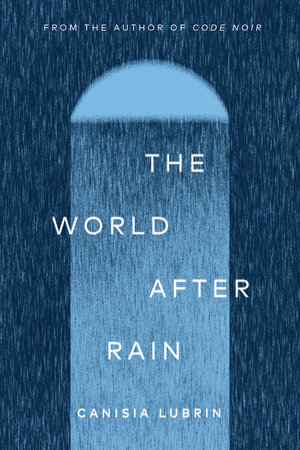
Finalist for the Trillium Book Award for Poetry • Named a Best Canadian Poetry Book of 2025 by CBC Books • Excerpt included in The Yale Review's Most-Read Poems of 2025 • Featured in the Publishers Weekly Spring 2026 Preview
"How incandescent the language is, each line emitting light through the membrane of time and anticipated grief. The work has a rigorousness, the poet pushing through the ache of experience from the first to the last word."
—Dionne Brand
"Epic. . . . The World After Rain expands our understanding of what elegy can accomplish, demonstrating how personal grief can open onto larger questions of history, diaspora, and survival. In an era when poetry often struggles to address collective trauma, Lubrin offers a model for how the intimate and the political can illuminate each other. . . . [accommodating] the full complexity of mourning while maintaining the emotional precision that transforms private grief into shared understanding."
—Selena Mercuri, The Fiddlehead
“Under Lubrin’s attentive and testing gaze and in her singular voice, the elegy feels at once new and timeless. . . . Lubrin’s attention at once holds the fleetest of moments, brief as the falling of a drop of rain, and the accumulation of personal and cultural histories.”
— Melanie Brannagan Frederiksen, Winnipeg Free Press
“[I]n this poem, the relationship is beyond biological; it is creative and generative, as the poet beholds her mother as a muse, and through this muse, the poet is able to make sense of the world around her, interrogate history, and further complicate and extend traditions. Lubrin is a poet aware of history; one humble enough to admit language’s inadequacy—to yield the sweetest name back to the sorcery (of Anne) on the stage—and alert to the eternal resourcefulness of her forebears. It is the world Lubrin creates that is most riveting: scientific, philosophical, existential, intimate, and, at the same time, incongruous, as it integrates and disintegrates to insist that it is ‘silly to mourn Anne, still alive.’” —World Literature Today “In The World After Rain, written in what Canisia Lubrin calls ‘anticipated grief’ for her mother Anne, the poet wonders ‘if the poem must close, if hollow things must float / if some might say, after this wilting, you must be mad to write / any poem at all . . .’ The book keeps grasping at ‘motherlike’ time: ‘I am keeping time, mama,’ ‘time worshipping time is a mother-image,’ time leaning against ‘the whipping work of conclusion.’ Poetry turns finality into time, and trope is what does the turning. Grief becomes rain, rain becomes ‘the thing you least expect will mother you.’ Anne’s courage is a cloudburst, her life the ceaseless waters.” —Poetry Foundation “At the centre of this book lives the person whose loss looms, the speaker’s mother, Anne. Like the ocean is for all life on earth, Anne is the origin point of the speaker’s life. But even here, complexity exists. Mother may be the person who gave you life, who you literally get to know from the inside out, but she is also a person with depths you may not be able to reach, with a history and interior life that existed before you and beyond you. As the speaker notes, ‘but there is a private time, a mother beneath the literal / where we can talk for hours about yours / gone and mine going, gone and mine / distance is the thing you least expect will mother you.’ This creates a sense of layers not only for the mother as an individual, but also a kind of palimpsest in which traces of all the mothers who came before continue to echo. Lubrin refuses a stable definition of mother, instead letting it change course throughout the collection until who or what can mother expand to include distance, time, cloud, and rain.” —Discours/e