Close Modal

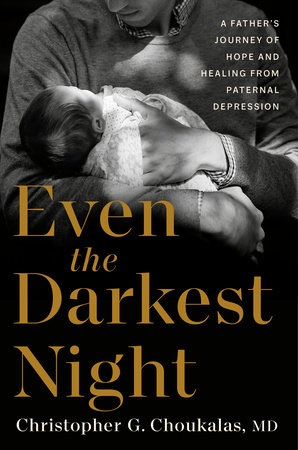
Even the Darkest Night

A Father's Journey of Hope and Healing from Paternal Depression

Look inside
Hardcover
$30.00 US
5.73"W x 8.54"H x 0.94"D   (14.6 x 21.7 x 2.4 cm) | 12 oz (352 g) | 12 per carton
On sale Jun 02, 2026 | 272 Pages | 9780593980224
Sales rights: World

Offering hope and illumination, the bone-raw story of a father’s failure to bond with his infant twin daughters, and his journey through paternal depression—an often undiagnosed condition that affects millions of new fathers.

After a traumatic birth nearly claimed his wife’s life, anesthesiologist and intensive care physician Christopher Choukalas should have felt grateful. His twin daughters were healthy, his wife had survived, and they had started a family. But instead of joy, Choukalas found himself spiraling—spending long evenings in the garage, unable to face the chaos and emotional strain inside his home. Caught between caring for his wife, deciphering the needs of his newborns, and confronting painful childhood memories, his world began to unravel.

Despite clear signs—racing thoughts, anxiety, sleeplessness, panic attacks, and emotional distance from his children—Choukalas failed to recognize he was suffering from a serious condition. Like many men, he internalized his pain, hoping it was just the “baby blues” and would fade with time.

His turning point came when his wife, exhausted with his behavior and “checked-outness,” urged him to seek help. Even though he’s a doctor, he had missed the fact that he ticked off every symptom of paternal depression. Through intensive therapy, medication, and the support of a fathers’ group, Choukalas began to understand his need for control and the lingering hurt from his own father’s absence. Slowly, he rebuilt his connection with his wife and children and found healing.

Even the Darkest Night, Choukalas’s powerful memoir, sheds light on the hidden struggles of fatherhood. With raw honesty and emotional insight, it challenges the silence and stigma surrounding men’s mental health, especially in the early years of parenting. A much-needed voice and new understanding for fathers navigating love, identity, and healing in the shadows of expectation.
Chapter 1

The Dark at the End of the Tunnel

Our anesthesiologist, Dr. Oana Maties, probably didn’t know why she dreamed of death the night before our twins were born. Nor, wisely, did she tell us beforehand. But there was something in the way she lingered a beat too long on the one small part of her consent paperwork—Lindsey’s consent to receive donated blood. Maybe that didn’t reach my consciousness, at least not right away, but it set off a subtle alarm bell, an annoyance almost. Geez, I thought, I’ve done anesthesia for hundreds of cesarean sections and never focused on blood this much.

As an academic anesthesiologist and intensive care physician, a physician who takes care of patients in the operating rooms and Intensive Care Unit at the University of California, San Francisco (UCSF), I’ve had versions of that talk with my own patients thousands of times. The thick stack of preoperative paperwork had become second nature to me in my own practice. Her perseveration was subtle, but unmistakable all the same. The paperwork was completed in a matter of minutes, but what lingered was my colleague’s pause as she hovered over that medical release, the soft catch of concern in her voice, the undercurrent of foreboding.

A premonition of death is a very unusual thing for any doctor to admit, let alone an anesthesiologist at an elite academic university. It’s squishy. Imprecise. Inconvenient. Unquantifiable against the backdrop of science that underpins our practice. Our belief in the knowable, the provable, the demonstrable is kind of a funny crutch that we use, an object of faith that allows us to do the things we do to patients, the risks we take. She couldn’t have known this routine operation would be complicated; that my wife, Lindsey, would nearly die, bleeding so much and so quickly that her body would go into shock, not able to support enough blood pressure to remain conscious. None of us knew. And yet Dr. Maties paused there.

Lindsey had had a textbook pregnancy, which is very surprising because she was thirty-nine years old and carrying twins that were conceived via IVF after five and a half years of seeing countless doctors and specialists. The chances of her having a normal pregnancy after IVF was only about 20 percent, and that was for a singleton, not twins; plus, after all the failed cycles we’d had, who knew? In fact, her own obstetrician was scanning her chart toward the end of her pregnancy, asking what exactly the problem had been for those five and a half years when we couldn’t conceive. As a fellow physician, I knew she wasn’t so much asking what the diagnosis was (as with the majority of infertility cases, our formal diagnosis was “unexplained subfertility,” and we would never have a clear answer about what was actually “wrong”); rather, it was a rare moment of candor in which she was essentially saying out loud, I can’t believe you are this far along without any complications.

Lindsey ended up carrying our twins to almost forty weeks. Thirty-six weeks is considered to be full term for twins; by thirty weeks, doctors usually induce birth. But the twins’ conception was so heavily medicalized, her pregnancy was so filled with tests, procedures, and ultrasounds, that I am sure a part of her wanted the birth to be less like that. By the time we went to the hospital, on the morning of August 27, 2020, deep into the pandemic culture of shutdowns and social isolation, still months before the vaccine would give us some relief, it was almost painful for me to look at Lindsey because her belly was so huge. Even she would laugh and agree with this statement. She’s five foot three with a petite frame, and from behind you couldn’t even tell she was pregnant. I once heard someone standing behind her in line at the grocery store gasp when Lindsey turned around, “Oh my God, she’s pregnant!” The twins would end up being almost six and a half pounds each, a staggering combined thirteen pounds of baby on that tiny frame.

In the inky blue hours of August 27, 2020, just before sunrise, Lindsey woke me up gently to tell me that she felt she needed to go to the hospital. It had been too long, she said, and she didn’t feel like she should be pregnant anymore. It was just a gut instinct, she said. We had walked five miles the day before along Crissy Field, one of the most beautiful open spaces in the city, under the splendor of the Golden Gate Bridge, the burnished red arches overhead, San Francisco Bay lapping beside us, the surfers daring to ride the waves in that notoriously complicated cove. Women smiled at her. I caught men eyeing her, even at almost forty weeks. She’s just one of those women.

So there I was, at five in the morning, still groggy from sleep, still unsure what all was happening, still maybe buried in denial that these babies were coming at all, when Lindsey told me her mom, Ayn (pronounced “Ann”), was already driving into San Francisco, where we lived, from Marin County, where Lindsey grew up. Ayn would be our “lay doula,” the only non-medical person allowed to be with us in the hospital at the pre-vaccine height of the pandemic.

As Lindsey was telling me all of this, I recall thinking she was beautiful and that I should have felt like the luckiest guy in the world, overwhelmed with anticipation and excitement to meet our babies, for whom we had not just waited but also endured and suffered for so long. While I remember thinking that, I felt nothing—nothing for her, nothing for our unborn babies—and I’m not sure I realized it at the time. All the words and expressions that conjure up my state in that moment—empty, hollow, a robot—now sound clichéd and tired, but they were deeply true. I was a shell. I had spent most of my life “compartmentalizing,” mentally separating hard or unpleasant things from my everyday internal dialogue, both because of my career and my own complicated childhood, but this had reached its zenith in the last nine months. I hoped no one had noticed, but I was checked out and disengaged from Lindsey and the entire pregnancy. In that moment, though, the reality of what was to come was just beginning to set in. All my mechanisms that kept my life orderly, that shielded me from uncertainty, from pain I didn’t even know I had, would be dismantled, and I would find myself adrift—and I wouldn’t even see it coming.

I don’t recall what I was thinking as we drove to the hospital that morning to give birth. The three of us were huddled in Ayn’s Volvo station wagon in the dark, early hours of the morning. The fact that I don’t remember what I was thinking as I was about to meet my babies is telling in its own right: I’m always cogitating, thinking about next steps, obstacles, and work-arounds.

Our labor experience was a thirty-six-hour hellscape of sleep deprivation, confusion, and failure. Nothing seemed to stimulate Lindsey to have contractions, and one of the babies was moving around so much that the monitors, necessary to track fetal heart rate as a proxy for the babies’ well-being, simply couldn’t track her. The physicians and nurses spent literally hours at a time, all day and all night, adjusting this, moving that, trying to keep Baby B on the monitor, keeping us awake and miserable, and all the while, nary a contraction nor any sign of labor occurred. As our second day was turning to night, Ayn napped on the daybed under the long stretch of windows facing Oakland and the East Bay. The smell of smoke was just beginning to permeate the hospital; it would be another week until the Tubbs fire in Santa Rosa would cause the daytime sky to turn an eerie orange, something so bizarre news outlets throughout the world reported on it.

But for now, it strangely felt like we were camping and Ayn had come over to join us at the campfire, even as the trio of medical professionals huddled in the corner of the room tried to figure out next steps for Lindsey’s induction. Ayn had birthed Lindsey’s sister at home, unmedicated, in less than two hours. Lindsey was born in five hours. Ayn was a bit crunchy, an earth mom, favoring tinctures, whole foods as medicine, and yoga over antibiotics or even Tylenol. We’d often clash, me rolling my eyes at her severely unscientific approach to nearly everything. I’d rib her pretty hard about what I’d call “elephant placenta” (her favorite garlic and echinacea blend, which she swore by during flu season) or her faith in astrology over the scientific method as a way to make sense of the world. So imagine my shock when, in the middle of the hemming and hawing about next steps, she said, with the clarity of a phonograph needle scratching into silence, “I think we need to be talking about a C-section.”
“We don’t have all the answers when it comes to men’s mental health. But we do know it starts with honest conversations. Dr. Christopher Choukalas brings paternal depression into the light with courage and vulnerability. This book will help countless men feel seen, understood, and less alone in their struggles.”—Jon Gustin, author of The Tired Dad

“Dr. Choukalas shines a light on post-natal depression in men—a condition hiding in plain sight, suffered mostly in silence by millions of new fathers. Choukalas’s story is compelling, his writing is beautiful, and his courage in telling it is something I deeply admire.”—Robert Wachter, MD, chair, Department of Medicine, University of California, San Francisco, and author of A Giant Leap

“This is a gripping, beautifully written story of one father’s journey through deep depression and recovery. Dr. Choukalas’shonest, searching account will resonate with other fathers who are struggling with new parenthood.”—Darby Saxbe, PhD, professor of psychology at the University of Southern California, and author of Dad Brain

“This book is long overdue, but I am so glad Dr. Choukalas was brave enough to write it. Brave because so many men will see themselves in his story, yet so many feel they aren’t supposed to talk about it. This book will save lives.”—Jennifer Lincoln, MD, author of The Birth Book

“This brave and insightful book by a new father (who is also a physician) is a beautifully written personal account that offers hope for dads who struggle at this critical time.”—Donna E Stewart, CM, MD, FRCPC, professor of psychiatry and obstetrics/gynecology at the
University of Toronto, Centre for Mental Health

“This authentic and insightful story offers compassion and hope to fathers and their loved ones. Dr. Choukalas’s journey provides reassurance that help is available and healing is possible!”—Jonathan Scarff, MD, psychiatrist, Lexington VA Health Care System
© Ian Tuttle
Christopher G. Choukalas, MD, MS, is a physician in community practice in Marin County, California. While he is board-certified in anesthesiology and critical care medicine and is a professor in the School of Medicine at the University of California, San Francisco, he remains still a student of parenting. View titles by Christopher G. Choukalas, MD
Available for sale exclusive:
•     Afghanistan
•     Aland Islands
•     Albania
•     Algeria
•     Andorra
•     Angola
•     Anguilla
•     Antarctica
•     Antigua/Barbuda
•     Argentina
•     Armenia
•     Aruba
•     Australia
•     Austria
•     Azerbaijan
•     Bahamas
•     Bahrain
•     Bangladesh
•     Barbados
•     Belarus
•     Belgium
•     Belize
•     Benin
•     Bermuda
•     Bhutan
•     Bolivia
•     Bonaire, Saba
•     Bosnia Herzeg.
•     Botswana
•     Bouvet Island
•     Brazil
•     Brit.Ind.Oc.Ter
•     Brit.Virgin Is.
•     Brunei
•     Bulgaria
•     Burkina Faso
•     Burundi
•     Cambodia
•     Cameroon
•     Canada
•     Cape Verde
•     Cayman Islands
•     Centr.Afr.Rep.
•     Chad
•     Chile
•     China
•     Christmas Islnd
•     Cocos Islands
•     Colombia
•     Comoro Is.
•     Congo
•     Cook Islands
•     Costa Rica
•     Croatia
•     Cuba
•     Curacao
•     Cyprus
•     Czech Republic
•     Dem. Rep. Congo
•     Denmark
•     Djibouti
•     Dominica
•     Dominican Rep.
•     Ecuador
•     Egypt
•     El Salvador
•     Equatorial Gui.
•     Eritrea
•     Estonia
•     Ethiopia
•     Falkland Islnds
•     Faroe Islands
•     Fiji
•     Finland
•     France
•     Fren.Polynesia
•     French Guinea
•     Gabon
•     Gambia
•     Georgia
•     Germany
•     Ghana
•     Gibraltar
•     Greece
•     Greenland
•     Grenada
•     Guadeloupe
•     Guam
•     Guatemala
•     Guernsey
•     Guinea Republic
•     Guinea-Bissau
•     Guyana
•     Haiti
•     Heard/McDon.Isl
•     Honduras
•     Hong Kong
•     Hungary
•     Iceland
•     India
•     Indonesia
•     Iran
•     Iraq
•     Ireland
•     Isle of Man
•     Israel
•     Italy
•     Ivory Coast
•     Jamaica
•     Japan
•     Jersey
•     Jordan
•     Kazakhstan
•     Kenya
•     Kiribati
•     Kuwait
•     Kyrgyzstan
•     Laos
•     Latvia
•     Lebanon
•     Lesotho
•     Liberia
•     Libya
•     Liechtenstein
•     Lithuania
•     Luxembourg
•     Macau
•     Macedonia
•     Madagascar
•     Malawi
•     Malaysia
•     Maldives
•     Mali
•     Malta
•     Marshall island
•     Martinique
•     Mauritania
•     Mauritius
•     Mayotte
•     Mexico
•     Micronesia
•     Minor Outl.Ins.
•     Moldavia
•     Monaco
•     Mongolia
•     Montenegro
•     Montserrat
•     Morocco
•     Mozambique
•     Myanmar
•     Namibia
•     Nauru
•     Nepal
•     Netherlands
•     New Caledonia
•     New Zealand
•     Nicaragua
•     Niger
•     Nigeria
•     Niue
•     Norfolk Island
•     North Korea
•     North Mariana
•     Norway
•     Oman
•     Pakistan
•     Palau
•     Palestinian Ter
•     Panama
•     PapuaNewGuinea
•     Paraguay
•     Peru
•     Philippines
•     Pitcairn Islnds
•     Poland
•     Portugal
•     Puerto Rico
•     Qatar
•     Reunion Island
•     Romania
•     Russian Fed.
•     Rwanda
•     S. Sandwich Ins
•     Saint Martin
•     Samoa,American
•     San Marino
•     SaoTome Princip
•     Saudi Arabia
•     Senegal
•     Serbia
•     Seychelles
•     Sierra Leone
•     Singapore
•     Sint Maarten
•     Slovakia
•     Slovenia
•     Solomon Islands
•     Somalia
•     South Africa
•     South Korea
•     South Sudan
•     Spain
•     Sri Lanka
•     St Barthelemy
•     St. Helena
•     St. Lucia
•     St. Vincent
•     St.Chr.,Nevis
•     St.Pier,Miquel.
•     Sth Terr. Franc
•     Sudan
•     Suriname
•     Svalbard
•     Swaziland
•     Sweden
•     Switzerland
•     Syria
•     Tadschikistan
•     Taiwan
•     Tanzania
•     Thailand
•     Timor-Leste
•     Togo
•     Tokelau Islands
•     Tonga
•     Trinidad,Tobago
•     Tunisia
•     Turkey
•     Turkmenistan
•     Turks&Caicos Is
•     Tuvalu
•     US Virgin Is.
•     USA
•     Uganda
•     Ukraine
•     Unit.Arab Emir.
•     United Kingdom
•     Uruguay
•     Uzbekistan
•     Vanuatu
•     Vatican City
•     Venezuela
•     Vietnam
•     Wallis,Futuna
•     West Saharan
•     Western Samoa
•     Yemen
•     Zambia
•     Zimbabwe

About

Offering hope and illumination, the bone-raw story of a father’s failure to bond with his infant twin daughters, and his journey through paternal depression—an often undiagnosed condition that affects millions of new fathers.

After a traumatic birth nearly claimed his wife’s life, anesthesiologist and intensive care physician Christopher Choukalas should have felt grateful. His twin daughters were healthy, his wife had survived, and they had started a family. But instead of joy, Choukalas found himself spiraling—spending long evenings in the garage, unable to face the chaos and emotional strain inside his home. Caught between caring for his wife, deciphering the needs of his newborns, and confronting painful childhood memories, his world began to unravel.

Despite clear signs—racing thoughts, anxiety, sleeplessness, panic attacks, and emotional distance from his children—Choukalas failed to recognize he was suffering from a serious condition. Like many men, he internalized his pain, hoping it was just the “baby blues” and would fade with time.

His turning point came when his wife, exhausted with his behavior and “checked-outness,” urged him to seek help. Even though he’s a doctor, he had missed the fact that he ticked off every symptom of paternal depression. Through intensive therapy, medication, and the support of a fathers’ group, Choukalas began to understand his need for control and the lingering hurt from his own father’s absence. Slowly, he rebuilt his connection with his wife and children and found healing.

Even the Darkest Night, Choukalas’s powerful memoir, sheds light on the hidden struggles of fatherhood. With raw honesty and emotional insight, it challenges the silence and stigma surrounding men’s mental health, especially in the early years of parenting. A much-needed voice and new understanding for fathers navigating love, identity, and healing in the shadows of expectation.

Excerpt

Chapter 1

The Dark at the End of the Tunnel

Our anesthesiologist, Dr. Oana Maties, probably didn’t know why she dreamed of death the night before our twins were born. Nor, wisely, did she tell us beforehand. But there was something in the way she lingered a beat too long on the one small part of her consent paperwork—Lindsey’s consent to receive donated blood. Maybe that didn’t reach my consciousness, at least not right away, but it set off a subtle alarm bell, an annoyance almost. Geez, I thought, I’ve done anesthesia for hundreds of cesarean sections and never focused on blood this much.

As an academic anesthesiologist and intensive care physician, a physician who takes care of patients in the operating rooms and Intensive Care Unit at the University of California, San Francisco (UCSF), I’ve had versions of that talk with my own patients thousands of times. The thick stack of preoperative paperwork had become second nature to me in my own practice. Her perseveration was subtle, but unmistakable all the same. The paperwork was completed in a matter of minutes, but what lingered was my colleague’s pause as she hovered over that medical release, the soft catch of concern in her voice, the undercurrent of foreboding.

A premonition of death is a very unusual thing for any doctor to admit, let alone an anesthesiologist at an elite academic university. It’s squishy. Imprecise. Inconvenient. Unquantifiable against the backdrop of science that underpins our practice. Our belief in the knowable, the provable, the demonstrable is kind of a funny crutch that we use, an object of faith that allows us to do the things we do to patients, the risks we take. She couldn’t have known this routine operation would be complicated; that my wife, Lindsey, would nearly die, bleeding so much and so quickly that her body would go into shock, not able to support enough blood pressure to remain conscious. None of us knew. And yet Dr. Maties paused there.

Lindsey had had a textbook pregnancy, which is very surprising because she was thirty-nine years old and carrying twins that were conceived via IVF after five and a half years of seeing countless doctors and specialists. The chances of her having a normal pregnancy after IVF was only about 20 percent, and that was for a singleton, not twins; plus, after all the failed cycles we’d had, who knew? In fact, her own obstetrician was scanning her chart toward the end of her pregnancy, asking what exactly the problem had been for those five and a half years when we couldn’t conceive. As a fellow physician, I knew she wasn’t so much asking what the diagnosis was (as with the majority of infertility cases, our formal diagnosis was “unexplained subfertility,” and we would never have a clear answer about what was actually “wrong”); rather, it was a rare moment of candor in which she was essentially saying out loud, I can’t believe you are this far along without any complications.

Lindsey ended up carrying our twins to almost forty weeks. Thirty-six weeks is considered to be full term for twins; by thirty weeks, doctors usually induce birth. But the twins’ conception was so heavily medicalized, her pregnancy was so filled with tests, procedures, and ultrasounds, that I am sure a part of her wanted the birth to be less like that. By the time we went to the hospital, on the morning of August 27, 2020, deep into the pandemic culture of shutdowns and social isolation, still months before the vaccine would give us some relief, it was almost painful for me to look at Lindsey because her belly was so huge. Even she would laugh and agree with this statement. She’s five foot three with a petite frame, and from behind you couldn’t even tell she was pregnant. I once heard someone standing behind her in line at the grocery store gasp when Lindsey turned around, “Oh my God, she’s pregnant!” The twins would end up being almost six and a half pounds each, a staggering combined thirteen pounds of baby on that tiny frame.

In the inky blue hours of August 27, 2020, just before sunrise, Lindsey woke me up gently to tell me that she felt she needed to go to the hospital. It had been too long, she said, and she didn’t feel like she should be pregnant anymore. It was just a gut instinct, she said. We had walked five miles the day before along Crissy Field, one of the most beautiful open spaces in the city, under the splendor of the Golden Gate Bridge, the burnished red arches overhead, San Francisco Bay lapping beside us, the surfers daring to ride the waves in that notoriously complicated cove. Women smiled at her. I caught men eyeing her, even at almost forty weeks. She’s just one of those women.

So there I was, at five in the morning, still groggy from sleep, still unsure what all was happening, still maybe buried in denial that these babies were coming at all, when Lindsey told me her mom, Ayn (pronounced “Ann”), was already driving into San Francisco, where we lived, from Marin County, where Lindsey grew up. Ayn would be our “lay doula,” the only non-medical person allowed to be with us in the hospital at the pre-vaccine height of the pandemic.

As Lindsey was telling me all of this, I recall thinking she was beautiful and that I should have felt like the luckiest guy in the world, overwhelmed with anticipation and excitement to meet our babies, for whom we had not just waited but also endured and suffered for so long. While I remember thinking that, I felt nothing—nothing for her, nothing for our unborn babies—and I’m not sure I realized it at the time. All the words and expressions that conjure up my state in that moment—empty, hollow, a robot—now sound clichéd and tired, but they were deeply true. I was a shell. I had spent most of my life “compartmentalizing,” mentally separating hard or unpleasant things from my everyday internal dialogue, both because of my career and my own complicated childhood, but this had reached its zenith in the last nine months. I hoped no one had noticed, but I was checked out and disengaged from Lindsey and the entire pregnancy. In that moment, though, the reality of what was to come was just beginning to set in. All my mechanisms that kept my life orderly, that shielded me from uncertainty, from pain I didn’t even know I had, would be dismantled, and I would find myself adrift—and I wouldn’t even see it coming.

I don’t recall what I was thinking as we drove to the hospital that morning to give birth. The three of us were huddled in Ayn’s Volvo station wagon in the dark, early hours of the morning. The fact that I don’t remember what I was thinking as I was about to meet my babies is telling in its own right: I’m always cogitating, thinking about next steps, obstacles, and work-arounds.

Our labor experience was a thirty-six-hour hellscape of sleep deprivation, confusion, and failure. Nothing seemed to stimulate Lindsey to have contractions, and one of the babies was moving around so much that the monitors, necessary to track fetal heart rate as a proxy for the babies’ well-being, simply couldn’t track her. The physicians and nurses spent literally hours at a time, all day and all night, adjusting this, moving that, trying to keep Baby B on the monitor, keeping us awake and miserable, and all the while, nary a contraction nor any sign of labor occurred. As our second day was turning to night, Ayn napped on the daybed under the long stretch of windows facing Oakland and the East Bay. The smell of smoke was just beginning to permeate the hospital; it would be another week until the Tubbs fire in Santa Rosa would cause the daytime sky to turn an eerie orange, something so bizarre news outlets throughout the world reported on it.

But for now, it strangely felt like we were camping and Ayn had come over to join us at the campfire, even as the trio of medical professionals huddled in the corner of the room tried to figure out next steps for Lindsey’s induction. Ayn had birthed Lindsey’s sister at home, unmedicated, in less than two hours. Lindsey was born in five hours. Ayn was a bit crunchy, an earth mom, favoring tinctures, whole foods as medicine, and yoga over antibiotics or even Tylenol. We’d often clash, me rolling my eyes at her severely unscientific approach to nearly everything. I’d rib her pretty hard about what I’d call “elephant placenta” (her favorite garlic and echinacea blend, which she swore by during flu season) or her faith in astrology over the scientific method as a way to make sense of the world. So imagine my shock when, in the middle of the hemming and hawing about next steps, she said, with the clarity of a phonograph needle scratching into silence, “I think we need to be talking about a C-section.”

Praise

“We don’t have all the answers when it comes to men’s mental health. But we do know it starts with honest conversations. Dr. Christopher Choukalas brings paternal depression into the light with courage and vulnerability. This book will help countless men feel seen, understood, and less alone in their struggles.”—Jon Gustin, author of The Tired Dad

“Dr. Choukalas shines a light on post-natal depression in men—a condition hiding in plain sight, suffered mostly in silence by millions of new fathers. Choukalas’s story is compelling, his writing is beautiful, and his courage in telling it is something I deeply admire.”—Robert Wachter, MD, chair, Department of Medicine, University of California, San Francisco, and author of A Giant Leap

“This is a gripping, beautifully written story of one father’s journey through deep depression and recovery. Dr. Choukalas’shonest, searching account will resonate with other fathers who are struggling with new parenthood.”—Darby Saxbe, PhD, professor of psychology at the University of Southern California, and author of Dad Brain

“This book is long overdue, but I am so glad Dr. Choukalas was brave enough to write it. Brave because so many men will see themselves in his story, yet so many feel they aren’t supposed to talk about it. This book will save lives.”—Jennifer Lincoln, MD, author of The Birth Book

“This brave and insightful book by a new father (who is also a physician) is a beautifully written personal account that offers hope for dads who struggle at this critical time.”—Donna E Stewart, CM, MD, FRCPC, professor of psychiatry and obstetrics/gynecology at the
University of Toronto, Centre for Mental Health

“This authentic and insightful story offers compassion and hope to fathers and their loved ones. Dr. Choukalas’s journey provides reassurance that help is available and healing is possible!”—Jonathan Scarff, MD, psychiatrist, Lexington VA Health Care System

Author

© Ian Tuttle
Christopher G. Choukalas, MD, MS, is a physician in community practice in Marin County, California. While he is board-certified in anesthesiology and critical care medicine and is a professor in the School of Medicine at the University of California, San Francisco, he remains still a student of parenting. View titles by Christopher G. Choukalas, MD

Rights

Available for sale exclusive:
•     Afghanistan
•     Aland Islands
•     Albania
•     Algeria
•     Andorra
•     Angola
•     Anguilla
•     Antarctica
•     Antigua/Barbuda
•     Argentina
•     Armenia
•     Aruba
•     Australia
•     Austria
•     Azerbaijan
•     Bahamas
•     Bahrain
•     Bangladesh
•     Barbados
•     Belarus
•     Belgium
•     Belize
•     Benin
•     Bermuda
•     Bhutan
•     Bolivia
•     Bonaire, Saba
•     Bosnia Herzeg.
•     Botswana
•     Bouvet Island
•     Brazil
•     Brit.Ind.Oc.Ter
•     Brit.Virgin Is.
•     Brunei
•     Bulgaria
•     Burkina Faso
•     Burundi
•     Cambodia
•     Cameroon
•     Canada
•     Cape Verde
•     Cayman Islands
•     Centr.Afr.Rep.
•     Chad
•     Chile
•     China
•     Christmas Islnd
•     Cocos Islands
•     Colombia
•     Comoro Is.
•     Congo
•     Cook Islands
•     Costa Rica
•     Croatia
•     Cuba
•     Curacao
•     Cyprus
•     Czech Republic
•     Dem. Rep. Congo
•     Denmark
•     Djibouti
•     Dominica
•     Dominican Rep.
•     Ecuador
•     Egypt
•     El Salvador
•     Equatorial Gui.
•     Eritrea
•     Estonia
•     Ethiopia
•     Falkland Islnds
•     Faroe Islands
•     Fiji
•     Finland
•     France
•     Fren.Polynesia
•     French Guinea
•     Gabon
•     Gambia
•     Georgia
•     Germany
•     Ghana
•     Gibraltar
•     Greece
•     Greenland
•     Grenada
•     Guadeloupe
•     Guam
•     Guatemala
•     Guernsey
•     Guinea Republic
•     Guinea-Bissau
•     Guyana
•     Haiti
•     Heard/McDon.Isl
•     Honduras
•     Hong Kong
•     Hungary
•     Iceland
•     India
•     Indonesia
•     Iran
•     Iraq
•     Ireland
•     Isle of Man
•     Israel
•     Italy
•     Ivory Coast
•     Jamaica
•     Japan
•     Jersey
•     Jordan
•     Kazakhstan
•     Kenya
•     Kiribati
•     Kuwait
•     Kyrgyzstan
•     Laos
•     Latvia
•     Lebanon
•     Lesotho
•     Liberia
•     Libya
•     Liechtenstein
•     Lithuania
•     Luxembourg
•     Macau
•     Macedonia
•     Madagascar
•     Malawi
•     Malaysia
•     Maldives
•     Mali
•     Malta
•     Marshall island
•     Martinique
•     Mauritania
•     Mauritius
•     Mayotte
•     Mexico
•     Micronesia
•     Minor Outl.Ins.
•     Moldavia
•     Monaco
•     Mongolia
•     Montenegro
•     Montserrat
•     Morocco
•     Mozambique
•     Myanmar
•     Namibia
•     Nauru
•     Nepal
•     Netherlands
•     New Caledonia
•     New Zealand
•     Nicaragua
•     Niger
•     Nigeria
•     Niue
•     Norfolk Island
•     North Korea
•     North Mariana
•     Norway
•     Oman
•     Pakistan
•     Palau
•     Palestinian Ter
•     Panama
•     PapuaNewGuinea
•     Paraguay
•     Peru
•     Philippines
•     Pitcairn Islnds
•     Poland
•     Portugal
•     Puerto Rico
•     Qatar
•     Reunion Island
•     Romania
•     Russian Fed.
•     Rwanda
•     S. Sandwich Ins
•     Saint Martin
•     Samoa,American
•     San Marino
•     SaoTome Princip
•     Saudi Arabia
•     Senegal
•     Serbia
•     Seychelles
•     Sierra Leone
•     Singapore
•     Sint Maarten
•     Slovakia
•     Slovenia
•     Solomon Islands
•     Somalia
•     South Africa
•     South Korea
•     South Sudan
•     Spain
•     Sri Lanka
•     St Barthelemy
•     St. Helena
•     St. Lucia
•     St. Vincent
•     St.Chr.,Nevis
•     St.Pier,Miquel.
•     Sth Terr. Franc
•     Sudan
•     Suriname
•     Svalbard
•     Swaziland
•     Sweden
•     Switzerland
•     Syria
•     Tadschikistan
•     Taiwan
•     Tanzania
•     Thailand
•     Timor-Leste
•     Togo
•     Tokelau Islands
•     Tonga
•     Trinidad,Tobago
•     Tunisia
•     Turkey
•     Turkmenistan
•     Turks&Caicos Is
•     Tuvalu
•     US Virgin Is.
•     USA
•     Uganda
•     Ukraine
•     Unit.Arab Emir.
•     United Kingdom
•     Uruguay
•     Uzbekistan
•     Vanuatu
•     Vatican City
•     Venezuela
•     Vietnam
•     Wallis,Futuna
•     West Saharan
•     Western Samoa
•     Yemen
•     Zambia
•     Zimbabwe