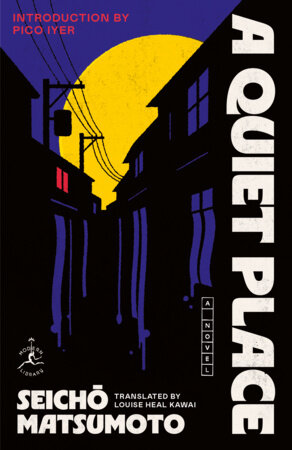
An artfully twisty psychological mystery from Seichō Matsumoto, hailed as “Japan’s Agatha Christie” (The Sunday Times), exploring the corrosive power of jealousy, guilt, and doubt
While on an important business trip, Tsuneo Asai receives word that his wife, Eiko, has died suddenly of a heart attack. She had long suffered from heart problems, so the news is not entirely unexpected—though she was far too young for such an end. Shaken but restrained, Asai throws himself into his work as a government official, using routine and responsibility to keep grief at bay. Their marriage, after all, had never been especially passionate.
Yet something about the circumstances of Eiko’s death begins to trouble him. She collapsed while walking alone on a quiet residential street in Tokyo—a place where she seemed to have no reason to be. A visit to the small shop where she died raises further questions, especially when Asai notices a hotel perched at the top of the hill, unmistakably designed as a discreet rendezvous for lovers. He begins to wonder whether his gentle, haiku-loving wife may have been leading a secret life.
As Asai’s suspicions deepen, his mental state begins to unravel, and the boundaries of normalcy slip away. In the process, Matsumoto lays bare the fraught tensions between ambition, domestic life, and emotional repression in postwar Japan—crafting a haunting portrait of a man undone by what he cannot know.
Seicho Matsumoto was born in 1909 in Fukuoka, Japan. Self-educated, Matsumoto published his first book when he was forty-one years old and he quickly established himself as a master of crime fiction. His exploration of human psychology and Japanese post-war malaise, coupled with the creation of twisting, dark mysteries, made him one of the most acclaimed and bestselling writers in Japan. He received the prestigious Akutagawa Literary Prize in 1953 and the Kikuchi Kan Prize in 1970. He died in 1992.
An artfully twisty psychological mystery from Seichō Matsumoto, hailed as “Japan’s Agatha Christie” (The Sunday Times), exploring the corrosive power of jealousy, guilt, and doubt
While on an important business trip, Tsuneo Asai receives word that his wife, Eiko, has died suddenly of a heart attack. She had long suffered from heart problems, so the news is not entirely unexpected—though she was far too young for such an end. Shaken but restrained, Asai throws himself into his work as a government official, using routine and responsibility to keep grief at bay. Their marriage, after all, had never been especially passionate.
Yet something about the circumstances of Eiko’s death begins to trouble him. She collapsed while walking alone on a quiet residential street in Tokyo—a place where she seemed to have no reason to be. A visit to the small shop where she died raises further questions, especially when Asai notices a hotel perched at the top of the hill, unmistakably designed as a discreet rendezvous for lovers. He begins to wonder whether his gentle, haiku-loving wife may have been leading a secret life.
As Asai’s suspicions deepen, his mental state begins to unravel, and the boundaries of normalcy slip away. In the process, Matsumoto lays bare the fraught tensions between ambition, domestic life, and emotional repression in postwar Japan—crafting a haunting portrait of a man undone by what he cannot know.
Author
Seicho Matsumoto was born in 1909 in Fukuoka, Japan. Self-educated, Matsumoto published his first book when he was forty-one years old and he quickly established himself as a master of crime fiction. His exploration of human psychology and Japanese post-war malaise, coupled with the creation of twisting, dark mysteries, made him one of the most acclaimed and bestselling writers in Japan. He received the prestigious Akutagawa Literary Prize in 1953 and the Kikuchi Kan Prize in 1970. He died in 1992.