One
On the very first day of seventh grade, at the very beginning of his first class, Clementine tried to take his seat like a normal person.
He wasn’t sure if he pulled it off.
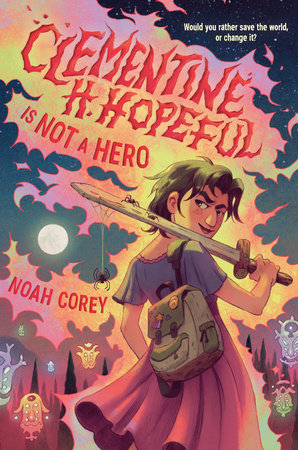
There was a whole variety of things Clementine didn’t want people to notice about him (like that he was fidgety) (and sort of sweaty) (and wearing pink sneakers). But he did want people to absolutely understand two things the minute they met him:
1. Clementine was a boy’s name, thank you very much, and
2. He would get taller eventually, because boys in his family did
eventually get tall, he promised. He really was very normal, and it wasn’t his fault he’d skipped a grade and also several growth spurts.
To prove he was
very normal, he wore his most regular red flannel, and his super-not-suspicious Loki T-shirt, and his only-a-bit-ripped-up jeans—which mostly covered the pink sneakers. That morning, he’d let his mom put flowery hair spray in his chin-length black hair. He’d even double-checked that his socks matched.
He sat very still. He pretended he wasn’t sweaty. He ignored how frizzy and itchy and in-his-eyes his bangs were, despite all the spray. Most importantly, he didn’t immediately start talking about spiders in intricate detail, which had been his mistake the year before.
(Normal kids talk about spiders a normal amount.) (Which apparently isn’t very much.)
Clementine’s plan went perfectly until the bell rang, and a shockingly tall teacher started calling roll.
The teacher was so tall because his legs were very, very long and spindly. He was wearing large square glasses and a thick gray cardigan over an
even thicker blue sweater, and he looked very much like he was using his curly, blond-with-brown-roots hair to hide two smallish horns.
He called out
Clementine H. Hopeful.
Clementine raised his hand in a profoundly average way.
The teacher frowned. He called out
Clementine H. Hopeful again.
Clementine raised his hand higher.
The teacher stared at him. Clementine stared back.
His teacher had reddish brown skin, striking dark freckles, and off-yellow eyebrows. Only his frown was ugly.
Clementine shook his hand a little.
“I said
Clementine.”
“That’s me,” said Clementine.
“Clementine’s a girl’s name,” the teacher sneered.
Clementine fiddled with his sleeve, disappointed that the (odd) (pretty) teacher was terrible. “Clementine’s a boy’s name if a boy has it. And I’m a boy. And I have it.”
The teacher squinted at him.
Clementine tried not to squint back, because that was rude, but he did stare at the teacher’s hair.
It just
really, really looked like horns.
The teacher said, “I’m marking Clementine absent, and I’m going to need your real name.”
“Clementine
is my real name. If you really don’t like it, you can call me Hopeful?”
The teacher marked something down on his clipboard and talked like Clementine was being punished for trying to trick him. “I’m going to call you Hopeful all semester. It might be a funny joke now, but I won’t let you change it.”
Clementine felt like he was going to vomit. Everyone was staring at him.
His words were a whisper. “You
can call me ‘Hopeful’ all semester. It’s my last name . . .”
The teacher called out another name and simply checked the box when the other kid raised their hand.
“. . . But I’d rather you called me Clementine.”
Clementine’s day did not get better after homeroom.
He liked his classes, but he had never been exceptionally good at them. (The grade he skipped was kindergarten, and only because his mom mixed up which room she was supposed to walk him to.) He was great at some parts of school! He understood how to read, of course, and he was really excellent at writing—he never forgot to dot his
is with neat little circles. He kinda liked a few of his teachers, even though they weren’t always particularly trusting (or kind) toward him. And he sorta liked a few of his classmates, but he wasn’t good at talking to people (about most things besides spiders).
He just didn’t understand what other people meant when they said things. And
nobody understood what
he meant when
he said things.
So, at lunch, when Ginger Jones saw him sitting alone and giggled, “What are you drawing?” he took her seriously and held it up to show her.
It was a spider—specifically, a brown recluse spider, with a hat and a different roller skate on every foot. Clementine knew he wasn’t
great at drawing, but he thought it was sweet Ginger was asking. And giving a spider roller skates was a good idea (if he could get a spider that big, or roller skates that small, obviously).
Ginger didn’t say anything else. She turned to her friends and laughed.
Clementine blinked, shocked and a little confused, then felt blood rush to his face. He dropped his notebook onto the table and furiously scribbled the spider out. Then he looked up and realized he was the only person sitting alone in the cafeteria.
He stood up stiffly, robotically walked out, then marched down the hallway to the bathroom.
When he pushed the heavy wood door open, he was met with a wave of cold, mildewy air. Clementine used the
old bathroom at the back of the school. It was the only bathroom he had used for years (because
nobody else ever used it).
It was water-stained and permanently grimy. It had a drafty window by the ceiling that looked out on a near-black patch of forest. And later in the year, when it got cold, it would have at least thirty-five spiders tucked away in odd cracks. It was “too scary” for the other kids, which is what made it safe for him. He felt a little relieved just walking in; it was a place he would be left
alone.
On the other hand, it
was creepy, especially being this close to the forest. And when he was all alone, with nothing to distract him, his Very Big imagination sometimes got out of control. When he hung out in this bathroom, he knew he might
see things from the forest. Things that his mom had reassured him were not real. Horrific, toothy,
definitely pretend things that would give him nightmares.
He knew the other kids didn’t see the things he saw. But the other kids never needed to hide in the nooks and corners that creepy things
hypothetically crept out of, like Clementine needed to do.
Clementine walked into the big stall in the back, locked the door, and sat on the closed toilet. He pulled his feet up onto the toilet lid after him. That way, even if someone did walk in, they wouldn’t see him or his pink sneakers.
(Also, if his haunted and overgrown imagination conjured up anything horrifying, he could pretend not to see
it.)
He swung his backpack onto the top of the toilet, curled his arms around his knees, and sighed.
Sometimes Clementine felt like everyone else was born with a little instructional book about
How to Be a Normal Girl or
How to Be a Normal Boy or
How to Grow Up to Be a Normal Teacher. The boys at his school wore camo hunting hoodies or loose shirts with basketball shorts. The girls wore tight jeans and cardigans. And the teachers were just grown-up versions of all the boys and girls.
But Clementine felt like he had not received the same instructions. He felt like he must have been born with an instructional book called
100 Reasons Why Beetles and Crickets and Other Assorted Creatures Are Deeply Beautiful. This was a good kind of internal book to have, but not one that was helpful for social things.
That’s why Clementine wasn’t good at school. He wasn’t good at having friends. He wasn’t good at talking to teachers.
And then he heard rustling from the woods outside the window, and his train of thought crashed to a halt.
He tried to ignore it. He tried to remember what his mom said.
But there was something scratching at the edges of the window frame.
Copyright © 2026 by Noah Corey. All rights reserved. No part of this excerpt may be reproduced or reprinted without permission in writing from the publisher.