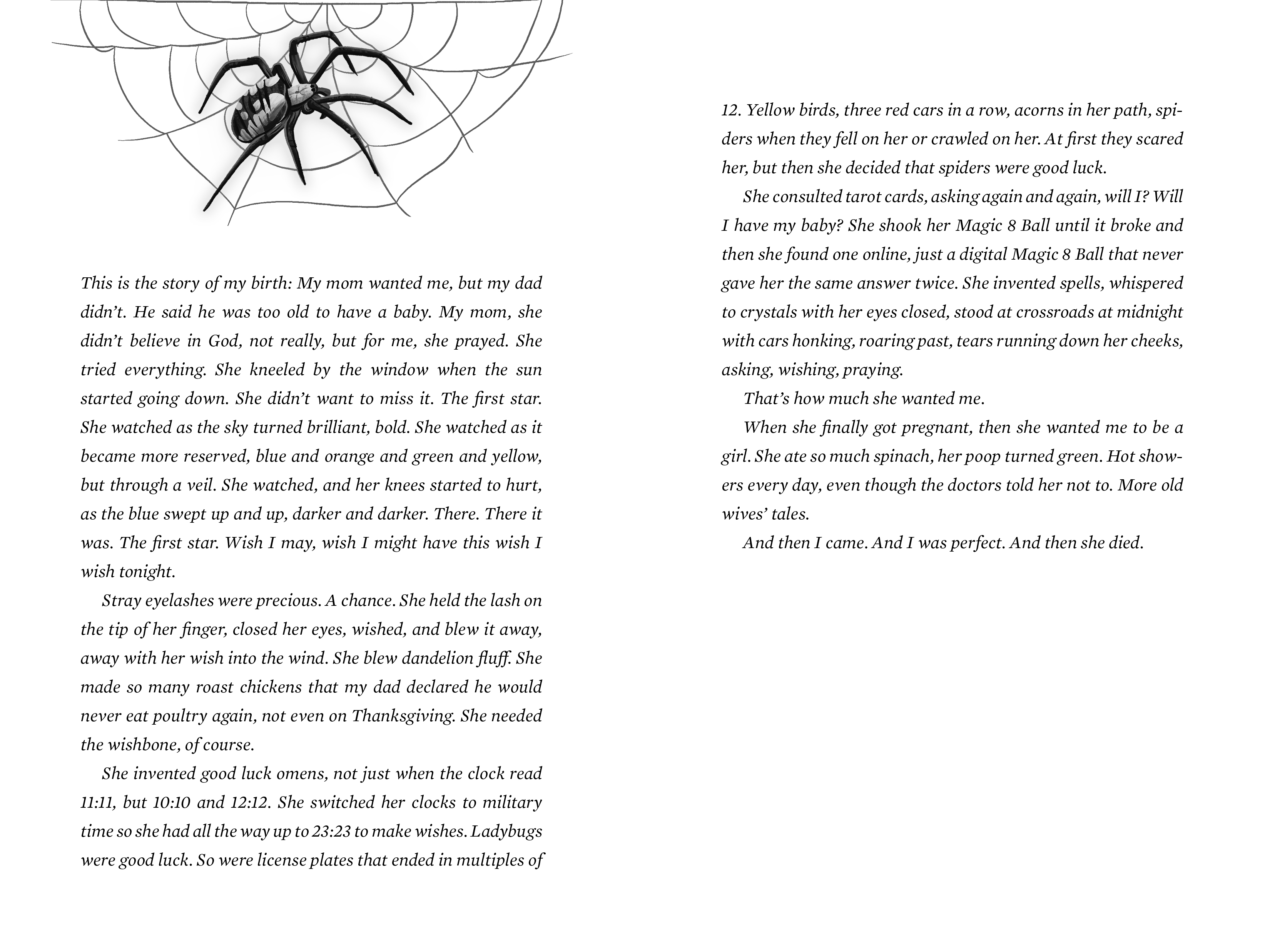
This is the story of my birth: My mom wanted me, but my dad didn’t. He said he was too old to have a baby. My mom, she didn’t believe in God, not really, but for me, she prayed. She tried everything. She kneeled by the window when the sun started going down. She didn’t want to miss it. The first star. She watched as the sky turned brilliant, bold. She watched as it became more reserved, blue and orange and green and yellow, but through a veil. She watched, and her knees started to hurt, as the blue swept up and up, darker and darker. There. There it was. The first star. Wish I may, wish I might have this wish I wish tonight.Stray eyelashes were precious. A chance. She held the lash on the tip of her finger, closed her eyes, wished, and blew it away, away with her wish into the wind. She blew dandelion fluff. She made so many roast chickens that my dad declared he would never eat poultry again, not even on Thanksgiving. She needed the wishbone, of course.She invented good luck omens, not just when the clock read 11:11, but 10:10 and 12:12. She switched her clocks to military time so she had all the way up to 23:23 to make wishes. Ladybugs were good luck. So were license plates that ended in multiples of 12. Yellow birds, three red cars in a row, acorns in her path, spiders when they fell on her or crawled on her. At first they scared her, but then she decided that spiders were good luck.She consulted tarot cards, asking again and again, will I? Will I have my baby? She shook her Magic 8 Ball until it broke and then she found one online, just a digital Magic 8 Ball that never gave her the same answer twice. She invented spells, whispered to crystals with her eyes closed, stood at crossroads at midnight with cars honking, roaring past, tears running down her cheeks, asking, wishing, praying.That’s how much she wanted me.When she finally got pregnant, then she wanted me to be a girl. She ate so much spinach, her poop turned green. Hot showers every day, even though the doctors told her not to. More old wives’ tales.And then I came. And I was perfect. And then she died.Part
1
1
W
hen I was ten, I memorized all the state capitals. It started as a contest at school, but it evolved into a fixation. Not just state capitals, state birds, state flowers. Did you know there is a state amphibian? A state fossil? Washington’s state flower is the rhododendron, which I hate. Its state fruit is the apple, which I am ambivalent about. And its state oyster is the Olympia oyster, which I guess makes sense, although I hate oysters. They taste like salt and slime. What’s to like? The truth is, I don’t think anybody
really likes oysters. I think they pretend to like oysters because it makes them feel as if they have a sophisticated palate.
I won the contest. I didn’t get extra credit for memorizing all the state symbols, including songs, dinosaurs, insects, and so on, even though I asked for it. My fifth-grade teacher did suggest I make a scrapbook with all my research, which, looking back, was a kind way to handle my obsession. I hadn’t been diagnosed with OCD yet, but maybe she suspected.
It wasn’t until, at sixteen, I told my therapist that I had this fear that I was going to kill my dad. Or I was going to kill my friend Safia. I could see it, even. The red blood, the open wound. That’s when I received my formal diagnosis.
People think that having OCD means, like, you’re tidy. You’re organized. You label things and you’re really dedicated to your capital-
P-Planner that you bought from Kate Spade and you use lots of floral stickers in it. It’s how Bad-Ass Girl Bosses describe themselves when what they really mean is that they have type-A personalities.
The thoughts started with my dad. I was young. Only eleven or twelve. I’d lie in bed at night thinking
I can kill him. I can. I can kill him right now.It terrified me. The idea that I could. I was physically capable of it. I could go to the kitchen, get a knife, and stab my father to death while he slept. It’s not that I
wanted to, it’s that I
could. And once the thought was in my mind, I didn’t know how to get it out. That I was capable of violence. That I was capable of murder.
I finally told my therapist about my fear. That I had homicidal urges. That I was crazy, a murderer. Her head tilted to the side after I said it.
Do you actually want
to kill your dad? she said.
No, I said.
Do you want your dad to die?No. But I can’t stop thinking about it.It’s called an intrusive thought, the kind that you can’t get out of your head even though you know it isn’t true. It’s not the same thing as homicidal urges. If I were homicidal, I would
really want to kill my dad. I would find myself planning it, fantasizing about it, and barely restraining myself. Instead, I knew how bizarre and wrong my intrusive thought was, but it still had power over me.
It’s the monster inside my head. That’s what I call it. Sometimes I imagine a literal monster. A beast, slinking through my thoughts, ambushing me, ripping me to shreds when I’m sitting in class, when I’m about to put a spoonful of cereal into my mouth.
It’s how I ended up here, in Nebraska. Nebraska doesn’t have a state amphibian. Its state fossil is the mammoth. Its gemstone is the blue agate. Little bluestem, square dance, catfish.
I knew, as one knows their ancestors are Russian or they get their hazel eyes from their grandpa, that my mom grew up in Nebraska. But up until a few weeks ago, the thought wasn’t of much interest to me. I didn’t think about Nebraska at all.
That all changed when I found the picture of my mom online.
svn
I walk through the spinning doors of the airport and the humidity smells good. Like hot pavement in the rain. A car honks at me. An old green Honda, like Madeline said. The person driving the car is so ugly, he’s hard to look at. He’s around my age, seventeen or eighteen. He has his hood pulled up over a baseball hat so I can barely see his face. His skin, it’s scaly and pimpled and peeling and flaking. He almost looks diseased. Like I’m probably going to catch something by sitting in the car with him.
God, I’m an asshole. And it’s exhausting, analyzing the way people look. Everybody. All the time. I hate it. I wish I could stop. “Thanks for picking me up,” I say. Madeline told me his name, but I can’t remember.
He nods, pulling into traffic, eyes on the road.
“So, you work for the preserve?”
He nods again.
“What do you do there?” I smile brightly, but he doesn’t answer.
The city lapses into cornfields. There’s no sprawl, no suburbs. Just city, then farms. We pass over a wide flat river and turn onto a highway. The word
Nebraska means “flat water” in Sioux. Although
Sioux, as a name, is disliked by the Lakota, Dakota, and Nakota because it means “little snake,” used as an insult by their enemy, way back when. So I’m not sure if I should keep referring to the language as Sioux or if there is a better word. I’ll look it up, I decide. I check my phone, but I have no service.
Nebraska is like a vast empty sea. I could drown in it. There’s not much else to think about as we drive by cornfields and pastures.
I roll the window down. “Do you mind?” I ask the driver. He shakes his head and rolls his down too. The air blows in. It smells like rivers and roads, like water and dirt. And beneath that, like sweet milk and clover honey. Like the very tips of the grass when it’s gone to seed and you pull the kernels off into the palm of your hand and roll them around between your fingers before tossing them to the wind.
Suddenly we pull off the road. The driver gets out. I’m surprised to see that he’s tall. He checks for cars and then crosses into the road. He has a strange walk. A shuffle, a dart, swaying almost as if he has a tail. He picks something up. Something flat and dark. Is it a rock? No, a little head pokes up between his fingers. It’s a turtle. He moves it off to the side of the road, into the grass, and gets back in the car.
We start driving again. “What’s your name?” I ask.
For a minute I think he isn’t going to answer. When he does, his voice is low, smooth, surprisingly pleasant. “Jack,” he says.
We pull through the gates under a rusted metal sign. It says
Bison Gap in curling letters. We drive down into a valley, winding among fields of swaying sunflowers, like giants heralding our arrival. Deep in the grass is a sound I’ve never heard. It isn’t a song, it’s a cadence, a rhythmic high chant, the same note from a thousand voices, again, again, again.
“Cicadas,” Jack says.
The sunflowers open into a vista, a wide sparkling pond, hazy with heat. Bison are grouped around the pond, their massive heads low. I see glimmers of water, other ponds, through the grass. The prairie sweeps out behind the compound. It all sways together, ruffling in the wind.
The lodge is a sprawling Queen Anne–style house, with patterned shingles and sunbursts on the gables. There are twelve guest cabins scattered around the preserve. At the lodge is a restaurant, all local food, and one menu item a day is made from ingredients foraged from the Bison Gap Prairie. My job this summer. Foraging, inventing recipes.
Jack gets out and gives me a country-boy nod. I watch him go with my suitcase in my hand. The gravel crunches as I shift side to side.
“Hi! Hello!” A small woman jogs out of the hotel, her face obscured by a waving hand. She’s wearing cut-offs and a plaid button-up. Her long gray hair is in a braid and she has very tan skin. I think she’s white but I’m not sure. “You must be Sylvie!” she says.
“Yeah, hi,” I say.
“I’m Madeline, welcome! Come in, come in.” She leans toward me, hesitates, then puts her arms out and says, “I’m a hugger, are you a hugger?”
I’m distinctly not a hugger, but I lean in anyway. She wraps me up tight for just a moment, then she pats me firmly on the back and releases me.
She shows me the lobby, the dining room and bar, the patio, where a few guests sit under striped umbrellas, sipping from glasses dripping with condensation. We wind our way up a back staircase paneled in dark wood.
“The house has been in my family since the eighteen hundreds. In the thirties my great-grandmother donated the whole place to the state so they could make it into a preserve. On the condition that our family would continue to own and operate the lodge,” Madeline says. “It draws visitors from all over the country.” Her cheeks round up in a proud smile.
She shows me to my room in the maids’ quarters.
“So Victorian,” I say.
Madeline laughs. “Well, yes, but look.” She swings the bedroom door open. There’s a wide gabled window with a cushioned seat, big enough for me to sit with my knees up. The view is bright, filled with sun. There’s a double bed in a white iron bedstead with a quilt and white eyelet pillowcases. A small bedside table with a stained-glass lamp and a mason jar of coneflowers and prairie phlox. There’s a dresser and a closet door and a painting on the wall of a bison wallowing in wildflowers.
“This is beautiful,” I say.
“The quilt was my grandmother’s. See this?” She points to a patch with some faded red lettering. “It’s part of an old potato sack. And this was my mother’s first-day-of-school dress.” It’s yellow, printed with white daisies.
The other doors on the narrow hallway are shut. There are three, other than mine. One of them has a doormat in front of it. It says
No Admittance Except on Party Business. “That’s Eva’s room,” Madeline says, about the door with the funny doormat. “That’s the bathroom,” she says, pointing at a green door. “Rules are: No showers longer than ten minutes, and don’t hang around in front of the mirror all day.”
“Yes ma’am,” I say, pretending to be a prairie girl.
Madeline introduces me to her grandson, Logan, who works on the preserve in the summers. He’s good-looking in a basic golden boy kind of way. Not truly attractive, but his features are even and his eyes are bright blue and altogether his tan skin and light hair and white teeth are striking enough to fool you into thinking he’s good-looking despite his plainness.
“Howdy,” Logan says, and grins.
Well, fool other people. Not me. My hair sticks to the sweat on the back of my neck.
“Logan is learning to become a butcher. It’s a real trade-craft,” Madeline says. She leads me to a small kitchen. “And this is our break room of sorts.” A normal kitchen as opposed to the industrial kitchen for the restaurant she says she’ll show me later. There’s a sweet little breakfast nook under a wide picture window. The table and benches are yellow and there’s a fern hanging above them in the distilled light of the north-facing window.
We do paperwork in her office, small and dim. The ceiling slants, and I think we’re under the stairs. The wallpaper is old, hunter green. I sit on a little stool, velvety and round, a piano stool. I sign tax stuff, a contract. It’s official, I’m here now. I’m really here.
Outside Madeline’s office, in the narrow hallway with faded wallpaper, there’s an ornate mirror. It has strange silver stains on it. I stand in front of it. “Mirror, mirror on the wall,” I whisper.
It’s actually
magic mirror, not
mirror mirror, in the Disney cartoon.
Magic mirror, on the wall, who’s the fairest of them all? That’s what the evil queen says. But somehow the whole world remembers it differently. Because sometimes things climb inside your brain and won’t get out again.
I smooth down my red hair, count my freckles, check my teeth.
Copyright © 2026 by Alena Bruzas. All rights reserved. No part of this excerpt may be reproduced or reprinted without permission in writing from the publisher.