Close Modal

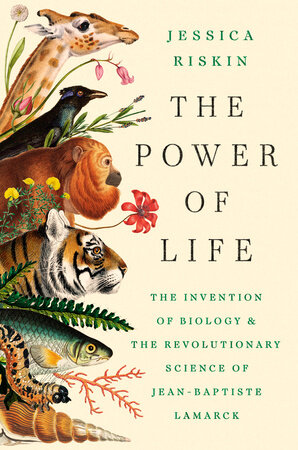
The Power of Life

The Invention of Biology and the Revolutionary Science of Jean-Baptiste Lamarck

Look inside
Hardcover
$32.00 US
6.25"W x 9.3"H x 1.54"D   (15.9 x 23.6 x 3.9 cm) | 23 oz (641 g) | 12 per carton
On sale Mar 24, 2026 | 496 Pages | 9780593852576
Sales rights: World

NAMED A BEST BOOK OF 2026 BY THE NEW YORKER

“A truly remarkable achievement.” —Jill Lepore

“A gorgeous story of human nature and animal behavior—and of the way science itself evolves.” —Dava Sobel

The tumultuous life and radical science of a revolutionary thinker, and the history of an idea that changed the world


In the early nineteenth century, the French naturalist Jean-Baptiste Lamarck proposed the first evolutionary theory of life and, with it, a new science: biology. Yet for centuries, evolutionary theorists have endeavored to discredit Lamarck and his theory of self-transforming organisms, rejecting the idea that animals play an active role in shaping their own evolution. In his lifetime, he was mocked by his adversaries and personally insulted by Napoleon. In this virtuosic melding of biography, history, politics, and science, Jessica Riskin sets out to correct the record. Riskin tells the story of Lamarck’s life and work as an intense struggle between rival forces to answer questions that remain foundational to our modern worldview: What is a living being, and what is science?

New findings suggest Lamarck’s basic claim was, in many ways, right, and a reconsideration of his life and work is long overdue. Denying the agency of living beings has informed two centuries of eugenic policies and environmental destruction, allowing people to regard the living world as so much raw material to shape and exploit for economic, industrial, and imperial gain.

Deeply researched, strikingly original, and beautifully written, The Power of Life shines a much-needed light on an underappreciated biologist whose radical ideas offered a more inclusive, collaborative, and enlightened approach to science.
“[Riskin] is an excellent stylist and...shines as a cultural historian, with enthralling tales of botanic gardens and early zoos.” Wall Street Journal

“Engaging. . . . In a time when science’s boundaries were less stable, Lamarck’s poetic theories had significant influence, and its traces can even be detected in contemporary epigenetics.” —The New Yorker

“A remarkably transformative work. . . . Thanks to Jessica Riskin, the mundane has once again become magical.” —Los Angeles Review of Books

“A truly remarkable achievement, at once a delightfully wry and wildly entertaining biography of Jean-Baptiste Lamarck and a riveting intellectual history of the tumultuous emergence of “biology” (a word Lamarck coined). The long-underrated and much-maligned professor of insects and worms is vindicated as the founder of a set of revolutionary ideas whose time, nearly two centuries after his death, has come at last.” —Jill Lepore, professor of American history, Harvard University; author of These Truths and We the People

“How thrilling to learn that Lamarck was right all along about the role of creativity and life experience in guiding evolutionary change. A gorgeous story of human nature and animal behavior—and of the way science itself evolves.”
—Dava Sobel, author of Longitude and Galileo’s Daughter

"An intriguing look at the life of a scientist who changed the way we look at life." Kirkus Reviews

“Jessica Riskin writes with the verve and vision of the very best literary novelists. A brilliant reclamation of a more expansive and poetic mode of science that still reads today as subversive—and is perhaps more timely and urgent than ever.”
—Meghan O’Gieblyn, author of God, Human, Animal, Machine

“[T]his fresh reconsideration. . . reevaluates the ideas of Jean-Baptiste Lamarck, the 18th-century French naturalist who was castigated for his claim that organisms’ acquired characteristics can be passed down to their offspring. . . .Historians and scientists will find much to savor.” —Publishers Weekly

“Transportive and engaging. . . . Richly detailed yet accessible, this work recenters a vital voice in the history of evolutionary thought.” Library Journal

“Jessica Riskin has given us that rarity, a work of pathbreaking intellectual history that is also marvelously entertaining. Every chapter sparkles with insight, wit, and keenly drawn portraits.”
—David A. Bell, professor of history, Princeton University, and author of Napoleon: A Concise Biography

The Power of Life is nothing less than an anatomy of Lamarck’s dangerous idea: living organisms are not passive mechanisms but agents that shape their worlds and the narrative of their species across time. With her storytelling gifts and finely tuned humor, Riskin takes her reader on a great adventure as she traces the history of a radical thinker whose time, it seems, has finally arrived.”
—Siri Hustvedt, author of What I Loved and The Blazing World

Jessica Riskin is the Frances and Charles Field Professor of History at Stanford University, where she teaches modern European history and the history of science. She is the author of The Restless Clock and Science in the Age of Sensibility and is a regular contributor to a number of publications, including Aeon, the Los Angeles Review of Books, and the New York Review of Books. She lives in Berkeley, California. View titles by Jessica Riskin
Available for sale exclusive:
•     Afghanistan
•     Aland Islands
•     Albania
•     Algeria
•     Andorra
•     Angola
•     Anguilla
•     Antarctica
•     Antigua/Barbuda
•     Argentina
•     Armenia
•     Aruba
•     Australia
•     Austria
•     Azerbaijan
•     Bahamas
•     Bahrain
•     Bangladesh
•     Barbados
•     Belarus
•     Belgium
•     Belize
•     Benin
•     Bermuda
•     Bhutan
•     Bolivia
•     Bonaire, Saba
•     Bosnia Herzeg.
•     Botswana
•     Bouvet Island
•     Brazil
•     Brit.Ind.Oc.Ter
•     Brit.Virgin Is.
•     Brunei
•     Bulgaria
•     Burkina Faso
•     Burundi
•     Cambodia
•     Cameroon
•     Canada
•     Cape Verde
•     Cayman Islands
•     Centr.Afr.Rep.
•     Chad
•     Chile
•     China
•     Christmas Islnd
•     Cocos Islands
•     Colombia
•     Comoro Is.
•     Congo
•     Cook Islands
•     Costa Rica
•     Croatia
•     Cuba
•     Curacao
•     Cyprus
•     Czech Republic
•     Dem. Rep. Congo
•     Denmark
•     Djibouti
•     Dominica
•     Dominican Rep.
•     Ecuador
•     Egypt
•     El Salvador
•     Equatorial Gui.
•     Eritrea
•     Estonia
•     Ethiopia
•     Falkland Islnds
•     Faroe Islands
•     Fiji
•     Finland
•     France
•     Fren.Polynesia
•     French Guinea
•     Gabon
•     Gambia
•     Georgia
•     Germany
•     Ghana
•     Gibraltar
•     Greece
•     Greenland
•     Grenada
•     Guadeloupe
•     Guam
•     Guatemala
•     Guernsey
•     Guinea Republic
•     Guinea-Bissau
•     Guyana
•     Haiti
•     Heard/McDon.Isl
•     Honduras
•     Hong Kong
•     Hungary
•     Iceland
•     India
•     Indonesia
•     Iran
•     Iraq
•     Ireland
•     Isle of Man
•     Israel
•     Italy
•     Ivory Coast
•     Jamaica
•     Japan
•     Jersey
•     Jordan
•     Kazakhstan
•     Kenya
•     Kiribati
•     Kuwait
•     Kyrgyzstan
•     Laos
•     Latvia
•     Lebanon
•     Lesotho
•     Liberia
•     Libya
•     Liechtenstein
•     Lithuania
•     Luxembourg
•     Macau
•     Macedonia
•     Madagascar
•     Malawi
•     Malaysia
•     Maldives
•     Mali
•     Malta
•     Marshall island
•     Martinique
•     Mauritania
•     Mauritius
•     Mayotte
•     Mexico
•     Micronesia
•     Minor Outl.Ins.
•     Moldavia
•     Monaco
•     Mongolia
•     Montenegro
•     Montserrat
•     Morocco
•     Mozambique
•     Myanmar
•     Namibia
•     Nauru
•     Nepal
•     Netherlands
•     New Caledonia
•     New Zealand
•     Nicaragua
•     Niger
•     Nigeria
•     Niue
•     Norfolk Island
•     North Korea
•     North Mariana
•     Norway
•     Oman
•     Pakistan
•     Palau
•     Palestinian Ter
•     Panama
•     PapuaNewGuinea
•     Paraguay
•     Peru
•     Philippines
•     Pitcairn Islnds
•     Poland
•     Portugal
•     Puerto Rico
•     Qatar
•     Reunion Island
•     Romania
•     Russian Fed.
•     Rwanda
•     S. Sandwich Ins
•     Saint Martin
•     Samoa,American
•     San Marino
•     SaoTome Princip
•     Saudi Arabia
•     Senegal
•     Serbia
•     Seychelles
•     Sierra Leone
•     Singapore
•     Sint Maarten
•     Slovakia
•     Slovenia
•     Solomon Islands
•     Somalia
•     South Africa
•     South Korea
•     South Sudan
•     Spain
•     Sri Lanka
•     St Barthelemy
•     St. Helena
•     St. Lucia
•     St. Vincent
•     St.Chr.,Nevis
•     St.Pier,Miquel.
•     Sth Terr. Franc
•     Sudan
•     Suriname
•     Svalbard
•     Swaziland
•     Sweden
•     Switzerland
•     Syria
•     Tadschikistan
•     Taiwan
•     Tanzania
•     Thailand
•     Timor-Leste
•     Togo
•     Tokelau Islands
•     Tonga
•     Trinidad,Tobago
•     Tunisia
•     Turkey
•     Turkmenistan
•     Turks&Caicos Is
•     Tuvalu
•     US Virgin Is.
•     USA
•     Uganda
•     Ukraine
•     Unit.Arab Emir.
•     United Kingdom
•     Uruguay
•     Uzbekistan
•     Vanuatu
•     Vatican City
•     Venezuela
•     Vietnam
•     Wallis,Futuna
•     West Saharan
•     Western Samoa
•     Yemen
•     Zambia
•     Zimbabwe

About

NAMED A BEST BOOK OF 2026 BY THE NEW YORKER

“A truly remarkable achievement.” —Jill Lepore

“A gorgeous story of human nature and animal behavior—and of the way science itself evolves.” —Dava Sobel

The tumultuous life and radical science of a revolutionary thinker, and the history of an idea that changed the world


In the early nineteenth century, the French naturalist Jean-Baptiste Lamarck proposed the first evolutionary theory of life and, with it, a new science: biology. Yet for centuries, evolutionary theorists have endeavored to discredit Lamarck and his theory of self-transforming organisms, rejecting the idea that animals play an active role in shaping their own evolution. In his lifetime, he was mocked by his adversaries and personally insulted by Napoleon. In this virtuosic melding of biography, history, politics, and science, Jessica Riskin sets out to correct the record. Riskin tells the story of Lamarck’s life and work as an intense struggle between rival forces to answer questions that remain foundational to our modern worldview: What is a living being, and what is science?

New findings suggest Lamarck’s basic claim was, in many ways, right, and a reconsideration of his life and work is long overdue. Denying the agency of living beings has informed two centuries of eugenic policies and environmental destruction, allowing people to regard the living world as so much raw material to shape and exploit for economic, industrial, and imperial gain.

Deeply researched, strikingly original, and beautifully written, The Power of Life shines a much-needed light on an underappreciated biologist whose radical ideas offered a more inclusive, collaborative, and enlightened approach to science.

Praise

“[Riskin] is an excellent stylist and...shines as a cultural historian, with enthralling tales of botanic gardens and early zoos.” Wall Street Journal

“Engaging. . . . In a time when science’s boundaries were less stable, Lamarck’s poetic theories had significant influence, and its traces can even be detected in contemporary epigenetics.” —The New Yorker

“A remarkably transformative work. . . . Thanks to Jessica Riskin, the mundane has once again become magical.” —Los Angeles Review of Books

“A truly remarkable achievement, at once a delightfully wry and wildly entertaining biography of Jean-Baptiste Lamarck and a riveting intellectual history of the tumultuous emergence of “biology” (a word Lamarck coined). The long-underrated and much-maligned professor of insects and worms is vindicated as the founder of a set of revolutionary ideas whose time, nearly two centuries after his death, has come at last.” —Jill Lepore, professor of American history, Harvard University; author of These Truths and We the People

“How thrilling to learn that Lamarck was right all along about the role of creativity and life experience in guiding evolutionary change. A gorgeous story of human nature and animal behavior—and of the way science itself evolves.”
—Dava Sobel, author of Longitude and Galileo’s Daughter

"An intriguing look at the life of a scientist who changed the way we look at life." Kirkus Reviews

“Jessica Riskin writes with the verve and vision of the very best literary novelists. A brilliant reclamation of a more expansive and poetic mode of science that still reads today as subversive—and is perhaps more timely and urgent than ever.”
—Meghan O’Gieblyn, author of God, Human, Animal, Machine

“[T]his fresh reconsideration. . . reevaluates the ideas of Jean-Baptiste Lamarck, the 18th-century French naturalist who was castigated for his claim that organisms’ acquired characteristics can be passed down to their offspring. . . .Historians and scientists will find much to savor.” —Publishers Weekly

“Transportive and engaging. . . . Richly detailed yet accessible, this work recenters a vital voice in the history of evolutionary thought.” Library Journal

“Jessica Riskin has given us that rarity, a work of pathbreaking intellectual history that is also marvelously entertaining. Every chapter sparkles with insight, wit, and keenly drawn portraits.”
—David A. Bell, professor of history, Princeton University, and author of Napoleon: A Concise Biography

The Power of Life is nothing less than an anatomy of Lamarck’s dangerous idea: living organisms are not passive mechanisms but agents that shape their worlds and the narrative of their species across time. With her storytelling gifts and finely tuned humor, Riskin takes her reader on a great adventure as she traces the history of a radical thinker whose time, it seems, has finally arrived.”
—Siri Hustvedt, author of What I Loved and The Blazing World

Author

Jessica Riskin is the Frances and Charles Field Professor of History at Stanford University, where she teaches modern European history and the history of science. She is the author of The Restless Clock and Science in the Age of Sensibility and is a regular contributor to a number of publications, including Aeon, the Los Angeles Review of Books, and the New York Review of Books. She lives in Berkeley, California. View titles by Jessica Riskin

Rights

Available for sale exclusive:
•     Afghanistan
•     Aland Islands
•     Albania
•     Algeria
•     Andorra
•     Angola
•     Anguilla
•     Antarctica
•     Antigua/Barbuda
•     Argentina
•     Armenia
•     Aruba
•     Australia
•     Austria
•     Azerbaijan
•     Bahamas
•     Bahrain
•     Bangladesh
•     Barbados
•     Belarus
•     Belgium
•     Belize
•     Benin
•     Bermuda
•     Bhutan
•     Bolivia
•     Bonaire, Saba
•     Bosnia Herzeg.
•     Botswana
•     Bouvet Island
•     Brazil
•     Brit.Ind.Oc.Ter
•     Brit.Virgin Is.
•     Brunei
•     Bulgaria
•     Burkina Faso
•     Burundi
•     Cambodia
•     Cameroon
•     Canada
•     Cape Verde
•     Cayman Islands
•     Centr.Afr.Rep.
•     Chad
•     Chile
•     China
•     Christmas Islnd
•     Cocos Islands
•     Colombia
•     Comoro Is.
•     Congo
•     Cook Islands
•     Costa Rica
•     Croatia
•     Cuba
•     Curacao
•     Cyprus
•     Czech Republic
•     Dem. Rep. Congo
•     Denmark
•     Djibouti
•     Dominica
•     Dominican Rep.
•     Ecuador
•     Egypt
•     El Salvador
•     Equatorial Gui.
•     Eritrea
•     Estonia
•     Ethiopia
•     Falkland Islnds
•     Faroe Islands
•     Fiji
•     Finland
•     France
•     Fren.Polynesia
•     French Guinea
•     Gabon
•     Gambia
•     Georgia
•     Germany
•     Ghana
•     Gibraltar
•     Greece
•     Greenland
•     Grenada
•     Guadeloupe
•     Guam
•     Guatemala
•     Guernsey
•     Guinea Republic
•     Guinea-Bissau
•     Guyana
•     Haiti
•     Heard/McDon.Isl
•     Honduras
•     Hong Kong
•     Hungary
•     Iceland
•     India
•     Indonesia
•     Iran
•     Iraq
•     Ireland
•     Isle of Man
•     Israel
•     Italy
•     Ivory Coast
•     Jamaica
•     Japan
•     Jersey
•     Jordan
•     Kazakhstan
•     Kenya
•     Kiribati
•     Kuwait
•     Kyrgyzstan
•     Laos
•     Latvia
•     Lebanon
•     Lesotho
•     Liberia
•     Libya
•     Liechtenstein
•     Lithuania
•     Luxembourg
•     Macau
•     Macedonia
•     Madagascar
•     Malawi
•     Malaysia
•     Maldives
•     Mali
•     Malta
•     Marshall island
•     Martinique
•     Mauritania
•     Mauritius
•     Mayotte
•     Mexico
•     Micronesia
•     Minor Outl.Ins.
•     Moldavia
•     Monaco
•     Mongolia
•     Montenegro
•     Montserrat
•     Morocco
•     Mozambique
•     Myanmar
•     Namibia
•     Nauru
•     Nepal
•     Netherlands
•     New Caledonia
•     New Zealand
•     Nicaragua
•     Niger
•     Nigeria
•     Niue
•     Norfolk Island
•     North Korea
•     North Mariana
•     Norway
•     Oman
•     Pakistan
•     Palau
•     Palestinian Ter
•     Panama
•     PapuaNewGuinea
•     Paraguay
•     Peru
•     Philippines
•     Pitcairn Islnds
•     Poland
•     Portugal
•     Puerto Rico
•     Qatar
•     Reunion Island
•     Romania
•     Russian Fed.
•     Rwanda
•     S. Sandwich Ins
•     Saint Martin
•     Samoa,American
•     San Marino
•     SaoTome Princip
•     Saudi Arabia
•     Senegal
•     Serbia
•     Seychelles
•     Sierra Leone
•     Singapore
•     Sint Maarten
•     Slovakia
•     Slovenia
•     Solomon Islands
•     Somalia
•     South Africa
•     South Korea
•     South Sudan
•     Spain
•     Sri Lanka
•     St Barthelemy
•     St. Helena
•     St. Lucia
•     St. Vincent
•     St.Chr.,Nevis
•     St.Pier,Miquel.
•     Sth Terr. Franc
•     Sudan
•     Suriname
•     Svalbard
•     Swaziland
•     Sweden
•     Switzerland
•     Syria
•     Tadschikistan
•     Taiwan
•     Tanzania
•     Thailand
•     Timor-Leste
•     Togo
•     Tokelau Islands
•     Tonga
•     Trinidad,Tobago
•     Tunisia
•     Turkey
•     Turkmenistan
•     Turks&Caicos Is
•     Tuvalu
•     US Virgin Is.
•     USA
•     Uganda
•     Ukraine
•     Unit.Arab Emir.
•     United Kingdom
•     Uruguay
•     Uzbekistan
•     Vanuatu
•     Vatican City
•     Venezuela
•     Vietnam
•     Wallis,Futuna
•     West Saharan
•     Western Samoa
•     Yemen
•     Zambia
•     Zimbabwe

Biodiversity Titles for Higher Education

The International Day for Biological Diversity is a UN-sanctioned day celebrated on May 22nd that aims to raise awareness on the importance of biodiversity and the need to protect against species loss. “First coined by Walter G. Rosen in 1985, biological diversity—or biodiversity, as it is more commonly called—is defined as the “variety of life

Read more