Close Modal

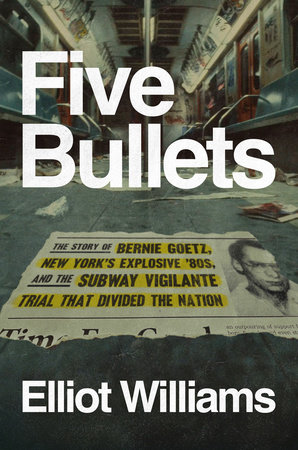
Five Bullets

The Story of Bernie Goetz, New York's Explosive '80s, and the Subway Vigilante Trial That Divided the Nation

Look inside
Hardcover
$32.00 US
6.44"W x 9.5"H x 1.29"D   (16.4 x 24.1 x 3.3 cm) | 20 oz (578 g) | 12 per carton
On sale Jan 20, 2026 | 384 Pages | 9780593833704
Sales rights: US, Canada, Open Mkt

"Read this book to understand human nature." (Preet Bharara) • "An amazing story, well told.” (Anderson Cooper) • "A masterful telling." (Dahlia Lithwick)

From CNN legal analyst Elliot Williams, a revelatory account of how one man, four teenagers, and a struggling city collided over race, vigilantism, and public safety . . . exposing the fault lines of a nation


On a dirty New York subway car on December 22, 1984, Bernhard Goetz shot Barry Allen, Darrell Cabey, Troy Canty, and James Ramseur, four teenagers from the Bronx, at point blank range. Goetz claimed they were going to mug him; the teens claim that one of them had simply asked for five dollars.

Crime was at an all-time high. So was racial tension. Was Goetz, who was white, a hero who finally fought back? Or a bigot whose itchy trigger finger seriously wounded three unarmed black kids and condemned a fourth to irreversible brain damage? By the time Goetz went on trial for quadruple attempted murder, the “Subway Vigilante” saga had become a global sensation, and New Yorkers across race and class were split over whether he deserved decades in prison…or a medal.

In Five Bullets, Elliot Williams vaults back to gritty 1980s Manhattan and reexamines the first major true-crime story of the cable news era. Drawing on archives and interviews with many main characters, including Goetz, Williams presents a masterful and vivid tale that also tells the origin stories of larger-than-life figures: Al Sharpton, a polarizing young local activist rocketing to national prominence; Rudy Giuliani, a rising-star prosecutor with an important decision to make; the NRA, which needed a poster boy for its transition from hunting club to political juggernaut; and Rupert Murdoch, whose new purchase, the New York Post, grew his empire by keeping a scary story in the headlines.

A shocking account of a pivotal moment in our history, Five Bullets demonstrates why, in order to understand today’s debates about race, crime, safety, and the media, it’s imperative to reflect on what went down in the subway four decades ago. As Williams’s powerful narrative reveals, it was not just Goetz on trial, but the conscience of a nation.
Chapter One

The Powder Keg

July 13, 1977
New York City

The city went dark.

Violent thunderstorms rolled across the region on a sweltering, humid evening. Lightning strikes clapped down on the earth below, with perhaps the most consequential one in New York history striking a substation about an hour north up the Hudson River in Westchester County at around 8:30 p.m.. The crash tripped two circuit breakers, sending a surge that cut off power from the massive Indian Point No. 3 plant, which served much of the region. Soon after, a second strike cut off power from another nearby plant. As surges knocked out substations one by one, demand increased on other parts of the region's power grid. As a result, a series of catastrophic power failures quickly crept southward, finally nestling in America's largest city.

By 9:30 p.m., New York City's five boroughs and most of Westchester County were literally, and figuratively, powerless. Tunnels leading into and out of the city had to be closed due to lack of ventilation. Thousands were evacuated from pitch-black subway cars that were becoming unbearably hot. Screaming riders got stranded in darkness atop Coney Island's Wonder Wheel, a rickety, fifty-seven-year-old Ferris wheel. Reporters in the New York Post's newsroom had heard over police radio monitors that blackouts were cascading south from the Bronx through Manhattan. Mindful of the city's geography, they did not panic when, a moment later, their lights went out too. Frank Sinatra, cozy on the thirty-eighth floor of the posh Waldorf-Astoria Hotel, passed the time by consuming the "rapidly thawing contents of the refrigerator." A pilot landing a cargo plane of strawberries at JFK Airport watched in shock as its runways vanished into the miles of blackness around them. As the plane circled above, he asked the control tower in exasperation, "Where is Kennedy Airport?" and "What am I supposed to do with the berries?" The control tower, dealing with problems of its own, responded simply, "Eat them." Both JFK and LaGuardia Airports would soon stop all arrivals and departures for the next eight hours, gumming up air travel across the planet.

For a time, the only three lights that remained on New York's silhouetted skyline sat atop symbols of the city's greatest areas of pride-its financial dominance and historic embrace of diversity. Somehow, only the blinking airplane beacons on the World Trade Center and the Citibank Building, and the torch being lifted by the Statue of Liberty, punctuated the shadows. In retrospect, the metaphor was almost too on-the-nose to be real.

Perhaps the blackout of 1977 should not have been anything remarkable; every region with an electrical grid loses power at some point. Indeed, the region had confronted a massive fifteen-hour blackout just twelve years earlier. In 1965, even as 25 million lost power, the public reacted with romance and cheer. People got out of their cars at clogged intersections and directed traffic. Others handed out candles to passersby. Some weary travelers, knowing they could be stuck in Grand Central Terminal for a while, settled in for a night of sleep, unconcerned (or unaware) of any risk. Citywide, police made only ninety-six arrests, mostly for minor offenses. Within days, advertising executives published a book of cartoons titled Where Were You When the Lights Went Out? The experience, almost instantly, became a thing of amusement and nostalgia that unified a resilient city.

The 1977 darkness brought its own moments of magic also. Restaurants on the chic Upper West Side of Manhattan moved their tables outside for al fresco dining. A motorist who spotted an elderly woman struggling to feel her way home was seen spinning his car around so that his lights could help usher her inside. As the lights went out during a performance at the Metropolitan Opera, the orchestra's harpist broke into an impromptu solo of "Dancing in the Dark."

Oh, but 1965 this was not. For the next twenty-four hours, arson, looting, and violent crimes tore through the entire city. The predominantly black and Hispanic neighborhoods of the South Bronx, East Harlem in Manhattan, and Bedford-Stuyvesant and Bushwick in Brooklyn were among the most devastated. Some 1,037 fires, 50 of them serious, were the most seen in a single day in New York history.

Rioters smashed through the steel door and windows at a Pontiac showroom in the Bronx, speeding off with fifty new cars, valued at $250,000. On Broadway in Brooklyn, the night air was filled with the sounds of iron store gates being forced up and windows smashed open, exposing troves of electronics, furniture, and clothing to be looted. Near Columbia University in northern Manhattan, people were reported to have hooked cars up to the doors of electronics shops in order to tear them off, making way for others to clear the shelves. Even the Brooks Brothers on tony Madison Avenue in Manhattan saw its shelves emptied. A lucky bride-to-be made off with a lace gown from a shop in the Fordham section of the Bronx. All told, 473 shops in the Bronx and 700 in Brooklyn were attacked, and the rioting led to a billion dollars of damage. Time's next cover story, echoing the words of Mayor Abraham Beame, dubbed the event a "night of terror."

Police, themselves dodging snipers and flying rocks and bottles, made 3,776 arrests-more in a single sweep than ever before in the city and some eight times more than were made during massive riots following Martin Luther King Jr.'s assassination in 1968. Before long, every cell in the city's seventy-three police precincts was full. Some in the NYPD turned instead to just cracking heads, in an egregious exercise of force from a department confronting years of allegations of widespread police brutality. Violence broke out in a jail in the Bronx, while several prisoners escaped in the darkness from Rikers Island, a 413-acre prison island and the city's largest jail. Across the city in lockups, the absence of working lights or air-conditioning was the least of the inmates' problems. Facilities were packed far beyond their capacity; one 29´ x 25´ holding pen was reported to have held thirty-six men. Sweaty bodies pocked with welts from nightsticks and open cuts from glass, all in need of immediate medical attention, were crammed together. Forget debating the wisdom of the city's criminal justice practices; the city had a brewing public health crisis.

Even before the first light bulb went out, though, the city was already on edge. A mysterious serial killer, who came to be known as the "Son of Sam," had been terrorizing the city throughout 1976 and 1977. In April 1977, Jimmy Breslin, a prominent columnist for the New York Daily News, received a handwritten note from the Son of Sam mocking the police and warning the public not to forget one of the shooter's early victims, continuing that "[s]he was a very sweet girl but Sam's a thirsty lad and he won't let me stop killing until he gets his fill of blood." Though David Berkowitz, the Son of Sam, killed or wounded only eight of New York's seven-million-plus people, his unpredictability and the police's inability to catch him bred fear that a menace could emerge anytime, anyplace, anywhere.

With a serial killer on the loose, the teenager running down the street with a looted television wasn't your biggest problem. The desperate mayor called NYPD leadership, pushing for them to do more. Ed Koch, then the congressman who represented the Village, was more direct and at one point called District Attorney Robert Morgenthau, screaming. "The city's verging on chaos," he railed. "If the cops can't do anything, can't you?"


While the blackout and threat posed by the Son of Sam would soon pass, they remained vivid symbols of two unassailable facts: many New Yorkers did not feel safe, and New York in the late 1970s could not manage itself. Nothing captured the city’s woes better than a line in a film review from The New York Times in 1974: “New York City is a mess. . . . It’s run by fools. Its citizens are at the mercy of its criminals who, as often as not, are protected by an unholy alliance of civil libertarians and crooked cops. The air is foul. The traffic is impossible. Services are diminishing and the morale is such that ordering a cup of coffee in a diner can turn into a request for a fat lip.”

A fiscal and political crisis in the mid-1970s had left the city broke and unable to borrow money from banks, credit markets, or Washington. Unable to make payroll and with the city almost bankrupt, Beame called for the first layoffs of city workers since the Great Depression, and at midnight on June 30, 1975, the city dismissed some nineteen thousand civil servants. More would follow, and in time the city would lay off approximately sixteen thousand teachers (four thousand from elementary schools), four thousand hospital staff, and thousands of others. All told, the city would slough off a quarter of its municipal workforce between 1975 and 1980. Those who managed to hold on to their jobs often threatened to strike, as wages stagnated under the weight of the crisis.

With a total collapse of the city's-and by extension the state's-economy a real possibility, the city sought a bailout from the federal government. On October 29, 1975, in a speech to the National Press Club, President Gerald R. Ford said he was "prepared to veto any bill that has as its purpose a federal bailout of New York City," leading to one the most famous headlines in history: "FORD TO CITY: DROP DEAD." Ford eventually relented and committed $2.3 billion in federal assistance to the city, but not before sniping with New York state and city leadership.

As local and national politicians bickered, law enforcement agencies were hit by cutbacks, and this became a matter of triage for the city. The city's transit police force was cut by 25 percent between 1975 and 1980. The city focused its energy on major crimes, turning its focus away from policing the more common but less serious crimes that made daily life difficult: the snatches-and-grabs, the petty thefts, the burglaries. Said Robert J. McGuire, the city's police commissioner, "I think it's intolerable for the police to walk away from any crime, but the system is so overcrowded with other stuff, it's a matter of priorities."


Unfortunately, the city’s management failures and extreme belt-tightening came just as it was confronting a historic spike in crime. Three hundred and ninety people were murdered in New York in 1960. That number ballooned to 1,117 in 1970, and 1,787 in 1980-a massive increase in a period in which the city’s population had declined by close to one million. By 1979 the city led the nation in violent crimes and muggings. By 1984 a crime was reported in the city, on average, once every eighteen seconds. So many burglaries were reported in 1980-a year the NYPD reported to be the worst year for crime in city history to date-that police would simply shrug and direct callers to call insurance and grease the windows of their apartments.

Many police officers didn't like the situation any more than the public did. Plainclothes members of the police union would greet new visitors arriving at LaGuardia Airport with flyers reading "WELCOME TO FEAR CITY" featuring an eerie silhouette of the Grim Reaper providing advice such as "Do not walk" and "You should never ride the subway for any reason whatsoever." It was quite a way to start a vacation in the Big Apple.

Even if authorities managed to make arrests, odds were that they were all but powerless to do anything with them. The Manhattan district attorney's office was horribly under-resourced in the late 1970s, with many of its prosecutors not even having telephones. In 1978, at the Manhattan Criminal Court, an average of seventeen judges tackled 85,512 misdemeanor cases. That year, the court held only 164 trials. Even adjusting for the fact that most criminal cases do not end up going to trial, the figure is astonishing. By 1980 criminal court judges handled up to 120 cases a day. Morgenthau was furious at the situation and complained that the city's criminal court "had ceased to function as a court."


Meanwhile, the city was hemorrhaging its white residents, thereby losing their incomes (and support to the city’s tax base). Between 1950 and 1976, the city’s white population plummeted from 90.2 percent to 76.6 percent. The Bronx, in particular, saw its complexion change. The white ethnic stronghold of the 1950s became far more diverse in the decades to come, with its white population dropping nearly 50 percent in the 1970s, from 1.08 million to 554,000.

While the city has long thought of itself as a progressive multiracial haven, rapid demographic change has an ugly conjoined twin-racial resentment. Nothing is more American than mom, apple pie, and suspicion of people from different backgrounds (particularly when they don't stay on their side of the street). As a result, the city that is guarded by the welcoming two-monument flotilla of the Statue of Liberty and Ellis Island incubated a stunning number of searing, high-profile racial incidents in the 1970s and 1980s. Their constant but invisible stress characterized the era more than perhaps any other aspect of city life.

For instance, in 1981, Willie Turks, a thirty-four-year-old transit worker, was dragged from an automobile and savagely beaten to death by a group of fifteen to twenty men shouting, "Nigger, get out of here" when his car stalled in the Gravesend section of Brooklyn.

In 1984, Eleanor Bumpurs, a sixty-seven-year-old mentally disturbed grandmother was shotgunned to death by New York City Police as she stood naked in the kitchen of her own home resisting an eviction.

In 1986, Michael Griffith, a Trinidadian immigrant, was traveling with friends from Brooklyn to Queens to pick up his paycheck when their car stalled. He and two others walked approximately three miles to the Howard Beach neighborhood where they were accosted by a group of white residents brandishing tire irons, baseball bats, and tree limbs, yelling racial slurs, and screaming at the three to get out of the neighborhood. Griffith was severely beaten and, while trying to flee, was struck and killed by a vehicle as he tried to run across a highway.

In 1989, Yusuf Hawkins was shot to death by a baseball bat-wielding mob of ten to thirty white men in the Bensonhurst section of Brooklyn. The group had been lying in wait for black youths who were believed to be attending a party at the home of a teenage girl. Hawkins hadn't even known the girl in question; he had come to the neighborhood with friends to look at a used Pontiac.
"Excellent . . . Deeply researched, providing detailed accounts of the circumstances leading up to the violence, the shootings themselves, and their aftermath . . . Williams has a firm command of the case’s legal issues. He also observes that the law doesn’t exist in a vacuum, noting that politics and public opinion often affect the workings of the justice system." —The Christian Science Monitor

“Elliot Williams does a brilliant job of re-creating the atmosphere of the 1980s, including the trial of Goetz, dubbed the 'Subway Vigilante' by the press, that resulted in his being acquitted of attempted murder but guilty of criminal possession of a weapon. He served eight months in jail. Five Bullets has a cast of characters—Al Sharpton, Ed Koch, Curtis Sliwa, Rupert Murdoch, Rudy Giuliani—that would make Ryan Murphy salivate, but Williams smartly stays focused on the five main characters and the legal questions raised during the trial. Four of the five men are still alive, and in a fascinating interview with the author, Goetz remains as unrepentant as ever.”Air Mail

“[Williams is] good at giving the reader mini law-school lessons, clarifying for example the significant difference between motive and intent. He’s also Black and from Brooklyn and works in TV, which likely accounts for his well-tuned antennae for the overheated madness that was the 1980s New York City news environment. In those years, a miserable and extensive roster of racially inflected deaths, from the Central Park jogger and the Exonerated Five to so many more, dominated local news programs and the tabloids, especially Rupert Murdoch’s Post. Five Bullets is a brisk journalistic trip through that history.”Curbed

Five Bullets, by the CNN legal analyst Elliot Williams, is a carefully wrought account . . . Williams closes with an interview with Goetz, who is allowed to emerge, if not exactly sympathetically, then at least as a three-dimensional figure.” —Adam Gopnik, The New Yorker

Five Bullets presents a deeply researched, richly detailed portrait of how a racially divided city came to excuse potentially deadly white-on-Black violence.”Columbia Magazine

"Outstanding account . . . Williams’s book is well written, deeply researched, and presents important questions about race, fear, media bias, and the purpose of criminal law.” —Library Journal (starred review)

“In this engrossing account of the Bernie Goetz vigilante subway shooting and subsequent trial, CNN investigative reporter Williams effectively recreates the media-fueled perception of 1980s New York City as a lawless dystopia . . . Comparisons between these forty-year-old events and today's social and political realities become apparent, shockingly punctuated by Williams' chilling epilogue detailing recent conversations with an unrepentant Goetz. Williams' careful inclusion of multiple viewpoints and balanced, thoughtful commentary go far beyond typical true-crime accounts, elevating this to relevant social commentary.” —Booklist (starred review)

“A fast-paced tale of one of New York City’s defining moments unfolds in the 1984 subway shooting of four Black youths by Bernhard Goetz . . . Journalist and legal analyst Williams offers a vivid portrait of 1980s New York and the social and economic pressures that shaped the backdrop of the case. Through brisk, evocative prose, the author captures the complexities of a troubled city and the crime that mirrored its contradictions. He deftly weaves in the roles of figures such as Ed Koch, Rudolph Giuliani, Al Sharpton, and Rupert Murdoch in crafting the public narrative of the ‘Subway Vigilante’ . . . A lively and haunting account of five men linked by a shooting—echoing New York’s enduring tensions over fear and race.” Kirkus

“CNN legal analyst Williams debuts with a thorough reassessment of the 1984 subway vigilante shooting, when white 37-year-old Bernhard Goetz shot four Black teenagers on a New York City subway after one of the victims asked him for $5 . . . Williams explores how the central legal argument of the case—the ‘reasonableness’ of Goetz’s fear—still resonates today. It amounts to a sharp look at a touchstone moment in American conceptions of race, self-defense, and who “has a right to feel safe.” —Publishers Weekly

“Never has a book about the 1980s felt more like current events than Elliot Williams’s journey back to one of America's most notorious shootings, when Bernie Goetz opened fire in a crowded New York City subway. Deeply researched and carefully crafted, Five Bullets is a haunting examination of our nation's complicated fascination with vigilantes and the politics of crime—one that, given today’s headlines, will feel all too close to home.” —Garrett M. Graff, author of the Pulitzer Prize Finalist Watergate: A New History

“In his striking retelling of the story of Bernie Goetz, the so-called ‘Subway Vigilante,’ Elliot Williams manages to make sense of a complex and notorious case that transfixed and frightened an entire city. Even as he takes us back in time, Williams grounds us in the present, identifying all the hot button issues that are arguably just as hot or hotter today: race, violent crime, prosecutorial discretion, the right of self-defense, and media bias. Read this book to understand human nature and how shocking events can have a lasting impact on society even more than 40 years later.” —Preet Bharara, former U.S. Attorney for the Southern District of New York

“Elliot Williams’s Five Bullets is a masterful telling of the characters, the currents, and the media madness surrounding the 1984 shooting by Bernhard Goetz of four young Black men in a New York City subway car. As a meditation on fear and fame, rubbernecking and vigilantism, it soars as a riveting piece of legal history, gorgeously told. But as a cheat code to the present moment, this headlong dive into the racial divisions, policing anxieties, and institutional mistrust that pervaded Manhattan in the mid-1980’s, perfectly presages our discourse and politics. Four decades later, we are all of us still on that train with Goetz and his gun, still trying to understand how much violence is necessary to make us feel safe.” —Dahlia Lithwick, New York Times bestselling author of Lady Justice: Women, the Law, and the Battle to Save America

Five Bullets illuminates how a few pivotal minutes in a New York City subway car would go on to expose America’s uneasy tensions around race, crime, fear, and justice. Elliot Williams asks who gets to be afraid in America, and who will be cast as the victim, the threat, and the hero. Brimming with new details about the case of the Subway Vigilante–and its decades-long impact on our country–and written with a delicate touch, this book is essential reading for anyone who wants to understand how the media, politics, and public perception shape America’s justice system. More than forty years later, we’re still living the same headlines, and Williams masterfully holds a mirror up to America, urging us to recognize that in order to move towards the vision of America we hope to be, we must first confront who we still are.” —Van Jones, CNN host and founder, Dream Machine Innovation Lab

“Wow, what a ride back to New York in the 1980s, and the case that captivated the country! Elliot Williams’s Five Bullets is an amazing story, well told.” —Anderson Cooper

“Elliot Williams’s Five Bullets is a wise and sane guide to a great moment of 1980s madness – Bernie Goetz’s attack against (or is it defense against?) four Black teenagers in a New York City subway car. Williams weaves the personal, the political and the legal into a compelling and highly relevant story about the way we lived then and still live today.” —Jeffrey Toobin, author of The Pardon: The Politics of Presidential Mercy
© Kyo Morishima
Elliot Williams is a CNN legal analyst and regular guest host on SiriusXM and WAMU, NPR’s Washington, DC, station. He has spent his career thinking about law, crime, and politics, serving as a federal prosecutor and later as a senior official at the Departments of Justice and Homeland Security. A Brooklyn-born son of Jamaican immigrants, he grew up in New Jersey and vividly recalls the powder keg that was 1980s New York. He now lives in Washington with his wife and two children. View titles by Elliot Williams
Available for sale exclusive:
•     Canada
•     Guam
•     Minor Outl.Ins.
•     North Mariana
•     Philippines
•     Puerto Rico
•     Samoa,American
•     US Virgin Is.
•     USA

Available for sale non-exclusive:
•     Afghanistan
•     Aland Islands
•     Albania
•     Algeria
•     Andorra
•     Angola
•     Anguilla
•     Antarctica
•     Argentina
•     Armenia
•     Aruba
•     Austria
•     Azerbaijan
•     Bahrain
•     Belarus
•     Belgium
•     Benin
•     Bolivia
•     Bonaire, Saba
•     Bosnia Herzeg.
•     Bouvet Island
•     Brazil
•     Bulgaria
•     Burkina Faso
•     Burundi
•     Cambodia
•     Cape Verde
•     Centr.Afr.Rep.
•     Chad
•     Chile
•     China
•     Colombia
•     Comoro Is.
•     Congo
•     Cook Islands
•     Costa Rica
•     Croatia
•     Cuba
•     Curacao
•     Czech Republic
•     Dem. Rep. Congo
•     Denmark
•     Djibouti
•     Dominican Rep.
•     Ecuador
•     Egypt
•     El Salvador
•     Equatorial Gui.
•     Eritrea
•     Estonia
•     Ethiopia
•     Faroe Islands
•     Finland
•     France
•     Fren.Polynesia
•     French Guinea
•     Gabon
•     Georgia
•     Germany
•     Greece
•     Greenland
•     Guadeloupe
•     Guatemala
•     Guinea Republic
•     Guinea-Bissau
•     Haiti
•     Heard/McDon.Isl
•     Honduras
•     Hong Kong
•     Hungary
•     Iceland
•     Indonesia
•     Iran
•     Iraq
•     Israel
•     Italy
•     Ivory Coast
•     Japan
•     Jordan
•     Kazakhstan
•     Kuwait
•     Kyrgyzstan
•     Laos
•     Latvia
•     Lebanon
•     Liberia
•     Libya
•     Liechtenstein
•     Lithuania
•     Luxembourg
•     Macau
•     Macedonia
•     Madagascar
•     Mali
•     Marshall island
•     Martinique
•     Mauritania
•     Mayotte
•     Mexico
•     Micronesia
•     Moldavia
•     Monaco
•     Mongolia
•     Montenegro
•     Morocco
•     Myanmar
•     Nepal
•     Netherlands
•     New Caledonia
•     Nicaragua
•     Niger
•     Niue
•     Norfolk Island
•     North Korea
•     Norway
•     Oman
•     Palau
•     Palestinian Ter
•     Panama
•     Paraguay
•     Peru
•     Poland
•     Portugal
•     Qatar
•     Reunion Island
•     Romania
•     Russian Fed.
•     Saint Martin
•     San Marino
•     SaoTome Princip
•     Saudi Arabia
•     Senegal
•     Serbia
•     Singapore
•     Sint Maarten
•     Slovakia
•     Slovenia
•     South Korea
•     South Sudan
•     Spain
•     St Barthelemy
•     St.Pier,Miquel.
•     Sth Terr. Franc
•     Sudan
•     Suriname
•     Svalbard
•     Sweden
•     Switzerland
•     Syria
•     Tadschikistan
•     Taiwan
•     Thailand
•     Timor-Leste
•     Togo
•     Tokelau Islands
•     Tunisia
•     Turkey
•     Turkmenistan
•     Ukraine
•     Unit.Arab Emir.
•     Uruguay
•     Uzbekistan
•     Vatican City
•     Venezuela
•     Vietnam
•     Wallis,Futuna
•     West Saharan
•     Western Samoa
•     Yemen

Not available for sale:
•     Antigua/Barbuda
•     Australia
•     Bahamas
•     Bangladesh
•     Barbados
•     Belize
•     Bermuda
•     Bhutan
•     Botswana
•     Brit.Ind.Oc.Ter
•     Brit.Virgin Is.
•     Brunei
•     Cameroon
•     Cayman Islands
•     Christmas Islnd
•     Cocos Islands
•     Cyprus
•     Dominica
•     Falkland Islnds
•     Fiji
•     Gambia
•     Ghana
•     Gibraltar
•     Grenada
•     Guernsey
•     Guyana
•     India
•     Ireland
•     Isle of Man
•     Jamaica
•     Jersey
•     Kenya
•     Kiribati
•     Lesotho
•     Malawi
•     Malaysia
•     Maldives
•     Malta
•     Mauritius
•     Montserrat
•     Mozambique
•     Namibia
•     Nauru
•     New Zealand
•     Nigeria
•     Pakistan
•     PapuaNewGuinea
•     Pitcairn Islnds
•     Rwanda
•     S. Sandwich Ins
•     Seychelles
•     Sierra Leone
•     Solomon Islands
•     Somalia
•     South Africa
•     Sri Lanka
•     St. Helena
•     St. Lucia
•     St. Vincent
•     St.Chr.,Nevis
•     Swaziland
•     Tanzania
•     Tonga
•     Trinidad,Tobago
•     Turks&Caicos Is
•     Tuvalu
•     Uganda
•     United Kingdom
•     Vanuatu
•     Zambia
•     Zimbabwe

About

"Read this book to understand human nature." (Preet Bharara) • "An amazing story, well told.” (Anderson Cooper) • "A masterful telling." (Dahlia Lithwick)

From CNN legal analyst Elliot Williams, a revelatory account of how one man, four teenagers, and a struggling city collided over race, vigilantism, and public safety . . . exposing the fault lines of a nation


On a dirty New York subway car on December 22, 1984, Bernhard Goetz shot Barry Allen, Darrell Cabey, Troy Canty, and James Ramseur, four teenagers from the Bronx, at point blank range. Goetz claimed they were going to mug him; the teens claim that one of them had simply asked for five dollars.

Crime was at an all-time high. So was racial tension. Was Goetz, who was white, a hero who finally fought back? Or a bigot whose itchy trigger finger seriously wounded three unarmed black kids and condemned a fourth to irreversible brain damage? By the time Goetz went on trial for quadruple attempted murder, the “Subway Vigilante” saga had become a global sensation, and New Yorkers across race and class were split over whether he deserved decades in prison…or a medal.

In Five Bullets, Elliot Williams vaults back to gritty 1980s Manhattan and reexamines the first major true-crime story of the cable news era. Drawing on archives and interviews with many main characters, including Goetz, Williams presents a masterful and vivid tale that also tells the origin stories of larger-than-life figures: Al Sharpton, a polarizing young local activist rocketing to national prominence; Rudy Giuliani, a rising-star prosecutor with an important decision to make; the NRA, which needed a poster boy for its transition from hunting club to political juggernaut; and Rupert Murdoch, whose new purchase, the New York Post, grew his empire by keeping a scary story in the headlines.

A shocking account of a pivotal moment in our history, Five Bullets demonstrates why, in order to understand today’s debates about race, crime, safety, and the media, it’s imperative to reflect on what went down in the subway four decades ago. As Williams’s powerful narrative reveals, it was not just Goetz on trial, but the conscience of a nation.

Excerpt

Chapter One

The Powder Keg

July 13, 1977
New York City

The city went dark.

Violent thunderstorms rolled across the region on a sweltering, humid evening. Lightning strikes clapped down on the earth below, with perhaps the most consequential one in New York history striking a substation about an hour north up the Hudson River in Westchester County at around 8:30 p.m.. The crash tripped two circuit breakers, sending a surge that cut off power from the massive Indian Point No. 3 plant, which served much of the region. Soon after, a second strike cut off power from another nearby plant. As surges knocked out substations one by one, demand increased on other parts of the region's power grid. As a result, a series of catastrophic power failures quickly crept southward, finally nestling in America's largest city.

By 9:30 p.m., New York City's five boroughs and most of Westchester County were literally, and figuratively, powerless. Tunnels leading into and out of the city had to be closed due to lack of ventilation. Thousands were evacuated from pitch-black subway cars that were becoming unbearably hot. Screaming riders got stranded in darkness atop Coney Island's Wonder Wheel, a rickety, fifty-seven-year-old Ferris wheel. Reporters in the New York Post's newsroom had heard over police radio monitors that blackouts were cascading south from the Bronx through Manhattan. Mindful of the city's geography, they did not panic when, a moment later, their lights went out too. Frank Sinatra, cozy on the thirty-eighth floor of the posh Waldorf-Astoria Hotel, passed the time by consuming the "rapidly thawing contents of the refrigerator." A pilot landing a cargo plane of strawberries at JFK Airport watched in shock as its runways vanished into the miles of blackness around them. As the plane circled above, he asked the control tower in exasperation, "Where is Kennedy Airport?" and "What am I supposed to do with the berries?" The control tower, dealing with problems of its own, responded simply, "Eat them." Both JFK and LaGuardia Airports would soon stop all arrivals and departures for the next eight hours, gumming up air travel across the planet.

For a time, the only three lights that remained on New York's silhouetted skyline sat atop symbols of the city's greatest areas of pride-its financial dominance and historic embrace of diversity. Somehow, only the blinking airplane beacons on the World Trade Center and the Citibank Building, and the torch being lifted by the Statue of Liberty, punctuated the shadows. In retrospect, the metaphor was almost too on-the-nose to be real.

Perhaps the blackout of 1977 should not have been anything remarkable; every region with an electrical grid loses power at some point. Indeed, the region had confronted a massive fifteen-hour blackout just twelve years earlier. In 1965, even as 25 million lost power, the public reacted with romance and cheer. People got out of their cars at clogged intersections and directed traffic. Others handed out candles to passersby. Some weary travelers, knowing they could be stuck in Grand Central Terminal for a while, settled in for a night of sleep, unconcerned (or unaware) of any risk. Citywide, police made only ninety-six arrests, mostly for minor offenses. Within days, advertising executives published a book of cartoons titled Where Were You When the Lights Went Out? The experience, almost instantly, became a thing of amusement and nostalgia that unified a resilient city.

The 1977 darkness brought its own moments of magic also. Restaurants on the chic Upper West Side of Manhattan moved their tables outside for al fresco dining. A motorist who spotted an elderly woman struggling to feel her way home was seen spinning his car around so that his lights could help usher her inside. As the lights went out during a performance at the Metropolitan Opera, the orchestra's harpist broke into an impromptu solo of "Dancing in the Dark."

Oh, but 1965 this was not. For the next twenty-four hours, arson, looting, and violent crimes tore through the entire city. The predominantly black and Hispanic neighborhoods of the South Bronx, East Harlem in Manhattan, and Bedford-Stuyvesant and Bushwick in Brooklyn were among the most devastated. Some 1,037 fires, 50 of them serious, were the most seen in a single day in New York history.

Rioters smashed through the steel door and windows at a Pontiac showroom in the Bronx, speeding off with fifty new cars, valued at $250,000. On Broadway in Brooklyn, the night air was filled with the sounds of iron store gates being forced up and windows smashed open, exposing troves of electronics, furniture, and clothing to be looted. Near Columbia University in northern Manhattan, people were reported to have hooked cars up to the doors of electronics shops in order to tear them off, making way for others to clear the shelves. Even the Brooks Brothers on tony Madison Avenue in Manhattan saw its shelves emptied. A lucky bride-to-be made off with a lace gown from a shop in the Fordham section of the Bronx. All told, 473 shops in the Bronx and 700 in Brooklyn were attacked, and the rioting led to a billion dollars of damage. Time's next cover story, echoing the words of Mayor Abraham Beame, dubbed the event a "night of terror."

Police, themselves dodging snipers and flying rocks and bottles, made 3,776 arrests-more in a single sweep than ever before in the city and some eight times more than were made during massive riots following Martin Luther King Jr.'s assassination in 1968. Before long, every cell in the city's seventy-three police precincts was full. Some in the NYPD turned instead to just cracking heads, in an egregious exercise of force from a department confronting years of allegations of widespread police brutality. Violence broke out in a jail in the Bronx, while several prisoners escaped in the darkness from Rikers Island, a 413-acre prison island and the city's largest jail. Across the city in lockups, the absence of working lights or air-conditioning was the least of the inmates' problems. Facilities were packed far beyond their capacity; one 29´ x 25´ holding pen was reported to have held thirty-six men. Sweaty bodies pocked with welts from nightsticks and open cuts from glass, all in need of immediate medical attention, were crammed together. Forget debating the wisdom of the city's criminal justice practices; the city had a brewing public health crisis.

Even before the first light bulb went out, though, the city was already on edge. A mysterious serial killer, who came to be known as the "Son of Sam," had been terrorizing the city throughout 1976 and 1977. In April 1977, Jimmy Breslin, a prominent columnist for the New York Daily News, received a handwritten note from the Son of Sam mocking the police and warning the public not to forget one of the shooter's early victims, continuing that "[s]he was a very sweet girl but Sam's a thirsty lad and he won't let me stop killing until he gets his fill of blood." Though David Berkowitz, the Son of Sam, killed or wounded only eight of New York's seven-million-plus people, his unpredictability and the police's inability to catch him bred fear that a menace could emerge anytime, anyplace, anywhere.

With a serial killer on the loose, the teenager running down the street with a looted television wasn't your biggest problem. The desperate mayor called NYPD leadership, pushing for them to do more. Ed Koch, then the congressman who represented the Village, was more direct and at one point called District Attorney Robert Morgenthau, screaming. "The city's verging on chaos," he railed. "If the cops can't do anything, can't you?"


While the blackout and threat posed by the Son of Sam would soon pass, they remained vivid symbols of two unassailable facts: many New Yorkers did not feel safe, and New York in the late 1970s could not manage itself. Nothing captured the city’s woes better than a line in a film review from The New York Times in 1974: “New York City is a mess. . . . It’s run by fools. Its citizens are at the mercy of its criminals who, as often as not, are protected by an unholy alliance of civil libertarians and crooked cops. The air is foul. The traffic is impossible. Services are diminishing and the morale is such that ordering a cup of coffee in a diner can turn into a request for a fat lip.”

A fiscal and political crisis in the mid-1970s had left the city broke and unable to borrow money from banks, credit markets, or Washington. Unable to make payroll and with the city almost bankrupt, Beame called for the first layoffs of city workers since the Great Depression, and at midnight on June 30, 1975, the city dismissed some nineteen thousand civil servants. More would follow, and in time the city would lay off approximately sixteen thousand teachers (four thousand from elementary schools), four thousand hospital staff, and thousands of others. All told, the city would slough off a quarter of its municipal workforce between 1975 and 1980. Those who managed to hold on to their jobs often threatened to strike, as wages stagnated under the weight of the crisis.

With a total collapse of the city's-and by extension the state's-economy a real possibility, the city sought a bailout from the federal government. On October 29, 1975, in a speech to the National Press Club, President Gerald R. Ford said he was "prepared to veto any bill that has as its purpose a federal bailout of New York City," leading to one the most famous headlines in history: "FORD TO CITY: DROP DEAD." Ford eventually relented and committed $2.3 billion in federal assistance to the city, but not before sniping with New York state and city leadership.

As local and national politicians bickered, law enforcement agencies were hit by cutbacks, and this became a matter of triage for the city. The city's transit police force was cut by 25 percent between 1975 and 1980. The city focused its energy on major crimes, turning its focus away from policing the more common but less serious crimes that made daily life difficult: the snatches-and-grabs, the petty thefts, the burglaries. Said Robert J. McGuire, the city's police commissioner, "I think it's intolerable for the police to walk away from any crime, but the system is so overcrowded with other stuff, it's a matter of priorities."


Unfortunately, the city’s management failures and extreme belt-tightening came just as it was confronting a historic spike in crime. Three hundred and ninety people were murdered in New York in 1960. That number ballooned to 1,117 in 1970, and 1,787 in 1980-a massive increase in a period in which the city’s population had declined by close to one million. By 1979 the city led the nation in violent crimes and muggings. By 1984 a crime was reported in the city, on average, once every eighteen seconds. So many burglaries were reported in 1980-a year the NYPD reported to be the worst year for crime in city history to date-that police would simply shrug and direct callers to call insurance and grease the windows of their apartments.

Many police officers didn't like the situation any more than the public did. Plainclothes members of the police union would greet new visitors arriving at LaGuardia Airport with flyers reading "WELCOME TO FEAR CITY" featuring an eerie silhouette of the Grim Reaper providing advice such as "Do not walk" and "You should never ride the subway for any reason whatsoever." It was quite a way to start a vacation in the Big Apple.

Even if authorities managed to make arrests, odds were that they were all but powerless to do anything with them. The Manhattan district attorney's office was horribly under-resourced in the late 1970s, with many of its prosecutors not even having telephones. In 1978, at the Manhattan Criminal Court, an average of seventeen judges tackled 85,512 misdemeanor cases. That year, the court held only 164 trials. Even adjusting for the fact that most criminal cases do not end up going to trial, the figure is astonishing. By 1980 criminal court judges handled up to 120 cases a day. Morgenthau was furious at the situation and complained that the city's criminal court "had ceased to function as a court."


Meanwhile, the city was hemorrhaging its white residents, thereby losing their incomes (and support to the city’s tax base). Between 1950 and 1976, the city’s white population plummeted from 90.2 percent to 76.6 percent. The Bronx, in particular, saw its complexion change. The white ethnic stronghold of the 1950s became far more diverse in the decades to come, with its white population dropping nearly 50 percent in the 1970s, from 1.08 million to 554,000.

While the city has long thought of itself as a progressive multiracial haven, rapid demographic change has an ugly conjoined twin-racial resentment. Nothing is more American than mom, apple pie, and suspicion of people from different backgrounds (particularly when they don't stay on their side of the street). As a result, the city that is guarded by the welcoming two-monument flotilla of the Statue of Liberty and Ellis Island incubated a stunning number of searing, high-profile racial incidents in the 1970s and 1980s. Their constant but invisible stress characterized the era more than perhaps any other aspect of city life.

For instance, in 1981, Willie Turks, a thirty-four-year-old transit worker, was dragged from an automobile and savagely beaten to death by a group of fifteen to twenty men shouting, "Nigger, get out of here" when his car stalled in the Gravesend section of Brooklyn.

In 1984, Eleanor Bumpurs, a sixty-seven-year-old mentally disturbed grandmother was shotgunned to death by New York City Police as she stood naked in the kitchen of her own home resisting an eviction.

In 1986, Michael Griffith, a Trinidadian immigrant, was traveling with friends from Brooklyn to Queens to pick up his paycheck when their car stalled. He and two others walked approximately three miles to the Howard Beach neighborhood where they were accosted by a group of white residents brandishing tire irons, baseball bats, and tree limbs, yelling racial slurs, and screaming at the three to get out of the neighborhood. Griffith was severely beaten and, while trying to flee, was struck and killed by a vehicle as he tried to run across a highway.

In 1989, Yusuf Hawkins was shot to death by a baseball bat-wielding mob of ten to thirty white men in the Bensonhurst section of Brooklyn. The group had been lying in wait for black youths who were believed to be attending a party at the home of a teenage girl. Hawkins hadn't even known the girl in question; he had come to the neighborhood with friends to look at a used Pontiac.

Praise

"Excellent . . . Deeply researched, providing detailed accounts of the circumstances leading up to the violence, the shootings themselves, and their aftermath . . . Williams has a firm command of the case’s legal issues. He also observes that the law doesn’t exist in a vacuum, noting that politics and public opinion often affect the workings of the justice system." —The Christian Science Monitor

“Elliot Williams does a brilliant job of re-creating the atmosphere of the 1980s, including the trial of Goetz, dubbed the 'Subway Vigilante' by the press, that resulted in his being acquitted of attempted murder but guilty of criminal possession of a weapon. He served eight months in jail. Five Bullets has a cast of characters—Al Sharpton, Ed Koch, Curtis Sliwa, Rupert Murdoch, Rudy Giuliani—that would make Ryan Murphy salivate, but Williams smartly stays focused on the five main characters and the legal questions raised during the trial. Four of the five men are still alive, and in a fascinating interview with the author, Goetz remains as unrepentant as ever.”Air Mail

“[Williams is] good at giving the reader mini law-school lessons, clarifying for example the significant difference between motive and intent. He’s also Black and from Brooklyn and works in TV, which likely accounts for his well-tuned antennae for the overheated madness that was the 1980s New York City news environment. In those years, a miserable and extensive roster of racially inflected deaths, from the Central Park jogger and the Exonerated Five to so many more, dominated local news programs and the tabloids, especially Rupert Murdoch’s Post. Five Bullets is a brisk journalistic trip through that history.”Curbed

Five Bullets, by the CNN legal analyst Elliot Williams, is a carefully wrought account . . . Williams closes with an interview with Goetz, who is allowed to emerge, if not exactly sympathetically, then at least as a three-dimensional figure.” —Adam Gopnik, The New Yorker

Five Bullets presents a deeply researched, richly detailed portrait of how a racially divided city came to excuse potentially deadly white-on-Black violence.”Columbia Magazine

"Outstanding account . . . Williams’s book is well written, deeply researched, and presents important questions about race, fear, media bias, and the purpose of criminal law.” —Library Journal (starred review)

“In this engrossing account of the Bernie Goetz vigilante subway shooting and subsequent trial, CNN investigative reporter Williams effectively recreates the media-fueled perception of 1980s New York City as a lawless dystopia . . . Comparisons between these forty-year-old events and today's social and political realities become apparent, shockingly punctuated by Williams' chilling epilogue detailing recent conversations with an unrepentant Goetz. Williams' careful inclusion of multiple viewpoints and balanced, thoughtful commentary go far beyond typical true-crime accounts, elevating this to relevant social commentary.” —Booklist (starred review)

“A fast-paced tale of one of New York City’s defining moments unfolds in the 1984 subway shooting of four Black youths by Bernhard Goetz . . . Journalist and legal analyst Williams offers a vivid portrait of 1980s New York and the social and economic pressures that shaped the backdrop of the case. Through brisk, evocative prose, the author captures the complexities of a troubled city and the crime that mirrored its contradictions. He deftly weaves in the roles of figures such as Ed Koch, Rudolph Giuliani, Al Sharpton, and Rupert Murdoch in crafting the public narrative of the ‘Subway Vigilante’ . . . A lively and haunting account of five men linked by a shooting—echoing New York’s enduring tensions over fear and race.” Kirkus

“CNN legal analyst Williams debuts with a thorough reassessment of the 1984 subway vigilante shooting, when white 37-year-old Bernhard Goetz shot four Black teenagers on a New York City subway after one of the victims asked him for $5 . . . Williams explores how the central legal argument of the case—the ‘reasonableness’ of Goetz’s fear—still resonates today. It amounts to a sharp look at a touchstone moment in American conceptions of race, self-defense, and who “has a right to feel safe.” —Publishers Weekly

“Never has a book about the 1980s felt more like current events than Elliot Williams’s journey back to one of America's most notorious shootings, when Bernie Goetz opened fire in a crowded New York City subway. Deeply researched and carefully crafted, Five Bullets is a haunting examination of our nation's complicated fascination with vigilantes and the politics of crime—one that, given today’s headlines, will feel all too close to home.” —Garrett M. Graff, author of the Pulitzer Prize Finalist Watergate: A New History

“In his striking retelling of the story of Bernie Goetz, the so-called ‘Subway Vigilante,’ Elliot Williams manages to make sense of a complex and notorious case that transfixed and frightened an entire city. Even as he takes us back in time, Williams grounds us in the present, identifying all the hot button issues that are arguably just as hot or hotter today: race, violent crime, prosecutorial discretion, the right of self-defense, and media bias. Read this book to understand human nature and how shocking events can have a lasting impact on society even more than 40 years later.” —Preet Bharara, former U.S. Attorney for the Southern District of New York

“Elliot Williams’s Five Bullets is a masterful telling of the characters, the currents, and the media madness surrounding the 1984 shooting by Bernhard Goetz of four young Black men in a New York City subway car. As a meditation on fear and fame, rubbernecking and vigilantism, it soars as a riveting piece of legal history, gorgeously told. But as a cheat code to the present moment, this headlong dive into the racial divisions, policing anxieties, and institutional mistrust that pervaded Manhattan in the mid-1980’s, perfectly presages our discourse and politics. Four decades later, we are all of us still on that train with Goetz and his gun, still trying to understand how much violence is necessary to make us feel safe.” —Dahlia Lithwick, New York Times bestselling author of Lady Justice: Women, the Law, and the Battle to Save America

Five Bullets illuminates how a few pivotal minutes in a New York City subway car would go on to expose America’s uneasy tensions around race, crime, fear, and justice. Elliot Williams asks who gets to be afraid in America, and who will be cast as the victim, the threat, and the hero. Brimming with new details about the case of the Subway Vigilante–and its decades-long impact on our country–and written with a delicate touch, this book is essential reading for anyone who wants to understand how the media, politics, and public perception shape America’s justice system. More than forty years later, we’re still living the same headlines, and Williams masterfully holds a mirror up to America, urging us to recognize that in order to move towards the vision of America we hope to be, we must first confront who we still are.” —Van Jones, CNN host and founder, Dream Machine Innovation Lab

“Wow, what a ride back to New York in the 1980s, and the case that captivated the country! Elliot Williams’s Five Bullets is an amazing story, well told.” —Anderson Cooper

“Elliot Williams’s Five Bullets is a wise and sane guide to a great moment of 1980s madness – Bernie Goetz’s attack against (or is it defense against?) four Black teenagers in a New York City subway car. Williams weaves the personal, the political and the legal into a compelling and highly relevant story about the way we lived then and still live today.” —Jeffrey Toobin, author of The Pardon: The Politics of Presidential Mercy

Author

© Kyo Morishima
Elliot Williams is a CNN legal analyst and regular guest host on SiriusXM and WAMU, NPR’s Washington, DC, station. He has spent his career thinking about law, crime, and politics, serving as a federal prosecutor and later as a senior official at the Departments of Justice and Homeland Security. A Brooklyn-born son of Jamaican immigrants, he grew up in New Jersey and vividly recalls the powder keg that was 1980s New York. He now lives in Washington with his wife and two children. View titles by Elliot Williams

Rights

Available for sale exclusive:
•     Canada
•     Guam
•     Minor Outl.Ins.
•     North Mariana
•     Philippines
•     Puerto Rico
•     Samoa,American
•     US Virgin Is.
•     USA

Available for sale non-exclusive:
•     Afghanistan
•     Aland Islands
•     Albania
•     Algeria
•     Andorra
•     Angola
•     Anguilla
•     Antarctica
•     Argentina
•     Armenia
•     Aruba
•     Austria
•     Azerbaijan
•     Bahrain
•     Belarus
•     Belgium
•     Benin
•     Bolivia
•     Bonaire, Saba
•     Bosnia Herzeg.
•     Bouvet Island
•     Brazil
•     Bulgaria
•     Burkina Faso
•     Burundi
•     Cambodia
•     Cape Verde
•     Centr.Afr.Rep.
•     Chad
•     Chile
•     China
•     Colombia
•     Comoro Is.
•     Congo
•     Cook Islands
•     Costa Rica
•     Croatia
•     Cuba
•     Curacao
•     Czech Republic
•     Dem. Rep. Congo
•     Denmark
•     Djibouti
•     Dominican Rep.
•     Ecuador
•     Egypt
•     El Salvador
•     Equatorial Gui.
•     Eritrea
•     Estonia
•     Ethiopia
•     Faroe Islands
•     Finland
•     France
•     Fren.Polynesia
•     French Guinea
•     Gabon
•     Georgia
•     Germany
•     Greece
•     Greenland
•     Guadeloupe
•     Guatemala
•     Guinea Republic
•     Guinea-Bissau
•     Haiti
•     Heard/McDon.Isl
•     Honduras
•     Hong Kong
•     Hungary
•     Iceland
•     Indonesia
•     Iran
•     Iraq
•     Israel
•     Italy
•     Ivory Coast
•     Japan
•     Jordan
•     Kazakhstan
•     Kuwait
•     Kyrgyzstan
•     Laos
•     Latvia
•     Lebanon
•     Liberia
•     Libya
•     Liechtenstein
•     Lithuania
•     Luxembourg
•     Macau
•     Macedonia
•     Madagascar
•     Mali
•     Marshall island
•     Martinique
•     Mauritania
•     Mayotte
•     Mexico
•     Micronesia
•     Moldavia
•     Monaco
•     Mongolia
•     Montenegro
•     Morocco
•     Myanmar
•     Nepal
•     Netherlands
•     New Caledonia
•     Nicaragua
•     Niger
•     Niue
•     Norfolk Island
•     North Korea
•     Norway
•     Oman
•     Palau
•     Palestinian Ter
•     Panama
•     Paraguay
•     Peru
•     Poland
•     Portugal
•     Qatar
•     Reunion Island
•     Romania
•     Russian Fed.
•     Saint Martin
•     San Marino
•     SaoTome Princip
•     Saudi Arabia
•     Senegal
•     Serbia
•     Singapore
•     Sint Maarten
•     Slovakia
•     Slovenia
•     South Korea
•     South Sudan
•     Spain
•     St Barthelemy
•     St.Pier,Miquel.
•     Sth Terr. Franc
•     Sudan
•     Suriname
•     Svalbard
•     Sweden
•     Switzerland
•     Syria
•     Tadschikistan
•     Taiwan
•     Thailand
•     Timor-Leste
•     Togo
•     Tokelau Islands
•     Tunisia
•     Turkey
•     Turkmenistan
•     Ukraine
•     Unit.Arab Emir.
•     Uruguay
•     Uzbekistan
•     Vatican City
•     Venezuela
•     Vietnam
•     Wallis,Futuna
•     West Saharan
•     Western Samoa
•     Yemen

Not available for sale:
•     Antigua/Barbuda
•     Australia
•     Bahamas
•     Bangladesh
•     Barbados
•     Belize
•     Bermuda
•     Bhutan
•     Botswana
•     Brit.Ind.Oc.Ter
•     Brit.Virgin Is.
•     Brunei
•     Cameroon
•     Cayman Islands
•     Christmas Islnd
•     Cocos Islands
•     Cyprus
•     Dominica
•     Falkland Islnds
•     Fiji
•     Gambia
•     Ghana
•     Gibraltar
•     Grenada
•     Guernsey
•     Guyana
•     India
•     Ireland
•     Isle of Man
•     Jamaica
•     Jersey
•     Kenya
•     Kiribati
•     Lesotho
•     Malawi
•     Malaysia
•     Maldives
•     Malta
•     Mauritius
•     Montserrat
•     Mozambique
•     Namibia
•     Nauru
•     New Zealand
•     Nigeria
•     Pakistan
•     PapuaNewGuinea
•     Pitcairn Islnds
•     Rwanda
•     S. Sandwich Ins
•     Seychelles
•     Sierra Leone
•     Solomon Islands
•     Somalia
•     South Africa
•     Sri Lanka
•     St. Helena
•     St. Lucia
•     St. Vincent
•     St.Chr.,Nevis
•     Swaziland
•     Tanzania
•     Tonga
•     Trinidad,Tobago
•     Turks&Caicos Is
•     Tuvalu
•     Uganda
•     United Kingdom
•     Vanuatu
•     Zambia
•     Zimbabwe