Close Modal

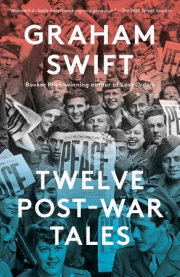
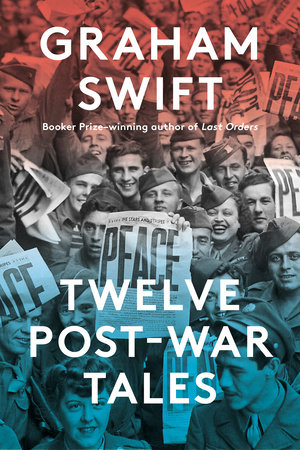
Twelve Post-War Tales

Hardcover
$30.00 US
5.76"W x 8.54"H x 1.15"D   (14.6 x 21.7 x 2.9 cm) | 16 oz (442 g) | 12 per carton
On sale May 06, 2025 | 304 Pages | 9780593803387
Sales rights: US,CAN,OpnMkt(no EU)

See Additional Formats
An exquisite new collection of stories from the Booker Prize–winning author, about lives shaped and haunted by war

Here are the soldiers and doctors and veterans, wives and lovers and children, who have been affected in ways both subtle and profound by the cataclysms of our times. In the aftermath of World War II, a young Jewish private, stationed in Germany, seeks the truth about lost family members. In the 1960s, a father focuses on his daughter’s wedding even as the Cuban Missile Crisis approaches the brink of global disaster. On September 11th, a maid working for U.S. Embassy staff in London wonders if her birth on the day of the Kennedy assassination determined the course of her life. And at the height of pandemic lockdown, a respiratory disease specialist comes out of retirement and is faced with a formative childhood memory.

These stories show history in the making, the reverberations of each personal loss and triumph set across the sweep of decades. Tender, humane, rich with humor, grief and moments of grace and contemplation, Twelve Post-War Tales is a collection of masterpieces in miniature.
I

The Next Best Thing

It hardly warranted his personal attention, but since his English was considered fluent—even sometimes ‘perfect’— and since it might involve an appointment with a British serviceman, Herr Büchner had decided he should handle the matter directly. It had anyway landed on his desk, as many things did that were not addressed to any specific person, in the form of a letter from the man’s commanding officer, a Major Wilkes, written, as it happened, in rather poor German.

How fitting that it should have fallen under the eye of a man with (almost) perfect English.

Certain useful English expressions had come quickly and freshly to Herr Büchner’s mind, such as ‘wrong channels’ or ‘knocking on the wrong door’. But since the circumstances were peculiar—this wasn’t a German citizen, it was one of the Allieds—and since the thing had the backing, as it were, of the British Army . . .

After reading the letter and looking through the enclo- sures, including the sobering list of names, he had sighed and pondered. He could recognise self-righteous pomposity when he saw it. He didn’t like being ordered about, even indirectly, by this Major Wilkes, as if he were under the man’s command himself. This was Germany in 1959, not 1949. And his was only a department at the Rathaus.

‘To whom it may concern.’ Well.

True, it was the constant business of his department, almost, he sometimes felt, its principal task, to receive enquiries and applications that were none of its business and to—politely, patiently and efficiently—redirect them. He might have written a reply to Major Wilkes, in excellent English of course, in the sort of chilly English the English were so good at, informing him, if not in such blunt lan- guage, that he was indeed knocking on the wrong door and that the Rathaus, as Major Wilkes should know, didn’t handle such stuff. And generally reminding him, if not in so many words, that Germany was not an occupied country any more.

Herr Büchner could see that this might have been a justifiable response. But he could also see—he sighed again—that the correct response was to put on a show of exemplary co-operation, and that this should perhaps include his receiving in his office, even with something like servility, the subject of the letter, the man himself.

And now the man himself, a Private Joseph Caan, from London N8, currently residing with the British Army of the Rhine, was before him, plainly unnerved to be greeted by an Amtsleiter who yet spoke alarmingly crisp English, and plainly trying but failing to equate this interview with the one—demanding enough—he must previously have had with his ‘CO’, Major Wilkes.

Plainly out of his depth, yet out of his depth—this aroused Herr Büchner’s interest—of his own choosing.

‘Won’t you sit down, Mr Caan?’

He shook the man’s hand in a routine way, but eyed him with a friendly smile. He had chosen the ‘Mr’, which might of course only have confused, but this was a civil institution and he was eager to put the man at ease, if not actually to say, ‘At ease.’ Wasn’t that the British Army rigmarole? ‘At ease.’ Then ‘Stand easy.’

‘I’m not your commanding officer.’ He smiled again.

‘You don’t have to stand to attention.’ He had tried to con- trol his tone. He had stood, himself, to greet the man, then gestured to the chair in front of his desk before resuming his own seat.

‘Won’t you take off your beret?’

Herr Büchner was more than twice the man’s age, and had been a soldier himself. It was long ago, but he retained from his military days the view that some men, perhaps most men, could both be and look like soldiers, even look as if soldiers were what they were meant to be; but some men could never look like, let alone be soldiers, even if, unfor- tunately, soldiers were what they were. He very quickly put Private Caan—Mr Caan—in the latter category. He once would have put himself in it, though this man before him might not have thought so. If, indeed, such thoughts ever occurred to him.

But perhaps they were occurring to him right now. Wasn’t it still the standard repeated thought of any British conscript doing his time in Germany: What had this smarmy bastard done in the war?

The man took off his beret, revealing short, curled, springing dark hair, which caused Herr Büchner to recall the English expression ‘short and curlies’, almost exclusively used, he remembered, with the phrase ‘got you by’.

Herr Büchner—Hans Büchner—retained, too, from his military days the view that a great many things happened in life that were beyond your control and might even be aimed at taking control from you—for example, if you were on the wrong side of a desk—but even when they happened in circumstances within your control, they really only happened, and whole futures might depend on it, because either you liked the look of the man’s face in front of you or you didn’t.

Private Caan’s face was likeable because he didn’t look like a soldier. Nor did he look, really, like a ‘Mr’. Would he nor- mally be known as ‘Joe’? He looked like a boy. He was only nineteen. Along with the curly dark hair, he had small dark eyes that peered effortfully in a way that suggested a need for spectacles or just for general clarity, but, plainly, hadn’t earned him an exemption on the grounds of a failed eye test.

The scant details in the file opened on Herr Büchner’s desk gave the man’s civilian occupation as ‘tailor’s appren- tice’. Close work—from the age of fifteen or so—with a needle? But the eyes when they finally met his own were not feeble. They were even a little ‘needling’.

The expressions all came back.

Joseph Benjamin Caan. Mother’s name, Eva Adele—maiden name, Rosenbaum. Father, Benjamin Franz—deceased. Major Wilkes had seen fit to point out: ‘killed in action in North Africa’.

Joe Caan, son of Ben Caan, from London N8.

The list that was the real matter in hand was mainly Caans and Rosenbaums. There was a Jakob, a Leopold, a Hanna, a Leah, a Bruno, an Elsa, a Ruben . . . There was even a Hans. They had mostly been, it seemed, residents of Hanover.

Major Wilkes had also seen fit to point out that Private Caan’s ‘intentions’ were in accordance with his mother’s wishes, the implication being, Herr Büchner supposed, that the man was carrying out a task conferred on him by at least one elder and better.

But that suddenly sharp, not-to-be-fooled gaze told him otherwise. Private Caan might have said this was the case, so as to give his intentions already solid backing; or Major Wilkes might have asked him, pushily, if it were the case, because he couldn’t just let any soldier go skiving off after some trumped-up personal matter. And Private Caan had wisely said that yes, of course, it was because his mother wished it.

But—bollocks. Herr Büchner used, to himself, another well-remembered and suddenly very serviceable English expression. Herr Büchner was a fairly shrewd judge of faces. The mother, Eva Adele, hadn’t put her son up to it, he felt sure. The mother, who would perhaps, like himself, be in her early forties, would rather forget the whole thing, push it out of her mind—the easiest and sometimes the best option. It was just unlucky for her that her son had first of all been called up, then been sent to Germany. Of all places. This was the nub of the matter before him, and hadn’t this Major Wilkes also seen it in this man’s face?

It was rather unlucky for the son, too, but the son couldn’t get out of it. It was where most of them got sent. Hadn’t both mother and son even reckoned on it? And of course there would have been the other, perhaps equally troubling factor: the son was now a soldier, just like his father, Benjamin Franz—born in Germany but apparently killed in the British Army.

It was all interesting. He would have liked to have a conversation with this Private Caan, just a free and leisurely conversation, and here in his undisturbed office was the ideal opportunity; but it was not the matter at hand. Nor was it possible anyway, since the man before him clearly had very limited powers of conversation. If not of initiative.

He would have liked to say, with the right kind of smile, ‘Your commanding officer has quite a command of German . . .’

Private Caan wasn’t acting under his mother’s orders, he’d give him that. It was all in those eyes. He wasn’t a ‘mother’s boy’, as the English say. He was probably about as far from his mother right now as he’d ever been. True, he might not have been sent to Germany at all, and then the matter would not have come up. He might have been sent to Hong Kong. But here he was, and here he’d be for several months, and Joseph Caan had decided he had to face the consequences—the ‘music’, as the English also say.

The man had taken off his beret promptly, as if ordered, but seemed not to know what to do with it. He clutched it in both hands, squeezing it like some comforting toy. Something had come into his life, something big and press- ing, unlike perhaps anything that had come into his life before, and Joseph Caan had decided, all by himself, that he wasn’t going to duck out of it. He wasn’t going to allow his future self to say, when it would be for ever too late: You went to Germany, didn’t you, you were in Germany, weren’t you, and you never did anything. You prick.

The words came back—the words of English soldiers. And didn’t this young man have a perfect right and reason to wonder what this smarmy bastard—or ‘prick’ too—had done in the war? Though how tripped-up he now seemed, to be addressed by a German in English better than his own.

Private Caan, though he was a soldier constantly required to obey orders, was acting, if very awkwardly, by himself, for himself. Herr Büchner could see that. He liked not only his face, he liked him.

But it was all very depressing. What could he, head of his department as he was, actually do for him? Might they not simply have a conversation? If Herr Büchner had smoked, he might have offered this man a cigarette. But he’d given up smoking when he’d returned to Germany, years ago. Smoking—if you could get cigarettes—had been all about killing time. He might invite the man to smoke anyway. Was that a pack of ten nestling in his breast pocket? ‘Player’s Please.’

Herr Büchner remembered when, long ago in another age, he’d just become an officer. A real officer, not a cadet, an officer of the most junior sort, but an officer. He hadn’t anticipated the invisible threshold he’d still have to cross, the test he’d still have to undergo. If he was an officer, then he must act like one.

A man was standing before him. It was a moment just like this one, though it wasn’t in an office in a town hall and the man really was standing rigidly to attention with no option to sit. And though the man was many years Hans Büchner’s senior, he’d been obliged to salute and stamp his feet because he was before an officer, who was sitting at the time at a little desk, a good deal smaller and plainer than this present one, and might have looked like a boy in detention.

He hadn’t anticipated being in a position of judgement, with the power to exercise either pitilessness or mercy, of being like God Almighty.

It was a trivial matter. The man would have liked, for convincingly pressing personal reasons, an extra day’s leave. It was not an unreasonable request, and leniency would have been simple. Yet because Hans Büchner was an officer and had only just become one, he was not to be seen as a push-over. So he’d curtly dismissed the man’s request, then told him he was dismissed himself.

Why? The man—he even remembered his name was Krüger—would hate him now. And he would hate himself, he would continue to hate himself. He wouldn’t forget the moment—he couldn’t forget it now—even when immeas- urably worse things had come his way. His priggish little flaunting of power.

That was over twenty years ago. In Koblenz. And, years before then, he’d said to himself: Enlist, sign up, even while you’re still at school. Choose before you’re chosen. That way, you might be selected as an officer. That had been his covertly defensive line of thinking. See everything as an opportunity—that is, as a path always turning towards the minimum ultimate danger. ‘Play your cards right’, as the English put it.

And how cards had got played, again and again, to kill time, in sodden, rain-swept Lincolnshire. He might never have known there was such a place. Till the cards them- selves became damp and tattered, each in their own forlorn way, till you could recognise every single one of them—if you were clever, if you played your cards right—without having to turn them over.
Quite wonderful. Such grace and clarity—I’m filled with admiration." —Philip Pullman, author of His Dark Materials

“Bravura. . . . Word-perfect. . . . Immensely readable. . . . Swift is a master of dialogue who delights in the possibilities of the human voice. . . . His archly modulated, precise prose, reminiscent at times of Kazuo Ishiguro’s, has lost none of its power. . . . From start to finish, Twelve Post-War Tales is a marvel of the storyteller’s art.” —Ian Thomson, Financial Times

“Wonderful—both heartbreaking and generous. . . . The characters in this collection share their thoughts and memories with the reader as though with a close friend, and the warmth of their confidences balances against their sadness. We feel we’ve been in the trenches with them, even when a story has gone no farther than the living room.” —Sam Sacks, Wall Street Journal

“Setting the seemingly ordinary lives of his characters against the great, tumultuous moments of history—from the Second World War to the Cuban Missile Crisis, September 11th and the Covid pandemic—the Booker Prize winner traces a tender and moving web of connections across decades.” Financial Times (Most Anticipated Books of 2025)

“Like its title, the stories in this collection are deceptively simple. . . . I’m still thinking about [one in particular]. . . . I’ll be adding this book to my shelf. I’m not ready to part with it.” —Shannon Rhoades, NPR

“With characteristic exactness and compassion, Swift considers the cost of human conflict in all its forms. . . . Skilful, generous, and humane, these twelve tales suggest the complexity and heartbreak of being engaged on such an uncertain journey. . . . Swift’s conceptual agility is on dazzling display.” —Elizabeth Lowry, The Guardian

“Striking—a variegated lens on conflict and resolution through the decades. . . . Beautiful. . . . Gorgeously nuanced. . . . There can surely be no better contemporary writer to take on history’s circularities than Graham Swift." —Catherine Taylor, The Observer

“A bravura new collection. . . . Swift’s characters invariably captivate.” —Malcolm Forbes, Washington Examiner

“Very powerful and poignant.” —Leyla Sanai, The Spectator

“These stories, depth charges of love, anguish, resentment, each in their way relating to the effects of World War II, are so good. Swift at his best—and he’s on top form here—has the humanity and wry humour of William Trevor.” —Patrick Gale, author of A Place Called Winter

“Perceptive. . . . Finely tuned.” Publishers Weekly

“A brilliant, illuminating collection of short fiction, perhaps the author’s best. . . . In Swift’s touching, deeply humane stories, life leaves its mark in mysterious and sometimes-humorous ways. His gift for capturing in revealing detail the interior lives of people coping—or failing to cope—with disappointment gives each of these stories a rare depth.” —Kirkus Reviews (starred review)

“Affecting. . . . In stark, immediate prose, deployed with utmost patience, Swift holds us close and points to powerful truths.” —Brendan Driscoll, Booklist

“Swift makes history personal in the stunning Twelve Post-War Tales. . . . Every story is a keeper.” Robert Allen Papinchak, Shelf Awareness

“Exquisite, touching. . . . The stories are small masterworks that deal with personal pain and victory as only a writer as perceptive and talented as Graham Swift can.” —Steven Whitton, Anniston Star

“A subtle, empathic collection written with tenderness and gentle humour.” Sydney Morning Herald

“A clever, subtle, and satisfying collection.” New Zealand Listener

“Deeply human. These are ordinary people living with what history, time, and love have made of them. . . . The collection spans decades yet feels immediate. . . . Swift [has an] extraordinary ear for voice. . . . Every sentence feels earned. His silences speak volumes. . . . With this collection, Swift reaffirms his place among the finest storytellers. He writes with such emotional precision and grace that no life, however quiet, feels small. This may be his finest work since Last Orders—a masterclass in restraint and the art of the short story.” —Paul Perry, Irish Independent

“Miraculous. . . . Over more than forty years, Graham Swift has been writing without a misstep. . . . I’m blown away by the subtlety of these stories. . . . There is neither bombast nor sentimentality in Swift’s writing. This tremendous stylist, who tirelessly explores the human soul, gets up close to the emotions of his characters instead. He embodies them magnificently, with remarkable restraint.” —Alexandre Fillon, Les Echos (France)

“The ‘tales’ demonstrate Swift’s masterful ability to link the local and the global, the historical and the personal.” —Donald P. Kaczvinsky, World Literature Today

“Masterful. . . . Swift is not merely chronicling the aftermath—he is wrestling with the echo of memory. . . . In Twelve Post-War Tales, Swift peers into the spaces between what is said and unsaid, what is done and left undone, and finds the heartbeat of history.” —Philip Martin, Arkansas Democrat Gazette
© Janus van den Eijnden
GRAHAM SWIFT was born in 1949 and is the author of ten novels, two collections of short stories, and Making an Elephant, a book of essays, portraits, poetry, and reflections on his life in writing. With Waterland he won The Guardian Fiction Award, and with Last Orders, the Booker Prize. Both novels have since been made into films. His work has appeared in more than thirty languages. View titles by Graham Swift
Available for sale exclusive:
•     Canada
•     Guam
•     Minor Outl.Ins.
•     North Mariana
•     Philippines
•     Puerto Rico
•     Samoa,American
•     US Virgin Is.
•     USA

Available for sale non-exclusive:
•     Afghanistan
•     Aland Islands
•     Albania
•     Algeria
•     Angola
•     Antarctica
•     Argentina
•     Armenia
•     Aruba
•     Azerbaijan
•     Bahrain
•     Belarus
•     Benin
•     Bolivia
•     Bonaire, Saba
•     Bosnia Herzeg.
•     Bouvet Island
•     Brazil
•     Burkina Faso
•     Burundi
•     Cambodia
•     Cape Verde
•     Centr.Afr.Rep.
•     Chad
•     Chile
•     China
•     Colombia
•     Comoro Is.
•     Congo
•     Cook Islands
•     Costa Rica
•     Cuba
•     Curacao
•     Dem. Rep. Congo
•     Djibouti
•     Dominican Rep.
•     Ecuador
•     Egypt
•     El Salvador
•     Equatorial Gui.
•     Eritrea
•     Ethiopia
•     Faroe Islands
•     Fren.Polynesia
•     French Guinea
•     Gabon
•     Georgia
•     Greenland
•     Guadeloupe
•     Guatemala
•     Guinea Republic
•     Guinea-Bissau
•     Haiti
•     Heard/McDon.Isl
•     Honduras
•     Hong Kong
•     Indonesia
•     Iran
•     Iraq
•     Israel
•     Ivory Coast
•     Japan
•     Kazakhstan
•     Kuwait
•     Kyrgyzstan
•     Laos
•     Lebanon
•     Liberia
•     Libya
•     Macau
•     Macedonia
•     Madagascar
•     Mali
•     Marshall island
•     Martinique
•     Mauritania
•     Mayotte
•     Mexico
•     Micronesia
•     Moldavia
•     Mongolia
•     Montenegro
•     Morocco
•     New Caledonia
•     Nicaragua
•     Niger
•     Niue
•     Norfolk Island
•     North Korea
•     Oman
•     Palau
•     Palestinian Ter
•     Panama
•     Paraguay
•     Peru
•     Qatar
•     Reunion Island
•     Russian Fed.
•     Rwanda
•     Saint Martin
•     SaoTome Princip
•     Saudi Arabia
•     Senegal
•     Serbia
•     Sint Maarten
•     South Korea
•     South Sudan
•     St Barthelemy
•     St.Pier,Miquel.
•     Sth Terr. Franc
•     Sudan
•     Suriname
•     Svalbard
•     Syria
•     Tadschikistan
•     Taiwan
•     Thailand
•     Timor-Leste
•     Togo
•     Tokelau Islands
•     Tunisia
•     Turkey
•     Turkmenistan
•     Ukraine
•     Unit.Arab Emir.
•     Uruguay
•     Uzbekistan
•     Venezuela
•     Vietnam
•     Wallis,Futuna
•     West Saharan

Not available for sale:
•     Andorra
•     Anguilla
•     Antigua/Barbuda
•     Australia
•     Austria
•     Bahamas
•     Bangladesh
•     Barbados
•     Belgium
•     Belize
•     Bermuda
•     Bhutan
•     Botswana
•     Brit.Ind.Oc.Ter
•     Brit.Virgin Is.
•     Brunei
•     Bulgaria
•     Cameroon
•     Cayman Islands
•     Christmas Islnd
•     Cocos Islands
•     Croatia
•     Cyprus
•     Czech Republic
•     Denmark
•     Dominica
•     Estonia
•     Falkland Islnds
•     Fiji
•     Finland
•     France
•     Gambia
•     Germany
•     Ghana
•     Gibraltar
•     Greece
•     Grenada
•     Guernsey
•     Guyana
•     Hungary
•     Iceland
•     India
•     Ireland
•     Isle of Man
•     Italy
•     Jamaica
•     Jersey
•     Jordan
•     Kenya
•     Kiribati
•     Latvia
•     Lesotho
•     Liechtenstein
•     Lithuania
•     Luxembourg
•     Malawi
•     Malaysia
•     Maldives
•     Malta
•     Mauritius
•     Monaco
•     Montserrat
•     Mozambique
•     Myanmar
•     Namibia
•     Nauru
•     Nepal
•     Netherlands
•     New Zealand
•     Nigeria
•     Norway
•     Pakistan
•     PapuaNewGuinea
•     Pitcairn Islnds
•     Poland
•     Portugal
•     Romania
•     S. Sandwich Ins
•     San Marino
•     Seychelles
•     Sierra Leone
•     Singapore
•     Slovakia
•     Slovenia
•     Solomon Islands
•     Somalia
•     South Africa
•     Spain
•     Sri Lanka
•     St. Helena
•     St. Lucia
•     St. Vincent
•     St.Chr.,Nevis
•     Swaziland
•     Sweden
•     Switzerland
•     Tanzania
•     Tonga
•     Trinidad,Tobago
•     Turks&Caicos Is
•     Tuvalu
•     Uganda
•     United Kingdom
•     Vanuatu
•     Vatican City
•     Western Samoa
•     Yemen
•     Zambia
•     Zimbabwe

About

An exquisite new collection of stories from the Booker Prize–winning author, about lives shaped and haunted by war

Here are the soldiers and doctors and veterans, wives and lovers and children, who have been affected in ways both subtle and profound by the cataclysms of our times. In the aftermath of World War II, a young Jewish private, stationed in Germany, seeks the truth about lost family members. In the 1960s, a father focuses on his daughter’s wedding even as the Cuban Missile Crisis approaches the brink of global disaster. On September 11th, a maid working for U.S. Embassy staff in London wonders if her birth on the day of the Kennedy assassination determined the course of her life. And at the height of pandemic lockdown, a respiratory disease specialist comes out of retirement and is faced with a formative childhood memory.

These stories show history in the making, the reverberations of each personal loss and triumph set across the sweep of decades. Tender, humane, rich with humor, grief and moments of grace and contemplation, Twelve Post-War Tales is a collection of masterpieces in miniature.

Excerpt

I

The Next Best Thing

It hardly warranted his personal attention, but since his English was considered fluent—even sometimes ‘perfect’— and since it might involve an appointment with a British serviceman, Herr Büchner had decided he should handle the matter directly. It had anyway landed on his desk, as many things did that were not addressed to any specific person, in the form of a letter from the man’s commanding officer, a Major Wilkes, written, as it happened, in rather poor German.

How fitting that it should have fallen under the eye of a man with (almost) perfect English.

Certain useful English expressions had come quickly and freshly to Herr Büchner’s mind, such as ‘wrong channels’ or ‘knocking on the wrong door’. But since the circumstances were peculiar—this wasn’t a German citizen, it was one of the Allieds—and since the thing had the backing, as it were, of the British Army . . .

After reading the letter and looking through the enclo- sures, including the sobering list of names, he had sighed and pondered. He could recognise self-righteous pomposity when he saw it. He didn’t like being ordered about, even indirectly, by this Major Wilkes, as if he were under the man’s command himself. This was Germany in 1959, not 1949. And his was only a department at the Rathaus.

‘To whom it may concern.’ Well.

True, it was the constant business of his department, almost, he sometimes felt, its principal task, to receive enquiries and applications that were none of its business and to—politely, patiently and efficiently—redirect them. He might have written a reply to Major Wilkes, in excellent English of course, in the sort of chilly English the English were so good at, informing him, if not in such blunt lan- guage, that he was indeed knocking on the wrong door and that the Rathaus, as Major Wilkes should know, didn’t handle such stuff. And generally reminding him, if not in so many words, that Germany was not an occupied country any more.

Herr Büchner could see that this might have been a justifiable response. But he could also see—he sighed again—that the correct response was to put on a show of exemplary co-operation, and that this should perhaps include his receiving in his office, even with something like servility, the subject of the letter, the man himself.

And now the man himself, a Private Joseph Caan, from London N8, currently residing with the British Army of the Rhine, was before him, plainly unnerved to be greeted by an Amtsleiter who yet spoke alarmingly crisp English, and plainly trying but failing to equate this interview with the one—demanding enough—he must previously have had with his ‘CO’, Major Wilkes.

Plainly out of his depth, yet out of his depth—this aroused Herr Büchner’s interest—of his own choosing.

‘Won’t you sit down, Mr Caan?’

He shook the man’s hand in a routine way, but eyed him with a friendly smile. He had chosen the ‘Mr’, which might of course only have confused, but this was a civil institution and he was eager to put the man at ease, if not actually to say, ‘At ease.’ Wasn’t that the British Army rigmarole? ‘At ease.’ Then ‘Stand easy.’

‘I’m not your commanding officer.’ He smiled again.

‘You don’t have to stand to attention.’ He had tried to con- trol his tone. He had stood, himself, to greet the man, then gestured to the chair in front of his desk before resuming his own seat.

‘Won’t you take off your beret?’

Herr Büchner was more than twice the man’s age, and had been a soldier himself. It was long ago, but he retained from his military days the view that some men, perhaps most men, could both be and look like soldiers, even look as if soldiers were what they were meant to be; but some men could never look like, let alone be soldiers, even if, unfor- tunately, soldiers were what they were. He very quickly put Private Caan—Mr Caan—in the latter category. He once would have put himself in it, though this man before him might not have thought so. If, indeed, such thoughts ever occurred to him.

But perhaps they were occurring to him right now. Wasn’t it still the standard repeated thought of any British conscript doing his time in Germany: What had this smarmy bastard done in the war?

The man took off his beret, revealing short, curled, springing dark hair, which caused Herr Büchner to recall the English expression ‘short and curlies’, almost exclusively used, he remembered, with the phrase ‘got you by’.

Herr Büchner—Hans Büchner—retained, too, from his military days the view that a great many things happened in life that were beyond your control and might even be aimed at taking control from you—for example, if you were on the wrong side of a desk—but even when they happened in circumstances within your control, they really only happened, and whole futures might depend on it, because either you liked the look of the man’s face in front of you or you didn’t.

Private Caan’s face was likeable because he didn’t look like a soldier. Nor did he look, really, like a ‘Mr’. Would he nor- mally be known as ‘Joe’? He looked like a boy. He was only nineteen. Along with the curly dark hair, he had small dark eyes that peered effortfully in a way that suggested a need for spectacles or just for general clarity, but, plainly, hadn’t earned him an exemption on the grounds of a failed eye test.

The scant details in the file opened on Herr Büchner’s desk gave the man’s civilian occupation as ‘tailor’s appren- tice’. Close work—from the age of fifteen or so—with a needle? But the eyes when they finally met his own were not feeble. They were even a little ‘needling’.

The expressions all came back.

Joseph Benjamin Caan. Mother’s name, Eva Adele—maiden name, Rosenbaum. Father, Benjamin Franz—deceased. Major Wilkes had seen fit to point out: ‘killed in action in North Africa’.

Joe Caan, son of Ben Caan, from London N8.

The list that was the real matter in hand was mainly Caans and Rosenbaums. There was a Jakob, a Leopold, a Hanna, a Leah, a Bruno, an Elsa, a Ruben . . . There was even a Hans. They had mostly been, it seemed, residents of Hanover.

Major Wilkes had also seen fit to point out that Private Caan’s ‘intentions’ were in accordance with his mother’s wishes, the implication being, Herr Büchner supposed, that the man was carrying out a task conferred on him by at least one elder and better.

But that suddenly sharp, not-to-be-fooled gaze told him otherwise. Private Caan might have said this was the case, so as to give his intentions already solid backing; or Major Wilkes might have asked him, pushily, if it were the case, because he couldn’t just let any soldier go skiving off after some trumped-up personal matter. And Private Caan had wisely said that yes, of course, it was because his mother wished it.

But—bollocks. Herr Büchner used, to himself, another well-remembered and suddenly very serviceable English expression. Herr Büchner was a fairly shrewd judge of faces. The mother, Eva Adele, hadn’t put her son up to it, he felt sure. The mother, who would perhaps, like himself, be in her early forties, would rather forget the whole thing, push it out of her mind—the easiest and sometimes the best option. It was just unlucky for her that her son had first of all been called up, then been sent to Germany. Of all places. This was the nub of the matter before him, and hadn’t this Major Wilkes also seen it in this man’s face?

It was rather unlucky for the son, too, but the son couldn’t get out of it. It was where most of them got sent. Hadn’t both mother and son even reckoned on it? And of course there would have been the other, perhaps equally troubling factor: the son was now a soldier, just like his father, Benjamin Franz—born in Germany but apparently killed in the British Army.

It was all interesting. He would have liked to have a conversation with this Private Caan, just a free and leisurely conversation, and here in his undisturbed office was the ideal opportunity; but it was not the matter at hand. Nor was it possible anyway, since the man before him clearly had very limited powers of conversation. If not of initiative.

He would have liked to say, with the right kind of smile, ‘Your commanding officer has quite a command of German . . .’

Private Caan wasn’t acting under his mother’s orders, he’d give him that. It was all in those eyes. He wasn’t a ‘mother’s boy’, as the English say. He was probably about as far from his mother right now as he’d ever been. True, he might not have been sent to Germany at all, and then the matter would not have come up. He might have been sent to Hong Kong. But here he was, and here he’d be for several months, and Joseph Caan had decided he had to face the consequences—the ‘music’, as the English also say.

The man had taken off his beret promptly, as if ordered, but seemed not to know what to do with it. He clutched it in both hands, squeezing it like some comforting toy. Something had come into his life, something big and press- ing, unlike perhaps anything that had come into his life before, and Joseph Caan had decided, all by himself, that he wasn’t going to duck out of it. He wasn’t going to allow his future self to say, when it would be for ever too late: You went to Germany, didn’t you, you were in Germany, weren’t you, and you never did anything. You prick.

The words came back—the words of English soldiers. And didn’t this young man have a perfect right and reason to wonder what this smarmy bastard—or ‘prick’ too—had done in the war? Though how tripped-up he now seemed, to be addressed by a German in English better than his own.

Private Caan, though he was a soldier constantly required to obey orders, was acting, if very awkwardly, by himself, for himself. Herr Büchner could see that. He liked not only his face, he liked him.

But it was all very depressing. What could he, head of his department as he was, actually do for him? Might they not simply have a conversation? If Herr Büchner had smoked, he might have offered this man a cigarette. But he’d given up smoking when he’d returned to Germany, years ago. Smoking—if you could get cigarettes—had been all about killing time. He might invite the man to smoke anyway. Was that a pack of ten nestling in his breast pocket? ‘Player’s Please.’

Herr Büchner remembered when, long ago in another age, he’d just become an officer. A real officer, not a cadet, an officer of the most junior sort, but an officer. He hadn’t anticipated the invisible threshold he’d still have to cross, the test he’d still have to undergo. If he was an officer, then he must act like one.

A man was standing before him. It was a moment just like this one, though it wasn’t in an office in a town hall and the man really was standing rigidly to attention with no option to sit. And though the man was many years Hans Büchner’s senior, he’d been obliged to salute and stamp his feet because he was before an officer, who was sitting at the time at a little desk, a good deal smaller and plainer than this present one, and might have looked like a boy in detention.

He hadn’t anticipated being in a position of judgement, with the power to exercise either pitilessness or mercy, of being like God Almighty.

It was a trivial matter. The man would have liked, for convincingly pressing personal reasons, an extra day’s leave. It was not an unreasonable request, and leniency would have been simple. Yet because Hans Büchner was an officer and had only just become one, he was not to be seen as a push-over. So he’d curtly dismissed the man’s request, then told him he was dismissed himself.

Why? The man—he even remembered his name was Krüger—would hate him now. And he would hate himself, he would continue to hate himself. He wouldn’t forget the moment—he couldn’t forget it now—even when immeas- urably worse things had come his way. His priggish little flaunting of power.

That was over twenty years ago. In Koblenz. And, years before then, he’d said to himself: Enlist, sign up, even while you’re still at school. Choose before you’re chosen. That way, you might be selected as an officer. That had been his covertly defensive line of thinking. See everything as an opportunity—that is, as a path always turning towards the minimum ultimate danger. ‘Play your cards right’, as the English put it.

And how cards had got played, again and again, to kill time, in sodden, rain-swept Lincolnshire. He might never have known there was such a place. Till the cards them- selves became damp and tattered, each in their own forlorn way, till you could recognise every single one of them—if you were clever, if you played your cards right—without having to turn them over.

Praise

Quite wonderful. Such grace and clarity—I’m filled with admiration." —Philip Pullman, author of His Dark Materials

“Bravura. . . . Word-perfect. . . . Immensely readable. . . . Swift is a master of dialogue who delights in the possibilities of the human voice. . . . His archly modulated, precise prose, reminiscent at times of Kazuo Ishiguro’s, has lost none of its power. . . . From start to finish, Twelve Post-War Tales is a marvel of the storyteller’s art.” —Ian Thomson, Financial Times

“Wonderful—both heartbreaking and generous. . . . The characters in this collection share their thoughts and memories with the reader as though with a close friend, and the warmth of their confidences balances against their sadness. We feel we’ve been in the trenches with them, even when a story has gone no farther than the living room.” —Sam Sacks, Wall Street Journal

“Setting the seemingly ordinary lives of his characters against the great, tumultuous moments of history—from the Second World War to the Cuban Missile Crisis, September 11th and the Covid pandemic—the Booker Prize winner traces a tender and moving web of connections across decades.” Financial Times (Most Anticipated Books of 2025)

“Like its title, the stories in this collection are deceptively simple. . . . I’m still thinking about [one in particular]. . . . I’ll be adding this book to my shelf. I’m not ready to part with it.” —Shannon Rhoades, NPR

“With characteristic exactness and compassion, Swift considers the cost of human conflict in all its forms. . . . Skilful, generous, and humane, these twelve tales suggest the complexity and heartbreak of being engaged on such an uncertain journey. . . . Swift’s conceptual agility is on dazzling display.” —Elizabeth Lowry, The Guardian

“Striking—a variegated lens on conflict and resolution through the decades. . . . Beautiful. . . . Gorgeously nuanced. . . . There can surely be no better contemporary writer to take on history’s circularities than Graham Swift." —Catherine Taylor, The Observer

“A bravura new collection. . . . Swift’s characters invariably captivate.” —Malcolm Forbes, Washington Examiner

“Very powerful and poignant.” —Leyla Sanai, The Spectator

“These stories, depth charges of love, anguish, resentment, each in their way relating to the effects of World War II, are so good. Swift at his best—and he’s on top form here—has the humanity and wry humour of William Trevor.” —Patrick Gale, author of A Place Called Winter

“Perceptive. . . . Finely tuned.” Publishers Weekly

“A brilliant, illuminating collection of short fiction, perhaps the author’s best. . . . In Swift’s touching, deeply humane stories, life leaves its mark in mysterious and sometimes-humorous ways. His gift for capturing in revealing detail the interior lives of people coping—or failing to cope—with disappointment gives each of these stories a rare depth.” —Kirkus Reviews (starred review)

“Affecting. . . . In stark, immediate prose, deployed with utmost patience, Swift holds us close and points to powerful truths.” —Brendan Driscoll, Booklist

“Swift makes history personal in the stunning Twelve Post-War Tales. . . . Every story is a keeper.” Robert Allen Papinchak, Shelf Awareness

“Exquisite, touching. . . . The stories are small masterworks that deal with personal pain and victory as only a writer as perceptive and talented as Graham Swift can.” —Steven Whitton, Anniston Star

“A subtle, empathic collection written with tenderness and gentle humour.” Sydney Morning Herald

“A clever, subtle, and satisfying collection.” New Zealand Listener

“Deeply human. These are ordinary people living with what history, time, and love have made of them. . . . The collection spans decades yet feels immediate. . . . Swift [has an] extraordinary ear for voice. . . . Every sentence feels earned. His silences speak volumes. . . . With this collection, Swift reaffirms his place among the finest storytellers. He writes with such emotional precision and grace that no life, however quiet, feels small. This may be his finest work since Last Orders—a masterclass in restraint and the art of the short story.” —Paul Perry, Irish Independent

“Miraculous. . . . Over more than forty years, Graham Swift has been writing without a misstep. . . . I’m blown away by the subtlety of these stories. . . . There is neither bombast nor sentimentality in Swift’s writing. This tremendous stylist, who tirelessly explores the human soul, gets up close to the emotions of his characters instead. He embodies them magnificently, with remarkable restraint.” —Alexandre Fillon, Les Echos (France)

“The ‘tales’ demonstrate Swift’s masterful ability to link the local and the global, the historical and the personal.” —Donald P. Kaczvinsky, World Literature Today

“Masterful. . . . Swift is not merely chronicling the aftermath—he is wrestling with the echo of memory. . . . In Twelve Post-War Tales, Swift peers into the spaces between what is said and unsaid, what is done and left undone, and finds the heartbeat of history.” —Philip Martin, Arkansas Democrat Gazette

Author

© Janus van den Eijnden
GRAHAM SWIFT was born in 1949 and is the author of ten novels, two collections of short stories, and Making an Elephant, a book of essays, portraits, poetry, and reflections on his life in writing. With Waterland he won The Guardian Fiction Award, and with Last Orders, the Booker Prize. Both novels have since been made into films. His work has appeared in more than thirty languages. View titles by Graham Swift

Rights

Available for sale exclusive:
•     Canada
•     Guam
•     Minor Outl.Ins.
•     North Mariana
•     Philippines
•     Puerto Rico
•     Samoa,American
•     US Virgin Is.
•     USA

Available for sale non-exclusive:
•     Afghanistan
•     Aland Islands
•     Albania
•     Algeria
•     Angola
•     Antarctica
•     Argentina
•     Armenia
•     Aruba
•     Azerbaijan
•     Bahrain
•     Belarus
•     Benin
•     Bolivia
•     Bonaire, Saba
•     Bosnia Herzeg.
•     Bouvet Island
•     Brazil
•     Burkina Faso
•     Burundi
•     Cambodia
•     Cape Verde
•     Centr.Afr.Rep.
•     Chad
•     Chile
•     China
•     Colombia
•     Comoro Is.
•     Congo
•     Cook Islands
•     Costa Rica
•     Cuba
•     Curacao
•     Dem. Rep. Congo
•     Djibouti
•     Dominican Rep.
•     Ecuador
•     Egypt
•     El Salvador
•     Equatorial Gui.
•     Eritrea
•     Ethiopia
•     Faroe Islands
•     Fren.Polynesia
•     French Guinea
•     Gabon
•     Georgia
•     Greenland
•     Guadeloupe
•     Guatemala
•     Guinea Republic
•     Guinea-Bissau
•     Haiti
•     Heard/McDon.Isl
•     Honduras
•     Hong Kong
•     Indonesia
•     Iran
•     Iraq
•     Israel
•     Ivory Coast
•     Japan
•     Kazakhstan
•     Kuwait
•     Kyrgyzstan
•     Laos
•     Lebanon
•     Liberia
•     Libya
•     Macau
•     Macedonia
•     Madagascar
•     Mali
•     Marshall island
•     Martinique
•     Mauritania
•     Mayotte
•     Mexico
•     Micronesia
•     Moldavia
•     Mongolia
•     Montenegro
•     Morocco
•     New Caledonia
•     Nicaragua
•     Niger
•     Niue
•     Norfolk Island
•     North Korea
•     Oman
•     Palau
•     Palestinian Ter
•     Panama
•     Paraguay
•     Peru
•     Qatar
•     Reunion Island
•     Russian Fed.
•     Rwanda
•     Saint Martin
•     SaoTome Princip
•     Saudi Arabia
•     Senegal
•     Serbia
•     Sint Maarten
•     South Korea
•     South Sudan
•     St Barthelemy
•     St.Pier,Miquel.
•     Sth Terr. Franc
•     Sudan
•     Suriname
•     Svalbard
•     Syria
•     Tadschikistan
•     Taiwan
•     Thailand
•     Timor-Leste
•     Togo
•     Tokelau Islands
•     Tunisia
•     Turkey
•     Turkmenistan
•     Ukraine
•     Unit.Arab Emir.
•     Uruguay
•     Uzbekistan
•     Venezuela
•     Vietnam
•     Wallis,Futuna
•     West Saharan

Not available for sale:
•     Andorra
•     Anguilla
•     Antigua/Barbuda
•     Australia
•     Austria
•     Bahamas
•     Bangladesh
•     Barbados
•     Belgium
•     Belize
•     Bermuda
•     Bhutan
•     Botswana
•     Brit.Ind.Oc.Ter
•     Brit.Virgin Is.
•     Brunei
•     Bulgaria
•     Cameroon
•     Cayman Islands
•     Christmas Islnd
•     Cocos Islands
•     Croatia
•     Cyprus
•     Czech Republic
•     Denmark
•     Dominica
•     Estonia
•     Falkland Islnds
•     Fiji
•     Finland
•     France
•     Gambia
•     Germany
•     Ghana
•     Gibraltar
•     Greece
•     Grenada
•     Guernsey
•     Guyana
•     Hungary
•     Iceland
•     India
•     Ireland
•     Isle of Man
•     Italy
•     Jamaica
•     Jersey
•     Jordan
•     Kenya
•     Kiribati
•     Latvia
•     Lesotho
•     Liechtenstein
•     Lithuania
•     Luxembourg
•     Malawi
•     Malaysia
•     Maldives
•     Malta
•     Mauritius
•     Monaco
•     Montserrat
•     Mozambique
•     Myanmar
•     Namibia
•     Nauru
•     Nepal
•     Netherlands
•     New Zealand
•     Nigeria
•     Norway
•     Pakistan
•     PapuaNewGuinea
•     Pitcairn Islnds
•     Poland
•     Portugal
•     Romania
•     S. Sandwich Ins
•     San Marino
•     Seychelles
•     Sierra Leone
•     Singapore
•     Slovakia
•     Slovenia
•     Solomon Islands
•     Somalia
•     South Africa
•     Spain
•     Sri Lanka
•     St. Helena
•     St. Lucia
•     St. Vincent
•     St.Chr.,Nevis
•     Swaziland
•     Sweden
•     Switzerland
•     Tanzania
•     Tonga
•     Trinidad,Tobago
•     Turks&Caicos Is
•     Tuvalu
•     Uganda
•     United Kingdom
•     Vanuatu
•     Vatican City
•     Western Samoa
•     Yemen
•     Zambia
•     Zimbabwe