Close Modal

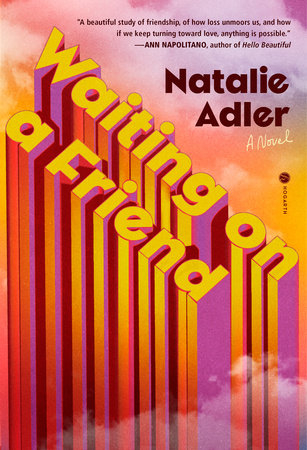
Waiting on a Friend

A Novel

Hardcover
$28.00 US
5.99"W x 8.55"H x 1.04"D   (15.2 x 21.7 x 2.6 cm) | 13 oz (369 g) | 12 per carton
On sale May 26, 2026 | 288 Pages | 9780593734025
Grades 9-12 + AP/IB
Sales rights: US, Canada, Open Mkt

See Additional Formats
New York City, East Village, 1984. A young woman with the power to see the ghosts of her friends is haunted by the one who refuses to return—a dazzling, big-hearted debut of friendship and community during a time of devastation and defiance.

“A wildly inventive and moving novel . . . an astonishingly brilliant debut.”—Patrick Ryan, author of Buckeye


“A beautiful study of friendship, of how loss unmoors us, and how if we keep turning towards love, anything is possible.”—Ann Napolitano, author of Hello Beautiful

“Fresh and refreshing, both heartbreaking and uplifting. Natalie Adler has given us a gem.”—Rabih Alameddine, winner of the National Book Award


“[A] powerhouse debut . . . Adler’s intimate portrayal of the period is richly detailed, both in the grim atmosphere and the city’s life-affirming downtown arts community. This dazzles like a mirror ball.”—Publishers Weekly (starred review)

“Spellbinding.”—Library Journal (starred review)


A MOST ANTICIPATED BOOK OF THE YEAR: Debutiful, Lit Hub, Publishers Lunch

Renata is a young dyke-about-town who can see ghosts, something she's doing more and more of lately as too many of her friends are dying of a new, terrifying disease. When Renata's best friend Mark dies of complications from AIDS, Renata is devastated by the loss of the person she loved most in the world. And to her disappointment and increasing despair, Mark seems unwilling or unable to return for the proper goodbye they both were denied.

While Renata waits anxiously for Mark, she must stay vigilant: a mysterious, police-like force has begun ridding their East Village neighborhood of anything abnormal or inexplicable. What first seems like a scam reveals itself to be far more sinister, targeting the soul of Renata's community. With her band of lovably eccentric pals and lovers, Renata is determined to fight back against the erasure of her friends' memories and the sanitizing of her beloved New York. But haunting her every step is Mark, the one ghost who stubbornly refuses to reappear.

Both heartbreaking and healing, tragic and triumphant, Waiting on a Friend is a magical retelling of queer history and a celebration of youth and camaraderie. With pathos and humor, empathy and an edge, Natalie Adler freshly reimagines the past for a new generation, reclaiming the spirit of resistance and determination that would become one of the era's defining legacies.
Chapter 1

Mirrors

How horribly does a guy have to die that his ghost keeps on suffering even after he leaves his sick body behind?

François had lived across the hall from Mark and me. He was our friend, the first friend we shared in the city. He was a little older than us and would cook us roast chicken and potatoes. He was short, elfish, delicate looking, but he had a real pervert’s mustache and one motherf***er of an attitude. He liked to introduce himself at parties as a failed artist, a manqué. He used to be an art teacher at a private school for precocious Upper West Side children, passing off his French accent and sense of style as the equivalent of a teaching degree. His walls were filled with his students’ drawings, all crayon and primary colors. “They’re better than any shit at the gallery on the corner,” he’d say. “Any child can scribble on a wall. Of course, I am not jealous.” Springtime of last year, once he really started looking sick, the school board asked him to resign because, they said, his face was “scaring the children.” He had been taking such care to cover his KS with makeup that I actually think he convinced himself that no one else noticed.

“I’m so angry,” he told me, “I broke two of my hand mirrors.”

I asked him how many hand mirrors he had, and he waved the question away, as if it were impossible to count that high.

He tore down every construction paper drawing, every last series of lopsided paper dolls holding hands. I suggested we plot ways to curse the backstabbing school board and the parents who worried for their precious little angels, right after we figured out what he’d do without health insurance, which, for a French person, was an inconceivable problem. It’s not possible, he kept saying. A thing about François is he liked to say things were a catastrophe. Missing the train, spilling his coffee, coming down with a cold before a hot date. But when he got really sick, he didn’t call it a catastrophe. He just said, “It’s not possible” over and over, like he could ward off the worst with it. So we burned the art in the slop sink in the hall, along with a caricature of his enemies he drew with a red marker. After that, he stopped with the makeup, having realized that it was his anger more than his face that scared people. The sicker he got, the more he embraced that anger. At first, he said his anger made him feel better, and later he said it kept him alive.

It upset Mark, though. He said that watching François get worse felt like getting pulled away from the edge of a platform when a train was screaming toward you. Even if you were glad to be spared, you couldn’t help but picture your body crushed.

François’s decline came in waves: KS on his gums, stroke, brain lesions, blindness, dementia. His death was the first to really shock me with how ghastly someone could go out. The first guys I knew who died of AIDS didn’t die so much as vanish into whispers and rumors—in hospitals where we couldn’t visit, or with families who wouldn’t return our calls. If they came back after they died, they tended to be confused about what exactly had killed them but were pretty f***ing sure they had been done wrong—not by luck, per se, but by the people who were supposed to take care of them. They were the ones with houses on Fire Island, with memberships at the Saint. Guys with money and jobs who expected more out of life. We had friends who thought those clones would be the only guys who could get it, the profligate rich whores who only lived for themselves. It’s not like the people I was close with did fewer drugs and had less sex, so I guess it was less a lifestyle judgment and more of a class resentment or, I realize now, a fantasy of being able to contain something scary. The guys who died first weren’t my close friends, but I lived in the world and they did too, and I was sorry it was happening, to them, to everybody.

François, however, thought everyone would get it eventually, that all it took was a little bad luck, that it would rip through the gays and then the straights, and then maybe the whole rotten planet would die out.

“Even the lesbians?” I asked.

“Perhaps not,” he said. “Unless they are very bad girls who inject themselves with needles. The good ones can take care of the children who remain.”

“F*** off,” I said. “Absolutely not.”

He had been bitter about those who would survive. “Everyone who lives longer than me,” he said, scowling, “will think it is because they are stronger. Or more virtuous. They didn’t visit the bathhouses, they didn’t have too many partners. They were good, and I am so bad.”

He wanted to go home to France for treatment because, he was sure, they wouldn’t treat him like garbage like they did here. His boyfriend, Leon, said, “Don’t be silly, baby. In this country, garbage gets taken care of.”

“It’s a good line,” Mark said. “But the garbagemen do go on strike every couple of years.”

“As is their right,” François said with a hiss.

“New York’s strongest,” I added. “Maybe we need to get the teamsters on it, then we’ll have a cure by the end of the year.”

“If you had an organized Left in your country—”

Leon rested his chin in his hand and batted his eyelashes. “Oh, darling, were you part of May ’68? You’ve never mentioned it. Why don’t you enthrall us?”

François went to meetings at the Community Health Center at seven in the morning, answered calls on the hotline, went to the fundraisers, went to the GMHC meetings where, he said, doctors and social workers told him what it was like to have AIDS while he had shingles zipping up his torso. If you called him a victim, he’d throw something at you. As he got sicker, he got angrier, angrier, somehow more himself in his anger, and as a year passed with no response from anyone with power, and the groups he organized with fought and fractured, and as his anger got stronger, his mind got cloudier until the anger swallowed him and he lost all control, dribbling shit as he walked down the hall, screaming, spitting at the people in the hospital who were too afraid to touch him. He slumped into a coma the day the government announced that AIDS was caused by a virus and they’d have a vaccine in two years. Leon whispered the news into François’s ear, but if he understood, he didn’t wake up happy. I bet he wouldn’t have believed it. I still don’t.

I think what frightened me more than anything was knowing that someone could go on that way, that even after you were dead, you could still feel the hell of being left to die. His anger outlived him.

After François vanished from my apartment, I still felt him with me. The air was stuffy again, but staticky, the way it is when it storms but the humidity isn’t burned off by lightning. I thought of getting back into the tub, but the water felt stale, like a dog bowl. I staggered to bed, wrapped myself in every blanket I had over my damp towel, and didn’t move until dawn, when the light, I hoped, would make me feel safe enough to get up.
A wildly inventive and moving novel that walks a tightrope of emotion with grace and humor . . . an astonishingly brilliant debut.”—Patrick Ryan, New York Times bestselling author of Buckeye

“A magical retelling of queer history, a celebration of NYC youth and friendship.”Literary Hub, “Most Anticipated Books of 2026”

“Fresh and refreshing, both heartbreaking and uplifting . . . Natalie Adler has given us a gem.”—Rabih Alameddine, author of The True True Story of Raja the Gullible (and His Mother), winner of the National Book Award

“A fun, sexy, heartbreaking, inventive whirl of a novel.”—Ann Napolitano, New York Times bestselling author of Hello Beautiful

“Quirky, queer, poignant, and funny, this book shines with spirit and hope.”—Julia Glass, author of Three Junes, winner of the National Book Award

“A perfect ghost story . . . beautiful, quietly radical, and so heartfelt it hurts.”—Gretchen Felker-Martin, author of Manhunt

“Adler gets the feeling of the time more right than almost any historical fiction I’ve read about the early-middle height of AIDS in NYC.”—Andrea Lawlor, author of Paul Takes the Form of a Mortal Girl

“Natalie Adler is bringing one incarnation of the AIDS experience into the present where it all belongs. Someone is listening.”—Sarah Schulman, author of Let the Record Show: A Political History of ACT UP

“[A book] everyone should be itching to read. Adler has her finger on the pulse of humanity, humor, and a damn good haunting plot.”Debutiful

“A riveting debut by a writer of tremendous compassion and insight.”—Helen Phillips, author of The Need

“A breathtaking novel . . . I absolutely loved it and could not stop reading.”—Jiaming Tang, author of Cinema Love

“This book will linger long after the last page.”—Garrard Conley, author of Boy Erased

“Tender, funny, insightful . . . These characters and this world stayed in my heart long after I finished the book.”—Carter Sickels, author of The Prettiest Star

“At turns funny and wise, sexy and sad, paranormal and devastatingly real—this book made me feel more human.”—Molly McGhee, author of Jonathan Abernathy You Are Kind

“By turns biting and generous, funny and devastating, Waiting on a Friend evokes friendship in all its complexity—its resentments, tender obsessions, marvelous intimacies, and supernatural power.”—Beth Morgan, author of A Touch of Jen

“Spellbinding . . . Adler’s debut is highly recommended for readers who enjoy vividly drawn literary fiction about the past.”Library Journal, starred review

“[A] powerhouse debut . . . Adler’s intimate portrayal of the period is richly detailed, both in the grim atmosphere and the city’s life-affirming downtown arts community. This dazzles like a mirror ball.”Publishers Weekly, starred review
© Emily Steinfeld Mahler
Natalie Adler has an MFA in Fiction from Brooklyn College and a PhD in Comparative Literature from Brown University. She was a Susan Kamil Emerging Writer Fellow at the Center for Fiction and is an editor at Lux magazine. She is from New Jersey and lives in New York City. View titles by Natalie Adler
Available for sale exclusive:
•     Canada
•     Guam
•     Minor Outl.Ins.
•     North Mariana
•     Philippines
•     Puerto Rico
•     Samoa,American
•     US Virgin Is.
•     USA

Available for sale non-exclusive:
•     Afghanistan
•     Aland Islands
•     Albania
•     Algeria
•     Andorra
•     Angola
•     Antarctica
•     Argentina
•     Armenia
•     Aruba
•     Austria
•     Azerbaijan
•     Bahrain
•     Belarus
•     Belgium
•     Benin
•     Bhutan
•     Bolivia
•     Bonaire, Saba
•     Bosnia Herzeg.
•     Bouvet Island
•     Brazil
•     Bulgaria
•     Burkina Faso
•     Burundi
•     Cambodia
•     Cape Verde
•     Centr.Afr.Rep.
•     Chad
•     Chile
•     China
•     Colombia
•     Comoro Is.
•     Congo
•     Cook Islands
•     Costa Rica
•     Croatia
•     Cuba
•     Curacao
•     Czech Republic
•     Dem. Rep. Congo
•     Denmark
•     Djibouti
•     Dominican Rep.
•     Ecuador
•     Egypt
•     El Salvador
•     Equatorial Gui.
•     Eritrea
•     Estonia
•     Ethiopia
•     Faroe Islands
•     Finland
•     France
•     Fren.Polynesia
•     French Guinea
•     Gabon
•     Georgia
•     Germany
•     Greece
•     Greenland
•     Guadeloupe
•     Guatemala
•     Guinea Republic
•     Guinea-Bissau
•     Haiti
•     Heard/McDon.Isl
•     Honduras
•     Hong Kong
•     Hungary
•     Iceland
•     Indonesia
•     Iran
•     Israel
•     Italy
•     Ivory Coast
•     Japan
•     Kazakhstan
•     Kyrgyzstan
•     Laos
•     Latvia
•     Lebanon
•     Liberia
•     Libya
•     Liechtenstein
•     Lithuania
•     Luxembourg
•     Macau
•     Macedonia
•     Madagascar
•     Maldives
•     Mali
•     Marshall island
•     Martinique
•     Mauritania
•     Mayotte
•     Mexico
•     Micronesia
•     Moldavia
•     Monaco
•     Mongolia
•     Montenegro
•     Morocco
•     Myanmar
•     Nepal
•     Netherlands
•     New Caledonia
•     Nicaragua
•     Niger
•     Niue
•     Norfolk Island
•     North Korea
•     Norway
•     Oman
•     Palau
•     Palestinian Ter
•     Panama
•     Paraguay
•     Peru
•     Poland
•     Portugal
•     Qatar
•     Reunion Island
•     Romania
•     Russian Fed.
•     Saint Martin
•     San Marino
•     SaoTome Princip
•     Saudi Arabia
•     Senegal
•     Serbia
•     Sint Maarten
•     Slovakia
•     Slovenia
•     South Korea
•     South Sudan
•     Spain
•     St Barthelemy
•     St.Pier,Miquel.
•     Sth Terr. Franc
•     Suriname
•     Svalbard
•     Sweden
•     Switzerland
•     Syria
•     Tadschikistan
•     Taiwan
•     Thailand
•     Timor-Leste
•     Togo
•     Tokelau Islands
•     Tunisia
•     Turkey
•     Turkmenistan
•     Ukraine
•     Unit.Arab Emir.
•     Uruguay
•     Uzbekistan
•     Vatican City
•     Venezuela
•     Vietnam
•     Wallis,Futuna
•     West Saharan
•     Yemen

Not available for sale:
•     Anguilla
•     Antigua/Barbuda
•     Australia
•     Bahamas
•     Bangladesh
•     Barbados
•     Belize
•     Bermuda
•     Botswana
•     Brit.Ind.Oc.Ter
•     Brit.Virgin Is.
•     Brunei
•     Cameroon
•     Cayman Islands
•     Christmas Islnd
•     Cocos Islands
•     Cyprus
•     Dominica
•     Falkland Islnds
•     Fiji
•     Gambia
•     Ghana
•     Gibraltar
•     Grenada
•     Guernsey
•     Guyana
•     India
•     Iraq
•     Ireland
•     Isle of Man
•     Jamaica
•     Jersey
•     Jordan
•     Kenya
•     Kiribati
•     Kuwait
•     Lesotho
•     Malawi
•     Malaysia
•     Malta
•     Mauritius
•     Montserrat
•     Mozambique
•     Namibia
•     Nauru
•     New Zealand
•     Nigeria
•     Pakistan
•     PapuaNewGuinea
•     Pitcairn Islnds
•     Rwanda
•     S. Sandwich Ins
•     Seychelles
•     Sierra Leone
•     Singapore
•     Solomon Islands
•     Somalia
•     South Africa
•     Sri Lanka
•     St. Helena
•     St. Lucia
•     St. Vincent
•     St.Chr.,Nevis
•     Sudan
•     Swaziland
•     Tanzania
•     Tonga
•     Trinidad,Tobago
•     Turks&Caicos Is
•     Tuvalu
•     Uganda
•     United Kingdom
•     Vanuatu
•     Western Samoa
•     Zambia
•     Zimbabwe

About

New York City, East Village, 1984. A young woman with the power to see the ghosts of her friends is haunted by the one who refuses to return—a dazzling, big-hearted debut of friendship and community during a time of devastation and defiance.

“A wildly inventive and moving novel . . . an astonishingly brilliant debut.”—Patrick Ryan, author of Buckeye


“A beautiful study of friendship, of how loss unmoors us, and how if we keep turning towards love, anything is possible.”—Ann Napolitano, author of Hello Beautiful

“Fresh and refreshing, both heartbreaking and uplifting. Natalie Adler has given us a gem.”—Rabih Alameddine, winner of the National Book Award


“[A] powerhouse debut . . . Adler’s intimate portrayal of the period is richly detailed, both in the grim atmosphere and the city’s life-affirming downtown arts community. This dazzles like a mirror ball.”—Publishers Weekly (starred review)

“Spellbinding.”—Library Journal (starred review)


A MOST ANTICIPATED BOOK OF THE YEAR: Debutiful, Lit Hub, Publishers Lunch

Renata is a young dyke-about-town who can see ghosts, something she's doing more and more of lately as too many of her friends are dying of a new, terrifying disease. When Renata's best friend Mark dies of complications from AIDS, Renata is devastated by the loss of the person she loved most in the world. And to her disappointment and increasing despair, Mark seems unwilling or unable to return for the proper goodbye they both were denied.

While Renata waits anxiously for Mark, she must stay vigilant: a mysterious, police-like force has begun ridding their East Village neighborhood of anything abnormal or inexplicable. What first seems like a scam reveals itself to be far more sinister, targeting the soul of Renata's community. With her band of lovably eccentric pals and lovers, Renata is determined to fight back against the erasure of her friends' memories and the sanitizing of her beloved New York. But haunting her every step is Mark, the one ghost who stubbornly refuses to reappear.

Both heartbreaking and healing, tragic and triumphant, Waiting on a Friend is a magical retelling of queer history and a celebration of youth and camaraderie. With pathos and humor, empathy and an edge, Natalie Adler freshly reimagines the past for a new generation, reclaiming the spirit of resistance and determination that would become one of the era's defining legacies.

Excerpt

Chapter 1

Mirrors

How horribly does a guy have to die that his ghost keeps on suffering even after he leaves his sick body behind?

François had lived across the hall from Mark and me. He was our friend, the first friend we shared in the city. He was a little older than us and would cook us roast chicken and potatoes. He was short, elfish, delicate looking, but he had a real pervert’s mustache and one motherf***er of an attitude. He liked to introduce himself at parties as a failed artist, a manqué. He used to be an art teacher at a private school for precocious Upper West Side children, passing off his French accent and sense of style as the equivalent of a teaching degree. His walls were filled with his students’ drawings, all crayon and primary colors. “They’re better than any shit at the gallery on the corner,” he’d say. “Any child can scribble on a wall. Of course, I am not jealous.” Springtime of last year, once he really started looking sick, the school board asked him to resign because, they said, his face was “scaring the children.” He had been taking such care to cover his KS with makeup that I actually think he convinced himself that no one else noticed.

“I’m so angry,” he told me, “I broke two of my hand mirrors.”

I asked him how many hand mirrors he had, and he waved the question away, as if it were impossible to count that high.

He tore down every construction paper drawing, every last series of lopsided paper dolls holding hands. I suggested we plot ways to curse the backstabbing school board and the parents who worried for their precious little angels, right after we figured out what he’d do without health insurance, which, for a French person, was an inconceivable problem. It’s not possible, he kept saying. A thing about François is he liked to say things were a catastrophe. Missing the train, spilling his coffee, coming down with a cold before a hot date. But when he got really sick, he didn’t call it a catastrophe. He just said, “It’s not possible” over and over, like he could ward off the worst with it. So we burned the art in the slop sink in the hall, along with a caricature of his enemies he drew with a red marker. After that, he stopped with the makeup, having realized that it was his anger more than his face that scared people. The sicker he got, the more he embraced that anger. At first, he said his anger made him feel better, and later he said it kept him alive.

It upset Mark, though. He said that watching François get worse felt like getting pulled away from the edge of a platform when a train was screaming toward you. Even if you were glad to be spared, you couldn’t help but picture your body crushed.

François’s decline came in waves: KS on his gums, stroke, brain lesions, blindness, dementia. His death was the first to really shock me with how ghastly someone could go out. The first guys I knew who died of AIDS didn’t die so much as vanish into whispers and rumors—in hospitals where we couldn’t visit, or with families who wouldn’t return our calls. If they came back after they died, they tended to be confused about what exactly had killed them but were pretty f***ing sure they had been done wrong—not by luck, per se, but by the people who were supposed to take care of them. They were the ones with houses on Fire Island, with memberships at the Saint. Guys with money and jobs who expected more out of life. We had friends who thought those clones would be the only guys who could get it, the profligate rich whores who only lived for themselves. It’s not like the people I was close with did fewer drugs and had less sex, so I guess it was less a lifestyle judgment and more of a class resentment or, I realize now, a fantasy of being able to contain something scary. The guys who died first weren’t my close friends, but I lived in the world and they did too, and I was sorry it was happening, to them, to everybody.

François, however, thought everyone would get it eventually, that all it took was a little bad luck, that it would rip through the gays and then the straights, and then maybe the whole rotten planet would die out.

“Even the lesbians?” I asked.

“Perhaps not,” he said. “Unless they are very bad girls who inject themselves with needles. The good ones can take care of the children who remain.”

“F*** off,” I said. “Absolutely not.”

He had been bitter about those who would survive. “Everyone who lives longer than me,” he said, scowling, “will think it is because they are stronger. Or more virtuous. They didn’t visit the bathhouses, they didn’t have too many partners. They were good, and I am so bad.”

He wanted to go home to France for treatment because, he was sure, they wouldn’t treat him like garbage like they did here. His boyfriend, Leon, said, “Don’t be silly, baby. In this country, garbage gets taken care of.”

“It’s a good line,” Mark said. “But the garbagemen do go on strike every couple of years.”

“As is their right,” François said with a hiss.

“New York’s strongest,” I added. “Maybe we need to get the teamsters on it, then we’ll have a cure by the end of the year.”

“If you had an organized Left in your country—”

Leon rested his chin in his hand and batted his eyelashes. “Oh, darling, were you part of May ’68? You’ve never mentioned it. Why don’t you enthrall us?”

François went to meetings at the Community Health Center at seven in the morning, answered calls on the hotline, went to the fundraisers, went to the GMHC meetings where, he said, doctors and social workers told him what it was like to have AIDS while he had shingles zipping up his torso. If you called him a victim, he’d throw something at you. As he got sicker, he got angrier, angrier, somehow more himself in his anger, and as a year passed with no response from anyone with power, and the groups he organized with fought and fractured, and as his anger got stronger, his mind got cloudier until the anger swallowed him and he lost all control, dribbling shit as he walked down the hall, screaming, spitting at the people in the hospital who were too afraid to touch him. He slumped into a coma the day the government announced that AIDS was caused by a virus and they’d have a vaccine in two years. Leon whispered the news into François’s ear, but if he understood, he didn’t wake up happy. I bet he wouldn’t have believed it. I still don’t.

I think what frightened me more than anything was knowing that someone could go on that way, that even after you were dead, you could still feel the hell of being left to die. His anger outlived him.

After François vanished from my apartment, I still felt him with me. The air was stuffy again, but staticky, the way it is when it storms but the humidity isn’t burned off by lightning. I thought of getting back into the tub, but the water felt stale, like a dog bowl. I staggered to bed, wrapped myself in every blanket I had over my damp towel, and didn’t move until dawn, when the light, I hoped, would make me feel safe enough to get up.

Praise

A wildly inventive and moving novel that walks a tightrope of emotion with grace and humor . . . an astonishingly brilliant debut.”—Patrick Ryan, New York Times bestselling author of Buckeye

“A magical retelling of queer history, a celebration of NYC youth and friendship.”Literary Hub, “Most Anticipated Books of 2026”

“Fresh and refreshing, both heartbreaking and uplifting . . . Natalie Adler has given us a gem.”—Rabih Alameddine, author of The True True Story of Raja the Gullible (and His Mother), winner of the National Book Award

“A fun, sexy, heartbreaking, inventive whirl of a novel.”—Ann Napolitano, New York Times bestselling author of Hello Beautiful

“Quirky, queer, poignant, and funny, this book shines with spirit and hope.”—Julia Glass, author of Three Junes, winner of the National Book Award

“A perfect ghost story . . . beautiful, quietly radical, and so heartfelt it hurts.”—Gretchen Felker-Martin, author of Manhunt

“Adler gets the feeling of the time more right than almost any historical fiction I’ve read about the early-middle height of AIDS in NYC.”—Andrea Lawlor, author of Paul Takes the Form of a Mortal Girl

“Natalie Adler is bringing one incarnation of the AIDS experience into the present where it all belongs. Someone is listening.”—Sarah Schulman, author of Let the Record Show: A Political History of ACT UP

“[A book] everyone should be itching to read. Adler has her finger on the pulse of humanity, humor, and a damn good haunting plot.”Debutiful

“A riveting debut by a writer of tremendous compassion and insight.”—Helen Phillips, author of The Need

“A breathtaking novel . . . I absolutely loved it and could not stop reading.”—Jiaming Tang, author of Cinema Love

“This book will linger long after the last page.”—Garrard Conley, author of Boy Erased

“Tender, funny, insightful . . . These characters and this world stayed in my heart long after I finished the book.”—Carter Sickels, author of The Prettiest Star

“At turns funny and wise, sexy and sad, paranormal and devastatingly real—this book made me feel more human.”—Molly McGhee, author of Jonathan Abernathy You Are Kind

“By turns biting and generous, funny and devastating, Waiting on a Friend evokes friendship in all its complexity—its resentments, tender obsessions, marvelous intimacies, and supernatural power.”—Beth Morgan, author of A Touch of Jen

“Spellbinding . . . Adler’s debut is highly recommended for readers who enjoy vividly drawn literary fiction about the past.”Library Journal, starred review

“[A] powerhouse debut . . . Adler’s intimate portrayal of the period is richly detailed, both in the grim atmosphere and the city’s life-affirming downtown arts community. This dazzles like a mirror ball.”Publishers Weekly, starred review

Author

© Emily Steinfeld Mahler
Natalie Adler has an MFA in Fiction from Brooklyn College and a PhD in Comparative Literature from Brown University. She was a Susan Kamil Emerging Writer Fellow at the Center for Fiction and is an editor at Lux magazine. She is from New Jersey and lives in New York City. View titles by Natalie Adler

Rights

Available for sale exclusive:
•     Canada
•     Guam
•     Minor Outl.Ins.
•     North Mariana
•     Philippines
•     Puerto Rico
•     Samoa,American
•     US Virgin Is.
•     USA

Available for sale non-exclusive:
•     Afghanistan
•     Aland Islands
•     Albania
•     Algeria
•     Andorra
•     Angola
•     Antarctica
•     Argentina
•     Armenia
•     Aruba
•     Austria
•     Azerbaijan
•     Bahrain
•     Belarus
•     Belgium
•     Benin
•     Bhutan
•     Bolivia
•     Bonaire, Saba
•     Bosnia Herzeg.
•     Bouvet Island
•     Brazil
•     Bulgaria
•     Burkina Faso
•     Burundi
•     Cambodia
•     Cape Verde
•     Centr.Afr.Rep.
•     Chad
•     Chile
•     China
•     Colombia
•     Comoro Is.
•     Congo
•     Cook Islands
•     Costa Rica
•     Croatia
•     Cuba
•     Curacao
•     Czech Republic
•     Dem. Rep. Congo
•     Denmark
•     Djibouti
•     Dominican Rep.
•     Ecuador
•     Egypt
•     El Salvador
•     Equatorial Gui.
•     Eritrea
•     Estonia
•     Ethiopia
•     Faroe Islands
•     Finland
•     France
•     Fren.Polynesia
•     French Guinea
•     Gabon
•     Georgia
•     Germany
•     Greece
•     Greenland
•     Guadeloupe
•     Guatemala
•     Guinea Republic
•     Guinea-Bissau
•     Haiti
•     Heard/McDon.Isl
•     Honduras
•     Hong Kong
•     Hungary
•     Iceland
•     Indonesia
•     Iran
•     Israel
•     Italy
•     Ivory Coast
•     Japan
•     Kazakhstan
•     Kyrgyzstan
•     Laos
•     Latvia
•     Lebanon
•     Liberia
•     Libya
•     Liechtenstein
•     Lithuania
•     Luxembourg
•     Macau
•     Macedonia
•     Madagascar
•     Maldives
•     Mali
•     Marshall island
•     Martinique
•     Mauritania
•     Mayotte
•     Mexico
•     Micronesia
•     Moldavia
•     Monaco
•     Mongolia
•     Montenegro
•     Morocco
•     Myanmar
•     Nepal
•     Netherlands
•     New Caledonia
•     Nicaragua
•     Niger
•     Niue
•     Norfolk Island
•     North Korea
•     Norway
•     Oman
•     Palau
•     Palestinian Ter
•     Panama
•     Paraguay
•     Peru
•     Poland
•     Portugal
•     Qatar
•     Reunion Island
•     Romania
•     Russian Fed.
•     Saint Martin
•     San Marino
•     SaoTome Princip
•     Saudi Arabia
•     Senegal
•     Serbia
•     Sint Maarten
•     Slovakia
•     Slovenia
•     South Korea
•     South Sudan
•     Spain
•     St Barthelemy
•     St.Pier,Miquel.
•     Sth Terr. Franc
•     Suriname
•     Svalbard
•     Sweden
•     Switzerland
•     Syria
•     Tadschikistan
•     Taiwan
•     Thailand
•     Timor-Leste
•     Togo
•     Tokelau Islands
•     Tunisia
•     Turkey
•     Turkmenistan
•     Ukraine
•     Unit.Arab Emir.
•     Uruguay
•     Uzbekistan
•     Vatican City
•     Venezuela
•     Vietnam
•     Wallis,Futuna
•     West Saharan
•     Yemen

Not available for sale:
•     Anguilla
•     Antigua/Barbuda
•     Australia
•     Bahamas
•     Bangladesh
•     Barbados
•     Belize
•     Bermuda
•     Botswana
•     Brit.Ind.Oc.Ter
•     Brit.Virgin Is.
•     Brunei
•     Cameroon
•     Cayman Islands
•     Christmas Islnd
•     Cocos Islands
•     Cyprus
•     Dominica
•     Falkland Islnds
•     Fiji
•     Gambia
•     Ghana
•     Gibraltar
•     Grenada
•     Guernsey
•     Guyana
•     India
•     Iraq
•     Ireland
•     Isle of Man
•     Jamaica
•     Jersey
•     Jordan
•     Kenya
•     Kiribati
•     Kuwait
•     Lesotho
•     Malawi
•     Malaysia
•     Malta
•     Mauritius
•     Montserrat
•     Mozambique
•     Namibia
•     Nauru
•     New Zealand
•     Nigeria
•     Pakistan
•     PapuaNewGuinea
•     Pitcairn Islnds
•     Rwanda
•     S. Sandwich Ins
•     Seychelles
•     Sierra Leone
•     Singapore
•     Solomon Islands
•     Somalia
•     South Africa
•     Sri Lanka
•     St. Helena
•     St. Lucia
•     St. Vincent
•     St.Chr.,Nevis
•     Sudan
•     Swaziland
•     Tanzania
•     Tonga
•     Trinidad,Tobago
•     Turks&Caicos Is
•     Tuvalu
•     Uganda
•     United Kingdom
•     Vanuatu
•     Western Samoa
•     Zambia
•     Zimbabwe