Close Modal

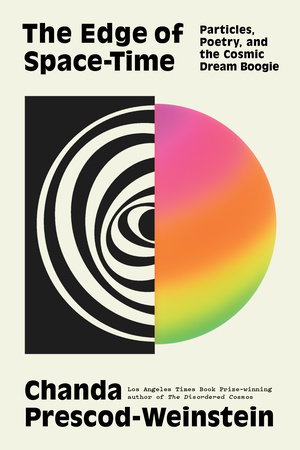
The Edge of Space-Time

Particles, Poetry, and the Cosmic Dream Boogie

Look inside
Hardcover
$32.00 US
6.36"W x 9.6"H x 1.19"D   (16.2 x 24.4 x 3.0 cm) | 20 oz (561 g) | 12 per carton
On sale Apr 07, 2026 | 368 Pages | 9780593701683
Grades 9-12 + AP/IB
Sales rights: US, Canada, Open Mkt

NATIONAL BESTSELLER • A fresh, charming, socially conscious tour of the mysteries of space-time, from the award-winning author of The Disordered Cosmos

“With this extraordinary book, Prescod-Weinstein cements her status as one of the most accomplished and important science writers of our time” —Ed Yong, author of An Immense World


In her highly acclaimed debut, distinguished cosmologist and particle physicist Dr. Chanda Prescod-Weinstein shared with her audience an abiding sense of wonder at the cosmos, while imagining a world without the entrenched injustice that plagues her field. Now, in The Edge of Space-Time, she embraces that cosmic wonder, taking readers on a mind-altering journey to the boundaries of the universe, inviting us to spend time at the edge of what we know about space-time and about ourselves.

Guided by her conviction that for humanity to go forward we must know our cosmic past, and drawing on poetry and popular culture—from Langston Hughes, Queen Latifah, and Lewis Carroll, to Big K.R.I.T., Sun Ra, and Star Trek—Prescod-Weinstein renders accessible some of the most abstract concepts of theoretical physics to tell fascinating stories about the history and fundamental nature of our universe. Here we meet the quantum cat that is both dead and alive, learn the difference between dark matter and dark energy, explore the inner workings of black holes, and investigate the possibility of a unified theory of quantum gravity, following our guide out to the far reaches of the cosmic event horizon and down to the tiniest (and queerest) neutrino. Along the way, she calls on us to resist colonial approaches to space exploration and instead imagine a better path forward in our pursuit of humanity’s undeniable connection with the stars.

Through Prescod-Weinstein’s clear-eyed and unique perspective, and informed by her deep knowledge of postcolonial history and Black feminist thought, The Edge of Space-Time argues that physics is an essential way for everyone to look at the universe and presents a compelling case that “the edge” is a powerful vantage point from which to see the big picture.
Chapter One

How to Live Safely in a Science Factual Universe

In which we notice that we need metaphors to live (and do science)

Before the lab, before the data collection, there is language. Language is sometimes direct and quite literal: “The prettiest rose is a red rose.” But it is just as often figurative, working through comparisons that require imagination to comprehend them. To tell you the story of space-time is to use figurative language, most especially the metaphors that so many of us use to understand our everyday lives. Think about how the idea of space-time as a “fabric” has become culturally ubiquitous. Meanwhile, physicists describe electricity and magnetism as “fields.” What does it mean to explain abstract ideas by drawing on these comparisons to our lived environments and everyday objects?

It would be easy to jump into the science and the metaphors without spending time thinking about what exactly we are doing when we do so. But if we are to think carefully about the fundamental nature of the universe and everything inside of it—from space-time to the invisible dark matter that we’ve never seen or touched but feel fairly confident makes up most of the matter in the universe—then that means thinking carefully about metaphors and what work they are doing in our lives and scientific habits. As a physicist and science communicator, I live with the weight of the metaphors we choose in science, asking myself almost daily: “Is this the right one? What misunderstandings does this metaphor induce?” I ask these critical questions while also knowing that I am completely dependent on metaphors for my own understanding.

We live and breathe the world through metaphor, and our earliest metaphors have the power to govern our thinking. These are the lessons that Natasha Trethewey offers us in her 2020 essay, “You Are Not Safe in Science; You Are Not Safe in History: On Abiding Metaphors and Finding a Calling.” In the essay, Trethewey meditates on her upbringing as a child of a white father and Black mother. It is here that I first saw these lines from Robert Frost’s essay “Education by Poetry”:

What I am pointing out is that unless you are at home in the metaphor, unless you have had your proper poetical education in the metaphor, you are not safe anywhere. Because you are not at ease with figurative values: you don’t know the metaphor in its strength and its weakness. You don’t know how far you may expect to ride it and when it may break down with you. You are not safe in science; you are not safe in history.

The first time I read Frost’s lines in Trethewey’s essay, I actually did a double-take. I was reading this essay for literary craft, not to study science craft. Yet there it was: “You are not safe in science. You are not safe in history.”

In the essay that follows, the metaphors Trethewey centers are focused on the embodied experience of being a child of miscegenation—a mixed-race marriage between a Black woman and a white man. Trethewey writes of the abiding metaphors that govern how Black children with white biological parents have historically been interpreted both socially and scientifically, i.e., as mules, the English version of the Spanish/Portuguese “mulato.” Her father believed, as Robert Frost did, that Trethewey had to understand metaphors because they are powerful mediators of the relationship between our internal world and the outer universe. Her mother also believed that an education by metaphor was necessary because “if I could not parse the metaphorical thinking of the time and place into which I’d entered, I could be defeated by it.” This is true for a physicist too. The beating heart of physics is creating models of the world because, ultimately, we are searching for mathematical metaphors that give us insight into our cosmos. The models that survive scrutiny become the next generation’s abiding metaphors.

Abiding Metaphors

How do we learn to think about our universe as it actually is? We start with our abiding metaphors, which shape how we understand our reality. Our childhood stories follow us through life. In my case, like many Black children of the 1980s United States, I was raised on Virginia Hamilton’s short-story collection The People Could Fly: American Black Folktales. The titular tale, which concludes the collection, opens, “They say the people could fly.” It is a story about enslaved Black folks escaping the horrors of enslavement by literally flying away.

In reading this story to me, my mom passed on a multigenerational Black metaphor for Black freedom dreams. Because of course the point wasn’t that our African ancestors who were kidnapped and forced to endure the Middle Passage were actually capable of flying. Flight was a metaphor for the freedom that was stolen from them, and it was also a metaphor for the freedom that Black people restored for themselves when they took flight from enslavement, whether by running away or through other means.

The People Could Fly is now one of the abiding metaphors of at least one physicist’s upbringing, or training as we might otherwise call it. To be a physicist is to parse not just the metaphorical thinking of the here and now but also to be trained in the metaphors of yesterday, including the ones that tell stories about what we are. To understand the abiding metaphors of her family and her culture, Trethewey’s essay excavates the race science that evolved to explain that people like her (people like me) are a specific kind of abomination. It’s easy to understand race/racist science as a pseudoscience of the past, but not only does it live with us in the here and now, it was considered mainstream, state-of-the-art biological science right around the time that physicists began exploring fields.

When I first read through Trethewey’s essay, I thought about the way the history of science and the history of racialism are themselves mixed. Specifically, I wondered about the impulse to categorize—the organizing impulse of racial classification got borrowed/intermixed/reused in science during key developmental moments in the seventeenth, eighteenth, and nineteenth centuries. Can this be separated from the way natural philosophers—then scientists—also attached themselves to searching for principles of order/ordering and hierarchy as fundamental truths about nature?

Damascan-Ottoman polymath Taqi al-Din Muhammad ibn Ma’ruf ash-Shami al-Asadi (Taqi al-Din), and eventually French philosopher René Descartes, imagined the universe as an orderly, machine-like phenomenon. The idea that the universe has an organized, hierarchical structure is its own kind of abiding metaphor. The attempt to translate humanity (and later, identity) into a mathematical equation was a fundamental political practice that also had its roots in science, and it was also a scientific practice that was driven by politics. Trethewey writes in her poem “Taxonomy” that “this plus this equals this,” which is a good summary of how physicists are taught to conceive of the world. Reading that line, I thought of the standard model of particle physics—we call it “the standard model” for short—which names every single particle that humans have ever detected in a collider or some other particle-detection instrument on Earth.

As I read and reread Trethewey’s essay, I found myself wondering whether her critical analysis of miscegenation had direct implications for how particle physics came to be. The ordering impulse that prompted the invention of the mulatto—the human child as a mule—is the same socialized instinct that encourages me to seek out a standard model for the particle menagerie and space-time that actually is my material foundation. I wondered what other abiding metaphors I had been taught as part of my education in cosmology and particle physics and how they were permanently altering how I would perceive the world. We imagine that matter is reducible to identifiable fundamental particles (we’ll come back to these later), and this is an organizing structure for our knowledge of the universe that our metaphors encourage us to arrive at.

Hierarchy is baked into how we talk about physics now. One of the major open problems in the particle-physics community is literally “the hierarchy problem” (I’ll return to this in chapter 14). We don’t question the name or the assumption that a hierarchy will emerge. We only conceive of difference in existence and impact through a hierarchy of strength and impact. This is what happens when you move through the world imagining that the abiding metaphors that govern your intellectual origins are synonymous with reality, when, as Trethewey says, “received knowledge becomes synonymous with truth.”

Hierarchy as a guiding metaphor has been useful to physicists in the past, but it doesn’t necessarily always serve us—or at least serve us well. One problem with the idea that the universe is reducible to fundamental particles is that the standard model does not explain gravity. We know that gravity is in fact an effect of space-time’s shape—how angles and distances are measured within it. If we imagine that space-time is a stage and the matter in it is a cast of actors, then why would reducibility apply to just the characters (matter) and not the stage (space-time)? At subatomic length scales, we might expect the weird rules of quantum mechanics to kick in.

A quantum rule that could become relevant is that every measurable quantity, like distance, has the property whereby the more you try to pin it down, the more jittery it gets. So we might expect that there are jitters in space-time, at the tiniest of scales, and that there may even be a minimum measurable distance. Why would space-time be exempt from being reduced to individual parts, just like atoms reduce to particles? Yet we experience the space we live in as a smooth, uninterrupted phenomenon, with no apparent gaps. And so far we have been unable to formulate a quantum description of space-time—a problem that I’ll return to in chapter 16. But in the meantime, the way we describe particles treats them as if they exist on top of what we call a “background.” Space-time lives in the back, a smooth, gapless tabula rasa where the action of particle matter occurs.

Given the metaphor I have just introduced, where the particles are actors on the stage that is space-time, a reader might create an image in their mind of a stage that never changes. But in fact, space is what we physicists call “dynamical”—it changes and mixes with time. How it changes is governed in part by how particles are moving in it, and whether particles are there at all. The metaphors sound nice on the page, but they can cause problems for our efforts to actually understand the thing at hand, which is not how to develop a pleasing metaphor but rather to understand and craft an accurate story about the inner workings of our cosmos.

The work of physics is to convert observed physical phenomena into quantifiable characteristics about its original as well as current and future status in a variety of conditions: how fast is something going, where it will be, how it will interact with a silver atom or a light wave. These are simple questions to ask, but it turns out that thinking about them gets us into trouble rather quickly, though it’s the good, curious kind of trouble. Physicist Julian Barbour notes, “By its very ubiquity, motion ceases to strike us as particularly marvelous or mysterious. But the seemingly simple is complex and subtle.” Motion is everywhere. Blood moves through our veins, birds fly above, spiders walk onto our beds. It is often difficult to model how exactly any of this happens. Even so, physics is fundamentally driven by the idea that we can model motion—changes across space and time—with mathematical stories that reflect our physical reality.

We take for granted that anything we encounter is available for modeling because so far, it’s worked out that way for us. In the case of general relativity, we have an equation that models how space-time evolved from the earliest fraction of a second until now, whenever you read this sentence. We also have a story about the dynamical relationship between space-time and particles, which are not actually like tiny billiard balls but are in fact something so much stranger that later I will tell you that actually you’re just a mathematical abstraction that comes from nothing, and I will mean it in the kindest possible way. This perspective represents a profound shift in how we understand the very foundations of who and what we are. And it shows us that there’s no guarantee that our abiding metaphors are good ones.
“Astonishing.”—Los Angeles Times

“The word 'ambitious' is often dulled by overuse. But The Edge of Space-Time captures its essence. It draws on Black studies, cultural criticism, political thought, and literary reflection while speaking to some of the most conceptually difficult problems in modern physics. The book’s ambition lies in its refusal to keep these domains apart. . . . in that sense, it understands something that science fiction, from Octavia Butler to Star Trek, has long known: Our visions of the cosmos are always also visions of ourselves.”Science

“A fresh and wholly unique take on space-time and on where science fits into our history and society. . . . In a crowded field of science communicators who tackle advanced topics, Prescod-Weinstein’s voice continues to be a refreshing standout. . . . firmly grounded in the political realities of 2026 in the United States, this book meets the moment: a book that says science is important, that science is political, and that, yes, science is still meaningful, even now.”American Scientist

“[A] jaunty affront to just about everything our senses tell us about the world. . . . Draws from just about every intellectual nook and cranny — from Bantu linguistics and Star Trek, to hip-hop and gender theory — to weave an idiosyncratic illustration of the universe as physicists understand it today. It's an accessible take on a flabbergasting subject which, to put it mildly, offers a rather different view of reality than the one I remember learning in school.”—NPR

“Written with a provocative and very human voice and perspective, that of a Black feminist cosmologist . . . who also happens to [have a] fascination with language’s power. . . . The Edge of Space-Time isn’t just fiery but also fun.”—The Boston Globe

“Distills the knowns and unknowns of our universe in a heady brew of astronomical observation, complex calculus, personal anecdote, and political polemic. . . . Buckle up and shoot for the stars.”TIME

“For the girls who are interested in everything from poetry, to cosmic particles to pop culture, cosmologist and physicist Chanda Prescod-Weinstein, Ph.D.’s collection is for you. Prescod-Weinstein uses an anti-colonial, Black feminist approach to share what the cosmos can teach us about life here on earth.”Essence

“Prescod-Weinstein explores the wonders of the cosmos through Black feminist, anti-colonial and historical frameworks. She presents topics such as space-time, quantum mechanics, black holes, and more in fun and relatable ways that even the most unscientific mind . . . can understand.”Ms. Magazine

“If you’ve ever wanted to understand the mysteries of the universe, theoretical physicist Chanda Prescod-Weinstein wrote just the book for you. Her infectious passion and poetic explanations . . . make concepts ranging from microscopic particles to the big bang feel accessible. How? She illustrates how physics and art have more in common than you’d think.”—WBUR

“Nothing short of mind-blowing. . . . A brilliant book that explores what we can learn about life here on Earth by looking up.”Book Riot

“A cosmologist and particle physicist who also happens to be a great writer with wonderful cross-cultural fluencies, Prescod-Weinstein seems possessed of an off-kilter and roving curiosity ideally suited to answering all the bigger questions about where we are, why we’re here, and where, exactly, are we going.”Lit Hub

“With this extraordinary book, Prescod-Weinstein cements her status as one of the most accomplished and important science writers of our time; as polymath, griot, teacher, and more; as the guide to the universe that we don’t deserve but absolutely need. She has given us a book about physics as story and metaphor, as revelation and revolution, as answer and antidote. It’s suffused with gorgeous poetry and frequently very, very funny.”­—Ed Yong, author of An Immense World

“Of course, the most politically audacious book I’ve read in decades would be a book about physics and space. In The Edge of Space-Time, Chanda Prescod-Weinstein shows us that we are here because we have always been there . . . making and reckoning with space. An absolute instant classic and an intergalactic monument. Read this now.”­—Kiese Laymon, author of Heavy

“Lots of books talk about the universe. The Edge of Space-Time talks about the universe from the perspective of a real human living within it—a person with a body, embedded in a community, burdened by history, fueled by curiosity, sustained by hope. A great read for any human being who lives in the universe.”—Sean Carroll, author of The Biggest Ideas in the Universe

“A lyrical, genre-defying exploration of the universe that dances at the intersection of physics, pop culture, and Black intellectual thought, this book invites readers to see the cosmos not just through equations, but through the rhythms of music, the textures of art, and the power of storytelling.”­—Ruha Benjamin, author of Race After Technology

“Yet another book by Dr. Prescod-Weinstein that I’ll want to bring up in every conversation! Whatever you thought you would learn about space-time, you’ll get that and so much more from this deft weave of quantum physics and cultural wisdom.”­—Moiya McTier, author of The Milky Way: An Autobiography of Our Galaxy

“An enthralling introduction to the universe, The Edge of Space-Time reminds us all that stargazing is the work of generations of physicists and poets, and people both enslaved and free. Dr. Chanda Prescod-Weinstein invites us to imagine grander, queerer theories for our cosmic future and, along the way, achieves the unthinkable: She makes physics accessible and funny. A paean to caring for the unknown and the unknowable, this is a book for anyone in any world.”­—Sabrina Imbler, author of How Far the Light Reaches: A Life in Ten Sea Creatures

“Astonishing. One of the greatest gifts a writer can offer the world is vibrant, heartfelt perspective, and Prescod-Weinstein warmly presents a new prism that will stoke your curiosity about how we meet our universe. The epic tale shows how big and small, we're part of it all.”—Riley Black, bestselling author of The Last Days of the Dinosaurs

"Chanda Prescod-Weinstein brings light to the universe. This is a book of beautiful ideas about our cosmos, but it is a book of poetry, too. This is what science books should be, full of love and fascination and a sense of how vital progress is, not just in how we view the universe but how we view each other."—Robin Ince, comedian, actor, and author

“Humanity shines through her writing. One feels a mind present on the page, actively working through ideas, producing a text that’s engaging and alive. For readers put off by the overwhelmingly male, white, heteronormative world of physics, here is a warm, impassioned welcome.” —Kirkus
© Courtesy of the author
Chanda Prescod-Weinstein is an associate professor of physics and astronomy and core faculty in women’s and gender studies at the University of New Hampshire. She conducts award-winning theoretical physics research on dark matter, the early universe, and neutron stars, while also researching Black feminist science studies. Her first book, The Disordered Cosmos: A Journey into Dark Matter, Spacetime, and Dreams Deferred, won the 2021 Los Angeles Times Book Prize in Science and Technology, the 2022 Phi Beta Kappa Award in Science, and a 2022 PEN Oakland/Josephine Miles Literary Award. A columnist for New Scientist and Physics World, she is originally from East L.A. and now divides her time between the New Hampshire Seacoast and Cambridge, Massachusetts. View titles by Chanda Prescod-Weinstein
Available for sale exclusive:
•     Canada
•     Guam
•     Minor Outl.Ins.
•     North Mariana
•     Philippines
•     Puerto Rico
•     Samoa,American
•     US Virgin Is.
•     USA

Available for sale non-exclusive:
•     Afghanistan
•     Aland Islands
•     Albania
•     Algeria
•     Andorra
•     Angola
•     Anguilla
•     Antarctica
•     Argentina
•     Armenia
•     Aruba
•     Austria
•     Azerbaijan
•     Bahrain
•     Belarus
•     Belgium
•     Benin
•     Bhutan
•     Bolivia
•     Bonaire, Saba
•     Bosnia Herzeg.
•     Bouvet Island
•     Brazil
•     Bulgaria
•     Burkina Faso
•     Burundi
•     Cambodia
•     Cameroon
•     Cape Verde
•     Centr.Afr.Rep.
•     Chad
•     Chile
•     China
•     Colombia
•     Comoro Is.
•     Congo
•     Cook Islands
•     Costa Rica
•     Croatia
•     Cuba
•     Curacao
•     Czech Republic
•     Dem. Rep. Congo
•     Denmark
•     Djibouti
•     Dominican Rep.
•     Ecuador
•     Egypt
•     El Salvador
•     Equatorial Gui.
•     Eritrea
•     Estonia
•     Ethiopia
•     Faroe Islands
•     Finland
•     France
•     Fren.Polynesia
•     French Guinea
•     Gabon
•     Georgia
•     Germany
•     Greece
•     Greenland
•     Guadeloupe
•     Guatemala
•     Guinea Republic
•     Guinea-Bissau
•     Haiti
•     Heard/McDon.Isl
•     Honduras
•     Hong Kong
•     Hungary
•     Iceland
•     Indonesia
•     Iran
•     Iraq
•     Israel
•     Italy
•     Ivory Coast
•     Japan
•     Jordan
•     Kazakhstan
•     Kuwait
•     Kyrgyzstan
•     Laos
•     Latvia
•     Lebanon
•     Liberia
•     Libya
•     Liechtenstein
•     Lithuania
•     Luxembourg
•     Macau
•     Macedonia
•     Madagascar
•     Maldives
•     Mali
•     Marshall island
•     Martinique
•     Mauritania
•     Mayotte
•     Mexico
•     Micronesia
•     Moldavia
•     Monaco
•     Mongolia
•     Montenegro
•     Morocco
•     Myanmar
•     Nepal
•     Netherlands
•     New Caledonia
•     Nicaragua
•     Niger
•     Niue
•     Norfolk Island
•     North Korea
•     Norway
•     Oman
•     Palau
•     Palestinian Ter
•     Panama
•     Paraguay
•     Peru
•     Poland
•     Portugal
•     Qatar
•     Reunion Island
•     Romania
•     Russian Fed.
•     Rwanda
•     Saint Martin
•     San Marino
•     SaoTome Princip
•     Saudi Arabia
•     Senegal
•     Serbia
•     Singapore
•     Sint Maarten
•     Slovakia
•     Slovenia
•     South Korea
•     South Sudan
•     Spain
•     St Barthelemy
•     St.Pier,Miquel.
•     Sth Terr. Franc
•     Sudan
•     Suriname
•     Svalbard
•     Sweden
•     Switzerland
•     Syria
•     Tadschikistan
•     Taiwan
•     Thailand
•     Timor-Leste
•     Togo
•     Tokelau Islands
•     Tunisia
•     Turkey
•     Turkmenistan
•     Ukraine
•     Unit.Arab Emir.
•     Uruguay
•     Uzbekistan
•     Vatican City
•     Venezuela
•     Vietnam
•     Wallis,Futuna
•     West Saharan
•     Western Samoa
•     Yemen

Not available for sale:
•     Antigua/Barbuda
•     Australia
•     Bahamas
•     Bangladesh
•     Barbados
•     Belize
•     Bermuda
•     Botswana
•     Brit.Ind.Oc.Ter
•     Brit.Virgin Is.
•     Brunei
•     Cayman Islands
•     Christmas Islnd
•     Cocos Islands
•     Cyprus
•     Dominica
•     Falkland Islnds
•     Fiji
•     Gambia
•     Ghana
•     Gibraltar
•     Grenada
•     Guernsey
•     Guyana
•     India
•     Ireland
•     Isle of Man
•     Jamaica
•     Jersey
•     Kenya
•     Kiribati
•     Lesotho
•     Malawi
•     Malaysia
•     Malta
•     Mauritius
•     Montserrat
•     Mozambique
•     Namibia
•     Nauru
•     New Zealand
•     Nigeria
•     Pakistan
•     PapuaNewGuinea
•     Pitcairn Islnds
•     S. Sandwich Ins
•     Seychelles
•     Sierra Leone
•     Solomon Islands
•     Somalia
•     South Africa
•     Sri Lanka
•     St. Helena
•     St. Lucia
•     St. Vincent
•     St.Chr.,Nevis
•     Swaziland
•     Tanzania
•     Tonga
•     Trinidad,Tobago
•     Turks&Caicos Is
•     Tuvalu
•     Uganda
•     United Kingdom
•     Vanuatu
•     Zambia
•     Zimbabwe

Sankofa! xi

I. The People Could Fly
One: How to Live Safely in a Science Factual Universe 3
Two: The Voyage Home 21
Three: Space-Time Is the Place 37
Four: The Cosmic Origins of the 808 56
Five: Beyond a Cosmic Boundary 70
Six: Baby’s First Field Theory 88

II. Queer Phenomenology
A Note on “Great” Men of Science 107
Seven: The Book of Nonsense 110
Eight: The Quantum Turn 124
Nine: TRAP Phenomenology 139
Ten: Quantum Sankofa 157

III. Through the Looking Glass
Eleven: The Photon Collectors 173
Twelve: You Are an Abstract Contraption Made of Nothing 189
Thirteen: The Vacuum Will Tear Us Apart 201
Fourteen: All That We May Never See 213
Fifteen: The Ultimate Tool for Laying Edges 233
Sixteen: U.N.I.T.Y. 248

IV. Let’s Fly
Seventeen: Cosmic Energy 265
Eighteen: You Are Not Safe in Science 278
Go Back and Get It 296

Acknowledgments 305
Notes 309
Bibliography and Recommended Reading 317
Index 329

About

NATIONAL BESTSELLER • A fresh, charming, socially conscious tour of the mysteries of space-time, from the award-winning author of The Disordered Cosmos

“With this extraordinary book, Prescod-Weinstein cements her status as one of the most accomplished and important science writers of our time” —Ed Yong, author of An Immense World


In her highly acclaimed debut, distinguished cosmologist and particle physicist Dr. Chanda Prescod-Weinstein shared with her audience an abiding sense of wonder at the cosmos, while imagining a world without the entrenched injustice that plagues her field. Now, in The Edge of Space-Time, she embraces that cosmic wonder, taking readers on a mind-altering journey to the boundaries of the universe, inviting us to spend time at the edge of what we know about space-time and about ourselves.

Guided by her conviction that for humanity to go forward we must know our cosmic past, and drawing on poetry and popular culture—from Langston Hughes, Queen Latifah, and Lewis Carroll, to Big K.R.I.T., Sun Ra, and Star Trek—Prescod-Weinstein renders accessible some of the most abstract concepts of theoretical physics to tell fascinating stories about the history and fundamental nature of our universe. Here we meet the quantum cat that is both dead and alive, learn the difference between dark matter and dark energy, explore the inner workings of black holes, and investigate the possibility of a unified theory of quantum gravity, following our guide out to the far reaches of the cosmic event horizon and down to the tiniest (and queerest) neutrino. Along the way, she calls on us to resist colonial approaches to space exploration and instead imagine a better path forward in our pursuit of humanity’s undeniable connection with the stars.

Through Prescod-Weinstein’s clear-eyed and unique perspective, and informed by her deep knowledge of postcolonial history and Black feminist thought, The Edge of Space-Time argues that physics is an essential way for everyone to look at the universe and presents a compelling case that “the edge” is a powerful vantage point from which to see the big picture.

Excerpt

Chapter One

How to Live Safely in a Science Factual Universe

In which we notice that we need metaphors to live (and do science)

Before the lab, before the data collection, there is language. Language is sometimes direct and quite literal: “The prettiest rose is a red rose.” But it is just as often figurative, working through comparisons that require imagination to comprehend them. To tell you the story of space-time is to use figurative language, most especially the metaphors that so many of us use to understand our everyday lives. Think about how the idea of space-time as a “fabric” has become culturally ubiquitous. Meanwhile, physicists describe electricity and magnetism as “fields.” What does it mean to explain abstract ideas by drawing on these comparisons to our lived environments and everyday objects?

It would be easy to jump into the science and the metaphors without spending time thinking about what exactly we are doing when we do so. But if we are to think carefully about the fundamental nature of the universe and everything inside of it—from space-time to the invisible dark matter that we’ve never seen or touched but feel fairly confident makes up most of the matter in the universe—then that means thinking carefully about metaphors and what work they are doing in our lives and scientific habits. As a physicist and science communicator, I live with the weight of the metaphors we choose in science, asking myself almost daily: “Is this the right one? What misunderstandings does this metaphor induce?” I ask these critical questions while also knowing that I am completely dependent on metaphors for my own understanding.

We live and breathe the world through metaphor, and our earliest metaphors have the power to govern our thinking. These are the lessons that Natasha Trethewey offers us in her 2020 essay, “You Are Not Safe in Science; You Are Not Safe in History: On Abiding Metaphors and Finding a Calling.” In the essay, Trethewey meditates on her upbringing as a child of a white father and Black mother. It is here that I first saw these lines from Robert Frost’s essay “Education by Poetry”:

What I am pointing out is that unless you are at home in the metaphor, unless you have had your proper poetical education in the metaphor, you are not safe anywhere. Because you are not at ease with figurative values: you don’t know the metaphor in its strength and its weakness. You don’t know how far you may expect to ride it and when it may break down with you. You are not safe in science; you are not safe in history.

The first time I read Frost’s lines in Trethewey’s essay, I actually did a double-take. I was reading this essay for literary craft, not to study science craft. Yet there it was: “You are not safe in science. You are not safe in history.”

In the essay that follows, the metaphors Trethewey centers are focused on the embodied experience of being a child of miscegenation—a mixed-race marriage between a Black woman and a white man. Trethewey writes of the abiding metaphors that govern how Black children with white biological parents have historically been interpreted both socially and scientifically, i.e., as mules, the English version of the Spanish/Portuguese “mulato.” Her father believed, as Robert Frost did, that Trethewey had to understand metaphors because they are powerful mediators of the relationship between our internal world and the outer universe. Her mother also believed that an education by metaphor was necessary because “if I could not parse the metaphorical thinking of the time and place into which I’d entered, I could be defeated by it.” This is true for a physicist too. The beating heart of physics is creating models of the world because, ultimately, we are searching for mathematical metaphors that give us insight into our cosmos. The models that survive scrutiny become the next generation’s abiding metaphors.

Abiding Metaphors

How do we learn to think about our universe as it actually is? We start with our abiding metaphors, which shape how we understand our reality. Our childhood stories follow us through life. In my case, like many Black children of the 1980s United States, I was raised on Virginia Hamilton’s short-story collection The People Could Fly: American Black Folktales. The titular tale, which concludes the collection, opens, “They say the people could fly.” It is a story about enslaved Black folks escaping the horrors of enslavement by literally flying away.

In reading this story to me, my mom passed on a multigenerational Black metaphor for Black freedom dreams. Because of course the point wasn’t that our African ancestors who were kidnapped and forced to endure the Middle Passage were actually capable of flying. Flight was a metaphor for the freedom that was stolen from them, and it was also a metaphor for the freedom that Black people restored for themselves when they took flight from enslavement, whether by running away or through other means.

The People Could Fly is now one of the abiding metaphors of at least one physicist’s upbringing, or training as we might otherwise call it. To be a physicist is to parse not just the metaphorical thinking of the here and now but also to be trained in the metaphors of yesterday, including the ones that tell stories about what we are. To understand the abiding metaphors of her family and her culture, Trethewey’s essay excavates the race science that evolved to explain that people like her (people like me) are a specific kind of abomination. It’s easy to understand race/racist science as a pseudoscience of the past, but not only does it live with us in the here and now, it was considered mainstream, state-of-the-art biological science right around the time that physicists began exploring fields.

When I first read through Trethewey’s essay, I thought about the way the history of science and the history of racialism are themselves mixed. Specifically, I wondered about the impulse to categorize—the organizing impulse of racial classification got borrowed/intermixed/reused in science during key developmental moments in the seventeenth, eighteenth, and nineteenth centuries. Can this be separated from the way natural philosophers—then scientists—also attached themselves to searching for principles of order/ordering and hierarchy as fundamental truths about nature?

Damascan-Ottoman polymath Taqi al-Din Muhammad ibn Ma’ruf ash-Shami al-Asadi (Taqi al-Din), and eventually French philosopher René Descartes, imagined the universe as an orderly, machine-like phenomenon. The idea that the universe has an organized, hierarchical structure is its own kind of abiding metaphor. The attempt to translate humanity (and later, identity) into a mathematical equation was a fundamental political practice that also had its roots in science, and it was also a scientific practice that was driven by politics. Trethewey writes in her poem “Taxonomy” that “this plus this equals this,” which is a good summary of how physicists are taught to conceive of the world. Reading that line, I thought of the standard model of particle physics—we call it “the standard model” for short—which names every single particle that humans have ever detected in a collider or some other particle-detection instrument on Earth.

As I read and reread Trethewey’s essay, I found myself wondering whether her critical analysis of miscegenation had direct implications for how particle physics came to be. The ordering impulse that prompted the invention of the mulatto—the human child as a mule—is the same socialized instinct that encourages me to seek out a standard model for the particle menagerie and space-time that actually is my material foundation. I wondered what other abiding metaphors I had been taught as part of my education in cosmology and particle physics and how they were permanently altering how I would perceive the world. We imagine that matter is reducible to identifiable fundamental particles (we’ll come back to these later), and this is an organizing structure for our knowledge of the universe that our metaphors encourage us to arrive at.

Hierarchy is baked into how we talk about physics now. One of the major open problems in the particle-physics community is literally “the hierarchy problem” (I’ll return to this in chapter 14). We don’t question the name or the assumption that a hierarchy will emerge. We only conceive of difference in existence and impact through a hierarchy of strength and impact. This is what happens when you move through the world imagining that the abiding metaphors that govern your intellectual origins are synonymous with reality, when, as Trethewey says, “received knowledge becomes synonymous with truth.”

Hierarchy as a guiding metaphor has been useful to physicists in the past, but it doesn’t necessarily always serve us—or at least serve us well. One problem with the idea that the universe is reducible to fundamental particles is that the standard model does not explain gravity. We know that gravity is in fact an effect of space-time’s shape—how angles and distances are measured within it. If we imagine that space-time is a stage and the matter in it is a cast of actors, then why would reducibility apply to just the characters (matter) and not the stage (space-time)? At subatomic length scales, we might expect the weird rules of quantum mechanics to kick in.

A quantum rule that could become relevant is that every measurable quantity, like distance, has the property whereby the more you try to pin it down, the more jittery it gets. So we might expect that there are jitters in space-time, at the tiniest of scales, and that there may even be a minimum measurable distance. Why would space-time be exempt from being reduced to individual parts, just like atoms reduce to particles? Yet we experience the space we live in as a smooth, uninterrupted phenomenon, with no apparent gaps. And so far we have been unable to formulate a quantum description of space-time—a problem that I’ll return to in chapter 16. But in the meantime, the way we describe particles treats them as if they exist on top of what we call a “background.” Space-time lives in the back, a smooth, gapless tabula rasa where the action of particle matter occurs.

Given the metaphor I have just introduced, where the particles are actors on the stage that is space-time, a reader might create an image in their mind of a stage that never changes. But in fact, space is what we physicists call “dynamical”—it changes and mixes with time. How it changes is governed in part by how particles are moving in it, and whether particles are there at all. The metaphors sound nice on the page, but they can cause problems for our efforts to actually understand the thing at hand, which is not how to develop a pleasing metaphor but rather to understand and craft an accurate story about the inner workings of our cosmos.

The work of physics is to convert observed physical phenomena into quantifiable characteristics about its original as well as current and future status in a variety of conditions: how fast is something going, where it will be, how it will interact with a silver atom or a light wave. These are simple questions to ask, but it turns out that thinking about them gets us into trouble rather quickly, though it’s the good, curious kind of trouble. Physicist Julian Barbour notes, “By its very ubiquity, motion ceases to strike us as particularly marvelous or mysterious. But the seemingly simple is complex and subtle.” Motion is everywhere. Blood moves through our veins, birds fly above, spiders walk onto our beds. It is often difficult to model how exactly any of this happens. Even so, physics is fundamentally driven by the idea that we can model motion—changes across space and time—with mathematical stories that reflect our physical reality.

We take for granted that anything we encounter is available for modeling because so far, it’s worked out that way for us. In the case of general relativity, we have an equation that models how space-time evolved from the earliest fraction of a second until now, whenever you read this sentence. We also have a story about the dynamical relationship between space-time and particles, which are not actually like tiny billiard balls but are in fact something so much stranger that later I will tell you that actually you’re just a mathematical abstraction that comes from nothing, and I will mean it in the kindest possible way. This perspective represents a profound shift in how we understand the very foundations of who and what we are. And it shows us that there’s no guarantee that our abiding metaphors are good ones.

Praise

“Astonishing.”—Los Angeles Times

“The word 'ambitious' is often dulled by overuse. But The Edge of Space-Time captures its essence. It draws on Black studies, cultural criticism, political thought, and literary reflection while speaking to some of the most conceptually difficult problems in modern physics. The book’s ambition lies in its refusal to keep these domains apart. . . . in that sense, it understands something that science fiction, from Octavia Butler to Star Trek, has long known: Our visions of the cosmos are always also visions of ourselves.”Science

“A fresh and wholly unique take on space-time and on where science fits into our history and society. . . . In a crowded field of science communicators who tackle advanced topics, Prescod-Weinstein’s voice continues to be a refreshing standout. . . . firmly grounded in the political realities of 2026 in the United States, this book meets the moment: a book that says science is important, that science is political, and that, yes, science is still meaningful, even now.”American Scientist

“[A] jaunty affront to just about everything our senses tell us about the world. . . . Draws from just about every intellectual nook and cranny — from Bantu linguistics and Star Trek, to hip-hop and gender theory — to weave an idiosyncratic illustration of the universe as physicists understand it today. It's an accessible take on a flabbergasting subject which, to put it mildly, offers a rather different view of reality than the one I remember learning in school.”—NPR

“Written with a provocative and very human voice and perspective, that of a Black feminist cosmologist . . . who also happens to [have a] fascination with language’s power. . . . The Edge of Space-Time isn’t just fiery but also fun.”—The Boston Globe

“Distills the knowns and unknowns of our universe in a heady brew of astronomical observation, complex calculus, personal anecdote, and political polemic. . . . Buckle up and shoot for the stars.”TIME

“For the girls who are interested in everything from poetry, to cosmic particles to pop culture, cosmologist and physicist Chanda Prescod-Weinstein, Ph.D.’s collection is for you. Prescod-Weinstein uses an anti-colonial, Black feminist approach to share what the cosmos can teach us about life here on earth.”Essence

“Prescod-Weinstein explores the wonders of the cosmos through Black feminist, anti-colonial and historical frameworks. She presents topics such as space-time, quantum mechanics, black holes, and more in fun and relatable ways that even the most unscientific mind . . . can understand.”Ms. Magazine

“If you’ve ever wanted to understand the mysteries of the universe, theoretical physicist Chanda Prescod-Weinstein wrote just the book for you. Her infectious passion and poetic explanations . . . make concepts ranging from microscopic particles to the big bang feel accessible. How? She illustrates how physics and art have more in common than you’d think.”—WBUR

“Nothing short of mind-blowing. . . . A brilliant book that explores what we can learn about life here on Earth by looking up.”Book Riot

“A cosmologist and particle physicist who also happens to be a great writer with wonderful cross-cultural fluencies, Prescod-Weinstein seems possessed of an off-kilter and roving curiosity ideally suited to answering all the bigger questions about where we are, why we’re here, and where, exactly, are we going.”Lit Hub

“With this extraordinary book, Prescod-Weinstein cements her status as one of the most accomplished and important science writers of our time; as polymath, griot, teacher, and more; as the guide to the universe that we don’t deserve but absolutely need. She has given us a book about physics as story and metaphor, as revelation and revolution, as answer and antidote. It’s suffused with gorgeous poetry and frequently very, very funny.”­—Ed Yong, author of An Immense World

“Of course, the most politically audacious book I’ve read in decades would be a book about physics and space. In The Edge of Space-Time, Chanda Prescod-Weinstein shows us that we are here because we have always been there . . . making and reckoning with space. An absolute instant classic and an intergalactic monument. Read this now.”­—Kiese Laymon, author of Heavy

“Lots of books talk about the universe. The Edge of Space-Time talks about the universe from the perspective of a real human living within it—a person with a body, embedded in a community, burdened by history, fueled by curiosity, sustained by hope. A great read for any human being who lives in the universe.”—Sean Carroll, author of The Biggest Ideas in the Universe

“A lyrical, genre-defying exploration of the universe that dances at the intersection of physics, pop culture, and Black intellectual thought, this book invites readers to see the cosmos not just through equations, but through the rhythms of music, the textures of art, and the power of storytelling.”­—Ruha Benjamin, author of Race After Technology

“Yet another book by Dr. Prescod-Weinstein that I’ll want to bring up in every conversation! Whatever you thought you would learn about space-time, you’ll get that and so much more from this deft weave of quantum physics and cultural wisdom.”­—Moiya McTier, author of The Milky Way: An Autobiography of Our Galaxy

“An enthralling introduction to the universe, The Edge of Space-Time reminds us all that stargazing is the work of generations of physicists and poets, and people both enslaved and free. Dr. Chanda Prescod-Weinstein invites us to imagine grander, queerer theories for our cosmic future and, along the way, achieves the unthinkable: She makes physics accessible and funny. A paean to caring for the unknown and the unknowable, this is a book for anyone in any world.”­—Sabrina Imbler, author of How Far the Light Reaches: A Life in Ten Sea Creatures

“Astonishing. One of the greatest gifts a writer can offer the world is vibrant, heartfelt perspective, and Prescod-Weinstein warmly presents a new prism that will stoke your curiosity about how we meet our universe. The epic tale shows how big and small, we're part of it all.”—Riley Black, bestselling author of The Last Days of the Dinosaurs

"Chanda Prescod-Weinstein brings light to the universe. This is a book of beautiful ideas about our cosmos, but it is a book of poetry, too. This is what science books should be, full of love and fascination and a sense of how vital progress is, not just in how we view the universe but how we view each other."—Robin Ince, comedian, actor, and author

“Humanity shines through her writing. One feels a mind present on the page, actively working through ideas, producing a text that’s engaging and alive. For readers put off by the overwhelmingly male, white, heteronormative world of physics, here is a warm, impassioned welcome.” —Kirkus

Author

© Courtesy of the author
Chanda Prescod-Weinstein is an associate professor of physics and astronomy and core faculty in women’s and gender studies at the University of New Hampshire. She conducts award-winning theoretical physics research on dark matter, the early universe, and neutron stars, while also researching Black feminist science studies. Her first book, The Disordered Cosmos: A Journey into Dark Matter, Spacetime, and Dreams Deferred, won the 2021 Los Angeles Times Book Prize in Science and Technology, the 2022 Phi Beta Kappa Award in Science, and a 2022 PEN Oakland/Josephine Miles Literary Award. A columnist for New Scientist and Physics World, she is originally from East L.A. and now divides her time between the New Hampshire Seacoast and Cambridge, Massachusetts. View titles by Chanda Prescod-Weinstein

Rights

Available for sale exclusive:
•     Canada
•     Guam
•     Minor Outl.Ins.
•     North Mariana
•     Philippines
•     Puerto Rico
•     Samoa,American
•     US Virgin Is.
•     USA

Available for sale non-exclusive:
•     Afghanistan
•     Aland Islands
•     Albania
•     Algeria
•     Andorra
•     Angola
•     Anguilla
•     Antarctica
•     Argentina
•     Armenia
•     Aruba
•     Austria
•     Azerbaijan
•     Bahrain
•     Belarus
•     Belgium
•     Benin
•     Bhutan
•     Bolivia
•     Bonaire, Saba
•     Bosnia Herzeg.
•     Bouvet Island
•     Brazil
•     Bulgaria
•     Burkina Faso
•     Burundi
•     Cambodia
•     Cameroon
•     Cape Verde
•     Centr.Afr.Rep.
•     Chad
•     Chile
•     China
•     Colombia
•     Comoro Is.
•     Congo
•     Cook Islands
•     Costa Rica
•     Croatia
•     Cuba
•     Curacao
•     Czech Republic
•     Dem. Rep. Congo
•     Denmark
•     Djibouti
•     Dominican Rep.
•     Ecuador
•     Egypt
•     El Salvador
•     Equatorial Gui.
•     Eritrea
•     Estonia
•     Ethiopia
•     Faroe Islands
•     Finland
•     France
•     Fren.Polynesia
•     French Guinea
•     Gabon
•     Georgia
•     Germany
•     Greece
•     Greenland
•     Guadeloupe
•     Guatemala
•     Guinea Republic
•     Guinea-Bissau
•     Haiti
•     Heard/McDon.Isl
•     Honduras
•     Hong Kong
•     Hungary
•     Iceland
•     Indonesia
•     Iran
•     Iraq
•     Israel
•     Italy
•     Ivory Coast
•     Japan
•     Jordan
•     Kazakhstan
•     Kuwait
•     Kyrgyzstan
•     Laos
•     Latvia
•     Lebanon
•     Liberia
•     Libya
•     Liechtenstein
•     Lithuania
•     Luxembourg
•     Macau
•     Macedonia
•     Madagascar
•     Maldives
•     Mali
•     Marshall island
•     Martinique
•     Mauritania
•     Mayotte
•     Mexico
•     Micronesia
•     Moldavia
•     Monaco
•     Mongolia
•     Montenegro
•     Morocco
•     Myanmar
•     Nepal
•     Netherlands
•     New Caledonia
•     Nicaragua
•     Niger
•     Niue
•     Norfolk Island
•     North Korea
•     Norway
•     Oman
•     Palau
•     Palestinian Ter
•     Panama
•     Paraguay
•     Peru
•     Poland
•     Portugal
•     Qatar
•     Reunion Island
•     Romania
•     Russian Fed.
•     Rwanda
•     Saint Martin
•     San Marino
•     SaoTome Princip
•     Saudi Arabia
•     Senegal
•     Serbia
•     Singapore
•     Sint Maarten
•     Slovakia
•     Slovenia
•     South Korea
•     South Sudan
•     Spain
•     St Barthelemy
•     St.Pier,Miquel.
•     Sth Terr. Franc
•     Sudan
•     Suriname
•     Svalbard
•     Sweden
•     Switzerland
•     Syria
•     Tadschikistan
•     Taiwan
•     Thailand
•     Timor-Leste
•     Togo
•     Tokelau Islands
•     Tunisia
•     Turkey
•     Turkmenistan
•     Ukraine
•     Unit.Arab Emir.
•     Uruguay
•     Uzbekistan
•     Vatican City
•     Venezuela
•     Vietnam
•     Wallis,Futuna
•     West Saharan
•     Western Samoa
•     Yemen

Not available for sale:
•     Antigua/Barbuda
•     Australia
•     Bahamas
•     Bangladesh
•     Barbados
•     Belize
•     Bermuda
•     Botswana
•     Brit.Ind.Oc.Ter
•     Brit.Virgin Is.
•     Brunei
•     Cayman Islands
•     Christmas Islnd
•     Cocos Islands
•     Cyprus
•     Dominica
•     Falkland Islnds
•     Fiji
•     Gambia
•     Ghana
•     Gibraltar
•     Grenada
•     Guernsey
•     Guyana
•     India
•     Ireland
•     Isle of Man
•     Jamaica
•     Jersey
•     Kenya
•     Kiribati
•     Lesotho
•     Malawi
•     Malaysia
•     Malta
•     Mauritius
•     Montserrat
•     Mozambique
•     Namibia
•     Nauru
•     New Zealand
•     Nigeria
•     Pakistan
•     PapuaNewGuinea
•     Pitcairn Islnds
•     S. Sandwich Ins
•     Seychelles
•     Sierra Leone
•     Solomon Islands
•     Somalia
•     South Africa
•     Sri Lanka
•     St. Helena
•     St. Lucia
•     St. Vincent
•     St.Chr.,Nevis
•     Swaziland
•     Tanzania
•     Tonga
•     Trinidad,Tobago
•     Turks&Caicos Is
•     Tuvalu
•     Uganda
•     United Kingdom
•     Vanuatu
•     Zambia
•     Zimbabwe

Table of Contents

Sankofa! xi

I. The People Could Fly
One: How to Live Safely in a Science Factual Universe 3
Two: The Voyage Home 21
Three: Space-Time Is the Place 37
Four: The Cosmic Origins of the 808 56
Five: Beyond a Cosmic Boundary 70
Six: Baby’s First Field Theory 88

II. Queer Phenomenology
A Note on “Great” Men of Science 107
Seven: The Book of Nonsense 110
Eight: The Quantum Turn 124
Nine: TRAP Phenomenology 139
Ten: Quantum Sankofa 157

III. Through the Looking Glass
Eleven: The Photon Collectors 173
Twelve: You Are an Abstract Contraption Made of Nothing 189
Thirteen: The Vacuum Will Tear Us Apart 201
Fourteen: All That We May Never See 213
Fifteen: The Ultimate Tool for Laying Edges 233
Sixteen: U.N.I.T.Y. 248

IV. Let’s Fly
Seventeen: Cosmic Energy 265
Eighteen: You Are Not Safe in Science 278
Go Back and Get It 296

Acknowledgments 305
Notes 309
Bibliography and Recommended Reading 317
Index 329