Close Modal

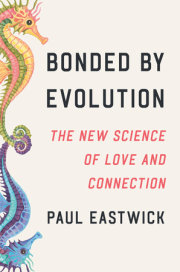
Bonded by Evolution

The New Science of Love and Connection

Look inside
Hardcover
$32.00 US
6.45"W x 9.4"H x 1.11"D   (16.4 x 23.9 x 2.8 cm) | 18 oz (505 g) | 12 per carton
On sale Feb 10, 2026 | 352 Pages | 9780593593981
Grades 9-12 + AP/IB
Sales rights: US, Canada, Open Mkt

See Additional Formats
A groundbreaking look at the science of attachment and compatibility, challenging our most fundamental assumptions about love and attraction and revealing the real keys to lasting connection and deeper relationships.

Modern media and culture have taught you a vast array of inaccurate ideas about dating and relationships. Scroll through Instagram and Tiktok, and you’ll inevitably see the influence of a buzzy new branch of science—evolutionary psychology— at play in videos, touting gender stereotypes and spreading a deeply flawed story about romance and connection. Evolutionary psychology claims that our minds have been shaped by primal drives that pit the genders against each other, from the myth that men are wired to be promiscuous to the notion that wealth, status, and beauty are the ultimate aphrodisiacs.

In Bonded by Evolution UC Davis psychology professor Paul Eastwick reveals that these stories bear little resemblance to how pair-bonding really works. While beauty and charisma factor into first impressions, their influence fades fast—after a few months, we barely agree on who's “desirable.” Drawing on pathbreaking research—including original experiments from his own lab—Eastwick explains that lasting attraction has, from ancestral times through the present, been built through gradual, often mundane moments that forge strong attachment bonds. Ultimately, he offers a liberating new paradigm for finding meaningful, exciting relationships, showing us:

  • Why the traits we often look for in a partner—personality, lifestyle, values, and humor—are poor predictors of compatibility, and what behaviors and experiences we should focus on instead
  • Why someone's tendency to “date around” or their reputation as a player has little bearing on their long-term relationship potential
  • Why the most secure relationships offer a "safe haven" and "secure base" for each partner, and how to cultivate them in new and existing relationships

By excavating the hidden history of human mating, Eastwick paints a radical new picture of the roots of enduring chemistry. Distilling evolutionary biology, anthropology, and psychology into accessible insights, Bonded by Evolution explains why we so often choose dating strategies that make us miserable and how to use a more evolved approach.
• 1 •

Measuring Desirability

Here is a story about how I learned my place.

It is 1999, and I’m at Cornell University in upstate New York. The school is big enough to foster considerable anonymity, and the dazzling cold makes it easy to disappear under the requisite winter hat, scarf, and parka. On one such freezing morning in early November, a woman approaches me in the middle of the sidewalk. This is not a common occurrence. Did I drop something? Will I be asked to make a donation? Surely she has mistaken me for someone else? She exudes a social confidence that feels like a foreign language.

I quickly discover that she knows who I am; we went to the same high school. After fumbling awkwardly through the first few minutes of conversation, it finally occurs to me to blurt out that I have a car, since the easiest way to travel back to our hometown outside of Boston is a six-hour car trip. We exchange email addresses.

Anna is younger than me, but she possesses an uncommon level of sophistication. She is tall and striking; when she enters a room, the center of gravity shifts in her direction. She is fluent in Russian, she is a fan of classic films, and she writes poetry. She is friends with interesting people. On the 1–10 EvoScript scale of mate value, Anna is a 9.

I, on the other hand, would be considered a 6. I’m not bad-looking, but at this particular moment in my life I don’t exercise much, so my physique can charitably be described as “doughy-adjacent.” More problematic is that I have very little social cachet: I wake up early, dutifully attend all my classes, study hard, and spend any remaining free time with a small group of close friends. I’m a little too proud of the fact that I rarely go to parties, and when I do, I’ll glom onto the one or two people I already know. I have not yet learned the fine art of mingling.

A drive home together over the holiday break gives Anna and me a chance to get to know each other. The conversation is easy; I initially award the credit to her charming lack of inhibition, but maybe I’m playing a role, too—I do seem to be making her laugh. We talk about exes and the Beatles and my pet gecko named Ringo. We make plans to hang out in person over the break. Cue butterflies.

And we do hang out. A lot. Whereas most month-long breaks reach a plateau of dreary sameness, this one is jam-packed. I go with her to buy her first guitar, and I teach her how to play. We get high and watch Yellow Submarine. She shares with me some poetry she has written, and I set it to music. Critically, whatever tiny crushes and flings she had mentioned previously all seem to be evaporating. It feels like I can’t lose.

Or can I? On the one hand, we are spending a massive amount of time together. Not many women have ever wanted to spend this much time with me without being at least somewhat into me. She emails regularly, and she returns every voicemail that I leave for her. On the other hand, when it’s just the two of us? She’s not giving me any signals. If anything, she seems to know exactly how not to give off signals. She never touches my arm accidentally. She never catches my eye for too long. We watch My Fair Lady; she stays on her side of the couch. Wistfully, I stay on mine.

By January, it’s becoming obvious that if something doesn’t happen soon, we will retreat to our disconnected social circles. This is my biggest fear, because I have tremendous doubts about my ability to hack it in her universe. As I mentioned, she is friends with interesting people. And many of these interesting people are also men who are accomplished, charming, and hot. Men who are worldly like her and who thrive in her social milieu.

As we arrive back at school, we make plans to watch one of the remaining movies on her bucket list for me: It’s a Mad, Mad, Mad, Mad World. I am initially delighted to see the three-and-a-half hour running time as we head up to her room.

Except now, the signals are crystal clear, and they are decidedly inauspicious. If I move in her direction, she moves away. She receives phone calls from other people, and she takes them. I retreat to a corner of her twin bed; wow, this movie is long. When it is over, I say good night and head home.

Later that same night, after I leave, she goes to hang out with some other friends. Within a couple of days, she has a new crush in her life that she is hooking up with. I won’t lie: He’s pretty damn good-looking.

Learning your place in the dating pool can be a brutal process. You come to understand your intrinsic mate value—whether you are an appealing 8 or a lackluster 3—through repeated rejection. Are you rejected by only the most desirable people, or by pretty much everyone? Your answer to this question feels like an indication of your rank: your position in the hierarchy of desirability. This feeling shapes the romantic risks that you take, the situations you walk into, and the speed with which you count yourself out. After all, rejection hurts. If you continually aim too high with your attentions and affections, you’ll receive an extra dose of ridicule and mockery. Find your rank and stay put, or fry like Icarus.

According to this logic, I was a fool for thinking I had a shot with Anna. Put simply, Anna was more attractive than me and more socially skilled than me. Even though she enjoyed spending time with me, she could attract someone with a lot more value than what I had to offer. I never spent much time with the good-looking guy she fell for that January, but nevertheless, I was competing with him—and I lost. For anyone of any gender who has had the experience of being rejected for someone else, the EvoScript is the voice that says: “This is your core essence. You’re just not desirable enough. Get used to it.”

In some cases, that voice offers an even more sweeping indictment. In this story, it might tell me that I was a willing participant in my own swindling. It whispers that I was a useful tool in the short term to alleviate Anna’s boredom, and I should have known better than to walk right into the friendzone. Aggrieved men online might point to stories like mine to gin up misogyny: Anna was just another attractive, popular woman who gets everything she wants in life and delights in making sure that beta males like me know my place.

This interpretation—that Anna is a winner and I am a loser in the marketplace of mating—distorts the specifics of this story, and more important, it distorts the abstract, generalizable lesson about how romantic attachments form and what sustains them. To understand why, we need to scrutinize—and disassemble—the mate value concept.

We All Have a Value

It is a basic fact in evolutionary biology that animals differ in something called reproductive success. Put simply, only some individuals of a given species produce offspring who survive to reproduce themselves. Critically, members of early human (and protohuman) groups who made prudent mate choices—perhaps by identifying mates who had high reproductive potential—sent their own genes forward into future generations and became our ancestors. The ones who made poor choices did not.

Animals are not clairvoyant; they cannot directly peer into the future and know which potential mates are destined to be reproductive champions. So they try to size it up as best they can, usually by assessing whether potential mates possess traits that have historically been decent signals of reproductive success. This set of trait judgments is what evolutionary psychologists mean by the term mate value.

The EvoScript proclaims that mate value lingers among humans living today: Even if you don’t have any intention of reproducing anytime soon (or ever), you have nevertheless inherited the instinct to assess others’ mate value, and you have a mate value yourself. My friend’s “how not to be a dating loser” list from the introduction is a fine illustration of the mate value concept. The more you possess these desirable traits—like attractiveness, or confidence, or a good sense of humor—the more mate value you have. Possessing the trait doesn’t need to be binary, of course; the sexier you are, the better. These traits could have different origins, too: Some traits may derive from your genetics; others might be acquired through hard work and persistence. Some, like status, could accrue with time; others, like youth itself, slowly fade. Critically, your mate value is an amalgamation of all these appealing traits at a given moment in time—your worth on the open market.

Traits do not need to be universally desirable across all contexts to be a part of someone’s mate value. As an avid 8-bit Nintendo player in the early nineties, I fully understood that this skill added nothing to my mate value while attending junior high. In gamer communities today, it could well be an asset. In other words, cultures can shape whether a specific modern skill or trait is linked to broader attributes—someone’s status, social skills, or value to the local group—which would have been a reliable signal of reproductive success in ancestral times.
“In this bold and compelling challenge to the popular science of romance, Paul Eastwick argues that human beings have not evolved to find partners who match their beauty and brilliance or maximize the potential of their offspring, but to seek compatibility. The implications of this thesis are both profound and pragmatic, suggesting an entirely different approach to the study—and pursuit—of love.”—Eric Klinenberg, Helen Gould Shepard Professor in the Social Sciences at NYU and coauthor of Modern Romance

“In a world saturated with cynical advice about dating and gender, this book is a revelation. Eastwick argues—persuasively and often movingly—that human beings are built for cooperation, not conquest. Bonded by Evolution is rigorous science written with warmth and moral clarity.”—Daniel H. Pink, #1 New York Times bestselling author of Drive and The Power of Regret

“Rarely have scientific rigor and exuberant optimism been such congenial companions. Drawing on the strongest scientific studies, Eastwick unearths a joyous truth: Happiness in love isn’t a gated country club where the tens and nines splash about together in skimpy swimsuits. A pro-tip for the lovelorn, Bonded by Evolution overturns the flawed conventional wisdom on love and compatibility. It presents an optimistic new paradigm, one that provides clear guidance for romantic success.”—Eli Finkel, author of The All-or-Nothing Marriage

“Eastwick analyzes how the EvoScript theory has shaped the modern dating landscape, from online dating to tradwife and incel subcultures that reinforce rigid notions of gender, and offers useful suggestions for finding one’s partner in spite of such obstacles . . . Bolstered by thorough research, lucid personal anecdotes, and useful questionnaires, the result is an astute road map for finding a love that lasts.”Publishers Weekly, starred review

“Cutting through memes, myths, and misinformation, Bonded by Evolution teaches us what science really says about love and dating: All people, of all genders, have been equipped by Mother Nature to build sexy, satisfying partnerships. Whether you are a young person bewildered by the dating world, or a not-so-young person looking for some evidence-based encouragement, you must buy this book!”—Kathryn Paige Harden, author of Original Sin and The Genetic Lottery
© Alison Ledgerwood
Paul Eastwick is a Professor of Psychology at UC Davis, where he serves as the head of the Social-Personality Psychology program and the director of the Attraction and Relationships Research Laboratory. Thousands of undergraduate students have taken his course on attraction and close relationships, and he has published over one hundred scientific articles and chapters and won numerous early career awards. His research and writing has been featured in outlets like The New York Times, The Atlantic, NPR, and Scientific American Mind. He hosts the popular podcast Love Factually with his longtime colleague, Eli Finkel, where they analyze rom-coms and romantic dramas from the perspective of relationship science. He earned his bachelor’s degree at Cornell University and his PhD at Northwestern University. View titles by Paul Eastwick
Available for sale exclusive:
•     Canada
•     Guam
•     Minor Outl.Ins.
•     North Mariana
•     Philippines
•     Puerto Rico
•     Samoa,American
•     US Virgin Is.
•     USA

Available for sale non-exclusive:
•     Afghanistan
•     Aland Islands
•     Albania
•     Algeria
•     Andorra
•     Angola
•     Anguilla
•     Antarctica
•     Argentina
•     Armenia
•     Aruba
•     Austria
•     Azerbaijan
•     Bahrain
•     Belarus
•     Belgium
•     Benin
•     Bhutan
•     Bolivia
•     Bonaire, Saba
•     Bosnia Herzeg.
•     Bouvet Island
•     Brazil
•     Bulgaria
•     Burkina Faso
•     Burundi
•     Cambodia
•     Cameroon
•     Cape Verde
•     Centr.Afr.Rep.
•     Chad
•     Chile
•     China
•     Colombia
•     Comoro Is.
•     Congo
•     Cook Islands
•     Costa Rica
•     Croatia
•     Cuba
•     Curacao
•     Czech Republic
•     Dem. Rep. Congo
•     Denmark
•     Djibouti
•     Dominican Rep.
•     Ecuador
•     Egypt
•     El Salvador
•     Equatorial Gui.
•     Eritrea
•     Estonia
•     Ethiopia
•     Faroe Islands
•     Finland
•     France
•     Fren.Polynesia
•     French Guinea
•     Gabon
•     Georgia
•     Germany
•     Greece
•     Greenland
•     Guadeloupe
•     Guatemala
•     Guinea Republic
•     Guinea-Bissau
•     Haiti
•     Heard/McDon.Isl
•     Honduras
•     Hong Kong
•     Hungary
•     Iceland
•     Indonesia
•     Iran
•     Iraq
•     Israel
•     Italy
•     Ivory Coast
•     Japan
•     Jordan
•     Kazakhstan
•     Kuwait
•     Kyrgyzstan
•     Laos
•     Latvia
•     Lebanon
•     Liberia
•     Libya
•     Liechtenstein
•     Lithuania
•     Luxembourg
•     Macau
•     Macedonia
•     Madagascar
•     Maldives
•     Mali
•     Marshall island
•     Martinique
•     Mauritania
•     Mayotte
•     Mexico
•     Micronesia
•     Moldavia
•     Monaco
•     Mongolia
•     Montenegro
•     Morocco
•     Myanmar
•     Nepal
•     Netherlands
•     New Caledonia
•     Nicaragua
•     Niger
•     Niue
•     Norfolk Island
•     North Korea
•     Norway
•     Oman
•     Palau
•     Palestinian Ter
•     Panama
•     Paraguay
•     Peru
•     Poland
•     Portugal
•     Qatar
•     Reunion Island
•     Romania
•     Russian Fed.
•     Rwanda
•     Saint Martin
•     San Marino
•     SaoTome Princip
•     Saudi Arabia
•     Senegal
•     Serbia
•     Singapore
•     Sint Maarten
•     Slovakia
•     Slovenia
•     South Korea
•     South Sudan
•     Spain
•     St Barthelemy
•     St.Pier,Miquel.
•     Sth Terr. Franc
•     Sudan
•     Suriname
•     Svalbard
•     Sweden
•     Switzerland
•     Syria
•     Tadschikistan
•     Taiwan
•     Thailand
•     Timor-Leste
•     Togo
•     Tokelau Islands
•     Tunisia
•     Turkey
•     Turkmenistan
•     Ukraine
•     Unit.Arab Emir.
•     Uruguay
•     Uzbekistan
•     Vatican City
•     Venezuela
•     Vietnam
•     Wallis,Futuna
•     West Saharan
•     Western Samoa
•     Yemen

Not available for sale:
•     Antigua/Barbuda
•     Australia
•     Bahamas
•     Bangladesh
•     Barbados
•     Belize
•     Bermuda
•     Botswana
•     Brit.Ind.Oc.Ter
•     Brit.Virgin Is.
•     Brunei
•     Cayman Islands
•     Christmas Islnd
•     Cocos Islands
•     Cyprus
•     Dominica
•     Falkland Islnds
•     Fiji
•     Gambia
•     Ghana
•     Gibraltar
•     Grenada
•     Guernsey
•     Guyana
•     India
•     Ireland
•     Isle of Man
•     Jamaica
•     Jersey
•     Kenya
•     Kiribati
•     Lesotho
•     Malawi
•     Malaysia
•     Malta
•     Mauritius
•     Montserrat
•     Mozambique
•     Namibia
•     Nauru
•     New Zealand
•     Nigeria
•     Pakistan
•     PapuaNewGuinea
•     Pitcairn Islnds
•     S. Sandwich Ins
•     Seychelles
•     Sierra Leone
•     Solomon Islands
•     Somalia
•     South Africa
•     Sri Lanka
•     St. Helena
•     St. Lucia
•     St. Vincent
•     St.Chr.,Nevis
•     Swaziland
•     Tanzania
•     Tonga
•     Trinidad,Tobago
•     Turks&Caicos Is
•     Tuvalu
•     Uganda
•     United Kingdom
•     Vanuatu
•     Zambia
•     Zimbabwe

About

A groundbreaking look at the science of attachment and compatibility, challenging our most fundamental assumptions about love and attraction and revealing the real keys to lasting connection and deeper relationships.

Modern media and culture have taught you a vast array of inaccurate ideas about dating and relationships. Scroll through Instagram and Tiktok, and you’ll inevitably see the influence of a buzzy new branch of science—evolutionary psychology— at play in videos, touting gender stereotypes and spreading a deeply flawed story about romance and connection. Evolutionary psychology claims that our minds have been shaped by primal drives that pit the genders against each other, from the myth that men are wired to be promiscuous to the notion that wealth, status, and beauty are the ultimate aphrodisiacs.

In Bonded by Evolution UC Davis psychology professor Paul Eastwick reveals that these stories bear little resemblance to how pair-bonding really works. While beauty and charisma factor into first impressions, their influence fades fast—after a few months, we barely agree on who's “desirable.” Drawing on pathbreaking research—including original experiments from his own lab—Eastwick explains that lasting attraction has, from ancestral times through the present, been built through gradual, often mundane moments that forge strong attachment bonds. Ultimately, he offers a liberating new paradigm for finding meaningful, exciting relationships, showing us:

  • Why the traits we often look for in a partner—personality, lifestyle, values, and humor—are poor predictors of compatibility, and what behaviors and experiences we should focus on instead
  • Why someone's tendency to “date around” or their reputation as a player has little bearing on their long-term relationship potential
  • Why the most secure relationships offer a "safe haven" and "secure base" for each partner, and how to cultivate them in new and existing relationships

By excavating the hidden history of human mating, Eastwick paints a radical new picture of the roots of enduring chemistry. Distilling evolutionary biology, anthropology, and psychology into accessible insights, Bonded by Evolution explains why we so often choose dating strategies that make us miserable and how to use a more evolved approach.

Excerpt

• 1 •

Measuring Desirability

Here is a story about how I learned my place.

It is 1999, and I’m at Cornell University in upstate New York. The school is big enough to foster considerable anonymity, and the dazzling cold makes it easy to disappear under the requisite winter hat, scarf, and parka. On one such freezing morning in early November, a woman approaches me in the middle of the sidewalk. This is not a common occurrence. Did I drop something? Will I be asked to make a donation? Surely she has mistaken me for someone else? She exudes a social confidence that feels like a foreign language.

I quickly discover that she knows who I am; we went to the same high school. After fumbling awkwardly through the first few minutes of conversation, it finally occurs to me to blurt out that I have a car, since the easiest way to travel back to our hometown outside of Boston is a six-hour car trip. We exchange email addresses.

Anna is younger than me, but she possesses an uncommon level of sophistication. She is tall and striking; when she enters a room, the center of gravity shifts in her direction. She is fluent in Russian, she is a fan of classic films, and she writes poetry. She is friends with interesting people. On the 1–10 EvoScript scale of mate value, Anna is a 9.

I, on the other hand, would be considered a 6. I’m not bad-looking, but at this particular moment in my life I don’t exercise much, so my physique can charitably be described as “doughy-adjacent.” More problematic is that I have very little social cachet: I wake up early, dutifully attend all my classes, study hard, and spend any remaining free time with a small group of close friends. I’m a little too proud of the fact that I rarely go to parties, and when I do, I’ll glom onto the one or two people I already know. I have not yet learned the fine art of mingling.

A drive home together over the holiday break gives Anna and me a chance to get to know each other. The conversation is easy; I initially award the credit to her charming lack of inhibition, but maybe I’m playing a role, too—I do seem to be making her laugh. We talk about exes and the Beatles and my pet gecko named Ringo. We make plans to hang out in person over the break. Cue butterflies.

And we do hang out. A lot. Whereas most month-long breaks reach a plateau of dreary sameness, this one is jam-packed. I go with her to buy her first guitar, and I teach her how to play. We get high and watch Yellow Submarine. She shares with me some poetry she has written, and I set it to music. Critically, whatever tiny crushes and flings she had mentioned previously all seem to be evaporating. It feels like I can’t lose.

Or can I? On the one hand, we are spending a massive amount of time together. Not many women have ever wanted to spend this much time with me without being at least somewhat into me. She emails regularly, and she returns every voicemail that I leave for her. On the other hand, when it’s just the two of us? She’s not giving me any signals. If anything, she seems to know exactly how not to give off signals. She never touches my arm accidentally. She never catches my eye for too long. We watch My Fair Lady; she stays on her side of the couch. Wistfully, I stay on mine.

By January, it’s becoming obvious that if something doesn’t happen soon, we will retreat to our disconnected social circles. This is my biggest fear, because I have tremendous doubts about my ability to hack it in her universe. As I mentioned, she is friends with interesting people. And many of these interesting people are also men who are accomplished, charming, and hot. Men who are worldly like her and who thrive in her social milieu.

As we arrive back at school, we make plans to watch one of the remaining movies on her bucket list for me: It’s a Mad, Mad, Mad, Mad World. I am initially delighted to see the three-and-a-half hour running time as we head up to her room.

Except now, the signals are crystal clear, and they are decidedly inauspicious. If I move in her direction, she moves away. She receives phone calls from other people, and she takes them. I retreat to a corner of her twin bed; wow, this movie is long. When it is over, I say good night and head home.

Later that same night, after I leave, she goes to hang out with some other friends. Within a couple of days, she has a new crush in her life that she is hooking up with. I won’t lie: He’s pretty damn good-looking.

Learning your place in the dating pool can be a brutal process. You come to understand your intrinsic mate value—whether you are an appealing 8 or a lackluster 3—through repeated rejection. Are you rejected by only the most desirable people, or by pretty much everyone? Your answer to this question feels like an indication of your rank: your position in the hierarchy of desirability. This feeling shapes the romantic risks that you take, the situations you walk into, and the speed with which you count yourself out. After all, rejection hurts. If you continually aim too high with your attentions and affections, you’ll receive an extra dose of ridicule and mockery. Find your rank and stay put, or fry like Icarus.

According to this logic, I was a fool for thinking I had a shot with Anna. Put simply, Anna was more attractive than me and more socially skilled than me. Even though she enjoyed spending time with me, she could attract someone with a lot more value than what I had to offer. I never spent much time with the good-looking guy she fell for that January, but nevertheless, I was competing with him—and I lost. For anyone of any gender who has had the experience of being rejected for someone else, the EvoScript is the voice that says: “This is your core essence. You’re just not desirable enough. Get used to it.”

In some cases, that voice offers an even more sweeping indictment. In this story, it might tell me that I was a willing participant in my own swindling. It whispers that I was a useful tool in the short term to alleviate Anna’s boredom, and I should have known better than to walk right into the friendzone. Aggrieved men online might point to stories like mine to gin up misogyny: Anna was just another attractive, popular woman who gets everything she wants in life and delights in making sure that beta males like me know my place.

This interpretation—that Anna is a winner and I am a loser in the marketplace of mating—distorts the specifics of this story, and more important, it distorts the abstract, generalizable lesson about how romantic attachments form and what sustains them. To understand why, we need to scrutinize—and disassemble—the mate value concept.

We All Have a Value

It is a basic fact in evolutionary biology that animals differ in something called reproductive success. Put simply, only some individuals of a given species produce offspring who survive to reproduce themselves. Critically, members of early human (and protohuman) groups who made prudent mate choices—perhaps by identifying mates who had high reproductive potential—sent their own genes forward into future generations and became our ancestors. The ones who made poor choices did not.

Animals are not clairvoyant; they cannot directly peer into the future and know which potential mates are destined to be reproductive champions. So they try to size it up as best they can, usually by assessing whether potential mates possess traits that have historically been decent signals of reproductive success. This set of trait judgments is what evolutionary psychologists mean by the term mate value.

The EvoScript proclaims that mate value lingers among humans living today: Even if you don’t have any intention of reproducing anytime soon (or ever), you have nevertheless inherited the instinct to assess others’ mate value, and you have a mate value yourself. My friend’s “how not to be a dating loser” list from the introduction is a fine illustration of the mate value concept. The more you possess these desirable traits—like attractiveness, or confidence, or a good sense of humor—the more mate value you have. Possessing the trait doesn’t need to be binary, of course; the sexier you are, the better. These traits could have different origins, too: Some traits may derive from your genetics; others might be acquired through hard work and persistence. Some, like status, could accrue with time; others, like youth itself, slowly fade. Critically, your mate value is an amalgamation of all these appealing traits at a given moment in time—your worth on the open market.

Traits do not need to be universally desirable across all contexts to be a part of someone’s mate value. As an avid 8-bit Nintendo player in the early nineties, I fully understood that this skill added nothing to my mate value while attending junior high. In gamer communities today, it could well be an asset. In other words, cultures can shape whether a specific modern skill or trait is linked to broader attributes—someone’s status, social skills, or value to the local group—which would have been a reliable signal of reproductive success in ancestral times.

Praise

“In this bold and compelling challenge to the popular science of romance, Paul Eastwick argues that human beings have not evolved to find partners who match their beauty and brilliance or maximize the potential of their offspring, but to seek compatibility. The implications of this thesis are both profound and pragmatic, suggesting an entirely different approach to the study—and pursuit—of love.”—Eric Klinenberg, Helen Gould Shepard Professor in the Social Sciences at NYU and coauthor of Modern Romance

“In a world saturated with cynical advice about dating and gender, this book is a revelation. Eastwick argues—persuasively and often movingly—that human beings are built for cooperation, not conquest. Bonded by Evolution is rigorous science written with warmth and moral clarity.”—Daniel H. Pink, #1 New York Times bestselling author of Drive and The Power of Regret

“Rarely have scientific rigor and exuberant optimism been such congenial companions. Drawing on the strongest scientific studies, Eastwick unearths a joyous truth: Happiness in love isn’t a gated country club where the tens and nines splash about together in skimpy swimsuits. A pro-tip for the lovelorn, Bonded by Evolution overturns the flawed conventional wisdom on love and compatibility. It presents an optimistic new paradigm, one that provides clear guidance for romantic success.”—Eli Finkel, author of The All-or-Nothing Marriage

“Eastwick analyzes how the EvoScript theory has shaped the modern dating landscape, from online dating to tradwife and incel subcultures that reinforce rigid notions of gender, and offers useful suggestions for finding one’s partner in spite of such obstacles . . . Bolstered by thorough research, lucid personal anecdotes, and useful questionnaires, the result is an astute road map for finding a love that lasts.”Publishers Weekly, starred review

“Cutting through memes, myths, and misinformation, Bonded by Evolution teaches us what science really says about love and dating: All people, of all genders, have been equipped by Mother Nature to build sexy, satisfying partnerships. Whether you are a young person bewildered by the dating world, or a not-so-young person looking for some evidence-based encouragement, you must buy this book!”—Kathryn Paige Harden, author of Original Sin and The Genetic Lottery

Author

© Alison Ledgerwood
Paul Eastwick is a Professor of Psychology at UC Davis, where he serves as the head of the Social-Personality Psychology program and the director of the Attraction and Relationships Research Laboratory. Thousands of undergraduate students have taken his course on attraction and close relationships, and he has published over one hundred scientific articles and chapters and won numerous early career awards. His research and writing has been featured in outlets like The New York Times, The Atlantic, NPR, and Scientific American Mind. He hosts the popular podcast Love Factually with his longtime colleague, Eli Finkel, where they analyze rom-coms and romantic dramas from the perspective of relationship science. He earned his bachelor’s degree at Cornell University and his PhD at Northwestern University. View titles by Paul Eastwick

Rights

Available for sale exclusive:
•     Canada
•     Guam
•     Minor Outl.Ins.
•     North Mariana
•     Philippines
•     Puerto Rico
•     Samoa,American
•     US Virgin Is.
•     USA

Available for sale non-exclusive:
•     Afghanistan
•     Aland Islands
•     Albania
•     Algeria
•     Andorra
•     Angola
•     Anguilla
•     Antarctica
•     Argentina
•     Armenia
•     Aruba
•     Austria
•     Azerbaijan
•     Bahrain
•     Belarus
•     Belgium
•     Benin
•     Bhutan
•     Bolivia
•     Bonaire, Saba
•     Bosnia Herzeg.
•     Bouvet Island
•     Brazil
•     Bulgaria
•     Burkina Faso
•     Burundi
•     Cambodia
•     Cameroon
•     Cape Verde
•     Centr.Afr.Rep.
•     Chad
•     Chile
•     China
•     Colombia
•     Comoro Is.
•     Congo
•     Cook Islands
•     Costa Rica
•     Croatia
•     Cuba
•     Curacao
•     Czech Republic
•     Dem. Rep. Congo
•     Denmark
•     Djibouti
•     Dominican Rep.
•     Ecuador
•     Egypt
•     El Salvador
•     Equatorial Gui.
•     Eritrea
•     Estonia
•     Ethiopia
•     Faroe Islands
•     Finland
•     France
•     Fren.Polynesia
•     French Guinea
•     Gabon
•     Georgia
•     Germany
•     Greece
•     Greenland
•     Guadeloupe
•     Guatemala
•     Guinea Republic
•     Guinea-Bissau
•     Haiti
•     Heard/McDon.Isl
•     Honduras
•     Hong Kong
•     Hungary
•     Iceland
•     Indonesia
•     Iran
•     Iraq
•     Israel
•     Italy
•     Ivory Coast
•     Japan
•     Jordan
•     Kazakhstan
•     Kuwait
•     Kyrgyzstan
•     Laos
•     Latvia
•     Lebanon
•     Liberia
•     Libya
•     Liechtenstein
•     Lithuania
•     Luxembourg
•     Macau
•     Macedonia
•     Madagascar
•     Maldives
•     Mali
•     Marshall island
•     Martinique
•     Mauritania
•     Mayotte
•     Mexico
•     Micronesia
•     Moldavia
•     Monaco
•     Mongolia
•     Montenegro
•     Morocco
•     Myanmar
•     Nepal
•     Netherlands
•     New Caledonia
•     Nicaragua
•     Niger
•     Niue
•     Norfolk Island
•     North Korea
•     Norway
•     Oman
•     Palau
•     Palestinian Ter
•     Panama
•     Paraguay
•     Peru
•     Poland
•     Portugal
•     Qatar
•     Reunion Island
•     Romania
•     Russian Fed.
•     Rwanda
•     Saint Martin
•     San Marino
•     SaoTome Princip
•     Saudi Arabia
•     Senegal
•     Serbia
•     Singapore
•     Sint Maarten
•     Slovakia
•     Slovenia
•     South Korea
•     South Sudan
•     Spain
•     St Barthelemy
•     St.Pier,Miquel.
•     Sth Terr. Franc
•     Sudan
•     Suriname
•     Svalbard
•     Sweden
•     Switzerland
•     Syria
•     Tadschikistan
•     Taiwan
•     Thailand
•     Timor-Leste
•     Togo
•     Tokelau Islands
•     Tunisia
•     Turkey
•     Turkmenistan
•     Ukraine
•     Unit.Arab Emir.
•     Uruguay
•     Uzbekistan
•     Vatican City
•     Venezuela
•     Vietnam
•     Wallis,Futuna
•     West Saharan
•     Western Samoa
•     Yemen

Not available for sale:
•     Antigua/Barbuda
•     Australia
•     Bahamas
•     Bangladesh
•     Barbados
•     Belize
•     Bermuda
•     Botswana
•     Brit.Ind.Oc.Ter
•     Brit.Virgin Is.
•     Brunei
•     Cayman Islands
•     Christmas Islnd
•     Cocos Islands
•     Cyprus
•     Dominica
•     Falkland Islnds
•     Fiji
•     Gambia
•     Ghana
•     Gibraltar
•     Grenada
•     Guernsey
•     Guyana
•     India
•     Ireland
•     Isle of Man
•     Jamaica
•     Jersey
•     Kenya
•     Kiribati
•     Lesotho
•     Malawi
•     Malaysia
•     Malta
•     Mauritius
•     Montserrat
•     Mozambique
•     Namibia
•     Nauru
•     New Zealand
•     Nigeria
•     Pakistan
•     PapuaNewGuinea
•     Pitcairn Islnds
•     S. Sandwich Ins
•     Seychelles
•     Sierra Leone
•     Solomon Islands
•     Somalia
•     South Africa
•     Sri Lanka
•     St. Helena
•     St. Lucia
•     St. Vincent
•     St.Chr.,Nevis
•     Swaziland
•     Tanzania
•     Tonga
•     Trinidad,Tobago
•     Turks&Caicos Is
•     Tuvalu
•     Uganda
•     United Kingdom
•     Vanuatu
•     Zambia
•     Zimbabwe