Close Modal

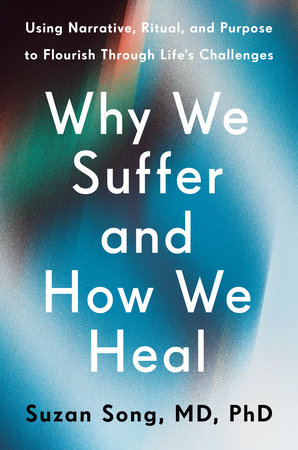
Why We Suffer and How We Heal

Using Narrative, Ritual, and Purpose to Flourish Through Life's Challenges

Look inside
Hardcover
$30.00 US
6.37"W x 9.53"H x 1"D   (16.2 x 24.2 x 2.5 cm) | 15 oz (431 g) | 12 per carton
On sale Feb 24, 2026 | 272 Pages | 9780593581537
Sales rights: US, Canada, Open Mkt

A psychiatrist who has dedicated her life to treating global survivors of unspeakable horrors shares the three keys to resilience that we can use to weather stress, loss, and trauma in our own lives.

“This book is a gift of empathy and lived wisdom—rare, real, and deeply human.”—Dr. Koen Sevenants, former global lead for Mental Health and Psychosocial Support in Emergencies for UNICEF’s Child Protection Area of Responsibility

In her debut book, Dr. Suzan Song draws from patient stories, humanitarian research, and her own life to help readers release their unrealistic longing for stability and open them up to a new, healthier mindset. As uncomfortable as it is, instability, Dr. Song suggests, is what ultimately invites us into transformation.

From her clinical practice in the United States to her global work over two decades with survivors of human rights violations, Dr. Song has uncovered three keys to resilience: Narrative, Ritual, and Purpose. Western therapy teaches that we heal by examining our influences, inner conflicts, and goals. This is vital work, but insight alone does not lead to lasting change.

Song has found that rituals, whether private or community-based, create the bridge from insight to change. She brought this observation back to her clinical work along with the third potent source of healing: Purpose. Whatever you're going through, these three tools can help you not only weather the winters of life but thrive through them.

Profoundly insightful and beautifully written, Why We Suffer and How We Heal offers a groundbreaking new path to deep healing and finally feeling alive again.
Introduction

“At age fifteen, I was more comfortable with an AK-47 or machete than with a pencil,” Charles remembers as he shifts on a three-legged stool in his concrete home in Bujumbura, Burundi. Child soldiering for eight years is hard on the body; he can’t sit for long periods, so we move our interview to the forest to walk and talk in privacy. I am prepared to hear the stories of escaping lifethreatening mobs and isolation. I am not expecting to experience it myself.

Before beginning my PhD work in Burundi, I had studied multiple worlds of healing throughout my medical training, residency, and fellowship. While my master’s degree in public health policy gave conceptual models, it was Zulu healers in South Africa who showed me that knowledge lives in relationships. In post-earthquake Haiti, I saw the strength with which people managed to rebuild.

Through it all, I was struck by the resilience of those who had lost everything. Amid ruins and grief, people somehow pushed through the devastation and quietly rebuilt. It wasn’t just endurance—there was something about the human capacity to reimagine, carry hope, and find calm. I wanted to understand how, after the ground shifts and the world fractures, people still find a way not just to stand but to feel alive.

It doesn’t take a scientist to know that being a child soldier leaves deep scars—depression, anxiety, the weight of trauma that lingers long after the war ends. But I wanted to understand more than just the aftermath. I wanted to see how those whose childhoods had been stolen—some taken as young as ten—made sense of their own histories.

In Sierra Leone and Liberia, I met men and women who as children had been forced to fight, steal, and survive in ways no child should. Many struggled with disconnected relationships, restless nights, and memories that wouldn’t let go. Most people turn off the radio or TV when they hear stories of extreme trauma—they don’t know what to do with the helplessness, and the pain is too close to bear, so they turn away.

I did the opposite. I wanted to hear the stories—not through the lens of pathology but through the survivors’ own words. So I pursued a PhD at the University of Amsterdam and used an ethnographic approach to study intergenerational stress among former child soldiers in Burundi. What does survival look like, not just in the moment but across time and generations? I wanted to understand their past as well as the future they were shaping.

Known for its coffee plantations and lounging hippos by the beach, Burundi is the size of Maryland, bordered by Rwanda and the Democratic Republic of the Congo. In 1993, the assassination of the country’s first democratically elected Hutu president triggered a civil war, a brutal conflict between Hutus and Tutsis. Intensified by the spillover from neighboring Rwanda’s genocide, the war claimed the lives of over three hundred thousand people and displaced more than one million. Though a formal peace treaty was signed in 2001, many small factions simmered. Lasting over a decade, the war continued on with the help of a secret weapon: children.

Around the world, there are an estimated 250,000 children conscripted into the armed forces. While many envision a child soldier as a drugged boy with red eyes slinging an AK-47 over his shoulder, 40 percent of child soldiers are unarmed girls and boys. In addition to working as fighters, these children are used as porters, sex slaves, messengers, and cooks. Why are so many children exploited into soldiering?

In countries with predominantly young populations, armed groups have a steady supply of potential soldiers. Children, still in the early stages of cognitive and moral development, often struggle to grasp the full weight of their actions. Highly impressionable, they are vulnerable to coercion and are often manipulated through fear, false promises, or forced drug use. Their neuroplasticity makes them fast learners, easy to train for the most dangerous assignments. Teens are idealistic with a strong sense of social justice—when an uncle or parent is murdered, revenge pulls them into an armed group; it’s similar to the social calling of gangs around the world.

This was the case for Charles. At ten years old, he fled his village with his parents and uncle after Burundi’s first elected president was killed. “I stayed with strangers, sometimes passing the night in banana trees with nowhere else to go,” he tells me as his eyes gaze past his toddler, who is waddling over sticks beneath her feet.

With the end of war, these former child soldiers were expected to be civilians. Now they were having children of their own. How did they fare as parents? What strengths and struggles, if any, were passed on to the next generation? Did they ever find stability? These were questions I had come across the globe to study, not only for what the answers might tell us about these woeful legacies of war but also for what they might tell us about how all people—those who have experienced the worst humanity has to offer as well as those who suffer more “everyday” hurts—can reclaim their lives.
“This is a really beautiful book. Dr. Suzan Song’s quiet warm voice carries you along even as she explores the tragedies and traumas in her own life and in the lives of others. She transcends typical self-help formulas with an experiential healing journey rooted in the body, soulfulness, and intuition. Out of her own pain, she has found meaning, joy, and love—and step by step, she helps us do the same.”—Rick Hanson, Ph.D., author of Buddha’s Brain, Hardwiring Happiness, and Resilient

“This book is a gift of empathy and lived wisdom—rare, real, and deeply human. Dr. Suzan Song’s voice is authentic and courageous; her words speak directly to the heart. Any reader of this book will come away touched, inspired, and grounded in what truly matters.”—Dr. Koen Sevenants, former global lead for Mental Health and Psychosocial Support in Emergencies for UNICEF’s Child Protection Area of Responsibility

“In Why We Suffer and How We Heal, Dr. Suzan Song brings a message of hope to individuals who feel repeatedly upended by life’s adversities. Pain and suffering are ineluctable but traumatization is not. Suffering, when it inevitably comes, points to a path for healing. We can live alongside uncer­tainty by embracing the instabilities of our daily lives rather than fleeing from them.”—James L. Griffith, MD, professor of psychiatry and behavioral sciences, George Washington University School of Medicine

Why We Suffer and How We Heal inspires readers to make meaning of life’s struggles. Using metaphor and a rich array of case histories, the author draws on her diverse background as an academic, mother, clinician, and ex­plorer in the universal experience of suffering. She is masterful at connect­ing commonalities among those born into privilege with those subjected to some of the most horrific challenges life has to offer. And the vulnerability she brings when reflecting on her own journey makes her insights excep­tionally readable. I particularly appreciate the generous use of ‘action tools,’ which I’ve started to incorporate into my own growth. An exceptional con­tribution to the literature, akin to Frankl’s Man’s Search for Meaning, I will be sharing this widely with colleagues, friends, and family.”—Joseph C. Kolars, MD, MACP, professor of medicine, learning health sciences, and health management and policy, University of Michigan Medical School and University of Michigan School of Public Health
© Susan Lebowitz Photography
Dr. Suzan Song is a Harvard- and Stanford-trained psychiatrist, humanitarian researcher and adviser. For more than two decades, she has dedicated her work to building resilience in individuals and communities affected by adversity. Dr. Song has advised the United Nations, multiple U.S. federal agencies and Ministries of Health, shaping systems of care for children and families in crisis to bridge clinical innovation with systems reform. She has a private practice in Washington D.C., is a professor of psychiatry at George Washington University, and is a sought-after speaker on the science of healing. View titles by Suzan Song, MD, PhD
Available for sale exclusive:
•     Canada
•     Guam
•     Minor Outl.Ins.
•     North Mariana
•     Philippines
•     Puerto Rico
•     Samoa,American
•     US Virgin Is.
•     USA

Available for sale non-exclusive:
•     Afghanistan
•     Aland Islands
•     Albania
•     Algeria
•     Andorra
•     Angola
•     Antarctica
•     Argentina
•     Armenia
•     Aruba
•     Austria
•     Azerbaijan
•     Bahrain
•     Belarus
•     Belgium
•     Benin
•     Bhutan
•     Bolivia
•     Bonaire, Saba
•     Bosnia Herzeg.
•     Bouvet Island
•     Brazil
•     Bulgaria
•     Burkina Faso
•     Burundi
•     Cambodia
•     Cameroon
•     Cape Verde
•     Centr.Afr.Rep.
•     Chad
•     Chile
•     China
•     Colombia
•     Comoro Is.
•     Congo
•     Cook Islands
•     Costa Rica
•     Croatia
•     Cuba
•     Curacao
•     Czech Republic
•     Dem. Rep. Congo
•     Denmark
•     Djibouti
•     Dominican Rep.
•     Ecuador
•     Egypt
•     El Salvador
•     Equatorial Gui.
•     Eritrea
•     Estonia
•     Ethiopia
•     Faroe Islands
•     Finland
•     France
•     Fren.Polynesia
•     French Guinea
•     Gabon
•     Georgia
•     Germany
•     Greece
•     Greenland
•     Guadeloupe
•     Guatemala
•     Guinea Republic
•     Guinea-Bissau
•     Haiti
•     Heard/McDon.Isl
•     Honduras
•     Hong Kong
•     Hungary
•     Iceland
•     Indonesia
•     Iran
•     Iraq
•     Israel
•     Italy
•     Ivory Coast
•     Japan
•     Jordan
•     Kazakhstan
•     Kuwait
•     Kyrgyzstan
•     Laos
•     Latvia
•     Lebanon
•     Liberia
•     Libya
•     Liechtenstein
•     Lithuania
•     Luxembourg
•     Macau
•     Macedonia
•     Madagascar
•     Maldives
•     Mali
•     Marshall island
•     Martinique
•     Mauritania
•     Mayotte
•     Mexico
•     Micronesia
•     Moldavia
•     Monaco
•     Mongolia
•     Montenegro
•     Morocco
•     Myanmar
•     Nepal
•     Netherlands
•     New Caledonia
•     Nicaragua
•     Niger
•     Niue
•     Norfolk Island
•     North Korea
•     Norway
•     Oman
•     Palau
•     Palestinian Ter
•     Panama
•     Paraguay
•     Peru
•     Poland
•     Portugal
•     Qatar
•     Reunion Island
•     Romania
•     Russian Fed.
•     Rwanda
•     Saint Martin
•     San Marino
•     SaoTome Princip
•     Saudi Arabia
•     Senegal
•     Serbia
•     Sint Maarten
•     Slovakia
•     Slovenia
•     South Korea
•     South Sudan
•     Spain
•     St Barthelemy
•     St.Pier,Miquel.
•     Sth Terr. Franc
•     Sudan
•     Suriname
•     Svalbard
•     Sweden
•     Switzerland
•     Syria
•     Tadschikistan
•     Taiwan
•     Thailand
•     Timor-Leste
•     Togo
•     Tokelau Islands
•     Tunisia
•     Turkey
•     Turkmenistan
•     Ukraine
•     Unit.Arab Emir.
•     Uruguay
•     Uzbekistan
•     Vatican City
•     Venezuela
•     Vietnam
•     Wallis,Futuna
•     West Saharan
•     Western Samoa
•     Yemen

Not available for sale:
•     Anguilla
•     Antigua/Barbuda
•     Australia
•     Bahamas
•     Bangladesh
•     Barbados
•     Belize
•     Bermuda
•     Botswana
•     Brit.Ind.Oc.Ter
•     Brit.Virgin Is.
•     Brunei
•     Cayman Islands
•     Christmas Islnd
•     Cocos Islands
•     Cyprus
•     Dominica
•     Falkland Islnds
•     Fiji
•     Gambia
•     Ghana
•     Gibraltar
•     Grenada
•     Guernsey
•     Guyana
•     India
•     Ireland
•     Isle of Man
•     Jamaica
•     Jersey
•     Kenya
•     Kiribati
•     Lesotho
•     Malawi
•     Malaysia
•     Malta
•     Mauritius
•     Montserrat
•     Mozambique
•     Namibia
•     Nauru
•     New Zealand
•     Nigeria
•     Pakistan
•     PapuaNewGuinea
•     Pitcairn Islnds
•     S. Sandwich Ins
•     Seychelles
•     Sierra Leone
•     Singapore
•     Solomon Islands
•     Somalia
•     South Africa
•     Sri Lanka
•     St. Helena
•     St. Lucia
•     St. Vincent
•     St.Chr.,Nevis
•     Swaziland
•     Tanzania
•     Tonga
•     Trinidad,Tobago
•     Turks&Caicos Is
•     Tuvalu
•     Uganda
•     United Kingdom
•     Vanuatu
•     Zambia
•     Zimbabwe

About

A psychiatrist who has dedicated her life to treating global survivors of unspeakable horrors shares the three keys to resilience that we can use to weather stress, loss, and trauma in our own lives.

“This book is a gift of empathy and lived wisdom—rare, real, and deeply human.”—Dr. Koen Sevenants, former global lead for Mental Health and Psychosocial Support in Emergencies for UNICEF’s Child Protection Area of Responsibility

In her debut book, Dr. Suzan Song draws from patient stories, humanitarian research, and her own life to help readers release their unrealistic longing for stability and open them up to a new, healthier mindset. As uncomfortable as it is, instability, Dr. Song suggests, is what ultimately invites us into transformation.

From her clinical practice in the United States to her global work over two decades with survivors of human rights violations, Dr. Song has uncovered three keys to resilience: Narrative, Ritual, and Purpose. Western therapy teaches that we heal by examining our influences, inner conflicts, and goals. This is vital work, but insight alone does not lead to lasting change.

Song has found that rituals, whether private or community-based, create the bridge from insight to change. She brought this observation back to her clinical work along with the third potent source of healing: Purpose. Whatever you're going through, these three tools can help you not only weather the winters of life but thrive through them.

Profoundly insightful and beautifully written, Why We Suffer and How We Heal offers a groundbreaking new path to deep healing and finally feeling alive again.

Excerpt

Introduction

“At age fifteen, I was more comfortable with an AK-47 or machete than with a pencil,” Charles remembers as he shifts on a three-legged stool in his concrete home in Bujumbura, Burundi. Child soldiering for eight years is hard on the body; he can’t sit for long periods, so we move our interview to the forest to walk and talk in privacy. I am prepared to hear the stories of escaping lifethreatening mobs and isolation. I am not expecting to experience it myself.

Before beginning my PhD work in Burundi, I had studied multiple worlds of healing throughout my medical training, residency, and fellowship. While my master’s degree in public health policy gave conceptual models, it was Zulu healers in South Africa who showed me that knowledge lives in relationships. In post-earthquake Haiti, I saw the strength with which people managed to rebuild.

Through it all, I was struck by the resilience of those who had lost everything. Amid ruins and grief, people somehow pushed through the devastation and quietly rebuilt. It wasn’t just endurance—there was something about the human capacity to reimagine, carry hope, and find calm. I wanted to understand how, after the ground shifts and the world fractures, people still find a way not just to stand but to feel alive.

It doesn’t take a scientist to know that being a child soldier leaves deep scars—depression, anxiety, the weight of trauma that lingers long after the war ends. But I wanted to understand more than just the aftermath. I wanted to see how those whose childhoods had been stolen—some taken as young as ten—made sense of their own histories.

In Sierra Leone and Liberia, I met men and women who as children had been forced to fight, steal, and survive in ways no child should. Many struggled with disconnected relationships, restless nights, and memories that wouldn’t let go. Most people turn off the radio or TV when they hear stories of extreme trauma—they don’t know what to do with the helplessness, and the pain is too close to bear, so they turn away.

I did the opposite. I wanted to hear the stories—not through the lens of pathology but through the survivors’ own words. So I pursued a PhD at the University of Amsterdam and used an ethnographic approach to study intergenerational stress among former child soldiers in Burundi. What does survival look like, not just in the moment but across time and generations? I wanted to understand their past as well as the future they were shaping.

Known for its coffee plantations and lounging hippos by the beach, Burundi is the size of Maryland, bordered by Rwanda and the Democratic Republic of the Congo. In 1993, the assassination of the country’s first democratically elected Hutu president triggered a civil war, a brutal conflict between Hutus and Tutsis. Intensified by the spillover from neighboring Rwanda’s genocide, the war claimed the lives of over three hundred thousand people and displaced more than one million. Though a formal peace treaty was signed in 2001, many small factions simmered. Lasting over a decade, the war continued on with the help of a secret weapon: children.

Around the world, there are an estimated 250,000 children conscripted into the armed forces. While many envision a child soldier as a drugged boy with red eyes slinging an AK-47 over his shoulder, 40 percent of child soldiers are unarmed girls and boys. In addition to working as fighters, these children are used as porters, sex slaves, messengers, and cooks. Why are so many children exploited into soldiering?

In countries with predominantly young populations, armed groups have a steady supply of potential soldiers. Children, still in the early stages of cognitive and moral development, often struggle to grasp the full weight of their actions. Highly impressionable, they are vulnerable to coercion and are often manipulated through fear, false promises, or forced drug use. Their neuroplasticity makes them fast learners, easy to train for the most dangerous assignments. Teens are idealistic with a strong sense of social justice—when an uncle or parent is murdered, revenge pulls them into an armed group; it’s similar to the social calling of gangs around the world.

This was the case for Charles. At ten years old, he fled his village with his parents and uncle after Burundi’s first elected president was killed. “I stayed with strangers, sometimes passing the night in banana trees with nowhere else to go,” he tells me as his eyes gaze past his toddler, who is waddling over sticks beneath her feet.

With the end of war, these former child soldiers were expected to be civilians. Now they were having children of their own. How did they fare as parents? What strengths and struggles, if any, were passed on to the next generation? Did they ever find stability? These were questions I had come across the globe to study, not only for what the answers might tell us about these woeful legacies of war but also for what they might tell us about how all people—those who have experienced the worst humanity has to offer as well as those who suffer more “everyday” hurts—can reclaim their lives.

Praise

“This is a really beautiful book. Dr. Suzan Song’s quiet warm voice carries you along even as she explores the tragedies and traumas in her own life and in the lives of others. She transcends typical self-help formulas with an experiential healing journey rooted in the body, soulfulness, and intuition. Out of her own pain, she has found meaning, joy, and love—and step by step, she helps us do the same.”—Rick Hanson, Ph.D., author of Buddha’s Brain, Hardwiring Happiness, and Resilient

“This book is a gift of empathy and lived wisdom—rare, real, and deeply human. Dr. Suzan Song’s voice is authentic and courageous; her words speak directly to the heart. Any reader of this book will come away touched, inspired, and grounded in what truly matters.”—Dr. Koen Sevenants, former global lead for Mental Health and Psychosocial Support in Emergencies for UNICEF’s Child Protection Area of Responsibility

“In Why We Suffer and How We Heal, Dr. Suzan Song brings a message of hope to individuals who feel repeatedly upended by life’s adversities. Pain and suffering are ineluctable but traumatization is not. Suffering, when it inevitably comes, points to a path for healing. We can live alongside uncer­tainty by embracing the instabilities of our daily lives rather than fleeing from them.”—James L. Griffith, MD, professor of psychiatry and behavioral sciences, George Washington University School of Medicine

Why We Suffer and How We Heal inspires readers to make meaning of life’s struggles. Using metaphor and a rich array of case histories, the author draws on her diverse background as an academic, mother, clinician, and ex­plorer in the universal experience of suffering. She is masterful at connect­ing commonalities among those born into privilege with those subjected to some of the most horrific challenges life has to offer. And the vulnerability she brings when reflecting on her own journey makes her insights excep­tionally readable. I particularly appreciate the generous use of ‘action tools,’ which I’ve started to incorporate into my own growth. An exceptional con­tribution to the literature, akin to Frankl’s Man’s Search for Meaning, I will be sharing this widely with colleagues, friends, and family.”—Joseph C. Kolars, MD, MACP, professor of medicine, learning health sciences, and health management and policy, University of Michigan Medical School and University of Michigan School of Public Health

Author

© Susan Lebowitz Photography
Dr. Suzan Song is a Harvard- and Stanford-trained psychiatrist, humanitarian researcher and adviser. For more than two decades, she has dedicated her work to building resilience in individuals and communities affected by adversity. Dr. Song has advised the United Nations, multiple U.S. federal agencies and Ministries of Health, shaping systems of care for children and families in crisis to bridge clinical innovation with systems reform. She has a private practice in Washington D.C., is a professor of psychiatry at George Washington University, and is a sought-after speaker on the science of healing. View titles by Suzan Song, MD, PhD

Rights

Available for sale exclusive:
•     Canada
•     Guam
•     Minor Outl.Ins.
•     North Mariana
•     Philippines
•     Puerto Rico
•     Samoa,American
•     US Virgin Is.
•     USA

Available for sale non-exclusive:
•     Afghanistan
•     Aland Islands
•     Albania
•     Algeria
•     Andorra
•     Angola
•     Antarctica
•     Argentina
•     Armenia
•     Aruba
•     Austria
•     Azerbaijan
•     Bahrain
•     Belarus
•     Belgium
•     Benin
•     Bhutan
•     Bolivia
•     Bonaire, Saba
•     Bosnia Herzeg.
•     Bouvet Island
•     Brazil
•     Bulgaria
•     Burkina Faso
•     Burundi
•     Cambodia
•     Cameroon
•     Cape Verde
•     Centr.Afr.Rep.
•     Chad
•     Chile
•     China
•     Colombia
•     Comoro Is.
•     Congo
•     Cook Islands
•     Costa Rica
•     Croatia
•     Cuba
•     Curacao
•     Czech Republic
•     Dem. Rep. Congo
•     Denmark
•     Djibouti
•     Dominican Rep.
•     Ecuador
•     Egypt
•     El Salvador
•     Equatorial Gui.
•     Eritrea
•     Estonia
•     Ethiopia
•     Faroe Islands
•     Finland
•     France
•     Fren.Polynesia
•     French Guinea
•     Gabon
•     Georgia
•     Germany
•     Greece
•     Greenland
•     Guadeloupe
•     Guatemala
•     Guinea Republic
•     Guinea-Bissau
•     Haiti
•     Heard/McDon.Isl
•     Honduras
•     Hong Kong
•     Hungary
•     Iceland
•     Indonesia
•     Iran
•     Iraq
•     Israel
•     Italy
•     Ivory Coast
•     Japan
•     Jordan
•     Kazakhstan
•     Kuwait
•     Kyrgyzstan
•     Laos
•     Latvia
•     Lebanon
•     Liberia
•     Libya
•     Liechtenstein
•     Lithuania
•     Luxembourg
•     Macau
•     Macedonia
•     Madagascar
•     Maldives
•     Mali
•     Marshall island
•     Martinique
•     Mauritania
•     Mayotte
•     Mexico
•     Micronesia
•     Moldavia
•     Monaco
•     Mongolia
•     Montenegro
•     Morocco
•     Myanmar
•     Nepal
•     Netherlands
•     New Caledonia
•     Nicaragua
•     Niger
•     Niue
•     Norfolk Island
•     North Korea
•     Norway
•     Oman
•     Palau
•     Palestinian Ter
•     Panama
•     Paraguay
•     Peru
•     Poland
•     Portugal
•     Qatar
•     Reunion Island
•     Romania
•     Russian Fed.
•     Rwanda
•     Saint Martin
•     San Marino
•     SaoTome Princip
•     Saudi Arabia
•     Senegal
•     Serbia
•     Sint Maarten
•     Slovakia
•     Slovenia
•     South Korea
•     South Sudan
•     Spain
•     St Barthelemy
•     St.Pier,Miquel.
•     Sth Terr. Franc
•     Sudan
•     Suriname
•     Svalbard
•     Sweden
•     Switzerland
•     Syria
•     Tadschikistan
•     Taiwan
•     Thailand
•     Timor-Leste
•     Togo
•     Tokelau Islands
•     Tunisia
•     Turkey
•     Turkmenistan
•     Ukraine
•     Unit.Arab Emir.
•     Uruguay
•     Uzbekistan
•     Vatican City
•     Venezuela
•     Vietnam
•     Wallis,Futuna
•     West Saharan
•     Western Samoa
•     Yemen

Not available for sale:
•     Anguilla
•     Antigua/Barbuda
•     Australia
•     Bahamas
•     Bangladesh
•     Barbados
•     Belize
•     Bermuda
•     Botswana
•     Brit.Ind.Oc.Ter
•     Brit.Virgin Is.
•     Brunei
•     Cayman Islands
•     Christmas Islnd
•     Cocos Islands
•     Cyprus
•     Dominica
•     Falkland Islnds
•     Fiji
•     Gambia
•     Ghana
•     Gibraltar
•     Grenada
•     Guernsey
•     Guyana
•     India
•     Ireland
•     Isle of Man
•     Jamaica
•     Jersey
•     Kenya
•     Kiribati
•     Lesotho
•     Malawi
•     Malaysia
•     Malta
•     Mauritius
•     Montserrat
•     Mozambique
•     Namibia
•     Nauru
•     New Zealand
•     Nigeria
•     Pakistan
•     PapuaNewGuinea
•     Pitcairn Islnds
•     S. Sandwich Ins
•     Seychelles
•     Sierra Leone
•     Singapore
•     Solomon Islands
•     Somalia
•     South Africa
•     Sri Lanka
•     St. Helena
•     St. Lucia
•     St. Vincent
•     St.Chr.,Nevis
•     Swaziland
•     Tanzania
•     Tonga
•     Trinidad,Tobago
•     Turks&Caicos Is
•     Tuvalu
•     Uganda
•     United Kingdom
•     Vanuatu
•     Zambia
•     Zimbabwe

New & Upcoming Psychology Titles for Higher Education

Keep your psychology curriculum current with these new and upcoming books. They bring today’s topics on mental health, identity, cognition, and connection into focus. Aligned with course objectives, these titles enhance core learning while blending current research with engaging narratives. For more books on psychology see here.

Read more