Close Modal

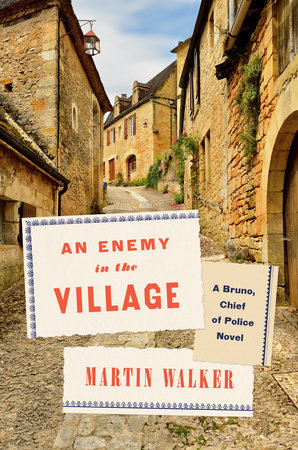
An Enemy in the Village

A Bruno, Chief of Police Novel

Look inside
Hardcover
$28.00 US
5.81"W x 8.54"H x 1.16"D   (14.8 x 21.7 x 2.9 cm) | 16 oz (442 g) | 12 per carton
On sale Jul 01, 2025 | 304 Pages | 9780593536643
Sales rights: US,CAN,OpnMkt(no EU)

See Additional Formats
A real estate agent’s death sends shockwaves through the idyllic town of St. Denis, leading Bruno, Chief of Police, to suspect that there’s more to this tragedy than meets the eye.

“Rich in atmosphere and personality. . .  It’s impossible to read a Bruno novel without getting hungry and thirsty.” —The New York Times


When Bruno stumbles upon a motionless figure in a car parked at a scenic overpass on the ridge of the Vézère valley, he’s ready to investigate. Inside, he finds a suicide note and the dead body of Monique, a successful businesswoman who rented châteaus to wealthy expats. It seems like an open-and-shut case. 

But Bruno can’t shake the suspicion that something sinister lurks underneath this tidy narrative. After he delivers Monique’s final messages to those most important to her, malicious gossip about Bruno begins to spread through the village. One thing leads to another, and soon Bruno faces pressure to resign from the job. Despite this disturbing turn of events, Bruno remains Bruno, never one to turn down a fine meal with good company in the French countryside. In the course of inquiry, he meets Laura—and her dog, which happens to be the same breed as his beloved basset hound. As sparks fly and Bruno realizes just how much he has at stake, he races to find out what really happened to Monique, before he loses his badge, his new love—or something even worse.
Chapter 1

Bruno Courrèges, chief of police of the small French town of St. Denis and of much of the valley of the Vézère River, liked to think of himself as un homme moyen sensuel: a man of conventional appetites, perhaps a little more sentimental than most. His feelings were easily stirred by children, puppies and damsels in distress, but also by good food and wine and the ever-­beguiling landscape of the Périgord and its seasons. In this, he knew he was fortunate. The climate of his region was usually sensible, in that each of the four seasons had its moment and seldom overstayed its welcome.

He took pleasure in the changes, delighting in the usually reliable arrival of springtime in March and of summer in May and of autumn as September began to give way to October. He enjoyed a brisk chill in December and especially those rare years when sufficient snow fell for the children to go sledding down the slopes toward the river. But the recent extremes of the weather, with tempests and heat waves, forest fires and floods, together with the alarm among his friends in the vineyards at the bizarrely premature ripening of the Merlot grapes in August, had begun to alarm him. Bruno had been persuaded that climate change and global warming were now invading his home turf.

On this wintry morning, however, with the sun just peeking over the eastern hills to redden the layers of plump clouds and turn the frost-­covered fields into a beguiling pink, Bruno slowed his police van to a crawl. He felt compelled to admire this unusual palette of wintry colors as he drove along the ridge that overlooked the Vézère Valley. His basset hound, Balzac, seemed equally impressed, sitting up in the passenger seat to stare into the glowing landscape below. As Bruno approached an overlook by the side of the road that he knew boasted a particularly spectacular view, his policeman’s instinct nagged at him.

Unusually for the time of day, the scenic overview was already occupied by a Peugeot 508. Its license plate carried the digits 24, which identified it as a local car, registered in the département of the Dordogne. Bruno would not be able to check the owner’s name until the registry opened at nine. His curiosity piqued, he pulled up behind the vehicle and turned off his engine. “Balzac, stay,” he told the basset. “I’ll be back in a second.”

Approaching the Peugeot, Bruno saw a figure slumped over the steering wheel and knew he’d been right to stop. Trying the doors, glad to be wearing gloves on such a cold morning, he found three of them locked from the inside, but the front passenger door yielded to his grip. Bruno had never owned a car with separate locks for each door; indeed, he had never owned a car so expensive. He opened the door and leaned in, already suspecting from the smell of urine and voided bowels that this could be a suicide. He pulled off his left glove and with the back of his hand checked the cheek of the woman slumped over the wheel. It was ice cold. She had been dead for hours.

He lifted her arm by the sleeve and it scarcely budged, an indicator that rigor mortis had already set in. Bruno pulled back into the open air and used his phone to report his find to the gendarmerie. He read out the number on the license plate to Jules, the desk sergeant, and asked for the presence of Dr. Gelletreau, the medical examiner, to certify what he knew to be—­but could not legally confirm was—­a death.

An almost empty bottle of water and a Chanel handbag lay on the passenger seat beside the dead woman. She was neatly dressed in a dark wool pantsuit and a gray turtleneck sweater. Her shoulder-­length fair hair was remarkably tidy, and her mouth was hanging slackly open, revealing perfect, or perhaps expensive, teeth.

An empty plastic container of zolpidem, which Bruno knew to be a sleeping pill, was on the floor of the passenger side, bearing the label of a pharmacy in Sarlat. A cardboard folder lay on the passenger seat with three sealed envelopes inside. The first was addressed to Maître Rebecca Weil, whom Bruno knew to be a respected lawyer in Sarlat. Beneath the name was written a phone number and the words, “Please call her first.” On a second envelope was the name Mademoiselle Laura Segret, with the words “Périgord concierge” below and a local phone number. The third was addressed to “My husband, Dominic,” with a mobile phone number. On a sheet of expensive notepaper, headed “La Conciergerie du Périgord,” with an address in Sarlat, was written, “My apologies to those who find my body and have to deal with the mess I leave here.” It was signed “Monique Duhamel.”

Bruno called the lawyer’s number, but since it was not yet eight in the morning there was no reply. He then called the conciergerie, and the answering machine asked him to call back after the office opened at nine. A high-­pitched male voice answered his third call. Bruno asked if he was speaking to Dominic. When the voice said yes, Bruno introduced himself and explained that he had bad news before asking if Dominic was alone.

“No, I’m having breakfast with family before going to a funeral,” came the reply, in perfect French but with an Alsatian accent, which Bruno recognized from the annual visits by people from Alsace to commemorate their wartime evacuation to the Périgord. He was taken aback, however, by the reply. The body in front of him was in no way ready for burial, so Bruno resigned himself to the bearing of additional bad news on what he presumed was an already challenging morning.

“Is Monique Duhamel your wife, monsieur?” Bruno asked, feeling he was making a mess of this conversation.

“Yes, but she’s at home while I’m in Strasbourg at this funeral. You say you’re a policeman? What’s this bad news?”

“I’m at the scene of what seems to be a suicide of a woman in her forties who I think is your wife. She was found in a Peugeot 508, and in the car there’s an envelope addressed to you with your mobile number.” He paused before adding, “I’m sorry to be the bearer of this news.”

The phone seemed to be dropped, and after some confusion a woman’s voice came on the line, asking who he was. Bruno explained and asked whom he was speaking with.

“I’m Sabine, Dominic’s sister, actually his foster sister. We’re here in Strasbourg for the funeral of our foster father. Are you sure the dead woman is Monique?”

“We can’t be sure until we get a positive identification from a close friend or family member, but I have checked the handbag in the car and found her ID and credit cards. I’m sorry, but from the photo on the ID it looks to be her. The car was parked in a remote place, and there was an empty box of pills beside the body, envelopes for her husband, her lawyer and another woman, and a note of apology for causing trouble. It looks very much like a suicide.”

“Understood. What happens now?”

“There will have to be an autopsy to be sure of the cause of death, and then we can have the body taken to a funeral parlor of your brother’s choice. But we really need a visual identification today if at all possible. Does your brother know of any close friends or colleagues who could do it?”

“I’ll ask,” the woman said. Bruno heard murmuring before she came back to say that Dominic was writing down the names and contact numbers of Monique’s best friend and her doctor.

“Dominic will drive down as soon as he can after the funeral, but it will take some time,” Sabine said. “Our father was the stonemason at the cathedral here, and that’s where the service is being held.”

Bruno gave her his phone number and email address, adding that Monique’s body would be taken to the morgue in Sarlat, and he would have her Peugeot moved to the local gendarmerie in St. Denis.

“Okay,” the sister said. “The gendarmerie is fine. But Domi­nic is in shock, as I’m sure you can imagine.” There was a sharp intake of breath down the line. “Losing your wife on the day of your dad’s funeral, you can hardly imagine.” A pause. “And only a week after she lost her baby.”

Mon Dieu. That’s terrible, and I’m deeply sorry to be the bearer of yet more bad news,” said Bruno. “Maybe your brother need not drive down tonight. Tomorrow should be fine. He has my number. You and I should stay in touch, so please text me your phone number and email address. And ask your brother if there is any special friend in Sarlat I should contact.”

“Wait a minute.” Bruno heard muttering before she came back to say that Monique was good friends with a local magistrate named Annette Meraillon.

“I know Annette well,” Bruno replied. “I’ll call her as soon as we’re done.”

He took down Sabine’s details and the name of Monique’s gynecologist, but was surprised when Sabine said that the dead woman’s usual doctor was Fabiola Stern, of the medical center in Bruno’s hometown of St. Denis.

“I know Fabiola,” Bruno said, wondering why the dead woman had chosen a general practitioner who lived at least thirty minutes from her home. “I’ll call her now.”

He called the gendarmerie to inform them that Dr. Gelletreau’s services would no longer be required, and as soon as that was done he found Fabiola’s number in his list of recent calls. Bruno reached Fabiola as she was arriving at the clinic and asked her to delay her first appointment, as he needed her to confirm a death.

“It’s about one of your patients, Monique Duhamel. There hasn’t been a formal identification yet, nor a death certificate, but I think she’s the suicide I just found. I was going to summon Gelletreau, since he’s on the duty roster, but given that she’s a patient of yours we can kill two birds with one stone if you come here.”

Merde, just after her miscarriage,” Fabiola said. “Okay, I’m on my way.”

A little under twenty minutes later Bruno was gratefully accepting from Fabiola a cup of take-­out coffee from a gas station along her route. Handing both cups to Bruno, she slipped on a pair of disposable gloves before sliding into the passenger seat of the Peugeot. “It’s Monique, that I can confirm.”

Fabiola applied a stethoscope to her friend’s chest and put a thermometer into her mouth, and Bruno noticed the care she took to be gentle, treating Monique’s body with the same respect she would have done were Monique still living.
"An Enemy in the Village is charming and delectable and will send you running to the nearest French restaurant.”
The Denver Post

“Bruno mysteries offer a feast of history, archeology, food, and atmosphere, along with the intriguing character of Bruno himself.”
Booklist, starred

“During the already busy run-up to Christmas in the bucolic village of St. Denis, Chief of Police Bruno Courrèges—in between mouth-watering meals a-plenty—grapples with the death of a real-estate entrepreneur, a local family’s fracas, and dubious police-related politics.”
The Boston Globe
© Klaus Einwanger
After a long career working in international journalism and for think tanks, MARTIN WALKER now gardens, cooks, explores vineyards, writes, travels, and has never been busier. He divides his time between Washington D.C. and the Dordogne. View titles by Martin Walker
Available for sale exclusive:
•     Canada
•     Guam
•     Minor Outl.Ins.
•     North Mariana
•     Philippines
•     Puerto Rico
•     Samoa,American
•     US Virgin Is.
•     USA

Available for sale non-exclusive:
•     Afghanistan
•     Aland Islands
•     Albania
•     Algeria
•     Angola
•     Antarctica
•     Argentina
•     Armenia
•     Aruba
•     Azerbaijan
•     Bahrain
•     Belarus
•     Benin
•     Bolivia
•     Bonaire, Saba
•     Bosnia Herzeg.
•     Bouvet Island
•     Brazil
•     Burkina Faso
•     Burundi
•     Cambodia
•     Cape Verde
•     Centr.Afr.Rep.
•     Chad
•     Chile
•     China
•     Colombia
•     Comoro Is.
•     Congo
•     Cook Islands
•     Costa Rica
•     Cuba
•     Curacao
•     Dem. Rep. Congo
•     Djibouti
•     Dominican Rep.
•     Ecuador
•     Egypt
•     El Salvador
•     Equatorial Gui.
•     Eritrea
•     Ethiopia
•     Faroe Islands
•     Fren.Polynesia
•     French Guinea
•     Gabon
•     Georgia
•     Greenland
•     Guadeloupe
•     Guatemala
•     Guinea Republic
•     Guinea-Bissau
•     Haiti
•     Heard/McDon.Isl
•     Honduras
•     Hong Kong
•     Indonesia
•     Iran
•     Iraq
•     Israel
•     Ivory Coast
•     Japan
•     Jordan
•     Kazakhstan
•     Kyrgyzstan
•     Laos
•     Lebanon
•     Liberia
•     Libya
•     Macau
•     Macedonia
•     Madagascar
•     Mali
•     Marshall island
•     Martinique
•     Mauritania
•     Mayotte
•     Mexico
•     Micronesia
•     Moldavia
•     Mongolia
•     Morocco
•     New Caledonia
•     Nicaragua
•     Niger
•     Niue
•     Norfolk Island
•     North Korea
•     Oman
•     Palau
•     Palestinian Ter
•     Panama
•     Paraguay
•     Peru
•     Qatar
•     Reunion Island
•     Russian Fed.
•     Saint Martin
•     SaoTome Princip
•     Saudi Arabia
•     Senegal
•     Sint Maarten
•     South Korea
•     St Barthelemy
•     St.Pier,Miquel.
•     Sth Terr. Franc
•     Suriname
•     Svalbard
•     Syria
•     Tadschikistan
•     Taiwan
•     Thailand
•     Timor-Leste
•     Togo
•     Tokelau Islands
•     Tunisia
•     Turkey
•     Turkmenistan
•     Ukraine
•     Unit.Arab Emir.
•     Uruguay
•     Uzbekistan
•     Venezuela
•     Vietnam
•     Wallis,Futuna
•     West Saharan
•     Yemen

Not available for sale:
•     Andorra
•     Anguilla
•     Antigua/Barbuda
•     Australia
•     Austria
•     Bahamas
•     Bangladesh
•     Barbados
•     Belgium
•     Belize
•     Bermuda
•     Bhutan
•     Botswana
•     Brit.Ind.Oc.Ter
•     Brit.Virgin Is.
•     Brunei
•     Bulgaria
•     Cameroon
•     Cayman Islands
•     Christmas Islnd
•     Cocos Islands
•     Croatia
•     Cyprus
•     Czech Republic
•     Denmark
•     Dominica
•     Estonia
•     Falkland Islnds
•     Fiji
•     Finland
•     France
•     Gambia
•     Germany
•     Ghana
•     Gibraltar
•     Greece
•     Grenada
•     Guernsey
•     Guyana
•     Hungary
•     Iceland
•     India
•     Ireland
•     Isle of Man
•     Italy
•     Jamaica
•     Jersey
•     Kenya
•     Kiribati
•     Kuwait
•     Latvia
•     Lesotho
•     Liechtenstein
•     Lithuania
•     Luxembourg
•     Malawi
•     Malaysia
•     Maldives
•     Malta
•     Mauritius
•     Monaco
•     Montenegro
•     Montserrat
•     Mozambique
•     Myanmar
•     Namibia
•     Nauru
•     Nepal
•     Netherlands
•     New Zealand
•     Nigeria
•     Norway
•     Pakistan
•     PapuaNewGuinea
•     Pitcairn Islnds
•     Poland
•     Portugal
•     Romania
•     Rwanda
•     S. Sandwich Ins
•     San Marino
•     Serbia
•     Seychelles
•     Sierra Leone
•     Singapore
•     Slovakia
•     Slovenia
•     Solomon Islands
•     Somalia
•     South Africa
•     South Sudan
•     Spain
•     Sri Lanka
•     St. Helena
•     St. Lucia
•     St. Vincent
•     St.Chr.,Nevis
•     Sudan
•     Swaziland
•     Sweden
•     Switzerland
•     Tanzania
•     Tonga
•     Trinidad,Tobago
•     Turks&Caicos Is
•     Tuvalu
•     Uganda
•     United Kingdom
•     Vanuatu
•     Vatican City
•     Western Samoa
•     Zambia
•     Zimbabwe

About

A real estate agent’s death sends shockwaves through the idyllic town of St. Denis, leading Bruno, Chief of Police, to suspect that there’s more to this tragedy than meets the eye.

“Rich in atmosphere and personality. . .  It’s impossible to read a Bruno novel without getting hungry and thirsty.” —The New York Times


When Bruno stumbles upon a motionless figure in a car parked at a scenic overpass on the ridge of the Vézère valley, he’s ready to investigate. Inside, he finds a suicide note and the dead body of Monique, a successful businesswoman who rented châteaus to wealthy expats. It seems like an open-and-shut case. 

But Bruno can’t shake the suspicion that something sinister lurks underneath this tidy narrative. After he delivers Monique’s final messages to those most important to her, malicious gossip about Bruno begins to spread through the village. One thing leads to another, and soon Bruno faces pressure to resign from the job. Despite this disturbing turn of events, Bruno remains Bruno, never one to turn down a fine meal with good company in the French countryside. In the course of inquiry, he meets Laura—and her dog, which happens to be the same breed as his beloved basset hound. As sparks fly and Bruno realizes just how much he has at stake, he races to find out what really happened to Monique, before he loses his badge, his new love—or something even worse.

Excerpt

Chapter 1

Bruno Courrèges, chief of police of the small French town of St. Denis and of much of the valley of the Vézère River, liked to think of himself as un homme moyen sensuel: a man of conventional appetites, perhaps a little more sentimental than most. His feelings were easily stirred by children, puppies and damsels in distress, but also by good food and wine and the ever-­beguiling landscape of the Périgord and its seasons. In this, he knew he was fortunate. The climate of his region was usually sensible, in that each of the four seasons had its moment and seldom overstayed its welcome.

He took pleasure in the changes, delighting in the usually reliable arrival of springtime in March and of summer in May and of autumn as September began to give way to October. He enjoyed a brisk chill in December and especially those rare years when sufficient snow fell for the children to go sledding down the slopes toward the river. But the recent extremes of the weather, with tempests and heat waves, forest fires and floods, together with the alarm among his friends in the vineyards at the bizarrely premature ripening of the Merlot grapes in August, had begun to alarm him. Bruno had been persuaded that climate change and global warming were now invading his home turf.

On this wintry morning, however, with the sun just peeking over the eastern hills to redden the layers of plump clouds and turn the frost-­covered fields into a beguiling pink, Bruno slowed his police van to a crawl. He felt compelled to admire this unusual palette of wintry colors as he drove along the ridge that overlooked the Vézère Valley. His basset hound, Balzac, seemed equally impressed, sitting up in the passenger seat to stare into the glowing landscape below. As Bruno approached an overlook by the side of the road that he knew boasted a particularly spectacular view, his policeman’s instinct nagged at him.

Unusually for the time of day, the scenic overview was already occupied by a Peugeot 508. Its license plate carried the digits 24, which identified it as a local car, registered in the département of the Dordogne. Bruno would not be able to check the owner’s name until the registry opened at nine. His curiosity piqued, he pulled up behind the vehicle and turned off his engine. “Balzac, stay,” he told the basset. “I’ll be back in a second.”

Approaching the Peugeot, Bruno saw a figure slumped over the steering wheel and knew he’d been right to stop. Trying the doors, glad to be wearing gloves on such a cold morning, he found three of them locked from the inside, but the front passenger door yielded to his grip. Bruno had never owned a car with separate locks for each door; indeed, he had never owned a car so expensive. He opened the door and leaned in, already suspecting from the smell of urine and voided bowels that this could be a suicide. He pulled off his left glove and with the back of his hand checked the cheek of the woman slumped over the wheel. It was ice cold. She had been dead for hours.

He lifted her arm by the sleeve and it scarcely budged, an indicator that rigor mortis had already set in. Bruno pulled back into the open air and used his phone to report his find to the gendarmerie. He read out the number on the license plate to Jules, the desk sergeant, and asked for the presence of Dr. Gelletreau, the medical examiner, to certify what he knew to be—­but could not legally confirm was—­a death.

An almost empty bottle of water and a Chanel handbag lay on the passenger seat beside the dead woman. She was neatly dressed in a dark wool pantsuit and a gray turtleneck sweater. Her shoulder-­length fair hair was remarkably tidy, and her mouth was hanging slackly open, revealing perfect, or perhaps expensive, teeth.

An empty plastic container of zolpidem, which Bruno knew to be a sleeping pill, was on the floor of the passenger side, bearing the label of a pharmacy in Sarlat. A cardboard folder lay on the passenger seat with three sealed envelopes inside. The first was addressed to Maître Rebecca Weil, whom Bruno knew to be a respected lawyer in Sarlat. Beneath the name was written a phone number and the words, “Please call her first.” On a second envelope was the name Mademoiselle Laura Segret, with the words “Périgord concierge” below and a local phone number. The third was addressed to “My husband, Dominic,” with a mobile phone number. On a sheet of expensive notepaper, headed “La Conciergerie du Périgord,” with an address in Sarlat, was written, “My apologies to those who find my body and have to deal with the mess I leave here.” It was signed “Monique Duhamel.”

Bruno called the lawyer’s number, but since it was not yet eight in the morning there was no reply. He then called the conciergerie, and the answering machine asked him to call back after the office opened at nine. A high-­pitched male voice answered his third call. Bruno asked if he was speaking to Dominic. When the voice said yes, Bruno introduced himself and explained that he had bad news before asking if Dominic was alone.

“No, I’m having breakfast with family before going to a funeral,” came the reply, in perfect French but with an Alsatian accent, which Bruno recognized from the annual visits by people from Alsace to commemorate their wartime evacuation to the Périgord. He was taken aback, however, by the reply. The body in front of him was in no way ready for burial, so Bruno resigned himself to the bearing of additional bad news on what he presumed was an already challenging morning.

“Is Monique Duhamel your wife, monsieur?” Bruno asked, feeling he was making a mess of this conversation.

“Yes, but she’s at home while I’m in Strasbourg at this funeral. You say you’re a policeman? What’s this bad news?”

“I’m at the scene of what seems to be a suicide of a woman in her forties who I think is your wife. She was found in a Peugeot 508, and in the car there’s an envelope addressed to you with your mobile number.” He paused before adding, “I’m sorry to be the bearer of this news.”

The phone seemed to be dropped, and after some confusion a woman’s voice came on the line, asking who he was. Bruno explained and asked whom he was speaking with.

“I’m Sabine, Dominic’s sister, actually his foster sister. We’re here in Strasbourg for the funeral of our foster father. Are you sure the dead woman is Monique?”

“We can’t be sure until we get a positive identification from a close friend or family member, but I have checked the handbag in the car and found her ID and credit cards. I’m sorry, but from the photo on the ID it looks to be her. The car was parked in a remote place, and there was an empty box of pills beside the body, envelopes for her husband, her lawyer and another woman, and a note of apology for causing trouble. It looks very much like a suicide.”

“Understood. What happens now?”

“There will have to be an autopsy to be sure of the cause of death, and then we can have the body taken to a funeral parlor of your brother’s choice. But we really need a visual identification today if at all possible. Does your brother know of any close friends or colleagues who could do it?”

“I’ll ask,” the woman said. Bruno heard murmuring before she came back to say that Dominic was writing down the names and contact numbers of Monique’s best friend and her doctor.

“Dominic will drive down as soon as he can after the funeral, but it will take some time,” Sabine said. “Our father was the stonemason at the cathedral here, and that’s where the service is being held.”

Bruno gave her his phone number and email address, adding that Monique’s body would be taken to the morgue in Sarlat, and he would have her Peugeot moved to the local gendarmerie in St. Denis.

“Okay,” the sister said. “The gendarmerie is fine. But Domi­nic is in shock, as I’m sure you can imagine.” There was a sharp intake of breath down the line. “Losing your wife on the day of your dad’s funeral, you can hardly imagine.” A pause. “And only a week after she lost her baby.”

Mon Dieu. That’s terrible, and I’m deeply sorry to be the bearer of yet more bad news,” said Bruno. “Maybe your brother need not drive down tonight. Tomorrow should be fine. He has my number. You and I should stay in touch, so please text me your phone number and email address. And ask your brother if there is any special friend in Sarlat I should contact.”

“Wait a minute.” Bruno heard muttering before she came back to say that Monique was good friends with a local magistrate named Annette Meraillon.

“I know Annette well,” Bruno replied. “I’ll call her as soon as we’re done.”

He took down Sabine’s details and the name of Monique’s gynecologist, but was surprised when Sabine said that the dead woman’s usual doctor was Fabiola Stern, of the medical center in Bruno’s hometown of St. Denis.

“I know Fabiola,” Bruno said, wondering why the dead woman had chosen a general practitioner who lived at least thirty minutes from her home. “I’ll call her now.”

He called the gendarmerie to inform them that Dr. Gelletreau’s services would no longer be required, and as soon as that was done he found Fabiola’s number in his list of recent calls. Bruno reached Fabiola as she was arriving at the clinic and asked her to delay her first appointment, as he needed her to confirm a death.

“It’s about one of your patients, Monique Duhamel. There hasn’t been a formal identification yet, nor a death certificate, but I think she’s the suicide I just found. I was going to summon Gelletreau, since he’s on the duty roster, but given that she’s a patient of yours we can kill two birds with one stone if you come here.”

Merde, just after her miscarriage,” Fabiola said. “Okay, I’m on my way.”

A little under twenty minutes later Bruno was gratefully accepting from Fabiola a cup of take-­out coffee from a gas station along her route. Handing both cups to Bruno, she slipped on a pair of disposable gloves before sliding into the passenger seat of the Peugeot. “It’s Monique, that I can confirm.”

Fabiola applied a stethoscope to her friend’s chest and put a thermometer into her mouth, and Bruno noticed the care she took to be gentle, treating Monique’s body with the same respect she would have done were Monique still living.

Praise

"An Enemy in the Village is charming and delectable and will send you running to the nearest French restaurant.”
The Denver Post

“Bruno mysteries offer a feast of history, archeology, food, and atmosphere, along with the intriguing character of Bruno himself.”
Booklist, starred

“During the already busy run-up to Christmas in the bucolic village of St. Denis, Chief of Police Bruno Courrèges—in between mouth-watering meals a-plenty—grapples with the death of a real-estate entrepreneur, a local family’s fracas, and dubious police-related politics.”
The Boston Globe

Author

© Klaus Einwanger
After a long career working in international journalism and for think tanks, MARTIN WALKER now gardens, cooks, explores vineyards, writes, travels, and has never been busier. He divides his time between Washington D.C. and the Dordogne. View titles by Martin Walker

Rights

Available for sale exclusive:
•     Canada
•     Guam
•     Minor Outl.Ins.
•     North Mariana
•     Philippines
•     Puerto Rico
•     Samoa,American
•     US Virgin Is.
•     USA

Available for sale non-exclusive:
•     Afghanistan
•     Aland Islands
•     Albania
•     Algeria
•     Angola
•     Antarctica
•     Argentina
•     Armenia
•     Aruba
•     Azerbaijan
•     Bahrain
•     Belarus
•     Benin
•     Bolivia
•     Bonaire, Saba
•     Bosnia Herzeg.
•     Bouvet Island
•     Brazil
•     Burkina Faso
•     Burundi
•     Cambodia
•     Cape Verde
•     Centr.Afr.Rep.
•     Chad
•     Chile
•     China
•     Colombia
•     Comoro Is.
•     Congo
•     Cook Islands
•     Costa Rica
•     Cuba
•     Curacao
•     Dem. Rep. Congo
•     Djibouti
•     Dominican Rep.
•     Ecuador
•     Egypt
•     El Salvador
•     Equatorial Gui.
•     Eritrea
•     Ethiopia
•     Faroe Islands
•     Fren.Polynesia
•     French Guinea
•     Gabon
•     Georgia
•     Greenland
•     Guadeloupe
•     Guatemala
•     Guinea Republic
•     Guinea-Bissau
•     Haiti
•     Heard/McDon.Isl
•     Honduras
•     Hong Kong
•     Indonesia
•     Iran
•     Iraq
•     Israel
•     Ivory Coast
•     Japan
•     Jordan
•     Kazakhstan
•     Kyrgyzstan
•     Laos
•     Lebanon
•     Liberia
•     Libya
•     Macau
•     Macedonia
•     Madagascar
•     Mali
•     Marshall island
•     Martinique
•     Mauritania
•     Mayotte
•     Mexico
•     Micronesia
•     Moldavia
•     Mongolia
•     Morocco
•     New Caledonia
•     Nicaragua
•     Niger
•     Niue
•     Norfolk Island
•     North Korea
•     Oman
•     Palau
•     Palestinian Ter
•     Panama
•     Paraguay
•     Peru
•     Qatar
•     Reunion Island
•     Russian Fed.
•     Saint Martin
•     SaoTome Princip
•     Saudi Arabia
•     Senegal
•     Sint Maarten
•     South Korea
•     St Barthelemy
•     St.Pier,Miquel.
•     Sth Terr. Franc
•     Suriname
•     Svalbard
•     Syria
•     Tadschikistan
•     Taiwan
•     Thailand
•     Timor-Leste
•     Togo
•     Tokelau Islands
•     Tunisia
•     Turkey
•     Turkmenistan
•     Ukraine
•     Unit.Arab Emir.
•     Uruguay
•     Uzbekistan
•     Venezuela
•     Vietnam
•     Wallis,Futuna
•     West Saharan
•     Yemen

Not available for sale:
•     Andorra
•     Anguilla
•     Antigua/Barbuda
•     Australia
•     Austria
•     Bahamas
•     Bangladesh
•     Barbados
•     Belgium
•     Belize
•     Bermuda
•     Bhutan
•     Botswana
•     Brit.Ind.Oc.Ter
•     Brit.Virgin Is.
•     Brunei
•     Bulgaria
•     Cameroon
•     Cayman Islands
•     Christmas Islnd
•     Cocos Islands
•     Croatia
•     Cyprus
•     Czech Republic
•     Denmark
•     Dominica
•     Estonia
•     Falkland Islnds
•     Fiji
•     Finland
•     France
•     Gambia
•     Germany
•     Ghana
•     Gibraltar
•     Greece
•     Grenada
•     Guernsey
•     Guyana
•     Hungary
•     Iceland
•     India
•     Ireland
•     Isle of Man
•     Italy
•     Jamaica
•     Jersey
•     Kenya
•     Kiribati
•     Kuwait
•     Latvia
•     Lesotho
•     Liechtenstein
•     Lithuania
•     Luxembourg
•     Malawi
•     Malaysia
•     Maldives
•     Malta
•     Mauritius
•     Monaco
•     Montenegro
•     Montserrat
•     Mozambique
•     Myanmar
•     Namibia
•     Nauru
•     Nepal
•     Netherlands
•     New Zealand
•     Nigeria
•     Norway
•     Pakistan
•     PapuaNewGuinea
•     Pitcairn Islnds
•     Poland
•     Portugal
•     Romania
•     Rwanda
•     S. Sandwich Ins
•     San Marino
•     Serbia
•     Seychelles
•     Sierra Leone
•     Singapore
•     Slovakia
•     Slovenia
•     Solomon Islands
•     Somalia
•     South Africa
•     South Sudan
•     Spain
•     Sri Lanka
•     St. Helena
•     St. Lucia
•     St. Vincent
•     St.Chr.,Nevis
•     Sudan
•     Swaziland
•     Sweden
•     Switzerland
•     Tanzania
•     Tonga
•     Trinidad,Tobago
•     Turks&Caicos Is
•     Tuvalu
•     Uganda
•     United Kingdom
•     Vanuatu
•     Vatican City
•     Western Samoa
•     Zambia
•     Zimbabwe