Close Modal

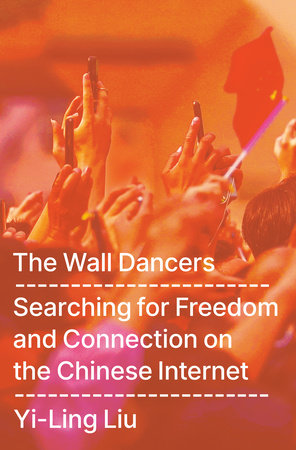
The Wall Dancers

Searching for Freedom and Connection on the Chinese Internet

Look inside
Hardcover
$30.00 US
6.37"W x 9.53"H x 1.17"D   (16.2 x 24.2 x 3.0 cm) | 17 oz (493 g) | 12 per carton
On sale Feb 03, 2026 | 336 Pages | 9780593491850
Sales rights: US, Canada, Open Mkt

An eye-opening exploration of the Chinese internet that reveals the intricate dance between freedom and control in contemporary China

The Wall Dancers is history told in a gripping, novelistic style. It is at once a crash course in contemporary Chinese politics and culture and an epic story about human drive, desperation, and ingenuity against inordinate odds. Yi-Ling Liu has written a masterwork.”
—Jonathan Blitzer, New York Times bestselling author of Everyone Who Is Gone Is Here


In the late 1990s, as the world was waking up to the power and emancipatory promise of the internet, Chinese authorities began constructing a system of online surveillance and censorship now known as the Great Firewall. But far from being a barren landscape, the digital world that sprouted up behind the firewall brimmed with new subcultures and tech innovations, offering many Chinese citizens previously unimaginable connection and opportunity.

Today, as the country’s leadership intensifies its control of public discourse and Western headlines reduce the Chinese public to a faceless monolith, journalist Yi-Ling Liu presents an intimate portrait of China’s online ecosystem—and a crucial lens into the on-the-ground reality of life there. Tracing the last three decades of the Chinese internet’s evolution—from its lexicon to its memes to the precise nature of its censorship—she equips readers with a critical tool to assess the past, present, and future of a global power.

Drawing on years of firsthand reporting, The Wall Dancers weaves together the stories of individuals navigating China’s transformation into both the world’s largest online user base and one of its most populous authoritarian states. As these entrepreneurs, activists, artists, and dreamers experience the internet’s power as a tool for both control and liberation, they grapple with universal questions of success and authenticity, love and solidarity, faith and resilience.

The Wall Dancers is at once an unforgettable work of human storytelling and a vital exploration of what it means to live with dignity and hope within the technological systems that now shape all our lives.
Chapter 1: Coming Out

Qinhuangdao, Hebei, 1995

When Ma Baoli felt that he could no longer contain his secret, he would go to the beach. He’d walk out of the squat police bureau building, where he worked as an officer, across the train tracks that cut through downtown Qinhuangdao, straight down the sandy path to the sea. The police bureau was his home, but the sea was his refuge. Standing alone on the stretch of golden sand, watching the tides come and go in silence, he’d calm down. His secret was safe with the sea.

Ma grew up in Qinhuangdao in the eighties, when the city was just a quiet port town where container ships picked up coal and timber, a passing point between Beijing and China’s northern hinterlands. As a child, he was raised in a working-­class household with modest means but was happy; his father was a factory worker at the local distillery, and his mother took care of him as a housewife. The three of them shared a courtyard home with two other families and had everything they needed. If it became cold in the winter, they lit the stove under their large wooden kang; if they got bored, they passed the time chatting with their neighbors in the courtyard.

The Mas were proud of their son, who enrolled in the all-­boys Qinhuangdao police academy when he was sixteen and was training to become a great officer one day. As a student, Ma was hardworking and diligent, quickly commanding the respect of his peers. He kept his hair short and neatly trimmed, spoke with a voice that was gentle but authoritative, and smiled with his brows slightly furrowed. He aced his classes—­not only math and physics but specialized police courses like constitutional law and criminal investigations. Outside of class, he managed the school paper and ran the campus radio station, playing cassette tapes of the latest pop hits. He loved the academy, its rules and routines, and the students’ easy camaraderie. Every morning before sunrise, they gathered by the courtyard and jogged to the beach to complete their daily sprints and wrestling exercises by the sea. Every evening, they slept together in dorms, eight to a room, huddled together for warmth in winter. The world was simple. His ideals were clear: Learn how to be a good cop, enforce the law, keep the city in order.

When he turned seventeen, a secret began to take root and bloom inside him, quietly and unannounced. While his classmates boasted about girls they wanted to date, he nursed crushes on boys. He became infatuated with his best friend—­a playful, mischievous student from the Hebei countryside. The two spent all their time together—­during their morning exercises, at meals, after class—­and, sometimes at night, shared the same bed. “We’ll issue you two a marriage certificate after we graduate,” their classmates joked. During the holidays, they exchanged long letters. Few households had their own phone then, so if Ma was desperate, he used the convenience store phone booth and called the number of his friend’s neighborhood committee, the only phone in his village. That feeling of anticipation—­receiver pressed to his ear, lightheaded with pleasure, waiting to hear his friend’s voice—­was delicious and disorienting, like tasting ice cream for the first time.

“What’s going on between us? What do you think our relationship is?” Ma blurted out anxiously during one of their conversations.

“Do you think we’re homosexual?” his friend responded.

“No, we’re not,” Ma said. “Of course not.”

The first time Ma encountered the word “homosexual,” or tong­xing­lian, was in one of his school textbooks, entitled Criminal Psychology. The book dedicated an entire page to “sexual deviancy” and explained how men who desired other men were more likely to commit crimes. At the time, homosexuality was still prosecuted as “hooliganism,” a vague descriptor that encompassed crimes like “humiliating women” and “stirring up a crowd to create brawls.” As a small-­town boy, Ma did not know this, but in larger cities, police routinely raided cruising spots; in Beijing, one man—­dubbed “Lady Paris” for his dalliances with a Parisian chef at the French embassy—­was arrested at a popular spot on the east side of Tiananmen Square and sent to a labor camp for two years.

Homosexuality was then also officially classified as a mental disorder. Across the country, clinics offered pills, injections, and electroshock treatments as forms of “conversion therapy.” Desperate parents sent their gay sons and daughters to psychiatric institutions in hopes that their “illness” might be cured. Doctors told their gay patients that if they did not change, they would get sick and bring shame to their families. Deep-­seated Confucian values—­an unshakable emphasis on having a respectable marriage, giving birth to sons, and honoring one’s elders—­meant that the family was one of the most intense places of discrimination. To not bear offspring, a popular proverb declared, was the greatest act of disrespect toward one’s ancestors.

Ma was terrified of being found out. As far as he understood, the textbooks were right, and his feelings were deviant and perverted. The secret grew like a tumor in his chest, threatening to overtake the order of his life. After graduation, he would go to the hospital to fix himself, he thought. For now, he would keep his secret to himself and the sea.

• • •

One night in 1998, Ma stopped by a new internet café that had opened next to the police bureau. He had graduated two years before and started working as a police officer, first in the investigations department, then writing speeches, strategy documents, and public announcements for the police chief.

The first internet cafés had recently arrived in Qinhuangdao, and everyone was flocking to these cramped, computer-­filled establishments to get a taste of the online realm. In 1995, after China’s first private internet service provider, China Infohighway Communications, gave ordinary users access to the web, China was swept up by an internet fever. Computer companies sold hardware from street stalls and department stores; roadside billboards advertised Acer and Microsoft. Internet start-­ups proliferated, launching China’s first search engine, instant-­messaging platform, and popular email service, 163.net. The number of internet users doubled every six months. People waited in line to visit China’s first internet café, Sparkice, in Beijing’s Haidian district, paying 20 yuan per hour—­to spend a whole day would cost nearly the average monthly income at the time—­to surf the web. As these cafés sprouted across the country, news reports insisted that the traditional greeting of “Have you eaten?” was being replaced with “Have you logged on?” Ma wanted to see what all the hype was about.

The café was a small, dim room, sandwiched into an alleyway, lit by two rows of desktops with buzzing screens. Ma picked a computer and searched tongxinglian—­homosexual. First, he scrolled through what he expected to find—­a messy jumble of advertisements promoting electroshock therapy clinics and conversion medication. Then he stumbled upon a discussion forum entitled “Chinese Men’s and Boy’s Paradise,” which featured a link to an online novel called Beijing Story. The novel was penned by an author who went by the pseudonym Beijing Comrade. Ma clicked on the link.

The story’s protagonist, Lan Yu, a poor architecture student, moves from China’s far-­flung west to Beijing in 1988. Enter Han Dong, spoiled princeling and rakish businessman, who squanders his money on houses and lovers. They meet for the first time and have sex. Han Dong tries to pay Lan Yu off with 3,000 yuan, Lan Yu rejects his money, and their first encounter evolves into a tumultuous romance.

Ma devoured the passages, heart racing. He’d never read anything like this before—­so cruel and tragic and yet so brazenly sensual, another man’s body described with the language of appetite and desire. The novel reached its emotional climax at a moment of tragedy and reckoning; after Lan Yu narrowly survives the crackdown at Tiananmen Square, he finally accepts his love for Han Dong: “Having just escaped death, we began to feel each other. We tried to confirm with our bodies that we were still alive. I caressed his skin with my face: it was warm; it was alive; he was still in my life.”

By the time Ma finished reading, the sun had risen. Hunched in front of the computer, he broke down in tears, crying so intensely that a young woman in the seat next to him checked in on him.

“All good, brother?” she asked. “What are you reading that’s such a downer? Can I read it, too?”

He shook his head, switched off his screen, and hurried out of the café, face shiny with tears. It was a revelation, a catharsis, knowing that there were people who shared his secret, who felt the way he did. “It felt like I’d opened up a new world,” he would later say, “a world where such a beautiful love between two men could exist.”

The internet café became Ma’s new refuge. Online, he stumbled upon a world where he belonged. He joined gay chat rooms, befriending other gay men seeking kinship and connection. He found gay film and television shows, such as Dosokai, a Japanese series about a gay man trapped in a marriage to a woman, and East Palace, West Palace, a Chinese film about a gay man arrested in a popular cruising spot in Beijing. Eventually, Ma bought his own computer and a clunky dial-­up modem to access the internet. During his lunch breaks, he would lock the door of his office and watch every gay film he could get his hands on, sobbing over his takeout noodles. The Chinese films almost always ended in tragedy—­gay men being disowned by their families, detained by authorities, dying in car crashes—­but he still saw hope in their love. He was no longer alone.

• • •

Drive twenty minutes from Ma’s seaside refuge down the length of the Qinhuangdao coast, and you will arrive at Beidaihe Beach. Everything about this place, a popular summer vacation spot for local and foreign visitors alike, feels incongruous: A dumpling shack serves lunch next to an Austrian bakery; buildings feature kitschy Tudor gables and Habsburg-­style domes; rental bikes pedal past black Audis with tinted windows. The New York Times once described Beidaihe as “a Chinese combination of Jersey Shore and Martha’s Vineyard, with a pinch of red fervor.” On the public beaches, shirtless tourists eat garlic prawns off paper plates; in the private enclaves of luxury villas, tucked among the evergreens, the Communist Party elite gather each summer to decide on the future of the nation.

Nicknamed the “Summer Capital,” Beidaihe has long been the retreat for the Party’s top echelons. In 1958, it was at Beidaihe that Mao, an avid swimmer who spent his spare time in black trunks wading in the sea, dictated the blueprint for the Great Leap Forward, a social experiment that instead led to the deaths of tens of millions of people by famine. After Mao died, in 1976, leaving China impoverished and rudderless, Beidaihe became the forum to discuss conflicting views on the nation’s path ahead.

Under the leadership of Deng Xiaoping, in 1978, China introduced the Reform and Opening policy: loosening the planned economy from state control and opening China’s doors to the world. While Party members agreed on the country’s urgent need to modernize, they disagreed on how far and how fast. Opening the door to foreign technology, such as Boeing aircraft and IBM computers, enabled the country to catch up with the West but also let in other forms of unwelcome Western influences—­“spiritual pollution,” as the Party liked to call it, which included everything from pornography to detective thrillers. Without a clear road map to reform, Deng followed an improvisational philosophy he often referred to as “crossing the river by feeling the stones.”

But after the brutal Tiananmen Square crackdown in 1989, thousands of protesters who took to the square demanding democratic reform were shot to death, arrested, or driven underground. Reforms came to a sudden, tragic halt. Reeling from the crisis, the Party faced a dilemma: Meet the growing demands of the Chinese people, emboldened by reform and desiring more freedom, or appease the unyielding grip of Party hard-­liners, who believed that tightened control was crucial to preserving order. The Party’s sense of crisis was compounded by the fall of the Soviet Union, in 1991. They had to do whatever was necessary to avoid repeating the missteps of what they believed to be Mikhail Gorbachev’s failed and chaotic perestroika.

Deng’s solution was to play it both ways: Hold tight to the reins of political authority but accelerate market reforms. In 1992, he traveled south by train, starting in Wuhan and stopping by Shenzhen and Shanghai, in a monthlong journey that would be immortalized as the “Southern Tour.” He visited technology companies and stock exchanges, encouraging local officials to push for growth and attract foreign investment and calling upon ordinary Chinese people to engage in private business. He championed the “East Asian Tigers”—­the booming economies of Hong Kong, Singapore, South Korea, and Taiwan—­as models of prosperous governance. The government, Deng said, “must not act like women with bound feet” but, rather, “should dare to experiment and break a new path.” His message was clear: The Party would stay firmly in control, but China’s doors would remain open.

By the time Ma Baoli was nursing schoolboy crushes at the police academy two years later, market reforms were in full gear—­overnight, it seemed to many, like a nation of communes and Mao jackets transformed into a land of Gucci-­wearing, Pepsi-­drinking businessmen.

As the economy liberalized, so did attitudes toward everything else—­not only education and business and enterprise but also sex and love. Economic revolution fertilized a sexual renaissance; the nation’s libido, bottled up for decades, burst loose. Prostitution skyrocketed, trashy romances flooded bookstore shelves, and porn—­once seen as a symbol of a depraved capitalist way of life—­proliferated. The percentage of Chinese people having premarital sex soared from 15 percent in 1989 to 70 percent more than a decade later, according to the surveys of Li Yinhe, a prominent Chinese sociologist. A call-­in sex education radio show called Midnight Whispers taught young people the secrets to lust and love; a wildly popular soap opera called Yearnings told a melodramatic tale of loves found and lost, devoid of Mao-­era political dogma. In 1993, China’s first legal sex shop, Adam & Eve Health-­Care Center, opened in Beijing.

Free from the bonds of Maoist prudishness, young people began to embrace desires they’d never before imagined: extramarital affairs, premarital sex, passionate love over familial obligation, and, of course, queer desire. If they couldn’t choose their leaders, the people realized, at least they could choose their lovers.
“A sensitive debut. . . . Foreign observers, Liu argues, tend to portray Chinese people as either the enablers or the victims of their government’s excesses. But reality, her book suggests, is messier, as the state and its citizens participate in a ‘dynamic push and pull.’”
New Yorker

“One of the best books of the year.”
—Joe Weisenthal, Bloomberg’s "Odd Lots" newsletter

"Eye-opening. . . . Liu shows how social media became the space for her generation to work out the politics and passions of their everyday lives. . . . It might be hard to build a book around online life, but Liu . . . follows a group of effervescent netizens who more than carry it. . . . What emerges is a portrait of nonconformists who, by feeling out the walls the regime has built, turn that maneuvering into a kind of limited freedom. They do not escape the system; they improvise within it. They dance."
The New Republic

“The Wall Dancers is such compelling reading because it provides deeply intimate portrayals of this universal yearning and the creativity of the human spirit in the face of repression. . . . Liu weaves these personal narratives into the broader background of intensifying authoritarianism and censorship, demonstrating the impact of seemingly abstract political shifts on real individuals’ lives.”
—Jacobin

"When American pundits talk about China, they often speak in the language of binaries. . . . Against these extremes . . . Liu offers an alternative language: one of dance. . . . It’s an apt metaphor . . . evok[ing] an idea often missing in conversations about China—a recognition of a common humanity; of people just like us, constrained by circumstance, grasping for freedom."
—The Nation

The Wall Dancers employs the stories of Ms. Liu’s interviewees to show how 'dancing in shackles' is both possible and ever-changing . . . China is notorious for its internet restrictions. . . . Ms. Liu acknowledges these limits to expression but highlights the people who have broadened and deepened their networks online…”
—Wall Street Journal

"An intimate social history of the Chinese internet told through the lives of characters who experienced profound transformations and empowerment while also navigating shifting red lines of government censorship and regulation."
—Reuters

“[The Wall Dancers] should prompt a timely, uncomfortable global debate on whether tech has proven easier to weaponize than to democratize. . . . As much as this book is a portrait of a flourishing garden behind the Great Firewall, it’s also a map of Beijing’s insecurities.”
—Bloomberg Opinion

The Wall Dancers is history told in a gripping, novelistic style. It is at once a crash course in contemporary Chinese politics and culture and an epic story about human drive, desperation, and ingenuity against inordinate odds. Yi-Ling Liu has written a masterwork.”
—Jonathan Blitzer, New York Times bestselling author of Everyone Who Is Gone Is Here

"In her intimate, inner history of the Chinese Internet, Yi-Ling Liu unearths lessons that apply worldwide as citizens struggle to assert their humanity against those who would homogenize what we see, believe, and consume. In the tradition of Vaclav Havel, Liu has given us an urgent, revealing guide for what Havel called 'living within the truth.’”
—Evan Osnos, winner of the National Book Award and New York Times bestselling author of The Haves and Have-Yachts

“With profound nuance, clarity, and courage, Yi-Ling Liu writes about a cast of individuals who deftly navigate the complex inner workings of the Chinese internet. And yet in Liu’s expert rendering, their stories embody so much more: a history of China’s dramatic rise, a portrait of those who molded and were molded by it, and an examination of the true scorecard of the global internet on free speech and expression. At once intimate and expansive, The Wall Dancers is a masterpiece, made only more impressive by Liu’s own exquisite dancing. To gain this level of access and trust to sources in China and to breathe humanity and agency into an often faceless story can only be pulled off by a journalist of the highest caliber.”
—Karen Hao, New York Times bestselling author of Empire of AI

“Gripping from the first page, The Wall Dancers is a work of rare urgency and insight. Moving effortlessly between the intimate and the world-historical, Yi-Ling Liu pushes beyond the tired binaries that so often define Western views of China, offering instead a portrait of human lives full of contradiction, aspiration, and desire. In doing so, she vividly demonstrates that psychic self-censorship—and the generative possibilities born of solidarity and collective power—are not unique to China but a lesson for all societies confronting ascendant authoritarianism.”
—Brian Goldstone, author of There Is No Place for Us


"Liu excels at the magazine-style profile, engagingly dramatizing the experiences and interior lives of her subjects. She deftly builds in contextual detail, ranging from political slogans to the rise of ByteDance (the parent company of TikTok). . . . The resulting narrative is more than a sum of its parts.
—Asian Review of Books

"While Liu is clear that she regards China as an 'increasingly repressive' state . . . she deftly avoids demonizing it by either moralizing or casting it as an existential threat. . . . Liu’s interviews perform a good job of conveying the profound influence of the web on small towns in China—places with few forums to explore one’s sexuality, intellectual beliefs or taste in music and literature. . . . Her clear, chronological account of the social, economic and political events, both in and outside China, that have shaped policy is interspersed with the personal stories of people on the margins."
—The Times Literary Supplement (UK)

“As Yi-Ling Liu shows in this masterful piece of reporting, China’s internet is not only a battleground for authoritarian leaders and their oligarchs but also the site of a vibrant counterculture of queer activists, feminist writers, edgy rappers, and tech bros turned sci-fi novelists. A rare report from inside contemporary China, The Wall Dancers is an important intervention in our often-simplistic debates about China.”
—Ian Johnson, winner of the Pulitzer Prize and author of Sparks

"There’s a tendency in writing about alternative music in China to consider scenes as cultural freezeframes, forever 'emerging' or 'flourishing.' In The Wall Dancers, the freezeframe flickers, then moves. Liu lets us feel the complex Chengdu backbeat that now pulses through all Chinese hip-hop. . . . We’re there as verses are spit, as moshpits heave . . . and beyond that, with the forum lurkers downloading Eminem mp3s in the hypnotic vastness of the early Chinese internet."
—Equator

"China may be known for its Great Firewall, but journalist Yi-Ling Liu chronicles how the Chinese internet has also provided fertile ground for countercultures, activists, and writers—and in doing so offers a portrait of the country’s political and cultural trajectory in the last three decades."
Foreign Policy, "Most Anticipated Books of 2026"

"This incisive, empathetic debut study from journalist Liu examines three decades of the internet’s evolution in China, from the mid-1990s explosion of microblogs and message boards that corresponded with the country’s increasing liberalization, to the mid-aughts raising of the Great Firewall. . . . A vital and subversive window into a cloistered but sprawling online world."
Publishers Weekly (STARRED REVIEW)

“Liu brings broad perspective and nuance to an issue that, despite its extensive global impact, is often discussed only in terms of its extremes. . . . If Liu’s text is in part revelatory of the particular ambitions, risks, and pitfalls humming beneath China’s internet domination, it is also a global cautionary tale. . . . A timely and sophisticated study that is eye-opening, and a touch eerie.”
Kirkus
© Courtesy of the Author
YI-LING LIU’s work has been published in The New York Times Magazine, The New Yorker, Harper’s Magazine, WIRED, and The New York Review of Books. She has been a New America Fellow, a recipient of the Matthew Power Literary Reporting Award, and an Overseas Press Club Foundation Scholar. Born and raised in Hong Kong, and a graduate of Yale University, she now lives in London. View titles by Yi-Ling Liu
Available for sale exclusive:
•     Canada
•     Guam
•     Minor Outl.Ins.
•     North Mariana
•     Philippines
•     Puerto Rico
•     Samoa,American
•     US Virgin Is.
•     USA

Available for sale non-exclusive:
•     Afghanistan
•     Aland Islands
•     Albania
•     Algeria
•     Andorra
•     Angola
•     Anguilla
•     Antarctica
•     Argentina
•     Armenia
•     Aruba
•     Austria
•     Azerbaijan
•     Bahrain
•     Belarus
•     Belgium
•     Benin
•     Bhutan
•     Bolivia
•     Bonaire, Saba
•     Bosnia Herzeg.
•     Bouvet Island
•     Brazil
•     Bulgaria
•     Burkina Faso
•     Burundi
•     Cambodia
•     Cape Verde
•     Centr.Afr.Rep.
•     Chad
•     Chile
•     China
•     Colombia
•     Comoro Is.
•     Congo
•     Cook Islands
•     Costa Rica
•     Croatia
•     Cuba
•     Curacao
•     Czech Republic
•     Dem. Rep. Congo
•     Denmark
•     Djibouti
•     Dominican Rep.
•     Ecuador
•     Egypt
•     El Salvador
•     Equatorial Gui.
•     Eritrea
•     Estonia
•     Ethiopia
•     Faroe Islands
•     Finland
•     France
•     Fren.Polynesia
•     French Guinea
•     Gabon
•     Georgia
•     Germany
•     Greece
•     Greenland
•     Guadeloupe
•     Guatemala
•     Guinea Republic
•     Guinea-Bissau
•     Haiti
•     Heard/McDon.Isl
•     Honduras
•     Hong Kong
•     Hungary
•     Iceland
•     Indonesia
•     Iran
•     Israel
•     Italy
•     Ivory Coast
•     Japan
•     Kazakhstan
•     Kyrgyzstan
•     Laos
•     Latvia
•     Lebanon
•     Liberia
•     Libya
•     Liechtenstein
•     Lithuania
•     Luxembourg
•     Macau
•     Macedonia
•     Madagascar
•     Maldives
•     Mali
•     Marshall island
•     Martinique
•     Mauritania
•     Mayotte
•     Mexico
•     Micronesia
•     Moldavia
•     Monaco
•     Mongolia
•     Montenegro
•     Morocco
•     Myanmar
•     Nepal
•     Netherlands
•     New Caledonia
•     Nicaragua
•     Niger
•     Niue
•     North Korea
•     Norway
•     Oman
•     Palau
•     Palestinian Ter
•     Panama
•     Paraguay
•     Peru
•     Poland
•     Portugal
•     Qatar
•     Reunion Island
•     Romania
•     Russian Fed.
•     Rwanda
•     Saint Martin
•     San Marino
•     SaoTome Princip
•     Saudi Arabia
•     Senegal
•     Serbia
•     Sint Maarten
•     Slovakia
•     Slovenia
•     South Korea
•     South Sudan
•     Spain
•     St Barthelemy
•     St.Pier,Miquel.
•     Sth Terr. Franc
•     Suriname
•     Svalbard
•     Sweden
•     Switzerland
•     Syria
•     Tadschikistan
•     Taiwan
•     Thailand
•     Timor-Leste
•     Togo
•     Tunisia
•     Turkey
•     Turkmenistan
•     Ukraine
•     Unit.Arab Emir.
•     Uruguay
•     Uzbekistan
•     Vatican City
•     Venezuela
•     Vietnam
•     Wallis,Futuna
•     West Saharan
•     Yemen

Not available for sale:
•     Antigua/Barbuda
•     Australia
•     Bahamas
•     Bangladesh
•     Barbados
•     Belize
•     Bermuda
•     Botswana
•     Brit.Ind.Oc.Ter
•     Brit.Virgin Is.
•     Brunei
•     Cameroon
•     Cayman Islands
•     Christmas Islnd
•     Cocos Islands
•     Cyprus
•     Dominica
•     Falkland Islnds
•     Fiji
•     Gambia
•     Ghana
•     Gibraltar
•     Grenada
•     Guernsey
•     Guyana
•     India
•     Iraq
•     Ireland
•     Isle of Man
•     Jamaica
•     Jersey
•     Jordan
•     Kenya
•     Kiribati
•     Kuwait
•     Lesotho
•     Malawi
•     Malaysia
•     Malta
•     Mauritius
•     Montserrat
•     Mozambique
•     Namibia
•     Nauru
•     New Zealand
•     Nigeria
•     Norfolk Island
•     Pakistan
•     PapuaNewGuinea
•     Pitcairn Islnds
•     S. Sandwich Ins
•     Seychelles
•     Sierra Leone
•     Singapore
•     Solomon Islands
•     Somalia
•     South Africa
•     Sri Lanka
•     St. Helena
•     St. Lucia
•     St. Vincent
•     St.Chr.,Nevis
•     Sudan
•     Swaziland
•     Tanzania
•     Tokelau Islands
•     Tonga
•     Trinidad,Tobago
•     Turks&Caicos Is
•     Tuvalu
•     Uganda
•     United Kingdom
•     Vanuatu
•     Western Samoa
•     Zambia
•     Zimbabwe

About

An eye-opening exploration of the Chinese internet that reveals the intricate dance between freedom and control in contemporary China

The Wall Dancers is history told in a gripping, novelistic style. It is at once a crash course in contemporary Chinese politics and culture and an epic story about human drive, desperation, and ingenuity against inordinate odds. Yi-Ling Liu has written a masterwork.”
—Jonathan Blitzer, New York Times bestselling author of Everyone Who Is Gone Is Here


In the late 1990s, as the world was waking up to the power and emancipatory promise of the internet, Chinese authorities began constructing a system of online surveillance and censorship now known as the Great Firewall. But far from being a barren landscape, the digital world that sprouted up behind the firewall brimmed with new subcultures and tech innovations, offering many Chinese citizens previously unimaginable connection and opportunity.

Today, as the country’s leadership intensifies its control of public discourse and Western headlines reduce the Chinese public to a faceless monolith, journalist Yi-Ling Liu presents an intimate portrait of China’s online ecosystem—and a crucial lens into the on-the-ground reality of life there. Tracing the last three decades of the Chinese internet’s evolution—from its lexicon to its memes to the precise nature of its censorship—she equips readers with a critical tool to assess the past, present, and future of a global power.

Drawing on years of firsthand reporting, The Wall Dancers weaves together the stories of individuals navigating China’s transformation into both the world’s largest online user base and one of its most populous authoritarian states. As these entrepreneurs, activists, artists, and dreamers experience the internet’s power as a tool for both control and liberation, they grapple with universal questions of success and authenticity, love and solidarity, faith and resilience.

The Wall Dancers is at once an unforgettable work of human storytelling and a vital exploration of what it means to live with dignity and hope within the technological systems that now shape all our lives.

Excerpt

Chapter 1: Coming Out

Qinhuangdao, Hebei, 1995

When Ma Baoli felt that he could no longer contain his secret, he would go to the beach. He’d walk out of the squat police bureau building, where he worked as an officer, across the train tracks that cut through downtown Qinhuangdao, straight down the sandy path to the sea. The police bureau was his home, but the sea was his refuge. Standing alone on the stretch of golden sand, watching the tides come and go in silence, he’d calm down. His secret was safe with the sea.

Ma grew up in Qinhuangdao in the eighties, when the city was just a quiet port town where container ships picked up coal and timber, a passing point between Beijing and China’s northern hinterlands. As a child, he was raised in a working-­class household with modest means but was happy; his father was a factory worker at the local distillery, and his mother took care of him as a housewife. The three of them shared a courtyard home with two other families and had everything they needed. If it became cold in the winter, they lit the stove under their large wooden kang; if they got bored, they passed the time chatting with their neighbors in the courtyard.

The Mas were proud of their son, who enrolled in the all-­boys Qinhuangdao police academy when he was sixteen and was training to become a great officer one day. As a student, Ma was hardworking and diligent, quickly commanding the respect of his peers. He kept his hair short and neatly trimmed, spoke with a voice that was gentle but authoritative, and smiled with his brows slightly furrowed. He aced his classes—­not only math and physics but specialized police courses like constitutional law and criminal investigations. Outside of class, he managed the school paper and ran the campus radio station, playing cassette tapes of the latest pop hits. He loved the academy, its rules and routines, and the students’ easy camaraderie. Every morning before sunrise, they gathered by the courtyard and jogged to the beach to complete their daily sprints and wrestling exercises by the sea. Every evening, they slept together in dorms, eight to a room, huddled together for warmth in winter. The world was simple. His ideals were clear: Learn how to be a good cop, enforce the law, keep the city in order.

When he turned seventeen, a secret began to take root and bloom inside him, quietly and unannounced. While his classmates boasted about girls they wanted to date, he nursed crushes on boys. He became infatuated with his best friend—­a playful, mischievous student from the Hebei countryside. The two spent all their time together—­during their morning exercises, at meals, after class—­and, sometimes at night, shared the same bed. “We’ll issue you two a marriage certificate after we graduate,” their classmates joked. During the holidays, they exchanged long letters. Few households had their own phone then, so if Ma was desperate, he used the convenience store phone booth and called the number of his friend’s neighborhood committee, the only phone in his village. That feeling of anticipation—­receiver pressed to his ear, lightheaded with pleasure, waiting to hear his friend’s voice—­was delicious and disorienting, like tasting ice cream for the first time.

“What’s going on between us? What do you think our relationship is?” Ma blurted out anxiously during one of their conversations.

“Do you think we’re homosexual?” his friend responded.

“No, we’re not,” Ma said. “Of course not.”

The first time Ma encountered the word “homosexual,” or tong­xing­lian, was in one of his school textbooks, entitled Criminal Psychology. The book dedicated an entire page to “sexual deviancy” and explained how men who desired other men were more likely to commit crimes. At the time, homosexuality was still prosecuted as “hooliganism,” a vague descriptor that encompassed crimes like “humiliating women” and “stirring up a crowd to create brawls.” As a small-­town boy, Ma did not know this, but in larger cities, police routinely raided cruising spots; in Beijing, one man—­dubbed “Lady Paris” for his dalliances with a Parisian chef at the French embassy—­was arrested at a popular spot on the east side of Tiananmen Square and sent to a labor camp for two years.

Homosexuality was then also officially classified as a mental disorder. Across the country, clinics offered pills, injections, and electroshock treatments as forms of “conversion therapy.” Desperate parents sent their gay sons and daughters to psychiatric institutions in hopes that their “illness” might be cured. Doctors told their gay patients that if they did not change, they would get sick and bring shame to their families. Deep-­seated Confucian values—­an unshakable emphasis on having a respectable marriage, giving birth to sons, and honoring one’s elders—­meant that the family was one of the most intense places of discrimination. To not bear offspring, a popular proverb declared, was the greatest act of disrespect toward one’s ancestors.

Ma was terrified of being found out. As far as he understood, the textbooks were right, and his feelings were deviant and perverted. The secret grew like a tumor in his chest, threatening to overtake the order of his life. After graduation, he would go to the hospital to fix himself, he thought. For now, he would keep his secret to himself and the sea.

• • •

One night in 1998, Ma stopped by a new internet café that had opened next to the police bureau. He had graduated two years before and started working as a police officer, first in the investigations department, then writing speeches, strategy documents, and public announcements for the police chief.

The first internet cafés had recently arrived in Qinhuangdao, and everyone was flocking to these cramped, computer-­filled establishments to get a taste of the online realm. In 1995, after China’s first private internet service provider, China Infohighway Communications, gave ordinary users access to the web, China was swept up by an internet fever. Computer companies sold hardware from street stalls and department stores; roadside billboards advertised Acer and Microsoft. Internet start-­ups proliferated, launching China’s first search engine, instant-­messaging platform, and popular email service, 163.net. The number of internet users doubled every six months. People waited in line to visit China’s first internet café, Sparkice, in Beijing’s Haidian district, paying 20 yuan per hour—­to spend a whole day would cost nearly the average monthly income at the time—­to surf the web. As these cafés sprouted across the country, news reports insisted that the traditional greeting of “Have you eaten?” was being replaced with “Have you logged on?” Ma wanted to see what all the hype was about.

The café was a small, dim room, sandwiched into an alleyway, lit by two rows of desktops with buzzing screens. Ma picked a computer and searched tongxinglian—­homosexual. First, he scrolled through what he expected to find—­a messy jumble of advertisements promoting electroshock therapy clinics and conversion medication. Then he stumbled upon a discussion forum entitled “Chinese Men’s and Boy’s Paradise,” which featured a link to an online novel called Beijing Story. The novel was penned by an author who went by the pseudonym Beijing Comrade. Ma clicked on the link.

The story’s protagonist, Lan Yu, a poor architecture student, moves from China’s far-­flung west to Beijing in 1988. Enter Han Dong, spoiled princeling and rakish businessman, who squanders his money on houses and lovers. They meet for the first time and have sex. Han Dong tries to pay Lan Yu off with 3,000 yuan, Lan Yu rejects his money, and their first encounter evolves into a tumultuous romance.

Ma devoured the passages, heart racing. He’d never read anything like this before—­so cruel and tragic and yet so brazenly sensual, another man’s body described with the language of appetite and desire. The novel reached its emotional climax at a moment of tragedy and reckoning; after Lan Yu narrowly survives the crackdown at Tiananmen Square, he finally accepts his love for Han Dong: “Having just escaped death, we began to feel each other. We tried to confirm with our bodies that we were still alive. I caressed his skin with my face: it was warm; it was alive; he was still in my life.”

By the time Ma finished reading, the sun had risen. Hunched in front of the computer, he broke down in tears, crying so intensely that a young woman in the seat next to him checked in on him.

“All good, brother?” she asked. “What are you reading that’s such a downer? Can I read it, too?”

He shook his head, switched off his screen, and hurried out of the café, face shiny with tears. It was a revelation, a catharsis, knowing that there were people who shared his secret, who felt the way he did. “It felt like I’d opened up a new world,” he would later say, “a world where such a beautiful love between two men could exist.”

The internet café became Ma’s new refuge. Online, he stumbled upon a world where he belonged. He joined gay chat rooms, befriending other gay men seeking kinship and connection. He found gay film and television shows, such as Dosokai, a Japanese series about a gay man trapped in a marriage to a woman, and East Palace, West Palace, a Chinese film about a gay man arrested in a popular cruising spot in Beijing. Eventually, Ma bought his own computer and a clunky dial-­up modem to access the internet. During his lunch breaks, he would lock the door of his office and watch every gay film he could get his hands on, sobbing over his takeout noodles. The Chinese films almost always ended in tragedy—­gay men being disowned by their families, detained by authorities, dying in car crashes—­but he still saw hope in their love. He was no longer alone.

• • •

Drive twenty minutes from Ma’s seaside refuge down the length of the Qinhuangdao coast, and you will arrive at Beidaihe Beach. Everything about this place, a popular summer vacation spot for local and foreign visitors alike, feels incongruous: A dumpling shack serves lunch next to an Austrian bakery; buildings feature kitschy Tudor gables and Habsburg-­style domes; rental bikes pedal past black Audis with tinted windows. The New York Times once described Beidaihe as “a Chinese combination of Jersey Shore and Martha’s Vineyard, with a pinch of red fervor.” On the public beaches, shirtless tourists eat garlic prawns off paper plates; in the private enclaves of luxury villas, tucked among the evergreens, the Communist Party elite gather each summer to decide on the future of the nation.

Nicknamed the “Summer Capital,” Beidaihe has long been the retreat for the Party’s top echelons. In 1958, it was at Beidaihe that Mao, an avid swimmer who spent his spare time in black trunks wading in the sea, dictated the blueprint for the Great Leap Forward, a social experiment that instead led to the deaths of tens of millions of people by famine. After Mao died, in 1976, leaving China impoverished and rudderless, Beidaihe became the forum to discuss conflicting views on the nation’s path ahead.

Under the leadership of Deng Xiaoping, in 1978, China introduced the Reform and Opening policy: loosening the planned economy from state control and opening China’s doors to the world. While Party members agreed on the country’s urgent need to modernize, they disagreed on how far and how fast. Opening the door to foreign technology, such as Boeing aircraft and IBM computers, enabled the country to catch up with the West but also let in other forms of unwelcome Western influences—­“spiritual pollution,” as the Party liked to call it, which included everything from pornography to detective thrillers. Without a clear road map to reform, Deng followed an improvisational philosophy he often referred to as “crossing the river by feeling the stones.”

But after the brutal Tiananmen Square crackdown in 1989, thousands of protesters who took to the square demanding democratic reform were shot to death, arrested, or driven underground. Reforms came to a sudden, tragic halt. Reeling from the crisis, the Party faced a dilemma: Meet the growing demands of the Chinese people, emboldened by reform and desiring more freedom, or appease the unyielding grip of Party hard-­liners, who believed that tightened control was crucial to preserving order. The Party’s sense of crisis was compounded by the fall of the Soviet Union, in 1991. They had to do whatever was necessary to avoid repeating the missteps of what they believed to be Mikhail Gorbachev’s failed and chaotic perestroika.

Deng’s solution was to play it both ways: Hold tight to the reins of political authority but accelerate market reforms. In 1992, he traveled south by train, starting in Wuhan and stopping by Shenzhen and Shanghai, in a monthlong journey that would be immortalized as the “Southern Tour.” He visited technology companies and stock exchanges, encouraging local officials to push for growth and attract foreign investment and calling upon ordinary Chinese people to engage in private business. He championed the “East Asian Tigers”—­the booming economies of Hong Kong, Singapore, South Korea, and Taiwan—­as models of prosperous governance. The government, Deng said, “must not act like women with bound feet” but, rather, “should dare to experiment and break a new path.” His message was clear: The Party would stay firmly in control, but China’s doors would remain open.

By the time Ma Baoli was nursing schoolboy crushes at the police academy two years later, market reforms were in full gear—­overnight, it seemed to many, like a nation of communes and Mao jackets transformed into a land of Gucci-­wearing, Pepsi-­drinking businessmen.

As the economy liberalized, so did attitudes toward everything else—­not only education and business and enterprise but also sex and love. Economic revolution fertilized a sexual renaissance; the nation’s libido, bottled up for decades, burst loose. Prostitution skyrocketed, trashy romances flooded bookstore shelves, and porn—­once seen as a symbol of a depraved capitalist way of life—­proliferated. The percentage of Chinese people having premarital sex soared from 15 percent in 1989 to 70 percent more than a decade later, according to the surveys of Li Yinhe, a prominent Chinese sociologist. A call-­in sex education radio show called Midnight Whispers taught young people the secrets to lust and love; a wildly popular soap opera called Yearnings told a melodramatic tale of loves found and lost, devoid of Mao-­era political dogma. In 1993, China’s first legal sex shop, Adam & Eve Health-­Care Center, opened in Beijing.

Free from the bonds of Maoist prudishness, young people began to embrace desires they’d never before imagined: extramarital affairs, premarital sex, passionate love over familial obligation, and, of course, queer desire. If they couldn’t choose their leaders, the people realized, at least they could choose their lovers.

Praise

“A sensitive debut. . . . Foreign observers, Liu argues, tend to portray Chinese people as either the enablers or the victims of their government’s excesses. But reality, her book suggests, is messier, as the state and its citizens participate in a ‘dynamic push and pull.’”
New Yorker

“One of the best books of the year.”
—Joe Weisenthal, Bloomberg’s "Odd Lots" newsletter

"Eye-opening. . . . Liu shows how social media became the space for her generation to work out the politics and passions of their everyday lives. . . . It might be hard to build a book around online life, but Liu . . . follows a group of effervescent netizens who more than carry it. . . . What emerges is a portrait of nonconformists who, by feeling out the walls the regime has built, turn that maneuvering into a kind of limited freedom. They do not escape the system; they improvise within it. They dance."
The New Republic

“The Wall Dancers is such compelling reading because it provides deeply intimate portrayals of this universal yearning and the creativity of the human spirit in the face of repression. . . . Liu weaves these personal narratives into the broader background of intensifying authoritarianism and censorship, demonstrating the impact of seemingly abstract political shifts on real individuals’ lives.”
—Jacobin

"When American pundits talk about China, they often speak in the language of binaries. . . . Against these extremes . . . Liu offers an alternative language: one of dance. . . . It’s an apt metaphor . . . evok[ing] an idea often missing in conversations about China—a recognition of a common humanity; of people just like us, constrained by circumstance, grasping for freedom."
—The Nation

The Wall Dancers employs the stories of Ms. Liu’s interviewees to show how 'dancing in shackles' is both possible and ever-changing . . . China is notorious for its internet restrictions. . . . Ms. Liu acknowledges these limits to expression but highlights the people who have broadened and deepened their networks online…”
—Wall Street Journal

"An intimate social history of the Chinese internet told through the lives of characters who experienced profound transformations and empowerment while also navigating shifting red lines of government censorship and regulation."
—Reuters

“[The Wall Dancers] should prompt a timely, uncomfortable global debate on whether tech has proven easier to weaponize than to democratize. . . . As much as this book is a portrait of a flourishing garden behind the Great Firewall, it’s also a map of Beijing’s insecurities.”
—Bloomberg Opinion

The Wall Dancers is history told in a gripping, novelistic style. It is at once a crash course in contemporary Chinese politics and culture and an epic story about human drive, desperation, and ingenuity against inordinate odds. Yi-Ling Liu has written a masterwork.”
—Jonathan Blitzer, New York Times bestselling author of Everyone Who Is Gone Is Here

"In her intimate, inner history of the Chinese Internet, Yi-Ling Liu unearths lessons that apply worldwide as citizens struggle to assert their humanity against those who would homogenize what we see, believe, and consume. In the tradition of Vaclav Havel, Liu has given us an urgent, revealing guide for what Havel called 'living within the truth.’”
—Evan Osnos, winner of the National Book Award and New York Times bestselling author of The Haves and Have-Yachts

“With profound nuance, clarity, and courage, Yi-Ling Liu writes about a cast of individuals who deftly navigate the complex inner workings of the Chinese internet. And yet in Liu’s expert rendering, their stories embody so much more: a history of China’s dramatic rise, a portrait of those who molded and were molded by it, and an examination of the true scorecard of the global internet on free speech and expression. At once intimate and expansive, The Wall Dancers is a masterpiece, made only more impressive by Liu’s own exquisite dancing. To gain this level of access and trust to sources in China and to breathe humanity and agency into an often faceless story can only be pulled off by a journalist of the highest caliber.”
—Karen Hao, New York Times bestselling author of Empire of AI

“Gripping from the first page, The Wall Dancers is a work of rare urgency and insight. Moving effortlessly between the intimate and the world-historical, Yi-Ling Liu pushes beyond the tired binaries that so often define Western views of China, offering instead a portrait of human lives full of contradiction, aspiration, and desire. In doing so, she vividly demonstrates that psychic self-censorship—and the generative possibilities born of solidarity and collective power—are not unique to China but a lesson for all societies confronting ascendant authoritarianism.”
—Brian Goldstone, author of There Is No Place for Us


"Liu excels at the magazine-style profile, engagingly dramatizing the experiences and interior lives of her subjects. She deftly builds in contextual detail, ranging from political slogans to the rise of ByteDance (the parent company of TikTok). . . . The resulting narrative is more than a sum of its parts.
—Asian Review of Books

"While Liu is clear that she regards China as an 'increasingly repressive' state . . . she deftly avoids demonizing it by either moralizing or casting it as an existential threat. . . . Liu’s interviews perform a good job of conveying the profound influence of the web on small towns in China—places with few forums to explore one’s sexuality, intellectual beliefs or taste in music and literature. . . . Her clear, chronological account of the social, economic and political events, both in and outside China, that have shaped policy is interspersed with the personal stories of people on the margins."
—The Times Literary Supplement (UK)

“As Yi-Ling Liu shows in this masterful piece of reporting, China’s internet is not only a battleground for authoritarian leaders and their oligarchs but also the site of a vibrant counterculture of queer activists, feminist writers, edgy rappers, and tech bros turned sci-fi novelists. A rare report from inside contemporary China, The Wall Dancers is an important intervention in our often-simplistic debates about China.”
—Ian Johnson, winner of the Pulitzer Prize and author of Sparks

"There’s a tendency in writing about alternative music in China to consider scenes as cultural freezeframes, forever 'emerging' or 'flourishing.' In The Wall Dancers, the freezeframe flickers, then moves. Liu lets us feel the complex Chengdu backbeat that now pulses through all Chinese hip-hop. . . . We’re there as verses are spit, as moshpits heave . . . and beyond that, with the forum lurkers downloading Eminem mp3s in the hypnotic vastness of the early Chinese internet."
—Equator

"China may be known for its Great Firewall, but journalist Yi-Ling Liu chronicles how the Chinese internet has also provided fertile ground for countercultures, activists, and writers—and in doing so offers a portrait of the country’s political and cultural trajectory in the last three decades."
Foreign Policy, "Most Anticipated Books of 2026"

"This incisive, empathetic debut study from journalist Liu examines three decades of the internet’s evolution in China, from the mid-1990s explosion of microblogs and message boards that corresponded with the country’s increasing liberalization, to the mid-aughts raising of the Great Firewall. . . . A vital and subversive window into a cloistered but sprawling online world."
Publishers Weekly (STARRED REVIEW)

“Liu brings broad perspective and nuance to an issue that, despite its extensive global impact, is often discussed only in terms of its extremes. . . . If Liu’s text is in part revelatory of the particular ambitions, risks, and pitfalls humming beneath China’s internet domination, it is also a global cautionary tale. . . . A timely and sophisticated study that is eye-opening, and a touch eerie.”
Kirkus

Author

© Courtesy of the Author
YI-LING LIU’s work has been published in The New York Times Magazine, The New Yorker, Harper’s Magazine, WIRED, and The New York Review of Books. She has been a New America Fellow, a recipient of the Matthew Power Literary Reporting Award, and an Overseas Press Club Foundation Scholar. Born and raised in Hong Kong, and a graduate of Yale University, she now lives in London. View titles by Yi-Ling Liu

Rights

Available for sale exclusive:
•     Canada
•     Guam
•     Minor Outl.Ins.
•     North Mariana
•     Philippines
•     Puerto Rico
•     Samoa,American
•     US Virgin Is.
•     USA

Available for sale non-exclusive:
•     Afghanistan
•     Aland Islands
•     Albania
•     Algeria
•     Andorra
•     Angola
•     Anguilla
•     Antarctica
•     Argentina
•     Armenia
•     Aruba
•     Austria
•     Azerbaijan
•     Bahrain
•     Belarus
•     Belgium
•     Benin
•     Bhutan
•     Bolivia
•     Bonaire, Saba
•     Bosnia Herzeg.
•     Bouvet Island
•     Brazil
•     Bulgaria
•     Burkina Faso
•     Burundi
•     Cambodia
•     Cape Verde
•     Centr.Afr.Rep.
•     Chad
•     Chile
•     China
•     Colombia
•     Comoro Is.
•     Congo
•     Cook Islands
•     Costa Rica
•     Croatia
•     Cuba
•     Curacao
•     Czech Republic
•     Dem. Rep. Congo
•     Denmark
•     Djibouti
•     Dominican Rep.
•     Ecuador
•     Egypt
•     El Salvador
•     Equatorial Gui.
•     Eritrea
•     Estonia
•     Ethiopia
•     Faroe Islands
•     Finland
•     France
•     Fren.Polynesia
•     French Guinea
•     Gabon
•     Georgia
•     Germany
•     Greece
•     Greenland
•     Guadeloupe
•     Guatemala
•     Guinea Republic
•     Guinea-Bissau
•     Haiti
•     Heard/McDon.Isl
•     Honduras
•     Hong Kong
•     Hungary
•     Iceland
•     Indonesia
•     Iran
•     Israel
•     Italy
•     Ivory Coast
•     Japan
•     Kazakhstan
•     Kyrgyzstan
•     Laos
•     Latvia
•     Lebanon
•     Liberia
•     Libya
•     Liechtenstein
•     Lithuania
•     Luxembourg
•     Macau
•     Macedonia
•     Madagascar
•     Maldives
•     Mali
•     Marshall island
•     Martinique
•     Mauritania
•     Mayotte
•     Mexico
•     Micronesia
•     Moldavia
•     Monaco
•     Mongolia
•     Montenegro
•     Morocco
•     Myanmar
•     Nepal
•     Netherlands
•     New Caledonia
•     Nicaragua
•     Niger
•     Niue
•     North Korea
•     Norway
•     Oman
•     Palau
•     Palestinian Ter
•     Panama
•     Paraguay
•     Peru
•     Poland
•     Portugal
•     Qatar
•     Reunion Island
•     Romania
•     Russian Fed.
•     Rwanda
•     Saint Martin
•     San Marino
•     SaoTome Princip
•     Saudi Arabia
•     Senegal
•     Serbia
•     Sint Maarten
•     Slovakia
•     Slovenia
•     South Korea
•     South Sudan
•     Spain
•     St Barthelemy
•     St.Pier,Miquel.
•     Sth Terr. Franc
•     Suriname
•     Svalbard
•     Sweden
•     Switzerland
•     Syria
•     Tadschikistan
•     Taiwan
•     Thailand
•     Timor-Leste
•     Togo
•     Tunisia
•     Turkey
•     Turkmenistan
•     Ukraine
•     Unit.Arab Emir.
•     Uruguay
•     Uzbekistan
•     Vatican City
•     Venezuela
•     Vietnam
•     Wallis,Futuna
•     West Saharan
•     Yemen

Not available for sale:
•     Antigua/Barbuda
•     Australia
•     Bahamas
•     Bangladesh
•     Barbados
•     Belize
•     Bermuda
•     Botswana
•     Brit.Ind.Oc.Ter
•     Brit.Virgin Is.
•     Brunei
•     Cameroon
•     Cayman Islands
•     Christmas Islnd
•     Cocos Islands
•     Cyprus
•     Dominica
•     Falkland Islnds
•     Fiji
•     Gambia
•     Ghana
•     Gibraltar
•     Grenada
•     Guernsey
•     Guyana
•     India
•     Iraq
•     Ireland
•     Isle of Man
•     Jamaica
•     Jersey
•     Jordan
•     Kenya
•     Kiribati
•     Kuwait
•     Lesotho
•     Malawi
•     Malaysia
•     Malta
•     Mauritius
•     Montserrat
•     Mozambique
•     Namibia
•     Nauru
•     New Zealand
•     Nigeria
•     Norfolk Island
•     Pakistan
•     PapuaNewGuinea
•     Pitcairn Islnds
•     S. Sandwich Ins
•     Seychelles
•     Sierra Leone
•     Singapore
•     Solomon Islands
•     Somalia
•     South Africa
•     Sri Lanka
•     St. Helena
•     St. Lucia
•     St. Vincent
•     St.Chr.,Nevis
•     Sudan
•     Swaziland
•     Tanzania
•     Tokelau Islands
•     Tonga
•     Trinidad,Tobago
•     Turks&Caicos Is
•     Tuvalu
•     Uganda
•     United Kingdom
•     Vanuatu
•     Western Samoa
•     Zambia
•     Zimbabwe