Close Modal

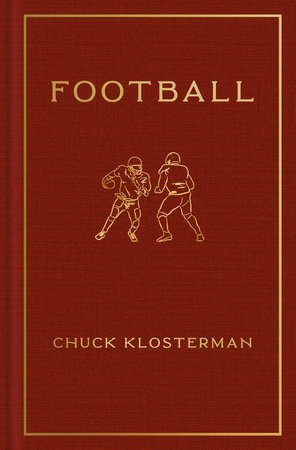
Football

Author Chuck Klosterman On Tour
Hardcover (Paper-over-Board, no jacket)
$32.00 US
6.32"W x 9.52"H x 1.02"D   (16.1 x 24.2 x 2.6 cm) | 16 oz (454 g) | 12 per carton
On sale Jan 20, 2026 | 304 Pages | 9780593490648
Grades 9-12
Sales rights: World

“Could this be the best book on football ever?” —Tyler Cowen

“Eye-opening and entertaining . . . a transcendent appraisal of America’s favorite sport.” —Publishers Weekly (starred review)

A hilarious but nonetheless groundbreaking contribution to the argument about which force shapes American life the most. For two kinds of readers—those who know it’s football and those who are about to find out.


Chuck Klosterman—New York Times bestselling critic, journalist, and, yes, football psychotic—did not write this book to deepen your appreciation of the game. He’s not trying to help you become that person at the party, or to teach you how to make better bets, or to validate any preexisting views you might have about the sport (positive or negative). Football does, in fact, do all of those things. But not in the way such things have been done in the past, and never in a way any normal person would expect.

Cultural theorists talk about hyperobjects—phenomena that bulk so large that their true dimensions are hidden in plain sight. In 2023, 93 of the 100 most-watched programs on U.S. television were NFL football games. This is not an anomaly. This is how society is best understood. Football is not merely the country’s most popular sport; it is engrained in almost everything that explains what America is, even for those who barely pay attention.

Klosterman gets to the bottom of all of it. He takes us to a metaphorical projection of Texas, where the religion of six-man football merges with America’s Team [sic] and makes an inexplicable impact on a boy in North Dakota. He dissects the question of natural greatness, the paradox of gambling and war, and the timeless caricature of the uncompromising head coach. He interrogates the perfection of football’s marriage with television and the morality of acceptable risk. He even conjures an extinction-level event. If Žižek liked the SEC more than he liked cinema, if Stephen Jay Gould cared about linebackers more than he cared about dinosaurs, if Steve Martin played quarterback instead of the banjo . . . it would still be nothing like this.

A century ago, Yale’s legendary coach Walter Camp wrote his unified theory of the game. He called it Football. Chuck Klosterman has given us a new Camp for the new age, rooted in a personal history he cannot escape.
1.

It's Not Like That

Football is an almost impossible game to play. This is not because it requires a unique set of physical skills or mental requirements, nor is it due to any social or political barriers. It's because the game itself is so complicated and overorganized that there's no reasonable way to replicate it recreationally. Any version of football that isn't (in some capacity) "official" is not football. This would seem, on the surface, to work to the sport's detriment: The game is undemocratic. But this is actually a strength, and a big part of what makes it different from so many other seemingly similar pursuits. Football is exclusionary, and that makes it special.

When we think about sports in the abstract, the ease of participation plays a significant factor in how we view the purity of that experience. Soccer is the most popular sport in the world, largely because no team game is easier to play or understand. All that's required is a kickable object and two roughly equal teams to kick that object around. Basketball can be even more spartan-the crux of the game can be pursued and perfected by a single individual playing alone. A pickup game among ten serious hoopers can feel the same as a coordinated league championship, and half-court 3-on-3 encompasses all the core qualities of the standard full-court variety (screening away from the ball, help-side defense, the give-and-go). Baseball needs eighteen players and a geometrically specialized playing surface, which would normally present an obstruction to leisure competition-except we've already established an ancillary sport as a surrogate: Softball is not the same as baseball, but it's more similar than different, and nine million Americans play it every summer. Hockey requires ice and expensive equipment, but the sport's free-flowing nature makes low-impact amateur versions surprisingly plausible (there are at least three adult hockey leagues in Portland, a midsize market with no professional franchise). Golf can be played by anyone who can afford it. Tennis thrives as a leisure activity, and when its physical demands become too taxing, the participant can transition to pickleball (or even ping-pong). You want to play volleyball? Go to a public beach. You miss your bygone days as a high school wrestler? Have six drinks in a bar and insult a stranger who's had nine. A former prep track star can always go for a run; a former swimming sensation can always find a pool; any novice bowler can reproduce the same perfection as a PBA legend, at least for one frame. Our relationship with most spectator sports is tied to a nebulous understanding of how the sport feels. We can replicate the game we see on TV.

But football is not like that.

Tackle football is played by one million people at the high school level, eighty thousand people at the college level, and twenty-seven hundred people at the pro level. That's it. That's the total North American adult football population, equating to .002 percent of the continent as a whole. I mean-sure: You can always play touch football in the backyard, like the Kennedys on the White House lawn or the cast of Friends on Thanksgiving. And yes, 5-on-5 flag football is now an Olympic event, and there's a handful of semipro football leagues scattered across various municipalities. But tackle football does not work as a hobby. It has no wide-scale participatory component as a recreational activity, and unofficial reconstructions have no meaningful relationship to the sport we collectively understand. Legitimate contact football requires large rosters, thousands of dollars of equipment, and multiple weeks of practice and repetition. It's possible to play without coaches, but not without referees. This is not a situation where participants can police themselves. Football is so multifaceted that it's difficult to visualize how a spontaneous version of the game would even be attempted. Imagine if you and ten of your friends were all given helmets and shoulder pads, and a massive grassy field was procured as the venue. Let's also imagine seven officials were available for the enforcement of rules, and eleven other people were randomly enlisted to serve as your opponent. How many minutes would it take to figure out what position every person was supposed to fill? How many hours would be needed to work out even twenty-five basic plays? After the first two minutes of full-speed collisions, how many of your friends would need immediate medical attention? It would be easier to stage an amateur production of Death of a Salesman than an amateur version of a Raiders-Broncos game. Even if you're not trying to produce an actual competitive game-even if you're just trying to accurately mimic the various actions football players do-the outcome will never feel like football. And this is because every detail of football is divorced from non-football life, in a way that other sports are not.

If I go to an open gymnasium with a basketball under my arm and shoot jump shots from the top of the key, I am (obviously) not having the same experience as Steph Curry when he takes an open jumper against the Lakers. Those are two different experiences. They are not, however, unspeakably different. The way I shoot a basketball when I'm by myself is the same way I'd want to shoot it if I were playing in a serious game, and the way Curry releases his jumper against the Lakers has been modeled on the thousands of hours he's spent shooting baskets in a gym by himself. The mechanics of what we're doing is the same in both scenarios, despite a massive difference in the rate of success. If a father sidearm-rifles a baseball at his teenage son standing 90 feet away, the father is making the same throw he'd make playing second base for the Mets; if that father and son visit a batting cage and juice the pitching machine to 103, the machine can photocopy a Nolan Ryan fastball. A hack golfer at Rancho Park tries to sink a 10-foot putt in the same way Brooks Koepka tries to sink a 10-footer at Augusta (the pressure is different, but the stroke is identical). Most sports allow for these simulations. Most sports allow a layperson to physically imitate how that sport operates at the highest level, performed with lower stakes. But football makes that impossible. Two shirtless dudes throwing a pigskin around the college quad has almost no connection to playing quarterback or wide receiver. For one thing, it's exceedingly rare to throw a football at an uncovered, nonmoving target; for another, completing a pass in an actual game is the end result of reading a defense and making an instinctive decision in less than three seconds; for still another, both the passer and the catcher need to accomplish those acts while other people try to put them in the hospital. It's possible to increase the realism by having your buddy run a predetermined route and asking a third person to play defense, but it's still not remotely close to the actual event. Blocking and tackling can't really be mimicked, and full-speed attempts to do so might result in a lawsuit or an arrest. A VR headset can project the visual perspective of a quarterback, but it can't make the user feel like they're wearing pads and it can't generate the visceral sensation of a collapsing pocket. Most critically, the actions of football are based on rehearsal: Almost everything that happens in a football game is the orchestrated extension of trials that have been practiced hundreds (if not thousands) of times, obliterating any possibility for a normal person to connect what they see on television with anything they could attempt or undergo.

This chasm between the game and its audience is so vast that most people obsessed with football have no firsthand perspective on the object of their obsession. Logic suggests that should limit the sport's potentiality. And it would, if football was like other sports. But football is not.

Z

A person who loves football on its most basic level can express any litany of subjective reasons explaining that love, and a person who thinks football is boring or immoral can invert those same reasons as proof that it sucks. If narrowly considered as one sport among many sports, its intrinsic value is debatable. But that debate misses the point. The outsized role football plays in U.S. culture is not a product of its rules or its players. What makes football distinctly compelling is that it's a purely mediated experience, even when there is no media involved.

I'm going to reiterate the previous sentence, because it's going to come up a lot over the next few pages: Football is a purely mediated experience, even when there is no media involved. What this means is that football's significance derives from how it is watched, how it is considered, and the metaphysical power imbuing its animation. This, quite obviously, was not the original intent. None of those elements were pondered when the first football game was played in 1869. They're not often pondered now, in any conscious manner. Yet this subconscious intoxicant is what separates football from all other sports, and it explains why football matters more to American culture than so many other things we'd like to believe have greater value. The reality of football is understood through the unreality of its media depiction, which is the same way we understand most of modern life.

Z

"What was the greatest football game ever played?"

This question, if posed during friendly conversation inside a tavern or a dive bar or a Buffalo Wild Wings, would likely be answered in a highly personal way. Upon considering the query, everyone sitting around the table would nominate the best football game he or she ever witnessed. My reflexive answer is the 1981 playoff between the Chargers and the Dolphins, a game now nicknamed the Epic in Miami. If I kept talking, I might change my answer to the 1984 Orange Bowl (when Nebraska coach Tom Osborne valiantly and unsuccessfully attempted a late two-point conversion, costing the Huskers the national title to Miami) or the 2006 Rose Bowl (when Vince Young and Texas beat USC 41-38). Maybe I'd mention the 2021 AFC Divisional Playoff as a more recent example (a 42-36 overtime shootout between Patrick Mahomes and Josh Allen). If our dialogue continued unabated, I might start nominating perverse alternatives that focus on the weather or a statistical anomaly or an unrelated event happening in my own life. Such a conversation could last hours, with all involved parties referencing any halfway memorable game they halfway remember. If, however, this conversation was not friendly an d uninhibited-if it was a trivia contest, or if the discussion was being recorded for a podcast-any well-educated person would give the same answer: the 1958 NFL Championship between the Baltimore Colts and the New York Giants. This is the only irrefutable answer to the question, "What was the greatest football game ever played?" in part because that specific phrase has become the event's designation. That game happened fourteen years before I was born. I've never watched it in its entirety, and I doubt even 10 percent of those who'd classify this contest as "the greatest game ever played" believe that statement to be true. However, I can't remember any point in my life when I was not aware that this was the greatest game in football history. How I came to know this is unclear, though I do know why I came to know this, and why so many other people know the same thing: television.

The 1958 Colts-Giants game was the first overtime game in NFL history. It's sometimes cited as the first example of a quarterback utilizing a two-minute drill to rapidly move his team downfield (a claim that's almost certainly untrue, though the QB in this case-the Colts' Johnny Unitas-was still regularly classified as the greatest quarterback in history until the end of the 1980s). It was a tight game and a meaningful game and a game involving many noteworthy figures. But the reason we continue to venerate this game (above all others) is barely connected to what happened on the field. It's primarily remembered for the 45 million people who watched it on NBC, a then-colossal ratings number achieved without a single viewer from metro New York (where the game was blacked out).

The 1958 NFL title game is the origin of modern football, not as a sport but as an idea that exists for TV. What happened on the field became imperative because it was simultaneously happening everywhere else, with a capacity for detail its live audience in Yankee Stadium completely missed. It's not as if 45 million people watched this game and realized that football was somehow unlike what they'd previously imagined. What they realized is that nothing-nothing-had ever been better designed for TV than this particular sport. It was the sudden comprehension of accidental perfection, spawning a relationship that would transform the parameters of what a sport can mean to a society increasingly controlled by a mediacentric view of everything.

Television defined the last half of the twentieth century, outperforming all other mass media combined. This was already understood by the onset of the 1970s, prompting countless network executives to kill themselves in the hope of creating something impeccably suited for sitting in front of an electromagnetic box and remaining there for as long as possible. This typically entailed thoughtful consideration over the content of TV: what a program was about, how it was written, and what personalities were involved. But what's even more critical, and far harder to manufacture, is the form of the program: the pacing, the visual construction, and the way the watcher experiences whatever they happen to be watching. How a person thinks about television is a manifestation of its content; how a person feels about television is a manifestation of its form. And there's simply never been a TV product more formally successful than televised football. This was an accident. But it turns out you can't design something on purpose that's superior to the way televised football naturally occurs.

I realize I'm making an aesthetic argument many will not accept, particularly if they start from the position that football games are boring, meaningless, or both. The merits of televised football as a formal spectacle are immaterial to someone who hates the thing being televised, in the same way the harmonic simplicity of Miles Davis is immaterial to someone who hates jazz. Appreciating the TV experience of football requires some casual interest in the game itself. But what makes the TV experience of football so remarkable is how "casual interest" is more than enough to generate an illogically deep level of satisfaction. The way football is broadcast manages to obliterate any difference between an informal consumer and a face-painting fanatic. This is due to many factors, the most critical being that football is always, always, always better on television than it is in person. The televised experience is so superior to the in-person experience that most people watching a football game live are mentally converting what they're seeing into its TV equivalent, without even trying.
“Chuck Klosterman’s Football—an investigation of the socio-cultural layers of college football in places like Texas and the Southeast—is another masterwork from one of our greatest minds.” Esquire

Football features [Klosterman’s] signature brand of humorous, sardonic and thought-provoking writing . . . A book worth keeping around and a great recommendation for the diehard and casual fan alike.” Edward Banchs, Pittsburgh Post-Gazette

“Klosterman’s thoughtful and revealing exploration of his and America’s obsession is insightful and richly infused with his engaging and entertaining perceptions.” —Booklist

“It is not a controversial thing to say that football is America’s game: it is violent, martial, and tribal; it makes billions of dollars and exploits thousands of people; it is brash and jingoistic, clinging all the while to an antiquated paternalism that fetishizes hierarchy and patriarchy. Yes, indeed, it is America’s game. And if you have any doubts, there is no better writer alive than Chuck Klosterman to walk you through all of the above . . . and much, much more.” Jonny Diamond, Lit Hub (Most Anticipated Books of 2026)

“Eye-opening and entertaining . . . Approaching the subject with rigor and drawing on his lifelong fascination with the game, Klosterman sheds light on football’s ‘outsized and underrated’ role in shaping contemporary culture. The result is a transcendent appraisal of America’s favorite sport.” —Publishers Weekly (starred review)

“Funny, thought-provoking . . . Marshalling [Klosterman’s] customary blend of learned and low-culture references—Noam Chomsky, meet AC/DC . . . a smart, rewarding consideration of football’s popularity—and eventual downfall.” —Kirkus (starred review)

“Klosterman is one of those writers whom I find it truly joyous to read, taking pure satisfaction in the simple act of reading words from a writer who cares about his craft, knows what he’s doing, and is clearly having a blast. It doesn’t matter what he’s writing about: I find it actively fun to read him, and have done so for more than two decades now. Whenever he has a new book come out, I find it difficult not to finish it in one setting.” —Will Leitch

“An excellent and highly conceptual book about America’s favorite sport. Could this be the best book on (American) football ever?” —Tyler Cowen
© Joanna Ceciliani
Chuck Klosterman is the bestselling author of nine nonfiction books (including Football; X; The Nineties; Sex, Drugs, and Cocoa Puffs; and But What If We’re Wrong?), two novels (Downtown Owl and The Visible Man), and the short story collection Raised in Captivity. He has written for The New York Times, The Washington Post, GQ (London), Esquire, Spin, The Guardian (London), The Believer, and ESPN. Klosterman served as the Ethicist for The New York Times Magazine for three years and was an original founder of the website Grantland with Bill Simmons. He was raised in rural North Dakota and now lives in Portland, Oregon. View titles by Chuck Klosterman
Available for sale exclusive:
•     Afghanistan
•     Aland Islands
•     Albania
•     Algeria
•     Andorra
•     Angola
•     Anguilla
•     Antarctica
•     Antigua/Barbuda
•     Argentina
•     Armenia
•     Aruba
•     Australia
•     Austria
•     Azerbaijan
•     Bahamas
•     Bahrain
•     Bangladesh
•     Barbados
•     Belarus
•     Belgium
•     Belize
•     Benin
•     Bermuda
•     Bhutan
•     Bolivia
•     Bonaire, Saba
•     Bosnia Herzeg.
•     Botswana
•     Bouvet Island
•     Brazil
•     Brit.Ind.Oc.Ter
•     Brit.Virgin Is.
•     Brunei
•     Bulgaria
•     Burkina Faso
•     Burundi
•     Cambodia
•     Cameroon
•     Canada
•     Cape Verde
•     Cayman Islands
•     Centr.Afr.Rep.
•     Chad
•     Chile
•     China
•     Christmas Islnd
•     Cocos Islands
•     Colombia
•     Comoro Is.
•     Congo
•     Cook Islands
•     Costa Rica
•     Croatia
•     Cuba
•     Curacao
•     Cyprus
•     Czech Republic
•     Dem. Rep. Congo
•     Denmark
•     Djibouti
•     Dominica
•     Dominican Rep.
•     Ecuador
•     Egypt
•     El Salvador
•     Equatorial Gui.
•     Eritrea
•     Estonia
•     Ethiopia
•     Falkland Islnds
•     Faroe Islands
•     Fiji
•     Finland
•     France
•     Fren.Polynesia
•     French Guinea
•     Gabon
•     Gambia
•     Georgia
•     Germany
•     Ghana
•     Gibraltar
•     Greece
•     Greenland
•     Grenada
•     Guadeloupe
•     Guam
•     Guatemala
•     Guernsey
•     Guinea Republic
•     Guinea-Bissau
•     Guyana
•     Haiti
•     Heard/McDon.Isl
•     Honduras
•     Hong Kong
•     Hungary
•     Iceland
•     India
•     Indonesia
•     Iran
•     Iraq
•     Ireland
•     Isle of Man
•     Israel
•     Italy
•     Ivory Coast
•     Jamaica
•     Japan
•     Jersey
•     Jordan
•     Kazakhstan
•     Kenya
•     Kiribati
•     Kuwait
•     Kyrgyzstan
•     Laos
•     Latvia
•     Lebanon
•     Lesotho
•     Liberia
•     Libya
•     Liechtenstein
•     Lithuania
•     Luxembourg
•     Macau
•     Macedonia
•     Madagascar
•     Malawi
•     Malaysia
•     Maldives
•     Mali
•     Malta
•     Marshall island
•     Martinique
•     Mauritania
•     Mauritius
•     Mayotte
•     Mexico
•     Micronesia
•     Minor Outl.Ins.
•     Moldavia
•     Monaco
•     Mongolia
•     Montenegro
•     Montserrat
•     Morocco
•     Mozambique
•     Myanmar
•     Namibia
•     Nauru
•     Nepal
•     Netherlands
•     New Caledonia
•     New Zealand
•     Nicaragua
•     Niger
•     Nigeria
•     Niue
•     Norfolk Island
•     North Korea
•     North Mariana
•     Norway
•     Oman
•     Pakistan
•     Palau
•     Palestinian Ter
•     Panama
•     PapuaNewGuinea
•     Paraguay
•     Peru
•     Philippines
•     Pitcairn Islnds
•     Poland
•     Portugal
•     Puerto Rico
•     Qatar
•     Reunion Island
•     Romania
•     Russian Fed.
•     Rwanda
•     S. Sandwich Ins
•     Saint Martin
•     Samoa,American
•     San Marino
•     SaoTome Princip
•     Saudi Arabia
•     Senegal
•     Serbia
•     Seychelles
•     Sierra Leone
•     Singapore
•     Sint Maarten
•     Slovakia
•     Slovenia
•     Solomon Islands
•     Somalia
•     South Africa
•     South Korea
•     South Sudan
•     Spain
•     Sri Lanka
•     St Barthelemy
•     St. Helena
•     St. Lucia
•     St. Vincent
•     St.Chr.,Nevis
•     St.Pier,Miquel.
•     Sth Terr. Franc
•     Sudan
•     Suriname
•     Svalbard
•     Swaziland
•     Sweden
•     Switzerland
•     Syria
•     Tadschikistan
•     Taiwan
•     Tanzania
•     Thailand
•     Timor-Leste
•     Togo
•     Tokelau Islands
•     Tonga
•     Trinidad,Tobago
•     Tunisia
•     Turkey
•     Turkmenistan
•     Turks&Caicos Is
•     Tuvalu
•     US Virgin Is.
•     USA
•     Uganda
•     Ukraine
•     Unit.Arab Emir.
•     United Kingdom
•     Uruguay
•     Uzbekistan
•     Vanuatu
•     Vatican City
•     Venezuela
•     Vietnam
•     Wallis,Futuna
•     West Saharan
•     Western Samoa
•     Yemen
•     Zambia
•     Zimbabwe

About

“Could this be the best book on football ever?” —Tyler Cowen

“Eye-opening and entertaining . . . a transcendent appraisal of America’s favorite sport.” —Publishers Weekly (starred review)

A hilarious but nonetheless groundbreaking contribution to the argument about which force shapes American life the most. For two kinds of readers—those who know it’s football and those who are about to find out.


Chuck Klosterman—New York Times bestselling critic, journalist, and, yes, football psychotic—did not write this book to deepen your appreciation of the game. He’s not trying to help you become that person at the party, or to teach you how to make better bets, or to validate any preexisting views you might have about the sport (positive or negative). Football does, in fact, do all of those things. But not in the way such things have been done in the past, and never in a way any normal person would expect.

Cultural theorists talk about hyperobjects—phenomena that bulk so large that their true dimensions are hidden in plain sight. In 2023, 93 of the 100 most-watched programs on U.S. television were NFL football games. This is not an anomaly. This is how society is best understood. Football is not merely the country’s most popular sport; it is engrained in almost everything that explains what America is, even for those who barely pay attention.

Klosterman gets to the bottom of all of it. He takes us to a metaphorical projection of Texas, where the religion of six-man football merges with America’s Team [sic] and makes an inexplicable impact on a boy in North Dakota. He dissects the question of natural greatness, the paradox of gambling and war, and the timeless caricature of the uncompromising head coach. He interrogates the perfection of football’s marriage with television and the morality of acceptable risk. He even conjures an extinction-level event. If Žižek liked the SEC more than he liked cinema, if Stephen Jay Gould cared about linebackers more than he cared about dinosaurs, if Steve Martin played quarterback instead of the banjo . . . it would still be nothing like this.

A century ago, Yale’s legendary coach Walter Camp wrote his unified theory of the game. He called it Football. Chuck Klosterman has given us a new Camp for the new age, rooted in a personal history he cannot escape.

Excerpt

1.

It's Not Like That

Football is an almost impossible game to play. This is not because it requires a unique set of physical skills or mental requirements, nor is it due to any social or political barriers. It's because the game itself is so complicated and overorganized that there's no reasonable way to replicate it recreationally. Any version of football that isn't (in some capacity) "official" is not football. This would seem, on the surface, to work to the sport's detriment: The game is undemocratic. But this is actually a strength, and a big part of what makes it different from so many other seemingly similar pursuits. Football is exclusionary, and that makes it special.

When we think about sports in the abstract, the ease of participation plays a significant factor in how we view the purity of that experience. Soccer is the most popular sport in the world, largely because no team game is easier to play or understand. All that's required is a kickable object and two roughly equal teams to kick that object around. Basketball can be even more spartan-the crux of the game can be pursued and perfected by a single individual playing alone. A pickup game among ten serious hoopers can feel the same as a coordinated league championship, and half-court 3-on-3 encompasses all the core qualities of the standard full-court variety (screening away from the ball, help-side defense, the give-and-go). Baseball needs eighteen players and a geometrically specialized playing surface, which would normally present an obstruction to leisure competition-except we've already established an ancillary sport as a surrogate: Softball is not the same as baseball, but it's more similar than different, and nine million Americans play it every summer. Hockey requires ice and expensive equipment, but the sport's free-flowing nature makes low-impact amateur versions surprisingly plausible (there are at least three adult hockey leagues in Portland, a midsize market with no professional franchise). Golf can be played by anyone who can afford it. Tennis thrives as a leisure activity, and when its physical demands become too taxing, the participant can transition to pickleball (or even ping-pong). You want to play volleyball? Go to a public beach. You miss your bygone days as a high school wrestler? Have six drinks in a bar and insult a stranger who's had nine. A former prep track star can always go for a run; a former swimming sensation can always find a pool; any novice bowler can reproduce the same perfection as a PBA legend, at least for one frame. Our relationship with most spectator sports is tied to a nebulous understanding of how the sport feels. We can replicate the game we see on TV.

But football is not like that.

Tackle football is played by one million people at the high school level, eighty thousand people at the college level, and twenty-seven hundred people at the pro level. That's it. That's the total North American adult football population, equating to .002 percent of the continent as a whole. I mean-sure: You can always play touch football in the backyard, like the Kennedys on the White House lawn or the cast of Friends on Thanksgiving. And yes, 5-on-5 flag football is now an Olympic event, and there's a handful of semipro football leagues scattered across various municipalities. But tackle football does not work as a hobby. It has no wide-scale participatory component as a recreational activity, and unofficial reconstructions have no meaningful relationship to the sport we collectively understand. Legitimate contact football requires large rosters, thousands of dollars of equipment, and multiple weeks of practice and repetition. It's possible to play without coaches, but not without referees. This is not a situation where participants can police themselves. Football is so multifaceted that it's difficult to visualize how a spontaneous version of the game would even be attempted. Imagine if you and ten of your friends were all given helmets and shoulder pads, and a massive grassy field was procured as the venue. Let's also imagine seven officials were available for the enforcement of rules, and eleven other people were randomly enlisted to serve as your opponent. How many minutes would it take to figure out what position every person was supposed to fill? How many hours would be needed to work out even twenty-five basic plays? After the first two minutes of full-speed collisions, how many of your friends would need immediate medical attention? It would be easier to stage an amateur production of Death of a Salesman than an amateur version of a Raiders-Broncos game. Even if you're not trying to produce an actual competitive game-even if you're just trying to accurately mimic the various actions football players do-the outcome will never feel like football. And this is because every detail of football is divorced from non-football life, in a way that other sports are not.

If I go to an open gymnasium with a basketball under my arm and shoot jump shots from the top of the key, I am (obviously) not having the same experience as Steph Curry when he takes an open jumper against the Lakers. Those are two different experiences. They are not, however, unspeakably different. The way I shoot a basketball when I'm by myself is the same way I'd want to shoot it if I were playing in a serious game, and the way Curry releases his jumper against the Lakers has been modeled on the thousands of hours he's spent shooting baskets in a gym by himself. The mechanics of what we're doing is the same in both scenarios, despite a massive difference in the rate of success. If a father sidearm-rifles a baseball at his teenage son standing 90 feet away, the father is making the same throw he'd make playing second base for the Mets; if that father and son visit a batting cage and juice the pitching machine to 103, the machine can photocopy a Nolan Ryan fastball. A hack golfer at Rancho Park tries to sink a 10-foot putt in the same way Brooks Koepka tries to sink a 10-footer at Augusta (the pressure is different, but the stroke is identical). Most sports allow for these simulations. Most sports allow a layperson to physically imitate how that sport operates at the highest level, performed with lower stakes. But football makes that impossible. Two shirtless dudes throwing a pigskin around the college quad has almost no connection to playing quarterback or wide receiver. For one thing, it's exceedingly rare to throw a football at an uncovered, nonmoving target; for another, completing a pass in an actual game is the end result of reading a defense and making an instinctive decision in less than three seconds; for still another, both the passer and the catcher need to accomplish those acts while other people try to put them in the hospital. It's possible to increase the realism by having your buddy run a predetermined route and asking a third person to play defense, but it's still not remotely close to the actual event. Blocking and tackling can't really be mimicked, and full-speed attempts to do so might result in a lawsuit or an arrest. A VR headset can project the visual perspective of a quarterback, but it can't make the user feel like they're wearing pads and it can't generate the visceral sensation of a collapsing pocket. Most critically, the actions of football are based on rehearsal: Almost everything that happens in a football game is the orchestrated extension of trials that have been practiced hundreds (if not thousands) of times, obliterating any possibility for a normal person to connect what they see on television with anything they could attempt or undergo.

This chasm between the game and its audience is so vast that most people obsessed with football have no firsthand perspective on the object of their obsession. Logic suggests that should limit the sport's potentiality. And it would, if football was like other sports. But football is not.

Z

A person who loves football on its most basic level can express any litany of subjective reasons explaining that love, and a person who thinks football is boring or immoral can invert those same reasons as proof that it sucks. If narrowly considered as one sport among many sports, its intrinsic value is debatable. But that debate misses the point. The outsized role football plays in U.S. culture is not a product of its rules or its players. What makes football distinctly compelling is that it's a purely mediated experience, even when there is no media involved.

I'm going to reiterate the previous sentence, because it's going to come up a lot over the next few pages: Football is a purely mediated experience, even when there is no media involved. What this means is that football's significance derives from how it is watched, how it is considered, and the metaphysical power imbuing its animation. This, quite obviously, was not the original intent. None of those elements were pondered when the first football game was played in 1869. They're not often pondered now, in any conscious manner. Yet this subconscious intoxicant is what separates football from all other sports, and it explains why football matters more to American culture than so many other things we'd like to believe have greater value. The reality of football is understood through the unreality of its media depiction, which is the same way we understand most of modern life.

Z

"What was the greatest football game ever played?"

This question, if posed during friendly conversation inside a tavern or a dive bar or a Buffalo Wild Wings, would likely be answered in a highly personal way. Upon considering the query, everyone sitting around the table would nominate the best football game he or she ever witnessed. My reflexive answer is the 1981 playoff between the Chargers and the Dolphins, a game now nicknamed the Epic in Miami. If I kept talking, I might change my answer to the 1984 Orange Bowl (when Nebraska coach Tom Osborne valiantly and unsuccessfully attempted a late two-point conversion, costing the Huskers the national title to Miami) or the 2006 Rose Bowl (when Vince Young and Texas beat USC 41-38). Maybe I'd mention the 2021 AFC Divisional Playoff as a more recent example (a 42-36 overtime shootout between Patrick Mahomes and Josh Allen). If our dialogue continued unabated, I might start nominating perverse alternatives that focus on the weather or a statistical anomaly or an unrelated event happening in my own life. Such a conversation could last hours, with all involved parties referencing any halfway memorable game they halfway remember. If, however, this conversation was not friendly an d uninhibited-if it was a trivia contest, or if the discussion was being recorded for a podcast-any well-educated person would give the same answer: the 1958 NFL Championship between the Baltimore Colts and the New York Giants. This is the only irrefutable answer to the question, "What was the greatest football game ever played?" in part because that specific phrase has become the event's designation. That game happened fourteen years before I was born. I've never watched it in its entirety, and I doubt even 10 percent of those who'd classify this contest as "the greatest game ever played" believe that statement to be true. However, I can't remember any point in my life when I was not aware that this was the greatest game in football history. How I came to know this is unclear, though I do know why I came to know this, and why so many other people know the same thing: television.

The 1958 Colts-Giants game was the first overtime game in NFL history. It's sometimes cited as the first example of a quarterback utilizing a two-minute drill to rapidly move his team downfield (a claim that's almost certainly untrue, though the QB in this case-the Colts' Johnny Unitas-was still regularly classified as the greatest quarterback in history until the end of the 1980s). It was a tight game and a meaningful game and a game involving many noteworthy figures. But the reason we continue to venerate this game (above all others) is barely connected to what happened on the field. It's primarily remembered for the 45 million people who watched it on NBC, a then-colossal ratings number achieved without a single viewer from metro New York (where the game was blacked out).

The 1958 NFL title game is the origin of modern football, not as a sport but as an idea that exists for TV. What happened on the field became imperative because it was simultaneously happening everywhere else, with a capacity for detail its live audience in Yankee Stadium completely missed. It's not as if 45 million people watched this game and realized that football was somehow unlike what they'd previously imagined. What they realized is that nothing-nothing-had ever been better designed for TV than this particular sport. It was the sudden comprehension of accidental perfection, spawning a relationship that would transform the parameters of what a sport can mean to a society increasingly controlled by a mediacentric view of everything.

Television defined the last half of the twentieth century, outperforming all other mass media combined. This was already understood by the onset of the 1970s, prompting countless network executives to kill themselves in the hope of creating something impeccably suited for sitting in front of an electromagnetic box and remaining there for as long as possible. This typically entailed thoughtful consideration over the content of TV: what a program was about, how it was written, and what personalities were involved. But what's even more critical, and far harder to manufacture, is the form of the program: the pacing, the visual construction, and the way the watcher experiences whatever they happen to be watching. How a person thinks about television is a manifestation of its content; how a person feels about television is a manifestation of its form. And there's simply never been a TV product more formally successful than televised football. This was an accident. But it turns out you can't design something on purpose that's superior to the way televised football naturally occurs.

I realize I'm making an aesthetic argument many will not accept, particularly if they start from the position that football games are boring, meaningless, or both. The merits of televised football as a formal spectacle are immaterial to someone who hates the thing being televised, in the same way the harmonic simplicity of Miles Davis is immaterial to someone who hates jazz. Appreciating the TV experience of football requires some casual interest in the game itself. But what makes the TV experience of football so remarkable is how "casual interest" is more than enough to generate an illogically deep level of satisfaction. The way football is broadcast manages to obliterate any difference between an informal consumer and a face-painting fanatic. This is due to many factors, the most critical being that football is always, always, always better on television than it is in person. The televised experience is so superior to the in-person experience that most people watching a football game live are mentally converting what they're seeing into its TV equivalent, without even trying.

Praise

“Chuck Klosterman’s Football—an investigation of the socio-cultural layers of college football in places like Texas and the Southeast—is another masterwork from one of our greatest minds.” Esquire

Football features [Klosterman’s] signature brand of humorous, sardonic and thought-provoking writing . . . A book worth keeping around and a great recommendation for the diehard and casual fan alike.” Edward Banchs, Pittsburgh Post-Gazette

“Klosterman’s thoughtful and revealing exploration of his and America’s obsession is insightful and richly infused with his engaging and entertaining perceptions.” —Booklist

“It is not a controversial thing to say that football is America’s game: it is violent, martial, and tribal; it makes billions of dollars and exploits thousands of people; it is brash and jingoistic, clinging all the while to an antiquated paternalism that fetishizes hierarchy and patriarchy. Yes, indeed, it is America’s game. And if you have any doubts, there is no better writer alive than Chuck Klosterman to walk you through all of the above . . . and much, much more.” Jonny Diamond, Lit Hub (Most Anticipated Books of 2026)

“Eye-opening and entertaining . . . Approaching the subject with rigor and drawing on his lifelong fascination with the game, Klosterman sheds light on football’s ‘outsized and underrated’ role in shaping contemporary culture. The result is a transcendent appraisal of America’s favorite sport.” —Publishers Weekly (starred review)

“Funny, thought-provoking . . . Marshalling [Klosterman’s] customary blend of learned and low-culture references—Noam Chomsky, meet AC/DC . . . a smart, rewarding consideration of football’s popularity—and eventual downfall.” —Kirkus (starred review)

“Klosterman is one of those writers whom I find it truly joyous to read, taking pure satisfaction in the simple act of reading words from a writer who cares about his craft, knows what he’s doing, and is clearly having a blast. It doesn’t matter what he’s writing about: I find it actively fun to read him, and have done so for more than two decades now. Whenever he has a new book come out, I find it difficult not to finish it in one setting.” —Will Leitch

“An excellent and highly conceptual book about America’s favorite sport. Could this be the best book on (American) football ever?” —Tyler Cowen

Author

© Joanna Ceciliani
Chuck Klosterman is the bestselling author of nine nonfiction books (including Football; X; The Nineties; Sex, Drugs, and Cocoa Puffs; and But What If We’re Wrong?), two novels (Downtown Owl and The Visible Man), and the short story collection Raised in Captivity. He has written for The New York Times, The Washington Post, GQ (London), Esquire, Spin, The Guardian (London), The Believer, and ESPN. Klosterman served as the Ethicist for The New York Times Magazine for three years and was an original founder of the website Grantland with Bill Simmons. He was raised in rural North Dakota and now lives in Portland, Oregon. View titles by Chuck Klosterman

Rights

Available for sale exclusive:
•     Afghanistan
•     Aland Islands
•     Albania
•     Algeria
•     Andorra
•     Angola
•     Anguilla
•     Antarctica
•     Antigua/Barbuda
•     Argentina
•     Armenia
•     Aruba
•     Australia
•     Austria
•     Azerbaijan
•     Bahamas
•     Bahrain
•     Bangladesh
•     Barbados
•     Belarus
•     Belgium
•     Belize
•     Benin
•     Bermuda
•     Bhutan
•     Bolivia
•     Bonaire, Saba
•     Bosnia Herzeg.
•     Botswana
•     Bouvet Island
•     Brazil
•     Brit.Ind.Oc.Ter
•     Brit.Virgin Is.
•     Brunei
•     Bulgaria
•     Burkina Faso
•     Burundi
•     Cambodia
•     Cameroon
•     Canada
•     Cape Verde
•     Cayman Islands
•     Centr.Afr.Rep.
•     Chad
•     Chile
•     China
•     Christmas Islnd
•     Cocos Islands
•     Colombia
•     Comoro Is.
•     Congo
•     Cook Islands
•     Costa Rica
•     Croatia
•     Cuba
•     Curacao
•     Cyprus
•     Czech Republic
•     Dem. Rep. Congo
•     Denmark
•     Djibouti
•     Dominica
•     Dominican Rep.
•     Ecuador
•     Egypt
•     El Salvador
•     Equatorial Gui.
•     Eritrea
•     Estonia
•     Ethiopia
•     Falkland Islnds
•     Faroe Islands
•     Fiji
•     Finland
•     France
•     Fren.Polynesia
•     French Guinea
•     Gabon
•     Gambia
•     Georgia
•     Germany
•     Ghana
•     Gibraltar
•     Greece
•     Greenland
•     Grenada
•     Guadeloupe
•     Guam
•     Guatemala
•     Guernsey
•     Guinea Republic
•     Guinea-Bissau
•     Guyana
•     Haiti
•     Heard/McDon.Isl
•     Honduras
•     Hong Kong
•     Hungary
•     Iceland
•     India
•     Indonesia
•     Iran
•     Iraq
•     Ireland
•     Isle of Man
•     Israel
•     Italy
•     Ivory Coast
•     Jamaica
•     Japan
•     Jersey
•     Jordan
•     Kazakhstan
•     Kenya
•     Kiribati
•     Kuwait
•     Kyrgyzstan
•     Laos
•     Latvia
•     Lebanon
•     Lesotho
•     Liberia
•     Libya
•     Liechtenstein
•     Lithuania
•     Luxembourg
•     Macau
•     Macedonia
•     Madagascar
•     Malawi
•     Malaysia
•     Maldives
•     Mali
•     Malta
•     Marshall island
•     Martinique
•     Mauritania
•     Mauritius
•     Mayotte
•     Mexico
•     Micronesia
•     Minor Outl.Ins.
•     Moldavia
•     Monaco
•     Mongolia
•     Montenegro
•     Montserrat
•     Morocco
•     Mozambique
•     Myanmar
•     Namibia
•     Nauru
•     Nepal
•     Netherlands
•     New Caledonia
•     New Zealand
•     Nicaragua
•     Niger
•     Nigeria
•     Niue
•     Norfolk Island
•     North Korea
•     North Mariana
•     Norway
•     Oman
•     Pakistan
•     Palau
•     Palestinian Ter
•     Panama
•     PapuaNewGuinea
•     Paraguay
•     Peru
•     Philippines
•     Pitcairn Islnds
•     Poland
•     Portugal
•     Puerto Rico
•     Qatar
•     Reunion Island
•     Romania
•     Russian Fed.
•     Rwanda
•     S. Sandwich Ins
•     Saint Martin
•     Samoa,American
•     San Marino
•     SaoTome Princip
•     Saudi Arabia
•     Senegal
•     Serbia
•     Seychelles
•     Sierra Leone
•     Singapore
•     Sint Maarten
•     Slovakia
•     Slovenia
•     Solomon Islands
•     Somalia
•     South Africa
•     South Korea
•     South Sudan
•     Spain
•     Sri Lanka
•     St Barthelemy
•     St. Helena
•     St. Lucia
•     St. Vincent
•     St.Chr.,Nevis
•     St.Pier,Miquel.
•     Sth Terr. Franc
•     Sudan
•     Suriname
•     Svalbard
•     Swaziland
•     Sweden
•     Switzerland
•     Syria
•     Tadschikistan
•     Taiwan
•     Tanzania
•     Thailand
•     Timor-Leste
•     Togo
•     Tokelau Islands
•     Tonga
•     Trinidad,Tobago
•     Tunisia
•     Turkey
•     Turkmenistan
•     Turks&Caicos Is
•     Tuvalu
•     US Virgin Is.
•     USA
•     Uganda
•     Ukraine
•     Unit.Arab Emir.
•     United Kingdom
•     Uruguay
•     Uzbekistan
•     Vanuatu
•     Vatican City
•     Venezuela
•     Vietnam
•     Wallis,Futuna
•     West Saharan
•     Western Samoa
•     Yemen
•     Zambia
•     Zimbabwe