Close Modal

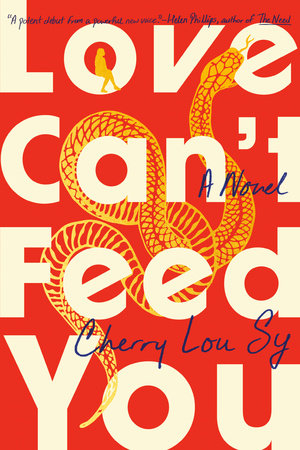
Love Can't Feed You

A Novel

Look inside
Hardcover
$28.00 US
5.73"W x 8.56"H x 1.12"D   (14.6 x 21.7 x 2.8 cm) | 15 oz (431 g) | 12 per carton
On sale Oct 08, 2024 | 336 Pages | 9780593474549
Grades 9-12
Sales rights: US, Canada, Open Mkt

A beautiful, tender yet searing debut novel about intergenerational fractures and coming of age, following a young woman who immigrates to the United States from the Philippines and finds herself adrift between familial expectations and her own burning desires

Love Can't Feed You is a stunning, heartbreaking, and compressed look at coming of age, shifting notions of home, and the disintegration of the American dream. It asks us: What does it mean to be of multiple cultures without a road map for how to belong?        

After a harrowing flight, Queenie, her younger brother, and their elderly Chinese father arrive in the United States from the Philippines. They’re here to finally reunite with Queenie’s Filipina mother, who has been working as a nurse in Brooklyn for the past few years—building a life that everyone hopes will set them up for better prospects. But her mother is not the same woman she was in the Philippines: Something in her face is different, almost hardened, and she seems so American already.
 
Queenie, on the cusp of adulthood, has big dreams of attending college, of spending her days immersed in the pages of books. But there is not enough money for her and her brother to both be in school, so first she must work. Queenie rotates through jobs and settles, tentatively, into her new life, but her brother begins to withdraw and act out, and her father’s anger swells. As the pressures of assimilation compound, and the fissures within her family deepen into fractures, Queenie is left suspended between two countries, two identities, and two parents.
I am going to die. My body contracts the second the plane descends from thirty thousand feet. I feel bile in my throat and grab another vomit bag. I think of the stories others will tell about me-gone too soon, what a shame that she didn't get to live out her potential. This is not how anyone imagines arriving to America.

Papa tells me to pray. My mouth forms Hail Marys, but the monster in my stomach shoves its way to my throat again. The queasiness possesses me with violence and pins me to my seat as I lurch like the women from back home-the ones who thrash on the ground filled with the Holy Spirit.

"I should have given you the Dramamine," Papa says for the tenth time since we left Ninoy Aquino International Airport in Manila.

Papa didn't let me eat anything he could save for later: the crumbly granola bars, foil-wrapped biscuits, and even the hard dinner rolls. He pocketed the silverware too.

He complains to the flight attendant and asks for more vomit bags since I have used mine, his, and even Junior's vomit bags. Junior sleeps soundly on the other side of Papa, his legs akimbo. A white woman next to me turns to her young companion and shakes her head. Her disgust pierces through my nausea.

"Never have children," she says.

My ears pop and the rest of her words blur. The plane rocks from the turbulence of November winds. My eyes roll to the back of my head.

"Can't you do something about your grandchild?" the woman asks Papa.

Papa apologizes to her, ashamed to say that I am not his grandchild but his teenage daughter. How could he explain his silver hair to her? How could he explain that he fathered his first child-who has done nothing but stir trouble-at the age of fifty? He says that I've been throwing up nonstop because he didn't give me Dramamine. How this is our first plane ride. How he should have known that this was like taking a long bus ride, only worse. He even tells this stranger that he would give me Dramamine as a two-year-old to control the motion sickness, a sickness that made me a terrible travel companion when what he needed was a good girl who never made a fuss.

The white woman softens a little and tells him how she learned from a Chinese herbalist that ginger is good for motion sickness, and that he should be giving me ginger instead. She mentions that the herbalist helped her with her many health issues, explaining the concept of hot and cold air in the body, the yin and yang.

"Aren't you Chinese?" she asks him. Papa's tongue loosens and says yes, but not exactly Chinese. The woman's mouth makes an O.

He tells her that his parents moved from China to the Philippines and that he was born and left in the hospital for two years because his parents couldn't afford to have another mouth to feed.

"What a shame," the woman says, then asks him if we are going to the US for a visit. Papa pauses. It feels like the same question the man from the embassy asked us a few months before. Papa tells her the story we all rehearsed before the interview to get our visas. That we're tourists visiting Ma, who's been in New York working as a nurse for the last five years. That we're going to see snow for the first time. That five years is long enough for a mother to go without seeing her family.

"What do you do?" the woman asks.

"Business," Papa says.

The little lies and the big lies all meld. He doesn't tell her about all the money he lost-how he bought wholesale rice the year when three Category 3 typhoons flooded the rice fields, along with the stockrooms that housed the harvested rice, or that his partner ran away with the money that was supposed to be used to pay off their creditors. He doesn't tell her about getting into the export business with an Australian man who fled after the big earthquake and left him with a storage house filled with giant rotting wood carvings. He doesn't tell her that he wants to start fresh in America. He doesn't tell her about his plans for his son and daughter to go to American schools and have American lives, or that we bought round-trip tickets for a one-way journey. This is inside talk that she doesn't need to hear.

"How long are you going to stay?" she asks.

We are on alert. Junior, whose eyes were closed a moment earlier, turns and looks at Papa. Even in my state, where every movement causes me discomfort, I sense danger and turn my head a little with my eyes closed. Papa slows down, careful not to give away too much, though he has given away so much already.

"Until the end of winter," he says, repeating the rehearsed words we said to the man in the gray suit at the embassy as he looked us over, one by one, trying to gauge what was true and what was not. Junior asked Papa then, before the interview, if it's all right to lie, and Papa said yes-when you have to.

The woman hails one of the flight attendants and clears her throat. "Do you have Dramamine by any chance?" she asks, pointing to me.

The flight attendant, a thin young woman with long hair, looks at me and says in a low voice, "We're not supposed to have it. Regulations, you know.

"Someone from across the aisle overhears her and fishes something out of her bag, a tube of Dramamine. She offers it to our neighbor. "I forgot I had this."

At this moment, I vomit again and some of the bile gets on my T-shirt, jeans, and jacket-clothes from the last balikbayan box Ma sent in preparation for the trip. The strong, distinct scent of puke emanates from my mouth, all traces of food I've eaten on the plane from Manila to Japan combined into a fermented, sour mess."

She may not be able to hold this down if she keeps throwing up like that," the woman who talked about yin and yang says, wrinkling her nose.None of these humiliations are enough, of course. My sanitary pad needed changing over two hours ago, but I don't dare get up to go to the bathroom. I can't anyway. My body defies me and here I am, an animal sitting in her own bloody filth. Another jolt in the air. Another wave of nausea. I reach for the vomit bag. I moan.

JFK, New York

When the plane lands, in the confusion, Papa loses an entire bag of handmade salakot, native headgear and hats he purchased from roadside sellers. They are supposed to be souvenir gifts for Ma's friends.

They put me in a blue wheelchair. I cling tightly to the handles and fight back exhaustion. A Black woman with long brown braids pushes my wheelchair, her hands covered in blue latex gloves."She's been throwing up. Nonstop," she says to the man in uniform behind the counter. He nods, then looks through our passports and asks Papa about the purpose of our trip."

A vacation," Papa says.

We go through customs and passport control a bit too easily. They take pity on the sick girl; the tired, confused elderly man with her; and the boy who looks just as tired and confused as the old man.

We see Ma at the arrival gate. She looks like someone we know and don't know. Her made-up face smoothened by concealer, foundation, and powder-but we can see the edges where her skin begins and the makeup ends. Eyes brightened by mascara, eye shadow, and eyeliner. Lips painted with bright red lipstick. She chats with a short, plump woman holding a small dog tucked under her arm like a baby. We recognize her and her dog from pictures Ma has sent. Tita Cynthia, an older Filipina widow who befriended her at the hospital, where they both worked on a medical-surgical floor.

I am too weak to get up, but I notice how Papa looks at Ma. The way his irises go up and down, as if looking at her directly would hurt his eyes, so he focuses on points of her. Her shoulders arched back with her chest lifted. Her hair done up with highlights. Her shaped eyebrows. She looks sleek and expensive. Like a woman we see on television.

A woman I remember seeing once.

When I was twelve, a few months before Ma left for New York, we went to the local Jollibee and ordered a round of cheeseburgers, Chickenjoys, sweet spaghetti, and plastic cups of pineapple juice. For the first time, I hardly recognized Ma at all. Her expression was blank, faraway, like she was watching for something that was about to happen. This moment stands out to me as a portent-I had just learned that word, portent, from the thick dictionary I often skimmed to look up English words, like octet, officious, and fallacious. Perhaps this was the moment when we lost Ma.

She seemed both girl and woman, familiar and unfamiliar, beautiful and ethereal. When she got up to go to the bathroom, Ate Tessie sat down in her place. My mind froze. How quickly a person can be replaced. All she needs to do is to disappear from the space she once occupied. I cried out in alarm, and everyone looked at me.

When Ma came back, her face was normal again. But with that glimpse of her, that woman who was my mother and not my mother, something changed in me.Here she is now. A woman, once again, transformed.Ma hugs Junior first and comments on how big he's gotten. She last saw him at five years old, and Junior has shot to ten in a blink. He barely remembers her, but he still puts his arms out to embrace our mother.

"Hug me harder," Ma says, and he does.

When she turns to me, her eyes widen as she takes in my frozen hands, matted hair, and pale face. She asks Papa what happened. He repeats what he's been telling everyone this whole trip. He forgot to give me Dramamine. Ma rolls her eyes. With this small action, I knew her again. Until this moment, I didn't know whether I would.

She's about to say something to me when I lean in and whisper, "Do you have a pad? I need one."

Sunset Park, Brooklyn

"Your mother's changed," Papa says to Junior and me in between bites of lo mein, sesame chicken, and pork fried rice. We nod in agreement. She is as foreign as this new place we are in.Everything in this city seems new, old, and strange. That balmy November, the first thing we noticed driving on the highway from JFK was the expanse of New York. In Manila, the cars, tricycles, jeepneys, and trucks choked each other's space like weeds. The traffic was so unbelievable that men, women, and children could walk by and steal purses and belongings if you cracked your window open for some of the tepid air. But driving into Brooklyn was strange. Everything was grimy. Our fears shot up looking at our neighborhood in Sunset Park. Graffiti and dilapidated buildings everywhere. No white people in sight. This was not what we expected. We expected to see the Big Apple from the movies right away. The Empire State Building. The skyscrapers. Men in suits. Wall Street. White people everywhere doing American things like in TV shows. Papa even asks Ma, "Where are all the Americans?"

We want to be here and not back home where everyone is trying to leave. I'd seen in movies how people, upon arrival, would kiss the ground and scream. But we don't belong in the movies, so we don't act big, screaming our joy.

It takes five full days before the nausea subsides. I barely notice the apartment, which is smaller than the basement we lived in previously, which had three small bedrooms in addition to the kitchen and living room. Here, there was only one bedroom. Papa seemed disappointed when he looked around and noticed the single queen-sized bed and a small futon on the floor. "Bakit ganoon?" he asked. Ma shrugged and said that he could sleep on the couch in the living room if he wanted. He hasn't been in a good mood since.

"Everyone changes here," Ma says. She's coming out from the shower wrapped in a baby-pink terry cloth robe, drying her hair with a towel. She walks to the bedroom, and we all watch her, mesmerized. The way she carries herself, head held high, her steps so sure of where they're going, and even how she smells-pungent from liberal sprays of what I discovered is Victoria's Secret body spray. This is not the Ma we knew.

"Everyone's got to start working," Ma says. "I owe a lot of money for bringing you all here." None of us respond, shocked that she would bring this up.

"Even me?" Junior asks, his eyes wide.

"No, you're ten. So you go to school since it's free."

"How about me?" I ask."

We can get work for you-"

"But I want to go to college!"

"Yes, you can do that and still work, but right now, it's better to go to work."

This was not what she said months ago on the phone. When I mentioned that it'd be cheaper if I stayed in the Philippines and went to one of the universities, she claimed I'd be able to go to college in the US. We both knew that attending school in the Philippines is not what I wanted. There was prestige in going to school abroad. Ma said I could be an American college student. My high school classmates, when they found out I was migrating, were jealous and compared their lives to mine. "Buti ka pa, pa-abroad abroad ka pa," they said. Ma instructed me to tell the embassy interviewer that I might go get my degree in America, if we liked it, and I would pay for my degree out of pocket. "They like to hear that we'll spend money here," she said.

"Now, wait a minute," Papa finally says, "this is not what we talked about."

Ma rolls her eyes, of course.

"That's not what we told the guy in the interview," I say, reminding her.

"You lie, big deal. Everyone does it. How do you think anyone gets by?" Ma is irritated. "A new life costs money," she says, and she starts listing her hardships. She arrived in New York with the clothes on her back, one small piece of luggage, and six hundred dollars to her name. She tells us how she worked nights and took extra shifts while trying to pass her licensing exam, which she took not once but three times. It was a feat, and did we not know it?
Winner of the Zibby Award for Best Coming-of-Age Book

A CBS New York Book Club Top 3 FickPick

A People Book of the Week

Gold House October Book Club Pick

An Amazon Best Book of the Month

One of Vanity Fair’s “Can’t-Miss Novels to Read in November”

“[A] gorgeously written, shattering debut…Deeply compassionate and devastating.”
People, "Best of October"

“A tender-hearted coming-of-age story”
Harper’s Bazaar, "Best Books of Fall"

“Occasionally dark, ultimately profound, Love Can’t Feed You illustrates the challenge of figuring out who you are when your life straddles two worlds.”
Real Simple

“This powerful debut novel explores the complexities of immigration, identity, and family through the lens of Queenie, a young Filipina woman navigating life in the U.S. as she balances familial expectations and her own ambitions. Set against the backdrop of the American dream, Queenie’s journey paints a vivid portrait of intergenerational fractures, cultural displacement, and the longing for belonging.”
—Gold House

“Astonishing . . . Sy skillfully lays bare Queenie’s wide-ranging emotions, from rage to sadness, and reveals the nuances of the family members’ relationships. Rich details of Filipino culture such as folk stories and religious iconography are interwoven with gritty depictions of the compromises made by the immigrant characters . . . It’s a knockout.”
Publishers Weekly, *starred review*

“Strong characterizations and heartfelt emotions are well depicted in this engrossing coming-of-age story, full of surprising narratives.”
Library Journal

Love Can't Feed You is a stunningly written, devastating book about all manners of suspension, between countries, between parents, between identities, between what it is to be a woman and what it is to be a girl. Cherry Lou Sy is a brilliant and exacting observer of human uncertainty and desire and this book is an utter thrill.”
—Lynn Steger Strong, author of Flight

“One of my favorite genres is New York City immigrant literature, and so it is extra-thrilling to immerse oneself in a new entry in that canon! Cherry Lou Sy brings her expert playwriting gifts into the realm of Filipina coming-of-age novel and the results are stunning. At every turn, I was struck by our storyteller’s stunning precision—that kind of attention to detail is often described as ‘cold’ and ‘sharp’ but in Cherry Lou Sy’s moving novel the skill is sourced from much warmth and tenderness. Plus, the unwillingness to simplify and spoon-feed identity is key to why Love Can't Feed You works so well; this novel is an intensely engrossing master-class in a most real all-encompassing humanity!”
—Porochista Khakpour, author of Tehrangeles

"Love Can't Feed You is a searing, searching, soulful novel of the utmost humanity. An intoxicating examination of desire and shame, at turns sublimely tender and incandescent with rage, it asks who deserves to live with dignity in an America divided by class, color, and capitalism. I devoured this book."
—Cecily Wong, author of Kaleidoscope

“Cherry Lou Sy’s picaresque-like Love Can't Feed You follows five years of our mixed Chinese Filipina narrator’s life as she immigrates to New York, adapts to her family’s fracturing dynamic, and transitions to adulthood. Imbued with folklore and biting social critique, this novel interrogates the ways young women come to terms with their own desires inside familial and social structures designed to work against them. ‘We can’t eat stories,’ the narrator claims, but I swallowed this alternately haunting and heartening tale whole, and chewed on it long after.”
—Jami Nakamura Lin, author of The Night Parade

“In Love Can’t Feed You, Cherry Lou Sy keenly and compassionately evokes a vivid cast of characters. Queenie is an irresistibly honest and wise narrator who carries the reader along as she navigates her many identities—Filipina, Chinese, New Yorker, immigrant, daughter, sister, student, worker, woman, friend, lover. Rich with emotional nuance and deeply absorbing, Love Can’t Feed You is a potent debut from a powerful new voice.”
—Helen Phillips, author of The Need

“A rollercoaster of emotions and an assault on the senses. Through the lives of one family, Sy has distilled the immigrant experience down to its most painful and traumatic moments, in the process writing an intelligent, wide ranging gut-punch of a debut. Queenie, the protagonist, is the very personification of instinct, curiosity, dislocation, and adaptation. This is a New York book that captures well what happens when life becomes about survival more than living.”
—Alejandro Varela, author of The Town of Babylon
© Aleksander Smageen
Cherry Lou Sy is a writer and playwright originally from the Philippines currently based in Brooklyn, NY. She received her BA at the Gallatin School of Individualized Study at NYU and her MFA in playwriting from Brooklyn College, where she has been an adjunct lecturer in the English and American Studies departments. Cherry is also a teacher with PEN America’s DREAMing Out Loud. She has received fellowships and residencies from VONA, Tin House, and elsewhere. Love Can’t Feed You is her debut novel. View titles by Cherry Lou Sy
Available for sale exclusive:
•     Canada
•     Guam
•     Minor Outl.Ins.
•     North Mariana
•     Philippines
•     Puerto Rico
•     Samoa,American
•     US Virgin Is.
•     USA

Available for sale non-exclusive:
•     Afghanistan
•     Aland Islands
•     Albania
•     Algeria
•     Andorra
•     Angola
•     Anguilla
•     Antarctica
•     Argentina
•     Armenia
•     Aruba
•     Austria
•     Azerbaijan
•     Bahrain
•     Belarus
•     Belgium
•     Benin
•     Bolivia
•     Bonaire, Saba
•     Bosnia Herzeg.
•     Bouvet Island
•     Brazil
•     Bulgaria
•     Burkina Faso
•     Burundi
•     Cambodia
•     Cameroon
•     Cape Verde
•     Centr.Afr.Rep.
•     Chad
•     Chile
•     China
•     Colombia
•     Comoro Is.
•     Congo
•     Cook Islands
•     Costa Rica
•     Croatia
•     Cuba
•     Curacao
•     Czech Republic
•     Dem. Rep. Congo
•     Denmark
•     Djibouti
•     Dominican Rep.
•     Ecuador
•     Egypt
•     El Salvador
•     Equatorial Gui.
•     Eritrea
•     Estonia
•     Ethiopia
•     Faroe Islands
•     Finland
•     France
•     Fren.Polynesia
•     French Guinea
•     Gabon
•     Georgia
•     Germany
•     Greece
•     Greenland
•     Guadeloupe
•     Guatemala
•     Guinea Republic
•     Guinea-Bissau
•     Haiti
•     Heard/McDon.Isl
•     Honduras
•     Hong Kong
•     Hungary
•     Iceland
•     India
•     Indonesia
•     Iran
•     Iraq
•     Israel
•     Italy
•     Ivory Coast
•     Japan
•     Jordan
•     Kazakhstan
•     Kuwait
•     Kyrgyzstan
•     Laos
•     Latvia
•     Lebanon
•     Liberia
•     Libya
•     Liechtenstein
•     Lithuania
•     Luxembourg
•     Macau
•     Macedonia
•     Madagascar
•     Malaysia
•     Maldives
•     Mali
•     Marshall island
•     Martinique
•     Mauritania
•     Mayotte
•     Mexico
•     Micronesia
•     Moldavia
•     Monaco
•     Mongolia
•     Montenegro
•     Morocco
•     Myanmar
•     Nepal
•     Netherlands
•     New Caledonia
•     Nicaragua
•     Niger
•     Niue
•     Norfolk Island
•     North Korea
•     Norway
•     Oman
•     Palau
•     Palestinian Ter
•     Panama
•     Paraguay
•     Peru
•     Poland
•     Portugal
•     Qatar
•     Reunion Island
•     Romania
•     Russian Fed.
•     Rwanda
•     Saint Martin
•     San Marino
•     SaoTome Princip
•     Saudi Arabia
•     Senegal
•     Serbia
•     Singapore
•     Sint Maarten
•     Slovakia
•     Slovenia
•     South Korea
•     South Sudan
•     Spain
•     St Barthelemy
•     St.Pier,Miquel.
•     Sth Terr. Franc
•     Sudan
•     Suriname
•     Svalbard
•     Sweden
•     Switzerland
•     Syria
•     Tadschikistan
•     Taiwan
•     Thailand
•     Timor-Leste
•     Togo
•     Tokelau Islands
•     Tunisia
•     Turkey
•     Turkmenistan
•     Ukraine
•     Unit.Arab Emir.
•     Uruguay
•     Uzbekistan
•     Vatican City
•     Venezuela
•     Vietnam
•     Wallis,Futuna
•     West Saharan
•     Western Samoa
•     Yemen

Not available for sale:
•     Antigua/Barbuda
•     Australia
•     Bahamas
•     Bangladesh
•     Barbados
•     Belize
•     Bermuda
•     Bhutan
•     Botswana
•     Brit.Ind.Oc.Ter
•     Brit.Virgin Is.
•     Brunei
•     Cayman Islands
•     Christmas Islnd
•     Cocos Islands
•     Cyprus
•     Dominica
•     Falkland Islnds
•     Fiji
•     Gambia
•     Ghana
•     Gibraltar
•     Grenada
•     Guernsey
•     Guyana
•     Ireland
•     Isle of Man
•     Jamaica
•     Jersey
•     Kenya
•     Kiribati
•     Lesotho
•     Malawi
•     Malta
•     Mauritius
•     Montserrat
•     Mozambique
•     Namibia
•     Nauru
•     New Zealand
•     Nigeria
•     Pakistan
•     PapuaNewGuinea
•     Pitcairn Islnds
•     S. Sandwich Ins
•     Seychelles
•     Sierra Leone
•     Solomon Islands
•     Somalia
•     South Africa
•     Sri Lanka
•     St. Helena
•     St. Lucia
•     St. Vincent
•     St.Chr.,Nevis
•     Swaziland
•     Tanzania
•     Tonga
•     Trinidad,Tobago
•     Turks&Caicos Is
•     Tuvalu
•     Uganda
•     United Kingdom
•     Vanuatu
•     Zambia
•     Zimbabwe

About

A beautiful, tender yet searing debut novel about intergenerational fractures and coming of age, following a young woman who immigrates to the United States from the Philippines and finds herself adrift between familial expectations and her own burning desires

Love Can't Feed You is a stunning, heartbreaking, and compressed look at coming of age, shifting notions of home, and the disintegration of the American dream. It asks us: What does it mean to be of multiple cultures without a road map for how to belong?        

After a harrowing flight, Queenie, her younger brother, and their elderly Chinese father arrive in the United States from the Philippines. They’re here to finally reunite with Queenie’s Filipina mother, who has been working as a nurse in Brooklyn for the past few years—building a life that everyone hopes will set them up for better prospects. But her mother is not the same woman she was in the Philippines: Something in her face is different, almost hardened, and she seems so American already.
 
Queenie, on the cusp of adulthood, has big dreams of attending college, of spending her days immersed in the pages of books. But there is not enough money for her and her brother to both be in school, so first she must work. Queenie rotates through jobs and settles, tentatively, into her new life, but her brother begins to withdraw and act out, and her father’s anger swells. As the pressures of assimilation compound, and the fissures within her family deepen into fractures, Queenie is left suspended between two countries, two identities, and two parents.

Excerpt

I am going to die. My body contracts the second the plane descends from thirty thousand feet. I feel bile in my throat and grab another vomit bag. I think of the stories others will tell about me-gone too soon, what a shame that she didn't get to live out her potential. This is not how anyone imagines arriving to America.

Papa tells me to pray. My mouth forms Hail Marys, but the monster in my stomach shoves its way to my throat again. The queasiness possesses me with violence and pins me to my seat as I lurch like the women from back home-the ones who thrash on the ground filled with the Holy Spirit.

"I should have given you the Dramamine," Papa says for the tenth time since we left Ninoy Aquino International Airport in Manila.

Papa didn't let me eat anything he could save for later: the crumbly granola bars, foil-wrapped biscuits, and even the hard dinner rolls. He pocketed the silverware too.

He complains to the flight attendant and asks for more vomit bags since I have used mine, his, and even Junior's vomit bags. Junior sleeps soundly on the other side of Papa, his legs akimbo. A white woman next to me turns to her young companion and shakes her head. Her disgust pierces through my nausea.

"Never have children," she says.

My ears pop and the rest of her words blur. The plane rocks from the turbulence of November winds. My eyes roll to the back of my head.

"Can't you do something about your grandchild?" the woman asks Papa.

Papa apologizes to her, ashamed to say that I am not his grandchild but his teenage daughter. How could he explain his silver hair to her? How could he explain that he fathered his first child-who has done nothing but stir trouble-at the age of fifty? He says that I've been throwing up nonstop because he didn't give me Dramamine. How this is our first plane ride. How he should have known that this was like taking a long bus ride, only worse. He even tells this stranger that he would give me Dramamine as a two-year-old to control the motion sickness, a sickness that made me a terrible travel companion when what he needed was a good girl who never made a fuss.

The white woman softens a little and tells him how she learned from a Chinese herbalist that ginger is good for motion sickness, and that he should be giving me ginger instead. She mentions that the herbalist helped her with her many health issues, explaining the concept of hot and cold air in the body, the yin and yang.

"Aren't you Chinese?" she asks him. Papa's tongue loosens and says yes, but not exactly Chinese. The woman's mouth makes an O.

He tells her that his parents moved from China to the Philippines and that he was born and left in the hospital for two years because his parents couldn't afford to have another mouth to feed.

"What a shame," the woman says, then asks him if we are going to the US for a visit. Papa pauses. It feels like the same question the man from the embassy asked us a few months before. Papa tells her the story we all rehearsed before the interview to get our visas. That we're tourists visiting Ma, who's been in New York working as a nurse for the last five years. That we're going to see snow for the first time. That five years is long enough for a mother to go without seeing her family.

"What do you do?" the woman asks.

"Business," Papa says.

The little lies and the big lies all meld. He doesn't tell her about all the money he lost-how he bought wholesale rice the year when three Category 3 typhoons flooded the rice fields, along with the stockrooms that housed the harvested rice, or that his partner ran away with the money that was supposed to be used to pay off their creditors. He doesn't tell her about getting into the export business with an Australian man who fled after the big earthquake and left him with a storage house filled with giant rotting wood carvings. He doesn't tell her that he wants to start fresh in America. He doesn't tell her about his plans for his son and daughter to go to American schools and have American lives, or that we bought round-trip tickets for a one-way journey. This is inside talk that she doesn't need to hear.

"How long are you going to stay?" she asks.

We are on alert. Junior, whose eyes were closed a moment earlier, turns and looks at Papa. Even in my state, where every movement causes me discomfort, I sense danger and turn my head a little with my eyes closed. Papa slows down, careful not to give away too much, though he has given away so much already.

"Until the end of winter," he says, repeating the rehearsed words we said to the man in the gray suit at the embassy as he looked us over, one by one, trying to gauge what was true and what was not. Junior asked Papa then, before the interview, if it's all right to lie, and Papa said yes-when you have to.

The woman hails one of the flight attendants and clears her throat. "Do you have Dramamine by any chance?" she asks, pointing to me.

The flight attendant, a thin young woman with long hair, looks at me and says in a low voice, "We're not supposed to have it. Regulations, you know.

"Someone from across the aisle overhears her and fishes something out of her bag, a tube of Dramamine. She offers it to our neighbor. "I forgot I had this."

At this moment, I vomit again and some of the bile gets on my T-shirt, jeans, and jacket-clothes from the last balikbayan box Ma sent in preparation for the trip. The strong, distinct scent of puke emanates from my mouth, all traces of food I've eaten on the plane from Manila to Japan combined into a fermented, sour mess."

She may not be able to hold this down if she keeps throwing up like that," the woman who talked about yin and yang says, wrinkling her nose.None of these humiliations are enough, of course. My sanitary pad needed changing over two hours ago, but I don't dare get up to go to the bathroom. I can't anyway. My body defies me and here I am, an animal sitting in her own bloody filth. Another jolt in the air. Another wave of nausea. I reach for the vomit bag. I moan.

JFK, New York

When the plane lands, in the confusion, Papa loses an entire bag of handmade salakot, native headgear and hats he purchased from roadside sellers. They are supposed to be souvenir gifts for Ma's friends.

They put me in a blue wheelchair. I cling tightly to the handles and fight back exhaustion. A Black woman with long brown braids pushes my wheelchair, her hands covered in blue latex gloves."She's been throwing up. Nonstop," she says to the man in uniform behind the counter. He nods, then looks through our passports and asks Papa about the purpose of our trip."

A vacation," Papa says.

We go through customs and passport control a bit too easily. They take pity on the sick girl; the tired, confused elderly man with her; and the boy who looks just as tired and confused as the old man.

We see Ma at the arrival gate. She looks like someone we know and don't know. Her made-up face smoothened by concealer, foundation, and powder-but we can see the edges where her skin begins and the makeup ends. Eyes brightened by mascara, eye shadow, and eyeliner. Lips painted with bright red lipstick. She chats with a short, plump woman holding a small dog tucked under her arm like a baby. We recognize her and her dog from pictures Ma has sent. Tita Cynthia, an older Filipina widow who befriended her at the hospital, where they both worked on a medical-surgical floor.

I am too weak to get up, but I notice how Papa looks at Ma. The way his irises go up and down, as if looking at her directly would hurt his eyes, so he focuses on points of her. Her shoulders arched back with her chest lifted. Her hair done up with highlights. Her shaped eyebrows. She looks sleek and expensive. Like a woman we see on television.

A woman I remember seeing once.

When I was twelve, a few months before Ma left for New York, we went to the local Jollibee and ordered a round of cheeseburgers, Chickenjoys, sweet spaghetti, and plastic cups of pineapple juice. For the first time, I hardly recognized Ma at all. Her expression was blank, faraway, like she was watching for something that was about to happen. This moment stands out to me as a portent-I had just learned that word, portent, from the thick dictionary I often skimmed to look up English words, like octet, officious, and fallacious. Perhaps this was the moment when we lost Ma.

She seemed both girl and woman, familiar and unfamiliar, beautiful and ethereal. When she got up to go to the bathroom, Ate Tessie sat down in her place. My mind froze. How quickly a person can be replaced. All she needs to do is to disappear from the space she once occupied. I cried out in alarm, and everyone looked at me.

When Ma came back, her face was normal again. But with that glimpse of her, that woman who was my mother and not my mother, something changed in me.Here she is now. A woman, once again, transformed.Ma hugs Junior first and comments on how big he's gotten. She last saw him at five years old, and Junior has shot to ten in a blink. He barely remembers her, but he still puts his arms out to embrace our mother.

"Hug me harder," Ma says, and he does.

When she turns to me, her eyes widen as she takes in my frozen hands, matted hair, and pale face. She asks Papa what happened. He repeats what he's been telling everyone this whole trip. He forgot to give me Dramamine. Ma rolls her eyes. With this small action, I knew her again. Until this moment, I didn't know whether I would.

She's about to say something to me when I lean in and whisper, "Do you have a pad? I need one."

Sunset Park, Brooklyn

"Your mother's changed," Papa says to Junior and me in between bites of lo mein, sesame chicken, and pork fried rice. We nod in agreement. She is as foreign as this new place we are in.Everything in this city seems new, old, and strange. That balmy November, the first thing we noticed driving on the highway from JFK was the expanse of New York. In Manila, the cars, tricycles, jeepneys, and trucks choked each other's space like weeds. The traffic was so unbelievable that men, women, and children could walk by and steal purses and belongings if you cracked your window open for some of the tepid air. But driving into Brooklyn was strange. Everything was grimy. Our fears shot up looking at our neighborhood in Sunset Park. Graffiti and dilapidated buildings everywhere. No white people in sight. This was not what we expected. We expected to see the Big Apple from the movies right away. The Empire State Building. The skyscrapers. Men in suits. Wall Street. White people everywhere doing American things like in TV shows. Papa even asks Ma, "Where are all the Americans?"

We want to be here and not back home where everyone is trying to leave. I'd seen in movies how people, upon arrival, would kiss the ground and scream. But we don't belong in the movies, so we don't act big, screaming our joy.

It takes five full days before the nausea subsides. I barely notice the apartment, which is smaller than the basement we lived in previously, which had three small bedrooms in addition to the kitchen and living room. Here, there was only one bedroom. Papa seemed disappointed when he looked around and noticed the single queen-sized bed and a small futon on the floor. "Bakit ganoon?" he asked. Ma shrugged and said that he could sleep on the couch in the living room if he wanted. He hasn't been in a good mood since.

"Everyone changes here," Ma says. She's coming out from the shower wrapped in a baby-pink terry cloth robe, drying her hair with a towel. She walks to the bedroom, and we all watch her, mesmerized. The way she carries herself, head held high, her steps so sure of where they're going, and even how she smells-pungent from liberal sprays of what I discovered is Victoria's Secret body spray. This is not the Ma we knew.

"Everyone's got to start working," Ma says. "I owe a lot of money for bringing you all here." None of us respond, shocked that she would bring this up.

"Even me?" Junior asks, his eyes wide.

"No, you're ten. So you go to school since it's free."

"How about me?" I ask."

We can get work for you-"

"But I want to go to college!"

"Yes, you can do that and still work, but right now, it's better to go to work."

This was not what she said months ago on the phone. When I mentioned that it'd be cheaper if I stayed in the Philippines and went to one of the universities, she claimed I'd be able to go to college in the US. We both knew that attending school in the Philippines is not what I wanted. There was prestige in going to school abroad. Ma said I could be an American college student. My high school classmates, when they found out I was migrating, were jealous and compared their lives to mine. "Buti ka pa, pa-abroad abroad ka pa," they said. Ma instructed me to tell the embassy interviewer that I might go get my degree in America, if we liked it, and I would pay for my degree out of pocket. "They like to hear that we'll spend money here," she said.

"Now, wait a minute," Papa finally says, "this is not what we talked about."

Ma rolls her eyes, of course.

"That's not what we told the guy in the interview," I say, reminding her.

"You lie, big deal. Everyone does it. How do you think anyone gets by?" Ma is irritated. "A new life costs money," she says, and she starts listing her hardships. She arrived in New York with the clothes on her back, one small piece of luggage, and six hundred dollars to her name. She tells us how she worked nights and took extra shifts while trying to pass her licensing exam, which she took not once but three times. It was a feat, and did we not know it?

Praise

Winner of the Zibby Award for Best Coming-of-Age Book

A CBS New York Book Club Top 3 FickPick

A People Book of the Week

Gold House October Book Club Pick

An Amazon Best Book of the Month

One of Vanity Fair’s “Can’t-Miss Novels to Read in November”

“[A] gorgeously written, shattering debut…Deeply compassionate and devastating.”
People, "Best of October"

“A tender-hearted coming-of-age story”
Harper’s Bazaar, "Best Books of Fall"

“Occasionally dark, ultimately profound, Love Can’t Feed You illustrates the challenge of figuring out who you are when your life straddles two worlds.”
Real Simple

“This powerful debut novel explores the complexities of immigration, identity, and family through the lens of Queenie, a young Filipina woman navigating life in the U.S. as she balances familial expectations and her own ambitions. Set against the backdrop of the American dream, Queenie’s journey paints a vivid portrait of intergenerational fractures, cultural displacement, and the longing for belonging.”
—Gold House

“Astonishing . . . Sy skillfully lays bare Queenie’s wide-ranging emotions, from rage to sadness, and reveals the nuances of the family members’ relationships. Rich details of Filipino culture such as folk stories and religious iconography are interwoven with gritty depictions of the compromises made by the immigrant characters . . . It’s a knockout.”
Publishers Weekly, *starred review*

“Strong characterizations and heartfelt emotions are well depicted in this engrossing coming-of-age story, full of surprising narratives.”
Library Journal

Love Can't Feed You is a stunningly written, devastating book about all manners of suspension, between countries, between parents, between identities, between what it is to be a woman and what it is to be a girl. Cherry Lou Sy is a brilliant and exacting observer of human uncertainty and desire and this book is an utter thrill.”
—Lynn Steger Strong, author of Flight

“One of my favorite genres is New York City immigrant literature, and so it is extra-thrilling to immerse oneself in a new entry in that canon! Cherry Lou Sy brings her expert playwriting gifts into the realm of Filipina coming-of-age novel and the results are stunning. At every turn, I was struck by our storyteller’s stunning precision—that kind of attention to detail is often described as ‘cold’ and ‘sharp’ but in Cherry Lou Sy’s moving novel the skill is sourced from much warmth and tenderness. Plus, the unwillingness to simplify and spoon-feed identity is key to why Love Can't Feed You works so well; this novel is an intensely engrossing master-class in a most real all-encompassing humanity!”
—Porochista Khakpour, author of Tehrangeles

"Love Can't Feed You is a searing, searching, soulful novel of the utmost humanity. An intoxicating examination of desire and shame, at turns sublimely tender and incandescent with rage, it asks who deserves to live with dignity in an America divided by class, color, and capitalism. I devoured this book."
—Cecily Wong, author of Kaleidoscope

“Cherry Lou Sy’s picaresque-like Love Can't Feed You follows five years of our mixed Chinese Filipina narrator’s life as she immigrates to New York, adapts to her family’s fracturing dynamic, and transitions to adulthood. Imbued with folklore and biting social critique, this novel interrogates the ways young women come to terms with their own desires inside familial and social structures designed to work against them. ‘We can’t eat stories,’ the narrator claims, but I swallowed this alternately haunting and heartening tale whole, and chewed on it long after.”
—Jami Nakamura Lin, author of The Night Parade

“In Love Can’t Feed You, Cherry Lou Sy keenly and compassionately evokes a vivid cast of characters. Queenie is an irresistibly honest and wise narrator who carries the reader along as she navigates her many identities—Filipina, Chinese, New Yorker, immigrant, daughter, sister, student, worker, woman, friend, lover. Rich with emotional nuance and deeply absorbing, Love Can’t Feed You is a potent debut from a powerful new voice.”
—Helen Phillips, author of The Need

“A rollercoaster of emotions and an assault on the senses. Through the lives of one family, Sy has distilled the immigrant experience down to its most painful and traumatic moments, in the process writing an intelligent, wide ranging gut-punch of a debut. Queenie, the protagonist, is the very personification of instinct, curiosity, dislocation, and adaptation. This is a New York book that captures well what happens when life becomes about survival more than living.”
—Alejandro Varela, author of The Town of Babylon

Author

© Aleksander Smageen
Cherry Lou Sy is a writer and playwright originally from the Philippines currently based in Brooklyn, NY. She received her BA at the Gallatin School of Individualized Study at NYU and her MFA in playwriting from Brooklyn College, where she has been an adjunct lecturer in the English and American Studies departments. Cherry is also a teacher with PEN America’s DREAMing Out Loud. She has received fellowships and residencies from VONA, Tin House, and elsewhere. Love Can’t Feed You is her debut novel. View titles by Cherry Lou Sy

Rights

Available for sale exclusive:
•     Canada
•     Guam
•     Minor Outl.Ins.
•     North Mariana
•     Philippines
•     Puerto Rico
•     Samoa,American
•     US Virgin Is.
•     USA

Available for sale non-exclusive:
•     Afghanistan
•     Aland Islands
•     Albania
•     Algeria
•     Andorra
•     Angola
•     Anguilla
•     Antarctica
•     Argentina
•     Armenia
•     Aruba
•     Austria
•     Azerbaijan
•     Bahrain
•     Belarus
•     Belgium
•     Benin
•     Bolivia
•     Bonaire, Saba
•     Bosnia Herzeg.
•     Bouvet Island
•     Brazil
•     Bulgaria
•     Burkina Faso
•     Burundi
•     Cambodia
•     Cameroon
•     Cape Verde
•     Centr.Afr.Rep.
•     Chad
•     Chile
•     China
•     Colombia
•     Comoro Is.
•     Congo
•     Cook Islands
•     Costa Rica
•     Croatia
•     Cuba
•     Curacao
•     Czech Republic
•     Dem. Rep. Congo
•     Denmark
•     Djibouti
•     Dominican Rep.
•     Ecuador
•     Egypt
•     El Salvador
•     Equatorial Gui.
•     Eritrea
•     Estonia
•     Ethiopia
•     Faroe Islands
•     Finland
•     France
•     Fren.Polynesia
•     French Guinea
•     Gabon
•     Georgia
•     Germany
•     Greece
•     Greenland
•     Guadeloupe
•     Guatemala
•     Guinea Republic
•     Guinea-Bissau
•     Haiti
•     Heard/McDon.Isl
•     Honduras
•     Hong Kong
•     Hungary
•     Iceland
•     India
•     Indonesia
•     Iran
•     Iraq
•     Israel
•     Italy
•     Ivory Coast
•     Japan
•     Jordan
•     Kazakhstan
•     Kuwait
•     Kyrgyzstan
•     Laos
•     Latvia
•     Lebanon
•     Liberia
•     Libya
•     Liechtenstein
•     Lithuania
•     Luxembourg
•     Macau
•     Macedonia
•     Madagascar
•     Malaysia
•     Maldives
•     Mali
•     Marshall island
•     Martinique
•     Mauritania
•     Mayotte
•     Mexico
•     Micronesia
•     Moldavia
•     Monaco
•     Mongolia
•     Montenegro
•     Morocco
•     Myanmar
•     Nepal
•     Netherlands
•     New Caledonia
•     Nicaragua
•     Niger
•     Niue
•     Norfolk Island
•     North Korea
•     Norway
•     Oman
•     Palau
•     Palestinian Ter
•     Panama
•     Paraguay
•     Peru
•     Poland
•     Portugal
•     Qatar
•     Reunion Island
•     Romania
•     Russian Fed.
•     Rwanda
•     Saint Martin
•     San Marino
•     SaoTome Princip
•     Saudi Arabia
•     Senegal
•     Serbia
•     Singapore
•     Sint Maarten
•     Slovakia
•     Slovenia
•     South Korea
•     South Sudan
•     Spain
•     St Barthelemy
•     St.Pier,Miquel.
•     Sth Terr. Franc
•     Sudan
•     Suriname
•     Svalbard
•     Sweden
•     Switzerland
•     Syria
•     Tadschikistan
•     Taiwan
•     Thailand
•     Timor-Leste
•     Togo
•     Tokelau Islands
•     Tunisia
•     Turkey
•     Turkmenistan
•     Ukraine
•     Unit.Arab Emir.
•     Uruguay
•     Uzbekistan
•     Vatican City
•     Venezuela
•     Vietnam
•     Wallis,Futuna
•     West Saharan
•     Western Samoa
•     Yemen

Not available for sale:
•     Antigua/Barbuda
•     Australia
•     Bahamas
•     Bangladesh
•     Barbados
•     Belize
•     Bermuda
•     Bhutan
•     Botswana
•     Brit.Ind.Oc.Ter
•     Brit.Virgin Is.
•     Brunei
•     Cayman Islands
•     Christmas Islnd
•     Cocos Islands
•     Cyprus
•     Dominica
•     Falkland Islnds
•     Fiji
•     Gambia
•     Ghana
•     Gibraltar
•     Grenada
•     Guernsey
•     Guyana
•     Ireland
•     Isle of Man
•     Jamaica
•     Jersey
•     Kenya
•     Kiribati
•     Lesotho
•     Malawi
•     Malta
•     Mauritius
•     Montserrat
•     Mozambique
•     Namibia
•     Nauru
•     New Zealand
•     Nigeria
•     Pakistan
•     PapuaNewGuinea
•     Pitcairn Islnds
•     S. Sandwich Ins
•     Seychelles
•     Sierra Leone
•     Solomon Islands
•     Somalia
•     South Africa
•     Sri Lanka
•     St. Helena
•     St. Lucia
•     St. Vincent
•     St.Chr.,Nevis
•     Swaziland
•     Tanzania
•     Tonga
•     Trinidad,Tobago
•     Turks&Caicos Is
•     Tuvalu
•     Uganda
•     United Kingdom
•     Vanuatu
•     Zambia
•     Zimbabwe

Deep Dives Into Life

Are your readers curious about life? About relationships? About self-improvement? Well, we’ve got it all for you. For those who find themselves wanting more in life, we’ve gathered 10 books that delve into the complexities of life, from the mind to relationships. These picks are sure to leave readers contemplating life’s biggest questions about human

Read more

Deep Dives Into Life