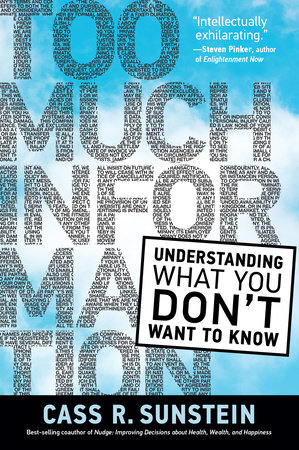
The New York Times–bestselling co-author of Nudge explores how more information can make us happy or miserable—and why we sometimes avoid it but sometimes seek it out.
How much information is too much? Do we need to know how many calories are in the giant vat of popcorn that we bought on our way into the movie theater? Do we want to know if we are genetically predisposed to a certain disease? Can we do anything useful with next week's weather forecast for Paris if we are not in Paris?
In Too Much Information, Cass Sunstein examines the effects of information on our lives. Policymakers emphasize “the right to know,” but Sunstein takes a different perspective, arguing that the focus should be on human well-being and what information contributes to it. Government should require companies, employers, hospitals, and others to disclose information not because of a general “right to know” but when the information in question would significantly improve people's lives.
Of course, says Sunstein, we are better off with stop signs, warnings on prescription drugs, and reminders about payment due dates. But sometimes less is more. What we need is more clarity about what information is actually doing or achieving.
Cass R. Sunstein, Robert Walmsley University Professor at Harvard Law School, was Administrator of the White House Office of Information and Regulatory Affairs in the Obama administration. He was the recipient of the 2018 Holberg Prize, one of the largest annual international research prizes awarded to scholars who have made outstanding contributions to research in the arts and humanities, social science, law, or theology. He is the author of The Cost-Benefit Revolution, How Change Happens (both published by the MIT Press), Nudge: Improving Decisions about Health, Wealth, and Happiness (with Richard H. Thaler), and other books.
Introduction 1 1 Knowledge Is Power, but Ignorance Is Bliss 11 2 Measuring Welfare 39 3 Psychology 79 with George Loewenstein and Russell Golman 4 Learning the Wrong Thing 109 with Oren Bar-Gill and David Schkade 5 Moral Wrongs 119 with Eric Posner 6 Valuing Facebook 135 7 Sludge 153 Epilogue 187 Acknowledgments 193 Notes 195 Index 227
The New York Times–bestselling co-author of Nudge explores how more information can make us happy or miserable—and why we sometimes avoid it but sometimes seek it out.
How much information is too much? Do we need to know how many calories are in the giant vat of popcorn that we bought on our way into the movie theater? Do we want to know if we are genetically predisposed to a certain disease? Can we do anything useful with next week's weather forecast for Paris if we are not in Paris?
In Too Much Information, Cass Sunstein examines the effects of information on our lives. Policymakers emphasize “the right to know,” but Sunstein takes a different perspective, arguing that the focus should be on human well-being and what information contributes to it. Government should require companies, employers, hospitals, and others to disclose information not because of a general “right to know” but when the information in question would significantly improve people's lives.
Of course, says Sunstein, we are better off with stop signs, warnings on prescription drugs, and reminders about payment due dates. But sometimes less is more. What we need is more clarity about what information is actually doing or achieving.
Author
Cass R. Sunstein, Robert Walmsley University Professor at Harvard Law School, was Administrator of the White House Office of Information and Regulatory Affairs in the Obama administration. He was the recipient of the 2018 Holberg Prize, one of the largest annual international research prizes awarded to scholars who have made outstanding contributions to research in the arts and humanities, social science, law, or theology. He is the author of The Cost-Benefit Revolution, How Change Happens (both published by the MIT Press), Nudge: Improving Decisions about Health, Wealth, and Happiness (with Richard H. Thaler), and other books.
Introduction 1 1 Knowledge Is Power, but Ignorance Is Bliss 11 2 Measuring Welfare 39 3 Psychology 79 with George Loewenstein and Russell Golman 4 Learning the Wrong Thing 109 with Oren Bar-Gill and David Schkade 5 Moral Wrongs 119 with Eric Posner 6 Valuing Facebook 135 7 Sludge 153 Epilogue 187 Acknowledgments 193 Notes 195 Index 227