Close Modal

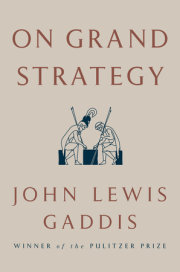
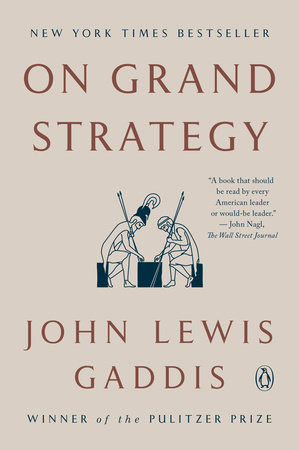
On Grand Strategy

Look inside
Paperback
$19.00 US
5.24"W x 7.92"H x 0.88"D   (13.3 x 20.1 x 2.2 cm) | 10 oz (272 g) | 24 per carton
On sale Apr 02, 2019 | 384 Pages | 9780143132516
Grades 9-12 + AP/IB
Sales rights: US, Canada, Open Mkt

See Additional Formats
“The best education in grand strategy available in a single volume . . . a book that should be read by every American leader or would-be leader.”—The Wall Street Journal

A master class in strategic thinking, distilled from the legendary program the author has co-taught at Yale for decades


John Lewis Gaddis, the distinguished historian of the Cold War, has for almost two decades co-taught grand strategy at Yale University with his colleagues Charles Hill and Paul Kennedy.  Now, in On Grand Strategy, Gaddis reflects on what he has learned.  In chapters extending from the ancient world through World War II, Gaddis assesses grand strategic theory and practice in Herodotus, Thucydides, Sun Tzu, Octavian/Augustus, St. Augustine, Machiavelli, Elizabeth I, Philip II, the American Founding Fathers, Clausewitz, Tolstoy, Lincoln, Wilson, Franklin D. Roosevelt, and Isaiah Berlin.  On Grand Strategy applies the sharp insights and wit readers have come to expect from Gaddis to times, places, and people he’s never written about before.  For anyone interested in the art of leadership, On Grand Strategy is, in every way, a master class.
CROSSING THE HELLESPONT

The date is 480 B.C.E. The place is Abydos, the town on the Asian side of the Hellespont where it narrows to just over a mile in width. The scene is worthy of Hollywood in its heyday. Xerxes, Persia’s King of Kings, ascends a throne on a promontory from which he can see armies assembled, the historian Herodotus tells us, of over a million and a half men. Had the number been only a tenth of that, as is more likely, it would still have approximated the size of Eisenhower’s forces on D-day in 1944. The Hellespont has no bridge now, but Xerxes had two then: one rested on 360 boats lashed together, the other on 314, both curved to accommodate winds and currents. For after an earlier bridge had broken apart in a storm, the furious king beheaded the builders and ordered the waters themselves whipped and branded. Somewhere on the bottom there presumably lie, to this day, the iron fetters he had thrown in for good measure.

On that day, though, the waters are calm and Xerxes is content— until he bursts into tears. His adviser and uncle Artabanus asks why. “Here are all these thousands,” the king replies, “and not one of them will be alive a hundred years from now.” Artabanus consoles his master by reminding him of all the calamities that can make life intolerable and death a relief. Xerxes acknowledges this, but demands: “Tell me the very truth.” Would Artabanus have favored the task at h and—a second Persian invasion of Greece in just over a d ecade— had they not both had the same frightening dream? Now it’s Artabanus who shudders: “I am still full, nay overfull, of fear.”

Xerxes’ dream had come twice after Artabanus dissuaded him from avenging the Greeks’ humiliation of Darius, Xerxes’ father, at Marathon ten years earlier. As if in anticipation of Hamlet— still two millennia into the f uture—a n apparition, regal in aspect, paternal in attitude, had issued an ultimatum: “[I]f you do not launch your war at o nce, . . . just as a short while raised you to be great and mighty, so with speed again shall you be humble.” Artabanus at first scoffed at the dream’s significance, whereupon Xerxes made him trade clothes and sleep in the royal bed. The specter reappeared, so terrifying Artabanus that he woke up screaming, instantly urging the new invasion. Xerxes then gave the orders, the great force gathered at Sardis, sacrificed a thousand heifers at the ruins of Troy, arrived at the Hellespont, found the bridges ready, and was preparing to cross them when the king allowed his uncle one last chance to voice whatever reservations he might yet have.

Artabanus, despite his nightmare, can’t resist. The enemies ahead, he warns, will not just be Greeks, formidable fighters though they are: they’ll also include the land and the sea. The march around the Aegean will traverse territories incapable of feeding so large an army. There won’t be enough harbors to shelter ships if storms arise.

Exhaustion, even starvation, could set in before fighting a single battle. The prudent leader “dreads and reflects on everything that can happen to him but is bold when he is in the thick of action.” Xerxes listens patiently, but objects that “if you were to take account of e. . . , you would never do anything. It is better to have a brave heart and endure one half of the terrors we dread than to [calculate] all of the terrors and suffer nothing at all. . . . Big things are won by big dangers.”

That settles it. Xerxes sends Artabanus back to rule the existing empire, while turning his own attention to doubling its extent. He prays to the sun for the strength to conquer not just Greece, but all of Europe. He has myrtle branches strewn before the bridges. He orders his priests to burn incense. And he rewards the Hellespont by pouring into it a libation, followed by the golden cup that contained it, followed by the golden bowl in which it was mixed, followed as well by a sword. This clears the way for the crossing, which takes seven days and nights to complete. As Xerxes himself reaches the European shore, an awed bystander is heard asking why Zeus has disguised himself as the Persian monarch, bringing along “all the people of the world?” Could the god not have destroyed Greece on his own?

I.
Two thousand four hundred and nineteen years later, an Oxford don took a break from tutorials to go to a party. Thirty at the time, Isaiah Berlin had been born in Riga, brought up in St. Petersburg, and, after witnessing the Bolshevik Revolution at the age of eight, emigrated with his family to England. There he thrived, mastering the new language through a thicket of accents that never left him, triumphing in his Oxford examinations, and becoming the first Jew ever elected to an All Souls College fellowship. By 1939 he was teaching philosophy at New College (established in 1379), developing an aversion to logical positivism (nothing means anything without reproducible verification), and hugely enjoying life.

A glittering conversationalist with a sponge-like thirst for ideas, Berlin relished opportunities to show himself off and to soak things up. At this party— the exact date isn’t known— he ran into Julian Edward George Asquith, the 2nd Earl of Oxford and Asquith, then finishing a classics degree at Balliol. Lord Oxford had come across an intriguing line from the ancient Greek poet Archilochus of Paros. It was, as Berlin remembered it: “The fox knows many things, but the hedgehog knows one big thing.”

The passage survives only as a fragment, so its context has long been lost. But the Renaissance scholar Erasmus played around with it, and Berlin couldn’t help doing the same. Might it become a scheme for classifying great writers? If so, Plato, Dante, Dostoevsky, Nietzsche, and Proust would all have been hedgehogs. Aristotle, Shakespeare, Goethe, Pushkin, and Joyce were obviously foxes. So was Berlin, who distrusted most big things— like logical positivism—but felt fully at ease with smaller ones.4 Diverted by World War II, Berlin didn’t return to his quadrupeds until 1951, when he used them to frame an essay he was preparing on Tolstoy’s philosophy of history. It appeared two years later as a short book, The Hedgehog and the Fox.

Hedgehogs, Berlin explained, “relate everything to a single central vision” through which “all that they say and do has significance.” Foxes, in contrast, “pursue many ends, often unrelated and even contradictory, connected, if at all, only in some de facto way.” The distinction was simple but not frivolous: it offered “a point of view from which to look and compare, a starting point for genuine investigation.” It might even reflect “one of the deepest differences which divide writers and thinkers, and, it may be, human beings in general.”

Having fired off that flare, however, Berlin failed to illuminate much with it beyond Tolstoy. The great man had wanted to be a hedgehog, Berlin claimed: War and Peace was supposed to reveal the laws by which history worked. But Tolstoy was too honest to neglect the peculiarities of personality and the contingencies of circumstance that defy such generalizations. So he filled his masterpiece with some of the most f ox-like writing in all literature, mesmerizing his readers, who happily skipped the hedgehog-like history ruminations scattered throughout the text. Torn by contradictions, Tolstoy approached death, Berlin concluded, “a desperate old man, beyond human aid, wandering self-blinded [like Oedipus] at Colonus.”

Biographically, this was too simple. Tolstoy did die in an obscure Russian railway station, in 1910 and at the age of eighty- two, after abandoning his home and family. It’s unlikely that he did so, though, regretting loose ends left decades earlier in War and Peace.6 Nor is it clear that Berlin evoked Oedipus for any deeper purpose than to end his essay with a dramatic flourish. Perhaps too dramatic, for it suggested irreconcilable differences between foxes and hedgehogs. You had to be one or the other, Berlin seemed to be saying. You couldn’t be both and be happy. Or effective. Or even whole.

Berlin was therefore surprised— but puckishly pleased— when his creatures went viral, long before there was an Internet to help them along. References began proliferating in print. Cartoons appeared, requiring no explanation.7 And in university classrooms, professors began asking their students: “Was X [who could be any historical or literary figure] a fox or a hedgehog?” Students began asking their professors: “Is it better [at this or any other moment] to be a hedgehog or a fox?” Both began asking themselves: “Where, within this polarity, should I seek to be?” And then: “Can I stay there?” And finally: “Who, in the end, am I?”
By way of an Oxford party, an Archilochus fragment, and Tolstoy’s epic, Berlin had stumbled upon two of the very best ways to become intellectually indelible. The first is to be Delphic, a trick known to oracles throughout time. The second is to be Aesopian: turn your ideas into animals, and they’ll achieve immortality.
“[T]he best education in grand strategy available in a single volume . . . a long walk with a single, delightful mind . . . On Grand Strategy is a book that should be read by every American leader or would-be leader.” — John Nagl, Wall Street Journal
 
“A remarkably erudite volume…[that] renders nuanced verdicts on an eclectic cohort of thinkers, writers, monarchs and conquerors…Gaddis has indisputably earned the right to plow different fields of historical inquiry, which he does in On Grand Strategy with self-evident glee and peripatetic curiosity.” —Washington Post

“Thought-provoking…The approach is highly idiosyncratic and the structure loose; it has something of the feel of a personal manifesto or intellectual memoir.” —Weekly Standard

“[An] eminently readable book by a master historian…It is a brilliant book—learned, seductively written, deep.” —The New Criterion
 
“Lively…Gaddis concludes with an invaluable warning that true morality embraces neither messianic interventionism nor the quest for utopianism…Instead, ethical leadership pursues the art of the possible for the greater (not the greatest) good…On Grand Strategy is many things—a thoughtful validation of the liberal arts, an argument for literature over social science, an engaging reflection on university education and some timely advice to Americans that lasting victory comes from winning what you can rather than all that you want.” —The New York Times Book Review
 
 “An extraordinary treatise on the need to teach the principles of sound strategy to today’s leaders…The book…is a rich one. It makes sense of our world, but is also capable of beautifully crafted pithy historical judgments…It is a book that cares about liberty, choice and a moral compass, that warns against the hubris of an angry Bonaparte on the turn in a Russian winter, against leaders who do not listen or learn. A training manual for our troubled times.”
The Times (UK)

“A fine summary of the complex concepts explored in [Gaddis’s] Grand Strategy seminar, full of vivid examples of leadership and strategic thinking, from the Persian king Xerxes to Churchill’s and Roosevelt’s WWII strategies…Gaddis brings a deep knowledge of history and a pleasingly economical prose style to this rigorous study of leadership.”  —Publishers Weekly

“A capacious analysis of how leaders make strategic decisions…A lively, erudite study of the past in service of the future.” Kirkus Reviews 


On The Cold War: A New History

 
“Outstanding . . . The most accessible distillation of that conflict yet written.” - The Boston Globe

“Energetically written and lucid, it makes an ideal introduction to the subject.” - The New York Times

“A fresh and admirably concise history . . . Gaddis’s mastery of the material, his fluent style and eye for the telling anecdote make his new work a pleasure.” - The Economist
 
 
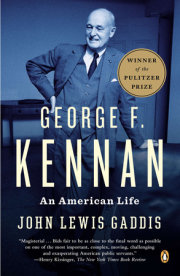
On George F. Kennan: An American Life
Winner of the Pulitzer Prize
 
''Magisterial . . . [Kennan] bids fair to be as close to the final word as possible on one of the most important, complex, moving, challenging, and exasperating American public servants . . . We can be grateful to John Lewis Gaddis for bringing Kennan back to us, thoughtful, human, self-centered, contradictory, inspirational­—a permanent spur as consciences are wont to be. Masterfully researched, exhaustively documented, Gaddis' moving work gives us a figure with whom, however one might differ on details, it was a privilege to be a contemporary.'' - Henry A. Kissinger, New York Times Book Review
 
“[A] first-rate biography . . . Kennan's life maps right onto twentieth-century political history, and no one is better qualified than Gaddis to lead the way through it . . . Gaddis has written with care and elegance, and he has produced a biography whose fineness is worthy of its subject.” –The New Yorker
© Eliza Valk
John Lewis Gaddis is the Robert A. Lovett Professor of History of Yale University. He is the author of numerous books, including The United States and the Origins of the Cold War, 1941-1947 (1972); Strategies of Containment: A Critical Appraisal of Postwar American National Security (1982); The Long Peace: Inquiries into the History of the Cold War (1987); We Now Know: Rethinking Cold War History (1997); The Landscape of History: How Historians Map the Past (2002); and Surprise, Security, and the American Experience (2004). View titles by John Lewis Gaddis
Available for sale exclusive:
•     Canada
•     Guam
•     Minor Outl.Ins.
•     North Mariana
•     Philippines
•     Puerto Rico
•     Samoa,American
•     US Virgin Is.
•     USA

Available for sale non-exclusive:
•     Afghanistan
•     Aland Islands
•     Albania
•     Algeria
•     Andorra
•     Angola
•     Anguilla
•     Antarctica
•     Argentina
•     Armenia
•     Aruba
•     Austria
•     Azerbaijan
•     Bahrain
•     Belarus
•     Belgium
•     Benin
•     Bhutan
•     Bolivia
•     Bonaire, Saba
•     Bosnia Herzeg.
•     Bouvet Island
•     Brazil
•     Bulgaria
•     Burkina Faso
•     Burundi
•     Cambodia
•     Cameroon
•     Cape Verde
•     Centr.Afr.Rep.
•     Chad
•     Chile
•     China
•     Colombia
•     Comoro Is.
•     Congo
•     Cook Islands
•     Costa Rica
•     Croatia
•     Cuba
•     Curacao
•     Czech Republic
•     Dem. Rep. Congo
•     Denmark
•     Djibouti
•     Dominican Rep.
•     Ecuador
•     Egypt
•     El Salvador
•     Equatorial Gui.
•     Eritrea
•     Estonia
•     Ethiopia
•     Faroe Islands
•     Finland
•     France
•     Fren.Polynesia
•     French Guinea
•     Gabon
•     Georgia
•     Germany
•     Greece
•     Greenland
•     Guadeloupe
•     Guatemala
•     Guinea Republic
•     Guinea-Bissau
•     Haiti
•     Heard/McDon.Isl
•     Honduras
•     Hong Kong
•     Hungary
•     Iceland
•     Indonesia
•     Iran
•     Iraq
•     Israel
•     Italy
•     Ivory Coast
•     Japan
•     Jordan
•     Kazakhstan
•     Kuwait
•     Kyrgyzstan
•     Laos
•     Latvia
•     Lebanon
•     Liberia
•     Libya
•     Liechtenstein
•     Lithuania
•     Luxembourg
•     Macau
•     Macedonia
•     Madagascar
•     Maldives
•     Mali
•     Marshall island
•     Martinique
•     Mauritania
•     Mayotte
•     Mexico
•     Micronesia
•     Moldavia
•     Monaco
•     Mongolia
•     Montenegro
•     Morocco
•     Myanmar
•     Nepal
•     Netherlands
•     New Caledonia
•     Nicaragua
•     Niger
•     Niue
•     Norfolk Island
•     North Korea
•     Norway
•     Oman
•     Palau
•     Palestinian Ter
•     Panama
•     Paraguay
•     Peru
•     Poland
•     Portugal
•     Qatar
•     Reunion Island
•     Romania
•     Russian Fed.
•     Rwanda
•     Saint Martin
•     San Marino
•     SaoTome Princip
•     Saudi Arabia
•     Senegal
•     Serbia
•     Singapore
•     Sint Maarten
•     Slovakia
•     Slovenia
•     South Korea
•     South Sudan
•     Spain
•     St Barthelemy
•     St.Pier,Miquel.
•     Sth Terr. Franc
•     Sudan
•     Suriname
•     Svalbard
•     Sweden
•     Switzerland
•     Syria
•     Tadschikistan
•     Taiwan
•     Thailand
•     Timor-Leste
•     Togo
•     Tokelau Islands
•     Tunisia
•     Turkey
•     Turkmenistan
•     Ukraine
•     Unit.Arab Emir.
•     Uruguay
•     Uzbekistan
•     Vatican City
•     Venezuela
•     Vietnam
•     Wallis,Futuna
•     West Saharan
•     Western Samoa
•     Yemen

Not available for sale:
•     Antigua/Barbuda
•     Australia
•     Bahamas
•     Bangladesh
•     Barbados
•     Belize
•     Bermuda
•     Botswana
•     Brit.Ind.Oc.Ter
•     Brit.Virgin Is.
•     Brunei
•     Cayman Islands
•     Christmas Islnd
•     Cocos Islands
•     Cyprus
•     Dominica
•     Falkland Islnds
•     Fiji
•     Gambia
•     Ghana
•     Gibraltar
•     Grenada
•     Guernsey
•     Guyana
•     India
•     Ireland
•     Isle of Man
•     Jamaica
•     Jersey
•     Kenya
•     Kiribati
•     Lesotho
•     Malawi
•     Malaysia
•     Malta
•     Mauritius
•     Montserrat
•     Mozambique
•     Namibia
•     Nauru
•     New Zealand
•     Nigeria
•     Pakistan
•     PapuaNewGuinea
•     Pitcairn Islnds
•     S. Sandwich Ins
•     Seychelles
•     Sierra Leone
•     Solomon Islands
•     Somalia
•     South Africa
•     Sri Lanka
•     St. Helena
•     St. Lucia
•     St. Vincent
•     St.Chr.,Nevis
•     Swaziland
•     Tanzania
•     Tonga
•     Trinidad,Tobago
•     Turks&Caicos Is
•     Tuvalu
•     Uganda
•     United Kingdom
•     Vanuatu
•     Zambia
•     Zimbabwe

About

“The best education in grand strategy available in a single volume . . . a book that should be read by every American leader or would-be leader.”—The Wall Street Journal

A master class in strategic thinking, distilled from the legendary program the author has co-taught at Yale for decades


John Lewis Gaddis, the distinguished historian of the Cold War, has for almost two decades co-taught grand strategy at Yale University with his colleagues Charles Hill and Paul Kennedy.  Now, in On Grand Strategy, Gaddis reflects on what he has learned.  In chapters extending from the ancient world through World War II, Gaddis assesses grand strategic theory and practice in Herodotus, Thucydides, Sun Tzu, Octavian/Augustus, St. Augustine, Machiavelli, Elizabeth I, Philip II, the American Founding Fathers, Clausewitz, Tolstoy, Lincoln, Wilson, Franklin D. Roosevelt, and Isaiah Berlin.  On Grand Strategy applies the sharp insights and wit readers have come to expect from Gaddis to times, places, and people he’s never written about before.  For anyone interested in the art of leadership, On Grand Strategy is, in every way, a master class.

Excerpt

CROSSING THE HELLESPONT

The date is 480 B.C.E. The place is Abydos, the town on the Asian side of the Hellespont where it narrows to just over a mile in width. The scene is worthy of Hollywood in its heyday. Xerxes, Persia’s King of Kings, ascends a throne on a promontory from which he can see armies assembled, the historian Herodotus tells us, of over a million and a half men. Had the number been only a tenth of that, as is more likely, it would still have approximated the size of Eisenhower’s forces on D-day in 1944. The Hellespont has no bridge now, but Xerxes had two then: one rested on 360 boats lashed together, the other on 314, both curved to accommodate winds and currents. For after an earlier bridge had broken apart in a storm, the furious king beheaded the builders and ordered the waters themselves whipped and branded. Somewhere on the bottom there presumably lie, to this day, the iron fetters he had thrown in for good measure.

On that day, though, the waters are calm and Xerxes is content— until he bursts into tears. His adviser and uncle Artabanus asks why. “Here are all these thousands,” the king replies, “and not one of them will be alive a hundred years from now.” Artabanus consoles his master by reminding him of all the calamities that can make life intolerable and death a relief. Xerxes acknowledges this, but demands: “Tell me the very truth.” Would Artabanus have favored the task at h and—a second Persian invasion of Greece in just over a d ecade— had they not both had the same frightening dream? Now it’s Artabanus who shudders: “I am still full, nay overfull, of fear.”

Xerxes’ dream had come twice after Artabanus dissuaded him from avenging the Greeks’ humiliation of Darius, Xerxes’ father, at Marathon ten years earlier. As if in anticipation of Hamlet— still two millennia into the f uture—a n apparition, regal in aspect, paternal in attitude, had issued an ultimatum: “[I]f you do not launch your war at o nce, . . . just as a short while raised you to be great and mighty, so with speed again shall you be humble.” Artabanus at first scoffed at the dream’s significance, whereupon Xerxes made him trade clothes and sleep in the royal bed. The specter reappeared, so terrifying Artabanus that he woke up screaming, instantly urging the new invasion. Xerxes then gave the orders, the great force gathered at Sardis, sacrificed a thousand heifers at the ruins of Troy, arrived at the Hellespont, found the bridges ready, and was preparing to cross them when the king allowed his uncle one last chance to voice whatever reservations he might yet have.

Artabanus, despite his nightmare, can’t resist. The enemies ahead, he warns, will not just be Greeks, formidable fighters though they are: they’ll also include the land and the sea. The march around the Aegean will traverse territories incapable of feeding so large an army. There won’t be enough harbors to shelter ships if storms arise.

Exhaustion, even starvation, could set in before fighting a single battle. The prudent leader “dreads and reflects on everything that can happen to him but is bold when he is in the thick of action.” Xerxes listens patiently, but objects that “if you were to take account of e. . . , you would never do anything. It is better to have a brave heart and endure one half of the terrors we dread than to [calculate] all of the terrors and suffer nothing at all. . . . Big things are won by big dangers.”

That settles it. Xerxes sends Artabanus back to rule the existing empire, while turning his own attention to doubling its extent. He prays to the sun for the strength to conquer not just Greece, but all of Europe. He has myrtle branches strewn before the bridges. He orders his priests to burn incense. And he rewards the Hellespont by pouring into it a libation, followed by the golden cup that contained it, followed by the golden bowl in which it was mixed, followed as well by a sword. This clears the way for the crossing, which takes seven days and nights to complete. As Xerxes himself reaches the European shore, an awed bystander is heard asking why Zeus has disguised himself as the Persian monarch, bringing along “all the people of the world?” Could the god not have destroyed Greece on his own?

I.
Two thousand four hundred and nineteen years later, an Oxford don took a break from tutorials to go to a party. Thirty at the time, Isaiah Berlin had been born in Riga, brought up in St. Petersburg, and, after witnessing the Bolshevik Revolution at the age of eight, emigrated with his family to England. There he thrived, mastering the new language through a thicket of accents that never left him, triumphing in his Oxford examinations, and becoming the first Jew ever elected to an All Souls College fellowship. By 1939 he was teaching philosophy at New College (established in 1379), developing an aversion to logical positivism (nothing means anything without reproducible verification), and hugely enjoying life.

A glittering conversationalist with a sponge-like thirst for ideas, Berlin relished opportunities to show himself off and to soak things up. At this party— the exact date isn’t known— he ran into Julian Edward George Asquith, the 2nd Earl of Oxford and Asquith, then finishing a classics degree at Balliol. Lord Oxford had come across an intriguing line from the ancient Greek poet Archilochus of Paros. It was, as Berlin remembered it: “The fox knows many things, but the hedgehog knows one big thing.”

The passage survives only as a fragment, so its context has long been lost. But the Renaissance scholar Erasmus played around with it, and Berlin couldn’t help doing the same. Might it become a scheme for classifying great writers? If so, Plato, Dante, Dostoevsky, Nietzsche, and Proust would all have been hedgehogs. Aristotle, Shakespeare, Goethe, Pushkin, and Joyce were obviously foxes. So was Berlin, who distrusted most big things— like logical positivism—but felt fully at ease with smaller ones.4 Diverted by World War II, Berlin didn’t return to his quadrupeds until 1951, when he used them to frame an essay he was preparing on Tolstoy’s philosophy of history. It appeared two years later as a short book, The Hedgehog and the Fox.

Hedgehogs, Berlin explained, “relate everything to a single central vision” through which “all that they say and do has significance.” Foxes, in contrast, “pursue many ends, often unrelated and even contradictory, connected, if at all, only in some de facto way.” The distinction was simple but not frivolous: it offered “a point of view from which to look and compare, a starting point for genuine investigation.” It might even reflect “one of the deepest differences which divide writers and thinkers, and, it may be, human beings in general.”

Having fired off that flare, however, Berlin failed to illuminate much with it beyond Tolstoy. The great man had wanted to be a hedgehog, Berlin claimed: War and Peace was supposed to reveal the laws by which history worked. But Tolstoy was too honest to neglect the peculiarities of personality and the contingencies of circumstance that defy such generalizations. So he filled his masterpiece with some of the most f ox-like writing in all literature, mesmerizing his readers, who happily skipped the hedgehog-like history ruminations scattered throughout the text. Torn by contradictions, Tolstoy approached death, Berlin concluded, “a desperate old man, beyond human aid, wandering self-blinded [like Oedipus] at Colonus.”

Biographically, this was too simple. Tolstoy did die in an obscure Russian railway station, in 1910 and at the age of eighty- two, after abandoning his home and family. It’s unlikely that he did so, though, regretting loose ends left decades earlier in War and Peace.6 Nor is it clear that Berlin evoked Oedipus for any deeper purpose than to end his essay with a dramatic flourish. Perhaps too dramatic, for it suggested irreconcilable differences between foxes and hedgehogs. You had to be one or the other, Berlin seemed to be saying. You couldn’t be both and be happy. Or effective. Or even whole.

Berlin was therefore surprised— but puckishly pleased— when his creatures went viral, long before there was an Internet to help them along. References began proliferating in print. Cartoons appeared, requiring no explanation.7 And in university classrooms, professors began asking their students: “Was X [who could be any historical or literary figure] a fox or a hedgehog?” Students began asking their professors: “Is it better [at this or any other moment] to be a hedgehog or a fox?” Both began asking themselves: “Where, within this polarity, should I seek to be?” And then: “Can I stay there?” And finally: “Who, in the end, am I?”
By way of an Oxford party, an Archilochus fragment, and Tolstoy’s epic, Berlin had stumbled upon two of the very best ways to become intellectually indelible. The first is to be Delphic, a trick known to oracles throughout time. The second is to be Aesopian: turn your ideas into animals, and they’ll achieve immortality.

Praise

“[T]he best education in grand strategy available in a single volume . . . a long walk with a single, delightful mind . . . On Grand Strategy is a book that should be read by every American leader or would-be leader.” — John Nagl, Wall Street Journal
 
“A remarkably erudite volume…[that] renders nuanced verdicts on an eclectic cohort of thinkers, writers, monarchs and conquerors…Gaddis has indisputably earned the right to plow different fields of historical inquiry, which he does in On Grand Strategy with self-evident glee and peripatetic curiosity.” —Washington Post

“Thought-provoking…The approach is highly idiosyncratic and the structure loose; it has something of the feel of a personal manifesto or intellectual memoir.” —Weekly Standard

“[An] eminently readable book by a master historian…It is a brilliant book—learned, seductively written, deep.” —The New Criterion
 
“Lively…Gaddis concludes with an invaluable warning that true morality embraces neither messianic interventionism nor the quest for utopianism…Instead, ethical leadership pursues the art of the possible for the greater (not the greatest) good…On Grand Strategy is many things—a thoughtful validation of the liberal arts, an argument for literature over social science, an engaging reflection on university education and some timely advice to Americans that lasting victory comes from winning what you can rather than all that you want.” —The New York Times Book Review
 
 “An extraordinary treatise on the need to teach the principles of sound strategy to today’s leaders…The book…is a rich one. It makes sense of our world, but is also capable of beautifully crafted pithy historical judgments…It is a book that cares about liberty, choice and a moral compass, that warns against the hubris of an angry Bonaparte on the turn in a Russian winter, against leaders who do not listen or learn. A training manual for our troubled times.”
The Times (UK)

“A fine summary of the complex concepts explored in [Gaddis’s] Grand Strategy seminar, full of vivid examples of leadership and strategic thinking, from the Persian king Xerxes to Churchill’s and Roosevelt’s WWII strategies…Gaddis brings a deep knowledge of history and a pleasingly economical prose style to this rigorous study of leadership.”  —Publishers Weekly

“A capacious analysis of how leaders make strategic decisions…A lively, erudite study of the past in service of the future.” Kirkus Reviews 


On The Cold War: A New History

 
“Outstanding . . . The most accessible distillation of that conflict yet written.” - The Boston Globe

“Energetically written and lucid, it makes an ideal introduction to the subject.” - The New York Times

“A fresh and admirably concise history . . . Gaddis’s mastery of the material, his fluent style and eye for the telling anecdote make his new work a pleasure.” - The Economist
 
 
On George F. Kennan: An American Life
Winner of the Pulitzer Prize
 
''Magisterial . . . [Kennan] bids fair to be as close to the final word as possible on one of the most important, complex, moving, challenging, and exasperating American public servants . . . We can be grateful to John Lewis Gaddis for bringing Kennan back to us, thoughtful, human, self-centered, contradictory, inspirational­—a permanent spur as consciences are wont to be. Masterfully researched, exhaustively documented, Gaddis' moving work gives us a figure with whom, however one might differ on details, it was a privilege to be a contemporary.'' - Henry A. Kissinger, New York Times Book Review
 
“[A] first-rate biography . . . Kennan's life maps right onto twentieth-century political history, and no one is better qualified than Gaddis to lead the way through it . . . Gaddis has written with care and elegance, and he has produced a biography whose fineness is worthy of its subject.” –The New Yorker

Author

© Eliza Valk
John Lewis Gaddis is the Robert A. Lovett Professor of History of Yale University. He is the author of numerous books, including The United States and the Origins of the Cold War, 1941-1947 (1972); Strategies of Containment: A Critical Appraisal of Postwar American National Security (1982); The Long Peace: Inquiries into the History of the Cold War (1987); We Now Know: Rethinking Cold War History (1997); The Landscape of History: How Historians Map the Past (2002); and Surprise, Security, and the American Experience (2004). View titles by John Lewis Gaddis

Rights

Available for sale exclusive:
•     Canada
•     Guam
•     Minor Outl.Ins.
•     North Mariana
•     Philippines
•     Puerto Rico
•     Samoa,American
•     US Virgin Is.
•     USA

Available for sale non-exclusive:
•     Afghanistan
•     Aland Islands
•     Albania
•     Algeria
•     Andorra
•     Angola
•     Anguilla
•     Antarctica
•     Argentina
•     Armenia
•     Aruba
•     Austria
•     Azerbaijan
•     Bahrain
•     Belarus
•     Belgium
•     Benin
•     Bhutan
•     Bolivia
•     Bonaire, Saba
•     Bosnia Herzeg.
•     Bouvet Island
•     Brazil
•     Bulgaria
•     Burkina Faso
•     Burundi
•     Cambodia
•     Cameroon
•     Cape Verde
•     Centr.Afr.Rep.
•     Chad
•     Chile
•     China
•     Colombia
•     Comoro Is.
•     Congo
•     Cook Islands
•     Costa Rica
•     Croatia
•     Cuba
•     Curacao
•     Czech Republic
•     Dem. Rep. Congo
•     Denmark
•     Djibouti
•     Dominican Rep.
•     Ecuador
•     Egypt
•     El Salvador
•     Equatorial Gui.
•     Eritrea
•     Estonia
•     Ethiopia
•     Faroe Islands
•     Finland
•     France
•     Fren.Polynesia
•     French Guinea
•     Gabon
•     Georgia
•     Germany
•     Greece
•     Greenland
•     Guadeloupe
•     Guatemala
•     Guinea Republic
•     Guinea-Bissau
•     Haiti
•     Heard/McDon.Isl
•     Honduras
•     Hong Kong
•     Hungary
•     Iceland
•     Indonesia
•     Iran
•     Iraq
•     Israel
•     Italy
•     Ivory Coast
•     Japan
•     Jordan
•     Kazakhstan
•     Kuwait
•     Kyrgyzstan
•     Laos
•     Latvia
•     Lebanon
•     Liberia
•     Libya
•     Liechtenstein
•     Lithuania
•     Luxembourg
•     Macau
•     Macedonia
•     Madagascar
•     Maldives
•     Mali
•     Marshall island
•     Martinique
•     Mauritania
•     Mayotte
•     Mexico
•     Micronesia
•     Moldavia
•     Monaco
•     Mongolia
•     Montenegro
•     Morocco
•     Myanmar
•     Nepal
•     Netherlands
•     New Caledonia
•     Nicaragua
•     Niger
•     Niue
•     Norfolk Island
•     North Korea
•     Norway
•     Oman
•     Palau
•     Palestinian Ter
•     Panama
•     Paraguay
•     Peru
•     Poland
•     Portugal
•     Qatar
•     Reunion Island
•     Romania
•     Russian Fed.
•     Rwanda
•     Saint Martin
•     San Marino
•     SaoTome Princip
•     Saudi Arabia
•     Senegal
•     Serbia
•     Singapore
•     Sint Maarten
•     Slovakia
•     Slovenia
•     South Korea
•     South Sudan
•     Spain
•     St Barthelemy
•     St.Pier,Miquel.
•     Sth Terr. Franc
•     Sudan
•     Suriname
•     Svalbard
•     Sweden
•     Switzerland
•     Syria
•     Tadschikistan
•     Taiwan
•     Thailand
•     Timor-Leste
•     Togo
•     Tokelau Islands
•     Tunisia
•     Turkey
•     Turkmenistan
•     Ukraine
•     Unit.Arab Emir.
•     Uruguay
•     Uzbekistan
•     Vatican City
•     Venezuela
•     Vietnam
•     Wallis,Futuna
•     West Saharan
•     Western Samoa
•     Yemen

Not available for sale:
•     Antigua/Barbuda
•     Australia
•     Bahamas
•     Bangladesh
•     Barbados
•     Belize
•     Bermuda
•     Botswana
•     Brit.Ind.Oc.Ter
•     Brit.Virgin Is.
•     Brunei
•     Cayman Islands
•     Christmas Islnd
•     Cocos Islands
•     Cyprus
•     Dominica
•     Falkland Islnds
•     Fiji
•     Gambia
•     Ghana
•     Gibraltar
•     Grenada
•     Guernsey
•     Guyana
•     India
•     Ireland
•     Isle of Man
•     Jamaica
•     Jersey
•     Kenya
•     Kiribati
•     Lesotho
•     Malawi
•     Malaysia
•     Malta
•     Mauritius
•     Montserrat
•     Mozambique
•     Namibia
•     Nauru
•     New Zealand
•     Nigeria
•     Pakistan
•     PapuaNewGuinea
•     Pitcairn Islnds
•     S. Sandwich Ins
•     Seychelles
•     Sierra Leone
•     Solomon Islands
•     Somalia
•     South Africa
•     Sri Lanka
•     St. Helena
•     St. Lucia
•     St. Vincent
•     St.Chr.,Nevis
•     Swaziland
•     Tanzania
•     Tonga
•     Trinidad,Tobago
•     Turks&Caicos Is
•     Tuvalu
•     Uganda
•     United Kingdom
•     Vanuatu
•     Zambia
•     Zimbabwe