Close Modal

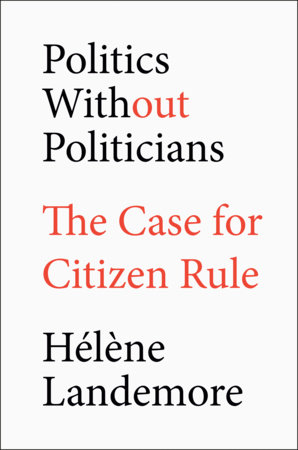
Politics Without Politicians

The Case for Citizen Rule

Look inside
Hardcover
$29.00 US
5.7"W x 8.6"H x 1.1"D   (14.5 x 21.8 x 2.8 cm) | 14 oz (397 g) | 12 per carton
On sale Feb 10, 2026 | 320 Pages | 9780593713983
Sales rights: US, Canada, Open Mkt

Politicians have failed us. But democracy doesn’t have to.

Bought by special interests, detached from real life, obsessed with reelection. Politicians make big promises, deliver little to nothing, and keep the game rigged in their favor. But what can we do?

In Politics Without Politicians, acclaimed political theorist Hélène Landemore asks and answers a radical question: What if we didn’t need politicians at all? What if everyday people—under the right conditions—could govern much better?

With disarming clarity and a deep sense of urgency, Landemore argues that electoral politics is broken but democracy isn’t. We’ve just been doing it wrong. Drawing on ancient Athenian practices and contemporary citizens’ assemblies, Landemore champions an alternative approach that is alive, working, and growing around the world: civic lotteries that select everyday people to govern—not as career politicians but as temporary stewards of the common good.

When regular citizens come together in this way, they make smarter, fairer, more forward-thinking decisions, often bringing out the best in one another. Witnessing this process firsthand, Landemore has learned that democracy should be like a good party where even the shyest guests feel welcome to speak, listen, and be heard.

With sharp analysis and real-world examples, drawing from her experience with deliberative processes in France and elsewhere, Landemore shows us how to move beyond democracy as a spectator sport, embracing it as a shared practice—not just in the voting booth but in shaping the laws and policies that govern our lives.

This is not a book about what’s wrong—it’s a manifesto for what’s possible. If you’ve ever felt powerless, Politics Without Politicians will show you how “We the People” take back democracy.
One
Fixing a Broken System

I've got both good and bad news. The bad news: Electoral politics is beyond repair. The good news: Democracy isn't. We can fix it.

The rest of this book is about the good news. But to get there, we first need to start with the failure of electoral politics. Believe me, it gives me no pleasure to see myself converging on a conclusion associated with the populists of the left and the right. Yet the populists have a point: A system based on electoral representation is no longer-if it ever was-capable of delivering either democratic or good governance.

Consider that the United States Congress currently holds a 15 percent approval rating and has consistently hovered well below 50 percent, on average, for decades. Is it because voters can never be satisfied or because Congress consistently does a subpar job?

Consider that in three of the world's so-called most advanced democracies-the United States, the United Kingdom, and France-over two thirds of the population think their governing elites are corrupt. (In my native country of France, this figure reached 74 percent in 2025!) In both the United States and France, large majorities think their political system needs drastic changes. Sixty-three percent of Americans express little confidence in the future of the US political system, and 56 percent of the French want a Sixth Republic.

Consider that in recent high-stakes elections, the 2016 Brexit vote in the UK and the 2016 and 2024 presidential elections in the United States, voters seem to be rejecting the status quo as much as choosing outcomes.

Consider that when the media cover politics they talk only about the horse race, the scandals, the strategizing, the posturing, and rarely-at best superficially-the substance of issues. Consider that when political scientists crunch the numbers, they find that the preferences of rich people shape policy outcomes and law substantially more than those of the majority do.

We could blame these problems on external factors and forces, such as globalization, capitalism, and the fast-paced changes brought by new technologies, foreign threats, or immigration-all of which undeniably make the job of governing at the scale of a nation-state quite difficult. And politicians are naturally the first to place the blame for their failed policies and the persistent "crisis of democracy" on these external factors.

But excuses can go only so far. Chronic underperformance and widespread dissatisfaction with the system-along with a growing retreat from it-should make one thing clear: There's a fundamental problem with the system itself. While electoral representation may have made sense two centuries ago, in a vastly different context and for very different populations, it's no longer up to the task, especially in modern societies of educated citizens with access to information.

I've reached this conclusion after a decade or more of resisting it. Like many people, I initially blamed empirical, external factors for the increasingly glaring inefficiencies and injustices of the system. My thinking was remedial: How can we improve the system without fundamentally changing it? For example, what if we got rid of money in politics or at least engaged in campaign finance reforms that leveled the playing field? What if we reached out more aggressively to minorities, women, and those on low incomes so they are given greater opportunities to run for elections, in the hope that we then have a greater diversity of profiles in government? What if we introduced strict term limits to prevent power entrenchment and expand further the pool of decision-makers? Or what if we did more to educate voters? For if they were better informed, they would care more, and democracy would yield better and more legitimate results. Surely, my thinking was, we have the politicians we deserve. The problem must be us, not them.

But this line of thinking, as it turns out, is flawed. Worse, it shifts the blame onto the victims-the ordinary citizens, especially those who've given up on a failing system. The next step down that slippery slope is often something like this: How about, as the political philosopher Jason Brennan suggests, we disenfranchise those who can't be bothered to learn the basics of politics, or "correct" their votes to better align with the preferences of the educated? What's so wrong with disenfranchising, say, 5 percent of the population, i.e., those who can't pass a basic civics test? Or how about "10 percent less democracy" and that much more of a role for experts, as the economist Garett Jones has recently argued? From these "solutions," it's a short hop and a skip to dictatorship of the (supposedly) knowledgeable.

A question arises: Why do most of us continue to adhere blindly to democracy as we know it and struggle to envision alternatives? The answer is quite simple. It's inherently challenging to imagine a future that diverges from our current reality and to move from what is to what should be. In my experience teaching political philosophy to undergraduates, I've observed that many struggle with the distinction between descriptive statements (what is) and normative statements (what ought to be). People often assume the future both will and should resemble the past, partly because the present is heavily influenced by it. Yet, as the philosopher David Hume famously argued, moral conclusions cannot be derived from purely factual statements or observations. In other words, you cannot derive an "ought" from an "is."

Additionally, the people currently in power are seemingly incapable of seeing the problems and the need for reform in a system that has worked so well for them. Not unlike many among the "boomer generation," who blame their kids and grandkids for failing to have a stable job, a house, and a couple of kids by age thirty, as they themselves so successfully did, our current elites (also mostly boomers) do not for a minute suspect that they might be part of the problem. And so, when people complain, they try to shame the rest of us into thinking that it's our fault because we don't vote often or well enough. Meanwhile, young people have figured it out. They no longer expect much from periodic elections and party competition. For them, life-changing politics-of climate, social justice, and other topics of urgent importance-happens elsewhere. Unfortunately, they are largely right, and this book is mostly for them.

If you picked up this book, young or not, chances are you already agree-at least in part-with its diagnosis. But the title might have you scratching your head. Politics without politicians? What does that even mean? Sure, politicians are often bad-but aren't they a necessary evil? Politics is a job, after all. In large, complex industrial societies, surely we need professionals to run the show? If not politicians, then who? And isn't politics itself what creates politicians? Even if we got rid of all the shady characters we grudgingly vote for every few years, wouldn't their replacements-whether ordinary citizens or experts-inevitably become politicians too? You can remove politicians from politics, but politics, by its nature, seems destined to turn anyone with power into a politician.

And anyway, what do we even mean by "politician"?

I try to answer these questions and more in this book. But the gist of it can be summarized by a famous quip by the American conservative author and journalist William F. Buckley Jr. In a 1961 Esquire magazine interview, Buckley said: "I would rather be governed by the first 2,000 people in the telephone directory than by the Harvard University faculty."

On the surface, this quote seems like a lighthearted jab at Harvard elites-an easy target, especially coming from someone who went to Yale. Most people read Buckley's remark ironically: Surely, the idea of preferring governance by a random group of citizens over Harvard's faculty is too absurd to be taken seriously. But there's another way to interpret it-a literal one-and I suspect that's what Buckley truly meant. A large, random sample of the population might not be such a bad mix of people. In fact, it could be both more democratic and more effective to be governed by them than by a group of Harvard academics.

If the first two thousand names in the phone book are a better choice than Harvard's faculty, then why wouldn't they also be a better bet than the few hundred elected officials who actually govern us? Especially when so many of those officials come from Ivy League schools themselves. Today, there are compelling historical and social scientific arguments to support this provocative, seemingly counterintuitive claim. My first book, Democratic Reason, explored many of these arguments, and I'll revisit them later in this book. At their core, they relate to the collective wisdom of ordinary people and the unique way a true, deliberative democracy can harness and channel that wisdom.

Bringing the Shy People Out

Another crucial element of my answer, however, is something I have come to appreciate only recently, and which I elaborate for the first time in this book: the importance of designing institutions from the perspective of and for the people least likely to seek or want power-those I will call, for lack of a better term, "the shy." I was inspired by a striking quote from the early-twentieth-century British essayist G. K. Chesterton, a figure with both conservative and radical leanings, who, though not otherwise a major influence on this book, offers this brilliant definition of democracy: "All real democracy is an attempt (like that of a jolly hostess) to bring the shy people out." I first encountered this quote in Maurice Pope's posthumously published The Keys to Democracy, a visionary work defending lot-based democracy in the 1980s, when few believed such an idea was practicable. Given my small role in helping Pope find readers for his book, I take the liberty of lifting this incredible quote, hoping to do more with it than he had the chance to.

It is a strange and unusual definition. It's also an "ought" type of definition, of course, not an empirically accurate or descriptive one. It says something about the nature or essence of democracy as a normative ideal, which reality typically fails to measure up to. According to it, democracy is not primarily about counting votes, elite competition, choosing one's rulers every few years, or "kicking out the rascals." It is about creating the conditions under which all of us, even the shy, feel comfortable enough to speak up and participate in public life.

The content of Chesterton's parenthesis in the above quote-"like that of a jolly hostess"-is also important. There is certainly something dated about the term "jolly hostess." The noun refers to a role that women at the time of Chesterton's writings did not necessarily choose, and the adjective comes across as somewhat paternalistic, if not downright sexist. But there is also something powerful and even feminist that we can reclaim for modern times in the idea of an inviting, joyful female figure who seeks to make everyone feel included and good about themselves as a metaphor for democracy.

This quote also suggests that if the test of a real democracy is whether it can make room for and listen to its shiest people, we should therefore conceive of it not merely as a set of impersonal rules, procedures, and institutions. Instead, we should envision democracy as a certain way of being and of treating people. Chesterton, for his part, suggests that democracy ought to emulate a party hostess who at least attempts to make all feel welcome and valued. For him, a real democratic system encourages and prods the people who least want power and lack the self-confidence to speak up to find their inner voice and make it heard. How about that for a radical vision of politics?

Contrast this with the definitions of democracy we are more familiar with. They are often exalted and vague on the specifics, such as "rule of, for, and by the people." Or they are utterly uninspiring and even downright cynical, like this one, supposedly from Churchill, that declares democracy "the worst form of government except for all the others."

Occasionally, definitions of democracy are both specific and uninspiring, like the one I was first exposed to as a graduate student and which, I came to realize, still completely dominates political scientists' understanding of democracy. Democracy, in that view, is simply a method, specifically "that institutional arrangement for arriving at political decisions in which individuals acquire the power to decide by means of a competitive struggle for the people's vote."

This definition was formulated by an Austrian economist named Joseph Schumpeter, who was no friend of democracy. It is minimalist and premised on the worst-possible assumptions about citizen competence and agency. Yet somehow it is now the official definition used by influential think tanks like Freedom House, not just to define democracy but also to measure it around the world. Freedom House thus defines democracy as a political system "whose leaders are elected in competitive multi-party and multi-candidate processes in which opposition parties have a legitimate chance of attaining . . . or participating in power."

What is striking about both the original Schumpeterian definition and the derivative version by Freedom House is its exclusive focus on elites competing for power and on the role of leaders, parties, and electoral candidates. Ordinary citizens-those who actually do the electing and for whom the whole system is supposed to be functioning-are nowhere to be found. Such an oversight is a good illustration of the problems with existing representative systems. Ordinary citizens are peripheral to them, convened now and again for the purpose of selecting representatives but kept at bay most of the time. When they are consulted on the substance of issues, in the occasional referendum, it is to express a simple yes or no, not the nuanced and rich opinions they often hold.

Another issue with this common definition of democracy is its narrow focus on vote counting and majority rule. In this view, the winning party gains the right to implement policies simply because it received more votes than the losing minority. While counting votes and majority rule are undeniably important-essential, even-they are not the whole story. Democracy can and should deploy mechanisms that make minorities feel valued and heard, not just outvoted. The problem with focusing purely on voting and competition, as seen in Schumpeterian models of democracy, is that it overlooks the importance of deliberation and listening-that is, the giving and receiving of reasons for the policies and laws that are ultimately imposed on all. This perspective reduces democracy to a numbers game, ignoring the potential for a more constructive process where diverse voices contribute to shaping decisions.

In this book, I pursue an "ought" definition and vision of politics, one that is constrained but not determined by what is. It consists, first, in imagining politics without professional politicians-that is, people for whom politics is a job-and envisioning instead a system run by ordinary citizens, who exercise politics as both a right and a duty. It consists, second, of a vision of politics centering deliberative processes-ordinary people talking to one another with the goal of coming to a joint decision that works for most, rather than elites and interest groups bargaining with one another, or just aggregative procedures tallying up votes. It consists, third, in paying particular attention to the perspectives of what Chesterton called "the shy." Chesterton probably had in mind the natural introverts. As I use the term in this book, however, "the shy" refers more broadly to the many among us who are shy not so much by virtue of a natural predisposition as by structural forces that create in them a sense of inadequacy, inferiority, or lack of worth. Class, gender, race, age, and sexual orientation are among the many possible sources of this constructed shyness, which prevents many people from speaking for themselves and sometimes causes them to retreat from politics altogether.
“A must read for anybody worried about the future, this thought-provoking book argues that the solution to dwindling support for our political institutions is more democracy, not less. We must usher ‘shy people’ into governance in order to reclaim American and world politics from politicians, parties, and power brokers.”
— Daron Acemoglu, Nobel laureate and coauthor of Why Nations Fail and Power and Progress

“Politics is too important to be left to politicians. [This is] a powerful argument for citizen rule—and for reimagining democracy beyond elites.”
Thomas Piketty, author of Capital in the Twenty-First Century

“In this book built on civic care, Landemore shows us that democracy need not be a showdown among the loudest voices; it can become, as she beautifully frames it, a jolly hostess welcoming every guest to the table. For anyone who believes the future of governance lies in recognizing we the people are the superintelligence, Politics Without Politicians is essential reading.”
Audrey Tang, Taiwan’s first Minister of Digital Affairs and coauthor of Plurality

Politics Without Politicians is a thrilling book. A reluctant populist, Hélène Landemore shows how ordinary citizens—in place of professional politicians—can govern with clarity and imagination. Over the course of this book, seemingly radical claims not only appear practical, but far more so than running our head into the same brick wall for another few decades.”
Zephyr Teachout, legal scholar, democracy reform advocate, and author of Corruption in America

“Extraordinary and extremely important… This book will powerfully shift the Overton window to recognizing why an obviously more effective institution needs to become a more regular part of how democracy works.”
Lawrence Lessig, Roy L. Furman Professor of Law and Leadership at Harvard Law School
© Stephanie Anestis
Hélène Landemore is a political theorist and professor of political science at Yale University. Her work explores the foundations and future of democracy, with a particular focus on participatory and deliberative innovations. She is the author of Open Democracy, a widely influential book that has shaped global debates about citizen participation and democratic legitimacy.

A sought-after speaker and adviser, Landemore has worked with governments, NGOs, and reformers around the world—from France and Finland to Chile and Taiwan. Her research has been featured in The New Yorker, Financial Times, and The Nation, on The Ezra Klein Show, and at the Aspen Festival of Ideas as well as the Athens Democracy Forum. She has written for the Boston Review, Slate, The Washington Post, Project Syndicate, Foreign Policy, l’Humanité, Libération, and Le Monde.

Originally from Normandy, France, she holds a PhD from Harvard University and degrees from the École Normale Supérieure and Sciences Po Paris. She lives in New Haven, Connecticut, with her husband and two daughters. View titles by Hélène Landemore
Available for sale exclusive:
•     Canada
•     Guam
•     Minor Outl.Ins.
•     North Mariana
•     Philippines
•     Puerto Rico
•     Samoa,American
•     US Virgin Is.
•     USA

Available for sale non-exclusive:
•     Afghanistan
•     Aland Islands
•     Albania
•     Algeria
•     Andorra
•     Angola
•     Anguilla
•     Antarctica
•     Argentina
•     Armenia
•     Aruba
•     Austria
•     Azerbaijan
•     Bahrain
•     Belarus
•     Belgium
•     Benin
•     Bolivia
•     Bonaire, Saba
•     Bosnia Herzeg.
•     Bouvet Island
•     Brazil
•     Bulgaria
•     Burkina Faso
•     Burundi
•     Cambodia
•     Cape Verde
•     Centr.Afr.Rep.
•     Chad
•     Chile
•     China
•     Colombia
•     Comoro Is.
•     Congo
•     Cook Islands
•     Costa Rica
•     Croatia
•     Cuba
•     Curacao
•     Czech Republic
•     Dem. Rep. Congo
•     Denmark
•     Djibouti
•     Dominican Rep.
•     Ecuador
•     Egypt
•     El Salvador
•     Equatorial Gui.
•     Eritrea
•     Estonia
•     Ethiopia
•     Faroe Islands
•     Finland
•     France
•     Fren.Polynesia
•     French Guinea
•     Gabon
•     Georgia
•     Germany
•     Greece
•     Greenland
•     Guadeloupe
•     Guatemala
•     Guinea Republic
•     Guinea-Bissau
•     Haiti
•     Heard/McDon.Isl
•     Honduras
•     Hong Kong
•     Hungary
•     Iceland
•     Indonesia
•     Iran
•     Iraq
•     Israel
•     Italy
•     Ivory Coast
•     Japan
•     Jordan
•     Kazakhstan
•     Kuwait
•     Kyrgyzstan
•     Laos
•     Latvia
•     Lebanon
•     Liberia
•     Libya
•     Liechtenstein
•     Lithuania
•     Luxembourg
•     Macau
•     Macedonia
•     Madagascar
•     Maldives
•     Mali
•     Marshall island
•     Martinique
•     Mauritania
•     Mayotte
•     Mexico
•     Micronesia
•     Moldavia
•     Monaco
•     Mongolia
•     Montenegro
•     Morocco
•     Myanmar
•     Nepal
•     Netherlands
•     New Caledonia
•     Nicaragua
•     Niger
•     Niue
•     Norfolk Island
•     North Korea
•     Norway
•     Oman
•     Palau
•     Palestinian Ter
•     Panama
•     Paraguay
•     Peru
•     Poland
•     Portugal
•     Qatar
•     Reunion Island
•     Romania
•     Russian Fed.
•     Rwanda
•     Saint Martin
•     San Marino
•     SaoTome Princip
•     Saudi Arabia
•     Senegal
•     Serbia
•     Singapore
•     Sint Maarten
•     Slovakia
•     Slovenia
•     South Korea
•     South Sudan
•     Spain
•     St Barthelemy
•     St.Pier,Miquel.
•     Sth Terr. Franc
•     Sudan
•     Suriname
•     Svalbard
•     Sweden
•     Switzerland
•     Syria
•     Tadschikistan
•     Taiwan
•     Thailand
•     Timor-Leste
•     Togo
•     Tokelau Islands
•     Tunisia
•     Turkey
•     Turkmenistan
•     Ukraine
•     Unit.Arab Emir.
•     Uruguay
•     Uzbekistan
•     Vatican City
•     Venezuela
•     Vietnam
•     Wallis,Futuna
•     West Saharan
•     Yemen

Not available for sale:
•     Antigua/Barbuda
•     Australia
•     Bahamas
•     Bangladesh
•     Barbados
•     Belize
•     Bermuda
•     Bhutan
•     Botswana
•     Brit.Ind.Oc.Ter
•     Brit.Virgin Is.
•     Brunei
•     Cameroon
•     Cayman Islands
•     Christmas Islnd
•     Cocos Islands
•     Cyprus
•     Dominica
•     Falkland Islnds
•     Fiji
•     Gambia
•     Ghana
•     Gibraltar
•     Grenada
•     Guernsey
•     Guyana
•     India
•     Ireland
•     Isle of Man
•     Jamaica
•     Jersey
•     Kenya
•     Kiribati
•     Lesotho
•     Malawi
•     Malaysia
•     Malta
•     Mauritius
•     Montserrat
•     Mozambique
•     Namibia
•     Nauru
•     New Zealand
•     Nigeria
•     Pakistan
•     PapuaNewGuinea
•     Pitcairn Islnds
•     S. Sandwich Ins
•     Seychelles
•     Sierra Leone
•     Solomon Islands
•     Somalia
•     South Africa
•     Sri Lanka
•     St. Helena
•     St. Lucia
•     St. Vincent
•     St.Chr.,Nevis
•     Swaziland
•     Tanzania
•     Tonga
•     Trinidad,Tobago
•     Turks&Caicos Is
•     Tuvalu
•     Uganda
•     United Kingdom
•     Vanuatu
•     Western Samoa
•     Zambia
•     Zimbabwe

About

Politicians have failed us. But democracy doesn’t have to.

Bought by special interests, detached from real life, obsessed with reelection. Politicians make big promises, deliver little to nothing, and keep the game rigged in their favor. But what can we do?

In Politics Without Politicians, acclaimed political theorist Hélène Landemore asks and answers a radical question: What if we didn’t need politicians at all? What if everyday people—under the right conditions—could govern much better?

With disarming clarity and a deep sense of urgency, Landemore argues that electoral politics is broken but democracy isn’t. We’ve just been doing it wrong. Drawing on ancient Athenian practices and contemporary citizens’ assemblies, Landemore champions an alternative approach that is alive, working, and growing around the world: civic lotteries that select everyday people to govern—not as career politicians but as temporary stewards of the common good.

When regular citizens come together in this way, they make smarter, fairer, more forward-thinking decisions, often bringing out the best in one another. Witnessing this process firsthand, Landemore has learned that democracy should be like a good party where even the shyest guests feel welcome to speak, listen, and be heard.

With sharp analysis and real-world examples, drawing from her experience with deliberative processes in France and elsewhere, Landemore shows us how to move beyond democracy as a spectator sport, embracing it as a shared practice—not just in the voting booth but in shaping the laws and policies that govern our lives.

This is not a book about what’s wrong—it’s a manifesto for what’s possible. If you’ve ever felt powerless, Politics Without Politicians will show you how “We the People” take back democracy.

Excerpt

One
Fixing a Broken System

I've got both good and bad news. The bad news: Electoral politics is beyond repair. The good news: Democracy isn't. We can fix it.

The rest of this book is about the good news. But to get there, we first need to start with the failure of electoral politics. Believe me, it gives me no pleasure to see myself converging on a conclusion associated with the populists of the left and the right. Yet the populists have a point: A system based on electoral representation is no longer-if it ever was-capable of delivering either democratic or good governance.

Consider that the United States Congress currently holds a 15 percent approval rating and has consistently hovered well below 50 percent, on average, for decades. Is it because voters can never be satisfied or because Congress consistently does a subpar job?

Consider that in three of the world's so-called most advanced democracies-the United States, the United Kingdom, and France-over two thirds of the population think their governing elites are corrupt. (In my native country of France, this figure reached 74 percent in 2025!) In both the United States and France, large majorities think their political system needs drastic changes. Sixty-three percent of Americans express little confidence in the future of the US political system, and 56 percent of the French want a Sixth Republic.

Consider that in recent high-stakes elections, the 2016 Brexit vote in the UK and the 2016 and 2024 presidential elections in the United States, voters seem to be rejecting the status quo as much as choosing outcomes.

Consider that when the media cover politics they talk only about the horse race, the scandals, the strategizing, the posturing, and rarely-at best superficially-the substance of issues. Consider that when political scientists crunch the numbers, they find that the preferences of rich people shape policy outcomes and law substantially more than those of the majority do.

We could blame these problems on external factors and forces, such as globalization, capitalism, and the fast-paced changes brought by new technologies, foreign threats, or immigration-all of which undeniably make the job of governing at the scale of a nation-state quite difficult. And politicians are naturally the first to place the blame for their failed policies and the persistent "crisis of democracy" on these external factors.

But excuses can go only so far. Chronic underperformance and widespread dissatisfaction with the system-along with a growing retreat from it-should make one thing clear: There's a fundamental problem with the system itself. While electoral representation may have made sense two centuries ago, in a vastly different context and for very different populations, it's no longer up to the task, especially in modern societies of educated citizens with access to information.

I've reached this conclusion after a decade or more of resisting it. Like many people, I initially blamed empirical, external factors for the increasingly glaring inefficiencies and injustices of the system. My thinking was remedial: How can we improve the system without fundamentally changing it? For example, what if we got rid of money in politics or at least engaged in campaign finance reforms that leveled the playing field? What if we reached out more aggressively to minorities, women, and those on low incomes so they are given greater opportunities to run for elections, in the hope that we then have a greater diversity of profiles in government? What if we introduced strict term limits to prevent power entrenchment and expand further the pool of decision-makers? Or what if we did more to educate voters? For if they were better informed, they would care more, and democracy would yield better and more legitimate results. Surely, my thinking was, we have the politicians we deserve. The problem must be us, not them.

But this line of thinking, as it turns out, is flawed. Worse, it shifts the blame onto the victims-the ordinary citizens, especially those who've given up on a failing system. The next step down that slippery slope is often something like this: How about, as the political philosopher Jason Brennan suggests, we disenfranchise those who can't be bothered to learn the basics of politics, or "correct" their votes to better align with the preferences of the educated? What's so wrong with disenfranchising, say, 5 percent of the population, i.e., those who can't pass a basic civics test? Or how about "10 percent less democracy" and that much more of a role for experts, as the economist Garett Jones has recently argued? From these "solutions," it's a short hop and a skip to dictatorship of the (supposedly) knowledgeable.

A question arises: Why do most of us continue to adhere blindly to democracy as we know it and struggle to envision alternatives? The answer is quite simple. It's inherently challenging to imagine a future that diverges from our current reality and to move from what is to what should be. In my experience teaching political philosophy to undergraduates, I've observed that many struggle with the distinction between descriptive statements (what is) and normative statements (what ought to be). People often assume the future both will and should resemble the past, partly because the present is heavily influenced by it. Yet, as the philosopher David Hume famously argued, moral conclusions cannot be derived from purely factual statements or observations. In other words, you cannot derive an "ought" from an "is."

Additionally, the people currently in power are seemingly incapable of seeing the problems and the need for reform in a system that has worked so well for them. Not unlike many among the "boomer generation," who blame their kids and grandkids for failing to have a stable job, a house, and a couple of kids by age thirty, as they themselves so successfully did, our current elites (also mostly boomers) do not for a minute suspect that they might be part of the problem. And so, when people complain, they try to shame the rest of us into thinking that it's our fault because we don't vote often or well enough. Meanwhile, young people have figured it out. They no longer expect much from periodic elections and party competition. For them, life-changing politics-of climate, social justice, and other topics of urgent importance-happens elsewhere. Unfortunately, they are largely right, and this book is mostly for them.

If you picked up this book, young or not, chances are you already agree-at least in part-with its diagnosis. But the title might have you scratching your head. Politics without politicians? What does that even mean? Sure, politicians are often bad-but aren't they a necessary evil? Politics is a job, after all. In large, complex industrial societies, surely we need professionals to run the show? If not politicians, then who? And isn't politics itself what creates politicians? Even if we got rid of all the shady characters we grudgingly vote for every few years, wouldn't their replacements-whether ordinary citizens or experts-inevitably become politicians too? You can remove politicians from politics, but politics, by its nature, seems destined to turn anyone with power into a politician.

And anyway, what do we even mean by "politician"?

I try to answer these questions and more in this book. But the gist of it can be summarized by a famous quip by the American conservative author and journalist William F. Buckley Jr. In a 1961 Esquire magazine interview, Buckley said: "I would rather be governed by the first 2,000 people in the telephone directory than by the Harvard University faculty."

On the surface, this quote seems like a lighthearted jab at Harvard elites-an easy target, especially coming from someone who went to Yale. Most people read Buckley's remark ironically: Surely, the idea of preferring governance by a random group of citizens over Harvard's faculty is too absurd to be taken seriously. But there's another way to interpret it-a literal one-and I suspect that's what Buckley truly meant. A large, random sample of the population might not be such a bad mix of people. In fact, it could be both more democratic and more effective to be governed by them than by a group of Harvard academics.

If the first two thousand names in the phone book are a better choice than Harvard's faculty, then why wouldn't they also be a better bet than the few hundred elected officials who actually govern us? Especially when so many of those officials come from Ivy League schools themselves. Today, there are compelling historical and social scientific arguments to support this provocative, seemingly counterintuitive claim. My first book, Democratic Reason, explored many of these arguments, and I'll revisit them later in this book. At their core, they relate to the collective wisdom of ordinary people and the unique way a true, deliberative democracy can harness and channel that wisdom.

Bringing the Shy People Out

Another crucial element of my answer, however, is something I have come to appreciate only recently, and which I elaborate for the first time in this book: the importance of designing institutions from the perspective of and for the people least likely to seek or want power-those I will call, for lack of a better term, "the shy." I was inspired by a striking quote from the early-twentieth-century British essayist G. K. Chesterton, a figure with both conservative and radical leanings, who, though not otherwise a major influence on this book, offers this brilliant definition of democracy: "All real democracy is an attempt (like that of a jolly hostess) to bring the shy people out." I first encountered this quote in Maurice Pope's posthumously published The Keys to Democracy, a visionary work defending lot-based democracy in the 1980s, when few believed such an idea was practicable. Given my small role in helping Pope find readers for his book, I take the liberty of lifting this incredible quote, hoping to do more with it than he had the chance to.

It is a strange and unusual definition. It's also an "ought" type of definition, of course, not an empirically accurate or descriptive one. It says something about the nature or essence of democracy as a normative ideal, which reality typically fails to measure up to. According to it, democracy is not primarily about counting votes, elite competition, choosing one's rulers every few years, or "kicking out the rascals." It is about creating the conditions under which all of us, even the shy, feel comfortable enough to speak up and participate in public life.

The content of Chesterton's parenthesis in the above quote-"like that of a jolly hostess"-is also important. There is certainly something dated about the term "jolly hostess." The noun refers to a role that women at the time of Chesterton's writings did not necessarily choose, and the adjective comes across as somewhat paternalistic, if not downright sexist. But there is also something powerful and even feminist that we can reclaim for modern times in the idea of an inviting, joyful female figure who seeks to make everyone feel included and good about themselves as a metaphor for democracy.

This quote also suggests that if the test of a real democracy is whether it can make room for and listen to its shiest people, we should therefore conceive of it not merely as a set of impersonal rules, procedures, and institutions. Instead, we should envision democracy as a certain way of being and of treating people. Chesterton, for his part, suggests that democracy ought to emulate a party hostess who at least attempts to make all feel welcome and valued. For him, a real democratic system encourages and prods the people who least want power and lack the self-confidence to speak up to find their inner voice and make it heard. How about that for a radical vision of politics?

Contrast this with the definitions of democracy we are more familiar with. They are often exalted and vague on the specifics, such as "rule of, for, and by the people." Or they are utterly uninspiring and even downright cynical, like this one, supposedly from Churchill, that declares democracy "the worst form of government except for all the others."

Occasionally, definitions of democracy are both specific and uninspiring, like the one I was first exposed to as a graduate student and which, I came to realize, still completely dominates political scientists' understanding of democracy. Democracy, in that view, is simply a method, specifically "that institutional arrangement for arriving at political decisions in which individuals acquire the power to decide by means of a competitive struggle for the people's vote."

This definition was formulated by an Austrian economist named Joseph Schumpeter, who was no friend of democracy. It is minimalist and premised on the worst-possible assumptions about citizen competence and agency. Yet somehow it is now the official definition used by influential think tanks like Freedom House, not just to define democracy but also to measure it around the world. Freedom House thus defines democracy as a political system "whose leaders are elected in competitive multi-party and multi-candidate processes in which opposition parties have a legitimate chance of attaining . . . or participating in power."

What is striking about both the original Schumpeterian definition and the derivative version by Freedom House is its exclusive focus on elites competing for power and on the role of leaders, parties, and electoral candidates. Ordinary citizens-those who actually do the electing and for whom the whole system is supposed to be functioning-are nowhere to be found. Such an oversight is a good illustration of the problems with existing representative systems. Ordinary citizens are peripheral to them, convened now and again for the purpose of selecting representatives but kept at bay most of the time. When they are consulted on the substance of issues, in the occasional referendum, it is to express a simple yes or no, not the nuanced and rich opinions they often hold.

Another issue with this common definition of democracy is its narrow focus on vote counting and majority rule. In this view, the winning party gains the right to implement policies simply because it received more votes than the losing minority. While counting votes and majority rule are undeniably important-essential, even-they are not the whole story. Democracy can and should deploy mechanisms that make minorities feel valued and heard, not just outvoted. The problem with focusing purely on voting and competition, as seen in Schumpeterian models of democracy, is that it overlooks the importance of deliberation and listening-that is, the giving and receiving of reasons for the policies and laws that are ultimately imposed on all. This perspective reduces democracy to a numbers game, ignoring the potential for a more constructive process where diverse voices contribute to shaping decisions.

In this book, I pursue an "ought" definition and vision of politics, one that is constrained but not determined by what is. It consists, first, in imagining politics without professional politicians-that is, people for whom politics is a job-and envisioning instead a system run by ordinary citizens, who exercise politics as both a right and a duty. It consists, second, of a vision of politics centering deliberative processes-ordinary people talking to one another with the goal of coming to a joint decision that works for most, rather than elites and interest groups bargaining with one another, or just aggregative procedures tallying up votes. It consists, third, in paying particular attention to the perspectives of what Chesterton called "the shy." Chesterton probably had in mind the natural introverts. As I use the term in this book, however, "the shy" refers more broadly to the many among us who are shy not so much by virtue of a natural predisposition as by structural forces that create in them a sense of inadequacy, inferiority, or lack of worth. Class, gender, race, age, and sexual orientation are among the many possible sources of this constructed shyness, which prevents many people from speaking for themselves and sometimes causes them to retreat from politics altogether.

Praise

“A must read for anybody worried about the future, this thought-provoking book argues that the solution to dwindling support for our political institutions is more democracy, not less. We must usher ‘shy people’ into governance in order to reclaim American and world politics from politicians, parties, and power brokers.”
— Daron Acemoglu, Nobel laureate and coauthor of Why Nations Fail and Power and Progress

“Politics is too important to be left to politicians. [This is] a powerful argument for citizen rule—and for reimagining democracy beyond elites.”
Thomas Piketty, author of Capital in the Twenty-First Century

“In this book built on civic care, Landemore shows us that democracy need not be a showdown among the loudest voices; it can become, as she beautifully frames it, a jolly hostess welcoming every guest to the table. For anyone who believes the future of governance lies in recognizing we the people are the superintelligence, Politics Without Politicians is essential reading.”
Audrey Tang, Taiwan’s first Minister of Digital Affairs and coauthor of Plurality

Politics Without Politicians is a thrilling book. A reluctant populist, Hélène Landemore shows how ordinary citizens—in place of professional politicians—can govern with clarity and imagination. Over the course of this book, seemingly radical claims not only appear practical, but far more so than running our head into the same brick wall for another few decades.”
Zephyr Teachout, legal scholar, democracy reform advocate, and author of Corruption in America

“Extraordinary and extremely important… This book will powerfully shift the Overton window to recognizing why an obviously more effective institution needs to become a more regular part of how democracy works.”
Lawrence Lessig, Roy L. Furman Professor of Law and Leadership at Harvard Law School

Author

© Stephanie Anestis
Hélène Landemore is a political theorist and professor of political science at Yale University. Her work explores the foundations and future of democracy, with a particular focus on participatory and deliberative innovations. She is the author of Open Democracy, a widely influential book that has shaped global debates about citizen participation and democratic legitimacy.

A sought-after speaker and adviser, Landemore has worked with governments, NGOs, and reformers around the world—from France and Finland to Chile and Taiwan. Her research has been featured in The New Yorker, Financial Times, and The Nation, on The Ezra Klein Show, and at the Aspen Festival of Ideas as well as the Athens Democracy Forum. She has written for the Boston Review, Slate, The Washington Post, Project Syndicate, Foreign Policy, l’Humanité, Libération, and Le Monde.

Originally from Normandy, France, she holds a PhD from Harvard University and degrees from the École Normale Supérieure and Sciences Po Paris. She lives in New Haven, Connecticut, with her husband and two daughters. View titles by Hélène Landemore

Rights

Available for sale exclusive:
•     Canada
•     Guam
•     Minor Outl.Ins.
•     North Mariana
•     Philippines
•     Puerto Rico
•     Samoa,American
•     US Virgin Is.
•     USA

Available for sale non-exclusive:
•     Afghanistan
•     Aland Islands
•     Albania
•     Algeria
•     Andorra
•     Angola
•     Anguilla
•     Antarctica
•     Argentina
•     Armenia
•     Aruba
•     Austria
•     Azerbaijan
•     Bahrain
•     Belarus
•     Belgium
•     Benin
•     Bolivia
•     Bonaire, Saba
•     Bosnia Herzeg.
•     Bouvet Island
•     Brazil
•     Bulgaria
•     Burkina Faso
•     Burundi
•     Cambodia
•     Cape Verde
•     Centr.Afr.Rep.
•     Chad
•     Chile
•     China
•     Colombia
•     Comoro Is.
•     Congo
•     Cook Islands
•     Costa Rica
•     Croatia
•     Cuba
•     Curacao
•     Czech Republic
•     Dem. Rep. Congo
•     Denmark
•     Djibouti
•     Dominican Rep.
•     Ecuador
•     Egypt
•     El Salvador
•     Equatorial Gui.
•     Eritrea
•     Estonia
•     Ethiopia
•     Faroe Islands
•     Finland
•     France
•     Fren.Polynesia
•     French Guinea
•     Gabon
•     Georgia
•     Germany
•     Greece
•     Greenland
•     Guadeloupe
•     Guatemala
•     Guinea Republic
•     Guinea-Bissau
•     Haiti
•     Heard/McDon.Isl
•     Honduras
•     Hong Kong
•     Hungary
•     Iceland
•     Indonesia
•     Iran
•     Iraq
•     Israel
•     Italy
•     Ivory Coast
•     Japan
•     Jordan
•     Kazakhstan
•     Kuwait
•     Kyrgyzstan
•     Laos
•     Latvia
•     Lebanon
•     Liberia
•     Libya
•     Liechtenstein
•     Lithuania
•     Luxembourg
•     Macau
•     Macedonia
•     Madagascar
•     Maldives
•     Mali
•     Marshall island
•     Martinique
•     Mauritania
•     Mayotte
•     Mexico
•     Micronesia
•     Moldavia
•     Monaco
•     Mongolia
•     Montenegro
•     Morocco
•     Myanmar
•     Nepal
•     Netherlands
•     New Caledonia
•     Nicaragua
•     Niger
•     Niue
•     Norfolk Island
•     North Korea
•     Norway
•     Oman
•     Palau
•     Palestinian Ter
•     Panama
•     Paraguay
•     Peru
•     Poland
•     Portugal
•     Qatar
•     Reunion Island
•     Romania
•     Russian Fed.
•     Rwanda
•     Saint Martin
•     San Marino
•     SaoTome Princip
•     Saudi Arabia
•     Senegal
•     Serbia
•     Singapore
•     Sint Maarten
•     Slovakia
•     Slovenia
•     South Korea
•     South Sudan
•     Spain
•     St Barthelemy
•     St.Pier,Miquel.
•     Sth Terr. Franc
•     Sudan
•     Suriname
•     Svalbard
•     Sweden
•     Switzerland
•     Syria
•     Tadschikistan
•     Taiwan
•     Thailand
•     Timor-Leste
•     Togo
•     Tokelau Islands
•     Tunisia
•     Turkey
•     Turkmenistan
•     Ukraine
•     Unit.Arab Emir.
•     Uruguay
•     Uzbekistan
•     Vatican City
•     Venezuela
•     Vietnam
•     Wallis,Futuna
•     West Saharan
•     Yemen

Not available for sale:
•     Antigua/Barbuda
•     Australia
•     Bahamas
•     Bangladesh
•     Barbados
•     Belize
•     Bermuda
•     Bhutan
•     Botswana
•     Brit.Ind.Oc.Ter
•     Brit.Virgin Is.
•     Brunei
•     Cameroon
•     Cayman Islands
•     Christmas Islnd
•     Cocos Islands
•     Cyprus
•     Dominica
•     Falkland Islnds
•     Fiji
•     Gambia
•     Ghana
•     Gibraltar
•     Grenada
•     Guernsey
•     Guyana
•     India
•     Ireland
•     Isle of Man
•     Jamaica
•     Jersey
•     Kenya
•     Kiribati
•     Lesotho
•     Malawi
•     Malaysia
•     Malta
•     Mauritius
•     Montserrat
•     Mozambique
•     Namibia
•     Nauru
•     New Zealand
•     Nigeria
•     Pakistan
•     PapuaNewGuinea
•     Pitcairn Islnds
•     S. Sandwich Ins
•     Seychelles
•     Sierra Leone
•     Solomon Islands
•     Somalia
•     South Africa
•     Sri Lanka
•     St. Helena
•     St. Lucia
•     St. Vincent
•     St.Chr.,Nevis
•     Swaziland
•     Tanzania
•     Tonga
•     Trinidad,Tobago
•     Turks&Caicos Is
•     Tuvalu
•     Uganda
•     United Kingdom
•     Vanuatu
•     Western Samoa
•     Zambia
•     Zimbabwe