Close Modal

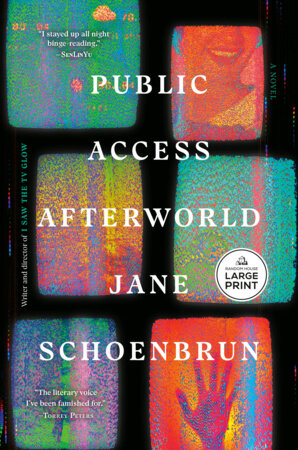
Public Access Afterworld

A Novel

Look inside
Large Print (Large Print - Tradepaper)
$35.00 US
6.21"W x 9.27"H x 1.36"D   (15.8 x 23.5 x 3.5 cm) | 28 oz (782 g) | 12 per carton
On sale Nov 24, 2026 | 800 Pages | 9798217509386
Grades 9-12 + AP/IB
Sales rights: US, Canada, Open Mkt

See Additional Formats
NEW YORK TIMES BESTSELLER • GOODREADS CHOICE AWARD NOMINEE • A mysterious realm on the other side of our screens. A dark force that draws victims into its static. The unlikely hero called to save them and herself from this electric hell. Public Access Afterworld is the profound, binge-all-night, headrush of a novel by the celebrated filmmaker of I Saw the TV Glow and Teenage Sex and Death at Camp Miasma

One of Publisher Weekly’s Ten Best Books of the Year
One of the Best Books of the Year: Kirkus Reviews

“No synopsis can possibly convey the weird, full-hearted wonder of Jane Schoenbrun’s electrifying first novel . . . An entire generation may have found a receiver in this revelation of a book. Schoenbrun has called together the dreams and tribulations of a dimension of peoples—long erased, long maligned, too often brutalized, heroically resisting—and made them real.”—Junot Diaz, New York Times Book Review (Editors’ Choice)

“Schoenbrun’s stunning debut is a psychedelic work of genius.”—People (Book of the Week)

“Beautiful, funny, and scathing . . . I stayed up all night binge-reading.”—SenLinYu, author of Alchemised
“Gave me a vertiginous thrill I haven’t encountered since David Mitchell.”—Torrey Peters, author of Detransition, Baby
“Heart-wrenching, hilarious, visionary, and so damned smart, this novel is a major work by a major writer.”—Paul Tremblay, author of A Head Full of Ghosts
“Dazzling and politically acute, Schoenbrun’s debut announces a major literary voice.”—Kirkus Reviews (starred review)
“A dazzling story . . . a great American novel.”—Publishers Weekly (starred review)
“One of the best novels of the year.”—Booklist (starred review)


Find the receiver. Make it real.

At 5:35 p.m. on September 3, 1988, Dallas weatherman Ray “Can You Say Sunshine” Davino makes passing reference to Public Access Afterworld during a rambling monologue, right before he puts a gun to his head on live television and pulls the trigger.

On June 12, 2009, David Sawyer and Erin Morrison, two lonely, TV-obsessed suburban teens who might be falling in love, gather in Erin's basement to watch TV's analog-to-digital transition. But in the static that follows, Erin witnesses surreal broadcasts from a pirate TV network called Public Access Afterworld, and their lives are changed forever.

Seventeen years later, Bethany Peters toils through the night shift at megacorp GlobalVill’s bleak Austin campus. A trans content moderator, she spends her evenings reviewing an endless stream of horrific videos. But then a young streamer begins to crop up in her feed calling out to Public Access Afterworld.

But what is Public Access Afterworld?

Spanning decades and realities, with an unforgettable ensemble of outcasts and nerds—especially the messy but wholly relatable Bethany, who must overcome paranoia and self-doubt to transform into a hero of our times—Public Access Afterworld will have you reading through the night and rooting for its characters to survive. A mesmerizing mash-up of speculative fiction, horror, and conspiracy, it marks the arrival of a major new force in contemporary fiction by a groundbreaking filmmaker who’s been compared to David Lynch and Paul Thomas Anderson.
1

My TV show starts nine feet under the American suburbs, in Erin Morrison's basement.

That basement was a refuge. A nook to hide from the town above. Waste your youth watching horror movies and weird early internet videos. A cocoon without windows, incubated by central air.

My TV show starts on Friday, June 12, 2009, the night of the analog-to-digital switch-off. Maybe that date doesn't mean anything to you, but if your high school experience was anything like mine, you probably remember the legally mandated deadline when every television network in America, be it local or national, was required to flip the switch and put analog broadcasting out of its misery forever. David Sawyer and Erin Morrison had been quietly anticipating the deadline all school year long. They were, of course, losers.

It had all been a long time coming. Analog broadcasting had spent at least a decade in the TV equivalent of hospice, and during that time, houses all over town had been leveling up to flat-screens and TiVos, banishing their old bulky sets to collect dust in attics and basements. Digital television was the future. It meant more channels, crisper picture quality. Analog television meant fuzzy images and . . . I don't know, Dick Van Dyke reruns? Maybe back in the 1950s, all that had been a necessary stepping stone, but now analog was a relic, one whose government-mandated extinction date was way past due.

For David and Erin, the switch-off was an excuse for celebration. The best friends stayed up late that night, throwing themselves a two-person kegger in the basement with a bottle of Tito's they "borrowed" from Erin's mom's liquor cabinet. As the hour approached, they traded swigs, passing the bottle back and forth from beanbag to couch, waiting for analog broadcasting to end and the digital era to begin. That's what they would say on the news later that night (for the very first time broadcast exclusively over cable boxes and digital receivers): "The digital era has begun."

Around eleven-thirty, David stumbled to his feet and got to work setting up his Canon VIXIA. He fiddled with the tripod, trying to get the framing just right so he could capture the exact moment in history when some Cronkite-style newsman, nearly extinct himself, in some television studio somewhere, flipped the switch and transitioned eighty years of television back to that which came before it: static.

Never-ending static. Fuzzy and numbing.

Keep your eye on the static: It's an important part of my TV show's mythology.

David loved Erin's basement. You could call it his second home, but that would be giving too much credit to his first. To David, Erin's basement was a sanctuary. Its lava lamps and glow-in-the-dark alien smoking weed posters from Spencer Gifts. That "I Love NYC" snow globe on the mantel that Erin brought back from a school trip to the city at the end of the third grade, just months before 9/11 rendered its miniature skyline as outdated as the analog signal David and Erin were tuning into for the very last time.

A short list of things David loved: Erin's basement, which we've already covered. Television, obviously. Blockbuster, before it closed. Ms. Walsh's AV dungeon and the Auxiliaries who spent their time down there. Reading the plots of horror movies on Wikipedia without ever watching them. Double Stuf Oreos (David liked to combine the frosted halves of two to make a custom sandwich he dubbed the Quadruple Stuf Oreo).

And Erin. There was no one and nothing in this world David loved more than Erin Morrison, not even television. Erin, that anxious, mousy girl who'd first talked to him in the cafeteria back in fourth grade because they were reading the same Animorphs book. Erin, whom David had started having weekly playdates with before elementary school was over, even though both their moms were clearly uncomfortable with them being coed best friends.

And okay, look: Yes. If you need to know, David was utterly, totally, one hundred percent madly in love with Erin. Obviously. Always had been. Always would be.

David loved Erin. David loved watching TV with Erin down in her basement. And David knew without a doubt in his mind that before too long, Erin was going to leave him.

"Okay, it's . . ." David checks his watch. He grins at his camcorder, standing in front of Erin's old Toshiba.

"It's 11:58 p.m., June twelfth, 2009. And this is the biggest moment in television history since the Man on the Moon. The Fall of the Berlin Wall. Or when JFK got shot by someone who was definitely not Lee Harvey Oswald."

"It's the end of analog broadcasting," Erin says from behind the camera.

"It's over, baby! RIP!" David shouts.

Erin smiles, watching her best friend from the beanbag and beaming like a proud parent at a school play. David checks his watch.

"In just one minute and eleven seconds, Uncle Sam is gonna flip the switch, and eighty years of television history is going to go up in static. And the last thing ever broadcast on analog television was . . ." David looks behind him. "Sex and the f***ing City. The lamest show ever!" On the screen, the Sex and the City credits begin to scroll faster than anyone could possibly read.

Now midnight approaches. David checks his watch again and hams a countdown for the camera like it's New Year's Eve and he's a young, lactose intolerant Dick Clark.

"All right. In EIGHT. SEVEN. SIX . . ."

From her spot on the beanbag, Erin joins in on the count.

"FIVE. FOUR. THREE.

"TWO.

"ONE."

They don't hit the mark exactly. Maybe David's watch is a little off. Or maybe that decrepit Cronkite in his radio tower flips the switch a second or two past midnight. But who cares? Because even though it happens a moment later than it's supposed to, it still happens.

TSSSSSSSSSSSS-

Static. Without warning. A signal washed of its image. A transmission cut with the abruptness of lightning.

TSSSSSSSSSS. The static hisses from its boxed enclosure. Vibrates against the glass of Erin's newly useless Toshiba.

Do you know what static is, literally? Radio waves. Invisible to our sense perceptions, but surrounding us at all times, like water we don't even know we're swimming in. For centuries, millennia, since before the Big Bang, we didn't know these waves existed. But that doesn't mean they weren't there, waiting to be discovered.

And then about a century ago, we tuned in. We learned how to recognize those waves, to conjure them onto a screen in a digestible form. We tapped the signal, and soon we learned to work with it, to control it, to bend the static to our will.

We made shadows and shapes. Transmissions in color and black and white. The Honeymooners. The Andy Griffith Show. Sex and the f***ing City. Soon, as the decades passed, we discovered newer, more cost-effective ways to control electricity. To recognize and manipulate that invisible water that surrounds us all. To remake it in our image. So we allowed the analog signal to revert back to its original form: wild, endless static.

It's still there, of course. Even if our world moves on. Even if we hide our analog sets in storage closets and garbage dumps. The static remains underneath everything.

Eight percent uploaded.

Erin balances her mom's bottle of Tito's on her belly, sprawled out on her beanbag still watching the static on her Toshiba. David's in a leather chair at the computer desk, hunched over Erin's family desktop, uploading his video to GlobalVill.com, that new streaming platform people say is two times faster than YouTube, better quality than Dailymotion, more community-oriented than Vimeo.

This, too, another sign of the changing times. The streaming revolution is at hand. It seems like just yesterday it took David forty-five minutes to play a Flash game on his parents' 56K dial-up, three hours to download a WAV file from LimeWire. But recently, suddenly, streaming video was instantaneous. Anything was ready to watch or upload anytime. Anyone could start a TV channel of their very own.

David's not the only person racing tonight to upload his documentation of the analog switch-off, not the only loser who's dedicated his Friday night to playing amateur television historian. But he's probably the youngest. Some videos are already up on GlobalVill.com. "The Exact Moment that Analog Broadcasting Ended!" uploaded by JakeMonster. "Analog TV is Over You Guys!" uploaded by triggerhappyninja. David's been scooped, beaten to the punch thanks to Erin's mediocre DSL connection.

Nine percent. The upload stutters along.

"I switched your settings off Energy Saver," David tells Erin. He stumbles across the room, scoops up his cellphone, then grabs his house keys from next to that Twin Tower snow globe up on the mantel.

"I'm okay to bike. I think I'm okay to bike."

"It's one a.m.," Erin says. "Crash on the couch. Mom can make us waffles in the morning."

David looks towards the staircase and thinks about emerging out of air-conditioning into the swamp outside. A minor bout of vertigo wobbles him.

Erin rolls her eyes. "You're drunk," she says. Static hums from the screen across the room.
“‘Find the receiver. Make it real,’ the novel urges. An entire generation may have found a receiver in this revelation of a book. Schoenbrun has called together the dreams and tribulations of a dimension of peoples—long erased, long maligned, too often brutalized, heroically resisting—and made them real.”—Junot, Diaz, The New York Times

“A reality-warping epic about friendship, transformation, and the internet that stretches across decades and dimensions.”—New York

“Schoenbrun’s mind-bending fiction debut screams ‘instant cult classic . . . Schoenbrun revels in horror and speculative elements, writing a multimedia mashup that reflects our destabilized world.”—Time

“An utterly unique storyteller. Twisty-turny horror and humor come together in [Public Access Afterworld].”—Boston Globe

“A psychedelic work of genius.”—Newsday

“[ [A] queer, speculative, decade-hopping, profoundly witty sci-fi horror phantasmagoria.”—Interview Magazine

“Confirmation that Schoenbrun’s worldbuilding skill is well beyond their peers, cinematic or literary.” —Salon

“Cinematic and profound.” —Marie Claire

“ [A] binge-worthy novel.” —Forbes

“Unlike anything else hitting shelves this month—or that has been released this year . . . both disturbing and dazzling by turns.” —AV Club, Best Books of October

“Reads like a David Mitchell fever dream imagined by somebody working the last Blockbuster on the planet . . . Is there anything Jane Schoenbrun can’t do?”—Literary Hub

“Few artists are able to capture the disconnection, longing, and eeriness of the early internet age and the holes it created in our society [like Schoenbrun], and Public Access Afterworld continues that trend. It’s like a creepypasta come to life, and I’m here for it.”—Chicago Review of Books

“A fever dream-esque love letter to television, the internet, science fiction, and nerds.”—Reactor

“You absolutely won’t want to miss this epic, beautifully strange novel.” —Bloody Disgusting

“Dreamy and thrilling literary horror . . . intoxicating.”—Autostraddle

“This book is just as awesome as their growing [film] oeuvre. . . . So good!”—Crime Reads

“[T]he epic, spine-chilling story to help you settle into autumn’s long nights.”—Electric Lit

“Paying homage to classic horror movies and late-night television, filmmaker Schoenbrun debuts with a dazzling story.” —The Millions

“One of the best novels of the year . . . [An] existentially terrifying, David Lynchian horror.”—Booklist, starred review

“Dazzling and politically acute, Schoenbrun’s debut announces a major literary voice.”—Kirkus Reviews, starred review

“Captivating.”—Library Journal

“For fans of Kaliane Bradley, David Mitchell, and Stranger Things . . . a cult classic in the making.”—The Bookseller

“An immersive and chilling journey that I stayed up all night binge-reading . . . Adroitly beautiful, funny, and scathing, Public Access Afterworld is a book from a talented storyteller with much to say, who’s not afraid to say it.”—SenLinYu, author of Alchemised

“Strange, urgent, utterly hypnotic—once you start reading Public Access Afterworld, you won't stop.”—Lev Grossman, author of The Magicians

“Constantly yanking the magical carpet out from under the reader's feet, this epic quest for the source of all television is psychedelic horror of the first order.”—Grady Hendrix, author of Witchcraft for Wayward Girls

“Thrilling, heart-wrenching, hilarious, visionary, and so damned smart, this novel is a major work from a major talent.”—Paul Tremblay, author of Dead But Dreaming of Electric Sheep

“Public Access Afterworld gave me a vertiginous thrill I haven’t encountered since David Mitchell; the kind of epic book that doesn’t just warp reality on the page, but goes on warping when you look up—you read it and the world glints with secrets anew.”—Torrey Peters, author of Detransition, Baby

“A riot in novel form by an author with an utterly singular, original vision. Public Access Afterworld will leave you breathless and desperate for a sequel.”—Kaliane Bradley, author of The Ministry of Time

“Such a compulsive read. Dark and glittering and full of static.”—Helen Macdonald, author of H Is For Hawk
© Mila Matveeva
Jane Schoenbrun is an award-winning filmmaker and writer. Their films include I Saw the TV Glow and We're All Going to the World's Fair. Their newest film, Teenage Sex and Death at Camp Miasma starring Gillian Anderson and Hannah Einbinder, releases in 2026. Public Access Afterworld is their first novel. View titles by Jane Schoenbrun
Available for sale exclusive:
•     Canada
•     Guam
•     Minor Outl.Ins.
•     North Mariana
•     Philippines
•     Puerto Rico
•     Samoa,American
•     US Virgin Is.
•     USA

Available for sale non-exclusive:
•     Afghanistan
•     Aland Islands
•     Albania
•     Algeria
•     Andorra
•     Angola
•     Antarctica
•     Argentina
•     Armenia
•     Aruba
•     Austria
•     Azerbaijan
•     Bahrain
•     Belarus
•     Belgium
•     Benin
•     Bolivia
•     Bonaire, Saba
•     Bosnia Herzeg.
•     Bouvet Island
•     Brazil
•     Bulgaria
•     Burkina Faso
•     Burundi
•     Cambodia
•     Cape Verde
•     Centr.Afr.Rep.
•     Chad
•     Chile
•     China
•     Colombia
•     Comoro Is.
•     Congo
•     Cook Islands
•     Costa Rica
•     Croatia
•     Cuba
•     Curacao
•     Czech Republic
•     Dem. Rep. Congo
•     Denmark
•     Djibouti
•     Dominican Rep.
•     Ecuador
•     Egypt
•     El Salvador
•     Equatorial Gui.
•     Eritrea
•     Estonia
•     Ethiopia
•     Faroe Islands
•     Finland
•     France
•     Fren.Polynesia
•     French Guinea
•     Gabon
•     Georgia
•     Germany
•     Greece
•     Greenland
•     Guadeloupe
•     Guatemala
•     Guinea Republic
•     Guinea-Bissau
•     Haiti
•     Heard/McDon.Isl
•     Honduras
•     Hong Kong
•     Hungary
•     Iceland
•     Indonesia
•     Iran
•     Iraq
•     Israel
•     Italy
•     Ivory Coast
•     Japan
•     Jordan
•     Kazakhstan
•     Kuwait
•     Kyrgyzstan
•     Laos
•     Latvia
•     Lebanon
•     Liberia
•     Libya
•     Liechtenstein
•     Lithuania
•     Luxembourg
•     Macau
•     Macedonia
•     Madagascar
•     Mali
•     Marshall island
•     Martinique
•     Mauritania
•     Mayotte
•     Mexico
•     Micronesia
•     Moldavia
•     Monaco
•     Mongolia
•     Montenegro
•     Morocco
•     Netherlands
•     New Caledonia
•     Nicaragua
•     Niger
•     Niue
•     Norfolk Island
•     North Korea
•     Norway
•     Oman
•     Palau
•     Palestinian Ter
•     Panama
•     Paraguay
•     Peru
•     Poland
•     Portugal
•     Qatar
•     Reunion Island
•     Romania
•     Russian Fed.
•     Rwanda
•     Saint Martin
•     San Marino
•     SaoTome Princip
•     Saudi Arabia
•     Senegal
•     Serbia
•     Sint Maarten
•     Slovakia
•     Slovenia
•     South Korea
•     South Sudan
•     Spain
•     St Barthelemy
•     St.Pier,Miquel.
•     Sth Terr. Franc
•     Suriname
•     Svalbard
•     Sweden
•     Switzerland
•     Syria
•     Tadschikistan
•     Taiwan
•     Thailand
•     Timor-Leste
•     Togo
•     Tokelau Islands
•     Tunisia
•     Turkey
•     Turkmenistan
•     Ukraine
•     Unit.Arab Emir.
•     Uruguay
•     Uzbekistan
•     Vatican City
•     Venezuela
•     Vietnam
•     Wallis,Futuna
•     West Saharan
•     Western Samoa
•     Yemen

Not available for sale:
•     Anguilla
•     Antigua/Barbuda
•     Australia
•     Bahamas
•     Bangladesh
•     Barbados
•     Belize
•     Bermuda
•     Bhutan
•     Botswana
•     Brit.Ind.Oc.Ter
•     Brit.Virgin Is.
•     Brunei
•     Cameroon
•     Cayman Islands
•     Christmas Islnd
•     Cocos Islands
•     Cyprus
•     Dominica
•     Falkland Islnds
•     Fiji
•     Gambia
•     Ghana
•     Gibraltar
•     Grenada
•     Guernsey
•     Guyana
•     India
•     Ireland
•     Isle of Man
•     Jamaica
•     Jersey
•     Kenya
•     Kiribati
•     Lesotho
•     Malawi
•     Malaysia
•     Maldives
•     Malta
•     Mauritius
•     Montserrat
•     Mozambique
•     Myanmar
•     Namibia
•     Nauru
•     Nepal
•     New Zealand
•     Nigeria
•     Pakistan
•     PapuaNewGuinea
•     Pitcairn Islnds
•     S. Sandwich Ins
•     Seychelles
•     Sierra Leone
•     Singapore
•     Solomon Islands
•     Somalia
•     South Africa
•     Sri Lanka
•     St. Helena
•     St. Lucia
•     St. Vincent
•     St.Chr.,Nevis
•     Sudan
•     Swaziland
•     Tanzania
•     Tonga
•     Trinidad,Tobago
•     Turks&Caicos Is
•     Tuvalu
•     Uganda
•     United Kingdom
•     Vanuatu
•     Zambia
•     Zimbabwe

About

NEW YORK TIMES BESTSELLER • GOODREADS CHOICE AWARD NOMINEE • A mysterious realm on the other side of our screens. A dark force that draws victims into its static. The unlikely hero called to save them and herself from this electric hell. Public Access Afterworld is the profound, binge-all-night, headrush of a novel by the celebrated filmmaker of I Saw the TV Glow and Teenage Sex and Death at Camp Miasma

One of Publisher Weekly’s Ten Best Books of the Year
One of the Best Books of the Year: Kirkus Reviews

“No synopsis can possibly convey the weird, full-hearted wonder of Jane Schoenbrun’s electrifying first novel . . . An entire generation may have found a receiver in this revelation of a book. Schoenbrun has called together the dreams and tribulations of a dimension of peoples—long erased, long maligned, too often brutalized, heroically resisting—and made them real.”—Junot Diaz, New York Times Book Review (Editors’ Choice)

“Schoenbrun’s stunning debut is a psychedelic work of genius.”—People (Book of the Week)

“Beautiful, funny, and scathing . . . I stayed up all night binge-reading.”—SenLinYu, author of Alchemised
“Gave me a vertiginous thrill I haven’t encountered since David Mitchell.”—Torrey Peters, author of Detransition, Baby
“Heart-wrenching, hilarious, visionary, and so damned smart, this novel is a major work by a major writer.”—Paul Tremblay, author of A Head Full of Ghosts
“Dazzling and politically acute, Schoenbrun’s debut announces a major literary voice.”—Kirkus Reviews (starred review)
“A dazzling story . . . a great American novel.”—Publishers Weekly (starred review)
“One of the best novels of the year.”—Booklist (starred review)


Find the receiver. Make it real.

At 5:35 p.m. on September 3, 1988, Dallas weatherman Ray “Can You Say Sunshine” Davino makes passing reference to Public Access Afterworld during a rambling monologue, right before he puts a gun to his head on live television and pulls the trigger.

On June 12, 2009, David Sawyer and Erin Morrison, two lonely, TV-obsessed suburban teens who might be falling in love, gather in Erin's basement to watch TV's analog-to-digital transition. But in the static that follows, Erin witnesses surreal broadcasts from a pirate TV network called Public Access Afterworld, and their lives are changed forever.

Seventeen years later, Bethany Peters toils through the night shift at megacorp GlobalVill’s bleak Austin campus. A trans content moderator, she spends her evenings reviewing an endless stream of horrific videos. But then a young streamer begins to crop up in her feed calling out to Public Access Afterworld.

But what is Public Access Afterworld?

Spanning decades and realities, with an unforgettable ensemble of outcasts and nerds—especially the messy but wholly relatable Bethany, who must overcome paranoia and self-doubt to transform into a hero of our times—Public Access Afterworld will have you reading through the night and rooting for its characters to survive. A mesmerizing mash-up of speculative fiction, horror, and conspiracy, it marks the arrival of a major new force in contemporary fiction by a groundbreaking filmmaker who’s been compared to David Lynch and Paul Thomas Anderson.

Excerpt

1

My TV show starts nine feet under the American suburbs, in Erin Morrison's basement.

That basement was a refuge. A nook to hide from the town above. Waste your youth watching horror movies and weird early internet videos. A cocoon without windows, incubated by central air.

My TV show starts on Friday, June 12, 2009, the night of the analog-to-digital switch-off. Maybe that date doesn't mean anything to you, but if your high school experience was anything like mine, you probably remember the legally mandated deadline when every television network in America, be it local or national, was required to flip the switch and put analog broadcasting out of its misery forever. David Sawyer and Erin Morrison had been quietly anticipating the deadline all school year long. They were, of course, losers.

It had all been a long time coming. Analog broadcasting had spent at least a decade in the TV equivalent of hospice, and during that time, houses all over town had been leveling up to flat-screens and TiVos, banishing their old bulky sets to collect dust in attics and basements. Digital television was the future. It meant more channels, crisper picture quality. Analog television meant fuzzy images and . . . I don't know, Dick Van Dyke reruns? Maybe back in the 1950s, all that had been a necessary stepping stone, but now analog was a relic, one whose government-mandated extinction date was way past due.

For David and Erin, the switch-off was an excuse for celebration. The best friends stayed up late that night, throwing themselves a two-person kegger in the basement with a bottle of Tito's they "borrowed" from Erin's mom's liquor cabinet. As the hour approached, they traded swigs, passing the bottle back and forth from beanbag to couch, waiting for analog broadcasting to end and the digital era to begin. That's what they would say on the news later that night (for the very first time broadcast exclusively over cable boxes and digital receivers): "The digital era has begun."

Around eleven-thirty, David stumbled to his feet and got to work setting up his Canon VIXIA. He fiddled with the tripod, trying to get the framing just right so he could capture the exact moment in history when some Cronkite-style newsman, nearly extinct himself, in some television studio somewhere, flipped the switch and transitioned eighty years of television back to that which came before it: static.

Never-ending static. Fuzzy and numbing.

Keep your eye on the static: It's an important part of my TV show's mythology.

David loved Erin's basement. You could call it his second home, but that would be giving too much credit to his first. To David, Erin's basement was a sanctuary. Its lava lamps and glow-in-the-dark alien smoking weed posters from Spencer Gifts. That "I Love NYC" snow globe on the mantel that Erin brought back from a school trip to the city at the end of the third grade, just months before 9/11 rendered its miniature skyline as outdated as the analog signal David and Erin were tuning into for the very last time.

A short list of things David loved: Erin's basement, which we've already covered. Television, obviously. Blockbuster, before it closed. Ms. Walsh's AV dungeon and the Auxiliaries who spent their time down there. Reading the plots of horror movies on Wikipedia without ever watching them. Double Stuf Oreos (David liked to combine the frosted halves of two to make a custom sandwich he dubbed the Quadruple Stuf Oreo).

And Erin. There was no one and nothing in this world David loved more than Erin Morrison, not even television. Erin, that anxious, mousy girl who'd first talked to him in the cafeteria back in fourth grade because they were reading the same Animorphs book. Erin, whom David had started having weekly playdates with before elementary school was over, even though both their moms were clearly uncomfortable with them being coed best friends.

And okay, look: Yes. If you need to know, David was utterly, totally, one hundred percent madly in love with Erin. Obviously. Always had been. Always would be.

David loved Erin. David loved watching TV with Erin down in her basement. And David knew without a doubt in his mind that before too long, Erin was going to leave him.

"Okay, it's . . ." David checks his watch. He grins at his camcorder, standing in front of Erin's old Toshiba.

"It's 11:58 p.m., June twelfth, 2009. And this is the biggest moment in television history since the Man on the Moon. The Fall of the Berlin Wall. Or when JFK got shot by someone who was definitely not Lee Harvey Oswald."

"It's the end of analog broadcasting," Erin says from behind the camera.

"It's over, baby! RIP!" David shouts.

Erin smiles, watching her best friend from the beanbag and beaming like a proud parent at a school play. David checks his watch.

"In just one minute and eleven seconds, Uncle Sam is gonna flip the switch, and eighty years of television history is going to go up in static. And the last thing ever broadcast on analog television was . . ." David looks behind him. "Sex and the f***ing City. The lamest show ever!" On the screen, the Sex and the City credits begin to scroll faster than anyone could possibly read.

Now midnight approaches. David checks his watch again and hams a countdown for the camera like it's New Year's Eve and he's a young, lactose intolerant Dick Clark.

"All right. In EIGHT. SEVEN. SIX . . ."

From her spot on the beanbag, Erin joins in on the count.

"FIVE. FOUR. THREE.

"TWO.

"ONE."

They don't hit the mark exactly. Maybe David's watch is a little off. Or maybe that decrepit Cronkite in his radio tower flips the switch a second or two past midnight. But who cares? Because even though it happens a moment later than it's supposed to, it still happens.

TSSSSSSSSSSSS-

Static. Without warning. A signal washed of its image. A transmission cut with the abruptness of lightning.

TSSSSSSSSSS. The static hisses from its boxed enclosure. Vibrates against the glass of Erin's newly useless Toshiba.

Do you know what static is, literally? Radio waves. Invisible to our sense perceptions, but surrounding us at all times, like water we don't even know we're swimming in. For centuries, millennia, since before the Big Bang, we didn't know these waves existed. But that doesn't mean they weren't there, waiting to be discovered.

And then about a century ago, we tuned in. We learned how to recognize those waves, to conjure them onto a screen in a digestible form. We tapped the signal, and soon we learned to work with it, to control it, to bend the static to our will.

We made shadows and shapes. Transmissions in color and black and white. The Honeymooners. The Andy Griffith Show. Sex and the f***ing City. Soon, as the decades passed, we discovered newer, more cost-effective ways to control electricity. To recognize and manipulate that invisible water that surrounds us all. To remake it in our image. So we allowed the analog signal to revert back to its original form: wild, endless static.

It's still there, of course. Even if our world moves on. Even if we hide our analog sets in storage closets and garbage dumps. The static remains underneath everything.

Eight percent uploaded.

Erin balances her mom's bottle of Tito's on her belly, sprawled out on her beanbag still watching the static on her Toshiba. David's in a leather chair at the computer desk, hunched over Erin's family desktop, uploading his video to GlobalVill.com, that new streaming platform people say is two times faster than YouTube, better quality than Dailymotion, more community-oriented than Vimeo.

This, too, another sign of the changing times. The streaming revolution is at hand. It seems like just yesterday it took David forty-five minutes to play a Flash game on his parents' 56K dial-up, three hours to download a WAV file from LimeWire. But recently, suddenly, streaming video was instantaneous. Anything was ready to watch or upload anytime. Anyone could start a TV channel of their very own.

David's not the only person racing tonight to upload his documentation of the analog switch-off, not the only loser who's dedicated his Friday night to playing amateur television historian. But he's probably the youngest. Some videos are already up on GlobalVill.com. "The Exact Moment that Analog Broadcasting Ended!" uploaded by JakeMonster. "Analog TV is Over You Guys!" uploaded by triggerhappyninja. David's been scooped, beaten to the punch thanks to Erin's mediocre DSL connection.

Nine percent. The upload stutters along.

"I switched your settings off Energy Saver," David tells Erin. He stumbles across the room, scoops up his cellphone, then grabs his house keys from next to that Twin Tower snow globe up on the mantel.

"I'm okay to bike. I think I'm okay to bike."

"It's one a.m.," Erin says. "Crash on the couch. Mom can make us waffles in the morning."

David looks towards the staircase and thinks about emerging out of air-conditioning into the swamp outside. A minor bout of vertigo wobbles him.

Erin rolls her eyes. "You're drunk," she says. Static hums from the screen across the room.

Praise

“‘Find the receiver. Make it real,’ the novel urges. An entire generation may have found a receiver in this revelation of a book. Schoenbrun has called together the dreams and tribulations of a dimension of peoples—long erased, long maligned, too often brutalized, heroically resisting—and made them real.”—Junot, Diaz, The New York Times

“A reality-warping epic about friendship, transformation, and the internet that stretches across decades and dimensions.”—New York

“Schoenbrun’s mind-bending fiction debut screams ‘instant cult classic . . . Schoenbrun revels in horror and speculative elements, writing a multimedia mashup that reflects our destabilized world.”—Time

“An utterly unique storyteller. Twisty-turny horror and humor come together in [Public Access Afterworld].”—Boston Globe

“A psychedelic work of genius.”—Newsday

“[ [A] queer, speculative, decade-hopping, profoundly witty sci-fi horror phantasmagoria.”—Interview Magazine

“Confirmation that Schoenbrun’s worldbuilding skill is well beyond their peers, cinematic or literary.” —Salon

“Cinematic and profound.” —Marie Claire

“ [A] binge-worthy novel.” —Forbes

“Unlike anything else hitting shelves this month—or that has been released this year . . . both disturbing and dazzling by turns.” —AV Club, Best Books of October

“Reads like a David Mitchell fever dream imagined by somebody working the last Blockbuster on the planet . . . Is there anything Jane Schoenbrun can’t do?”—Literary Hub

“Few artists are able to capture the disconnection, longing, and eeriness of the early internet age and the holes it created in our society [like Schoenbrun], and Public Access Afterworld continues that trend. It’s like a creepypasta come to life, and I’m here for it.”—Chicago Review of Books

“A fever dream-esque love letter to television, the internet, science fiction, and nerds.”—Reactor

“You absolutely won’t want to miss this epic, beautifully strange novel.” —Bloody Disgusting

“Dreamy and thrilling literary horror . . . intoxicating.”—Autostraddle

“This book is just as awesome as their growing [film] oeuvre. . . . So good!”—Crime Reads

“[T]he epic, spine-chilling story to help you settle into autumn’s long nights.”—Electric Lit

“Paying homage to classic horror movies and late-night television, filmmaker Schoenbrun debuts with a dazzling story.” —The Millions

“One of the best novels of the year . . . [An] existentially terrifying, David Lynchian horror.”—Booklist, starred review

“Dazzling and politically acute, Schoenbrun’s debut announces a major literary voice.”—Kirkus Reviews, starred review

“Captivating.”—Library Journal

“For fans of Kaliane Bradley, David Mitchell, and Stranger Things . . . a cult classic in the making.”—The Bookseller

“An immersive and chilling journey that I stayed up all night binge-reading . . . Adroitly beautiful, funny, and scathing, Public Access Afterworld is a book from a talented storyteller with much to say, who’s not afraid to say it.”—SenLinYu, author of Alchemised

“Strange, urgent, utterly hypnotic—once you start reading Public Access Afterworld, you won't stop.”—Lev Grossman, author of The Magicians

“Constantly yanking the magical carpet out from under the reader's feet, this epic quest for the source of all television is psychedelic horror of the first order.”—Grady Hendrix, author of Witchcraft for Wayward Girls

“Thrilling, heart-wrenching, hilarious, visionary, and so damned smart, this novel is a major work from a major talent.”—Paul Tremblay, author of Dead But Dreaming of Electric Sheep

“Public Access Afterworld gave me a vertiginous thrill I haven’t encountered since David Mitchell; the kind of epic book that doesn’t just warp reality on the page, but goes on warping when you look up—you read it and the world glints with secrets anew.”—Torrey Peters, author of Detransition, Baby

“A riot in novel form by an author with an utterly singular, original vision. Public Access Afterworld will leave you breathless and desperate for a sequel.”—Kaliane Bradley, author of The Ministry of Time

“Such a compulsive read. Dark and glittering and full of static.”—Helen Macdonald, author of H Is For Hawk

Author

© Mila Matveeva
Jane Schoenbrun is an award-winning filmmaker and writer. Their films include I Saw the TV Glow and We're All Going to the World's Fair. Their newest film, Teenage Sex and Death at Camp Miasma starring Gillian Anderson and Hannah Einbinder, releases in 2026. Public Access Afterworld is their first novel. View titles by Jane Schoenbrun

Rights

Available for sale exclusive:
•     Canada
•     Guam
•     Minor Outl.Ins.
•     North Mariana
•     Philippines
•     Puerto Rico
•     Samoa,American
•     US Virgin Is.
•     USA

Available for sale non-exclusive:
•     Afghanistan
•     Aland Islands
•     Albania
•     Algeria
•     Andorra
•     Angola
•     Antarctica
•     Argentina
•     Armenia
•     Aruba
•     Austria
•     Azerbaijan
•     Bahrain
•     Belarus
•     Belgium
•     Benin
•     Bolivia
•     Bonaire, Saba
•     Bosnia Herzeg.
•     Bouvet Island
•     Brazil
•     Bulgaria
•     Burkina Faso
•     Burundi
•     Cambodia
•     Cape Verde
•     Centr.Afr.Rep.
•     Chad
•     Chile
•     China
•     Colombia
•     Comoro Is.
•     Congo
•     Cook Islands
•     Costa Rica
•     Croatia
•     Cuba
•     Curacao
•     Czech Republic
•     Dem. Rep. Congo
•     Denmark
•     Djibouti
•     Dominican Rep.
•     Ecuador
•     Egypt
•     El Salvador
•     Equatorial Gui.
•     Eritrea
•     Estonia
•     Ethiopia
•     Faroe Islands
•     Finland
•     France
•     Fren.Polynesia
•     French Guinea
•     Gabon
•     Georgia
•     Germany
•     Greece
•     Greenland
•     Guadeloupe
•     Guatemala
•     Guinea Republic
•     Guinea-Bissau
•     Haiti
•     Heard/McDon.Isl
•     Honduras
•     Hong Kong
•     Hungary
•     Iceland
•     Indonesia
•     Iran
•     Iraq
•     Israel
•     Italy
•     Ivory Coast
•     Japan
•     Jordan
•     Kazakhstan
•     Kuwait
•     Kyrgyzstan
•     Laos
•     Latvia
•     Lebanon
•     Liberia
•     Libya
•     Liechtenstein
•     Lithuania
•     Luxembourg
•     Macau
•     Macedonia
•     Madagascar
•     Mali
•     Marshall island
•     Martinique
•     Mauritania
•     Mayotte
•     Mexico
•     Micronesia
•     Moldavia
•     Monaco
•     Mongolia
•     Montenegro
•     Morocco
•     Netherlands
•     New Caledonia
•     Nicaragua
•     Niger
•     Niue
•     Norfolk Island
•     North Korea
•     Norway
•     Oman
•     Palau
•     Palestinian Ter
•     Panama
•     Paraguay
•     Peru
•     Poland
•     Portugal
•     Qatar
•     Reunion Island
•     Romania
•     Russian Fed.
•     Rwanda
•     Saint Martin
•     San Marino
•     SaoTome Princip
•     Saudi Arabia
•     Senegal
•     Serbia
•     Sint Maarten
•     Slovakia
•     Slovenia
•     South Korea
•     South Sudan
•     Spain
•     St Barthelemy
•     St.Pier,Miquel.
•     Sth Terr. Franc
•     Suriname
•     Svalbard
•     Sweden
•     Switzerland
•     Syria
•     Tadschikistan
•     Taiwan
•     Thailand
•     Timor-Leste
•     Togo
•     Tokelau Islands
•     Tunisia
•     Turkey
•     Turkmenistan
•     Ukraine
•     Unit.Arab Emir.
•     Uruguay
•     Uzbekistan
•     Vatican City
•     Venezuela
•     Vietnam
•     Wallis,Futuna
•     West Saharan
•     Western Samoa
•     Yemen

Not available for sale:
•     Anguilla
•     Antigua/Barbuda
•     Australia
•     Bahamas
•     Bangladesh
•     Barbados
•     Belize
•     Bermuda
•     Bhutan
•     Botswana
•     Brit.Ind.Oc.Ter
•     Brit.Virgin Is.
•     Brunei
•     Cameroon
•     Cayman Islands
•     Christmas Islnd
•     Cocos Islands
•     Cyprus
•     Dominica
•     Falkland Islnds
•     Fiji
•     Gambia
•     Ghana
•     Gibraltar
•     Grenada
•     Guernsey
•     Guyana
•     India
•     Ireland
•     Isle of Man
•     Jamaica
•     Jersey
•     Kenya
•     Kiribati
•     Lesotho
•     Malawi
•     Malaysia
•     Maldives
•     Malta
•     Mauritius
•     Montserrat
•     Mozambique
•     Myanmar
•     Namibia
•     Nauru
•     Nepal
•     New Zealand
•     Nigeria
•     Pakistan
•     PapuaNewGuinea
•     Pitcairn Islnds
•     S. Sandwich Ins
•     Seychelles
•     Sierra Leone
•     Singapore
•     Solomon Islands
•     Somalia
•     South Africa
•     Sri Lanka
•     St. Helena
•     St. Lucia
•     St. Vincent
•     St.Chr.,Nevis
•     Sudan
•     Swaziland
•     Tanzania
•     Tonga
•     Trinidad,Tobago
•     Turks&Caicos Is
•     Tuvalu
•     Uganda
•     United Kingdom
•     Vanuatu
•     Zambia
•     Zimbabwe

Halloween Picks for Higher Education

October is here, bringing a change of season and the perfect time for a spooky read. These Halloween titles combine eerie settings and suspenseful stories with topics that work well in higher education, such as history, culture, folklore, identity, and fear in literature. Each book can support class conversations, reading groups, seminars, or independent study

Read more