Close Modal

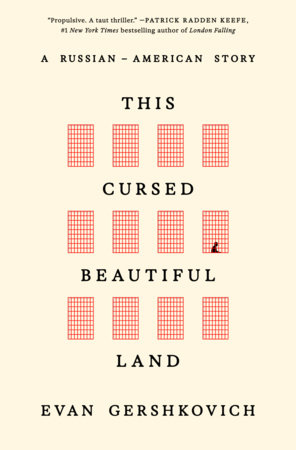
This Cursed Beautiful Land

A Russian-American Story

Look inside
Hardcover
$34.00 US
6.35"W x 9.53"H x 1.37"D   (16.1 x 24.2 x 3.5 cm) | 22 oz (624 g) | 12 per carton
On sale Sep 29, 2026 | 432 Pages | 9798217087266
Grades 9-12 + AP/IB
Sales rights: US, Canada, Open Mkt

See Additional Formats
NEW YORK TIMES BESTSELLER • The “enthralling” (The New York Times), much-anticipated memoir from the Wall Street Journal reporter who was wrongly imprisoned in Putin’s Russia for more than a year—a glimpse inside the perils and contradictions of a country in the midst of autocracy

“Propulsive . . . a taut thriller.”—Patrick Radden Keefe, #1 New York Times bestselling author of London Falling

“Beautiful writing . . . a phenomenal book.”—Jon Stewart, The Daily Show

“Extraordinary . . . deeply insightful into Russia . . . I really urge everyone to pick up this book.”—Ben Rhodes, Pod Save the World


A NEW YORKER BEST BOOK OF THE YEAR (SO FAR)

In March 2023, a year after Russia invaded Ukraine, Evan Gershkovich met with a union boss connected with a Russian tank factory. As the journalist sat with his source in an empty restaurant in an industrial city 900 miles east of Moscow, a squad of masked agents charged in, blindfolded Evan, and dragged him into an unmarked van. The agents were from the FSB, Putin’s powerful security service, and the successor to the Soviet-era KGB.

Five years earlier, Evan had arrived in Moscow to jumpstart his journalism career. His parents had left the Soviet Union in the 1970s, forging a middle-class life in New Jersey, where Evan grew up on Soviet-era cartoons and weekend trips to Brighton Beach. In Moscow, Evan dove into life—unpacking politics for readers of The Moscow Times and developing a circle of deep friendships with Russian peers, all striving to make their way in perilous times.

Western journalists had long felt insulated from the dangers their Russian counterparts experienced. But war, it seemed, had changed the rules. Interrogated for hours after his arrest, Evan was told he was being charged with spying and thrown in Moscow’s notorious Lefortovo prison—a pawn in a geopolitical chess match.

After his world suddenly shrunk to a tiny, cement-walled cell, Evan did something remarkable: he continued reporting. For the next sixteen months, he documented a life in Russia that few Westerners will ever experience: its sprawling prison system, with its own vocabulary and customs—and surprising pockets of humanity.

In writing by turns riveting and humorous, Evan brings readers inside the events leading to his arrest, his nearly 500 days in Russian prisons, and the blockbuster, multi-country prisoner swap that freed him. More than a prison memoir, This Cursed Beautiful Land is an extraordinary, deeply reported chronicle of a misunderstood people and their land—marked at once by stunning beauty and a haunting history.
One

Suburban Soviets

October 1991–­October 2017

I am an American, born in New Jersey, but the place my parents came from has never felt far away.

I arrived in the world exactly two months before the collapse of the Soviet Union. Twelve years earlier, in 1979, my parents left the country for America. They were part of a sustained wave of Jewish emigration set off by a law passed by the U.S. Congress to ease Cold War tensions—­legislation that tied trade relations to freedom of movement for Soviet citizens. Many Jews were eager to go.

My mother left Leningrad with her own mother and landed in Detroit. My father and his parents departed Odessa—­the port city in today’s Ukraine that is now Odesa—­and settled in Brooklyn near Brighton Beach, an area known as Little Odessa.

My father would later joke how, in the years before his departure, “when two Jews met on the street, they greeted each other not with hello but with a question: So, you getting ready?” Leaving was an easy decision. His father, Mark, hated the Soviet Union. Mark’s father, my great­grandfather, vanished after his arrest in 1937 at the height of Stalin’s purges. Mark and his mother had spent years moving from city to city in fear of persecution. As my grandfather watched his own son grow up, he was filled with unease, fearing my father would face mandatory conscription into the Soviet Army.

For my mother, who was twenty-­two, leaving simply felt logical. She was born in 1957, several years after the so-­called “doctors’ plot affair,” a state-­sponsored campaign that saw Jewish doctors dismissed from their jobs or arrested on false charges of conspiring to assassinate Stalin. One of these unfortunate doctors was a neighbor in her parents’ communal apartment.

Antisemitism loomed over daily life. My grandfather originally wanted to name my mother Etya, short for Esther, after his sister, who had recently passed away. But my grandmother worried that an overtly Jewish name would draw unwanted attention and instead suggested the name Ella. That the starkly Jewish last name Milman would stick out anyway didn’t soothe my grandmother’s worries. In any case, Soviet passports listed ethnic nationalities, of which “Jew” was one—­it was there on paper, for anyone to see.

Growing up, my mother adored the Soviet literary magazine Yunost, or Youth, and dreamed of becoming a writer. But she was laughed off when she applied to Leningrad State University’s journalism department. The woman receiving her application took one look at my mother’s passport and said, “Sweetheart, did you just drop from the moon?”

My mother ended up studying at the Leningrad Order of Lenin Shipbuilding Institute. She was depressed about her prospects. On Voice of America, she listened to jazz and the Rolling Stones, as well as rumors that the Kremlin would soon round up Jews and forcibly send them thousands of miles east to Birobidzhan, the capital of the so-­called “Jewish Autonomous Region” near the border with China. Created in the 1930s and touted as the world’s first official jurisdiction for Jewish people, the project was an administrative and cultural failure, another Soviet farce. For Soviet Jews, the idea of spending their lives in a freezing corner of Russia’s Far East wasn’t very appealing. By contrast, the American radio programs made the United States seem “bright and rosy,” as my mother put it.

To evade strict customs rules, my mother sewed an extra pair of gold earrings her father had gifted her into the waistband of her skirt. My grandfather had died eight years earlier. At Leningrad’s Pulkovo airport, she was carefully searched, but the border guards didn’t catch the earrings. Once she boarded the plane, she alternated between laughing and weeping.

After several tough years starting from scratch in Detroit, my mother made her way to New York. That’s where she met my father. The two of them bonded over shared language and their dark sense of humor, and after a year of dating, they were married. They settled in the university town of Princeton, New Jersey, in a post­war ranch house complete with the requisite picket fence and two cars in the driveway. An hour and a half by train southwest of Manhattan, Princeton, they decided, would be the launching pad that would thrust my sister, Danielle, and me toward the American dream.

Still, while the Soviet Union itself no longer existed, Soviet habits were alive and well on our suburban New Jersey street. We spoke Russian. We watched Soviet cartoons and films. We read Krylov’s fables rather than Aesop’s. And our English names were reserved for use outside the home. We called my sister Dusya, while I answered to Vanya, a diminutive for Ivan. When I misbehaved, my father would address me with pretend formality, appending the customary patronymic to my name: “Ivan Mikhailovich, where were you bumming around?”

Weeknight family dinners often featured reheated borsch and kotlety, ground-­beef patties somewhere between a plump hamburger and flattened meatball. When I complained that my American friends delighted in Taco Tuesdays, say, or Pizza Fridays, my mother would issue a favorite declaration, one every post-­Soviet kid knows: “I’m not a restaurant.” On days when her mood was darker, she reminded me that her first cousin had died in the Nazi blockade of Leningrad when he was nine.

The Great Patriotic War, as World War II is known in Russia, occupied an important place in our lives. From time to time, my mother sang “Katyusha,” the Soviet patriotic war song, as a lullaby. Once, I came home from school recounting with pride what I’d just learned about the heroics of Allied troops on D-­Day. My mother bristled. “Never forget that twenty-­seven million Soviet soldiers and civilians died in the war,” she said. “It was the Soviet Union that made the greatest sacrifice.”

Her father was always a hero to me. My maternal grandfather had met my grandmother, a Soviet medic, on a train evacuating the wounded from the front during the fight against the Nazis, though the exact circumstances have been lost to history. That goes for much of our family story, passed on orally in fits and starts by people rendered reluctant to speak after decades of trauma: anti-­Jewish pogroms, Soviet repressions, World War II calamities. The only relic of my grandfather’s we have from the war is a photo from 1942. As a token of memorable years, he wrote, signing off as Tin soldier.

My parents wanted my sister and me to know that our roots lay well beyond the lush pastures of New Jersey. In elementary school, we spent Saturday mornings with a Russian tutor, an exercise I remember as near torture. Dusya, or Dani, as she is known to her American friends, recently confirmed that memory when she found an old workbook of hers containing Russian grammar exercises smudged by teardrops.

The fact that we spoke Russian at home resulted in a number of embarrassments: Classmates teased me for gaps in my English, particularly over anything related to domestic life. Once, I couldn’t come up with the word for “dresser.” I also struggled to control the English “th” sound—­a lisp that consigned me to speech therapy for a year.

Still, Dani and I took pride in our heritage. Maybe too much pride. I boasted to classmates that I was better at long division than they were because I had learned the process from a Soviet textbook. “Soviets were better at math than Americans,” I explained. Like the Soviet comedians of their youth, my parents didn’t shy away from poking fun at American culture. Parroting my father, I joked that Americans call everything salad—­chicken salad, potato salad, macaroni salad—­so they don’t have to eat actual greens.

Our Soviet habits reached their pinnacle on family trips to Brighton Beach. My father’s parents had remained in the seaside Brooklyn neighborhood, which, over the decades, had become a kind of living museum of the late Soviet period. Several times a year, we drove up the New Jersey Turnpike, cut through Staten Island, and crossed the double-­decked Verrazano-­Narrows Bridge overlooking the Statue of Liberty. Arriving in southern Brooklyn after the hour-­and-­a-­half-long journey felt like stepping into another world—­our own world.

Mainly, I loved the food. We visited Georgian or Uzbek joints for shashlik, or grilled lamb kebab—­I preferred the Uzbek version for its tail fat lodged between the chunks of meat—­or went to the boardwalk restaurant Volna (meaning “wave”) for dumplings served with sour cream. On the way home, we stopped at Brighton Bazaar, where we picked out Russian candies with names like Little Red Riding Hood or the Clubfoot Bear, cans of salmon roe, jars of marinated mushrooms, and cartons of mors, a juice made from berries. Chudo-­Yagoda, or Wonder-­Berry, imported from Russia, brought me more childhood joy than Capri-­Sun or Sunny Delight ever did.

Why were my parents, after leaving the Soviet Union, so fixated on preserving their Soviet-­ness?
“The book is an extraordinary testament to [Evan’s] courage, and his humor, and his wisdom.”—David Remnick, editor of The New Yorker

“This book reveals, with a taut sense of pacing and a fastidious eye for detail, the codes and culture of life on the inside . . . Moscow’s Lefortovo prison”—The New Yorker

“This moving prison sketch is a scan of Russia’s soul.”—The Economist

“Extraordinary . . . deeply insightful into Russia . . . I really urge everyone to pick up this book.”—Ben Rhodes, Pod Save the World

“Captivating . . . A rare glimpse into a brutal and secretive system. [Gershkovich] uses his prison diary to evoke the sights, smells and routines of Russia’s jails with gut-wrenching precision. . . . His portraits of prison guards, FSB agents, investigators, bailiffs, prosecutors, informants, lawyers and inmates are empathetic, revealing and sometimes moving.”—Financial Times

“Warm, funny, and remarkably perceptive, this is far more than a prison diary—it is a deeply human portrait of a country Gershkovich can neither idealize nor stop loving. A vivid and often tender portrait of Russia that transcends the conventions of a prison memoir.”—Kirkus Reviews, starred review

“Gripping, courageous and important.”—The Irish Times

“Remarkably vivid.”—The New York Post

“An intimate, unrestrained account of Russian prison life . . . The bar is admittedly high when it comes to the artistic merits of Russian prison literature—courtesy of the likes of Solzhenitsyn and Dostoevsky—as is the level of suffering. But while Gershkovich’s time inside may not have been quite as long or hard as theirs, his book may still take its place in the canon.”—The Daily Telegraph

“A rich and suspenseful saga of Russia’s rapid descent into autocracy, told in intimate, often chilling detail by an American reporter who saw it from the inside—as a prisoner falsely arrested for espionage by Putin’s FSB. I could be wrong, but I think I hear Solzhenitsyn applauding in his grave.”—Erik Larson, New York Times-bestselling author of The Demon of Unrest

“This book is a testament to the humanity [Gershkovich] refused to surrender, and a prison memoir that doubles as a love letter, not to the dictatorship that imprisoned him, but to the Russia underneath: its language, landscape, literature, and people.”—Anthony Doerr, Pulitzer Prize-winning author of All the Light We Cannot See

“A taut thriller of high stakes ‘hostage diplomacy,’ and a poignant meditation on the human struggle between hope and apathy under authoritarian rule.”—Patrick Radden Keefe, New York Times bestselling author of London Falling

“In this memoir that reads like a thriller, Evan Gershkovich brings all his reportorial skills to bear as he chronicles his journey through a Kafka-esque justice system.”—Radhika Jones, writer and former editor, Vanity Fair
© Courtesy of the author
Evan Gershkovich is a foreign correspondent for The Wall Street Journal based in Berlin. Born in New Jersey to Soviet émigrés, he lived in Russia for over five years before his 2023 arrest and subsequent sixteen-month imprisonment on false espionage charges. His writing has also appeared in The New York Times, The Economist and Foreign Policy, and he was a Pulitzer Prize finalist in 2025 as part of an investigative team for The Journal. He is the recipient of a MacDowell Fellowship. View titles by Evan Gershkovich
Available for sale exclusive:
•     Canada
•     Guam
•     Minor Outl.Ins.
•     North Mariana
•     Philippines
•     Puerto Rico
•     Samoa,American
•     US Virgin Is.
•     USA

Available for sale non-exclusive:
•     Afghanistan
•     Aland Islands
•     Albania
•     Algeria
•     Andorra
•     Angola
•     Antarctica
•     Argentina
•     Armenia
•     Aruba
•     Austria
•     Azerbaijan
•     Bahrain
•     Belarus
•     Belgium
•     Benin
•     Bolivia
•     Bonaire, Saba
•     Bosnia Herzeg.
•     Bouvet Island
•     Brazil
•     Bulgaria
•     Burkina Faso
•     Burundi
•     Cambodia
•     Cape Verde
•     Centr.Afr.Rep.
•     Chad
•     Chile
•     China
•     Colombia
•     Comoro Is.
•     Congo
•     Cook Islands
•     Costa Rica
•     Croatia
•     Cuba
•     Curacao
•     Czech Republic
•     Dem. Rep. Congo
•     Denmark
•     Djibouti
•     Dominican Rep.
•     Ecuador
•     Egypt
•     El Salvador
•     Equatorial Gui.
•     Eritrea
•     Estonia
•     Ethiopia
•     Faroe Islands
•     Finland
•     France
•     Fren.Polynesia
•     French Guinea
•     Gabon
•     Georgia
•     Germany
•     Greece
•     Greenland
•     Guadeloupe
•     Guatemala
•     Guinea Republic
•     Guinea-Bissau
•     Haiti
•     Heard/McDon.Isl
•     Honduras
•     Hong Kong
•     Hungary
•     Iceland
•     Indonesia
•     Iran
•     Israel
•     Italy
•     Ivory Coast
•     Japan
•     Kazakhstan
•     Kyrgyzstan
•     Laos
•     Latvia
•     Lebanon
•     Liberia
•     Libya
•     Liechtenstein
•     Lithuania
•     Luxembourg
•     Macau
•     Macedonia
•     Madagascar
•     Mali
•     Marshall island
•     Martinique
•     Mauritania
•     Mayotte
•     Mexico
•     Micronesia
•     Moldavia
•     Monaco
•     Mongolia
•     Montenegro
•     Morocco
•     Netherlands
•     New Caledonia
•     Nicaragua
•     Niger
•     Niue
•     North Korea
•     Norway
•     Oman
•     Palau
•     Palestinian Ter
•     Panama
•     Paraguay
•     Peru
•     Poland
•     Portugal
•     Qatar
•     Reunion Island
•     Romania
•     Russian Fed.
•     Saint Martin
•     San Marino
•     SaoTome Princip
•     Saudi Arabia
•     Senegal
•     Serbia
•     Sint Maarten
•     Slovakia
•     Slovenia
•     South Korea
•     South Sudan
•     Spain
•     St Barthelemy
•     St.Pier,Miquel.
•     Sth Terr. Franc
•     Suriname
•     Svalbard
•     Sweden
•     Switzerland
•     Syria
•     Tadschikistan
•     Taiwan
•     Thailand
•     Timor-Leste
•     Togo
•     Tunisia
•     Turkey
•     Turkmenistan
•     Ukraine
•     Unit.Arab Emir.
•     Uruguay
•     Uzbekistan
•     Vatican City
•     Venezuela
•     Vietnam
•     Wallis,Futuna
•     West Saharan
•     Yemen

Not available for sale:
•     Anguilla
•     Antigua/Barbuda
•     Australia
•     Bahamas
•     Bangladesh
•     Barbados
•     Belize
•     Bermuda
•     Bhutan
•     Botswana
•     Brit.Ind.Oc.Ter
•     Brit.Virgin Is.
•     Brunei
•     Cameroon
•     Cayman Islands
•     Christmas Islnd
•     Cocos Islands
•     Cyprus
•     Dominica
•     Falkland Islnds
•     Fiji
•     Gambia
•     Ghana
•     Gibraltar
•     Grenada
•     Guernsey
•     Guyana
•     India
•     Iraq
•     Ireland
•     Isle of Man
•     Jamaica
•     Jersey
•     Jordan
•     Kenya
•     Kiribati
•     Kuwait
•     Lesotho
•     Malawi
•     Malaysia
•     Maldives
•     Malta
•     Mauritius
•     Montserrat
•     Mozambique
•     Myanmar
•     Namibia
•     Nauru
•     Nepal
•     New Zealand
•     Nigeria
•     Norfolk Island
•     Pakistan
•     PapuaNewGuinea
•     Pitcairn Islnds
•     Rwanda
•     S. Sandwich Ins
•     Seychelles
•     Sierra Leone
•     Singapore
•     Solomon Islands
•     Somalia
•     South Africa
•     Sri Lanka
•     St. Helena
•     St. Lucia
•     St. Vincent
•     St.Chr.,Nevis
•     Sudan
•     Swaziland
•     Tanzania
•     Tokelau Islands
•     Tonga
•     Trinidad,Tobago
•     Turks&Caicos Is
•     Tuvalu
•     Uganda
•     United Kingdom
•     Vanuatu
•     Western Samoa
•     Zambia
•     Zimbabwe

About

NEW YORK TIMES BESTSELLER • The “enthralling” (The New York Times), much-anticipated memoir from the Wall Street Journal reporter who was wrongly imprisoned in Putin’s Russia for more than a year—a glimpse inside the perils and contradictions of a country in the midst of autocracy

“Propulsive . . . a taut thriller.”—Patrick Radden Keefe, #1 New York Times bestselling author of London Falling

“Beautiful writing . . . a phenomenal book.”—Jon Stewart, The Daily Show

“Extraordinary . . . deeply insightful into Russia . . . I really urge everyone to pick up this book.”—Ben Rhodes, Pod Save the World


A NEW YORKER BEST BOOK OF THE YEAR (SO FAR)

In March 2023, a year after Russia invaded Ukraine, Evan Gershkovich met with a union boss connected with a Russian tank factory. As the journalist sat with his source in an empty restaurant in an industrial city 900 miles east of Moscow, a squad of masked agents charged in, blindfolded Evan, and dragged him into an unmarked van. The agents were from the FSB, Putin’s powerful security service, and the successor to the Soviet-era KGB.

Five years earlier, Evan had arrived in Moscow to jumpstart his journalism career. His parents had left the Soviet Union in the 1970s, forging a middle-class life in New Jersey, where Evan grew up on Soviet-era cartoons and weekend trips to Brighton Beach. In Moscow, Evan dove into life—unpacking politics for readers of The Moscow Times and developing a circle of deep friendships with Russian peers, all striving to make their way in perilous times.

Western journalists had long felt insulated from the dangers their Russian counterparts experienced. But war, it seemed, had changed the rules. Interrogated for hours after his arrest, Evan was told he was being charged with spying and thrown in Moscow’s notorious Lefortovo prison—a pawn in a geopolitical chess match.

After his world suddenly shrunk to a tiny, cement-walled cell, Evan did something remarkable: he continued reporting. For the next sixteen months, he documented a life in Russia that few Westerners will ever experience: its sprawling prison system, with its own vocabulary and customs—and surprising pockets of humanity.

In writing by turns riveting and humorous, Evan brings readers inside the events leading to his arrest, his nearly 500 days in Russian prisons, and the blockbuster, multi-country prisoner swap that freed him. More than a prison memoir, This Cursed Beautiful Land is an extraordinary, deeply reported chronicle of a misunderstood people and their land—marked at once by stunning beauty and a haunting history.

Excerpt

One

Suburban Soviets

October 1991–­October 2017

I am an American, born in New Jersey, but the place my parents came from has never felt far away.

I arrived in the world exactly two months before the collapse of the Soviet Union. Twelve years earlier, in 1979, my parents left the country for America. They were part of a sustained wave of Jewish emigration set off by a law passed by the U.S. Congress to ease Cold War tensions—­legislation that tied trade relations to freedom of movement for Soviet citizens. Many Jews were eager to go.

My mother left Leningrad with her own mother and landed in Detroit. My father and his parents departed Odessa—­the port city in today’s Ukraine that is now Odesa—­and settled in Brooklyn near Brighton Beach, an area known as Little Odessa.

My father would later joke how, in the years before his departure, “when two Jews met on the street, they greeted each other not with hello but with a question: So, you getting ready?” Leaving was an easy decision. His father, Mark, hated the Soviet Union. Mark’s father, my great­grandfather, vanished after his arrest in 1937 at the height of Stalin’s purges. Mark and his mother had spent years moving from city to city in fear of persecution. As my grandfather watched his own son grow up, he was filled with unease, fearing my father would face mandatory conscription into the Soviet Army.

For my mother, who was twenty-­two, leaving simply felt logical. She was born in 1957, several years after the so-­called “doctors’ plot affair,” a state-­sponsored campaign that saw Jewish doctors dismissed from their jobs or arrested on false charges of conspiring to assassinate Stalin. One of these unfortunate doctors was a neighbor in her parents’ communal apartment.

Antisemitism loomed over daily life. My grandfather originally wanted to name my mother Etya, short for Esther, after his sister, who had recently passed away. But my grandmother worried that an overtly Jewish name would draw unwanted attention and instead suggested the name Ella. That the starkly Jewish last name Milman would stick out anyway didn’t soothe my grandmother’s worries. In any case, Soviet passports listed ethnic nationalities, of which “Jew” was one—­it was there on paper, for anyone to see.

Growing up, my mother adored the Soviet literary magazine Yunost, or Youth, and dreamed of becoming a writer. But she was laughed off when she applied to Leningrad State University’s journalism department. The woman receiving her application took one look at my mother’s passport and said, “Sweetheart, did you just drop from the moon?”

My mother ended up studying at the Leningrad Order of Lenin Shipbuilding Institute. She was depressed about her prospects. On Voice of America, she listened to jazz and the Rolling Stones, as well as rumors that the Kremlin would soon round up Jews and forcibly send them thousands of miles east to Birobidzhan, the capital of the so-­called “Jewish Autonomous Region” near the border with China. Created in the 1930s and touted as the world’s first official jurisdiction for Jewish people, the project was an administrative and cultural failure, another Soviet farce. For Soviet Jews, the idea of spending their lives in a freezing corner of Russia’s Far East wasn’t very appealing. By contrast, the American radio programs made the United States seem “bright and rosy,” as my mother put it.

To evade strict customs rules, my mother sewed an extra pair of gold earrings her father had gifted her into the waistband of her skirt. My grandfather had died eight years earlier. At Leningrad’s Pulkovo airport, she was carefully searched, but the border guards didn’t catch the earrings. Once she boarded the plane, she alternated between laughing and weeping.

After several tough years starting from scratch in Detroit, my mother made her way to New York. That’s where she met my father. The two of them bonded over shared language and their dark sense of humor, and after a year of dating, they were married. They settled in the university town of Princeton, New Jersey, in a post­war ranch house complete with the requisite picket fence and two cars in the driveway. An hour and a half by train southwest of Manhattan, Princeton, they decided, would be the launching pad that would thrust my sister, Danielle, and me toward the American dream.

Still, while the Soviet Union itself no longer existed, Soviet habits were alive and well on our suburban New Jersey street. We spoke Russian. We watched Soviet cartoons and films. We read Krylov’s fables rather than Aesop’s. And our English names were reserved for use outside the home. We called my sister Dusya, while I answered to Vanya, a diminutive for Ivan. When I misbehaved, my father would address me with pretend formality, appending the customary patronymic to my name: “Ivan Mikhailovich, where were you bumming around?”

Weeknight family dinners often featured reheated borsch and kotlety, ground-­beef patties somewhere between a plump hamburger and flattened meatball. When I complained that my American friends delighted in Taco Tuesdays, say, or Pizza Fridays, my mother would issue a favorite declaration, one every post-­Soviet kid knows: “I’m not a restaurant.” On days when her mood was darker, she reminded me that her first cousin had died in the Nazi blockade of Leningrad when he was nine.

The Great Patriotic War, as World War II is known in Russia, occupied an important place in our lives. From time to time, my mother sang “Katyusha,” the Soviet patriotic war song, as a lullaby. Once, I came home from school recounting with pride what I’d just learned about the heroics of Allied troops on D-­Day. My mother bristled. “Never forget that twenty-­seven million Soviet soldiers and civilians died in the war,” she said. “It was the Soviet Union that made the greatest sacrifice.”

Her father was always a hero to me. My maternal grandfather had met my grandmother, a Soviet medic, on a train evacuating the wounded from the front during the fight against the Nazis, though the exact circumstances have been lost to history. That goes for much of our family story, passed on orally in fits and starts by people rendered reluctant to speak after decades of trauma: anti-­Jewish pogroms, Soviet repressions, World War II calamities. The only relic of my grandfather’s we have from the war is a photo from 1942. As a token of memorable years, he wrote, signing off as Tin soldier.

My parents wanted my sister and me to know that our roots lay well beyond the lush pastures of New Jersey. In elementary school, we spent Saturday mornings with a Russian tutor, an exercise I remember as near torture. Dusya, or Dani, as she is known to her American friends, recently confirmed that memory when she found an old workbook of hers containing Russian grammar exercises smudged by teardrops.

The fact that we spoke Russian at home resulted in a number of embarrassments: Classmates teased me for gaps in my English, particularly over anything related to domestic life. Once, I couldn’t come up with the word for “dresser.” I also struggled to control the English “th” sound—­a lisp that consigned me to speech therapy for a year.

Still, Dani and I took pride in our heritage. Maybe too much pride. I boasted to classmates that I was better at long division than they were because I had learned the process from a Soviet textbook. “Soviets were better at math than Americans,” I explained. Like the Soviet comedians of their youth, my parents didn’t shy away from poking fun at American culture. Parroting my father, I joked that Americans call everything salad—­chicken salad, potato salad, macaroni salad—­so they don’t have to eat actual greens.

Our Soviet habits reached their pinnacle on family trips to Brighton Beach. My father’s parents had remained in the seaside Brooklyn neighborhood, which, over the decades, had become a kind of living museum of the late Soviet period. Several times a year, we drove up the New Jersey Turnpike, cut through Staten Island, and crossed the double-­decked Verrazano-­Narrows Bridge overlooking the Statue of Liberty. Arriving in southern Brooklyn after the hour-­and-­a-­half-long journey felt like stepping into another world—­our own world.

Mainly, I loved the food. We visited Georgian or Uzbek joints for shashlik, or grilled lamb kebab—­I preferred the Uzbek version for its tail fat lodged between the chunks of meat—­or went to the boardwalk restaurant Volna (meaning “wave”) for dumplings served with sour cream. On the way home, we stopped at Brighton Bazaar, where we picked out Russian candies with names like Little Red Riding Hood or the Clubfoot Bear, cans of salmon roe, jars of marinated mushrooms, and cartons of mors, a juice made from berries. Chudo-­Yagoda, or Wonder-­Berry, imported from Russia, brought me more childhood joy than Capri-­Sun or Sunny Delight ever did.

Why were my parents, after leaving the Soviet Union, so fixated on preserving their Soviet-­ness?

Praise

“The book is an extraordinary testament to [Evan’s] courage, and his humor, and his wisdom.”—David Remnick, editor of The New Yorker

“This book reveals, with a taut sense of pacing and a fastidious eye for detail, the codes and culture of life on the inside . . . Moscow’s Lefortovo prison”—The New Yorker

“This moving prison sketch is a scan of Russia’s soul.”—The Economist

“Extraordinary . . . deeply insightful into Russia . . . I really urge everyone to pick up this book.”—Ben Rhodes, Pod Save the World

“Captivating . . . A rare glimpse into a brutal and secretive system. [Gershkovich] uses his prison diary to evoke the sights, smells and routines of Russia’s jails with gut-wrenching precision. . . . His portraits of prison guards, FSB agents, investigators, bailiffs, prosecutors, informants, lawyers and inmates are empathetic, revealing and sometimes moving.”—Financial Times

“Warm, funny, and remarkably perceptive, this is far more than a prison diary—it is a deeply human portrait of a country Gershkovich can neither idealize nor stop loving. A vivid and often tender portrait of Russia that transcends the conventions of a prison memoir.”—Kirkus Reviews, starred review

“Gripping, courageous and important.”—The Irish Times

“Remarkably vivid.”—The New York Post

“An intimate, unrestrained account of Russian prison life . . . The bar is admittedly high when it comes to the artistic merits of Russian prison literature—courtesy of the likes of Solzhenitsyn and Dostoevsky—as is the level of suffering. But while Gershkovich’s time inside may not have been quite as long or hard as theirs, his book may still take its place in the canon.”—The Daily Telegraph

“A rich and suspenseful saga of Russia’s rapid descent into autocracy, told in intimate, often chilling detail by an American reporter who saw it from the inside—as a prisoner falsely arrested for espionage by Putin’s FSB. I could be wrong, but I think I hear Solzhenitsyn applauding in his grave.”—Erik Larson, New York Times-bestselling author of The Demon of Unrest

“This book is a testament to the humanity [Gershkovich] refused to surrender, and a prison memoir that doubles as a love letter, not to the dictatorship that imprisoned him, but to the Russia underneath: its language, landscape, literature, and people.”—Anthony Doerr, Pulitzer Prize-winning author of All the Light We Cannot See

“A taut thriller of high stakes ‘hostage diplomacy,’ and a poignant meditation on the human struggle between hope and apathy under authoritarian rule.”—Patrick Radden Keefe, New York Times bestselling author of London Falling

“In this memoir that reads like a thriller, Evan Gershkovich brings all his reportorial skills to bear as he chronicles his journey through a Kafka-esque justice system.”—Radhika Jones, writer and former editor, Vanity Fair

Author

© Courtesy of the author
Evan Gershkovich is a foreign correspondent for The Wall Street Journal based in Berlin. Born in New Jersey to Soviet émigrés, he lived in Russia for over five years before his 2023 arrest and subsequent sixteen-month imprisonment on false espionage charges. His writing has also appeared in The New York Times, The Economist and Foreign Policy, and he was a Pulitzer Prize finalist in 2025 as part of an investigative team for The Journal. He is the recipient of a MacDowell Fellowship. View titles by Evan Gershkovich

Rights

Available for sale exclusive:
•     Canada
•     Guam
•     Minor Outl.Ins.
•     North Mariana
•     Philippines
•     Puerto Rico
•     Samoa,American
•     US Virgin Is.
•     USA

Available for sale non-exclusive:
•     Afghanistan
•     Aland Islands
•     Albania
•     Algeria
•     Andorra
•     Angola
•     Antarctica
•     Argentina
•     Armenia
•     Aruba
•     Austria
•     Azerbaijan
•     Bahrain
•     Belarus
•     Belgium
•     Benin
•     Bolivia
•     Bonaire, Saba
•     Bosnia Herzeg.
•     Bouvet Island
•     Brazil
•     Bulgaria
•     Burkina Faso
•     Burundi
•     Cambodia
•     Cape Verde
•     Centr.Afr.Rep.
•     Chad
•     Chile
•     China
•     Colombia
•     Comoro Is.
•     Congo
•     Cook Islands
•     Costa Rica
•     Croatia
•     Cuba
•     Curacao
•     Czech Republic
•     Dem. Rep. Congo
•     Denmark
•     Djibouti
•     Dominican Rep.
•     Ecuador
•     Egypt
•     El Salvador
•     Equatorial Gui.
•     Eritrea
•     Estonia
•     Ethiopia
•     Faroe Islands
•     Finland
•     France
•     Fren.Polynesia
•     French Guinea
•     Gabon
•     Georgia
•     Germany
•     Greece
•     Greenland
•     Guadeloupe
•     Guatemala
•     Guinea Republic
•     Guinea-Bissau
•     Haiti
•     Heard/McDon.Isl
•     Honduras
•     Hong Kong
•     Hungary
•     Iceland
•     Indonesia
•     Iran
•     Israel
•     Italy
•     Ivory Coast
•     Japan
•     Kazakhstan
•     Kyrgyzstan
•     Laos
•     Latvia
•     Lebanon
•     Liberia
•     Libya
•     Liechtenstein
•     Lithuania
•     Luxembourg
•     Macau
•     Macedonia
•     Madagascar
•     Mali
•     Marshall island
•     Martinique
•     Mauritania
•     Mayotte
•     Mexico
•     Micronesia
•     Moldavia
•     Monaco
•     Mongolia
•     Montenegro
•     Morocco
•     Netherlands
•     New Caledonia
•     Nicaragua
•     Niger
•     Niue
•     North Korea
•     Norway
•     Oman
•     Palau
•     Palestinian Ter
•     Panama
•     Paraguay
•     Peru
•     Poland
•     Portugal
•     Qatar
•     Reunion Island
•     Romania
•     Russian Fed.
•     Saint Martin
•     San Marino
•     SaoTome Princip
•     Saudi Arabia
•     Senegal
•     Serbia
•     Sint Maarten
•     Slovakia
•     Slovenia
•     South Korea
•     South Sudan
•     Spain
•     St Barthelemy
•     St.Pier,Miquel.
•     Sth Terr. Franc
•     Suriname
•     Svalbard
•     Sweden
•     Switzerland
•     Syria
•     Tadschikistan
•     Taiwan
•     Thailand
•     Timor-Leste
•     Togo
•     Tunisia
•     Turkey
•     Turkmenistan
•     Ukraine
•     Unit.Arab Emir.
•     Uruguay
•     Uzbekistan
•     Vatican City
•     Venezuela
•     Vietnam
•     Wallis,Futuna
•     West Saharan
•     Yemen

Not available for sale:
•     Anguilla
•     Antigua/Barbuda
•     Australia
•     Bahamas
•     Bangladesh
•     Barbados
•     Belize
•     Bermuda
•     Bhutan
•     Botswana
•     Brit.Ind.Oc.Ter
•     Brit.Virgin Is.
•     Brunei
•     Cameroon
•     Cayman Islands
•     Christmas Islnd
•     Cocos Islands
•     Cyprus
•     Dominica
•     Falkland Islnds
•     Fiji
•     Gambia
•     Ghana
•     Gibraltar
•     Grenada
•     Guernsey
•     Guyana
•     India
•     Iraq
•     Ireland
•     Isle of Man
•     Jamaica
•     Jersey
•     Jordan
•     Kenya
•     Kiribati
•     Kuwait
•     Lesotho
•     Malawi
•     Malaysia
•     Maldives
•     Malta
•     Mauritius
•     Montserrat
•     Mozambique
•     Myanmar
•     Namibia
•     Nauru
•     Nepal
•     New Zealand
•     Nigeria
•     Norfolk Island
•     Pakistan
•     PapuaNewGuinea
•     Pitcairn Islnds
•     Rwanda
•     S. Sandwich Ins
•     Seychelles
•     Sierra Leone
•     Singapore
•     Solomon Islands
•     Somalia
•     South Africa
•     Sri Lanka
•     St. Helena
•     St. Lucia
•     St. Vincent
•     St.Chr.,Nevis
•     Sudan
•     Swaziland
•     Tanzania
•     Tokelau Islands
•     Tonga
•     Trinidad,Tobago
•     Turks&Caicos Is
•     Tuvalu
•     Uganda
•     United Kingdom
•     Vanuatu
•     Western Samoa
•     Zambia
•     Zimbabwe

Journalism Titles for Higher Education

Journalism plays a vital role in informing the public, holding the powerful accountable, and shaping how we make sense of the world around us. This selection brings together titles with higher education themes of journalism that examine the subject through historical, ethical, political, and cultural perspectives. From accounts of landmark investigations and the fight for

Read more