Close Modal

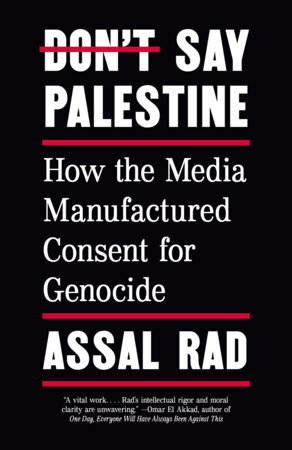
Don't Say Palestine

How the Media Manufactured Consent for Genocide

Author Assal Rad
Look inside
Paperback
$20.00 US
5.14"W x 7.98"H x 0.76"D   (13.1 x 20.3 x 1.9 cm) | 9 oz (255 g) | 24 per carton
On sale Sep 08, 2026 | 256 Pages | 9798217010349
Sales rights: US, Canada, Open Mkt

A searing indictment of Western media that lays bare how the "free press," long tasked with speaking truth to power, instead became a vital part of the machinery that enabled the genocide in Palestine

"In this important new work of media criticism, Rad dissects the biases, distortions, and falsehoods by which press institutions conceal the atrocities of empire—as well as delivering a powerful call for accountability, justice, and truth." —Molly Crabapple, author of Here Where We Live Is Our Country


If you’re not writing the truth about crimes against humanity, you’re culpable in them.

Activist and Middle East historian Assal Rad is known as the “headline fixer” for her powerful posts that illustrate how mainstream Western media’s coverage of the Gaza Genocide is filled with double standards. Israelis are described as "children" and "civilians," while Palestinians are "people under 18" and "collateral damage"; Israelis are killed; Palestinians die. Even in the wake of the so-called ceasefire, major Western media continually obfuscates Israeli violence in Palestine: For example, the Associated Press reported that "Gaza's living conditions worsen as strong winds and hypothermia kill 5." No, Rad corrects: Gaza's living conditions worsen as Israel blocks aid.

In Don’t Say Palestine, Rad reveals a pattern of dehumanizing language—in outlets from CNN and the AP to the BBC and The New York Times—so consistently employed throughout the Palestinian genocide that it amounts to a policy. Mainstream Western media consistently downplays Israeli responsibility, “others” Palestinians, and casts doubt on inviolable tenets of international law like the sanctity of hospitals and journalists in war zones. This groundbreaking, eye-opening exposé offers both a moral reckoning and an urgent call to action, mapping with devastating clarity the media’s complicity in whitewashing a human rights crisis.
Chapter 1

When Dehumanization Becomes Standard

I. Rationalizing Atrocities

As a society, we often reflect on historic human brutalities with dismay. Questions like “how could they let that happen?” or “how were people okay with it?” are raised in a manner that implies such cruelties would not be permissible today. Yet the world watched in horror as Israel’s most devastating assault on the besieged Gaza Strip to date unfolded with nightmarish scenes of entire neighborhoods reduced to rubble, children pulled lifeless from the debris, and parents cradling shrouded bodies too small for graves.

By January 2026, the official death toll had surpassed 71,000, the majority of whom were civilians. According to researchers, these figures significantly undercount the actual death toll in Gaza. The evidence of atrocity was not only overwhelming, it was broadcast in real time by Palestinian journalists who remained on the ground, often until they themselves were killed by Israeli forces. And yet much of the Western media refused to name what was unfolding: a genocide.

Instead, we were told this was a “war” against Hamas, a “response” to the attacks of October 7, a part of the “conflict” between Israel and Palestinians—whose land Israel has illegally occupied for decades. The headlines echoed official Israeli and U.S. talking points nearly word for word. When entire families were wiped out, the language softened the crime: Israel said it was targeting Hamas. When children starved due to deliberate aid blockages, the narrative focused on logistics, not policy. Hospitals were not obliterated; they were caught in cross fire. All the while, Palestinian lives were rendered abstract, conditional, and unworthy of the same humanity as Israeli lives.

But this is not a book seeking to prove what is known to be true and what most of the world knows to be true. This is a book about how it was allowed to happen. This book is a study in how narrative shapes reality. It is not simply about media bias. It is about the weaponization of language to justify the most heinous of crimes. It is about how a self-styled free press became complicit in silencing the truth and shielding power. It is about how the media, rather than holding those in power accountable, became a vital part of the machinery that enabled genocide. It is about how Western media manufactured consent for Israel’s genocide against Palestinians.

To understand how this happened, we must first recognize the long history of how Palestine has been framed in Western thinking—not as a nation seeking liberation and self-determination, but as a problem to be managed. For decades, Western media have largely repeated the framing of Israel as a liberal democracy defending itself, and Palestinians as either obstacles to peace or threats to be neutralized. Long before the events of October 2023, this framing laid the groundwork for what would come. Israel’s actions were always couched in the language of self-defense, no matter the scale of violence; Palestinian resistance, even nonviolent protest, was criminalized or erased. Palestinians were described not as people with rights under international law but as figures in a security narrative dictated by Israeli and American priorities.

This is not new. Of course, there is the centuries-old history of Western colonialism in the Middle East and the language of Orientalism that was used to reinforce and justify the existing power imbalances, rooted in the exploitation of regional peoples. However, recent history may provide a more familiar case to illustrate this larger pattern. The invasion of Iraq in 2003 offers a useful precedent. Then, too, we were told stories about weapons of mass destruction (WMDs) that did not exist, and about liberating people who would suffer far more after U.S. intervention. The media, instead of interrogating the narrative, laundered it. The result was a war that killed hundreds of thousands of people and destabilized an entire region. Then as now, consent was manufactured—not by flagrant censorship, but by selective storytelling, by privileging the voices of the powerful, by embedding with soldiers, which shaped the coverage, and by suppressing inconvenient truths.

In the case of the Gaza Genocide, the foundation had already been laid for its rationalization through years of political rhetoric that was unequivocally pro-Israel and media coverage that followed suit. The media were able to manufacture consent in real time and understate Israel’s atrocities by tapping into existing narratives and relying on the public to accept them without question. The only kink in their plan was the courageous work of Palestinian journalists and social media platforms, which showed the world the reality of Israel’s unprecedented slaughter in Gaza.

II. Selective Justice: The West’s Misleading Narrative of Palestine

Even before the Gaza Genocide, the Western narrative of Palestine—led by the United States, which is both the most powerful state in the world and Israel’s largest funder and supporter—had largely focused on Israel’s exclusive rights while relegating Palestinian rights to an afterthought. We are all familiar with the now ubiquitous language of “Israel has a right to exist” and “Israel has the right to defend itself,” which Western officials use to deflect questions about Israel’s actions or the plight of Palestinian people. Yet Western officials never acknowledge that Palestine has a right to exist and that Palestine has a right to defend itself, denying Palestinians the same protections enshrined in international law. In fact, when reporters pushed the Biden administration on the Palestinian right to self-defense, the State Department spokesman Matthew Miller refused to acknowledge that Palestinians have such a right.

They often get away with this by using legal language to create a paradox for Palestinians, wherein Palestinian statehood is denied and, because no official Palestinian state exists, they are deprived of the same rights afforded to other nations. Miller demonstrated this absurdity during a press briefing in November 2024, when reporters questioned the Biden administration’s selective support for the warrant issued by the International Criminal Court (ICC) against the Russian president, Vladimir Putin, versus warrants for Israeli officials, which had been issued on November 21, 2024, “for crimes against humanity and war crimes.” Miller’s response boiled down to the fact that Ukraine is a sovereign state, but “there is no sovereign state of Palestine.”

Israel has intentionally thwarted Palestinian statehood—with help from the United States, which refuses to recognize a Palestinian state despite overwhelming international support—to create such a paradox, while feigning interest in the “peace process.” All the while, Israel’s expansion of illegal settlements continues unabated, Palestinians are subjected to apartheid and other mistreatment under Israel’s decades-long military occupation, and Palestinians are given no legal recourse to address this injustice.

Zealous support of Israel in the West, especially in the United States, goes unquestioned, whereas being critical of Israel can be seen as a political liability. The language of “unconditional support” that is commonly used to describe the U.S. relationship with Israel is plainly an extremist position, effectively saying the United States will support Israel no matter what it does, even if it is committing a genocide. Such a statement also defies international and U.S. domestic law, which prohibits aid and weapons being supplied to a state committing gross human rights abuses.

At the same time, anti-genocide advocates and pro-Palestine voices are forcibly silenced, raising questions about the values of liberty and freedom Western states claim to espouse. In the United States, campus protests were brutally repressed in the spring of 2024, under the Democratic Joe Biden administration. This chilling effect on basic constitutional rights like speech and protest continued under the Republican administration of President Trump. In Europe—especially in the U.K. and Germany, which vociferously support Israel’s actions despite the flagrant violations of international norms—human rights groups and experts have raised concerns over the suppression of pro-Palestine advocacy, targeting of free speech, and arresting of protesters.

For their part, legacy media have played the role of stenographers through all of this. Rather than challenging such repression of freedoms, questioning the legality of U.S. policy vis-à-vis Israel, or presenting the Palestinian perspective with any sense of balance, the mainstream media have acted as the propaganda wing of Western and Israeli governments. Moreover, the media’s tendency to compartmentalize the Palestinian cause into separate issues based on their geography influences public perception and understanding. Though treated as distinct concerns, the Gaza Strip, the West Bank, and East Jerusalem are all Palestinian territories under Israeli occupation. They are inextricably tied together through the struggle for Palestinian statehood.

The right of return for Palestinian refugees expelled in the Nakba of 1948 and the 1967 war, as well as their descendants, is also part of the broader story of Palestinian identity and liberation. There can be no “peace in the Middle East,” as Western states led by the United States profess to care for, without Palestinian liberation. There can be no Palestinian liberation without Palestinian people and their homeland. Yet Western narratives rarely question the injustice of denying Palestinians the right of return to a homeland they were forcibly expelled from over the course of the last century, as Jewish people across the world are granted the right to immigrate to Israel (historic Palestine) or illegal settlements in the occupied territories, simply because they are Jewish.

In East Jerusalem, Palestinians are expelled from their homes so that Jewish New Yorkers can take their place—and their actual homes. In the West Bank, Israel is enforcing a system of apartheid, expanding its illegal settlements, facilitating settler violence and pogroms against Palestinians, and moving closer to annexation of the occupied territory. These stories receive little coverage in the media, and when they do, the language often normalizes Israel’s actions. For instance, in early July 2025, the story of Israeli ministers pushing for annexation of the West Bank by the end of the month was only covered by one major Western media outlet. The Reuters headline read, “Israeli Likud Party Ministers Urge Netanyahu to Annex West Bank,” which failed to mention the brazenly illegal nature of this action or the fact that the West Bank is occupied and belongs to Palestinians.

In Gaza—prior to the genocide—Israel had imposed a blockade for more than a decade that significantly deepened existing restrictions and solidified Israel’s control over Gaza by land, air, and sea. Though Israel argues that it withdrew from Gaza in 2005, the International Court of Justice (ICJ) affirmed in July 2024 what UN agencies and human rights groups had long asserted: Israel’s effective control over the Gaza Strip constituted an illegal occupation. Despite the dire reality of Israel’s occupation of Gaza before the Hamas attacks of October 7, this context was largely absent from the political talking points and media coverage that ensued. Yet articles covering Israel’s assault on Gaza in the wake of October 7 repeatedly contextualized the atrocities against the backdrop of the Hamas attacks, illustrating the selective nature of what qualifies as important background information.

For years, mainstream media have parroted the language of their own governments, and that of Israel, with little critical coverage of or challenge to the dominant political narrative in the West. Palestinians have been systematically dehumanized, along with the broader Arab and Muslim world, to serve the foreign policy objectives of governments without questioning the moral and legal implications. The horrors that have been normalized in Gaza are the culmination of this long history of racism and injustice. But it is not the first time in recent memory that the media have played a central role in legitimizing war crimes.

III. Iraq as a Precedent: The Death of Accountability

It is often said that hindsight is twenty-twenty—a phrase that suggests we are better equipped to judge past events once their consequences have come to light. This could not be truer than in the case of the 2003 U.S. invasion of Iraq. More than two decades after the incursion that claimed so many Iraqi lives, wrought havoc on the region, and sowed the seeds of ongoing conflict, there is now a clear consensus among analysts and the American public that the war was a catastrophic foreign policy mistake. Launched under the guise of national security, framed as a righteous mission to rid the region of WMDs and to liberate the Iraqi people from Saddam Hussein—whom the United States had supported as early as the 1950s and in the 1980s during his war of aggression against Iran—the invasion stands today as a textbook case of how deceit, racism, and empire were packaged for popular consumption, with the U.S. media serving as willing accomplices.
“Amidst some of the worst journalistic failures of this century, Assal Rad has consistently done vital work to point out the myriad ways institutional hypocrisy, cowardice, and willful obliviousness work hand-in-hand with state violence to justify and normalize any manner of atrocity. Her intellectual rigor and moral clarity—not only on the journalistic malpractice that so often marks Western media coverage of the ongoing genocide in Gaza, but on how this malpractice eventually seeps into all coverage—are unwavering. At a time when it would have been so much more convenient to stay silent, I and so many others are grateful for her willingness to speak.” —Omar El Akkad, National Book Award–winning author of One Day, Everyone Will Have Always Been Against This

“Eighty years ago, George Orwell wrote that ‘In our time, political speech and writing are largely the defense of the indefensible.’ Assal Rad shows, in painful detail, that in the case of Israel-Palestine, this remains true.” —Peter Beinart, author of Being Jewish After the Destruction of Gaza

“Throughout the course of the Gaza Genocide, historian Assal Rad has been a beacon of clarity in a media landscape clouded by lies. In this important new work of media criticism, Rad dissects the biases, distortions, and falsehoods by which press institutions conceal the atrocities of empire—as well as delivering a powerful call for accountability, justice, and truth.” —Molly Crabapple, author of Here Where We Live Is Our Country

“Assal Rad brilliantly exposes how, for the past years, reality itself had been distorted to fit a political ecosystem. Western media does not simply omit or distort reality, but actively launders it. Language reframes and ultimately erases both violence and responsibility. ‘Self-defense’ replaces the naming of genocide. These linguistic choices reveal intentionality in complicity: not neutral but political, shaping whose lives are grievable and whose deaths are rendered acceptable. In Don’t Say Palestine, Rad demonstrates how media narratives create permissive conditions for genocide through strategic omission, selective visibility, euphemism, and the erasing of Palestinian voices. When those same institutions dictate what can and cannot be said, this is not press freedom but censorship. And when they uncritically repeat the claims of a state responsible for unprecedented violence, in ways that obscure or diminish its gravity, this is not reporting—it is complicity.” —Francesca Albanese, UN Special Rapporteur on the Occupied Palestinian Territories and author of When the World Sleeps

“Remember ‘reading comprehension’ in high school? And then, in college, if you were pretentious, ‘critical theory’ or ‘media studies’? It was all about learning how to read—harder than it sounds. It was a lesson that was valuable then and is even more valuable now. Nobody has been as relentless a promotor of reading comprehension as Assal Rad. By showing us the gulf between what is said and what is meant—and what actually should be said—she has offered a vital lesson in reading comprehension—showing us how words can kill actual people in this actual world.” —Benjamin Moser, author of Anti-Zionism: A Jewish History

“If you’ve ever wondered how the media manipulated perception through subtle use of language, this is the book for you to read. Assal Rad in her superb book shows how no other institution is as instrumental in shaping perception like the media, which is not a record of truth-telling but a carefully curated narrative and elaborate system of erasure, euphemism, and deference to power.” —Raja Shehadeh, National Book Award finalist and author of We Could Have Been Friends, My Father and I

“A poignant reminder of the power of words to normalise, or legitimise, genocide.” —Yanis Varoufakis, author of Technofeudalism

“When so many chose indifference and obfuscation, Assal insists on clarity, honesty, and integrity. She documents how complicity for a livestreamed genocide was perpetrated. It is a chronicle of depravity and the depraved, and of the operation of cynicism on a grand dehumanizing scale.” —Ussama Makdisi, author of Anti-Palestinianism

“Assal Rad offers a profound meditation on the role of the media in a democratic society, which ideally serves as a check against the interests of the powerful and lifts up the voices of those on the receiving end of brutal governmental policies. Yet, when it comes to mainstream media coverage of Israel's ongoing genocide of Palestinians in Gaza, Rad expertly demonstrates how the media not only failed to uphold the ethical standards of its profession but, even worse, was and remains actively complicit in amplifying and reifying US and Israeli governmental talking points denying, excusing, and justifying Israel's crimes against humanity. This book is a shocking exposé illuminating the ways in which the media molds public opinion to help perpetuate and build consent for atrocities. A must read.” —Dr. Josh Ruebner, professor at Georgetown University and author of The United States and the Palestinian Nakba

“This is a searing indictment and a fierce demand for press accountability.” —Publishers Weekly (starred review)

“Rad is a firebrand with receipts, and this blazing but clear-eyed work of media criticism should be essential reading for anyone who wants to understand how we got to this terrible place.” —Literary Hub, “34 Books You Need to Read This Fall”
© Delnaz Rad
ASSAL RAD is an activist, historian of the modern Middle East, and a Fellow at the Arab Center Washington DC and DAWN. Her first book, The State of Resistance: Politics, Culture, and Identity in Modern Iran, was published by Cambridge University Press in 2022. Her writing has appeared in Newsweek, The National Interest, The Independent, Foreign Policy, and more, and she has appeared as a commentator on BBC World, Al Jazeera, CNN, NPR, and elsewhere. View titles by Assal Rad
Available for sale exclusive:
•     Canada
•     Guam
•     Minor Outl.Ins.
•     North Mariana
•     Philippines
•     Puerto Rico
•     Samoa,American
•     US Virgin Is.
•     USA

Available for sale non-exclusive:
•     Afghanistan
•     Aland Islands
•     Albania
•     Algeria
•     Andorra
•     Angola
•     Anguilla
•     Antarctica
•     Argentina
•     Armenia
•     Aruba
•     Austria
•     Azerbaijan
•     Bahrain
•     Belarus
•     Belgium
•     Benin
•     Bhutan
•     Bolivia
•     Bonaire, Saba
•     Bosnia Herzeg.
•     Bouvet Island
•     Brazil
•     Bulgaria
•     Burkina Faso
•     Burundi
•     Cambodia
•     Cameroon
•     Cape Verde
•     Centr.Afr.Rep.
•     Chad
•     Chile
•     China
•     Colombia
•     Comoro Is.
•     Congo
•     Cook Islands
•     Costa Rica
•     Croatia
•     Cuba
•     Curacao
•     Czech Republic
•     Dem. Rep. Congo
•     Denmark
•     Djibouti
•     Dominican Rep.
•     Ecuador
•     Egypt
•     El Salvador
•     Equatorial Gui.
•     Eritrea
•     Estonia
•     Ethiopia
•     Faroe Islands
•     Finland
•     France
•     Fren.Polynesia
•     French Guinea
•     Gabon
•     Georgia
•     Germany
•     Greece
•     Greenland
•     Guadeloupe
•     Guatemala
•     Guinea Republic
•     Guinea-Bissau
•     Haiti
•     Heard/McDon.Isl
•     Honduras
•     Hong Kong
•     Hungary
•     Iceland
•     Indonesia
•     Iran
•     Iraq
•     Israel
•     Italy
•     Ivory Coast
•     Japan
•     Jordan
•     Kazakhstan
•     Kuwait
•     Kyrgyzstan
•     Laos
•     Latvia
•     Lebanon
•     Liberia
•     Libya
•     Liechtenstein
•     Lithuania
•     Luxembourg
•     Macau
•     Macedonia
•     Madagascar
•     Malaysia
•     Maldives
•     Mali
•     Marshall island
•     Martinique
•     Mauritania
•     Mayotte
•     Mexico
•     Micronesia
•     Moldavia
•     Monaco
•     Mongolia
•     Montenegro
•     Morocco
•     Myanmar
•     Nepal
•     Netherlands
•     New Caledonia
•     Nicaragua
•     Niger
•     Niue
•     Norfolk Island
•     North Korea
•     Norway
•     Oman
•     Palau
•     Palestinian Ter
•     Panama
•     Paraguay
•     Peru
•     Poland
•     Portugal
•     Qatar
•     Reunion Island
•     Romania
•     Russian Fed.
•     Rwanda
•     Saint Martin
•     San Marino
•     SaoTome Princip
•     Saudi Arabia
•     Senegal
•     Serbia
•     Singapore
•     Sint Maarten
•     Slovakia
•     Slovenia
•     South Korea
•     South Sudan
•     Spain
•     St Barthelemy
•     St.Pier,Miquel.
•     Sth Terr. Franc
•     Sudan
•     Suriname
•     Svalbard
•     Sweden
•     Switzerland
•     Syria
•     Tadschikistan
•     Taiwan
•     Thailand
•     Timor-Leste
•     Togo
•     Tokelau Islands
•     Tunisia
•     Turkey
•     Turkmenistan
•     Ukraine
•     Unit.Arab Emir.
•     Uruguay
•     Uzbekistan
•     Vatican City
•     Venezuela
•     Vietnam
•     Wallis,Futuna
•     West Saharan
•     Western Samoa
•     Yemen

Not available for sale:
•     Antigua/Barbuda
•     Australia
•     Bahamas
•     Bangladesh
•     Barbados
•     Belize
•     Bermuda
•     Botswana
•     Brit.Ind.Oc.Ter
•     Brit.Virgin Is.
•     Brunei
•     Cayman Islands
•     Christmas Islnd
•     Cocos Islands
•     Cyprus
•     Dominica
•     Falkland Islnds
•     Fiji
•     Gambia
•     Ghana
•     Gibraltar
•     Grenada
•     Guernsey
•     Guyana
•     India
•     Ireland
•     Isle of Man
•     Jamaica
•     Jersey
•     Kenya
•     Kiribati
•     Lesotho
•     Malawi
•     Malta
•     Mauritius
•     Montserrat
•     Mozambique
•     Namibia
•     Nauru
•     New Zealand
•     Nigeria
•     Pakistan
•     PapuaNewGuinea
•     Pitcairn Islnds
•     S. Sandwich Ins
•     Seychelles
•     Sierra Leone
•     Solomon Islands
•     Somalia
•     South Africa
•     Sri Lanka
•     St. Helena
•     St. Lucia
•     St. Vincent
•     St.Chr.,Nevis
•     Swaziland
•     Tanzania
•     Tonga
•     Trinidad,Tobago
•     Turks&Caicos Is
•     Tuvalu
•     Uganda
•     United Kingdom
•     Vanuatu
•     Zambia
•     Zimbabwe

About

A searing indictment of Western media that lays bare how the "free press," long tasked with speaking truth to power, instead became a vital part of the machinery that enabled the genocide in Palestine

"In this important new work of media criticism, Rad dissects the biases, distortions, and falsehoods by which press institutions conceal the atrocities of empire—as well as delivering a powerful call for accountability, justice, and truth." —Molly Crabapple, author of Here Where We Live Is Our Country


If you’re not writing the truth about crimes against humanity, you’re culpable in them.

Activist and Middle East historian Assal Rad is known as the “headline fixer” for her powerful posts that illustrate how mainstream Western media’s coverage of the Gaza Genocide is filled with double standards. Israelis are described as "children" and "civilians," while Palestinians are "people under 18" and "collateral damage"; Israelis are killed; Palestinians die. Even in the wake of the so-called ceasefire, major Western media continually obfuscates Israeli violence in Palestine: For example, the Associated Press reported that "Gaza's living conditions worsen as strong winds and hypothermia kill 5." No, Rad corrects: Gaza's living conditions worsen as Israel blocks aid.

In Don’t Say Palestine, Rad reveals a pattern of dehumanizing language—in outlets from CNN and the AP to the BBC and The New York Times—so consistently employed throughout the Palestinian genocide that it amounts to a policy. Mainstream Western media consistently downplays Israeli responsibility, “others” Palestinians, and casts doubt on inviolable tenets of international law like the sanctity of hospitals and journalists in war zones. This groundbreaking, eye-opening exposé offers both a moral reckoning and an urgent call to action, mapping with devastating clarity the media’s complicity in whitewashing a human rights crisis.

Excerpt

Chapter 1

When Dehumanization Becomes Standard

I. Rationalizing Atrocities

As a society, we often reflect on historic human brutalities with dismay. Questions like “how could they let that happen?” or “how were people okay with it?” are raised in a manner that implies such cruelties would not be permissible today. Yet the world watched in horror as Israel’s most devastating assault on the besieged Gaza Strip to date unfolded with nightmarish scenes of entire neighborhoods reduced to rubble, children pulled lifeless from the debris, and parents cradling shrouded bodies too small for graves.

By January 2026, the official death toll had surpassed 71,000, the majority of whom were civilians. According to researchers, these figures significantly undercount the actual death toll in Gaza. The evidence of atrocity was not only overwhelming, it was broadcast in real time by Palestinian journalists who remained on the ground, often until they themselves were killed by Israeli forces. And yet much of the Western media refused to name what was unfolding: a genocide.

Instead, we were told this was a “war” against Hamas, a “response” to the attacks of October 7, a part of the “conflict” between Israel and Palestinians—whose land Israel has illegally occupied for decades. The headlines echoed official Israeli and U.S. talking points nearly word for word. When entire families were wiped out, the language softened the crime: Israel said it was targeting Hamas. When children starved due to deliberate aid blockages, the narrative focused on logistics, not policy. Hospitals were not obliterated; they were caught in cross fire. All the while, Palestinian lives were rendered abstract, conditional, and unworthy of the same humanity as Israeli lives.

But this is not a book seeking to prove what is known to be true and what most of the world knows to be true. This is a book about how it was allowed to happen. This book is a study in how narrative shapes reality. It is not simply about media bias. It is about the weaponization of language to justify the most heinous of crimes. It is about how a self-styled free press became complicit in silencing the truth and shielding power. It is about how the media, rather than holding those in power accountable, became a vital part of the machinery that enabled genocide. It is about how Western media manufactured consent for Israel’s genocide against Palestinians.

To understand how this happened, we must first recognize the long history of how Palestine has been framed in Western thinking—not as a nation seeking liberation and self-determination, but as a problem to be managed. For decades, Western media have largely repeated the framing of Israel as a liberal democracy defending itself, and Palestinians as either obstacles to peace or threats to be neutralized. Long before the events of October 2023, this framing laid the groundwork for what would come. Israel’s actions were always couched in the language of self-defense, no matter the scale of violence; Palestinian resistance, even nonviolent protest, was criminalized or erased. Palestinians were described not as people with rights under international law but as figures in a security narrative dictated by Israeli and American priorities.

This is not new. Of course, there is the centuries-old history of Western colonialism in the Middle East and the language of Orientalism that was used to reinforce and justify the existing power imbalances, rooted in the exploitation of regional peoples. However, recent history may provide a more familiar case to illustrate this larger pattern. The invasion of Iraq in 2003 offers a useful precedent. Then, too, we were told stories about weapons of mass destruction (WMDs) that did not exist, and about liberating people who would suffer far more after U.S. intervention. The media, instead of interrogating the narrative, laundered it. The result was a war that killed hundreds of thousands of people and destabilized an entire region. Then as now, consent was manufactured—not by flagrant censorship, but by selective storytelling, by privileging the voices of the powerful, by embedding with soldiers, which shaped the coverage, and by suppressing inconvenient truths.

In the case of the Gaza Genocide, the foundation had already been laid for its rationalization through years of political rhetoric that was unequivocally pro-Israel and media coverage that followed suit. The media were able to manufacture consent in real time and understate Israel’s atrocities by tapping into existing narratives and relying on the public to accept them without question. The only kink in their plan was the courageous work of Palestinian journalists and social media platforms, which showed the world the reality of Israel’s unprecedented slaughter in Gaza.

II. Selective Justice: The West’s Misleading Narrative of Palestine

Even before the Gaza Genocide, the Western narrative of Palestine—led by the United States, which is both the most powerful state in the world and Israel’s largest funder and supporter—had largely focused on Israel’s exclusive rights while relegating Palestinian rights to an afterthought. We are all familiar with the now ubiquitous language of “Israel has a right to exist” and “Israel has the right to defend itself,” which Western officials use to deflect questions about Israel’s actions or the plight of Palestinian people. Yet Western officials never acknowledge that Palestine has a right to exist and that Palestine has a right to defend itself, denying Palestinians the same protections enshrined in international law. In fact, when reporters pushed the Biden administration on the Palestinian right to self-defense, the State Department spokesman Matthew Miller refused to acknowledge that Palestinians have such a right.

They often get away with this by using legal language to create a paradox for Palestinians, wherein Palestinian statehood is denied and, because no official Palestinian state exists, they are deprived of the same rights afforded to other nations. Miller demonstrated this absurdity during a press briefing in November 2024, when reporters questioned the Biden administration’s selective support for the warrant issued by the International Criminal Court (ICC) against the Russian president, Vladimir Putin, versus warrants for Israeli officials, which had been issued on November 21, 2024, “for crimes against humanity and war crimes.” Miller’s response boiled down to the fact that Ukraine is a sovereign state, but “there is no sovereign state of Palestine.”

Israel has intentionally thwarted Palestinian statehood—with help from the United States, which refuses to recognize a Palestinian state despite overwhelming international support—to create such a paradox, while feigning interest in the “peace process.” All the while, Israel’s expansion of illegal settlements continues unabated, Palestinians are subjected to apartheid and other mistreatment under Israel’s decades-long military occupation, and Palestinians are given no legal recourse to address this injustice.

Zealous support of Israel in the West, especially in the United States, goes unquestioned, whereas being critical of Israel can be seen as a political liability. The language of “unconditional support” that is commonly used to describe the U.S. relationship with Israel is plainly an extremist position, effectively saying the United States will support Israel no matter what it does, even if it is committing a genocide. Such a statement also defies international and U.S. domestic law, which prohibits aid and weapons being supplied to a state committing gross human rights abuses.

At the same time, anti-genocide advocates and pro-Palestine voices are forcibly silenced, raising questions about the values of liberty and freedom Western states claim to espouse. In the United States, campus protests were brutally repressed in the spring of 2024, under the Democratic Joe Biden administration. This chilling effect on basic constitutional rights like speech and protest continued under the Republican administration of President Trump. In Europe—especially in the U.K. and Germany, which vociferously support Israel’s actions despite the flagrant violations of international norms—human rights groups and experts have raised concerns over the suppression of pro-Palestine advocacy, targeting of free speech, and arresting of protesters.

For their part, legacy media have played the role of stenographers through all of this. Rather than challenging such repression of freedoms, questioning the legality of U.S. policy vis-à-vis Israel, or presenting the Palestinian perspective with any sense of balance, the mainstream media have acted as the propaganda wing of Western and Israeli governments. Moreover, the media’s tendency to compartmentalize the Palestinian cause into separate issues based on their geography influences public perception and understanding. Though treated as distinct concerns, the Gaza Strip, the West Bank, and East Jerusalem are all Palestinian territories under Israeli occupation. They are inextricably tied together through the struggle for Palestinian statehood.

The right of return for Palestinian refugees expelled in the Nakba of 1948 and the 1967 war, as well as their descendants, is also part of the broader story of Palestinian identity and liberation. There can be no “peace in the Middle East,” as Western states led by the United States profess to care for, without Palestinian liberation. There can be no Palestinian liberation without Palestinian people and their homeland. Yet Western narratives rarely question the injustice of denying Palestinians the right of return to a homeland they were forcibly expelled from over the course of the last century, as Jewish people across the world are granted the right to immigrate to Israel (historic Palestine) or illegal settlements in the occupied territories, simply because they are Jewish.

In East Jerusalem, Palestinians are expelled from their homes so that Jewish New Yorkers can take their place—and their actual homes. In the West Bank, Israel is enforcing a system of apartheid, expanding its illegal settlements, facilitating settler violence and pogroms against Palestinians, and moving closer to annexation of the occupied territory. These stories receive little coverage in the media, and when they do, the language often normalizes Israel’s actions. For instance, in early July 2025, the story of Israeli ministers pushing for annexation of the West Bank by the end of the month was only covered by one major Western media outlet. The Reuters headline read, “Israeli Likud Party Ministers Urge Netanyahu to Annex West Bank,” which failed to mention the brazenly illegal nature of this action or the fact that the West Bank is occupied and belongs to Palestinians.

In Gaza—prior to the genocide—Israel had imposed a blockade for more than a decade that significantly deepened existing restrictions and solidified Israel’s control over Gaza by land, air, and sea. Though Israel argues that it withdrew from Gaza in 2005, the International Court of Justice (ICJ) affirmed in July 2024 what UN agencies and human rights groups had long asserted: Israel’s effective control over the Gaza Strip constituted an illegal occupation. Despite the dire reality of Israel’s occupation of Gaza before the Hamas attacks of October 7, this context was largely absent from the political talking points and media coverage that ensued. Yet articles covering Israel’s assault on Gaza in the wake of October 7 repeatedly contextualized the atrocities against the backdrop of the Hamas attacks, illustrating the selective nature of what qualifies as important background information.

For years, mainstream media have parroted the language of their own governments, and that of Israel, with little critical coverage of or challenge to the dominant political narrative in the West. Palestinians have been systematically dehumanized, along with the broader Arab and Muslim world, to serve the foreign policy objectives of governments without questioning the moral and legal implications. The horrors that have been normalized in Gaza are the culmination of this long history of racism and injustice. But it is not the first time in recent memory that the media have played a central role in legitimizing war crimes.

III. Iraq as a Precedent: The Death of Accountability

It is often said that hindsight is twenty-twenty—a phrase that suggests we are better equipped to judge past events once their consequences have come to light. This could not be truer than in the case of the 2003 U.S. invasion of Iraq. More than two decades after the incursion that claimed so many Iraqi lives, wrought havoc on the region, and sowed the seeds of ongoing conflict, there is now a clear consensus among analysts and the American public that the war was a catastrophic foreign policy mistake. Launched under the guise of national security, framed as a righteous mission to rid the region of WMDs and to liberate the Iraqi people from Saddam Hussein—whom the United States had supported as early as the 1950s and in the 1980s during his war of aggression against Iran—the invasion stands today as a textbook case of how deceit, racism, and empire were packaged for popular consumption, with the U.S. media serving as willing accomplices.

Praise

“Amidst some of the worst journalistic failures of this century, Assal Rad has consistently done vital work to point out the myriad ways institutional hypocrisy, cowardice, and willful obliviousness work hand-in-hand with state violence to justify and normalize any manner of atrocity. Her intellectual rigor and moral clarity—not only on the journalistic malpractice that so often marks Western media coverage of the ongoing genocide in Gaza, but on how this malpractice eventually seeps into all coverage—are unwavering. At a time when it would have been so much more convenient to stay silent, I and so many others are grateful for her willingness to speak.” —Omar El Akkad, National Book Award–winning author of One Day, Everyone Will Have Always Been Against This

“Eighty years ago, George Orwell wrote that ‘In our time, political speech and writing are largely the defense of the indefensible.’ Assal Rad shows, in painful detail, that in the case of Israel-Palestine, this remains true.” —Peter Beinart, author of Being Jewish After the Destruction of Gaza

“Throughout the course of the Gaza Genocide, historian Assal Rad has been a beacon of clarity in a media landscape clouded by lies. In this important new work of media criticism, Rad dissects the biases, distortions, and falsehoods by which press institutions conceal the atrocities of empire—as well as delivering a powerful call for accountability, justice, and truth.” —Molly Crabapple, author of Here Where We Live Is Our Country

“Assal Rad brilliantly exposes how, for the past years, reality itself had been distorted to fit a political ecosystem. Western media does not simply omit or distort reality, but actively launders it. Language reframes and ultimately erases both violence and responsibility. ‘Self-defense’ replaces the naming of genocide. These linguistic choices reveal intentionality in complicity: not neutral but political, shaping whose lives are grievable and whose deaths are rendered acceptable. In Don’t Say Palestine, Rad demonstrates how media narratives create permissive conditions for genocide through strategic omission, selective visibility, euphemism, and the erasing of Palestinian voices. When those same institutions dictate what can and cannot be said, this is not press freedom but censorship. And when they uncritically repeat the claims of a state responsible for unprecedented violence, in ways that obscure or diminish its gravity, this is not reporting—it is complicity.” —Francesca Albanese, UN Special Rapporteur on the Occupied Palestinian Territories and author of When the World Sleeps

“Remember ‘reading comprehension’ in high school? And then, in college, if you were pretentious, ‘critical theory’ or ‘media studies’? It was all about learning how to read—harder than it sounds. It was a lesson that was valuable then and is even more valuable now. Nobody has been as relentless a promotor of reading comprehension as Assal Rad. By showing us the gulf between what is said and what is meant—and what actually should be said—she has offered a vital lesson in reading comprehension—showing us how words can kill actual people in this actual world.” —Benjamin Moser, author of Anti-Zionism: A Jewish History

“If you’ve ever wondered how the media manipulated perception through subtle use of language, this is the book for you to read. Assal Rad in her superb book shows how no other institution is as instrumental in shaping perception like the media, which is not a record of truth-telling but a carefully curated narrative and elaborate system of erasure, euphemism, and deference to power.” —Raja Shehadeh, National Book Award finalist and author of We Could Have Been Friends, My Father and I

“A poignant reminder of the power of words to normalise, or legitimise, genocide.” —Yanis Varoufakis, author of Technofeudalism

“When so many chose indifference and obfuscation, Assal insists on clarity, honesty, and integrity. She documents how complicity for a livestreamed genocide was perpetrated. It is a chronicle of depravity and the depraved, and of the operation of cynicism on a grand dehumanizing scale.” —Ussama Makdisi, author of Anti-Palestinianism

“Assal Rad offers a profound meditation on the role of the media in a democratic society, which ideally serves as a check against the interests of the powerful and lifts up the voices of those on the receiving end of brutal governmental policies. Yet, when it comes to mainstream media coverage of Israel's ongoing genocide of Palestinians in Gaza, Rad expertly demonstrates how the media not only failed to uphold the ethical standards of its profession but, even worse, was and remains actively complicit in amplifying and reifying US and Israeli governmental talking points denying, excusing, and justifying Israel's crimes against humanity. This book is a shocking exposé illuminating the ways in which the media molds public opinion to help perpetuate and build consent for atrocities. A must read.” —Dr. Josh Ruebner, professor at Georgetown University and author of The United States and the Palestinian Nakba

“This is a searing indictment and a fierce demand for press accountability.” —Publishers Weekly (starred review)

“Rad is a firebrand with receipts, and this blazing but clear-eyed work of media criticism should be essential reading for anyone who wants to understand how we got to this terrible place.” —Literary Hub, “34 Books You Need to Read This Fall”

Author

© Delnaz Rad
ASSAL RAD is an activist, historian of the modern Middle East, and a Fellow at the Arab Center Washington DC and DAWN. Her first book, The State of Resistance: Politics, Culture, and Identity in Modern Iran, was published by Cambridge University Press in 2022. Her writing has appeared in Newsweek, The National Interest, The Independent, Foreign Policy, and more, and she has appeared as a commentator on BBC World, Al Jazeera, CNN, NPR, and elsewhere. View titles by Assal Rad

Rights

Available for sale exclusive:
•     Canada
•     Guam
•     Minor Outl.Ins.
•     North Mariana
•     Philippines
•     Puerto Rico
•     Samoa,American
•     US Virgin Is.
•     USA

Available for sale non-exclusive:
•     Afghanistan
•     Aland Islands
•     Albania
•     Algeria
•     Andorra
•     Angola
•     Anguilla
•     Antarctica
•     Argentina
•     Armenia
•     Aruba
•     Austria
•     Azerbaijan
•     Bahrain
•     Belarus
•     Belgium
•     Benin
•     Bhutan
•     Bolivia
•     Bonaire, Saba
•     Bosnia Herzeg.
•     Bouvet Island
•     Brazil
•     Bulgaria
•     Burkina Faso
•     Burundi
•     Cambodia
•     Cameroon
•     Cape Verde
•     Centr.Afr.Rep.
•     Chad
•     Chile
•     China
•     Colombia
•     Comoro Is.
•     Congo
•     Cook Islands
•     Costa Rica
•     Croatia
•     Cuba
•     Curacao
•     Czech Republic
•     Dem. Rep. Congo
•     Denmark
•     Djibouti
•     Dominican Rep.
•     Ecuador
•     Egypt
•     El Salvador
•     Equatorial Gui.
•     Eritrea
•     Estonia
•     Ethiopia
•     Faroe Islands
•     Finland
•     France
•     Fren.Polynesia
•     French Guinea
•     Gabon
•     Georgia
•     Germany
•     Greece
•     Greenland
•     Guadeloupe
•     Guatemala
•     Guinea Republic
•     Guinea-Bissau
•     Haiti
•     Heard/McDon.Isl
•     Honduras
•     Hong Kong
•     Hungary
•     Iceland
•     Indonesia
•     Iran
•     Iraq
•     Israel
•     Italy
•     Ivory Coast
•     Japan
•     Jordan
•     Kazakhstan
•     Kuwait
•     Kyrgyzstan
•     Laos
•     Latvia
•     Lebanon
•     Liberia
•     Libya
•     Liechtenstein
•     Lithuania
•     Luxembourg
•     Macau
•     Macedonia
•     Madagascar
•     Malaysia
•     Maldives
•     Mali
•     Marshall island
•     Martinique
•     Mauritania
•     Mayotte
•     Mexico
•     Micronesia
•     Moldavia
•     Monaco
•     Mongolia
•     Montenegro
•     Morocco
•     Myanmar
•     Nepal
•     Netherlands
•     New Caledonia
•     Nicaragua
•     Niger
•     Niue
•     Norfolk Island
•     North Korea
•     Norway
•     Oman
•     Palau
•     Palestinian Ter
•     Panama
•     Paraguay
•     Peru
•     Poland
•     Portugal
•     Qatar
•     Reunion Island
•     Romania
•     Russian Fed.
•     Rwanda
•     Saint Martin
•     San Marino
•     SaoTome Princip
•     Saudi Arabia
•     Senegal
•     Serbia
•     Singapore
•     Sint Maarten
•     Slovakia
•     Slovenia
•     South Korea
•     South Sudan
•     Spain
•     St Barthelemy
•     St.Pier,Miquel.
•     Sth Terr. Franc
•     Sudan
•     Suriname
•     Svalbard
•     Sweden
•     Switzerland
•     Syria
•     Tadschikistan
•     Taiwan
•     Thailand
•     Timor-Leste
•     Togo
•     Tokelau Islands
•     Tunisia
•     Turkey
•     Turkmenistan
•     Ukraine
•     Unit.Arab Emir.
•     Uruguay
•     Uzbekistan
•     Vatican City
•     Venezuela
•     Vietnam
•     Wallis,Futuna
•     West Saharan
•     Western Samoa
•     Yemen

Not available for sale:
•     Antigua/Barbuda
•     Australia
•     Bahamas
•     Bangladesh
•     Barbados
•     Belize
•     Bermuda
•     Botswana
•     Brit.Ind.Oc.Ter
•     Brit.Virgin Is.
•     Brunei
•     Cayman Islands
•     Christmas Islnd
•     Cocos Islands
•     Cyprus
•     Dominica
•     Falkland Islnds
•     Fiji
•     Gambia
•     Ghana
•     Gibraltar
•     Grenada
•     Guernsey
•     Guyana
•     India
•     Ireland
•     Isle of Man
•     Jamaica
•     Jersey
•     Kenya
•     Kiribati
•     Lesotho
•     Malawi
•     Malta
•     Mauritius
•     Montserrat
•     Mozambique
•     Namibia
•     Nauru
•     New Zealand
•     Nigeria
•     Pakistan
•     PapuaNewGuinea
•     Pitcairn Islnds
•     S. Sandwich Ins
•     Seychelles
•     Sierra Leone
•     Solomon Islands
•     Somalia
•     South Africa
•     Sri Lanka
•     St. Helena
•     St. Lucia
•     St. Vincent
•     St.Chr.,Nevis
•     Swaziland
•     Tanzania
•     Tonga
•     Trinidad,Tobago
•     Turks&Caicos Is
•     Tuvalu
•     Uganda
•     United Kingdom
•     Vanuatu
•     Zambia
•     Zimbabwe

Journalism Titles for Higher Education

Journalism plays a vital role in informing the public, holding the powerful accountable, and shaping how we make sense of the world around us. This selection brings together titles with higher education themes of journalism that examine the subject through historical, ethical, political, and cultural perspectives. From accounts of landmark investigations and the fight for

Read more