Close Modal

Ten Lives

How What We Have Shapes Who We Are

Look inside
Hardcover (Paper-over-Board, no jacket)
$30.00 US
6.54"W x 8.52"H x 1.15"D   (16.6 x 21.6 x 2.9 cm) | 28 oz (805 g) | 12 per carton
On sale Nov 10, 2026 | 320 Pages | 9780593243671
Grades 9-12 + AP/IB
Sales rights: US, Canada, Open Mkt

additional book photo
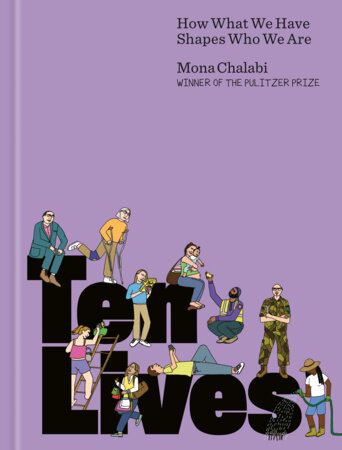
“Pulitzer Prize-winning journalist Mona Chalabi blends expert interviews and razor-sharp analysis with striking graphics” (Time) in this incisive exploration of money—and the lack of it—in America told through the lives of ten individuals.

“Astonishing . . . Chalabi’s taboo-busting transparency about peoples’ financial lives is revolutionary enough. But it’s the pellucid clarity of her data visualizations that will really change how you understand capitalism.”—Alison Bechdel, bestselling author of Fun Home: A Family Tragicomic

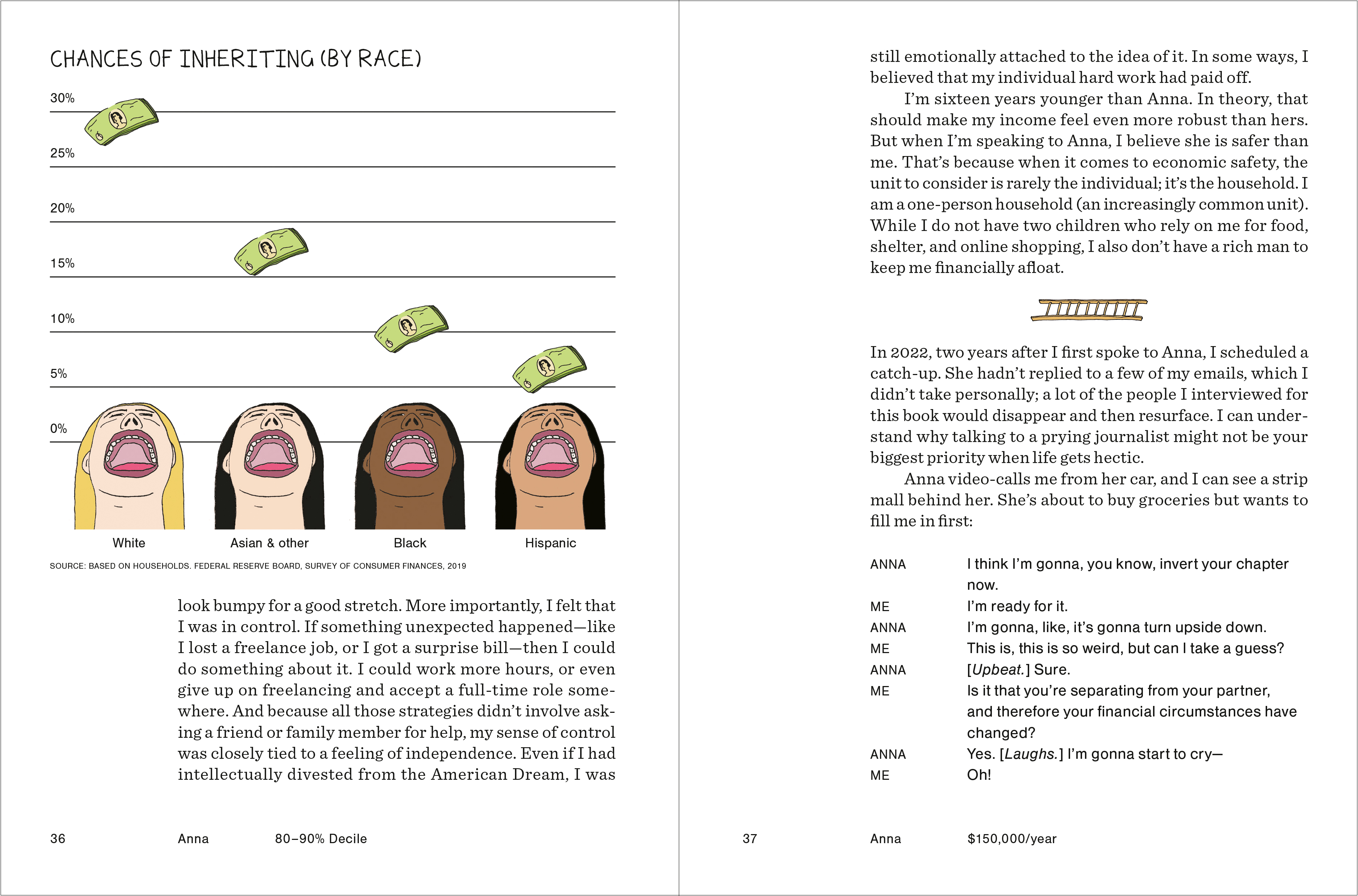
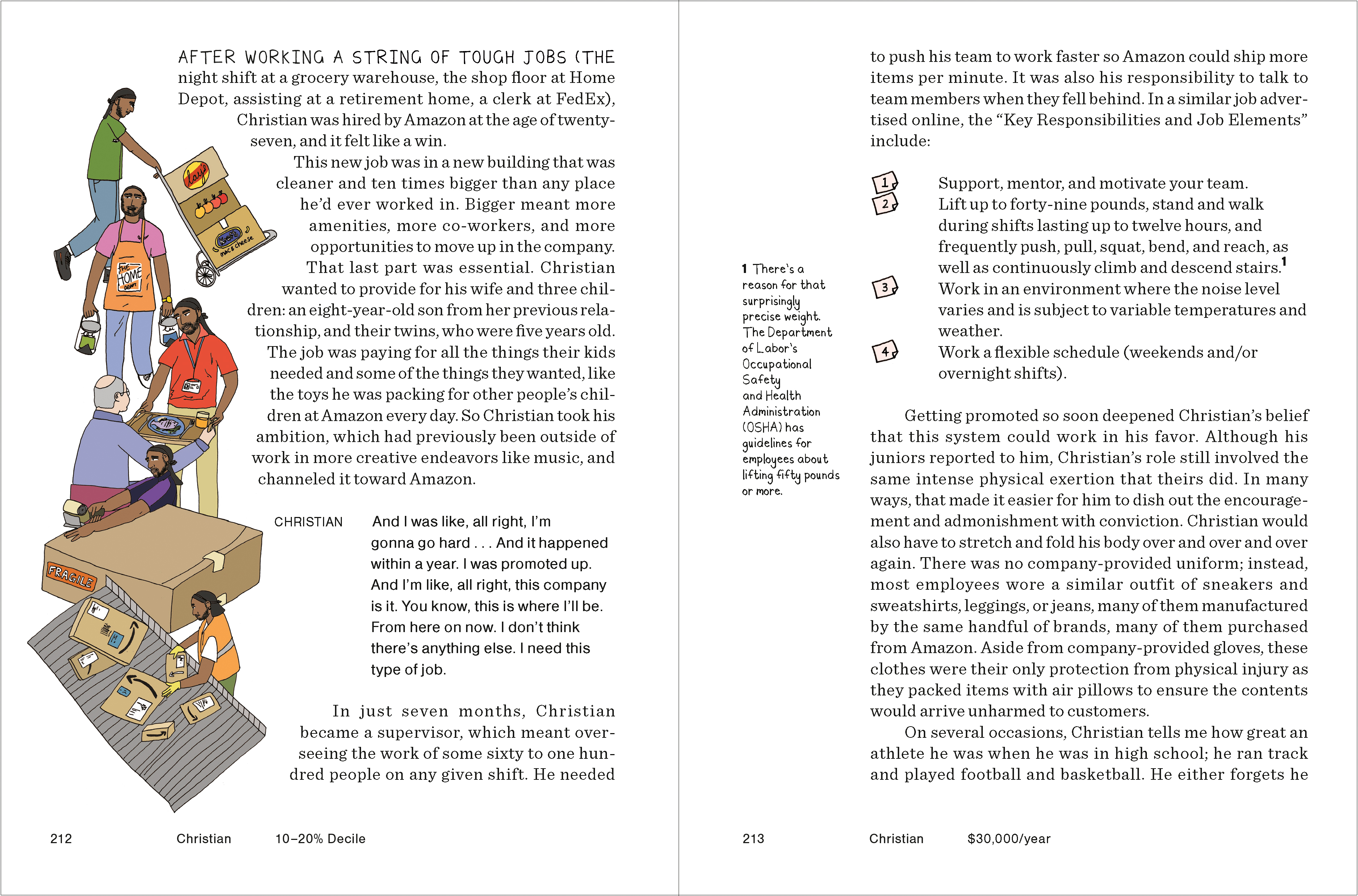
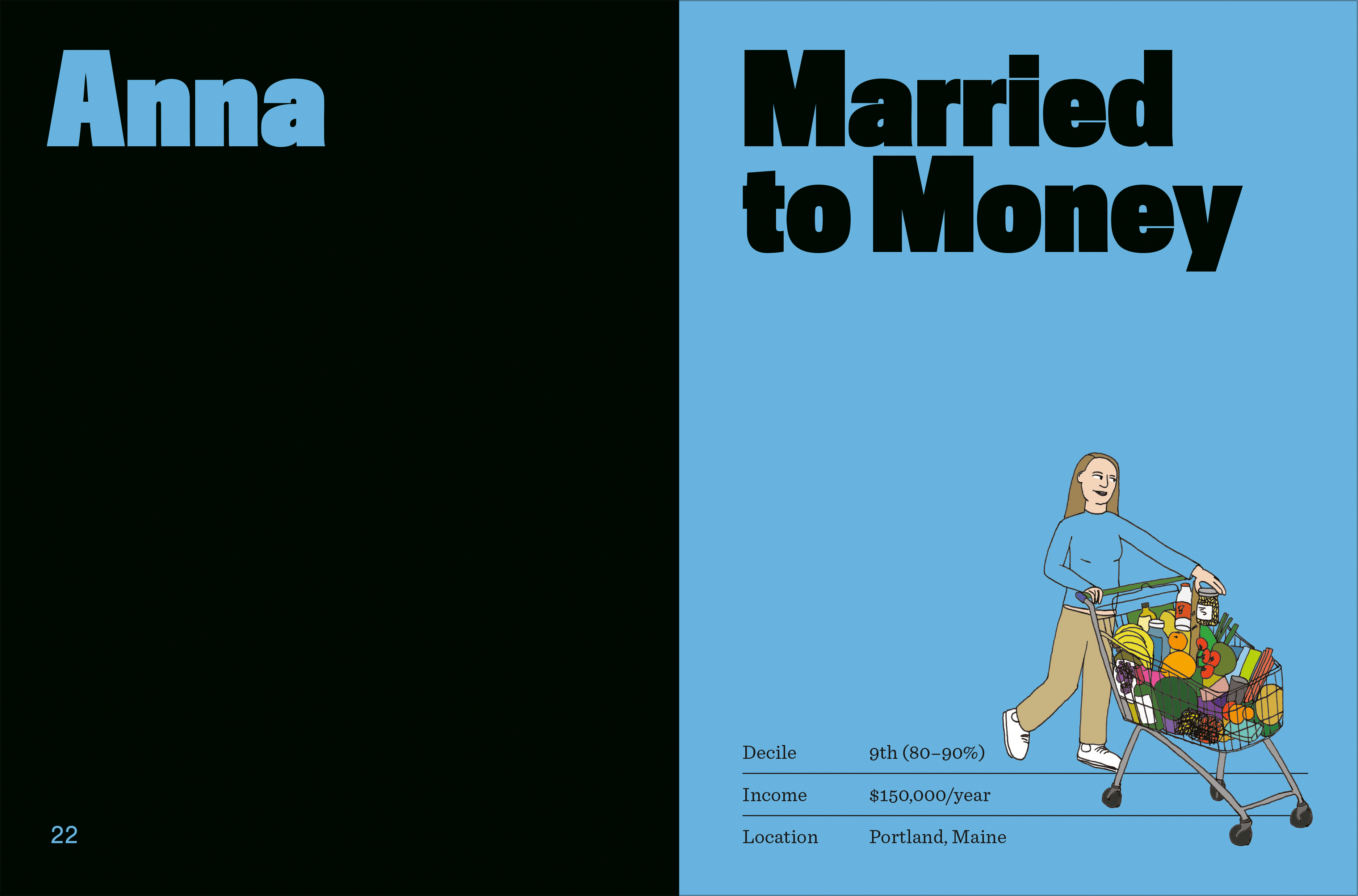
Anna has a comfortable life in a mansion in Maine thanks to her husband (well, his parents, really) until he suddenly asks for a divorce. In Arizona, Hunter is a U.S. veteran, feeling ashamed about claiming disability benefits. Then there’s Levi, who is trying to pay off his debts from a gambling addiction, one social media video at a time. And Christian, stifled by his job at an Amazon warehouse before a union-organizing effort offers a way out for his comrades and his young kids. Ten people, ten different incomes, all of them afraid for their futures.

For five years, data journalist Mona Chalabi followed them all, documenting how wealth shaped their feelings, their choices, their identities, and their insecurities. She researched the data behind their taxes, groceries, inheritances, and so much more to understand the systems that keep people stuck. But then, she too found herself facing the same fears, when her mother’s sudden illness and subsequent medical bills threatened her own financial safety and made the questions she had been writing about all too real. How much money is enough? To live a “good” life? To protect the people you love in an emergency?

Interweaving her own story with those of her interviewees and illustrated throughout with the data visualizations for which Chalabi is renowned, Ten Lives asks how much wealth it takes to be safe in the United States. It explores how difficult it is for us to be honest and open about what we have and argues that until we get better at it, we will never be able to address the underlying problems that drive inequality and insecurity for us all.
Introduction

For my mother, a vast, high-ceilinged grocery store in East London was another chore to get through. But for me, it was a playground and a classroom. Time was suspended by the total absence of natural light, the looping pop playlists and, most of all, by the limitless things. Things to sniff, things to squeeze, things to spot. From the time that my legs were too chunky to squeeze into the cart’s metal seat, I learned which things were too expensive or too useless for me to throw in, no matter how good my sales pitch. I learned how to reach to the back of the brightly lit refrigerated shelves for the dairy products that would take longer to expire. And I learned the etiquette of looking away.

If I craned to look in other people’s carts or peek at what they were loading onto the conveyor belt, my mum would whisper, “Rude!” in Arabic, and I would avert my gaze. Or that’s what I thought she was saying. It was the same monosyllabic word I’d hear if I tried to venture upstairs in a home where we were guests, or if my eyes lingered too long on a body in the changing rooms at the swimming pool. Years later, I would learn that the word echoing throughout my childhood actually translates to “shame.” My mother was teaching me that when there’s the unavoidable honesty of a naked body climbing out of a wet one-piece, or a stranger’s wire basket at a chain store, staring is shameful—or at least it should be.

Rarely is my mother wrong, but I have come to wonder if she underestimated the harm of looking away. Our collective ignorance is sustaining an unfair system where individuals with more in their carts can try to protect themselves and the things they care about, while those with less are rendered even more invisible. As an adult and as a journalist, I have stared shamelessly.

Of course, someone’s cart only tells you so much. Whether someone has a pint of store-brand chocolate ice cream or an organic, vegan Van Leeuwen of the same flavor might reveal something about their income. But it might instead reveal their psychological or even spiritual relationship with money, since our identities can be wrapped up in the products we pick off the shelf. These days, I can afford the expensive ice cream. But I love the large tubs of Neapolitan that are exclusively sold by cheap manufacturers, shards of tasteless ice crystals laying on their surfaces, in large part simply because it feels like an act of loyalty to my dad’s tastes. Our buying habits can also reveal an emotional attitude to money: a fear of spending money recently gained, for example, or a nihilism about spending more money after you’ve recently lost a large chunk of it. When this anxiety is expressed sincerely, it could be called money dysmorphia—you might feel poor despite a high bank balance, or you might feel rich despite a low one. When it’s insincere, it’s class cosplay, social deceit. Either way, we all seem obsessed with getting to some kind of truth about money—there are definitely plenty of books on the topic.

Most of this literature focuses on moving up, with the message “here’s how you can improve your life” (personal finance manuals), or else voyeurism: “look up, look down, come see a life you’ll probably never have” (prose about extreme wealth and extreme poverty). One of these books stands out to me: Down and Out in Paris and London, George Orwell’s 1933 account of hardship in the two cities. I read it when I was nineteen, and I hated it. I wasn’t fascinated by all these “poor rough men” Orwell was observing, I was more interested in the act of observation. In the fact that Orwell had deliberately impoverished himself in order to write the book.

Orwell, whose real name was Eric Arthur Blair, was raised in a family he described as “lower-upper-middle class.” That’s a soft-shoe dance, a word soup that has the intended effect: You don’t have a clue what this man is saying about his privilege. Blair was in fact a rich boy who changed his clothing, and presumably his accent, to pass as a “tramp” and spent months living among people who had fewer choices than he did in order to write “nonfiction”— a pretty extreme example of eating store-brand ice cream when you can afford Van Leeuwen. I found this act narcissistic and exploitative. As an adult, I’ve met a few Orwells. People who, I would discover after months or sometimes years, were pretending to have fewer financial choices.

Like Orwell, I’m interested in taking you on a journey through class, but not as a tour guide of the “other.” I do not want to write something that incites guilt, pity, jealousy, or any other emotional response that gets in the way of understanding and action. This isn’t shameless curiosity; it’s curiosity about the shame that makes so many of us want to conceal our bank balance. We often find ourselves among people who we suspect (with good evidence) have more or less than we do. Our observations of lack or abundance can quickly transform into dark feelings, which can manifest as silence.

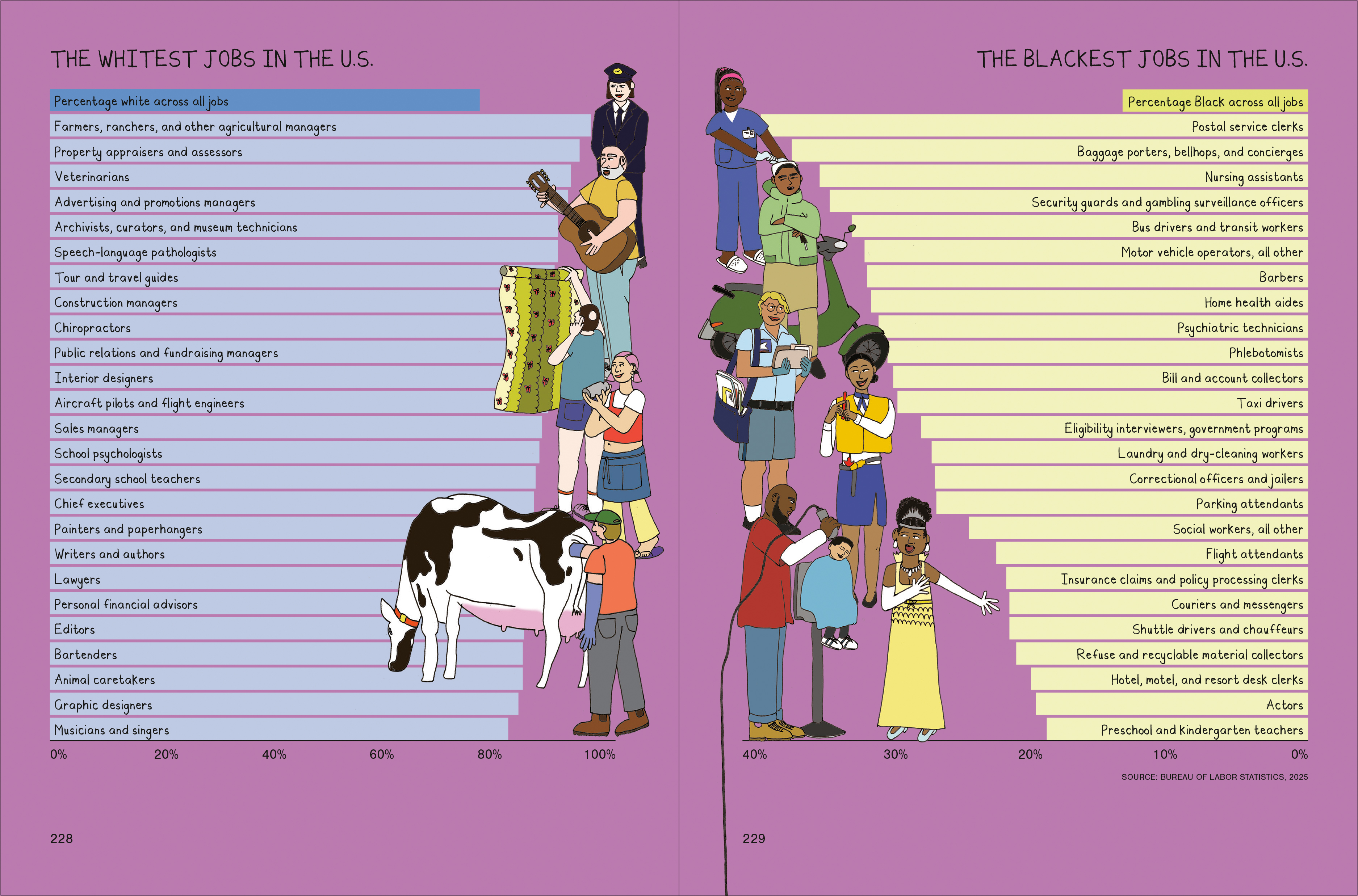
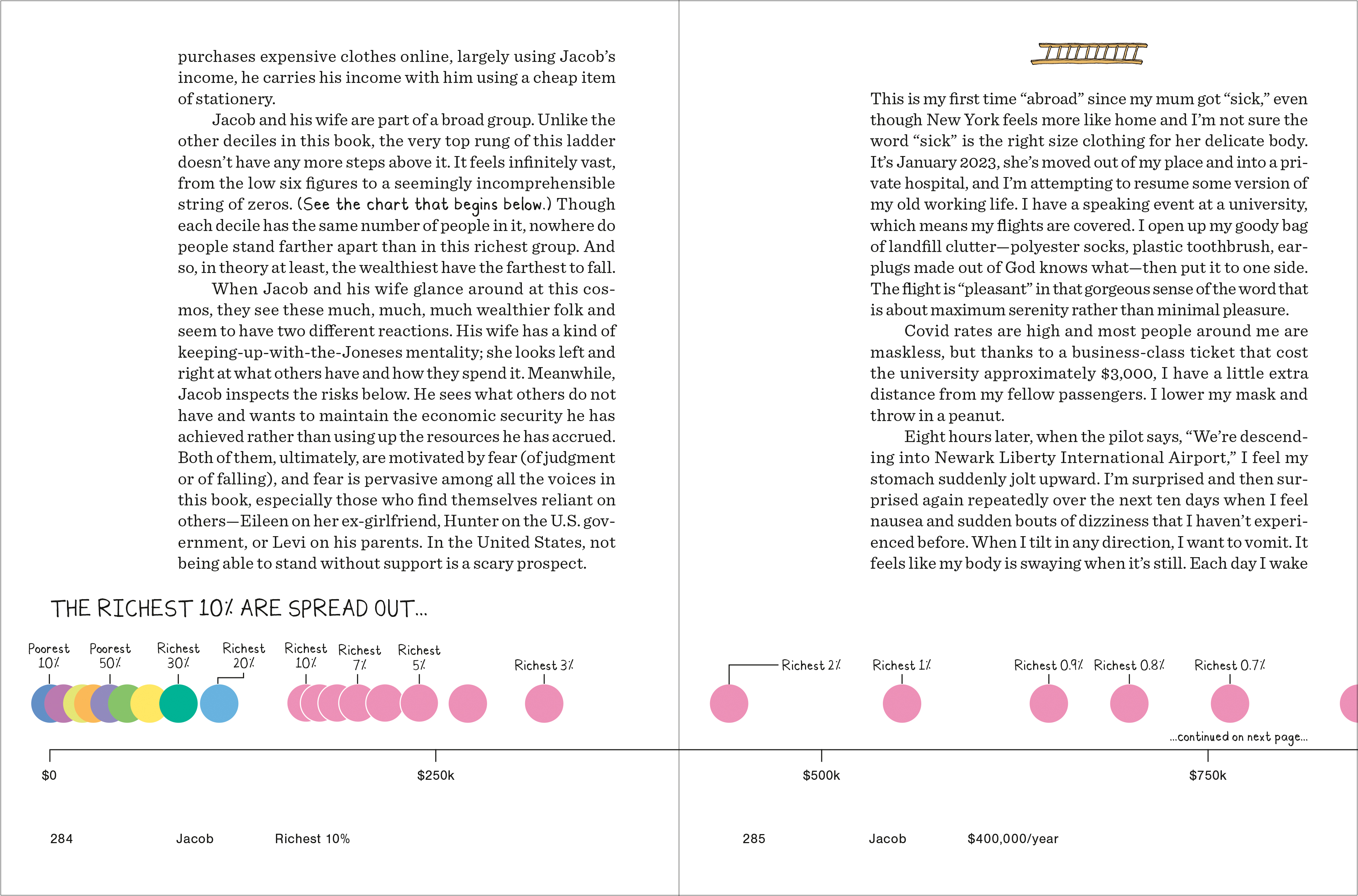
Conversations about “inequality” can sometimes be louder, or more articulate, but it’s typically when we’re talking about those who are (presumably) very far away: the 1 percent. Imagine a vertical line that separates us and them. On one side are those who don’t holiday on yachts or own tech companies; on the other side are those who do. In the United States, that divide separates about 339 million people crushing up against just 3 million. I think a singular focus on the 1 percent when we’re describing the flaws in our entire economic system has been just as unproductive as Orwell’s focus on the very poorest in society. Calling for this small elite to be held accountable has left us largely impotent, patiently awaiting the end of our exploitation (and of the earth’s exploitation too). It has also been a pretty ambitious political strategy, given that the richest people also hold the most legislative power—so we’re often asking for the 1 percent to be held accountable by the 1 percent.

The focus on the ultrarich also abdicates us from our own complicity in this system. It’s a system where injustice shows up long before a person reaches the top of the mountain. It’s in the fabric that you’re wearing right now and in the mode of transport you took this week.

Now, in this book, instead of a sharp divide between us and them, we can think of income as a spectrum. I want to consider the nuance that happens along the way from a yachted life to a publicly transported one. This is a vast (vaaaast) stretch of land. Compared to a salary of $200,000, a day in the United States on an annual income of $20,000 might feel like you’re in a different country (or on a different planet).

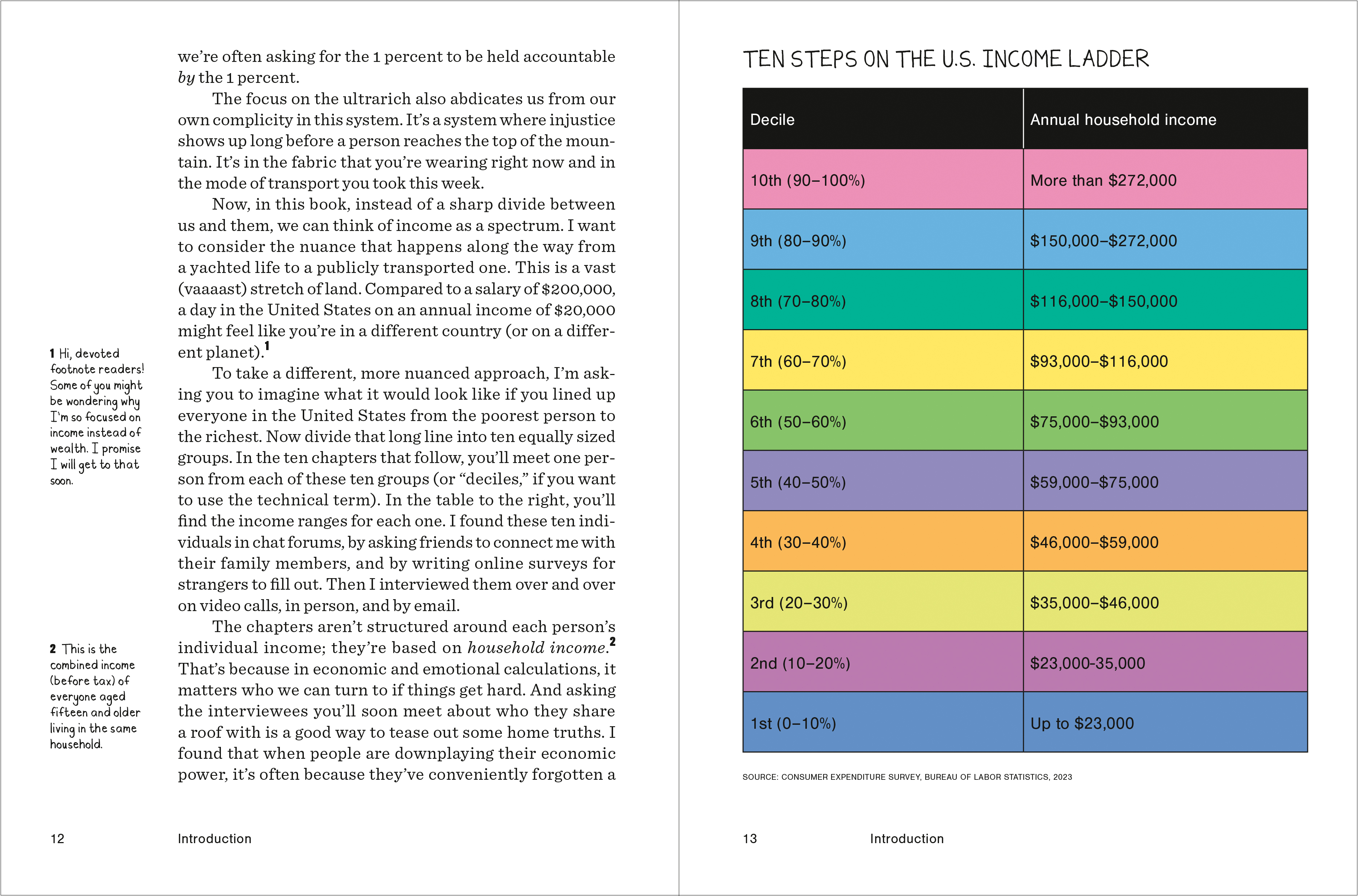
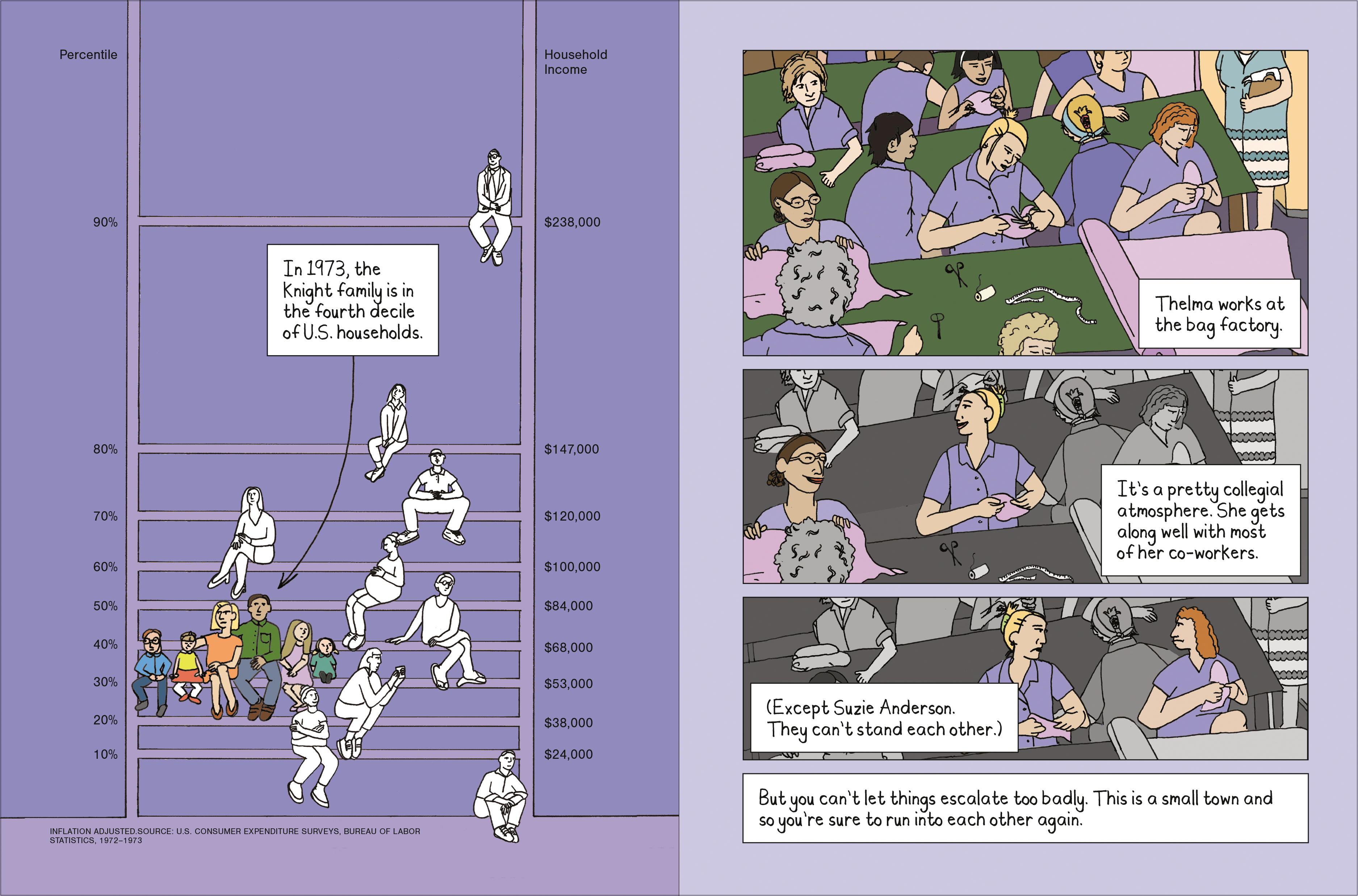
To take a different, more nuanced approach, I’m asking you to imagine what it would look like if you lined up everyone in the United States from the poorest person to the richest. Now divide that long line into ten equally sized groups. In the ten chapters that follow, you’ll meet one person from each of these ten groups (or “deciles,” if you want to use the technical term). In the table to the right, you’ll find the income ranges for each one. I found these ten individuals in chat forums, by asking friends to connect me with their family members, and by writing online surveys for strangers to fill out. Then I interviewed them over and over on video calls, in person, and by email.

The chapters aren’t structured around each person’s individual income; they’re based on household income. That’s because in economic and emotional calculations, it matters who we can turn to if things get hard. And asking the interviewees you’ll soon meet about who they share a roof with is a good way to tease out some home truths. I found that when people are downplaying their economic power, it’s often because they’ve conveniently forgotten a parent or a partner who is subsidizing them. After five years of talking to people about student loans, organ transplants, divorce, and gambling addiction, it’s clear to me that money (even a nice big pile of it) isn’t enough to secure someone’s safety in a hyper-individualized capitalistic system. You need at least one extra pair of hands. Ideally many more.

You are here in this income table (it’s a statistical certainty), and you’ll find yourself in most of the charts to come too. I hope that seeing where you sit can help foster some healthy conversations. About the ways that many of us are implicated in unfairness, and the ways that we can be addicted to our current way of life, even while it causes our own domination and demise.

I hope that these ten groups offer an opportunity to think beyond simple binaries of rich and poor, powerful and powerless. If we look at everyone in this economic universe—including those who might have finances that are more closely above or below ours, we can see more subtle forms of exploitation in which we might be perpetrator or victim. We can spot more opportunities for change, as well as for redistribution, reparation, and reimbursement, that we might not have thought of. I hope that naming exactly where we stand can show how each of us can move—not just individually but also by making collective economic demands on government that are more specific and powerful than “tax the rich.” But that requires some very difficult introspection.
“Pulitzer Prize-winning journalist Mona Chalabi blends expert interviews and razor-sharp analysis with striking graphics, delving into 10 American lives from disparate economic tiers. She crunches numbers and weaves in her own British background, offering a portrait of a nation whose stark inequality threatens its future.”—Time

“This book will transform the way you see your bank balance. An exploration of wealth, class and ever-widening income inequality . . . The Pulitzer Prize–winning data journalist and illustrator—known for her ability to translate dry statistics into simple visuals that elucidate societal realities with thunderbolt clarity . . . spent five years keeping up with the lives of her interviewees, and their revelations bolster her argument that it’s virtually impossible to feel financially secure in a hyper-individualistic, capitalist society.”—British Vogue

“This is an astonishing book. Chalabi’s taboo-busting transparency about peoples’ financial lives is revolutionary enough. But it’s the pellucid clarity of her data visualizations that will really change how you understand capitalism. I was riveted from start to finish.”—Alison Bechdel, bestselling author of Fun Home: A Family Tragicomic

“We live in an insanely unequal world. Does the concentration of wealth and resources into fewer and fewer hands make a difference? This book explores how deeply relevant inequality is—how it molds our minds and bends our moralities. It’s the most vivid and readable exploration of the wealth gap I’ve ever read. Anyone who cares about a better future should read this.”—Brian Eno, producer and songwriter

“Mona Chalabi writes with frank, engaging precision about what we’re all really wondering about: Money, and all the big, sinister financial machinery that makes each of our lives ‘just happen to be’ what they are. Ten Lives is Jane Austen without all the boring romance stuff, and with a sweeping lens that feels like finally looking up from your own narrow little corner.”—Liana Finck, author of Let There Be Light

“A brilliant melding of rage, empathy, and tactical rigor that maps the emotional intimacy of income inequality.”—Tessa Hulls, Pulitzer Prize–winning author of Feeding Ghosts

“In Ten Lives, Mona Chalabi does the seemingly impossible: She turns economic analysis into gripping human drama. Chalabi brings empathy and critical rigor to this essential topic, shining light where obfuscation usually reigns.”—Lauren Redniss, National Book Award finalist and author of Oak Flat

“Ten Lives is not only a triumph of data-wrangling but also a riveting book about the psychology and emotions that surround our financial worth.”—Bookseller (UK)

“An eye-catching investigation into income inequality. Drawing on interviews with one person from each decile of household income in the U.S., Chalabi creates inventive data visualizations exploring the connection between her subjects’ finances, quality of life, and life trajectories. . . . It’s a damning bird’s-eye view of a society with no safety net.”—Publishers Weekly

“Data journalist and visual artist Chalabi has found a really lovely way to combine her skills: Ten Lives is an eye-opening study of what money—and financial insecurity—means to ten different Americans.”—Literary Hub

“Dazzling . . . engrossing, lit by imaginative designs and graphic elements that ingeniously reflect and enhance the import of the data they record . . . Strong opinions and trenchant insights, dished up by a gifted expert in data visualization.”—Kirkus Reviews


© Jutharat Pinyodoonyachet
Mona Chalabi is an award-winning writer and illustrator. Her work has earned her a Pulitzer Prize, an honorary fellowship at the British Science Association, an Emmy nomination, a fellowship from New America, and recognition from the Royal Statistical Society. In recent years, her art has been exhibited at the Tate, the Smithsonian Design Museum, and the Brooklyn Museum. Her writing and illustrations have been featured in The New Yorker, The New York Review of Books, and The Guardian. View titles by Mona Chalabi
Available for sale exclusive:
•     Canada
•     Guam
•     Minor Outl.Ins.
•     North Mariana
•     Philippines
•     Puerto Rico
•     Samoa,American
•     US Virgin Is.
•     USA

Available for sale non-exclusive:
•     Afghanistan
•     Aland Islands
•     Albania
•     Algeria
•     Andorra
•     Angola
•     Anguilla
•     Antarctica
•     Argentina
•     Armenia
•     Aruba
•     Austria
•     Azerbaijan
•     Bahrain
•     Belarus
•     Belgium
•     Benin
•     Bhutan
•     Bolivia
•     Bonaire, Saba
•     Bosnia Herzeg.
•     Bouvet Island
•     Brazil
•     Bulgaria
•     Burkina Faso
•     Burundi
•     Cambodia
•     Cameroon
•     Cape Verde
•     Centr.Afr.Rep.
•     Chad
•     Chile
•     China
•     Colombia
•     Comoro Is.
•     Congo
•     Cook Islands
•     Costa Rica
•     Croatia
•     Cuba
•     Curacao
•     Czech Republic
•     Dem. Rep. Congo
•     Denmark
•     Djibouti
•     Dominican Rep.
•     Ecuador
•     Egypt
•     El Salvador
•     Equatorial Gui.
•     Eritrea
•     Estonia
•     Ethiopia
•     Faroe Islands
•     Finland
•     France
•     Fren.Polynesia
•     French Guinea
•     Gabon
•     Georgia
•     Germany
•     Greece
•     Greenland
•     Guadeloupe
•     Guatemala
•     Guinea Republic
•     Guinea-Bissau
•     Haiti
•     Heard/McDon.Isl
•     Honduras
•     Hong Kong
•     Hungary
•     Iceland
•     Indonesia
•     Iran
•     Iraq
•     Israel
•     Italy
•     Ivory Coast
•     Japan
•     Jordan
•     Kazakhstan
•     Kuwait
•     Kyrgyzstan
•     Laos
•     Latvia
•     Lebanon
•     Liberia
•     Libya
•     Liechtenstein
•     Lithuania
•     Luxembourg
•     Macau
•     Macedonia
•     Madagascar
•     Malaysia
•     Maldives
•     Mali
•     Marshall island
•     Martinique
•     Mauritania
•     Mayotte
•     Mexico
•     Micronesia
•     Moldavia
•     Monaco
•     Mongolia
•     Montenegro
•     Morocco
•     Myanmar
•     Nepal
•     Netherlands
•     New Caledonia
•     Nicaragua
•     Niger
•     Niue
•     Norfolk Island
•     North Korea
•     Norway
•     Oman
•     Palau
•     Palestinian Ter
•     Panama
•     Paraguay
•     Peru
•     Poland
•     Portugal
•     Qatar
•     Reunion Island
•     Romania
•     Russian Fed.
•     Rwanda
•     Saint Martin
•     San Marino
•     SaoTome Princip
•     Saudi Arabia
•     Senegal
•     Serbia
•     Singapore
•     Sint Maarten
•     Slovakia
•     Slovenia
•     South Korea
•     South Sudan
•     Spain
•     St Barthelemy
•     St.Pier,Miquel.
•     Sth Terr. Franc
•     Sudan
•     Suriname
•     Svalbard
•     Sweden
•     Switzerland
•     Syria
•     Tadschikistan
•     Taiwan
•     Thailand
•     Timor-Leste
•     Togo
•     Tokelau Islands
•     Tunisia
•     Turkey
•     Turkmenistan
•     Ukraine
•     Unit.Arab Emir.
•     Uruguay
•     Uzbekistan
•     Vatican City
•     Venezuela
•     Vietnam
•     Wallis,Futuna
•     West Saharan
•     Western Samoa
•     Yemen

Not available for sale:
•     Antigua/Barbuda
•     Australia
•     Bahamas
•     Bangladesh
•     Barbados
•     Belize
•     Bermuda
•     Botswana
•     Brit.Ind.Oc.Ter
•     Brit.Virgin Is.
•     Brunei
•     Cayman Islands
•     Christmas Islnd
•     Cocos Islands
•     Cyprus
•     Dominica
•     Falkland Islnds
•     Fiji
•     Gambia
•     Ghana
•     Gibraltar
•     Grenada
•     Guernsey
•     Guyana
•     India
•     Ireland
•     Isle of Man
•     Jamaica
•     Jersey
•     Kenya
•     Kiribati
•     Lesotho
•     Malawi
•     Malta
•     Mauritius
•     Montserrat
•     Mozambique
•     Namibia
•     Nauru
•     New Zealand
•     Nigeria
•     Pakistan
•     PapuaNewGuinea
•     Pitcairn Islnds
•     S. Sandwich Ins
•     Seychelles
•     Sierra Leone
•     Solomon Islands
•     Somalia
•     South Africa
•     Sri Lanka
•     St. Helena
•     St. Lucia
•     St. Vincent
•     St.Chr.,Nevis
•     Swaziland
•     Tanzania
•     Tonga
•     Trinidad,Tobago
•     Turks&Caicos Is
•     Tuvalu
•     Uganda
•     United Kingdom
•     Vanuatu
•     Zambia
•     Zimbabwe

Photos

additional book photo

About

“Pulitzer Prize-winning journalist Mona Chalabi blends expert interviews and razor-sharp analysis with striking graphics” (Time) in this incisive exploration of money—and the lack of it—in America told through the lives of ten individuals.

“Astonishing . . . Chalabi’s taboo-busting transparency about peoples’ financial lives is revolutionary enough. But it’s the pellucid clarity of her data visualizations that will really change how you understand capitalism.”—Alison Bechdel, bestselling author of Fun Home: A Family Tragicomic

Anna has a comfortable life in a mansion in Maine thanks to her husband (well, his parents, really) until he suddenly asks for a divorce. In Arizona, Hunter is a U.S. veteran, feeling ashamed about claiming disability benefits. Then there’s Levi, who is trying to pay off his debts from a gambling addiction, one social media video at a time. And Christian, stifled by his job at an Amazon warehouse before a union-organizing effort offers a way out for his comrades and his young kids. Ten people, ten different incomes, all of them afraid for their futures.

For five years, data journalist Mona Chalabi followed them all, documenting how wealth shaped their feelings, their choices, their identities, and their insecurities. She researched the data behind their taxes, groceries, inheritances, and so much more to understand the systems that keep people stuck. But then, she too found herself facing the same fears, when her mother’s sudden illness and subsequent medical bills threatened her own financial safety and made the questions she had been writing about all too real. How much money is enough? To live a “good” life? To protect the people you love in an emergency?

Interweaving her own story with those of her interviewees and illustrated throughout with the data visualizations for which Chalabi is renowned, Ten Lives asks how much wealth it takes to be safe in the United States. It explores how difficult it is for us to be honest and open about what we have and argues that until we get better at it, we will never be able to address the underlying problems that drive inequality and insecurity for us all.

Excerpt

Introduction

For my mother, a vast, high-ceilinged grocery store in East London was another chore to get through. But for me, it was a playground and a classroom. Time was suspended by the total absence of natural light, the looping pop playlists and, most of all, by the limitless things. Things to sniff, things to squeeze, things to spot. From the time that my legs were too chunky to squeeze into the cart’s metal seat, I learned which things were too expensive or too useless for me to throw in, no matter how good my sales pitch. I learned how to reach to the back of the brightly lit refrigerated shelves for the dairy products that would take longer to expire. And I learned the etiquette of looking away.

If I craned to look in other people’s carts or peek at what they were loading onto the conveyor belt, my mum would whisper, “Rude!” in Arabic, and I would avert my gaze. Or that’s what I thought she was saying. It was the same monosyllabic word I’d hear if I tried to venture upstairs in a home where we were guests, or if my eyes lingered too long on a body in the changing rooms at the swimming pool. Years later, I would learn that the word echoing throughout my childhood actually translates to “shame.” My mother was teaching me that when there’s the unavoidable honesty of a naked body climbing out of a wet one-piece, or a stranger’s wire basket at a chain store, staring is shameful—or at least it should be.

Rarely is my mother wrong, but I have come to wonder if she underestimated the harm of looking away. Our collective ignorance is sustaining an unfair system where individuals with more in their carts can try to protect themselves and the things they care about, while those with less are rendered even more invisible. As an adult and as a journalist, I have stared shamelessly.

Of course, someone’s cart only tells you so much. Whether someone has a pint of store-brand chocolate ice cream or an organic, vegan Van Leeuwen of the same flavor might reveal something about their income. But it might instead reveal their psychological or even spiritual relationship with money, since our identities can be wrapped up in the products we pick off the shelf. These days, I can afford the expensive ice cream. But I love the large tubs of Neapolitan that are exclusively sold by cheap manufacturers, shards of tasteless ice crystals laying on their surfaces, in large part simply because it feels like an act of loyalty to my dad’s tastes. Our buying habits can also reveal an emotional attitude to money: a fear of spending money recently gained, for example, or a nihilism about spending more money after you’ve recently lost a large chunk of it. When this anxiety is expressed sincerely, it could be called money dysmorphia—you might feel poor despite a high bank balance, or you might feel rich despite a low one. When it’s insincere, it’s class cosplay, social deceit. Either way, we all seem obsessed with getting to some kind of truth about money—there are definitely plenty of books on the topic.

Most of this literature focuses on moving up, with the message “here’s how you can improve your life” (personal finance manuals), or else voyeurism: “look up, look down, come see a life you’ll probably never have” (prose about extreme wealth and extreme poverty). One of these books stands out to me: Down and Out in Paris and London, George Orwell’s 1933 account of hardship in the two cities. I read it when I was nineteen, and I hated it. I wasn’t fascinated by all these “poor rough men” Orwell was observing, I was more interested in the act of observation. In the fact that Orwell had deliberately impoverished himself in order to write the book.

Orwell, whose real name was Eric Arthur Blair, was raised in a family he described as “lower-upper-middle class.” That’s a soft-shoe dance, a word soup that has the intended effect: You don’t have a clue what this man is saying about his privilege. Blair was in fact a rich boy who changed his clothing, and presumably his accent, to pass as a “tramp” and spent months living among people who had fewer choices than he did in order to write “nonfiction”— a pretty extreme example of eating store-brand ice cream when you can afford Van Leeuwen. I found this act narcissistic and exploitative. As an adult, I’ve met a few Orwells. People who, I would discover after months or sometimes years, were pretending to have fewer financial choices.

Like Orwell, I’m interested in taking you on a journey through class, but not as a tour guide of the “other.” I do not want to write something that incites guilt, pity, jealousy, or any other emotional response that gets in the way of understanding and action. This isn’t shameless curiosity; it’s curiosity about the shame that makes so many of us want to conceal our bank balance. We often find ourselves among people who we suspect (with good evidence) have more or less than we do. Our observations of lack or abundance can quickly transform into dark feelings, which can manifest as silence.

Conversations about “inequality” can sometimes be louder, or more articulate, but it’s typically when we’re talking about those who are (presumably) very far away: the 1 percent. Imagine a vertical line that separates us and them. On one side are those who don’t holiday on yachts or own tech companies; on the other side are those who do. In the United States, that divide separates about 339 million people crushing up against just 3 million. I think a singular focus on the 1 percent when we’re describing the flaws in our entire economic system has been just as unproductive as Orwell’s focus on the very poorest in society. Calling for this small elite to be held accountable has left us largely impotent, patiently awaiting the end of our exploitation (and of the earth’s exploitation too). It has also been a pretty ambitious political strategy, given that the richest people also hold the most legislative power—so we’re often asking for the 1 percent to be held accountable by the 1 percent.

The focus on the ultrarich also abdicates us from our own complicity in this system. It’s a system where injustice shows up long before a person reaches the top of the mountain. It’s in the fabric that you’re wearing right now and in the mode of transport you took this week.

Now, in this book, instead of a sharp divide between us and them, we can think of income as a spectrum. I want to consider the nuance that happens along the way from a yachted life to a publicly transported one. This is a vast (vaaaast) stretch of land. Compared to a salary of $200,000, a day in the United States on an annual income of $20,000 might feel like you’re in a different country (or on a different planet).

To take a different, more nuanced approach, I’m asking you to imagine what it would look like if you lined up everyone in the United States from the poorest person to the richest. Now divide that long line into ten equally sized groups. In the ten chapters that follow, you’ll meet one person from each of these ten groups (or “deciles,” if you want to use the technical term). In the table to the right, you’ll find the income ranges for each one. I found these ten individuals in chat forums, by asking friends to connect me with their family members, and by writing online surveys for strangers to fill out. Then I interviewed them over and over on video calls, in person, and by email.

The chapters aren’t structured around each person’s individual income; they’re based on household income. That’s because in economic and emotional calculations, it matters who we can turn to if things get hard. And asking the interviewees you’ll soon meet about who they share a roof with is a good way to tease out some home truths. I found that when people are downplaying their economic power, it’s often because they’ve conveniently forgotten a parent or a partner who is subsidizing them. After five years of talking to people about student loans, organ transplants, divorce, and gambling addiction, it’s clear to me that money (even a nice big pile of it) isn’t enough to secure someone’s safety in a hyper-individualized capitalistic system. You need at least one extra pair of hands. Ideally many more.

You are here in this income table (it’s a statistical certainty), and you’ll find yourself in most of the charts to come too. I hope that seeing where you sit can help foster some healthy conversations. About the ways that many of us are implicated in unfairness, and the ways that we can be addicted to our current way of life, even while it causes our own domination and demise.

I hope that these ten groups offer an opportunity to think beyond simple binaries of rich and poor, powerful and powerless. If we look at everyone in this economic universe—including those who might have finances that are more closely above or below ours, we can see more subtle forms of exploitation in which we might be perpetrator or victim. We can spot more opportunities for change, as well as for redistribution, reparation, and reimbursement, that we might not have thought of. I hope that naming exactly where we stand can show how each of us can move—not just individually but also by making collective economic demands on government that are more specific and powerful than “tax the rich.” But that requires some very difficult introspection.

Praise

“Pulitzer Prize-winning journalist Mona Chalabi blends expert interviews and razor-sharp analysis with striking graphics, delving into 10 American lives from disparate economic tiers. She crunches numbers and weaves in her own British background, offering a portrait of a nation whose stark inequality threatens its future.”—Time

“This book will transform the way you see your bank balance. An exploration of wealth, class and ever-widening income inequality . . . The Pulitzer Prize–winning data journalist and illustrator—known for her ability to translate dry statistics into simple visuals that elucidate societal realities with thunderbolt clarity . . . spent five years keeping up with the lives of her interviewees, and their revelations bolster her argument that it’s virtually impossible to feel financially secure in a hyper-individualistic, capitalist society.”—British Vogue

“This is an astonishing book. Chalabi’s taboo-busting transparency about peoples’ financial lives is revolutionary enough. But it’s the pellucid clarity of her data visualizations that will really change how you understand capitalism. I was riveted from start to finish.”—Alison Bechdel, bestselling author of Fun Home: A Family Tragicomic

“We live in an insanely unequal world. Does the concentration of wealth and resources into fewer and fewer hands make a difference? This book explores how deeply relevant inequality is—how it molds our minds and bends our moralities. It’s the most vivid and readable exploration of the wealth gap I’ve ever read. Anyone who cares about a better future should read this.”—Brian Eno, producer and songwriter

“Mona Chalabi writes with frank, engaging precision about what we’re all really wondering about: Money, and all the big, sinister financial machinery that makes each of our lives ‘just happen to be’ what they are. Ten Lives is Jane Austen without all the boring romance stuff, and with a sweeping lens that feels like finally looking up from your own narrow little corner.”—Liana Finck, author of Let There Be Light

“A brilliant melding of rage, empathy, and tactical rigor that maps the emotional intimacy of income inequality.”—Tessa Hulls, Pulitzer Prize–winning author of Feeding Ghosts

“In Ten Lives, Mona Chalabi does the seemingly impossible: She turns economic analysis into gripping human drama. Chalabi brings empathy and critical rigor to this essential topic, shining light where obfuscation usually reigns.”—Lauren Redniss, National Book Award finalist and author of Oak Flat

“Ten Lives is not only a triumph of data-wrangling but also a riveting book about the psychology and emotions that surround our financial worth.”—Bookseller (UK)

“An eye-catching investigation into income inequality. Drawing on interviews with one person from each decile of household income in the U.S., Chalabi creates inventive data visualizations exploring the connection between her subjects’ finances, quality of life, and life trajectories. . . . It’s a damning bird’s-eye view of a society with no safety net.”—Publishers Weekly

“Data journalist and visual artist Chalabi has found a really lovely way to combine her skills: Ten Lives is an eye-opening study of what money—and financial insecurity—means to ten different Americans.”—Literary Hub

“Dazzling . . . engrossing, lit by imaginative designs and graphic elements that ingeniously reflect and enhance the import of the data they record . . . Strong opinions and trenchant insights, dished up by a gifted expert in data visualization.”—Kirkus Reviews


Author

© Jutharat Pinyodoonyachet
Mona Chalabi is an award-winning writer and illustrator. Her work has earned her a Pulitzer Prize, an honorary fellowship at the British Science Association, an Emmy nomination, a fellowship from New America, and recognition from the Royal Statistical Society. In recent years, her art has been exhibited at the Tate, the Smithsonian Design Museum, and the Brooklyn Museum. Her writing and illustrations have been featured in The New Yorker, The New York Review of Books, and The Guardian. View titles by Mona Chalabi

Rights

Available for sale exclusive:
•     Canada
•     Guam
•     Minor Outl.Ins.
•     North Mariana
•     Philippines
•     Puerto Rico
•     Samoa,American
•     US Virgin Is.
•     USA

Available for sale non-exclusive:
•     Afghanistan
•     Aland Islands
•     Albania
•     Algeria
•     Andorra
•     Angola
•     Anguilla
•     Antarctica
•     Argentina
•     Armenia
•     Aruba
•     Austria
•     Azerbaijan
•     Bahrain
•     Belarus
•     Belgium
•     Benin
•     Bhutan
•     Bolivia
•     Bonaire, Saba
•     Bosnia Herzeg.
•     Bouvet Island
•     Brazil
•     Bulgaria
•     Burkina Faso
•     Burundi
•     Cambodia
•     Cameroon
•     Cape Verde
•     Centr.Afr.Rep.
•     Chad
•     Chile
•     China
•     Colombia
•     Comoro Is.
•     Congo
•     Cook Islands
•     Costa Rica
•     Croatia
•     Cuba
•     Curacao
•     Czech Republic
•     Dem. Rep. Congo
•     Denmark
•     Djibouti
•     Dominican Rep.
•     Ecuador
•     Egypt
•     El Salvador
•     Equatorial Gui.
•     Eritrea
•     Estonia
•     Ethiopia
•     Faroe Islands
•     Finland
•     France
•     Fren.Polynesia
•     French Guinea
•     Gabon
•     Georgia
•     Germany
•     Greece
•     Greenland
•     Guadeloupe
•     Guatemala
•     Guinea Republic
•     Guinea-Bissau
•     Haiti
•     Heard/McDon.Isl
•     Honduras
•     Hong Kong
•     Hungary
•     Iceland
•     Indonesia
•     Iran
•     Iraq
•     Israel
•     Italy
•     Ivory Coast
•     Japan
•     Jordan
•     Kazakhstan
•     Kuwait
•     Kyrgyzstan
•     Laos
•     Latvia
•     Lebanon
•     Liberia
•     Libya
•     Liechtenstein
•     Lithuania
•     Luxembourg
•     Macau
•     Macedonia
•     Madagascar
•     Malaysia
•     Maldives
•     Mali
•     Marshall island
•     Martinique
•     Mauritania
•     Mayotte
•     Mexico
•     Micronesia
•     Moldavia
•     Monaco
•     Mongolia
•     Montenegro
•     Morocco
•     Myanmar
•     Nepal
•     Netherlands
•     New Caledonia
•     Nicaragua
•     Niger
•     Niue
•     Norfolk Island
•     North Korea
•     Norway
•     Oman
•     Palau
•     Palestinian Ter
•     Panama
•     Paraguay
•     Peru
•     Poland
•     Portugal
•     Qatar
•     Reunion Island
•     Romania
•     Russian Fed.
•     Rwanda
•     Saint Martin
•     San Marino
•     SaoTome Princip
•     Saudi Arabia
•     Senegal
•     Serbia
•     Singapore
•     Sint Maarten
•     Slovakia
•     Slovenia
•     South Korea
•     South Sudan
•     Spain
•     St Barthelemy
•     St.Pier,Miquel.
•     Sth Terr. Franc
•     Sudan
•     Suriname
•     Svalbard
•     Sweden
•     Switzerland
•     Syria
•     Tadschikistan
•     Taiwan
•     Thailand
•     Timor-Leste
•     Togo
•     Tokelau Islands
•     Tunisia
•     Turkey
•     Turkmenistan
•     Ukraine
•     Unit.Arab Emir.
•     Uruguay
•     Uzbekistan
•     Vatican City
•     Venezuela
•     Vietnam
•     Wallis,Futuna
•     West Saharan
•     Western Samoa
•     Yemen

Not available for sale:
•     Antigua/Barbuda
•     Australia
•     Bahamas
•     Bangladesh
•     Barbados
•     Belize
•     Bermuda
•     Botswana
•     Brit.Ind.Oc.Ter
•     Brit.Virgin Is.
•     Brunei
•     Cayman Islands
•     Christmas Islnd
•     Cocos Islands
•     Cyprus
•     Dominica
•     Falkland Islnds
•     Fiji
•     Gambia
•     Ghana
•     Gibraltar
•     Grenada
•     Guernsey
•     Guyana
•     India
•     Ireland
•     Isle of Man
•     Jamaica
•     Jersey
•     Kenya
•     Kiribati
•     Lesotho
•     Malawi
•     Malta
•     Mauritius
•     Montserrat
•     Mozambique
•     Namibia
•     Nauru
•     New Zealand
•     Nigeria
•     Pakistan
•     PapuaNewGuinea
•     Pitcairn Islnds
•     S. Sandwich Ins
•     Seychelles
•     Sierra Leone
•     Solomon Islands
•     Somalia
•     South Africa
•     Sri Lanka
•     St. Helena
•     St. Lucia
•     St. Vincent
•     St.Chr.,Nevis
•     Swaziland
•     Tanzania
•     Tonga
•     Trinidad,Tobago
•     Turks&Caicos Is
•     Tuvalu
•     Uganda
•     United Kingdom
•     Vanuatu
•     Zambia
•     Zimbabwe

Journalism Titles for Higher Education

Journalism plays a vital role in informing the public, holding the powerful accountable, and shaping how we make sense of the world around us. This selection brings together titles with higher education themes of journalism that examine the subject through historical, ethical, political, and cultural perspectives. From accounts of landmark investigations and the fight for

Read more

November Picks for Higher Education

Our November picks for Higher Education feature a range of fiction and nonfiction curated to resonate with college students, professors, and lifelong learners. These selections are ideal for seminar discussions and independent exploration. For the complete list of November 2026 Higher Education Picks, click here. In case you missed them, check out these recent higher

Read more